DigitalCommons@University of Nebraska - Lincoln
DigitalCommons@University of Nebraska - Lincoln
Educational Administration: Theses,Dissertations, and Student Research Educational Administration, Department of 12-2010
Faculty Creativity in Distance Learning: A Phenomenological
Faculty Creativity in Distance Learning: A Phenomenological
Study to Understand How the Online Learning Environment
Study to Understand How the Online Learning Environment
Impacts Faculty Creativity
Impacts Faculty Creativity
Annaleah Demetra MorrowUniversity of Nebraska-Lincoln, [email protected]
Follow this and additional works at: https://digitalcommons.unl.edu/cehsedaddiss
Part of the Educational Administration and Supervision Commons
Morrow, Annaleah Demetra, "Faculty Creativity in Distance Learning: A Phenomenological Study to Understand How the Online Learning Environment Impacts Faculty Creativity" (2010). Educational Administration: Theses, Dissertations, and Student Research. 55.
https://digitalcommons.unl.edu/cehsedaddiss/55
This Article is brought to you for free and open access by the Educational Administration, Department of at
DigitalCommons@University of Nebraska - Lincoln. It has been accepted for inclusion in Educational Administration: Theses, Dissertations, and Student Research by an authorized administrator of DigitalCommons@University of Nebraska - Lincoln.
A PHENOMENOLOGICAL STUDY TO UNDERSTAND
HOW THE ONLINE LEARNING ENVIRONMENT IMPACTS FACULTY CREATIVITY
by
Annaleah D. Morrow
A DISSERTATION
Presented to the Faculty of
The Graduate College at the University of Nebraska In Partial Fulfillment of Requirements For the Degree of Doctor of Philosophy
Major: Educational Administration (Educational Leadership and Higher Education)
Under the Supervision of Professor Richard Torraco Lincoln, Nebraska
UMI Number: 3432182
All rights reserved
INFORMATION TO ALL USERS
The quality of this reproduction is dependent upon the quality of the copy submitted. In the unlikely event that the author did not send a complete manuscript
and there are missing pages, these will be noted. Also, if material had to be removed, a note will indicate the deletion.
UMI 3432182
Copyright 2010 by ProQuest LLC.
All rights reserved. This edition of the work is protected against unauthorized copying under Title 17, United States Code.
ProQuest LLC
789 East Eisenhower Parkway P.O. Box 1346
A PHENOMENOLOGICAL STUDY TO UNDERSTAND
HOW THE ONLINE LEARNING ENVIRONMENT IMPACTS FACULTY CREATIVITY
Annaleah D. Morrow, Ph.D. University of Nebraska, 2010 Advisor: Richard Torraco
What is the experience of expressing creativity for creative faculty teaching in the online environment? The literature regarding online learning covers topics relating to faculty and student satisfaction with distance learning, and faculty frustrations with the increased time required of online classes versus on-ground classes. Although the impact to creativity could be inferred in some cases, there is a void in studies focused
specifically on understanding the experience of creative faculty expressing their creativity in the online environment. This study is intended to gain a deeper understanding of how teaching in the online environment affects the expression of faculty creativity for faculty who are otherwise recognized as creative.
A sample of 10 online faculty, nominated as creative by their colleagues, were interviewed multiple times, and reviews of their online class environments were conducted. The themes that emerged from the data were as follows:
1. Technology is an enabler (but has challenges). 2. Students are important.
3. Course organization is key to expressing creativity online.
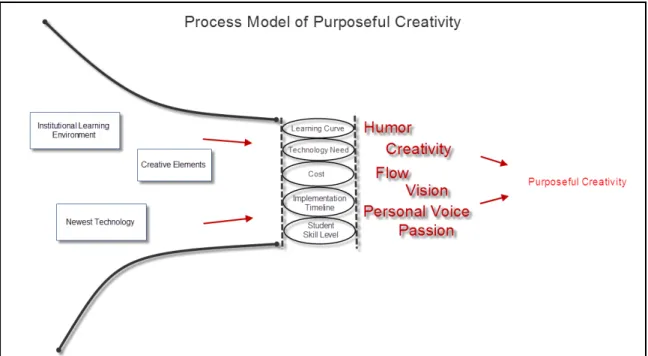
4. Administrators, take note of issues important to creative online faculty. As a phenomenological study, the goal of the research was to find the essence, or core, of participants’ experiences related to the phenomenon of expressing creativity while teaching online. The essence of the experience for these participants was that creative online instructors experience a freedom related to creativity expression, and practice purposeful creativity. The term purposeful creativity was coined to indicate that
to do so. They were evaluating several factors (i.e., learning curve, technology need, cost, implementation time, student skill level) to determine the value of each creative action or element in their online classes.
Copyright
Dedication
This is dedicated to my best friend, strongest cheerleader, and husband – Michael. It is also dedicated to my children, Preston and Mason. May you both also reach your highest goals.
Acknowledgements
Sometimes it is only through the eyes of those around us that we see what we can become. My deepest gratitude goes to those who have loved and supported me
throughout this process, and encouraged me to achieve what they saw for me. My husband, Michael, encouraged me and served as an insightful and intelligent sounding board for my ideas. His support at home and with our family also allowed me the time to focus on this process. My sons, Preston and Mason, sacrificed many family dinner and book times so that I could continue this journey; their understanding was appreciated.
To my dear friends and mentors, Donna Simmons (the best big sister), Shannon Freeney Nesbit, Dr. Sharon Sass (fellow UNL alumnae), Mike Bussell – thank you for continuing to push me forward; your regular inquiries and interest meant so much to me. To my previous professor, colleague, mentor, personal dissertation shrink, and dear friend, Dr. Bill Haney – thank you for giving your time to both share your experiences and to offer insights into this process, and for reminding me to laugh about all of this from time to time! To Dr. Heather Hartman and Jill Fitzgerald – thank you for taking time out of your busy schedule to share your expertise with me. To my advisor, Dr. Richard Torraco, thank you for offering advice and support through this process. To Dr. Torraco and my additional committee members, Dr. Rachelle Winkle-Wagner, Dr. Jim King, and Dr. Richard Hoover, your constructive comments and enthusiastic acceptance of my research helped fuel my persistence. And finally to my mother, Brenda, thank you for being an excellent example of what a dedicated woman can accomplish.
Table of Contents
Abstract ... ii
Copyright ... iv
Dedication ... v
Acknowledgements ... vi
Table of Contents ... vii
List of Tables ... iix
List of Figures ... ix
List of Appendices ... xii
Chapter 1 - Introduction ... 1
Scenario... 1
Creativity and Instructors ... 3
Central Phenomenon ... 5
Statement of Intent ... 5
Central Question ... 5
Guiding Research Questions ... 6
Definition of Terms... 6
Delimitations ... 7
Limitations ... 7
Target Audience ... 8
Significance of the Study ... 8
Chapter 2 - Literature Review ... 12
Literature Research Process ... 12
Creativity... 13
Creativity in Education ... 14
Creativity as it Relates to Distance Learning ... 16
Other Topics Related to Distance Learning ... 21
Time requirements. ... 21
Teaching excellence. ... 22
Framework and mentoring. ... 24
Best practice. ... 26
Adult learners. ... 27
Literature Summary. ... 29
Chapter 3 – Methodology ... 32
Phenomenology Research Tradition ... 33
Research Procedures ... 34
Obtaining participants. ... 34
Participants – delimitations. ... 36
Expert panel information. ... 39
Participant limitations. ... 39
Study overview. ... 40
Study part one – initial interviews. ... 40
Study part two – Web environment review. ... 41
Study part four - data review, validation procedures, & Expert Panel
review. ... 42
Chapter 4 – Results and Analysis ... 48
Introduction ... 48
Data Analysis - Themes ... 48
Technology is an enabler (but has challenges). ... 50
Students are important. ... 59
Course organization is key to expressing creativity online. ... 65
Administrators, take note of issues important to creative online faculty. . 69
Additional Observations. ... 75
Essence – Free and Purposeful Creativity ... 80
Chapter 5 – Study Summary and Recommendations ... 83
Summary ... 83
Study Limitations ... 85
Suggestions for Further Research ... 85
Confirmation of, and extension of, research. ... 86
Study Implications ... 88
For Online Faculty. ... 88
For Administrators. ... 89
Concluding Thoughts ... 90
References ... 92
Appendices ... 105
Appendix A – Participant Invitation Email ... 105
Appendix B – Interview Questions ... 107
Appendix C – Web Interview Screen Shot Example ... 109
Appendix D – Participant Course Screen Shot Examples ... 110
Appendix E – Science Class Screen Shot ... 111
Appendix F – Anatomy and Physiology Screen Shots ... 112
Appendix G – 3D Art Gallery Screen Shot ... 114
Appendix H – Pictures of Participants’ Offices ... 115
List of Tables
Table 2.1 - Selected Studies Relating to Creativity in Distance Learning ………30 Table 3.1 - Participant Demographics………...38 Table 4.1 – Participant Quotes Defining Expressing Creativity Online ………...49
List of Figures
List of Appendices
Appendix A – Participant Invitation Email ... 105
Appendix B – Interview Questions ... 107
Appendix C – Web Interview Screen Shot Example ... 109
Appendix D – Participant Course Screen Shot Examples ... 110
Appendix E – Science Class Screen Shot ... 111
Appendix F – Anatomy and Physiology Screen Shots ... 112
Appendix G – 3D Art Gallery Screen Shot ... 114
Appendix H – Pictures of Participants’ Offices ... 115
Faculty Creativity in Distance Learning:
Exploring How Teaching in the Online Environment Affects Faculty Creativity
Chapter 1 - Introduction
Why is the experience of taking a course with one faculty member so different than with another? Let us begin with a scenario (fictitious and extreme, of course).
Scenario
Jane and John are friends, both taking an Introduction to Business course online at the same institution, but with different instructors.
Jane’s Experience: Jane’s instructor has presented streaming video guest-speaker
lectures, incorporates Web conferencing for group project discussion, and has created a Business in Practice section of the class environment - for budding entrepreneurs to post their actual business plans and pictures of their
products/services. The instructor also facilitates weekly “Ask the Question” Web seminars where students can ask questions related to their class and business plans, to try to help bring the topics of the class into a more real-world application.
John’s Experience: John’s instructor requires weekly textbook readings, and
completes each unit with a unit exam.
Their Discussion: Jane feels she is really learning how to put her course
information to use in a business plan. Although she’s not one of the students who has a business plan yet, this class has motivated her to create one, and has given her the confidence that she would know how to get started. John understands the
course material, but does not feel motivated to create a business plan, or study Business further. He’s just glad he’s going to pass.
Scenario Reflection: Assuming that Jane and John were similarly motivated (and
skilled) to learn the topics in the Introduction to Business course, what was the drastic difference between Jane and John’s experiences? One could point to the use of technology in Jane’s class, but technology is just a tool for the important difference – creativity. Jane’s instructor moved beyond the textbook to find ways to bring the curriculum to life, and motivate students to engage in further research or classes.
In higher education, faculty members have the freedom to experiment with instructional strategies. Regarding online courses, faculty might experiment with different ways to engage students, and creative ways to provide more meaningful learning experiences. Distance learning (DL) provides students greater access to education, but is the education as creative as received in a class taught another way? What is the definition of creative expression in the online environment by a faculty member recognized as creative? The definition of creativity, that the researcher
developed for this study, will be as follows: creativity isthe ability to foster an engaging and supportive environment for students, where learning is unhindered by the mechanics, but is freed due to exemplary and creative teaching practices and class management. What is the experience of creativity expression teaching online? Do faculty feel this enhances or diminishes their ability to express creativity? The interest for linking creativity and education, beyond personal experiences, came from the writings of Maslow (1965; 1998), related to creative managers fostering creativity around them,
Greenleaf (1977), related to the theory of servant leadership, and Csikszentmihalyi (1990; 1996), related to the theory of flow. Following is a more in-depth review of research on creativity and instructors.
Creativity and Instructors
Maslow (1965; 1998) wrote what was originally to be a personal reflection journal, during the summer of 1962, while visiting a California plant as a visiting fellow. While there, however, Maslow became interested in management theory and research, conducted some personal research, and published Eupsychian Management in 1965. (Note: Because the newer version is a full reprint that includes comments from some of America’s greatest leaders, the more current Maslow on Maslow [1998] will often be solely referenced from here forward.) Maslow spent an entire summer performing in-depth qualitative interviews and testing plant workers, which led him to theorize that a creative manager (also called a eupsychian, or self-actualized, leader) would, by his very nature, create an environment where creativity is valued and nurtured.
Although Maslow (1998) focused on meeting one’s self needs first in order to create a freeing or creative environment for others, Greenleaf (1977) theorized that by focusing on supporting the needs of others first one would create a freeing environment. Greenleaf’s servant leadership theory focused on leading in a way that brings out the best in those around them – defining the goals to include fostering healthier, wiser, freer, and more autonomous individuals. Leading in this manner often involves finding new ways to engage others, or present new information in creative ways, but creativity is not without some potential challenge. “Creativity involves risk, experiment, and perseverance in the face of failure, somewhat the opposite of prudence” (p. 212).
Maslow (1965) and Greenleaf’s (1977) theories were expanded further by Csikszentmihalyi (1990; 1996) and his theory of flow. Flow is defined as “the state in which people are so involved in an activity that nothing else seems to matter; the experience itself is so enjoyable that people will do it even at great cost, for the sheer sake of doing it” (1990, p.4). Echoing both the notion of eupsychian leadership (Maslow) and servant leadership (Greenleaf), Csikszentmihalyi (1990) stated that
creative individuals were often “people who, regardless of their material conditions, have been able to improve the quality of their lives, who are satisfied, and who have a way of making those around them also a bit more happy” (p.11).
Bowman (2005) took the theory of servant leadership and applied it to education to consider teachers as servant leaders. “Operationally, the developmental commitment of the teacher as serving leader is no longer that of controlling or managing energy in others but rather inspiring creative energy in one's students and colleagues” (p. 257). Perhaps Bowman would agree with Sawyer (2004), who re-titled creative teaching an
“improvisational performance . . . [that] emphasizes the interactional and responsive creativity of a teacher working together with a unique group of students” (p. 12).
Maslow (1998), Greenleaf (1977), and Csikszentmihalyi (1990; 1996) were not alone in their theories that creative individuals naturally foster creativity in those around them. Greenleaf stated, “I have said that it is not hard for truly creative persons to be creative, providing they are given support, resources, and freedom from the restraints of convention” (p. 213). Muirhead (2007) agreed with the need for freedom to allow for creativity expression, and focused on the online classroom specifically. He recognized that while it is important to support creativity, defining it might be more challenging,
because many “do not want to undermine or diminish the positive aspects that are often associated with the word” (p. 1).
In addition to agreeing that creativity is a very subjective definition, most reviewed literature on creativity focused on this ability for creative people to bring out the most creative in others (Albert, 1983; Amabile, 1996; Bowman, 2005; MacKinnon, 1983; Ritchhart, 2004; Savery, 2005; Sawyer, 2004). Even though they foster creativity in others, do naturally creative faculty members feel hindered by the online medium? To explore this question, further literature review was conducted regarding online and faculty creativity research.
The literature from Maslow (1998), Greenleaf (1977), Csikszentmihalyi (1990; 1996), and Amabile (1996) provided the most influence for the researcher to reflect on the experiences of online faculty and their experiences related to expressing creativity online. The following sections provide definition and scope for the researcher’s study on this topic, and include important questions and considerations for this study.
Central Phenomenon
The central phenomenon focus for this study is distance learning faculty creativity.
Statement of Intent
The purpose of this qualitative phenomenological study is to understand how online faculty members perceive the impact to their creativity expression whenteaching in the online environment.
Central Question
Guiding Research Questions
1. What is the essence of the experience for creative instructors expressing creativity in the online environment?
2. What are some of the challenges creative instructors face expressing creativity in the online environment?
3. How does technology enable or hinder creativity expression for creative instructors?
Definition of Terms
The following definitions were created by the researcher to provide clarity of the researcher’s intent when using the terms throughout this study.
Creative online environment – An engaging and supportive environment for students, where learning is unhindered by the mechanics, but is freed due to exemplary and creative teaching practices and class management.
Creative online faculty – One who has been recognized as creative by his or her students, colleagues, and/or distance learning administrators. One who has the ability to foster an engaging and supportive environment, where learning is unhindered by mechanics, but is freed due to exemplary teaching practices and class
management. (Based on the concepts of Greenleaf, 1977; Amabile, 1996; Maslow, 1998; Csikszentmihalyi, 1990)
Distance learning or Online learning – Web-based instruction that is primarily asynchronous.
On-ground class – A class conducted in a physical classroom setting, regardless of being offered on-campus or at another facility; this term is often used interchangeably with face-to-face learning experience.
Delimitations
1. All participants were nominated to the researcher by a previous or current student, colleague, or distance learning administrator – based on recognizing the faculty member as creative in the online environment. Note: A distance learning administrator, defined for the purpose of this study, would be a person at an undefined level (perhaps Department Chair, Dean, etc.) who is responsible for hiring, training, and/or monitoring online faculty.
2. Participants must have online teaching experience, and currently teaching an undergraduate course online (or, the previous semester, if not currently teaching). 3. Participants were sought from institutions where the primary mission is
undergraduate education, and the primary teaching environment is on-ground. 4. Participants will be sought from male and female participants of various ages.
Limitations
1. Creativity evaluation is subjective. Those nominating online faculty as creative will have had varied and subjective criteria.
2. Some creative faculty might have been overlooked because they are so effective their practices are not even recognized as creative.
3. Some great faculty might have been excluded because of the online teaching experience requirements for participants.
4. Those nominating potential participants (DL administrators, colleagues, students) might view faculty creativity differently than others but, again, evaluation was subjective.
Target Audience
This study is intended for online faculty, administrators, and researchers. The intended outcome is to both fill a void in current research focusing on faculty creativity in online learning, and to provide information to spark discussion among DL professionals.
Significance of the Study
In order to examine where this study fits into the body of distance learning research, it is important to understand what has already been studied. Learning from a distance has been a practice for decades, with one of the most significant examples of distributed learning emerging as early as the 1960s with the State University of Nebraska (SUN), later becoming the University of Middle America (UMA) (McBride, 1977; McNeil, 1993; Van Kekerix, 1986). The growth of the internet and online learning has pushed DL into the spotlight. New technology is growing exponentially, and students are becoming more technologically savvy. Online faculty members teaching in this sterile environment are faced with questions regarding how to engage students effectively, and how to use technology as a vehicle for engagement and success. The learning outcomes for an online class should be the same as their on-ground counterparts, but the teaching techniques must be drastically different.
How do these differences influence the faculty member’s experiences in
expressing creativity? Do online faculty members have to make sacrifices to what they would like to present because they feel constrained by the environment? While the term
creativity is not often used in DL research, studies focusing on challenges for online faculty often discover several factors that could impact creativity. Many researchers (Bruner, 2007; J. Cavanaugh, 2005; Haber, 2005; Lo, 2005; Nkonge, 2004; Ryan, Carlton, & Ali, 1999; Schrum & Hong, 2002) have identified challenges for online faculty, some of which are time requirements to teach online versus on-ground, and lack of technological training or support. In addition to trying to engage students in new ways, these challenges also erode time for faculty to insert creative elements in their class.
What are creative elements? Although the concept of creativity is fairly nebulous, and certainly subjective in definition, researchers agree that creativity does exist and is important. Maslow (1998), Greenleaf (1977), Csikszentmihalyi (1990; 1996), and others (Albert, 1983; Amabile, 1996; Ario, 2006; Greenleaf, 1977; MacKinnon, 1983; Ritchhart, 2004; Sawyer, 2004) found that creative management sparks creativity in those around them. “Creative teaching results in deeper understanding among learners” (Sawyer, 2004, p. 18). Corporate America is calling for more creativity from their workforce and leaders, our students and graduates (Buchanan, 2008; Hildebrand, 2007; Sternberg, 2006). “Receiving less attention is the need [for educators] to also feed and nurture the creative side of those who would become professionals, as creative approaches will be a central and necessary aspect of their work and thought” (Merrill, 2007, p.148).
Csikszentmihalyi (1996) made a similar statement about business as follows:
American corporations spend a great deal of money and time trying to increase the originality of their employees, hoping thereby to get a competitive edge in the marketplace. But such programs make no
difference unless management also learns to recognize the valuable ideas among the many novel ones, and then finds way of implementing them. (p. 31)
Helping students learn about that competitive edge (i.e., originality) begins in the classroom. Creative online faculty facilitate in such a way that students are free to be as creative and productive as possible. This freedom for creativity and productivity fosters maximum creative growth within students during their educational experience, and prepares them for maximum productivity in a model environment. “A teacher’s understanding of a passion for ideas reveals itself in a curriculum in which the subject matter is organized in a way that facilitates connections, encourages excitement, and makes a powerful learning endeavor” (Ritchhart, 2004, p.38). This elevates education to a new level, not only to educate students on the basics of the curricula they study, but to be a model environment for learning, creativity, and productivity – from the inside-out.
A starting point would be to say that a society is “better” than another if a greater number of its people have access to experiences that are in line with their goals. A second essential criterion would specify that these experiences should lead to the growth of the self on an individual level, by allowing as many people as possible to develop increasingly complex skills. (Csikszentmihalyi, 1990, p.78)
In order to encourage more online faculty to use creative elements, and become more creative in this environment, we must understand what faculty are currently doing and the challenges to more innovation. This study will bring that information together to create a deeper understanding of online faculty perception of the elements of creativity in
distance learning, the challenges to expressing creativity in this environment, and identify potential areas for future change.
Chapter 2 - Literature Review
Following is an analysis of literature and studies related to the topics of creativity, distance learning (DL), and issues related to both topics such as time requirements, teaching excellence, framework and mentoring, best practice, and adult learners.
Literature Research Process
Literature for the last decade was reviewed for research relating to distance learning (DL), creativity, and creativity in education. Keyword searches were conducted on a variety of electronic research databases, including ERIC, OmniQuest, ProQuest Digital Dissertations, PsycINFO, WilsonWeb, and WorldCat Digital Dissertations. Lists of meta-analysis and narrative syntheses (Bernard, Abrami, & Lou, 2004; Cavanaugh, Gillan, Kromrey, Hess, & Blomeyer, 2004; Johnson, 2008; Tallent-Runnels et al., 2006; Zirkle, 2003) were reviewed for analysis and possible inclusion. Federal research was reviewed for discussion of distance learning and higher education. (Lee & NEA, 2001; Means, Toyama, Murphy, Bakia, & Jones, 2009; Miller et al., 2006) All article topics in leading professional journals (i.e., Online Journal of Distance Learning Administration, T.H.E. Journal, MERLOT Journal of Online Teaching and Learning) for the past decade were also reviewed to identify literature that might have been missed in macro searches. The review of DL literature revealed insufficient research joining the topics of faculty creativity with online or distance learning. Given the minimal availability of studies specifically related to creativity in online learning, the author reviewed DL literature to determine what issues have been researched that might have an impact on faculty creativity in this environment. The broadest topic (creativity) will be reviewed first, followed by more education-focused literature analysis.
Creativity
Definitions of creativity are as numbered and varied as creativity researchers, but on one point nearly all agree: creativity is subjective. Much like the concept that beauty is in the eye of the beholder, the existence of creativity is determined by the person evaluating the work. It is often easier for one to know creativity when one sees it, intuitively, than to define it (Merrill, 2007). There are, however, some guiding principles that help provide a framework for defining the concept of creativity.
• Creativity is generally thought of as a product (i.e., a piece of art, literature, classroom environment) from a creative person or process.
• Observers objectively determine if the product is creative, based on their expectations, expertise, and previous experiences.
One of the most notable definitions of creativity is as follows: A product or response is creative to the extent that appropriate observers independently agree it is creative. Appropriate observers are those familiar with the domain in which the product was created or the response articulated. Thus, creativity can be regarded as the quality of products or responses judged to be creative by appropriate observers, and it can also be regarded as the process by which
something so judged is produced. (Amabile, 1996, p.33)
Merrill (2007) stated that “the act of creation brings into being (into the real world) that which was not previously present in the world” (p.150).
Those in the “act of creation” also seem to foster creativity from those around them. Researchers have consistently found that those who are either creating creative products/works, or who use creative management or communication techniques, bring out the most creative elements in those around them. (Albert, 1983; Amabile, 1996; Bowman, 2005; Csikszentmihalyi, 1990; Greenleaf, 1977; MacKinnon, 1983; Maslow, 1998; Sawyer, 2004) It is like creativity stimulates those around them to think of
concepts, issues, and solutions in different ways. This goes beyond the traditional views of creativity, as a vehicle for art or music, but the more generic sense of creativity permeating through our everyday issues and, certainly, education.
Creativity in Education
The concept of creativity in education is not limited to elementary or
postsecondary learning. It happens any time a teacher takes the standard curriculum and enhances it, evolves it, brings it to life, to help students understand the curriculum in a different way. Ritchhart (2004) explained creativity in education as that which “involves looking at what one is asked to teach with an eye towards shaping it in new and more productive ways” (p.34). Csikszentmihalyi’s (1996) definitions were similar to
Ritchhart’s; however, Csikszentmihalyi stressed that that there must be an audience (i.e., students) for a faculty member to be creative. “Just as the sound of a tree crashing in the forest is unheard if nobody is there to hear it, so creative ideas vanish unless there is a receptive audience to record and implement them” (p.6). Several terms could be used in place of creativity, (e.g. innovation, excellence, perhaps even quality); however,
creativity has a connotation that one has gone beyond those who are just innovators or excellent in their field to have more ownership. It is for that reason that creativity, or
creative elements (perhaps where innovation comes in) remains the focus. So, one might instinctively recognize creativity, but can it be measured?
Amabile (1996) identified several standards by which one could measure
creativity (i.e., standardized assessments, defined rules or parameters), and determine its value; however, several researchers (Amabile, 1996; Csikszentmihalyi, 1990; Gardner, 1993; Hirsh-Pasek & Golinkoff, 2003; Ritchhart, 2004) warned against quantitative measurement when that measurement might stifle creativity all together.
While the end goal, to ensure quality education for all, is worthwhile, we need to be careful that our efforts to ensure across-the-board quality in the educational experience don’t diminish the very excellence we prize, that in our efforts to raise the floor, we don’t revert to lowering the ceiling instead.
(Ritchhart, p.35)
Hirsh-Pasek and Colinkoff took Amabile’s concept a step further and found evidence against stressing academic achievement over social engagement and creative experiences. Ritchhart cited four benefits to students when their instructors approach curriculum
creatively: motivation to engage in curriculum, enhanced sense of community, self-confidence in own learning ability, and increased performance regarding demonstration of learning.
While not focusing on creativity in particular, several researchers have studied instructors approaching their curriculum in more creative ways. Instructors cited various reasons for teaching with new methods, but the essence was that they wanted to reach students in new ways. For example, gaming has become an important influence in the
free time of many young people. Connolly and Stanfield (2006) tapped into that interest to teach information technology concepts with a games-based approach. Their approach is not new. Connolly and Stanfield cited other programs, such as Virtual U, using a games-based approach to train university administrators or KM Quest to train business leaders. Merrill (2007) encouraged Science and Math instructors to find ways to engage students in more creative ways, help students remember the imagination they had as children, and bring in real-world problem-solving scenarios for which students care deeply (i.e., pollution, public health). “Once they are stored in memory…this feeling of ownership – or better, of connectedness with the content recalled – becomes even more intense” (Csikszentmihalyi, 1990, p.124). While some of the concepts about creativity and education might pertain to DL instruction, the following reviewed literature shows additional considerations and challenges when teaching in the online environment.
Creativity as it Relates to Distance Learning
Related to distance learning, or online learning specifically, very little research was found focusing on how the learning environment affects faculty creativity; however, some research alluded to the possibility. For example, Bruner (2007) surveyed 63 faculty, with Likert scale questionnaire responses. Although the participants had fairly limited experience teaching in the online environment, the common theme identified by Bruner was that the majority viewed teaching online as “a lot of work” (p. 14), and many considered the “hassle factor” of workload, time requirements, and technological issues a major inhibitor. Technological issues, workload, and significant time requirement
challenges for online courses were also themes identified in other studies (Bennett, Priest, & Macpherson, 1999; Bower, 2001; Mortera-Gutierrez & Beatty, 2000; Ng, 2007). A
question that emerged from this literature for this researcher is that in order to cut down on some of the time spent, might faculty become more regimented (express less
creativity) in their distance learning classes?
Ryan, Carlton, and Ali (1999) moved away from faculty perceptions of distance learning to study student perceptions of classroom teaching methods versus online teaching methods. A sample of 96 Ball State University Nursing program students, who had a mixture of both on-ground and online courses, was selected to participate in a Likert scale questionnaire. The study used a mixed method approach; although the bulk of the questionnaire was quantitative, participants had the freedom to elaborate on their answers and offer personal examples. Ryan et al. evaluated the data in a primarily quantitative fashion using t-tests from a test-retest study, then correlated data from the two tests to evaluate results. The qualitative examples and quotes were also presented in tables and discussed in more depth during the analysis portion. The results of the study were that the participants rated classroom methods (identified as content, interaction, participation, faculty preparation, and communication) above DL methods for all except technical skills. These findings suggest online faculty might be hindered in the way they engage students or present information, which could affect instructor’s ability to express creativity.
Kanuka, Collett, and Caswell (2002) might have gotten closest to researching how creativity in online learning is impacted. The researchers conducted a qualitative study of twelve instructors, spanning a 2-year period, to understand faculty perceptions about how DL has impacted their teaching. Question and interview topics included new technology skills, classroom management techniques, student interaction, and previous teaching
experience compared to online teaching experience. One of the most common complaints of participants was the hindrance to spontaneity.
Participants in the study by Shrum and Hong (2002) warned against trying to insert spontaneity in online courses or planning. In fact, in studying strategies for success through the eyes of experienced online faculty members, organization and preparation were some of the highest-rated suggestions for faculty entering the online teaching environment. Fourteen participants, chosen by snowball model, completed a Likert scale questionnaire containing quantitative and qualitative elements (open-ended questions providing the qualitative portion). Data were analyzed using simple descriptive statistics and constant comparative methods. The researchers identified seven dimensions as critical to faculty creating online classes (and students taking online courses). Dimension themes (experienced as challenges by many participants) ranged from technology tools to learning styles and motivation.
Keeton (2004) moved beyond motivation to report best online instructional practices as determined in an ongoing study of more than 20 years. Keeton reported on the completion of Phase 1, a quantitative survey of interviews with eight experienced distance learning faculty. Participants echoed previous study findings citing significant time differences between online and on-ground courses, and also noted that student expectations of faculty availability were significantly increased for online courses. The issues of additional workload and time expectations for online courses were also found to be significant factors in Oliver’s (2004) research of online faculty.
Although the challenges for DL seem to be greater than their on-ground counterparts, many faculty still find teaching in this environment rewarding and
stimulating, and continue to strive for new ways to engage students with the curriculum. Podcasting, while not synchronous, is increasing in popularity for its ability to allow students to hear recorded instructor lectures and notes (McGarr, 2009). Even face-to-face instructors are increasingly recording podcasts to allow students to review class lectures or provide additional study aids. The way students access learning tools (i.e., podcasts) has also become more technical, with many students accessing course and supplemental materials through their mobile phone (Cheung & Hew, 2009). Wikis, a term for online asynchronous collaboration tools that has no real acronym meaning, are growing in popularity as instructors search for ways to capture students’ collaboration in centralized locations (Cheng, 2009). However effective instructors determine wikis to be, they cannot be used for synchronous collaboration.
Schullo (2005) conducted five case studies to determine the impact of
synchronous web-based course systems (SWBCS) supplementing DL courses. Tools such as voice-over internet protocol (VOIP), live text chats, interactive white-boarding, and web-enabled breakout rooms were reviewed. Although the time commitment was much greater for instructor management and oversight, Schullo concluded that SWBCS played a positive role in helping instructors engage students and build meaningful connections with courses. The benefit of adding multimedia-enhanced instruction was also supported by Schroeder’s (2006) research, finding that supplementing written or lecture material with multimedia can enhance a learner’s understanding of concepts. In order for faculty to incorporate multimedia or other new technologies into their online courses, they must have appropriate training – which can often require prior technical knowledge or expertise (Fender, 2001; Lee & NEA, 2001).
Literature reflects increasing use of synchronous technologies, enabling instructors to interact in real-time with students. Beyond static podcasts or even conference calls, faculty are using Web conferencing more often as a tool to be able to both see and hear students as they communicate (Descy, 2005; Foote, 2008; Litterst, 2007; Pan & Sullivan, 2005). Kuo (2005) conducted a mixed method study of seven faculty members, six university administrators, and 311 students to understand the experiences of students and faculty where web-based course management and
videoconference-based delivery methods were utilized. The study used mixed methods, but the results focused on the qualitative understanding of participants’ experiences in these environments. Positive student experiences related to positive faculty experiences and vice versa. Although somewhat inconclusive, this study does elude to how the training of the faculty member can directly impact students’ learning experience.
Kuo’s (2005) findings were similar to Kupczynski (2006), who studied how online instructor behaviors and methodologies affected student retention and success. Following a quantitative data analysis of 219 participants, Kupczynski concluded that there was sufficient evidence to support the statement that teaching methodology, clarity of instruction, and timely and effective feedback were directly correlated to student success (grades of A, B, or C).
Although the literature reviewed in this section generally related to creativity in education, or distance learning in particular, none of the studies specifically linked the concepts of creativity in online teaching. In fact, very few of the studies used the term creativity, often focusing on faculty skills, techniques, effectiveness, or teaching methodologies. There were also no studies focusing on understanding instructors’
experiences relating to expressing creativity (regardless of if they were teaching online). Perhaps some of the factors discussed in literature impact this experience? To understand any factors that might enhance or diminish online faculty member’s ability to express their creativity online, it was important to also review literature related to other distance learning issues.
Other Topics Related to Distance Learning
There were several additional recurring themes found in literature related to DL. Although most did not directly discuss creativity, one could find a connection between these issues and their impact on faculty creativity.
Time requirements.
Reviewing article topics for the past decade from several distance learning journals, discussions often focused on faculty load, distance learning technologies, distance learning student engagement, and faculty perceptions and stress. Literature reflected studies related to the additional time online faculty spend compared to on-ground faculty (Haber, 2005; Ryan et al., 1999; Samarawickrema & Stacey, 2008). For example, Cavanaugh (2005) found that faculty spent more than twice the amount of time to facilitate an online class compared to the same faculty teaching an on-ground class. Considerations included preparation, teaching, office hours, and final tasks. Although faculty reported spending more individualized time with students, there was an
underlying level of frustration with the amount of time spent (job satisfaction) during the process.
Although not directly related to time requirements, Schutt (2007) found that instructor availability (immediacy) can directly impact students’ learning outcomes. Two
sections of undergraduate psychology students at San Diego State University were separated into four groups to participate in a randomized two-factor design study to determine the effects of instructor immediacy behaviors on students’ perceptions of instructor immediacy, social presence, and learning outcomes. As an aside, an immediate post test indicated more positive effects than delayed post-tests, demonstrating that the results were fairly inconclusive, but does offer potential for future research on how instructors’ availability affects their students.
Does the increased time requirements and immediacy expectations affect online faculty member’s ability to express creativity? If faculty feel overcommitted, creativity could be impacted. Would an above-average teacher (a teacher recognized as excellent) sacrifice creative elements based on time challenges? It is important to review the literature on best practices, or teaching excellence.
Teaching excellence.
Several researchers have touched on the notion of creativity impacted in DL by studying how online teaching excellence seems to emerge once certain basic good teaching elements have been met (sort of like once Maslow’s hierarchy of needs have been met). A common theme that emerged in literature was for researchers to focus on foundational teaching techniques such as Chickering and Gamson’s, Seven principles for good practice in undergraduate education (1987). Chickering himself recognized the impact technology has had on teaching techniques, and updated his principles in later writing (1996).
Arbaugh and Hornik (2006) collected student learning and satisfaction survey data from MBA students to determine if Chickering and Gamson’s (1987) seven
principles were applicable in the online environment. Using Alavi’s six-item scale and factor analysis, Arbaugh and Hornik concluded that the principles are a good foundation to teaching in general – with no exception for online learning specifically, although several enhancements were suggested to recognize unique challenges of engaging students remotely. Arbaugh and Hornik’s research supported previous findings by Chizmar and Walker (1999) and Parker and Hankins (2002).
Batts, Colaric, and McFadden (2006) also focused on Chickering and Gamson’s (1987) principles in the online learning environment, studying both faculty and students’ perception of the principles’ use. After surveying two groups of 538 students and 31 instructors, and using descriptive statistics and correlated t-tests, Batts et al. concluded that even though the original seven principles were created for face-to-face use, their use in online classes was perceived as a positive impact by both faculty and students.
Although not data-driven, Savery (2005) took one of the most creative
approaches, moving beyond the Chickering and Gamson’s (1987) foundation to create a theory for a new set of online teaching excellence principles. Savery’s V-O-C-A-L approach encourages online faculty to be Visible to students, remain Organized, remembering to be Compassionate to students (especially considering the large adult learner population in most online classes), being Analytical in preparing an organized approach to classroom management and grading, and finally to be a Leader-by-example modeling desired behavior to students. Savery offered strategies for implementing each of his principles, and would be a good model for beginning online faculty.
The literature reviewed in this section describes techniques faculty can use to be more effective with their students. However, merely being effective does not mean that
one is creative, and understanding that distinction is important for this study. In addition to using effective teaching techniques, several researchers have studied models for preparing distance learning faculty to teach in the environment. Could the way a faculty member is taught to teach online affect his experience of expressing creativity online? Following is a review of literature relating to the way online faculty are taught to teach in the environment.
Framework and mentoring.
Faculty who are new to teaching online would benefit from some kind of
framework such as Savery’s (2005), especially as they struggle to learn new technologies. (Blundell, 1997; Fender, 2001; Milheim, 2001; Morris, Xu, & Finnegan, 2005) Another helpful program for new online faculty could be a mentoring program. Florida State College at Jacksonville (FSCJ, formerly Florida Community College at Jacksonville, FCCJ) has established an awarding-winning virtual mentoring program for online faculty. Experienced online instructors are paired with new faculty, usually adjuncts, to discuss some challenges unique to teaching in the online environment and to help guide new faculty through the technological and instructional learning curve of their first year. FSCJ found that approximately 70 percent of their online adjuncts teach for other
universities or colleges; this program has proven to be a good way to connect the adjuncts with FSCJ. Virtual mentees rated this program very successful, and it continues to
evolve.
The benefit of formalized training and peer mentoring prior to beginning teaching online was also found by Puzziferro-Schnitzer (2005) and Clay (2006). Clay conducted a Web-based survey of 235 faculty, where more than half of the participants reported
having to self-prepare prior to teaching online the first time. A case study phase also followed several participants through a formalized training process. While the study did not identify a best approach to preparing online faculty (i.e., group training, individual instruction, mentoring), the results clearly show the importance of formalized training to support and prepare online instructors. Lowry (2007) concluded that online training can be as effective as face-to-face learning, if organized and presented properly. This research supports the notion that administrators can provide beneficial training via distance, without incurring travel costs to bring faculty on-site.
The importance of DL faculty training should not be considered for college credit faculty only. A National Research Center for Career and Technical Education survey (Bruening, Scanlon, & NRCCTE, 2001) of program leaders from 164 institutions found that more than 60 percent of continuing education programs offering online courses as part of their programs. Given this statistic, the researchers stressed the importance for institution administrators to consider training an institution-wide initiative.
Searching for a common strategy or foundation theory for online instructors, Cercone (2006) studied if a constructivist learning theory would be effective in online courses. Using a quantitative approach and correlational research methodology, Cercone studied community college faculty members’ online teaching practices. While finding the constructivist learning theory beneficial to students, study results indicated that most faculty were not regularly employing constructivist pedagogy into their classes. The results of this study indicated a clear need for a more widely recognized pedagogy in online learning.
These studies reflect findings supporting the importance for training faculty before allowing them to teach online, and to provide them with mentoring or other support systems. However, these studies did not review how the training impacts the faculty member’s ability to express their creativity online, as related to the focus for this study. Regardless of how online faculty are trained, some instructors will rise above others. The following literature focused on best practices in distance learning, to review if these studies found any correlation between best practice and the experience of
expressing creativity.
Best practice.
As DL has become a more widely used teaching style, more research has been devoted to studying ‘best practice’ in online instruction. Nkonge (2004) conducted case studies of eight instructors to determine the most effective online teaching practices. Common patterns among participants focused on constructivism, frequent and effective communication, relevant and timely feedback, effective collaboration with students, academic rigor and expectations of quality excellence, an organized structure with a sense of flexibility in the curriculum and environment, and unwavering support of students’ learning goals from the faculty.
Samarawickrema and Stacey (2008) also researched best practices as institutions begin adopting web-based learning and online course management systems. Through interviews, examination of artifacts, and field notes observing 22 participants,
Samarawickrema and Stacey identified several challenges to implementation; however, all participants voiced the importance of utilizing technology to enable new ways of engaging students through the fairly sterile online environment. The importance of
training faculty to use new technologies was also identified as an important implementation factor.
As institutions consider new technologies, it is important to research how these technologies might impact students’ learning experiences and achievement (Carter, 2001). Skylar, Higgins, Boone, Jones, Pierce, and Gelfer (2005) studied sixty-seven students over a three-term period to determine the effectiveness of traditional learning environments versus more interactive WebCT and less interactive course-in-a-box classes. Following ANCOVA analysis, Skylar et al. concluded there was no significant different on students’ perception of their learning experience, and no difference on achievement. They did, however, note that the technology-based classes had significant differences in student perceptions (negative) if they experienced technology challenges (i.e., internet speed, computer skill).
The literature in this discussion included studies related to the best practices for online teaching, but did not strive to understand faculty experiences related to teaching online or their experience of expressing creativity. The focus was more focused on mastering the technological challenges of teaching in the online environment, and not as much on understanding the typical distance learning student.
Adult learners.
In addition to having to learn new technologies when teaching in the online environment, many faculty are faced with more non-traditional aged students. Studies also indicate most online students tend to be female (Halsne & Gatta, 2002; Sikora, NCES, & MPR, 2002; Tucker, 2000). Understanding the demographics of the traditional DL population is important for faculty to understand as they begin preparing their courses
and class activities, so that they can better understand how to engage their students (Donavant, 2009).
Adult learners often have different learning styles and needs than more traditional-aged learners (Donavant, 2009; Merriam & Caffarella, 1991; Tennant & Pogson, 1995). DeNeui and Dodge (2006) conducted a review of 80 students in two Psychology courses to determine the effect a learning management system (LMS, specifically, Blackboard – http://www.Blackboard.com) has on student learning outcomes and exam scores. Testing their hypothesis with a partial correlation, the researchers found a potential positive impact on student learning. Although their focus was on the LMS, they also concluded that “differences in learning styles may influence both how students utilize online components as well as the degree to which students derive benefit from them” (p.258).
It is also important for instructors to appreciate adult learners’ life experiences, and allow them to share or build on those experiences within the class environment (McCarthy, 2000).
Their readiness to learn and orientation to learning are
inexorably tied together, as both of these assumptions center on learners' life tasks and problems. Nontraditional learners have a life-centered orientation to learning, as opposed to the subject-centered orientation of traditional learners. (Gibbons & Wentworth, 2001, Training Section, Para. 4)
Brown’s (2000) study also supported the need for adult learners to feel part of an online community, where a supportive environment helps them be comfortable learning more
about the technology, earn faculty and student colleague respect, and become more engaged with other students and the curriculum.
These studies offer important contributions for helping online faculty understand how adult students learn when compared with traditional-aged students, so that the differences can be kept in mind when creating online courses. It is unclear if having an increased population of adult learners affects online instructors’ ability to express creativity. These studies focused on understanding the learner more than understanding the faculty or their experiences when teaching adult learners.
Although the literature reviewed included several studies offering contributions towards more effective online collaboration, understanding students, engaging students, and understanding the challenges of teaching in the online environment, none of the studies tied the concepts of creativity with distance learning specifically. There were also no studies found that focused on understanding online faculty experiences related to expressing creativity. A more complete literature review summary follows.
Literature Summary.
Maslow (1998), Greenleaf (1977), and Csikszentmihalyi’s (1990; 1996) theories provide a spark question regarding creativity. All theorized that creative individuals foster creativity and free-thinking in those around them. But is faculty’s expression of creativity hindered in the online environment? The literature regarding distance learning covers topic relating to faculty and student satisfaction with distance learning, and faculty frustrations with the increased time required of online classes versus on-ground classes. Many of the studies were either mixed methods – using a standardized quantitative study that included qualitative elements – or were completely qualitative. The majority of the
studies were qualitative, where researchers sought to provide a deeper understanding of faculty and/or students’ motivations and perceptions. Tallent-Runnels et al. (2006) also found a majority of qualitative studies, and noted that online teaching research is still a fairly young field. There is a void in studies focused specifically on understanding faculty perceptions regarding how the online environment impacts the expression of faculty creativity.
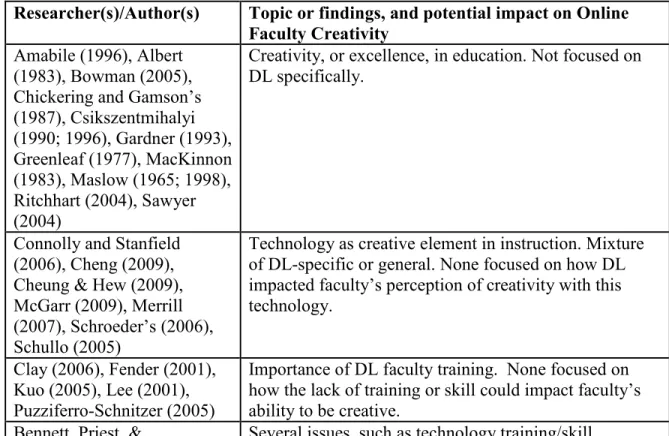
Table 2.1 highlights selections of literature, and how they relate to this study as foundational research. Many topics potentially impact faculty creativity, but fail to pull the correlations together to understand the issues in light of online faculty creativity specifically.
Table 2.1
Selected Studies Relating to Creativity in Distance Learning
Researcher(s)/Author(s) Topic or findings, and potential impact on Online
Faculty Creativity
Amabile (1996), Albert (1983), Bowman (2005), Chickering and Gamson’s (1987), Csikszentmihalyi (1990; 1996), Gardner (1993), Greenleaf (1977), MacKinnon (1983), Maslow (1965; 1998), Ritchhart (2004), Sawyer (2004)
Creativity, or excellence, in education. Not focused on DL specifically.
Connolly and Stanfield (2006), Cheng (2009), Cheung & Hew (2009), McGarr (2009), Merrill (2007), Schroeder’s (2006), Schullo (2005)
Technology as creative element in instruction. Mixture of DL-specific or general. None focused on how DL impacted faculty’s perception of creativity with this technology.
Clay (2006), Fender (2001), Kuo (2005), Lee (2001), Puzziferro-Schnitzer (2005)
Importance of DL faculty training. None focused on how the lack of training or skill could impact faculty’s ability to be creative.
Macpherson (1999), Bower (2001), Bruner (2007), Cavanaugh (2005) , Haber (2005), Oliver (2004), Mortera-Gutierrez & Beatty (2000), Ryan, Carlton, & Ali (1999), Samarawickrema & Stacey (2008)
workload, and significant time requirements were identified as DL Faculty issues, compared to Face-to-Face teaching. None tied to creativity specifically (although could be inferred).
Kanuka, Collett, and Caswell (2002), Shrum and Hong (2002)
How teaching online impacts faculty teaching. Touched issues related to creativity, but not specifically.
Arbaugh and Hornik (2006), Batts, Colaric, and McFadden (2006), Chickering (1996), Chizmar and Walker (1999), Keeton (2004), Muirhead (2007), Nkonge (2004), Parker and Hankins (2002), Savery (2005)
Best-practice in DL instructional. Varying degrees of direct or indirect discussion related to creativity.
Chapter 3 – Methodology
In light of the research, what was needed was a study to better understand the experiences of creative online faculty related to expressing creativity, and if (and/or how) the environment affected their ability to express creativity. The study results will create a new focus for the body of research literature, and will benefit both online faculty and administrators. For faculty, it is important to understand the experiences of other online instructors, and how they engage students within the online environment. It is also important for administrators to understand the lengths instructors go to engage students, and the challenges many instructors face. Through this type of research, administrators will get a more realistic picture of what encompasses teaching online versus face-to-face. In order to produce the most effective results, the study had to be conducted in a research tradition appropriate to yield the desired information.
Both quantitative and qualitative research approaches were considered. Quantitative research focuses more on facts (quantifiable data) to present an unbiased analysis. (Creswell, 2008) Alternately, Creswell defined qualitative research as that which “relies on the view of participants; asks broad, general questions; collects data consisting largely of words (or text); describes and analyzes these words for themes; and conducts the inquiry in a subjective, biased manner” (p. 46). Because of the depth of understanding desired on the issue, qualitative was deemed most appropriate for this study. Once the qualitative research method was determined, the most appropriate type of qualitative research had to be selected. A phenomenological research tradition, a qualitative research study researching a phenomenon (Moustakas, 1994), was chosen as most appropriate for this study.
Phenomenology Research Tradition
Although faculty creativity in online learning might not normally be considered a phenomenon (some students might argue that its rarity classifies it as such when found), this approach focuses on understanding the essence of participants’ experiences, and looking for outcome themes gleaned from participant responses, which was most appropriate for this study. (Creswell, 2007) Csikszentmihalyi (1990) also supported phenomenological study, as “the clearest way to examine the main facets of what happens in the mind” (p.25).
Moustakas (1994) went into great depth about phenomenology, exploring this term that was being used as early as 1765. At its foundation, the purpose of
phenomenology is to understand “knowledge as it appears to consciousness, the science of describing what one perceives, senses, and knows in one’s immediate awareness and experience” (p.26). As with other qualitative traditions, the researcher is not merely an observer, but recognizes his interests or biases throughout the study. Phenomenology takes the concept one step further, with experts claiming that the phenomenological researcher cannot understand participants’ experiences until he has taken the time to reflect on his own experiences related to the phenomenon. Through the concept of epoché, the researcher examines his own beliefs and experiences then, based on his deeper internal understanding, can look at the phenomenon free from his biases and preconceptions.
The world is placed out of action, while remaining bracketed. However, the world in the bracket has been cleared of ordinary thought and is present before us as a
phenomenon to be gazed upon, to be known naively and freshly through a “purified” consciousness. (p.85)
As both an online student and faculty member, it would have been impossible for the researcher to detach those experiences from a study on online learning creativity. By recognizing those experiences, and examining internal biases first however, the
researcher was better able to openly consider others’ experiences and how they related to each other.
Research Procedures
This study examined the central question of how teaching in the online
environment affects the expression of faculty creativity. The guiding research questions for this study were as follows:
1. What is the essence of the experience for creative instructors expressing creativity in the online environment?
2. What are some of the challenges creative instructors face expressing creativity in the online environment?
3. How does technology enable or hinder creativity expression for creative instructors?
Obtaining participants.
The researcher sent an email requesting a purposeful sample to colleagues at several institutions, where the primary mission is undergraduate education and the primary teaching environment is on-ground, requesting names of potential participants. Although a definition of creativity was not offered, since it is subjective, nominators were asked to think of faculty who are using creative elements to engage online students, or
perhaps using technology in a creative way to bring course curriculum to students in a unique way. Creative methods or technologies might include (but are not limited to): podcasts, videos, Web conferencing, interactive technology, immediate feedback mechanisms during assignments/tests, or games as learning tools. Some specific examples of creative faculty were offered as follows:
• A professor teaching anatomy online, who has created an electronic
simulation of heart dissection, so that online students get to participate in 3-dimensional exercises.
• A professor teaching communication online, who uses video messaging and conferencing to create a face-to-face community where students can dialogue and present speeches.
Nominations included a statement indicating why the nominator perceived the potential participant is a creative faculty member, and a list of creative elements the nominee includes in his online classes. Some follow-up phone calls were placed to those who nominated participants to ask additional questions and further qualify potential participants.
The researcher selected the candidates with the most varied and unique methods or technologies for online instruction, based on the pool of candidates. Examples of creative methods or technologies included (but were not limited to): podcasts, videos, Web conferencing, interactive technology, immediate feedback mechanisms during assignments/tests, and games as learning tools.
An email invitation was sent to each nominated participant (Appendix A). Although follow-up phone calls were planned, all nominees responded promptly
regarding their availability or desire for participation. Email or phone calls were
conducted with nominees who had additional questions prior to agreeing to participate. If the participant did not own, or have access to, a webcam, the researcher offered a loaned webcam, including a pre-paid return envelope so that the equipment could be returned for use with another participant. Only one participant required access to a loaned webcam. Multiple interviews were scheduled at participants’ convenience.
Participants – delimitations.
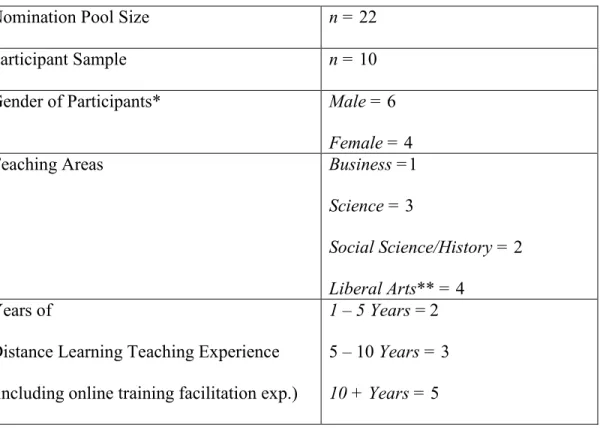
• Twenty-two (22) nominee names were submitted to the researcher by a previous or current student, colleague, or distance learning administrator of public or private institutions, where the primary mission was undergraduate on-ground instruction.
• Nominators were asked to make nominations based on recognizing the faculty member as creative in the online environment. (Because the notion of creativity is recognized to be subjective, parameters were not dictated for creativity;
however, examples were offered. Nominations were required to be accompanied by a statement indicating why the nominee was considered creative, and what creative elements the nominee employs. Those using the most unique elements, based on the nominee pool, were selected for the study.) Note: Although the request for nomination went to students, faculty, and administrators, at both nominating institutions, the distance learning administrators provided the final list.
• Participants were sought who have online undergraduate course teaching experience. No minimum-year teaching requirement.