HC12: Efficient Method in Optimal PID Tuning
R. Matousek, Member, IAENG, P. Minar, S. Lang and P. Pivonka
Equation Chapter 1 Section 1
Abstract— The concept of PID controllers (proportional integral derivative) belongs to the most frequently used principles of controlling in industrial and non-industrial applications. The process of setting of PID controller can be determined as optimization task. Requiring optimal settings of PID controller we can specify more goals of optimization which are often contradictory. Optimal setting of PID controller is generally task of nonlinear mathematic optimization which is furthermore done on top of dynamic system. In this paper shall be shown multi-criterion optimization of PID controller setting of two systems using soft computing optimization method HC12. To be correct the solution shall be compared with classic method of nonlinear optimization based on Nelder-Mead method and also shall be shown solution of PID controller using classic methods Zigler Nichols and Modulus Optimum.
Index Terms—HC12, PID, Optimal Control Design, PID Tuning, Magnetic Levitation System
I. INTRODUCTION
VOLUTIONARY algorithms or generally various soft-computing methods provide very robust tools usable in tasks of mathematical optimization. In this paper shall be presented relatively new optimization method denoted as HC12 [1], and [2]. HC12 algorithm is Soft Computing opti-mization method, capable of solving not-differentiable, nonlinear and multi-modal objective functions. As optimization task the optimal setting of PID controller for two dynamic systems has been chosen. From the point of view of optimization it is a nontrivial task of setting the optimum parameters of dynamic system. In general it is a task nonlinear and multi-criterion. From point of view of evolutionary algorithms (generally optimization soft-computing algorithms) this type of task can be viewed as challenge which solution has very practical implications [5], [6], and [7]. Apart from automation where PID controllers have very wide tradition it is a new approach which can support or compete with present methods of controller setting.
PID controller can be viewed as common tool usable for controlling of industrial and non-industrial processes. Controller can be used to control velocity, revolutions, temperature, etc. At present time because of major usage of
digital technology it is used mainly the digital variant of PID controller. Commonly the PID algorithm is in the process of control implemented using PLCs (Programmable Logic Controllers), DCS (Distributed Control System) or single loop or stand alone controllers. The PID principle is also the basic for many advances control strategies.
In this paper a novel optimal PID controller tuning approach based on the HC12 is proposed. The optimal PID parameters design are transformed into corresponding optimization problem. Of course for optimization can be used other various soft computing methods such as Differential Evolution (DE), Simulated Annealing (SA), Genetic Algorithms (GA) and many more [3], [8] etc.
Presented results and implementation of algorithms have been realized using the tools of Matlab/Simulink environment and Java for implementation of optimization solvers.
II. PIDCONTROLLER
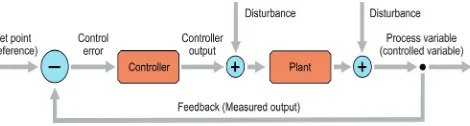
The theory of control deals with methods which leads to change of behavior of controlled dynamic system (further only system). The desired output of a system is called the reference or set point. When one or more outputs of the system need to follow a certain reference over time then a controller modifies the inputs of system to obtain the desired value on the output of the system, Fig. 1.
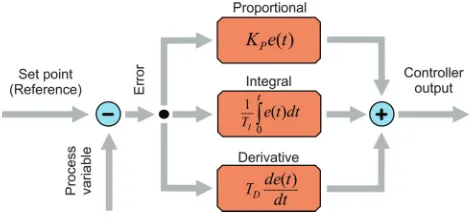
The PID controller has three separate constant parameters: Proportional (P), Integral (I) and Derivative (D). It can be said the P depends on present error, I on accumulation of past errors and D is prediction of future errors based on rate of change. The PID controller calculates an error value as the difference between a measured process variable and a desired set point. The controller attempts to minimize the control error by adjusting the process controller outputs.
After corrective action from the controller the system should reach point of stability as the result. Stability means the set point is being held on the output without oscillating around it. Description of controller is provided in forms of formulae or algorithms. Basic block diagram of PID controller is based on parallel circuit, Fig. 2. The proportional, integral, and derivative terms are summed to calculate the output of the PID controller.
[image:1.595.312.547.476.539.2]E
Fig. 1. The general concept of the negative feedback loop to control the dynamic behaviour of the system with description of the major parts.
Manuscript received August 3, 2011: Revised version received August 20, 2011. This work was supported by the research projects of MSM 0021630529 "Intelligent Systems in Automation", GACR No.: 102/091668 ''Control Design Evolutionary Approach'', and IGA FSI-S-11-31 "Application of Artificial Intelligence".
The key step of the Ziegler-Nichols tuning approach is to determine the ultimate gain and period. Then, the PID controller parameters are determined from Ku and Pu using
the Ziegler-Nichols tuning Table I.
Defining u(t) as the controller output, the general form of the PID algorithm is:
0
1 (
( ) ( ) ( )
t P
I
de t
u t K e t e t dt T
T d
D )t (1)
where constant KP is gain and TI resp. TD are integrative
resp. derivative time constants.
In our case we have used for testing the simplified variant of PID controller given by equation (2). Mutual conversion of controller’s constants KI, KD, TI and TD from (1) and (2)
is obvious. Other advanced forms of PID controllers with better real properties can be found in [4].
0
( )
( ) ( ) ( )
t
P I D
de t u t K e t K e y dt K
dt
(2)
Tuning a control loop is the adjustment of its control parameters (gain/proportional band, integral gain/reset, derivative gain/rate) to the optimum values for the desired control response. Designing and tuning a proportional-integral-derivative (PID) controller appears to be conceptually intuitive, but can be hard in practice [6], if multiple (and often conflicting) objectives such as short transient and high stability are to be achieved. There are several methods for tuning a PID loop. In our paper we will designate the found parameters as in (2), i.e. {KP, KI, KD}.
In order to solve optimal setting of controller’s parameters we will use reformulation of the problem. Optimal solution will be searched for by HC12 algorithm as optimum of given objective function. However for comparison there are used common methods for controller parameters tuning, i.e. empirical method Ziegler-Nichols (Ziegler, Nichols 1947) and Modulus Optimum method [9]. Of course many other PID controller tuning methods exist which consider desired properties of control loop.
A. Zigler-Nichols Tuning Method
Ziegler-Nichols (ZN) tuning rule was the first such effort to provide a practical approach to tune a PID controller. According to the rule, a PID controller is tuned by firstly setting it to the P-only mode but adjusting the gain to make the control system in continuous oscillation. The corre-sponding gain is referred to as the ultimate gain Ku and the
oscillation period is termed as the ultimate period Pu.
TABLEI
COMMONLY USED ZIEGLER-NICHOLS SETTING RULES*
KP TI TD
Controller
0.5 Ku --- ---
P
0.45 Ku 0.83Pu ---
PI
0.6 Ku 0.5Pu 0.125Pu
[image:2.595.51.286.50.161.2]PID Fig. 2. The block diagram of the PID controller.
*Ziegler, J.G and Nichols, N. B. (1942). Optimum settings for automatic controllers. Transactions of the ASME.
B. Modulus Optimum
Modulus Optimum (MO) method is based on the transfer function of set point Gref(s), where this transfer function is
ratio of Laplace s-domain of process output variable to set point input variables. In ideal case the transfer function would be Gref(s) = 1, i.e. step response of process variable is
equal to set point. In frequency domain it corresponds with following condition (3).
( ) 1 ( ) ( ) 1
ref ref ref
G j G j A (3)
This condition can not be satisfied in reality, however it can be proven that control process ends the fastest when amplitude characteristics Aref(j) will be flat at first and then
it will monotonically decreasing. Description of this method can be found in v [9]. The setting of PID parameters KP, TI
and TD by MO method is sorted in the table for practical use
and it depends on the type of controlled plant, Table II.
TABLEII
CALCULATION OF PIDCONTROLER'S PARAMTERS BY MOMETHOD*
Model of K
P TI TD
controlled plant
1 2 3
1 2 3
( 1)( 1)( 1
k T s T s T s
T T T 2 3
i
T kT
1 2
1 2
T T T T
III. EXPERIMENTAL PLANTS
For out tests we have developer two dynamic systems. First is artificially created system given by simple transfer function Gsimple(s). On this system there are shown classic
methods of PID controller tuning (Ziegler-Nichols, Modulus Optimum) and multi-criterion tuning using soft computing method HC12. Optimization method HC12 have been compared for objective consideration with classic method of nonlinear optimization Nelder-Mead [10].
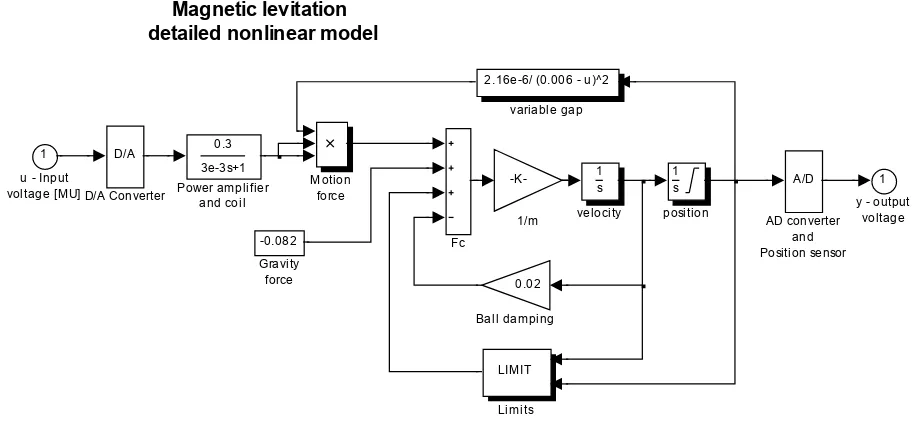
Second dynamic system have real physical basis and it is denoted as MGL. It is a model of magnetic levitation. In this case there are shown results of multi-criterion optimization of PID controller using HC12 method.
)
1 2
T T
Magnetic levitation detailed nonlinear model
1 y - output
voltage 1
s velocity 2.16e-6/ (0.006 - u)^2
variable gap
1 s position 0.3
3e-3s+1 Power amplifier
and coil
Motion force
LIMIT
Limits -0.082
Gravity force
Fc D/A
D/A Converter
0.02
Ball damping
A/D
AD converter and Position sensor
-K-1/m 1
[image:3.595.70.527.78.289.2]u - Input voltage [MU]
Fig. 3. Simulink model of the Magnetic Levitation system (MGL).
A. Plant A - Simple System
There is open loop stable system of third order which is given by (4), and transfer function (5).
0.5 0.25 0.1667
( ) 6 1 t t
y t e e e t (4)
3 2
6 ( )
48 44 12 1
SIMPLE
G s
s s s
(5)
Parameters required for the use of Zigler-Nichols method are ultimate gain Ku = 1.65 and corresponding period Pu = 12.6 (s-1). These values correspond with calculated
pa-rameters PIDZN = {0.99, 0.16, 1.575} according to Table I. For Modulus Optimum method are crucial parameters of plant {k, T1, T2, T3} = {6, 6, 4, 2}. According to Table II. these values correspond wits calculated parameters PIDMO = {0.08, 0.16, 1.33}.
B. Plant B - MGL System
The objective of this experiment is to design a controller that levitates the steel ball from the post and makes it track a specified position trajectory. Magnetic Levitation system (MGL) which is used for our experiments is based on the balance of all forces acting on the steel ball. System is driven by two signals which represents desired position of the steel ball in magnetic field. The motion equation is given by (6).
(6) (N)
a m g d
F F F F
where the forces are a
F mx the accelerating force (N),
2
2 0
c m
k i F
x x
the electromagnetic force (N),
g
F mg the gravity force (N),
d d
F k x the damping force (N),
kd the damping constant (N/ms), kc the coil constant,
x the ball position (m),
x0 coil offset (m)
m the mass of the ball (kg).
The (6) can be written as (7) for our Matlab/Simulink® realization. The matching Simulink model of MGL system is showed in Fig. 3.
2
0
( )
d c
k k i
x x g
m m x x
(7)
The power amplifier is designed as a source of constant current i, controlled by the input voltage signal u. The position sensor can be approximated with a linear function between the ball position x and the sensor voltage output y.
IV. OPTIMAL PIDTUNING USING HC12
Goal of this paper is to present optimal tuning of PID controller (2) using relatively novel soft computing optimization method denoted HC12. For every optimization process it is not only crucial the selection of the solver but the design of objective function as well. Further it is worthy to note that in case of soft computing methods the way of coding is very important, i.e. the representation of searched parameters of the task.
A. Objective Function
In case of optimal PID parameter tuning it can be counted for many demands of resulting control process. For example shortest time of control process, zero steady state error, zero overshoot, no oscillation, etc. Moreover the demands of optimization can be combined. Examples of common performance integral criteria for optimal control design are in Table III.
In our case we have the objective function fTOTAL
composed as sum of three objective functions which penalize inconvenient behavior of transitional process. To given type of optimization problem it is convenient to note that it is integral way of creating the objective function. The value of objective function (penalty functions) is obtained after finish of the simulation.
log log log
TOTAL ITAE OVER WAVE
f f f f
st
on (Akernel, i+1). The algorithm stops if no best
so tion can be found, that is, if (for a m problem)
(8)
(9) 3
*
[K K KP, I, D] arg min fTOTAL( )
K K
Where , , are weight coefficients. Penalty function
fOVER calculates all overshoot where response signal (process variable) exceeds its target (set point). In case of overshoot the function value is increased by one every sample period. Penalty function fWAVE calculates sum of all detected oscillations. Oscillation is detected if the shape of the process variable signal changes from concave to convex. The vector [KP, KI, KD]* corresponds to find optimum PID
parameters.
Principle of penalization is well known variant of evaluation in case of multiriterion optimization. However problem of this way can be weighting of individual penalizating objective functions. In case of our implementation we have reduced it significantly using logarithm function as is shown in (8). This practice can't be applied generally, it has to be always confronted with the choice of individual penalization functions. In our paper the objective function has been very well usable even using unsophisticated weighting like 0 or 1.
B. HC12 Algorithm
The basic principle of HC12 algorithm is very simple. Shortly, for a given optimization problem, in each iteration
ep i, a solution (Akernel, i) exists to which a neighborhood of
further possible solutions is generated using a fixed pattern. From this neighborhood, the best solution is chosen for iteration step i + 1, which will again be used to generate a new soluti
lu inimization
TABLEIII
COMMON INTEGRAL OBJECTIVE FUNCTIONS
1
min f Akernel,i min f Akernel,i (10)
where i is the iteratio
Formula*
Label Caption
2
0
( ) t ISE
f
e t dtIntegral of Squared Error ISE
n number and f is the objective fu
cretization de
wo binary vectors of equal length is the number of positions for which the co
nce of 1 corresponds to the length n of the bi
metic (m d 2) and using the special matrixes M (as a Mask) we can derived neighborhood vectors Aneighborhoodby (11
nction. A mathematical description of the algorithm can be found in [1] and [2].
Here the basic ideas are summarized: The solution of a given optimization problem is represented by a binary vector A. This binary vector A codes k real parameters of the optimization problem, that is, the real input parameters xi
of the objective function. This provides a basis for discretizing the domain of definition of the problem parameters to be found. The degree of dis
0
( ) t IAE
f
e t dtIntegral of Absolute Error IAE
2
0
( ) t ITSE
f
te t dtIntegral of Time multiply Squared Error ITSE
0
( ) t ITAE
f
t e t dt Integral of Time multiplyAbsolute Error ITAE*
* This control error criteria was used in our experiments.
pends on the size of the binary string being proportional to 2s where s is the number of bits per parameter.
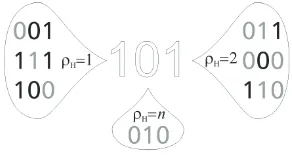
In the first iteration, a binary vectorAkernel,1 and a neighborhood to fit a fixed pattern are randomly generated. With HC12, this is a neighborhood with distances 1 and 2 from vector Akernel in the sense of the Hamming metric. In
each iteration, the best solution is chosen as the new basis. The Hamming distance H between t
rresponding symbols are different.
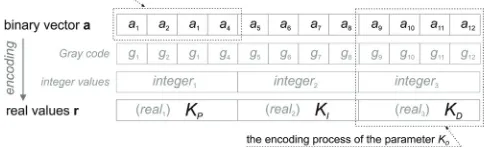
The principle of decoding a binary string to a vector of real parameters, which are in our case the PID parameters {KP, KI, KD} is shown in Fig. 4. It follows from the principle
that the cardinality (size) of the neighborhood for a Hamming dista
nary vector thus growing linearly with the length of the binary vector.
[image:4.595.49.294.178.320.2]Applying the principle of addition in modular arith
Fig. 4. Example of generating 4-bits parameters encoding scheme (binary and Gray code, integer and real parameters). As can be seen from the figure the number of bits determine the precision of the encoded real parameters. In our experiments we used 10-bit per parameter, i.e. precision approximately 1e-2 for all PID tuning parameters {KP, KI, KD}.
o
)
1
2
neighborhood kernel kernel
[image:4.595.305.550.571.645.2]where M are the mask matrixes given by (12) and the indexes i = 1, 2 are corresponding with H =1 and H =2.
Is should be noticed that generalization of the neighborhood generated process is possible (H =3, H =4,
... , H =n), but for real life optimization tasks the
combinatorial expansion is ruinous.
(12)
1,
1
,1 ,
1,
2,
2
,1 ,
2 2
1 0 0
0 1
0 1
1 1 0 0
1 0 1 0
0 1
n
n n n
n n
n n
n
M
M
[image:5.595.309.549.165.319.2]The computational time complexity is the amount of steps the algorithm has to do accordingly to the number of inputs. In the big O notation the behavior of function is analyzed when number of inputs is very high. Algorithm HC12 has quadratic complexity O(n2).
Fig. 5. An example of 3-bits neighborhood generating.
It generates neighborhood using bit masks. Those masks have Hamming distances one and two and rank of matrices
M are n and n choose 2 respective, where n is the length of binary string which represent the problem solution.
C. Nelder-Mead Method
The Nelder-Mead algorithm (NM) or simplex search algorithm, originally published in 1965 (Nelder and Mead, 1965), is one of the best known and successful algorithms for multidimensional unconstrained optimization without derivatives. In our case we use this algorithm for the comparison of HC12 performance.
The Nelder -Mead method is simplex-based. A simplex S
in is defined as the convex hull of n+1 vertices . For example in our case of PID parameters tuning {KP, KI, KD} a simplex is tetrahedron. Nelder–Mead
generates a new test position of simplex by extrapolating the behavior of the objective function measured at each test point arranged as the simplex. The algorithm then chooses to replace one of these test points with the new test point and so the technique progresses. Our implementation of the NM was based on Matlab function fminsearch
n
, , x0 x n
n
[10]. Furthermore, the presented results are obtained as optimum from 20 runs of the NM algorithm with different start points.
V. TESTS AND RESULTS
In this section there will be presented the results of optimal tuning of PID controller using presented strategies. For better objectiveness and possibility of comparing our results with others we mention PID tuning parameters and descriptive characteristics (popular performance criteria) of control process in Table IV.
Optimization of parameters of PID controller using HC12 algorithm has been done 20 times for every case of plant and configuration of weight coefficients in (8). The reason is, same as in the case of method NM, certain sensitivity of the solution to first iteration of algorithm.
Naturally, the best idea about results of the control and effect of selected penalization functions (8) to resulting controller's setting (9) are given to us by respective step responses. These characteristics best describe effectiveness of PID tuning by HC12 in comparison with other methods and also show very well the impact of penalization to given control process.
TABLEIV
COMMON PERFORMANCE CRITERIA* FOR PIDTUNING
Label Description Overshoot occurs when the output signal exceeds
its set point. It arises especially in the Overshoot
(OVER) response, often followed by ringing. step
Peek is the highest value reached by the response before reaching the desired value, therefore peak-time is the peak-time when the peek is reached. Peek time
(PET)
Rise time is the time required for the response to rise from x% to y% of its final value", with 0%-100% rise time common for overdamped second order systems. (90% in our description was used) Rise time
(RIT)
Settling time of output signal is the time elapsed from the application of an ideal step input to the time at which the output is equal to set point within tolerance. (2% is our set point tolerance)
Setting time (SET)
* There are a lot of criteria which can be used for comparison of performance ratio in case of optimal PID tuning.
A. Plant A - Simple system
This artificially designed plant of second order has been taken as reference, i.e. plant for comparison of some known methods for tuning of PID controller with our developed approach to PID tuning by HC12. Computed parameters of controller and values of performance criteria are in Table V.
Unit step responses for the ZN and MO methods are in Fig. 6. The Fig. 6 clearly shows influence of penalty functions where values 0/1 means if the given weight coefficient (, , ) enables the use of penalty function and
TABLEV
THE RESULTS OF PIDTUNING FOR SIMPLE PLANT*
PID Parameters PID Performance Criteria
KP KI KD
Method OVER PET RIT SET
ZN 0.990 0.159 1.575 0.516 8.9 5.3 40.6
MO 0.083 0.166 1.333 0.052 36.5 26.9 74.3
HC121-0-0 24.80 0.646 2.126 0.411 4.0 1.5 16.6
HC121-1-0 16.14 0.004 3.071 0 0 11.9 13.6
HC121-0-1 4.724 0.157 3.543 0.191 11.3 5.7 30.9
HC121-1-1 2.362 0.018 4.016 0 0 12.4 14.1
[image:5.595.100.246.359.438.2]also value 1 means real value of given weight coefficient. In the text we will use notation -- as index of given HC12 optimization, i.e. HC12--.
5 10 15 20 25 30 35 40 45 50
0 0.5 1
1.5 PID Tuning Using Zigler-Nichols and Modulus Optimum Methods
Un
it St
ep
Re
sp
on
se
Time (s)
Set point Ziegler-Nichols Modulus Optimum
HC121-1-1
0 0.5 1 1.5 2 2.5 3 3.5 4
0 0.1 0.2 0.3 0.4 0.5 0.6 0.7 0.8
Time (s)
B
al
l P
os
ition
(
%
), [
0 m
m
20
m
m
]
PID Tuning Using HC12 (Magnetic Levitation)
Set point
HC121-0-0
HC121-1-0
HC121-0-1
HC121-1-1
0 0.5 1 1.5 2 2.5 3 3.5 4 4.5 5
0 0.1 0.2 0.3 0.4 0.5 0.6 0.7 0.8
0.9 PID Tuning Using HC12 (Magnetic Levitation)
Time (s)
B
al
l P
os
iti
on (%
), [
0 mm - 20 mm]
Set point
HC121-0-0
HC121-1-0
HC121-0-1
HC121-1-1
5 10 15 20 25 30 35 40 45 50
0 0.5 1 1.5
Time (s)
U
ni
t S
tep
R
es
pons
e
PID Tuning Using HC12 (Simple)
Set point
HC121-0-0
HC121-1-0
HC121-0-1
[image:6.595.62.272.54.308.2]HC121-1-1
Fig. 6. Unit step responses for the Plant A (Simple) using ZN, MO and HC121-1-1 PID tuning methods (above). Unit step responses using HC12 PID tuning methods for basic variants of penalty functions (bottom).
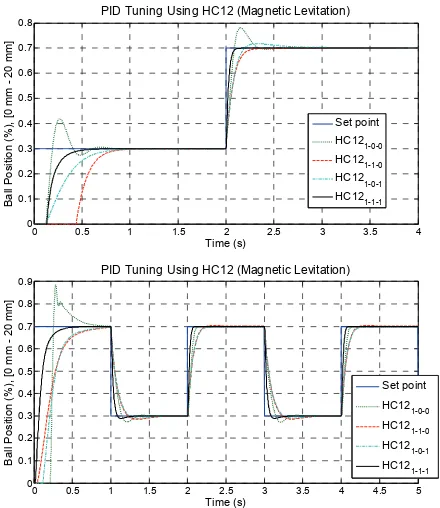
Fig. 7. Double step responses for the Plant B (MGL) using HC12 PID tuning methods and basic variants of penalty functions (above). The kind of the test but for PWM input signal reference (bottom).
VI. CONCLUSION
In this paper we introduce novel efficient optimal PID tuning method based on soft computing optimization algori-thm HC12 and sophisticated design of objective function as well. The HC12 was compared with classical PID tuning methods ZN and MO. The comparison with traditional clever optimization methods NM have shown, that the HC12 is more stable in case of optimal solution. Efficient results are summarized in Fig. 6 and Fig. 7.
B. Plant B - MGL system
The plant is represented by (7) and simulation model by Fig. 3. This nonlinear high speed model of MGL system is real equipment in our laboratory (MGL model CE152 made by Humusoft® Ltd.). Therefore the actuating signal corresponds with real values of desired position of steel ball levitating above the ground. The physical parameters are:
m = 0.008 (kg), x0 = 0.01 (m), kd = 0.02 (N/ms), a = 0.003 (s), ka = 1.5 (A/V), kx = 200 (A/V), y0 = 0 (V), kc = 2.16e-6.
Computed parameters of controller and statistic characteristics of objective function are in Table VI. There are 20 runs per penalization's variant of objective functions.
REFERENCES
[1] R. Matousek, “GAHC: A Hybrid Genetic Algorithm”, in Proc. of the 10th Fuzzy Colloquium in Zittau, Zittau, pp. 239-244., 2002. [2] R. Matousek, “GAHC, Improved Genetic Algorithm”, in the Springer
book series (Eds.: Krasnogor, et al.) Nature Inspired Cooperative Strategies for Optimization (NICSO 2007), Volume 129, 2008, XIV, pp. 114-125., ISSN 1860-949X, Springer Berlin, 2008.
TABLEVI
THE RESULTS OF PIDTUNING FOR MGLPLANT
[3] R. Matousek, "Grammatical Evolution: STE criterion in Symbolic Regression Task", in Proc. of the IAENG Int. conference WCECS 2009, pp.1050-1054, ISBN 978-988-18210-2-7, San Francisco, 2009. Objective function exp.
values characteristics PID Parameters*
I
NPUT
OPTIMI-ZATION
KP KI KD MEDIAN** STD** MIN [4] P.Pivonka, V. Veleba, M. Seda, P. Osmera, R. Matousek, "The short
Sampling Period in Adaptive Control", in Proc. of the IAENG Int. conference WCECS 2009, pp.724-729, San Francisco, 2009.
HC121-0-0 1.181 19.98 0.078 12.543 1.256 12.72
DO
UBE STEP
HC121-1-0 1.299 3.779 0.079 49.911 2.170 15.20
[5] P. Popela. J. Dupacova, “Melt Control: Charge Optimization via Stochastic Programming”. In W. Zieamba. et al. (eds.): Applications of Stochastic Programming. Chapter 15. pp. 277–289 , SIAM, 2005. HC121-0-1 1.299 3.779 0.079 18.353 4.953 15.33
HC121-1-1 1.765 7.221 0.031 34.862 4.001 8.844
[6] R. Grepl. J. Vejlupek. V. Lambersky. M. Jasansky. F. Vadlejch. P. Coupek. P. “Development of 4WS/4WD Experimental Vehicle: platform for research and education in mechatronics”. IEEE International Conference on Mechatronics. ICM 2011-13-15, 2011.
NM1-0-0 3.696 7.643 0.014 69.224 3.075 6.704
NM1-1-1 1.930 10.22 0.021 51.919 4.144 7.058
HC121-0-0 0.354 19.98 0.079 31.047 1.887 22.57
[7] Z. Oplatkova, R. Senkerik, I. Zelinka, “Synthesis of Control Rule for Synthesized Chaotic System by means of Evolutionary Techniques”, in 16th Int. Conference on Soft Computing, pp.91-98, Brno, 2010. HC121-1-0 1.063 5.354 0.079 70.537 1.250 54.48
[8] J. Roupec, J.:, "Advanced Genetic Algorithms for Engineering Design Problems", Engineering Mechanics, vol. 17, No. 5/6, 2010. [9] K. J. Astrom and T. Hagglund, “The Future of PID Control,” IFAC J.
Control Engineering Practice, Vol. 9, pp. 1163-1175, 2001.
[10] M.J.D. Powell, “Direct search algortihms for optimization
calculations”, in Acta Numerica 1998, A. Iserles (Ed.), UK, 1998. HC121-0-1 0.827 6.299 0.079
PWM
51.379 1.136 50.06 HC121-1-1 1.255 11.04 0.031 90.737 1.101 71.62
NM1-0-0 2.171 11.75 0.018 59.045 1.471 33.62
NM1-1-1 0.804 12.01 0.036 176.78 2.062 79.87
* The parameters' limitation: KP [0,10], KI [0,30], KD [0,5].
[image:6.595.322.542.55.309.2] [image:6.595.54.291.564.762.2]