THE ROLE OF COMMUNICATION
VARIABLES IN PROMOTING A
PRO-ENVIRONMENTAL
BEHAVIOUR
A STUDY TO BETTER COMMUNICATE
“ANTI-CONSUMPTION” BEHAVIOUR
Jacopo Fittavolini
Univeristy of Twente
Master Thesis 03.10.2018
Jacopo Fittavolini 1885103
Supervisor 1: Prof. Dr. M.D.T. De Jong Supervisor 2: Dr. T.J.L. Van Rompay
University of Twente
Abstract
The aim of this study is to understand how to better communicate anti-consumption behaviour. Anti-consumption has an integral role and in particular, the acts of rejecting, reducing and reusing products, resources, and services are essential elements to sustainable consumption. Therefore, especially nowadays, understanding how to promote this behaviour is an important topic to consider. To achieve this goal, three communication variables (message framing, message appeal, and label of the behaviour) are studied. Moreover, the role of people’s pre-existing environmental concerns is analysed and considered as a possible moderator of the relationship between independent and dependent variables. To achieve the research goal, a 2x2x2 between-subjects experimental design (N=221) is used. As stimulus material eight different texts are created accordingly to the different combinations of independent variables. The data is collected by using an online questionnaire where participants are asked to read the text and give their opinion on different questions measuring the dependent variables of the study. The results have shown that not every communication variable had significant effects when communicating anti-consumption behaviour. However, it has been demonstrated how the use of a certain message appeal, or the combination of specific communication variables lead to specific outcomes while communicating anti-consumption behaviour. For example, it was found that the use of rational messages, as well as the combination of message appeal and label of the behaviour, has significant effects on behavioural intention. Moreover, it was interesting to find how different levels in people’s environmental concerns (especially moderate and high levels) moderate the relationships between communication variables and for example, attitude towards the behaviour and behavioural intention.
Keywords
Abstract ... 1
Keywords ... 1
1. Introduction ... 3
2. Theoretical framework ... 6
2.1 Anti-consumption behaviour ... 6
2.2 Dependent variables ... 7
2.2.1 Attitude towards anti-consumption behaviour ... 7
2.2.2 Behavioural intention ... 8
2.2.3 Impact on perceived comprehensiveness of the behaviour ... 9
2.3 Independent variables ... 9
2.3.1 Message framing ... 9
2.3.2 Message appeal ... 11
2.3.3 Label of the behaviour ... 12
2.4 Moderator ... 14
2.5 Research model ... 15
3. Research method ... 17
3.1 Research design ... 17
3.2 Procedure ... 17
3.3 Stimulus materials ... 17
3.4 Pre-test: manipulation check ... 21
3.5 Participants ... 24
3.6 Measures ... 26
4. Results ... 29
4.1 Manipulation check ... 29
4.2 Attitude towards the behaviour ... 30
4.3 Behavioural intention ... 31
4.4 Impact on perceived comprehensiveness of the behaviour ... 33
4.5 Moderation analysis ... 34
4.5.1 Moderation effect between label of the behaviour and dependent variables ... 34
4.5.2 Moderation effect between message framing and dependent variables ... 35
4.5.3 Moderation effect between message appeal and dependent variables ... 36
5. Discussion ... 39
5.1 Main findings ... 39
5.2 Theoretical contribution ... 43
5.3 Limitations and recommendations for future research ... 44
5.4 Conclusions ... 45
Literature ... 47
Appendix ... 55
Appendix A – Materials ... 55
1. Introduction
“We buy things we don’t need
with money we don’t have to impress people we don’t like” Dave Ramsey (2013)
This quote might be one of the many we always see on our Facebook homepage when we scroll down during a boring moment of our daily routine, but why is this quote so
meaningful? One of the main questions that we do not take into account when we purchase is “What is it behind the way we consume? What are the consequences of mindless
consumption? How is consumerism changing our world?”.
In recent years, the way marketing and communication works has drastically increased the level of consumption, especially in western societies. More and more studies have been conducted to better understand consumer behaviour and to find new ways to promote and sell products and services. A communication strategy that involved for example “the principle of persuasion” (Cialdini, 2007) is just one example of the many psychological ways adopted by marketing to persuade, and sometimes manipulate consumers to purchase more. Of course, as human-beings we need to consume to survive, but what happens when we consume more than what we need, for example, just to satisfy unnecessary materialistic needs?
Nowadays, the way we consume products and services has a direct impact on the environment. Hence, with all the environmental issues we are facing, a more aware and sustainable consumption needs to be a central topic in our society.
As stated by Heiskanen and Pantzar (1997), the topic of sustainability is often presented around issues of sustainable consumption. Despite different debates about it, the notion of sustainability is still elusive as its official definition: “sustainable consumption is the use of goods and related products which respond to basic needs and bring a better quality of life, while minimizing the use of natural resources and toxic materials as well as the emission of waste and pollutants over the life cycle, so as not to jeopardize the needs of future generation” (Norwegian Ministry of Environment, 1994, cited in OECD, 2002).
normative framework based on material prosperity and wealth to an “anti-consumeristic ethic” (Press & Arnould, 2009).
According to this point of view, the traditional model of self-interested consumers and individualization loses effectiveness by the adoption of environmental consciousness and moral restraints on consumption choices, and additionally taking actions on daily life to reduce the impacts on the environment (Dodson, 2003). This idea includes the notion of downscaling consumption and behaving in an anti-consumption way that might represent an innovative motivation force for sustainable development.
A study conducted by Black and Cherrier (2010) shows that, in who is trying to live a more sustainable life, anti-consumption has an integral role and in particular, the acts of rejecting, reducing and reusing products, resources, and services are essential elements to sustainable consumption.
A radical concept such as anti-consumption might lead to negative reactions. People could be skeptic about the meaning of this word, it might be perceived slightly too “radical” and consequently, people might start to experience negative emotions about what it concerns. But what if the way we talk about anti-consumption behaviour is presented in different ways? What is the effect of different communication variables while communicating this topic?
In communication, the role of message features plays an important role. For example, the success of a health campaign often depends on the persuasiveness and impact of its message (Andsager, Bemker, Choi & Torwel, 2006). Specifically, researches have tried to determine which appeal and types of message an audience prefers, remembers and finds effective. In the marketing and consumer literatures, several models of persuasion suggest that people involved with an issue are more favourable to process relevant messages in detail (Chaiken 1980; Petty and Cacioppo 1986). For example, a research conducted by
Maheswaran and Meyers-Levy (1990) showed that people are more risk aversion when alternatives are framed positively but are more risk-seeking when options are framed negatively with a focus on benefit loss.
need to be considered to better understand how to communicate the anti-consumption behaviour.
Another important factor to take into consideration while promoting the behaviour is its name. The label anti-consumption might not properly fit the behaviour itself. Only the way the behaviour is presented is not enough to understand how it can be efficiently promoted. As marketing strategies demonstrated, the name of the brand plays a key role in the success of a company and its products (Malik et. al., 2013). Therefore, the name of the behaviour to promote is an additional important variable that needs to be manipulated and analysed.
This study aims to research more about how to better communicate an important behavior as anti-consumption. The aim is to furnish the best way to talk about this topic and make the communication more persuasive, and therefore more effective.
To achieve this goal the main research question has been set:
2. Theoretical framework
In this theoretical framework, it is defined what anti-consumption behaviour is, what the characteristics of this behaviour are, and how the concept has been developed over the years. Then the dependent variables are defined. Consequently, the possible effects of the independent variables are shown. Subsequently, those findings are matched with the anti-consumption behaviour in order to assume some possible research outcomes. Finally, the moderating role of environmental concerns is discussed. Altogether, this forms the framework of the research design.
2.1 Anti-consumption behaviour
As stated by Lee et al. (2009), “Anti-consumption literally means against consumption, yet the word is not synonymous with alternative, conscientious, or green consumption; neither does anti-consumption merely comprise the study of ethics,
sustainability, or public policy”. Anti-consumption should not be intended as contrary to business success or improved quality of life, neither it is supposed to interfere with societal and business progress. Conversely, behaviours as rejection, reduce and reuse products, resources, and services should be seen as tools for sustainability (Black & Cherrier, 2010).
Khan (2017) illustrates the contrast between anti-consumption and materialism. The author describes the materialism as the emphasizer of “possessions and money for personal happiness and social progress” (Moschis and Churchill, 1978). As opposed to materialism, Cherrier (2009) describes anti-consumption as the representation of the attitude able to decline to give resignation to the ideology of progress and material growth.
In 1990, Wall advanced the idea of a deliberate refusal to consume as a part of the pursuit of a more sustainable society. Subsequently, Agarwal (2013) formalized this idea into the concept of anti-consumption.
individual and groups, “non-consumption” is no longer a niche movement. Rather, it is developing into a major trend in the global market.
Nowadays, anti-consumption behaviour should be considered more seriously. The way we consume is no longer sustainable. Our current consumption patterns have an enormous impact on the environment. This consumption model contributes to world problems such as pollution, climate change, extinction of species, and resource depletion. Therefore, the goal of this research will be focused on the strategy to better communicate and promote the anti-consumption behaviour. This can be a first step in persuading people to embrace a new way to consume, a new way to behave that could make a strong and beneficial contribution to the welfare of our planet.
2.2 Dependent variables
2.2.1 Attitude towards anti-consumption behaviour
As stated by Ajzen and Fishbein (1977), attitudes are influenced by different aspects of the individual’s world. For example, another person, an object, a policy, or a behaviour. Although many definitions of attitude have been suggested, most investigators agreed that the own evaluation of the entity in question represents the person’s attitude. In a paper by Allport (1935), an attitude is defined as: “A mental and neural state of readiness, which exerts a directing, influence upon the individual’s response to all objects and situations with which it is related”. Since the attitude towards anti-consumption behaviour has not been defined yet, it could be explained as the personal evaluation of rejecting, reducing, and reusing products, resources, and services for the sake of the environment.
In a study conducted by Steg and Vlek (2009), it has been demonstrated how environmental behaviour change requires consumers to develop more positive
pro-environmental attitudes over time in order to lead to a more sustainable consumption. This relation between attitudes and behaviour can be explained by the expectancy-value model (Ajzen, 1991). According to this influential perspective, consumers are viewed as forming attitudes through active cognition: they collect information on the attributes forming an object, subsequently, on the basis of their prior beliefs, they consider each attribute, and draw final perceived values concerning the good (Bentler & Speckart, 1979). Once these attitudes are generated, they are stored in memory, and if new important information becomes
According to Panzone, Hilton, Sale, and Cohen (2016), this deliberate process of cognition leads to judgments called explicit attitudes.
In order to better communicate and promote the anti-consumption behaviour, and understand how to enhance the willingness to adopt this behaviour, the role of explicit attitudes needs to be investigated as a dependent variable.
2.2.2 Behavioural intention
To explain customer behavioural intentions, Fishbein and Ajzen (1975) developed the Theory of Reasoned Action (TRA). This theory assumed that humans are rational in making methodical use of any available information, and the intentions are the single most important predictor of human behaviours (Ding & Ng, 2009). Originally, the model was created and used to predict intentions to take reasoned action in ordinary life experiences. As stated by Guo et al. (2007), TRA focuses on the impacts of cognitive components. Moreover, Oppermann (1995) demonstrated how TRA is important to analyze non-routine thinking decisions and for such behaviors which require critical deliberation. In other words, consumers’ contextual decision making can be comprehended using TRA and its effectiveness in explaining psychological/cognitive processes (Han and Kim, 2010). As stated by Han and Kim (2010), individuals’ intention to engage in a given behaviour is the central principle of TRA. Therefore, the willingness or readiness to engage in a behaviour under consideration is referred to “intention”. According to this theory, the intention to adopt anti-consumption behaviour could be defined as the extent to which people are willing to reject, reduce, and reuse products, resources, and services for the sake of the environment.
As stated by Ajzen (2002), an intention is considered as the best predictor of and a precursor to behaviours. TRA has been widely studied, tested, and validated in different settings, for example, health behaviours, online mediums, organic food, alcohol use etc. (Netemeyer & Bearden, 1992; Lee & Green, 1991). Additionally, using the Theory of Reasoned Action model, intentions have been predicted in green marketing areas, such as recycling behaviours, and green purchase behaviours (Lam and Hsu, 2004).
In the context of pro-environmental behaviours and more specifically, the
by Barber et al. (2010), the intention to adopt a behaviour is positive influenced by the attitude consumers hold towards the behaviour.
2.2.3 Impact on perceived comprehensiveness of the behaviour
A central aim of this study is to understand the extent to which people perceive and comprehend the anti-consumption behaviour. To understand how people comprehend the behaviour it is important to know to what extent people perceive the behaviour to have an impact on their daily routines and know the perceived degree of intrusiveness of the behaviour. In the marketing field, the perception of an advertising as intrusive should be considered as a cognitive evaluation of the degree to which the advertisement interrupts a person’s goals (Edwards, Li & Lee, 2002). Specifically, intrusiveness is presented as the degree to which a person considers the presentation of information as adverse to his or her goals. In this research, adopting anti-consumption behaviour could be perceived as a threat to daily life goals and routines. For example, being at the supermarket and having to pay more attention to the products that are necessary to be bought might be perceived as a limitation or a huge effort in a common daily routine. Therefore, it becomes necessary to understand the way by which the perceptions of intrusiveness can be limited to reduce the negative outcomes (Edwards, Li & Lee, 2002).
In this study, the role of communication variables could lead to different perceptions of the meaning and intrusiveness of the behaviour, and consequently, the behaviour could be comprehended to have different impacts on people’s daily goals. For these reasons, and in order to better communicate the anti-consumption behaviour, it is important to understand how people intend the behaviour and its impact on daily life situations.
2.3 Independent variables
2.3.1 Message framing
Many studies have been conducted to better understand whether the use of positive framing is more or less persuasive than a negative framing. Also for Chandy et al. (2001), the most common strategy to frame a message involves the use of message frames that underline either the positive or negative consequence related with a certain behaviour; this strategy is called ‘goal framing strategy’. Levin et al. (1998) revealed that, in fostering the promoted behaviour, negatively framed messages seem to be more effective than positively framed messages. In their social marketing research, Ferguson and Gallagher (2007) found a greater persuasiveness of negative frames related to health-related behaviours such as fostering breast self-examination (Meyerowitz & Chaiken, 1987), HIV/AIDS prevention (Marchand & Filiatrault, 2002), and the use of condoms for a safe sex practices (Block & Keller, 1995). Jung and Villegas (2011) demonstrated that, when people feel a strong involvement in the topic of the message, the use of such negative frames is particularly stronger.
Other studies showed that messages with negative frames are more effective than positive frames also in promoting environmental behaviours such as solid waste reduction. Other supportive studies were conducted in the field of consumption situations; for example, Chang et al. (2015) demonstrated that messages with negative frames are more persuasive when consumers are particularly worried about environmental issues.
Another possible explanation of the efficacy of negative framing is mentioned by White et al. (2011): negatively framed messages are more persuasive than positive frames because consumers, and more general recipients, process negative messages more accurately.
According to the previous studies related to environmental or social issues, negative message framing seems to be more persuasive than a positive framing. Therefore, since the anti-consumption behaviour can be considered as a pro-environmental behaviour, the use of a negative message would lead to a more positive effect on attitude towards behaviour and consequently on the behavioural intention to adopt it. In line with the previous reasoning and the literature found, the following hypotheses are proposed:
H1a: Negative message framing (loss oriented) has a more positive influence on the attitude
towards anti-consumption behavior compared with positive message framing (gain oriented).
H1b: Negative message framing (loss oriented) has a more positive influence on the
2.3.2 Message appeal
The advertising literature reported that message appeal (i.e., rational versus emotional) is one of the primary strategic considerations (Singh & Dalal, 1999; Stafford, 2005). Schiffman and Kanuk (2007) defined the use of message appeal as the application of a psychologically motivating power to arouse action and desire in consumer’s decision. The appeal is used to attract people’s attention, to change the perception of a product and to emotionally affect individuals about a specific product or service (Belch & Belch, 2002)
The emotional appeal is known as a method used in persuasive communication that is designed to create an emotional response. As stated by Aristotle, an emotion is one of the main important modes of persuasion. A common way to compose an emotional appeal is the use of anecdotes, and metaphors as well as descriptive language. According to Kotler and Armstrong (1994, p. 468), “Emotional appeals attempt to stir up either negative or positive emotions that can motivate purchase. These include fear, guilt and shame appeals that get people to do things they should or stop doing things they shouldn’t... communicators also use positive emotional appeals such as love, humor, pride, and joy”. In this paper, the
manipulation of the message could include some metaphors and anecdotes to enhance people’s emotions concerned with environmental issues.
A rational appeal is known as a method of persuasion focused on providing factual information about specific details regarding the argument shown in the message. As mentioned by Belch and Belch (2012), rational appeals underline the facts, logic of
persuasion and learning. The extent of the arguments make sense or are logical, influence the message persuasiveness related to a topic. Environmental information about the actual world situation might be used in order to create a rational appeal in the message to manipulate in this paper.
Several studies have been conducted to better understand when the use of emotional appeal or rational appeal is more efficient. Baker and Churchill Jr (1997) showed that messages formulated to focus more on the customer emotions are more effective in increasing awareness of people, for example by evoking discussion. In contrast, messages that underline product attributes and related information, using a more rational approach, are more effective in evoking purchase intentions (Lloyd & Clancy, 1991).
emotional appeals result in more positive reactions and higher levels of recall (Choi & Thorson, 1983).
A study related to purchase intentions, knowing the possible environmental
consequences, demonstrated that marketers use rational appeals that highlight the benefits towards the environment to give positive sentiment and stimulate brand interest to highly involved consumers (Dahlstrom, 2011). According to Coad, De Haan and Woersdorfer (2009), consumers who know more about the existence of certain environmental problems will have the feeling of responsibility and belief that by adopting new behaviours, they will be able to improve the situation.
Therefore, since the aim of the research is to promote anti-consumption, previous literatures related with green consumption or environmental-friendly behaviour seem to suggest the adoption of rational messages to efficiently communicate a pro-environmental behaviour.
According to what has been said above, a rational appeal might have more impact on environmental issues and consequently, it might have a stronger impact on the attitude towards anti-consumption behaviour and behavioural intention. Therefore, the following hypotheses are proposed:
H2a: A rational appeal has a more positive influence on attitude towards Anti-Consumption
behavior compared with emotional appeal.
H2b: A rational appeal has a more positive influence on behavioural intention compared with
emotional appeal.
2.3.3 Label of the behaviour
One of the main purpose of this study is to understand which label better fits the anti-consumption behaviour. Therefore, the idea is to deal with the label of the behaviour as it is done with the name of a brand to promote.
experiences of the brand, brand perceptions or association to the brand. The information and perceptions people have about the brand are crucial in guiding our decisions and behaviours (Wienkielman et al., 2000).
In a social marketing context, one of the main issues is to understand what labels and meanings need to be connected to desired, or sometimes even undesired, behaviours as well as to the personal or social benefits and costs that come from these behaviours. Consequently, one challenge for branding in social marketing campaigns is to understand how to ensure that individuals correctly value the immediate benefits of desirable behaviours, i.e., feel part of an exchange or be a part of a social change (Keller, 1998).
In this project, the aim is to analyze which label is better to efficiently communicate the anti-consumption behaviour. Two words have been manipulated during this experiment: a negative-sounding word “anti-consumption” and a positive-sounding word “conscious- consumption”. Lowrey and Shrum (2007) investigated the effect of phonetic symbolism on brand name preference. The outcomes of this experiment demonstrated that the sounds of words can change people perception and judgments. With this experiment, Lowrey and Shrum (2007) confirmed the possibly pervasive effect of a preference for positive-sounding words over negative-sounding words (Smith, 1998).
According to what is previously mentioned above, it can be assumed that the use of a positive-sounding label such as “conscious- consumption” will have a more positive impact in order to communicate the anti-consumption behaviour. Consequently, more positive effects on attitude towards anti-consumption and people’s behavioural intention are expected when using the label conscious-consumption. Moreover, the use of conscious-consumption as a label might be perceived as a softer and less-demanding term to indicate the
anti-consumption behaviour. Therefore, depending on which label is used, it is important to analyze to what extent people perceive the behaviour to have an impact on their daily life. Even though the behaviour explained is the same, different outcomes can result from the use of different labels.
According to the literature found and the reasoning behind it, different hypotheses have been formulated.
H3a: The use of the label “conscious-consumption” has a more positive influence on attitude
towards anti-consumption behaviour compared with the label “anti-consumption”.
H3b: The use of the label “conscious-consumption” has a more positive influence on
H3c: The use of the label “conscious-consumption” has less impact on
perceived comprehensiveness of the behaviour than the use of the label “anti-consumption”.
2.4 Moderator
Environmental concerns
As stated by Shultz and Zelezny (2002), “attitudes of environmental concern are rooted in a person’s concept of self and the degree to which an individual perceives him or herself to be an integral part of the natural environment”. The quality of the environment is critically influenced by the level of knowledge, attitudes, values, and practices of people (Mansaray & Abijoye, 1998).
In a study conducted by Gärling et al. (2003), the interest was focused on relationships between environmental behaviour (e.g. travel mode choice) and general environmental beliefs. Studying the relationships between general beliefs and behaviours is important because general beliefs may influence a wide range of behaviours (De Groot & Steg, 2007). For example, Chyong et al. (2006) demonstrated how attitudes are the most consistent explanatory factors in predicting consumers’ willingness to pay for green products. Moreover, in a study among 380 university students about the intention to use a “green” electricity brochure, Bamberg (2003) concluded that environmental concerns probably affect environmental behaviour indirectly via specific beliefs.
In this study, anti-consumption behaviour, and, more specifically, behaviours as rejection, reduce, and reuse of products, resources, and services, can be defined as a pro-environmental behaviour because of their low negative pro-environmental impact. Therefore, since a positive level of people’s environmental concerns influence the adoption of pro-environmental behaviours (e.g., buying products good for the environment or choosing public transportation instead of cars) (Bamberg, 2003), it can be assumed that people who are more concerned about the environment will be more interested in anti-consumption behaviour. For these reasons, the role of the moderator “Environmental concerns” could lead to a higher moderating effect on the attitude towards the anti-consumption behaviour, a higher
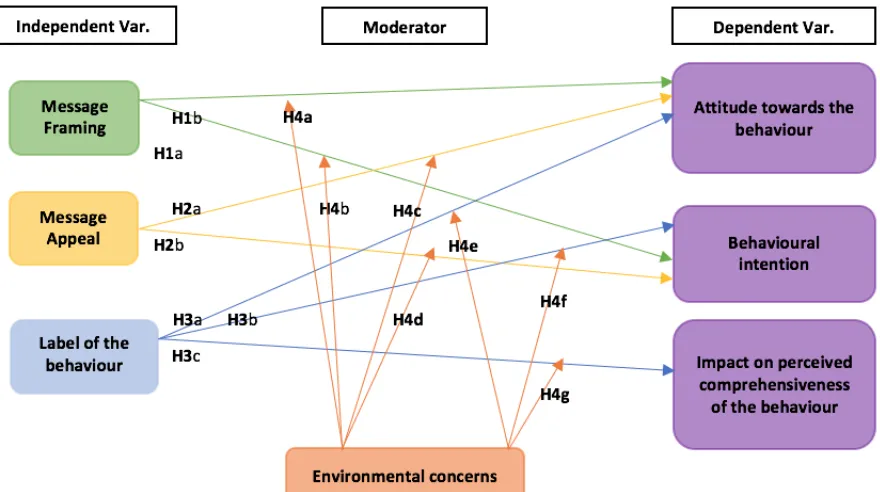
H4a: A high level of participant’s environmental concerns has a more positive moderating effect between the message framing and the attitude towards the behaviour than a low level of environmental concerns.
H4b: A high level of participant’s environmental concerns has a more positive moderating
effect between the message framing and the behavioural intention than a negative level of environmental concerns.
H4c: A high level of participant’s environmental concerns has a more positive moderating
effect between the message appeal and the attitude towards the behaviour than a negative level of environmental concerns.
H4d: A high level of participant’s environmental concerns has a more positive moderating
effect between the message appeal and the behavioural intention than a negative level of environmental concerns.
H4e: A high level of participant’s environmental concerns has a more positive moderating
effect between the label of the behaviour and the attitude towards the behaviour than a negative level of environmental concerns.
H4f: A high level of participant’s environmental concerns has a more positive moderating effect between the label of the behaviour and the behavioural intention than a negative level of environmental concerns.
H4g: A high level of participant’s environmental concerns has a more positive moderating effect between the label of the behaviour and the impact on perceived
comprehensiveness of the behaviour life than a negative level of environmental concerns.
2.5 Research model
anti-consumption behaviour will lead to a higher behavioural intention to adopt the pro-environmental behaviour. Accordingly, the following research model is presented.
3. Research method
3.1 Research design
A between-subjects experimental study was conducted to examine the effect of the message framing, the use of message appeal, and the label of the behaviour on attitude towards anti-consumption behaviour, behavioural intention, and perceived behavioural impact on people’s daily life. The moderator environmental concerns will be used in this study.
The current study utilizes a 2 (message framing: positive gain oriented/negative loss oriented) x 2 (message appeal: emotional personal oriented/rational logical oriented) x 2 (label of the behaviour: anti-consumption/conscious-consumption) between subject experimental design. Therefore, eight experimental condition groups were developed to analyze which combination of independent variables in the main text leads to higher effects on the dependent variables.
3.2 Procedure
The main study was created using the software Qualtrics. The recruited participants were randomly assigned to one of the eight experimental conditions with the randomized tool of Qualtrics.com. The questionnaire started with a brief introduction to the study and its purpose. Moreover, in the first section, participants were asked for their consents to
participate in the experiment and some demographic questions (age, gender, nationality, level of instruction) were presented. The experiment started with the presentation of one of the experimental conditions, which comprised of a text that needed to be carefully read by all participants. After that, a series of 7-point Likert scales question were presented to indicate the participants’ level of attitude toward anti-consumption behaviour, behavioural intention, perceived behavioural impact on people’s daily life, and environmental concerns. The survey ended with the same condition shown before and consequently, few control questions were asked. This survey required approximately 15 minutes to be completed.
3.3 Stimulus materials
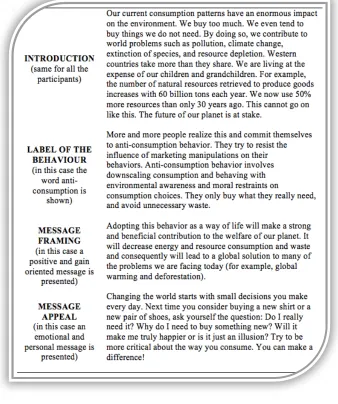
For the main questionnaire, different versions of the main text were created using the combination of different message stimuli (see Figure 5 for an example of the stimuli
consumption patterns have an enormous impact on the environment. We buy too much. We even tend to buy things we do not need. By doing so, we contribute to world problems such as pollution, climate change, extinction of species, and resource depletion. Western countries take more than they share. We are living at the expense of our children and grandchildren. For example, the number of natural resources retrieved to produce goods increases with 60 billion tons each year. We now use 50% more resources than only 30 years ago. This cannot go on like this. The future of our planet is at stake.” The introduction was kept the same for each participant in order to give to the participants the opportunity to get to know more about the case study and be more involved for the further manipulations.
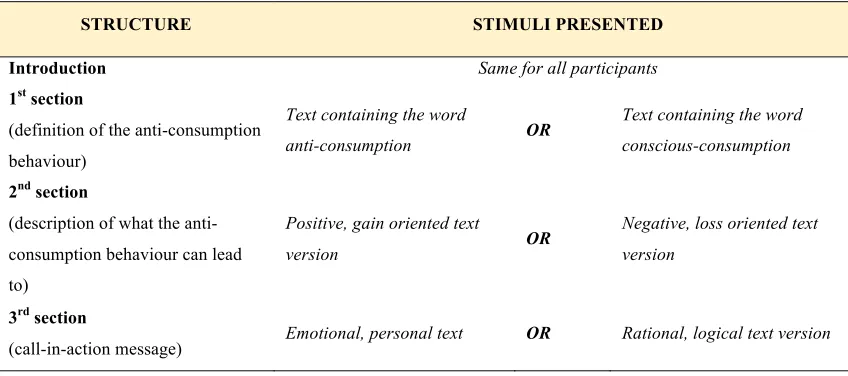
[image:19.595.73.497.465.653.2]Three other sections followed the introduction. Each section of the text was created to test an independent variable. To see which manipulation was more effective, two different versions of each section were created and randomized. For example, for the label of the beahaviour section, one version of the text contained the word anti-consumption and the other version the word conscious-consumption. Table 3.3 shows the general structure of the main text. In the following part, the manipulation created are shown for each independent variable.
Table 3.3: Structure of the main text
STRUCTURE STIMULI PRESENTED
Introduction Same for all participants
1st section
(definition of the anti-consumption behaviour)
Text containing the word
anti-consumption OR
Text containing the word conscious-consumption
2nd section
(description of what the anti-consumption behaviour can lead to)
Positive, gain oriented text
version OR
Negative, loss oriented text version
3rd section
Label of the behaviour
[image:20.595.101.494.220.435.2]For this study, two different versions of the label of the behaviour text section were created. Both versions explained the concept of anti-consumption. The main manipulation was the use of two different words to describe the same behavior: anti-consumption in one version and conscious-consumption in the second version (See Figure 2). The purpose of the manipulation was to find which word has a higher effect on the three dependent variables.
Figure 2: Label of the behaviour stimuli
Message framing
Figure 3: Message framing stimuli
Message appeal
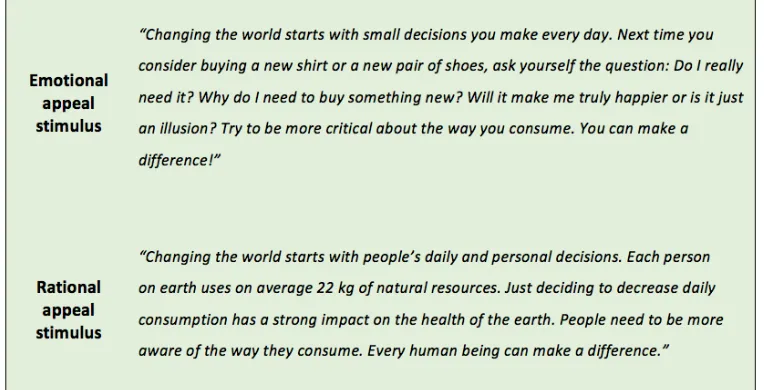
[image:21.595.107.489.448.643.2]The content of the last section was dedicated to the call-in-action message. As for the previous sections, this message was created in two different variations. The first one showed a more personal and emotional text, while the second one represented the rational appeal manipulation (see Figure 4).
Figure 4: Message appeal stimuli
Figure 5: example of main text
3.4 Pre-test: manipulation check
created. 53 participants (N=53) filled in the survey. After a cleaning process of participants who did not fit the requirements for the survey (e.g., consent, missing demographic
information, participants closing the questionnaire before the end), the outcomes of 42
participants (N=42) were analyzed with SPSS.
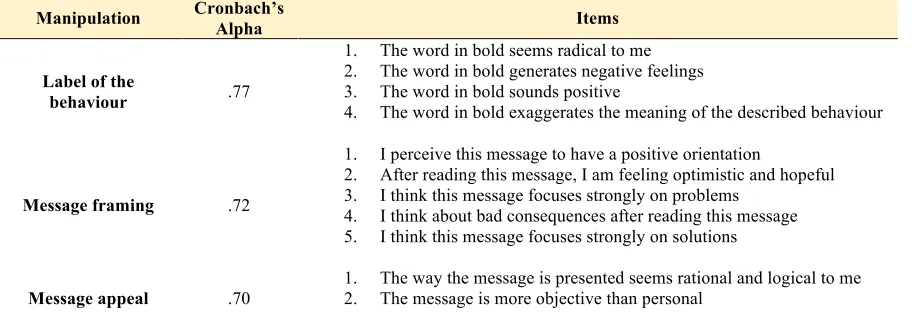
A reliability test (see Table 3.4.1) was done to ensure that the constructs used to conduct the manipulation checks were reliable. The items of label of the behaviour variable scored a positive Cronbach’s Alpha value of .77. These results showed a good reliability level of the questions used to test the stimuli created for the independent variable. Also for the message framing, the reliability of the construct used to test this independent variable was measured and tested, here six items were analysed. The first reliability analysis showed a
Cronbach’s alpha value (α=.69) below the minimum score for reliability (α=.70). For this
reason, one item was deleted to obtain a more reliable construct (α=.72). Regarding the
message appeal measurement, after the reliability analysis, two out of four items were deleted
due to a very low Cronbach’s alpha value (α<0.70). In this case, during the analysis only the
items testing the rationality of the conditions were considered because of a positive α-value
[image:23.595.74.530.447.610.2](α=.70). Table 3.4.1 shows an overview of the items used for the manipulation check.
Table 3.4.1: Overview of items used for the manipulation check
Manipulation Cronbach’s Alpha Items
Label of the
behaviour .77
1. The word in bold seems radical to me 2. The word in bold generates negative feelings 3. The word in bold sounds positive
4. The word in bold exaggerates the meaning of the described behaviour
Message framing .72
1. I perceive this message to have a positive orientation
2. After reading this message, I am feeling optimistic and hopeful 3. I think this message focuses strongly on problems
4. I think about bad consequences after reading this message 5. I think this message focuses strongly on solutions
Message appeal .70
1. The way the message is presented seems rational and logical to me 2. The message is more objective than personal
Subsequently, several independent sample t-tests were conducted to check whether the manipulations used in this test were successful. For the independent variable label of the behaviour, two different versions of the same message were created; one version containing the label of the behaviour “anti-consumption” and the second version with the label
participants were asked to express their opinion regarding the sound-orientation (positive or negative sounding) of the label or regarding the perception about the radicalism of the
behaviour. A significant difference (p<.001) (see Table 3.4.2) was found within the scores for “anti-consumption” and “conscious-consumption” conditions. These results led to the
[image:24.595.69.426.260.300.2]conclusion that the manipulations were successful and appropriate to be used in the main experiment; people perceived a difference between the use of the label “anti-consumption” and the label “conscious-consumption”.
Table 3.4.2: t-test results comparing anti-consumption and conscious-consumption label
Afterwards, another independent sample t-test was conducted to check whether participants distinguished between positive and negative messages conditions. For the independent variable message framing, two different versions of the message were created. The first condition (positive message) showed the benefits of adopting the anti-consumption behaviour while the second condition (negative message) informed people with the
disadvantages of not adopting the behaviour. Therefore, people were asked to give their opinions (see again Table 3.4.1) regarding the perceived message orientation (positive/gain oriented or negative/loss oriented) and about their feelings after reading the text. Looking at the results of the independent sample t-test (see Table 3.4.3), a significant difference in the mean scores between positive framing and negative framing conditions was found. These results led to the conclusion that the manipulations were successful and people distinguished between a positive message oriented and a negative oriented one.
Table 3.4.3: t-test results comparing positive and negative messages
Condition N Mean SD t df p
Positive 13 4.39 .80 3.20 40 .002
Negative 29 3.23 1.19
As for the previous variables, another independent sample t-test was conducted to check a significant difference in mean scores between message appeal conditions. Also, for this independent variable two different versions of the same text were created. The first condition was built using an emotional appeal and the second one with the use of a rational
Condition N Mean SD t df p
appeal. In this case, people were asked (see Table 3.4.1) to express options regarding the rationality and the logic of the message. The outcomes of the independent sample t-test demonstrated a significant difference between the mean scores for emotional and rational appeal conditions (see Table 3.4.4). Therefore, a significant difference between the two stimuli was proven; people identified an emotional oriented message to be different from a rational one.
Table 3.4.4: t-test results comparing emotional and negative appeals
Condition N Mean SD t df p
Emotional 25 4.16 1.40 -1.98 40 .03
Rational 17 4.97 1.15
3.5 Participants
To collect data, social media, e-mail or WhatsApp have been used. The use of this data collection allows to save time. Moreover, this approach is efficient for a large random sample and it is a low-priced tool to gather respondents. The participants were also
encouraged to ask other people from their network to take part in the survey, which created a
snowball effect. In total, 371 (N=371) subject participated in the experiment. Unfortunately,
not all participants completed the survey, some of them closed the questionnaire before the
last questions were answered (n=126) or some of them took less than 5 minutes or more than
1 hour to do the survey (n=23). After the cleaning process of the database, 222 (N=222)
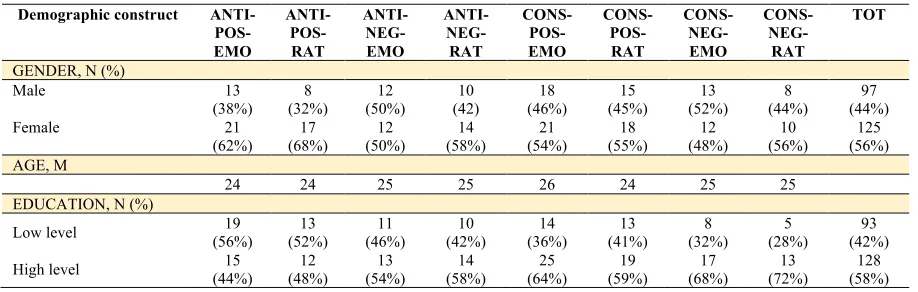
subjects resulted to be valid respondents. The sample for the main study included 97 men (44%) and 125 women (56%). Ages of participant differ from 15 to 66, with a mean age of M=24.82 (SD=6.48). The most relevant number of participants represented the study population.
The study participants were categorized in two groups: people who have obtained a “Low level” of education (primary education level, secondary education level and
trade/technical/vocal training educational level) and people who have obtained a “High level” of education (undergraduate educational level and post graduated level of education).
Accordingly, 128 (58%) study participants resulted to have a “High level” of education while 93 (42%) respondents resulted to have a low educational level.
32 different nationalities were involved in this study. Most of the participants claimed
15%) Dutch people (n=30, 14%), and participants from Belgium (n=4, 2%). 19% of participants claimed other nationalities.
Moreover, to ensure valid and reliable results, the data set was checked for significant outliers. According to a box-plot inspection of all responses on the dependent variables, a
total of n = 9 outliers was found. Based on the large sample size (N = 222) it can be expected
that values might appear in the lower and upper ends of the distribution. However, after a
more specific analysis of outliers, one participant (n=1) was found to have answered all the
questions by repeating the same answers all over the survey. Therefore, the decision to remove this participant from the dataset was taken.
Homogeneity between conditions
To test whether the sample characteristics were homogeneous over all the condition groups, the ANOVA tests and the Chi-square test were conducted. The results of the
ANOVA analysis demonstrate that the distribution of the age of the participants did not have a significant difference (alpha > .05) for all conditions groups (F (7,21) < 1, p= .85).
Additionally, a Chi-square test was conducted to investigate the difference between gender distribution inside the experimental condition groups. The outcomes of the test proved that the amount of female and male participants is equally distributed through all the
experimental conditions (𝑋"(7)> =3.07, p= 0.88). Furthermore, a Chi-square test was also
conducted to check the distribution of the educational level inside the condition groups. The results stated 𝑋"(7)> =7, p= .43, which is higher than alpha level .05. This indicates that there
are no differences in the distribution of education level between groups.
[image:26.595.71.530.601.747.2]It can be concluded that all the participants who took part in this experiment are equally distributed through all experimental conditions.
Table 3.2: Demographic information
Demographic construct ANTI- POS-EMO ANTI- POS-RAT ANTI- NEG-EMO ANTI- NEG-RAT CONS- POS-EMO CONS- POS-RAT CONS- NEG-EMO CONS- NEG-RAT TOT
GENDER, N (%)
Male 13
(38%) 8 (32%) 12 (50%) 10 (42) 18 (46%) 15 (45%) 13 (52%) 8 (44%) 97 (44%)
Female 21
(62%) 17 (68%) 12 (50%) 14 (58%) 21 (54%) 18 (55%) 12 (48%) 10 (56%) 125 (56%) AGE, M
24 24 25 25 26 24 25 25
EDUCATION, N (%)
3.6 Measures
Several 7-point Likert scales were used to measure the dependent variables and the moderator variable. Table 3 shows all the reliable constructs validated after the factor analysis. Accordingly, participants needed to indicate to what extent they agree or disagree with the specific statement.
Attitude towards the behavior
For the attitude towards the behavior measurement (see Table 3.3), items 1, 2, and 3 have been adapted from the work of Sengupta and Johar (2002) to test the consumer’s opinion of a certain brand of a product. From Items 4 to 6 the scale is adapted to an already existing scale measuring the “attitude towards green products” (environmental benefits) (Chang, 2011). This part of the scale is indented to test consumer’s beliefs regarding the positive effects of anti-consumption. The other items have been created according to the goal of this research and coherent with people general attitude towards the behaviour. Moreover, a
second section of the Likert-scale testing the attitude towards thebehaviour has been used to
test the feeling of favorableness or unfavorableness towards performing the behaviour. This second section has been adapted from the work of Shirley and Todd (1995). (see Appendix A)
Behavioural intention
For the behavioural intention measurement (see Table 3.3), the first three items were adapted from an already existing scale testing the intention to use a system in the future (Sykes, Venkatesh, & Gosain, 2009). The items from 4 to 6 are adapted from a scale to test the user’s intention to use a new system (Yogesh, 2008). In this case, it was interesting to know if people are interested to adopt the anti-consumption behaviour in the future. (see Appendix A)
Impact on perceived comprehensiveness of the behaviour
Regarding the impact on perceived comprehensiveness of the behaviour
Given specific actions, the goal was to understand whether people perceived the meaning of the behaviour to be the same within the different conditions of the experiment (see Appendix A)
Environmental concerns
Environmental concerns have been treated as an evaluation of, or an attitude towards facts, one’s own behaviour, or others’ behaviour with consequences for the environment (Weigel, 1983). It seems then, as if environmental concerns may refer to both, a specific attitude directly determining intentions or more broadly to a general attitude and value
orientation. The scale used in the questionnaire is based on the work of Dunlap and Van Liere (1978). Four items have been taken from the NEP scale and combined with new items. (see Appendix A)
The items were developed with the concern of the research questions and the scenario of the current study to provide high content validity. After the scales creation, a factor
analysis was conducted to test the validity of the constructs. After the first analysis, eight different factors were found, subsequently, the items that measured different factors were removed to guarantee the validity of each construct. With a second factor analysis, the five expected construct resulted to be valid (see Appendix B for the final Factor Analysis).
Additionally, the reliability check was conducted to examine the scale’s Cronbach’s alpha. The analysis demonstrated that the internal reliability of the constructs ‘attitude
towards anti-consumption behaviour’, ‘behavioural intention’, ‘perceived behavioural impact on people’s daily life (general)’, ‘perceived behavioural impact on people’s daily life
(specific)’, and ‘environmental concerns’ were all above .70. Therefore, all constructs of the dependent variables were sufficiently reliable to be used in this research.
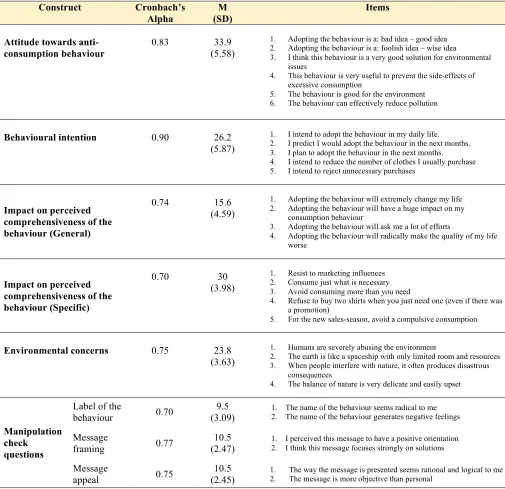
The scale items used for each dependent variable construct with Cronbach’s Alpha, means, and standard deviations are shown in Table 3.3.
Manipulation check
Also, the reliability of the manipulation check questions used in the main
(see Table 3.3) were used again in the main questionnaire. All the constructs adapted, scored
a Cronbach’s alpha level of at least .70: ‘label of the behaviour’ (α =.70), ‘message framing’
construct (α =.77), and ‘message appeal’ construct (α =.75). Therefore, it was possible to
[image:29.595.44.549.213.702.2]conclude the validity of each adopted construct to measure the manipulation check questions.
Table 3.3: Constructs: reliability scores, mean scores, standard deviations values and items
Construct Cronbach’s Alpha
M (SD)
Items
Attitude towards anti-consumption behaviour
0.83 33.9
(5.58)
1. Adopting the behaviour is a: bad idea – good idea 2. Adopting the behaviour is a: foolish idea – wise idea
3. I think this behaviour is a very good solution for environmental issues
4. This behaviour is very useful to prevent the side-effects of excessive consumption
5. The behaviour is good for the environment 6. The behaviour can effectively reduce pollution
Behavioural intention 0.90 26.2 (5.87)
1. I intend to adopt the behaviour in my daily life. 2. I predict I would adopt the behaviour in the next months. 3. I plan to adopt the behaviour in the next months. 4. I intend to reduce the number of clothes I usually purchase 5. I intend to reject unnecessary purchases
Impact on perceived comprehensiveness of the behaviour (General)
0.74 15.6
(4.59)
1. Adopting the behaviour will extremely change my life 2. Adopting the behaviour will have a huge impact on my
consumption behaviour
3. Adopting the behaviour will ask me a lot of efforts
4. Adopting the behaviour will radically make the quality of my life worse
Impact on perceived comprehensiveness of the behaviour (Specific)
0.70 30
(3.98)
1. Resist to marketing influences 2. Consume just what is necessary 3. Avoid consuming more than you need
4. Refuse to buy two shirts when you just need one (even if there was a promotion)
5. For the new sales-season, avoid a compulsive consumption
Environmental concerns 0.75 23.8 (3.63)
1. Humans are severely abusing the environment
2. The earth is like a spaceship with only limited room and resources 3. When people interfere with nature, it often produces disastrous
consequences
4. The balance of nature is very delicate and easily upset
Manipulation check
questions
Label of the
behaviour 0.70
9.5 (3.09)
1. The name of the behaviour seems radical to me 2. The name of the behaviour generates negative feelings
Message
framing 0.77
10.5 (2.47)
1. I perceived this message to have a positive orientation 2. I think this message focuses strongly on solutions
Message
appeal 0.75
10.5 (2.45)
1. The way the message is presented seems rational and logical to me 2. The message is more objective than personal
4. Results
In this section, the outputs from the current experiment are presented. Using SPSS 23, various statistical tests were conducted with the aim to test the hypotheses. Firstly, the control questions were checked to understand whether the manipulations were perceived correctly by the participants. Subsequently, several ANOVAs were conducted to analyse the effect of the independent variables on the dependents ones. In the end, the moderation analysis was executed. For each of the analysis, an alpha level of .05 was used.
4.1 Manipulation check
For the independent variable label of the behaviour, an independent-samples t-test was conducted to check any significant difference between the means of the two different conditions (anti-consumption/conscious-consumption). The results of the test showed a significant difference in the mean scores (see Table 5) for ‘anti-consumption and ‘conscious-consumption’ conditions; t(220)=6.91, p < 0.001. Therefore, it was concluded that
participants perceived the label anti-consumption to be more radical compared with the label conscious-consumption and the different conditions were properly manipulated.
Another independent-sample t-test was run in order to check any significant
difference in means scores between the two manipulations (positive/negative message) used for the independent variable message framing. Looking at the SPSS results, no significant difference between the mean scores of ‘positive frame’ and ‘negative frame’ conditions was found (see Table 4.1), t(220)=1.54, p=.13. This result shows that people were not able to significantly distinguish the two different manipulations adopted for the independent variable message framing. For example, when the message was positive oriented, participants did not recognize the positive message to be different from the negative message.
Also for the manipulations of the message appeal, no significant difference between the mean scores (see Table 4.1) of the emotional appeal condition and rational appeal condition was found, t(220)=-.68, p=.53. Therefore, when the appeal of the message was emotional, people did not distinguish it from the rational message. This result lead to the conclusion that in the main experiment, the manipulations of the message appeal and the
message framing were unsuccessful and unclear to the participants. These outcomes were
Table 4.1: Difference between conditions, N, Mean, SD
N Mean Std. Deviation
Label of the behaviour Anti-consumption 107 4.10 1.35 Conscious-consumption 115 2.80 1.46
Message framing Positive 131 5.35 1.26
Negative 91 5.09 1.18
Message appeal Emotional 122 5.22 1.30
Rational 100 5.32 1.13
4.2 Attitude towards the behaviour
In order to analyse and understand the main effects of the independent variables on the attitude towards the behaviour, ANOVA was conducted. Table 4.2.1 shows an overview of the tests of between-subjects effects.
Table 4.2.1: Tests of Between-Subjects Effects - Attitude towards the behaviour
Tests of Between-Subjects Effects
F df Sig. Partial Eta Squared
Label of behaviour .19 1,214 .67 .001
Message framing .77 1,214 .38 .004
Message appeal 1.88 1,214 .18 .008
Message appeal * Label of
behaviour .02 1,214 .89 .000
Message appeal * Message
framing .27 1,214 .64 .001
Label of behaviour *
Message framing .11 1,214 .74 .001
Message appeal * Label of behaviour * Message framing
4.01 1,214 .05 .018
The outcomes of ANOVA showed no main effects of the independent variables on the attitude towards the behaviour (p > .05). Before the data collection, it was assumed that the independent variables would have had a significant effect on the attitude towards the
behaviour. More specifically, it was hypothesized that the use of, a negative message (H1a), a rational message (H2a), and the label conscious-consumption (H3a) would have led to higher scores towards the attitude towards the behaviour. However, due to the outcomes of the ANOVA, H1a, H2a, and H3a were rejected.
[image:31.595.78.442.360.568.2]Table 4.2.2 shows the mean scores of experimental conditions within the interaction of the label of the behaviour, message appeal, and the message framing. According to the results, it is possible to see that the use of the label conscious-consumption, a positive message, and a rational message is the most efficient combination (M=5.92, SD=.16) for positively influencing the attitude towards the behaviour. On the other hand, the use of the word anti-consumption combined with a negative message and an emotional message is the least effective combination (M=5.32, SD=.19).
Table 4.2.2: Mean scores and SD of experimental conditions
Label of the behaviour Message framing
Message appeal
Mean Std. Error
Anti-consumption
Positive Emotional 5.71 .16
Rational 5.58 .19
Negative Emotional 5.32 .19
Rational 5.83 .19
Conscious-consumption
Positive Emotional 5.56 .15
Rational 5.92 .16
Negative Emotional 5.61 .19
Rational 5.57 .22
4.3 Behavioural intention
Table 4.3.1: Tests of Between-Subjects Effects - Behavioural Intention
Tests of Between-Subjects Effects
F df Sig. Partial Eta Squared
Label of behaviour .00 1,214 .98 .000
Message framing .34 1,214 .56 .002
Message appeal 4.69 1,214 .03 .022
Message appeal *
Label of behaviour 5.72 1,214 .02 .026
Message appeal *
Message framing .00 1,214 .97 .000
Label of behaviour *
Message framing .00 1,214 .96 .000
Message appeal * Label of behaviour * Message framing
[image:33.595.71.393.359.402.2]1.17 1,214 .28 .005
Table 4.3.2: Mean scores and SD of experimental conditions
Emotional appeal Mean St. Error
Emotional 5.08 .19
Rational 5.42 .12
Additionally, an interaction between message appeal and label of behaviour was found (F(1,214)=5.72, p=.02). In Table 4.3.3, the mean scores of experimental conditions within the interaction of the label of the behaviour and the message appeal are shown. In both rational and emotional condition, the label conscious-consumption did not particularly differ. More interesting is the significant difference in means of the label anti-consumption between conditions (emotional-rational). Overall, the combination of the label anti-consumption with a rational message resulted to be the best combination for positively influencing behavioural intention.
Table 4.3.3: Mean scores and SD of experimental conditions
Experimental condition Emotional Rational Mean St. Error Mean St. Error
Anti-consumption 4.89 .16 5.62 .17
4.4 Impact on perceived comprehensiveness of the behaviour
[image:34.595.78.500.320.507.2] [image:34.595.77.501.556.762.2]Another ANOVA was conducted to analyse and understand the main effects of the independent variables on the dependent variable impact on perceived comprehensiveness of the behaviour.
Table 4.4.1 and Table 4.4.2 show the main effects of the independent variables on perceived comprehensiveness of the behaviour (general and specific). In this case, no significant effects were found within all the conditions (p>.05).
It was assumed that the use of the label ‘conscious-consumption’ would have had less impact on perceived comprehensiveness of the behaviour (H3c). However, the results
provided by ANOVA led to the rejection of hypothesis H3c.
Table 4.4.1: Tests of Between-Subjects Effects – Impact on perceived comprehensiveness of the behaviour (General)
Tests of Between-Subjects Effects
F df Sig. Partial Eta Squared
Label of behaviour .28 1,214 .59 .001
Message framing .00 1,214 .98 .000
Message appeal 2.72 1,214 .10 .013
Message appeal * Label of
behaviour .00 1,214 .96 .000
Message appeal * Message
framing .01 1,214 .98 .000
Label of behaviour * Message
framing 2.02 1,214 .16 .009
Message appeal * Label of
behaviour * Message framing .22 1,214 .64 .001
Table 4.4.2: Tests of Between-Subjects Effects - Impact on perceived comprehensiveness of the behaviour (Specific)
Tests of Between-Subjects Effect
F df Sig. Partial Eta Squared
Label of behaviour .39 1,214 .53 .002
Message framing 1.63 1,214 .20 .008
Message appeal 1.27 1,214 .26 .006
Message appeal * Label of
behaviour .67 1,214 .41 .003
Message appeal * Message
framing .05 1,214 .83 .000
Label of behaviour *
Message framing .02 1,214 .90 .000
Message appeal * Label of behaviour * Message framing
4.5 Moderation analysis
The aim of the moderator analysis was to analyse whether the relationship between independent variables and the dependent variables were influenced by the moderator environmental concerns. To conduct the moderator analysis, the PROCESS function by Hayes (2012) was used on SPSS 23. Due to the research model’s structure of this study, Model 1 of PROCESS analysis was adopted.
To prevent a loss in information and a reduction in statistical power to detect a relationship between the independent and the dependent variable, the environmental concern variable was kept as a continuous instead of being transformed in a categorical one (Altman & Royston, 2006). However, to detect a positive or a negative level of environmental concerns, a descriptive analysis was run to see what the median score of this variable was (see Table 4.5). Because the median was 6, it was shown that the majority of the participants had a positive level of environmental concerns (scores above 4 based on 1 to 7 Likert-scale). Therefore, the decision was to consider people who scored a level below 6 as people with a moderate level of environmental concerns and participants who scored a result from score 6 to 7 as people with a high level of environmental concerns.
Table 4.5: Frequencies environmental concerns
Environmental concerns
N 221
Median 6
4.5.1 Moderation effect between label of the behaviour and dependent variables
Table 4.5.1: Moderator analysis, Label of the behaviour*environmental concerns
Moderator analysis
r2 F df1/2 p
Attitude towards the
behaviour .00 .57 1,217 .45
Behavioural intention .00 .03 1,217 .87
Impact on perceived comprehensiveness of the
behaviour (General) .00 .02 1,217 .88
Impact on perceived comprehensiveness of the behaviour (Specific)
.00 .78 1,217 .38
4.5.2 Moderation effect between message framing and dependent variables
[image:36.595.75.438.637.763.2]To indicate whether the relationship between the independent variable message framing and dependent variables was moderated by the variable environmental concerns, a second moderator analysis was conducted. As Table 4.5.2 shows, a significant interaction effect was found between message framing and environmental concerns on the dependent variable impact on perceived comprehensiveness of the behaviour (Specific), (F(1,22)=5.77, p=.02). In this case, it was possible to see that a significant moderation effect (p<0.05) was found in the score 5 of environmental concerns and above score 6. Therefore, it was concluded that a moderate level, as well as a high level of environmental concern had a moderation effect between message framing and environmental concerns on the dependent variable impact on perceived comprehensiveness of the behaviour (specific). However, as Figure 6 shows, the moderation effect is more significant when people have a moderate level of environmental concerns (between score 5 and 6). In this case the use of a positive message has a significant influence on impact on perceived comprehensiveness of the behaviour (specific). Nonetheless, when the level of people’s environmental concerns is significantly high, the use of a negative message is slightly more efficient.
Table 4.5.2: Moderator analysis, message framing*environmental concerns
Moderator analysis
r2 F df1/2 p
Attitude towards the
behaviour .00 .26 1,217 .61
Behavioural intention .00 .48 1,217 .49
Impact on perceived comprehensiveness of the
behaviour (General) .00 .63 1,217 .43
Impact on perceived comprehensiveness of the
Figure 6: Impact of message frame on the perceived behavioural impact on people's daily life (specific) under the influence of environmental concerns
4.5.3 Moderation effect between message appeal and dependent variables
Another moderator analysis was run to explore the moderating effect of
[image:37.595.74.421.542.665.2]environmental concern on the interaction between message appeal and dependent variables. Table 4.5.3 shows an overview of the results.
Table 4.5.3: Moderator analysis, message appeal*environmental concerns
Moderator analysis
r2 F df1/2 p
Attitude towards the
behaviour .02 4.52 1,217 .04
Behavioural intention .01 3.99 1,217 .05
Impact on perceived comprehensiveness of the
behaviour (General) .00 0.94 1,217 .76
Impact on perceived comprehensiveness of the behaviour (Specific)
.00 .73 1,217 .40
appeal and attitude towards the behaviour. As the Figure 7 shows, the use of a rational message has a considerable high impact on behavioural intention when the level of people’s environmental concerns is moderate. Nonetheless, with a significantly high level of
environmental concerns, the use of an emotional message results to be slightly more efficient. Additionally, a second interaction effect (see Table 4.5.3) was spotted on the
[image:38.595.126.471.390.634.2]behavioural intention (F(1,217)=3.99, p=.05). With the analysis of the conditional effects, it was difficult to define for which condition (‘Moderate’ or ‘High’) the moderator was significant. Due to a significant effect (p<.05) on score 5 and score 6 it can be assumed that both ‘Moderate’ and “Moderately high’ levels of environmental concerns moderate the relationship between message appeal and behavioural intention. As the Figure 8 shows, the use of a rational message has a higher impact on behavioural intention when the level of people’s environmental concerns is moderate. Nonetheless, when the level of environmental concerns is considerable high, the use of a different appeal (rational or emotional) is not relevant.