EXPLORING THE IMPACT OF
VIRTUAL REALITY IN
DESIGN REVIEW PROCESSES
EXPLORING THE IMPACT OF VIRTUAL REALITY IN DESIGN REVIEW PROCESSES
Marc van den Berg
In partial fulfillment of the requirements for the degree of: Master of Science in Construction Management and Engineering
University of Twente August, 2014
Under supervision of:
Dr. T. Hartmann (University of Twente) Dr. ir. R.S. de Graaf (University of Twente)
iv
“[…] there is little point in delivering the facility to budget and schedule if it is the wrong facility in the wrong place”
v
ABSTRACT
Virtual reality technologies offer emerging potential for design review processes in the Architecture, Engineering and Construction (AEC) industry. These technologies simulate physical presence in an interactive, three-dimensional setting. Previous research has suggested that consultancy and engineering firms in the AEC industry could use these technologies in design review processes - where designers and clients exchange information to resolve any design-related issues. I therefore created a virtual environment for design review and implemented it in two design review processes in the Netherlands: one dealing with the definitive design of three buildings for the production of drinking water and one dealing with the draft design of a parking garage. In this research, I explored the impact of individual design review sessions using a virtual environment prior to a design review meeting. By comparing theoretical patterns with empirical ones, I concluded that design review processes using a virtual environment prior to a design review meeting lead to a better understanding of the design, more involvement within the design review process, an increase in useful feedback on the design, and, to some extent, more efficient design review meetings. This enables consultancy and engineering firms to make a more informed choice about when to apply virtual reality technologies, offers a possibility to create more client value, and contributes to theories about design processes, virtual reality technologies and their integration. Future research should replicate the procedures followed here in contexts that are less proximally similar to this study, investigate the technical, social and economic factors that influence the adoption of virtual reality technologies, and explore the use of these technologies in other parts of the design process.
vi
This thesis describes my research about the potential of virtual reality technologies for design review. The review of a design is in essence a reflective activity. It requires one to look back at the outcomes of past design efforts. Witteveen+Bos, the host company where I conducted the research, does that frequently as an important business activity. It also applies to this thesis, which forms the final piece of my Master’s study Construction Management and Engineering. The moment has come for me to look back on my research efforts and to thank those who contributed to its outcomes.
My gratitude goes to my supervisors, Timo Hartmann and Robin de Graaf of the University of Twente and Maarten Veerman of Witteveen+Bos, for their enthusiastic support and helpful criticism. Timo has encouraged me to develop myself as a researcher. This started with the idea to create a prototypical software application myself – something I had not done before. Later, he also challenged me to work on a few other research proposals alongside this study and particularly helped me with improving my technical writing skills. Robin contributed a lot with his sharp yet constructive comments on draft versions of this thesis. He provided me with many new insights in conducting scientific research and especially had very valuable contributions in bridging the gap between data collection and data analysis. Maarten enthusiastically welcomed me at Witteveen+Bos and offered excellent insights into design projects. He also gave me a great degree of freedom to shape this research and supported me in finishing it.
I would also like to acknowledge my fellow colleagues at the Buildings PMC of Witteveen+Bos for providing a good atmosphere, their useful advice and our lunch walks. Special thanks go to Rinus Pelgrum for his great interest in my research and for introducing me at Brabant Water.
Further thanks go to all persons I could interview, used my software and/or allowed me to record their actions on video for their willingness to cooperate with this study. I especially thank the two project leaders of Brabant Water who helped me a lot with collecting data and who gave me a very welcome feeling. Many thanks go to my family and friends. Ana Patricia, as well as my brothers Remco and Erwin, helped me free my mind when needed. I am in grateful debt to my parents for their ongoing support and belief in me. They encouraged me to study and live a joyful student life – one that I can look back on with a smile.
Enschede, August 2014
ix
TABLE OF CONTENTS
1 Introduction... 1
2 Theoretical Framework ... 2
Concept 1 – Understanding ... 2
Concept 2 – Involvement ... 2
Concept 3 – Useful feedback ... 3
Concept 4 – Meeting efficiency ... 4
3 Research Method ... 5
Research model ... 5
Operationalization ... 5
Procedures and techniques ... 7
Data collected... 7
4 Findings ... 9
Concept 1 – Understanding ... 9
Concept 2 – Involvement ... 11
Concept 3 – Useful feedback ... 12
Concept 4 – Meeting efficiency ... 15
5 Conclusions ... 17
Concept 1 – Understanding ... 17
Concept 2 – Involvement ... 17
Concept 3 – Useful feedback ... 18
Concept 4 – Meeting efficiency ... 18
Summary... 18
6 Discussion ... 19
Concept 1 – Understanding ... 19
Concept 2 – Involvement ... 19
Concept 3 – Useful feedback ... 19
Concept 4 – Meeting efficiency ... 20
Implications ... 20
Future research directions ... 21
References ... 23
APPENDIX A – Virtual environment ... 25
APPENDIX B – Review session reports ... 26
Pump building ... 26
Filter building ... 30
Parking garage ... 39
APPENDIX C – Transcript Video recording ... 43
APPENDIX D – Question list answers ... 54
APPENDIX E – Interview reports ... 61
Interviewformat ... 61
Interview 1: Proces Technoloog (1) ... 63
Interview 2: Service en Onderhoud ... 66
Interview 3: Veiligheidskundige (1)... 70
Interview 4: Coördinator WTB ... 73
Interview 5: Projectleider WTB (1) ... 77
Interview 6: Projectleider WTB (2) ... 81
Interview 7: Veiligheidskundige (2)... 86
Interview 8: Projectleider E&I ... 89
Interview 9: Sectieleider Bedrijfsvoering ... 92
Interview 10: Proces Technoloog (2) ... 95
Interview 11: Sectieleider Onderhoud WTB ... 97
Interview 12: Projectleider ... 99
Introduction
1
1
INTRODUCTION
Virtual reality technologies offer emerging potential for design review processes in the Architecture, Engineering and Construction (AEC) industry. Such technologies simulate physical presence in an interactive, three-dimensional setting (Whyte, 2002). Recent advances in computer hardware and software have made virtual reality possible on any computer with average graphics performance (Koutsabasis, Vosinakis, Malisova, & Paparounas, 2012). Although scholars have demonstrated the added value of virtual reality for the AEC industry, such as in construction planning (Li et al., 2008) and multidisciplinary design (Merrick, Gu, & Wang, 2011; Rosenman, Smith, Maher, Ding, & Marchant, 2007), their use in design review processes has received much less attention. This research is one of the first attempts to try to understand the impact of the use of virtual reality technologies in design review processes.
During a design review process designers and clients exchange information to resolve any design-related issues. Clients are here seen as those persons who convey the needs of end-users and owners. The problems that design firms in the AEC industry try to solve for their clients have often been described as ill-structured (Cross, 2008, 2011), with solutions co-evolving with their problems (Dorst & Cross, 2001). An essential step that drives the design process (Castronovo, Nikolic, Liu, & Messner, 2013) is to evaluate the solutions from time to time to detect discrepancies in the design, improve design quality and to meet client’s goals (Cárcamo, Trefftz, Acosta, & Botero, 2014; Shiratuddin & Thabet, 2007). Design review processes typically involve regular face-to-face meetings between designers and clients (Le Dantec & Do, 2009), where the design-in-progress is talked about in relation to more or less clearly defined judgments, needs, desires, or pre-existing conditions of other stakeholders (Oak, 2011). Effective design review processes minimize potential errors or conflicts, shorten the project life-cycle, allow for earlier occupancy, and ultimately lead to significant total project savings (Shiratuddin & Thabet, 2011).
The Dutch firm Witteveen+Bos is interested in improving its design review processes. This firm offers consultancy and engineering services in the fields of construction, water, infrastructure and environment. Having the ambition to be a first-rate consultancy and engineering firm, Witteveen+Bos wants to develop high-quality solutions for the problems their clients face. While the firm applies state-of-the-art technologies in most of their business processes, the use of new technologies for design review has remained very limited. Current practice entails designers presenting a 3D building model using professional computer-aided design (CAD) software and then receiving feedback. Such a process implies that clients cannot determine the point of view themselves and are limited in giving feedback to the course of the meeting, and that designers cannot estimate in advance what kind of feedback they can expect.
This research investigates the use of virtual reality technologies to address that situation. Computer games that include three-dimensional environments make use of game engines to produce and display images in real-time on the display device (Shiratuddin & Thabet, 2011). Building on two game engines (Kusterer, 2013; Pan & Felinto, 2013), I developed a virtual environment (VE) for design review (Appendix A). This application allows clients to make a virtual walkthrough in a design-in-progress and to communicate feedback from their own workplaces. Designers can then use the outputs of those sessions to prepare a design review meeting. I will refer to such a process with the term ‘suggested design review process’ as it suggests a new kind of review process. Given that the dynamics in such processes are relatively unstructured (Verlinden, Horváth, & Nam, 2009), I organized the data analysis process in patterns. This leads to the research goal (Verschuren & Doorewaard, 2007), indicating what I attempt to achieve (first part) and how I intend to do that (second part). The goal is to explore the impact of design review sessions using a virtual environment prior to a design review meeting, by comparing theoretical patterns with empirical ones of the suggested design review process.
2
2
THEORETICAL FRAMEWORK
The introduction of individual review sessions using a virtual environment in advance of a design review meeting changes the review process substantially. In line with findings of Bassanino et al. (2010) and others, this might improve the design review process through (1) better client’s understanding, (2) more involvement, (3) an increase in useful feedback and (4) more efficient review meetings. In this chapter I will conceptualize theoretical arguments for each of these four propositions drawing on literature and expectations of professionals working in the AEC industry. Forerunning on the pattern-matching strategy explained in Chapter 3, the numbers between a pair of marks [ ] refer to the indicators used to operationalize the concept.
Concept 1 – Understanding
The first concept ‘Understanding’ refers to clients’ familiarity with the design. If one is familiar with the design, he is able to recognize how it meets a problematic situation (Paton & Dorst, 2011). This is necessary to evaluate and critique it (Castronovo et al., 2013). Representation techniques such as drawings or scale models are useful for understanding both the design problem and its solution, and they allow for meaningful critique. Related studies have shown that virtual reality as representation technique is very powerful in conveying how a realized design will look and feel (Bassanino et al., 2010; Conniff, Craig, Laing, & Galán-Díaz, 2010; Eastman, Teicholz, Sacks, & Liston, 2011). It is therefore likely that the addition of a virtual environment in the review process is a valuable means to increase a client’s understanding of a design.
Virtual reality has the capability to present spatial information in a more engaging manner, allowing for the frequent discovery of design features [1.1]. A virtual environment can offer clients to make a virtual walkthrough in a design-in-progress, thereby creating the illusion of depth and immersion (Shiratuddin & Thabet, 2011). The ability to navigate oneself seems to increase the number of observations made, especially about bigger structural and layout features (Conniff et al., 2010). This is in sharp contrast with current practice, where designers are in control of the views and use zooming, rotating and other modeling tools of professional computer-aided design (CAD) software to perform actions such as deleting walls, flying around, scaling or tilting a building. The interaction at a human scale that a virtual environment offers will therefore result in more discoveries of features in the design, thus enhancing a user’s understanding. The use of a virtual environment in the review process also enables persons to better imagine what a design will look like in the future [1.2]. One of the key characteristics of virtual environments is that they give their users a sense of psychological immersion (Koutsabasis et al., 2012), which gives people a feeling for what it is like to be in the designed building (Castronovo et al., 2013). According to Shen, Zhang, Shen, and Fernando (2013), users of a virtual environment find themselves therefore better able to comprehend how design features are related to each other. Clients can thus already form an image of the design in their heads (Mobach, 2008) prior to the start of the review meeting. The use of the virtual environment in the design review process thus enhances a client’s understanding of the design.
Proposition 1: The suggested design review process leads to a better understanding of the design.
Concept 2 – Involvement
Theoretical Framework
3 ultimately contributes to client satisfaction (Kujala, 2003). The virtual environment may be seen as a means to empower clients, and thus to increase their involvement.
A client’s willingness to collaborate will increase due to the introduction of the virtual environment in the review process. The virtual environment enables individuals to evaluate and critique a design-in-progress at their own ease. This will give them the feeling that their comments are valuable [2.1] and can have an impact on the design. Next to this feeling, I also expect clients to demonstrate their interest in improving the design during the review meeting by participating in design discussions about features they commented upon in the virtual environment [2.2]. In design discussions, people manage their own and each other’s forms of knowledge and expertise to construct meaningful interaction (McDonnell & Lloyd, 2014; Oak, 2011). Clients will adjust to their increase in knowledge about the design due to the virtual environment use. I expect them thus to exemplify their virtual environment comments when they notice design features they had already commented upon.
In addition to this, the confidence of clients to express feedback will increase by enabling them to express their comments in a virtual environment. The introduction of a virtual environment in the review process removes a barrier to talk. Shen et al. (2013) found that the large majority of the participants in their study agreed with their survey’s statement: “It is easier for me to express opinions by typing rather than speaking out in public. It can avoid pressure from others’ comments or shyness when speaking.” In this regard, the suggested design review process particularly contributes to the ability of silent people [2.3] to participate.
Proposition 2: The suggested design review process leads to more involvement within the design review process.
Concept 3 – Useful feedback
The third concept ‘Useful feedback’ refers to clients’ comments on part of a design that provide new insights suited to drive the design process. Cross (2008) argues that a client generally “does not know what the ‘answer’ [to a design problem] is, but they will recognize it when they see it”. With feedback, a client indicates that the right answer is not yet found: it points to key areas for improvement (Salter & Torbett, 2003). Feedback is considered useful when it has the potential to impact on the subsequent design process (Følstad, Hornbæk, & Ulleberg, 2013).
The feedback in the virtual environment will complement the comments expressed during the design review meeting. The presentation technique of the design influences the number and type of feedback expressed (Bassanino et al., 2010; Germani, Mengoni, & Peruzzini, 2012). Clients using the virtual environment evaluate the design from the inside, which is substantially different (Shiratuddin & Thabet, 2007) from evaluating cross-sections or top-down views such as usually applied in design review meetings (Eastman et al., 2011; Shen et al., 2012). Because of the use of different representation techniques, it is likely that the virtual environment feedback differs from the views brought forward during the review meeting. That means that not all virtual environment feedback will be dealt with during the meeting [3.1].
A large part of that feedback will be both relevant and inspiring [3.2]. Relevant feedback concerns a key part of the design, while inspiring feedback is suited to contribute to a change in the design (Følstad et al., 2013). Feedback that has both characteristics has the potential to impact on the design process. Previous work using an immersive virtual environment revealed that most feedback dealt with forward looking actions such as suggesting changes for important parts of the design (Majumdar, Fischer, & Schwegler, 2006): that clearly combines both characteristics. Similarly, a cross-comparative experiment by Shen et al. (2013) showed that the participants using their non-immersive virtual environment generated significantly more suggestions for improvement than participants who used conventional communication methods such as sheets of paper or the spoken word. Designers regard such virtual environment feedback as helpful [3.3] to determine whether the design is what the client envisioned (Shiratuddin & Thabet, 2011).
4
Concept 4 – Meeting efficiency
The fourth concept ‘Meeting efficiency’ refers to the extent to which scheduled interaction between designers and clients to review a design-in-progress makes good use of available resources. During design review meetings, participants allocate their time, efforts and knowledge to contribute to the decision-making on a design. Although review meetings are one of the most influential constituents of a design process (Verlinden et al., 2009), they have also been described as tedious and resource-intensive (Garcia, Kunz, & Fischer, 2005; Majumdar et al., 2006; Romano & Nunamaker Jr, 2001). Other research has suggested that virtual environments have huge potential to improve the review process (Shiratuddin & Thabet, 2007). The use of a virtual environment makes participants feel better prepared [4.1] for a review meeting. A lack of preparation was found as one of the core reasons for meeting failures (Romano & Nunamaker Jr, 2001). It is common for design review meetings to distribute relevant materials upfront, such as an agenda, design drawings and a list of known issues. A virtual environment adds to this: it allows clients to evaluate the design-in-progress and to communicate feedback, while designers already take notice of that feedback. Both parties are then better able to predict what the meeting will bring. This reflects in a reorganization of the design review meeting. I expect that designers use the virtual environment feedback to implicitly or explicitly update the meeting’s agenda [4.2].
The virtual environment review sessions subsequently result in a better use of the time available for the meeting. A study on small-group design meetings showed that meetings were strikingly similar in that only 40 % of the time was spent in ‘discussions about the design’ (argumentation about design aspects), while ‘coordination activities’ (management discussions and interruptions) and ‘taking stock of the progress’ (summaries and walkthroughs) both took about 30 % (Olson, Olson, Carter, & Storrosten, 1992). Since clients have already explored the design using the virtual environment, there is less need for descriptive tasks (Liston, Fischer, & Winograd, 2001) that are basically “on the job training” and add little value (Garcia et al., 2005). This suggests that following the suggested design review process relatively more time will be spent on design discussions [4.3]: the “heart of the design process” (Olson et al., 1992). Better communication and visualization offered by the virtual environment also make it possible to resolve problems much faster (Bassanino et al., 2010) and this will manifest itself in shorter design discussions [4.4].
Research Method
5
3
RESEARCH METHOD
The literature study in the previous chapter resulted in four propositions about the impact of design review sessions using a virtual environment prior to a design review meeting, compared to a normal design review process without the use of this technology. In this chapter I will argue why and how I applied a pattern-matching strategy to put the four propositions to the test. I will also describe the procedures and techniques I followed to collect data from real-world design review processes and conclude the chapter with an overview of those data.
Research model
[image:15.595.89.514.378.587.2]This research uses a pattern-matching strategy (Figure 3.1) to explore the impact of design review sessions using a virtual environment prior to a design review meeting. Four concepts specify where this suggested design review process (with virtual environment) potentially differs from a normal design review process (without virtual environment). Pattern-matching is one of the most recommended strategies for the qualitative analysis of such concepts (Cao, Clarke, & Lehaney, 2004; Yin, 2009). It involves (I) the specification of theoretical patterns, (II) the acquisition of empirical patterns, and (III) an attempt to match those two (Trochim, 1989). A theoretical pattern is a proposition about what is expected in the data and originates here from literature and expectations of professionals in the AEC industry (Chapter 2). An empirical pattern consists of the actual data found in real-life cases and originates from a variety of sources of evidence. If both patterns coincide, the theory can be used to explain why the reality is as it is, thereby helping to strengthen the internal validity of the study (Eisenhardt, 1989; Yin, 2009).
Figure 3.1 Research model describing how this study compares (I) theoretical patterns and (II) empirical patterns with each other (III) to generate new insights and formulate recommendations
Operationalization
Since the four concepts cannot be directly observed, they need to be operationalized. This is a process of defining operational measures, or indicators, to assess the relevant concepts. Trochim (1989) argues that the indicators “should be directly based upon a theoretical structure so that we know in advance which part of the theoretical pattern has its corresponding manifestation in any given observation”. I therefore derived the indicators from the theoretical patterns. The extent to which they measure the concept they intend to measure is called construct validity (Leedy & Ormrod, 2010). Using multiple sources of evidence but aimed
Theoretical patterns
Empirical patterns
Insights and recommendations Literature
Industry expectations
Observations Video recordings Telephonic interviews
Interviews Physical artifacts
Question lists
I
II
6
Table 3.1 Operationalizations and their sources of evidence per concept
Research Method
7 at corroborating the same concept, is a way to increase this challenging test (Yin, 2009). In this study, I collected data from observations, video recordings, interviews, telephonic interviews, physical artifacts and question lists. Table 3.1 presents the indicators and accompanying sources of evidence for the concepts.
Procedures and techniques
Here, I describe the procedures and techniques I took into account to collect the data, since “[making] as many [data collection] steps as operational as possible and to conduct research as if someone were always looking over your shoulder” is the general way to increase the reliability of a study (Yin, 2009). I used those data collection techniques that could reveal a better understanding of the suggested design review process with all its nuances and complexities. Three to four days before the design review meeting, I visited the client representatives with the virtual environment installed on a laptop in their respective offices for one-hour reviews and semi-structured interviews about the software use. This also created the opportunity to make direct observations of clients using the software, which is “useful in providing additional information about the topic studied” (Yin, 2009). After these sessions, I created reports of the virtual environment feedback and handed those over to the designers. These reports are a valuable data source since they reveal verbally (comments) and visually (screenshots) what feedback clients gave. Next, I observed and made video recordings of the design review meetings in their natural setting using video research guidelines of Derry (2007) and Jordan and Henderson (1995). Video recordings are considered as one of the most illuminating data sources, since they provide a means to overcome gaps between what people say they do and what they really do (Leedy & Ormrod, 2010). Right before and after the design review meeting, I distributed short qualitative question lists to all participants to investigate preparatory events and perceptions that cannot be observed or recorded directly. A few days after the design review meeting, I collected project documentation to study how clients’ input was processed. Finally, I held telephonic interviews with clients who had used the virtual and those who had not – using the same set of questions. Such “guided conversations” (Leedy & Ormrod, 2010) are preferable to collect qualitative data about feelings, perspectives, behaviors and the like (Van Tulder, 2007).
Data collected
I collected data from two cases. The first case entails the definitive design (Dutch: definitief ontwerp, DO) of three buildings for the production of drinking water located in the Dutch village Lith: a pump (renewal), filter (renewal) and softening (new) building. Brabant Water hired Witteveen+Bos to assist their engineering department in designing of, amongst others, these three buildings. For practical reasons, I loaded only the pump and filter building into the virtual environment and conducted five review sessions and interviews with six persons having different roles and backgrounds (Appendix B). Only three of those attended the design review meeting; the other three appeared to have other obligations that day. I recorded the whole 2 h 48 min meeting on video (Appendix C) and made field notes. Right before and after the meeting I distributed short question lists (Appendix D). Finally, some days after the meeting I received project documentation and recorded eleven telephonic interviews with client representatives; six of them had used the virtual environment and five had not (Appendix E).
The second case entails the draft design (Dutch: schetsontwerp, SO) of a parking garage in Amsterdam for project bureau ZuidasDok. As a consequence of the urban redevelopment program ZuidasDok, one existing parking garage must be replaced. The project bureau ZuidasDok has therefore asked Ingenieursbureau ZuidasDok (IBZ), in which Witteveen+Bos participates, to design that new parking garage. I conducted two virtual environment review sessions (Appendix B) and interviews (Appendix E), with the project leader and technical advisor. Since the project was formally ended at the time of this study, these sessions were fictitious and the persons participated by commenting “like they would do if the design would be elaborated into a preliminary design” (Dutch: voorlopig ontwerp, VO). It was not possible to schedule fictitious review meetings. Although compared to the Brabant Water case much less data could be collected in this case, the novel virtual environment review sessions alone have yielded important insights that justify the inclusion of the case in this research.
8
Table 3.2 Data collected per case
Source of evidence Case 1: Brabant Water Case 2: ZuidasDok
Sess
ion
s Observation Notes and 1 screen recording Notes and 2 sound recordings
Physical artifact 2 reports of 9 reviews 1 report of 2 reviews
Interview 5 forms 2 forms and 2 sound recordings
M
ee
tin
g
Question list (before) 20 forms -
Video recording 2 h 48 min -
Observation Notes -
Question list (after) 20 forms -
A
ft
er
-wa
rd
s Telephonic interview 11 recordings -
Findings
9
4
FINDINGS
This chapter organizes the relevant operationalizations in empirical patterns. In the previous chapter, I operationalized the four concepts central in this research and presented two cases from which I collected a large amount of data: the Brabant Water and ZuidasDok case. By operationalizing the data collected from these real-world cases, this chapter presents four empirical patterns that can be used to examine the theoretical patterns formulated in Chapter 2. The numbers between pairs of marks [ ] refer to the operationalizations – similar to the other chapters.
Concept 1 – Understanding
The first concept, ‘Understanding’, was earlier defined as clients’ familiarity with the design. I operationalized this concept in terms of [1.1] the discoveries made during individual reviews and [1.2] clients’ imagination of the design.
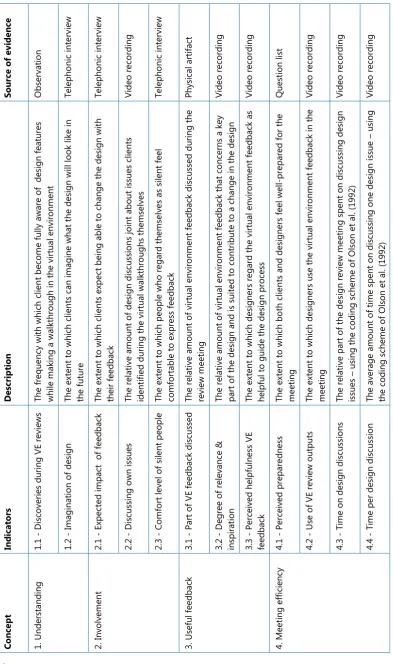
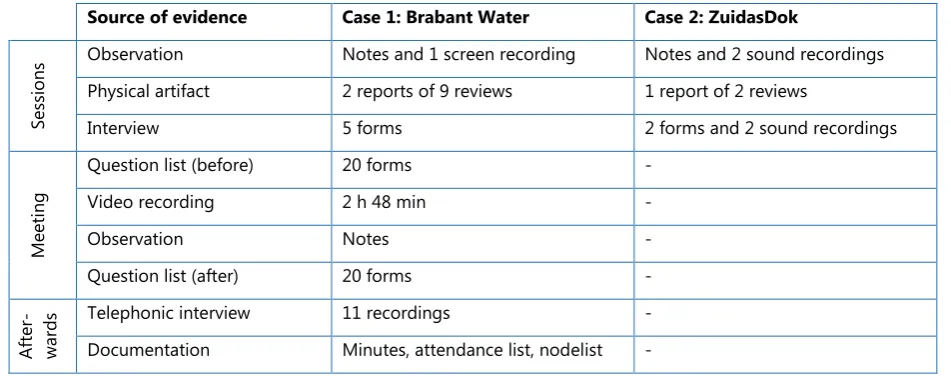
[1.1] I observed in both cases that the virtual environment review sessions frequently led to the discovery of design features. In the ZuidasDok case, for example, the technical advisor noticed “a strange corner” when making a virtual walkthrough (Figure 4.1-left). He was so surprised that he looked for an explanation in some drawings he brought with him, but eventually left the next comment in the virtual environment: “Strange corner, seems not socially secure! Is this a parking lot?” (G2.1). Another example in the same case comes from the project leader who found out what it will look like if cars are parked on a small slope of 7 % (Figure 4.1-right). Although that design feature had been a major topic of discussion in previous design review meetings, the virtual walkthrough helped him to recognize the implications of parking on a slope for the first time.
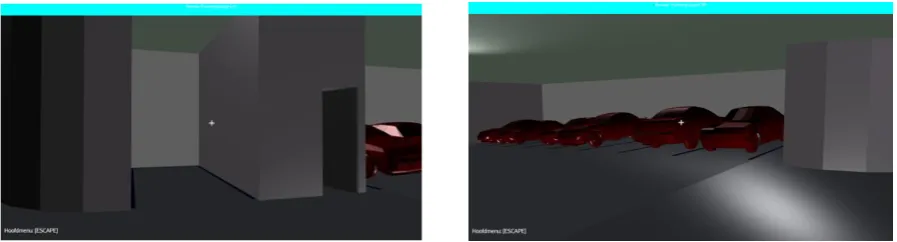
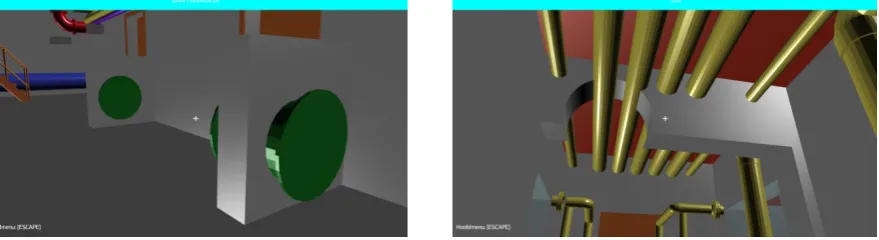
[image:19.595.73.522.587.708.2]The sessions in the Brabant Water case resulted in similar discoveries. The project employee Service & Maintenance, for example, found that one large pipe section was incomplete (Figure 4.2-left). However, from his comment in the virtual environment it appears that he realizes this might not be a mistake at all, but a result of a change in the water production process: “there are valves missing from the basement (maybe this becomes single filtrate, then this is not necessary)” (F3.3). The project leaders Mechanical installations knew that removing this pipe was correct and commented to “take out” (F5.7) the remaining pipe and wall piece. Another example is that the process technologist noticed a potential error in the number of tubes for the air intake, being either four or five (Figure 4.2-right). He had walked back and forth and looked around in the virtual environment to count the number of tubes and to see how they ran through the space. He referred back to this discovery during the review meeting, asking for clarification (1:03:53). During their virtual walkthroughs participants furthermore recognized that the buildings are “not new” and they told me anecdotes about the current building use, such as where they had lunch. All these examples clearly illustrate that the virtual environment helped the clients discovering design features and thus to get more familiar with the design.
10
Figure 4.2 Discoveries of design features in the Brabant Water case: (left) an unconnected pipe section, and (right) a potential design error in the number of tubes for the air intake
[1.2] Users of the virtual environment also indicated being able to imagine well what the future building would look like in reality. Clients in the ZuidasDok case attributed their increased understanding of the design to their walkthrough in a three-dimensional space. The project leader said that was primarily “helpful” as it enabled him to imagine how it would be to park a car on a slope and what a parking garage without structural columns would look like. The technical advisor in the ZuidasDok case commented that a virtual environment is primarily practical for non-expert clients:
“I think that especially the persons with somewhat less technical insight in drawing can really benefit from [the virtual environment]. From my technical background, I am used to imagine what something would look like by inspecting a flat drawing. I do that in my head, but not everybody can do that. For those people, [the virtual environment] is very beneficial, and they are sitting at the table anyway.”
– technical advisor ZuidasDok parking garage (interview 13)
Similar reactions were given by the virtual environment users in the Brabant Water case. One user of the virtual environment said that he had gained a good image of the filter building because he could navigate through the building himself this time, “which is easier than evaluating 2D drawings” (interview 3). Another said: “I got a very good image [due to the virtual environment]. We could walk properly through the buildings. I could see the technical aspects […] very well. Visually, the colors and the like, it is powerful, and also the details were visible” (interview 5). According to these interviewees, a walkthrough in a virtual environment is useful for getting an impression of a design-in-progress, which is needed to critique it. The coordinator Mechanical installations also illustrated that clearly with an example:
“On all locations we have air dryers that provide conditioned air in the buildings. My mechanics have indicated that the accessibility of those dryers is not so good in many cases, because they are placed against walls. They say that they need to be placed 0.5 to 1.0 m from the wall, so you can walk around them easily. […] If we perform a 3D walkthrough [in a virtual environment], and see that they are placed against walls, we could make a comment about that and then we can check next time whether [the engineering department] responded properly to the comment.”
– project coordinator Mechanical installations (interview 4)
Findings
11
Concept 2 – Involvement
The second concept ‘Involvement’ was earlier defined as clients’ willingness and confidence to collaboratively work with the designers to improve the design. I operationalized this concept in terms of [2.1] the expected impact of feedback, [2.2] the participation in one’s own design discussions and [2.3] the comfort level of silent people to participate.
[2.1] The interview data clearly show that users of the virtual environment strongly believe that their comments can make an impact on the design. The virtual environment offers individuals a new way to communicate feedback to the designers. They have positive expectations about the manner in which designers will address that feedback. While it is generally understood that not every comment can be accepted, people at least expect that their contributions are taken into consideration by the designers. The additional review sessions with the virtual environment therefore seem to increase individual’s involvement, like the process technologist also argued:
“I expressed my comments [in the virtual environment]. I don’t decide about those comments myself, but I assume [the designers] will do something with my comments. Not all comments will be accepted, but some will. […] Because of that, I feel more involved with the project.”
– process technologist (interview 1)
Other users of the virtual environment support this viewpoint. The safety expert argued: “I feel involved, because I can see that my input is put into work carefully” (interview 3). Even a client that said he had misunderstood the purpose of the virtual environment review session told me that he expected his “influence would be present” if he was better aware of the session’s goal (interview 4). The project employee Service & Maintenance formulated his expectations like this:
“I assume we can indeed have a certain influence on the design, otherwise we wouldn’t get involved in the first place. […] We are men of the workplace and we see other things. It seems to me that [the designers] will do at least something with our advices. Especially when also other people of our workplace talk about the same, I expect [they] are going to do something with it. I certainly have that feeling.”
– project employee Service & Maintenance (interview 2)
In contrast with these users of the virtual environment, most other clients are also willing and confident to express feedback – during the review meeting. An exception is one person who said that his feedback would have “no influence at all”, because “[the designers] do not listen carefully” and they “do not realize that [employees working in the buildings] need to work with it for 30 years” (interview 10). Other clients were more positive about the potential impact of comments expressed during the meeting (interview 7, 8, 9 and 11), as illustrated by a safety expert: “The suggestions I made are recorded and [the designers] confirmed that they will have a look at it […]” (interview 7). Although most clients thus feel involved, the inclusion of a virtual environment in the review process offers them more possibilities to individually express feedback, which makes them feel even “more involved” and “that is a good thing” (interview 2).
12
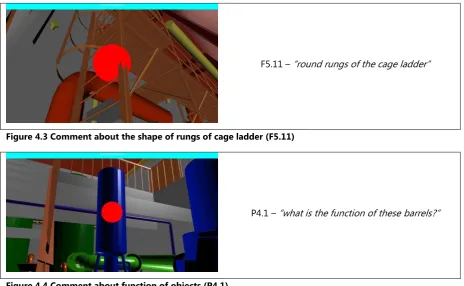
F5.11 – “round rungs of the cage ladder”
Figure 4.3 Comment about the shape of rungs of cage ladder (F5.11)
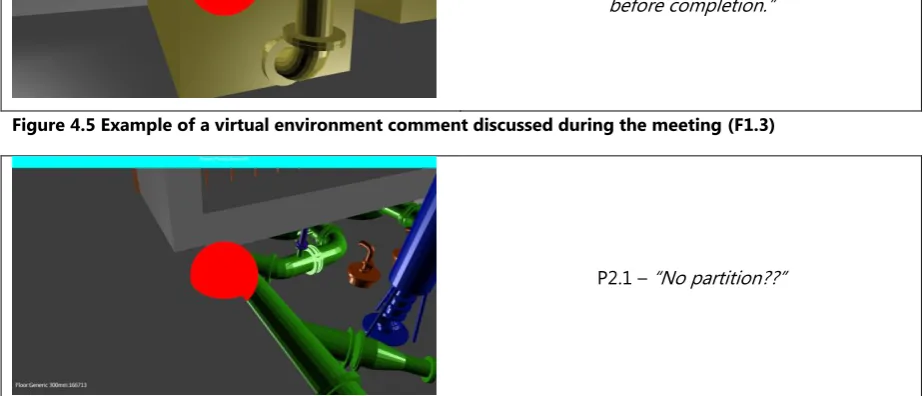
[image:22.595.65.530.68.354.2]P4.1 – “what is the function of these barrels?”
Figure 4.4 Comment about function of objects (P4.1)
participating in its discussion during the meeting include the layout of the plateaus (F5.10, F5.13 and 0:58:03) and the layout of the ventilation alley in the filter building (F5.5 and 1:03:33). These examples clearly demonstrate how people share findings of their virtual environment review sessions during the review meeting to improve the design.
[2.3] Finally, the virtual environment review sessions appeared to increase the confidence of silent people to express feedback. Although most clients said they did not feel uncomfortable to express their views during the review meeting, one person explicitly confirmed to feel a barrier to talk in large group meetings:
“I am not someone who likes to be in the picture and takes the initiative. I always let other people have their say first. I am biding. I always think that there are other people who like to say something first [during a meeting]. Oftentimes, the points I would like to discuss are then already brought forward. In that case, I don’t have to say them myself. But in case I won’t hear my findings and at the end someone will ask ‘are there any questions left?’, then I would give my comments anyway. Otherwise it would be pointless for me to attend [the meeting].”
– project employee Service & Maintenance (interview 2)
When I asked this person what could make him more comfortable in these situations, he answered that individual sessions, “like you did now”, could work for him. “For me that is more efficient than working in a big group” (interview 2). This finding is supported by the views of most other clients, who suggested “individual sessions” or “smaller groups” to increase the participation of silent people in the design review process (for example: interview 4, 5, 7 and 8). All in all, the use of a virtual environment in the review process enhances one’s confidence to express feedback and, with that, enables the more silent people to contribute to improving the design.
Concept 3 – Useful feedback
Findings
13 [3.1] It appeared that by far not all comments expressed in the virtual environment are dealt with during the design review meeting. From a comparison of the video recordings with the feedback reports, it appeared that the design discussions about the pump building covered only 6 (out of 10) comments and for the filter building 10 (out of 33) comments. One of such discussions dealt with the noise level produced by the air blowers (1:21:48). One designer argued then that the design “in principle” includes eight blowers, resulting in a noise level above 80 dB in the alley. In essence, that was an answer to one of the comments left in the virtual environment (F1.3 and Figure 4.5), although such a reference was not made. Other comments implicitly addressed during the review meeting are the adaptations to the ventilation alley (1:01:50 and F5.5) and the location of lifting beams (0:36:30 and P3.2, P3.3). In contrast with this, the majority of the virtual environment feedback was not discussed during the meeting. The designers and clients did, for example, not discuss the absence of partitions to protect from falling down at a certain place in the pump building (P2.1 and Figure 4.6), nor did they discuss the emergency exit signs (F1.1), a proposed sliding gate (F1.2), the lack of power outlets (F3.3 and F3.5), the location of flow meters (F4.2), problematic ceiling height (F5.6) and controls of hand wheels (F5.9). Although these comments obviously indicate an increase in feedback compared to a design review process without the use of a virtual environment, it is questionable whether such feedback is also useful.
F1.3 – “Does the air blower still make a lot of noise in the new-built situation? Measure the noise level
[image:23.595.64.527.306.491.2]before completion.”
Figure 4.5 Example of a virtual environment comment discussed during the meeting (F1.3)
P2.1 – “No partition??”
Figure 4.6 Example of a virtual environment comment not discussed during the meeting (P2.1)
[image:23.595.65.527.369.567.2]14
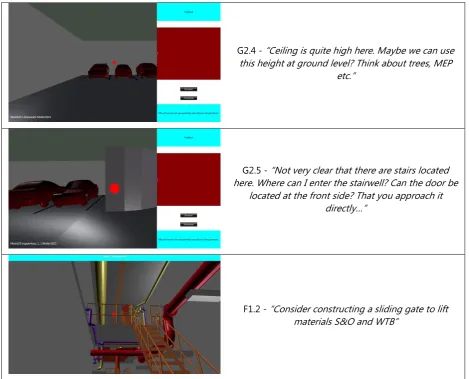
Nevertheless, a significant part of the virtual environment feedback clearly combines both characteristics. A few examples (Figure 4.7):
Comment G2.4 states that the ceiling of the parking garage is “quite high” at a certain point and suggests that this height could be used at ground level, for example for trees or the mechanical, electrical and plumbing (MEP) system. Since the amount of available space is very limited for this design project, this comment provides a new insight for dealing with an important constraint.
Comment G2.5 states that the entrance of the stairwell is not clearly visible and suggests relocating it so “that you approach it directly”. An important requirement is the accessibility of the parking garage for pedestrians, for which this comment makes constructive input.
Comment F1.2 suggests including a sliding gate to lift materials and equipment in the filter building. Employees need to perform lifting operations quite regularly in this industrial building and ergonomics have been considered as a major area of concern, so this comment may result in an important design change.
These examples of virtual environment feedback clearly provide new insights that may drive the design process. They are relevant and inspiring.
G2.4 - “Ceiling is quite high here. Maybe we can use this height at ground level? Think about trees, MEP
etc.”
G2.5 - “Not very clear that there are stairs located here. Where can I enter the stairwell? Can the door be
located at the front side? That you approach it directly…”
[image:24.595.64.534.320.699.2]F1.2 - “Consider constructing a sliding gate to lift materials S&O and WTB”
Figure 4.7 Examples of virtual environment comments that are both relevant and inspiring
Findings
15 design stage. “But we will deal with those anyway” (interview 5). Another designer also believed that most comments dealt with “minor issues”, but similarly revealed that those were still very valuable (interview 6). He argued that the virtual environment feedback was “helping [him] a lot to understand the [clients] well”. Because of that feedback he could “[…] respond well, listen to them carefully and retort properly”. The clients’ feedback expressed in the virtual environment provided the designers new insights that seem to be beneficial for the upcoming design stage. Both designers were therefore pretty content with the virtual environment feedback.
Concept 4 – Meeting efficiency
The fourth concept, ‘Meeting efficiency’, was earlier defined as the extent to which scheduled interaction between designers and clients to review a design-in-progress makes good use of available resources. I operationalized this concept in terms of [4.1] the perceived preparedness of participants of the review meeting, [4.2] the use of the outputs of the virtual environment review sessions, [4.3] the relative amount of time spent on design discussions and [4.4] the average duration of design discussions.
[4.1] There is limited evidence that participants of the review meeting feel better prepared for a design review meeting due to the virtual environment use. One of the project leaders Mechanical installations hypothesized that clients could use a virtual environment “to prepare such a [meeting], in the sense that you’ve already walked through a model at your own ease and that you’ve already thought about it” (interview 6). The process technologist also implicitly confirmed this when he answered on my question what he thought of the three designs that he was satisfied with the pump and filter building, but that he “saw the softening building actually for the first time [during the review meeting]” (interview 1). This statement suggests that he felt better prepared for the other buildings, since he had already seen those in the virtual environment. The virtual environment can then have an impact on the review meeting.
“The [virtual environment] makes one more alert and enables one to prepare better. During [the meeting] you can then get to the point faster. If everybody had walked through [the building] before, viewed everything, and can estimate what is important and what not, then there is less need to talk about the small things.”
– project leader Mechanical installations (interview 6)
The question lists (Appendix D) do not support this hypothesized value of a virtual environment. Three virtual environment users attended the review meeting, but none of them referred to the application when answering the question how they had prepared for the meeting. These three users wrote “presentation, evaluating 3D models”, “evaluating P&IDs” and “nothing” on their forms. From analyzing the other forms, I could not find any evidence either that indicates that designers or clients feel better prepared for a meeting due to the use of a virtual environment.
[4.2] I also found no clues that the designers used the virtual environment feedback as input for the meeting. The designers to whom I had handed over the two reports containing all feedback from the virtual environment both said they had taken notice of the feedback before the meeting – like I had asked them to do. At the start of the meeting, one of them also informed the other meeting attendants about the virtual environment and the review sessions that were previously held. After that, no more references were made to the virtual environment. I also observed no attempt to update the agenda of the meeting based on the review sessions’ outputs. This was also confirmed by the interviewees: none of them thought that the design review meeting was restructured based on the outputs of preceding review sessions. Most people were quite positive with the way the meeting advanced and they appreciated the contributions of other disciplines to the design discussions. Interviewees also mentioned that the meeting had, contrary to their expectations, little characteristics of a Hazard and Operability Study (HAZOP) – a technique to minimize the effects on processes resulting from atypical deviations from design conditions (Dunjó, Fthenakis, Vílchez, & Arnaldos, 2010). However, none of them commented about attempts to restructure the meeting. The course of the meeting was thus not adapted to the outputs of the virtual environment review sessions.
16
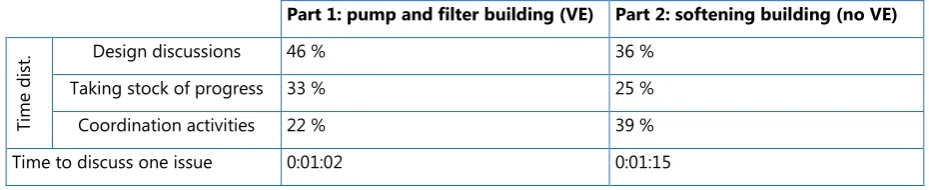
filter building, which were already evaluated and critiqued upon in the virtual environment, while the second part dealt with the softening building that was not reviewed earlier. It appeared that in the first part of the meeting people spent 46 % of their time on discussions of design issues; in the second part that was 36 % of the time (Table 4.1). Since ‘design discussions’ were classified as more valuable than ‘taking stock of progress’ and ‘coordination activities’, this suggests that the persons present at the meeting spent their time more efficient in the first part – where the virtual environment was put into use. However, forerunning on the discussion in Chapter 6, this does not necessarily imply a causal relationship as a number of other factors could have caused this change in time distribution.
[image:26.595.65.530.452.547.2][4.4] Finally, the average amount of time to discuss one design issue increased in the second part of the meeting. A design discussion typically started with a question or remark of one of the clients, often after a presentation of part of the design on a projection screen, and followed with a series of reasons, arguments or opinions that evaluate the solution. The discussion ended either with a solution that was agreed upon by the participants, or with the statement that the issue remained “a point of attention” and would be solved in a subsequent design stage. One design discussion, for example, dealt with the access to a drain (0:55:17). While a cross-section of the filter building was shown in 3D on a projection screen, one asked whether there would be placed “some kind of cover” on top of a hole to prevent a workman from falling in the hole. The designers initially answered with the some information about the size of the hole, and the safety expert added that a permanent grid was most advisable in this particular case “as it is a normal hole in which you could easily fall”. Some people explicitly agreed with this, while none of the other attendants disagreed. The issue was then solved and the meeting continued with another related topic. In total, I identified 61 discussions of this kind during the whole meeting (Appendix C), which is supported by one designer who said that the meeting dealt with “approximately sixty” issues (interview 6). From the video analysis it appeared that these design discussions for the pump and filter building (first part) took on average 0:01:02, and for the softening building (second part) on average 0:01:15 (Table 4.1). The length of the design discussions was thus lower for the two buildings that were already reviewed in the virtual environment than for the building that was not.
Table 4.1 Design review meeting characteristics
Part 1: pump and filter building (VE) Part 2: softening building (no VE)
Tim
e
di
st
. Design discussions 46 % 36 %
Taking stock of progress 33 % 25 %
Coordination activities 22 % 39 %
Conclusions
17
5
CONCLUSIONS
Following a pattern-matching strategy, I specified four theoretical patterns about the impact of design review sessions using a virtual environment prior to a design review meeting (Chapter 2) and organized the data collected of two real-world design review processes in an equal number of empirical patterns (Chapter 4). In this chapter, I compare the theoretical and empirical patterns with each other to explore the impact of design review sessions using a virtual environment prior to a design review meeting. To the extent that the patterns match, I will conclude that the theory that predicts the empirical pattern receives support (Trochim, 1989).
Concept 1 – Understanding
As predicted, the virtual environment review sessions frequently led to the discovery of design features and clients could imagine well what the design would look like in reality (Table 5.1).
[image:27.595.68.530.335.432.2]I therefore conclude that the first proposition is confirmed: the suggested design review process indeed leads to a better understanding of the design.
Table 5.1 Pattern-matching concept 1 – Understanding
Concept 1 Understanding: clients’ familiarity with the design
Indicators Theoretical pattern (Chapter 2) Empirical pattern (Chapter 4)
1.1 - Discoveries during VE reviews Frequent discoveries Frequent discoveries
1.2 - Imagination of design Able to imagine design in reality Able to imagine design in reality
Concept 2 – Involvement
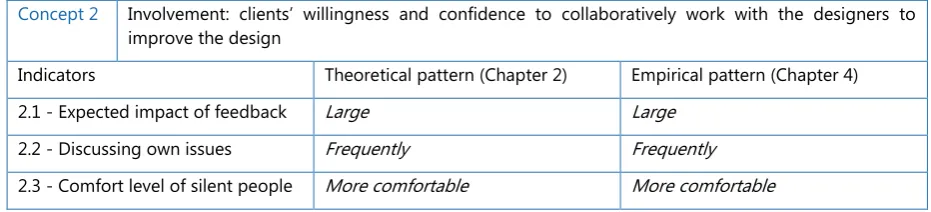
As predicted, clients expected that their virtual environment feedback can make an impact, they frequently participated in discussions about issues they commented upon in the virtual environment and silent people felt more confident to contribute to the review process (Table 5.2).
I therefore conclude that the second proposition is confirmed: the suggested design review process indeed leads to more involvement within the design review process.
Table 5.2 Pattern-matching Concept 2 – Involvement
Concept 2 Involvement: clients’ willingness and confidence to collaboratively work with the designers to improve the design
Indicators Theoretical pattern (Chapter 2) Empirical pattern (Chapter 4)
2.1 - Expected impact of feedback Large Large
2.2 - Discussing own issues Frequently Frequently
[image:27.595.62.528.586.692.2]18
Concept 3 – Useful feedback
As predicted, not all virtual environment feedback was discussed during the meeting, a large part of that feedback can be considered as both relevant and inspiring, and designers regard that feedback also as helpful (Table 5.3).
[image:28.595.62.522.207.314.2]I therefore conclude that the third proposition is confirmed: the suggested design review process indeed leads to an increase in useful feedback on the design.
Table 5.3 Pattern-matching Concept 3 – Useful feedback
Concept 3 Useful feedback: clients’ comments on part of a design that provide new insights suited to drive the design process
Indicators Theoretical pattern (Chapter 2) Empirical pattern (Chapter 4)
3.1 - Part of VE feedback discussed Not all VE feedback discussed Not all VE feedback discussed 3.2 - Degree of relv. & inspiration Large part is relevant and inspiring Large part is relevant and inspiring 3.3 - Perc. helpfulness VE feedback VE feedback regarded as helpful VE feedback regarded as helpful
Concept 4 – Meeting efficiency
Not entirely as predicted, there is only limited evidence that designers and clients felt better prepared for the design review meeting because of the virtual environment use. Contrary to my predictions, I found no clues that the designers used the virtual environment review outputs as input for the meeting. As predicted, the design review sessions have resulted in relatively more time spent on design discussions and they took less time (Table 5.4).
I therefore conclude that the fourth proposition is only partly confirmed: the suggested design review process leads to somewhat more efficient design review meetings.
Table 5.4 Pattern-matching Concept 4 – Meeting efficiency
Summary
Summarizing the above, I conclude that design review sessions using a virtual environment prior to a design review meeting lead to (1) a better understanding of the design, (2) more involvement within the design review process, (3) an increase in useful feedback on the design and (4) to somewhat more efficient design review meetings.
Concept 4 Meeting efficiency: the extent to which scheduled interaction between designers and clients to review a design-in-progress makes good use of available resources
Indicators Theoretical pattern (Chapter 2) Empirical pattern (Chapter 4)
[image:28.595.63.526.515.622.2]Discussion
19
6
DISCUSSION
This research has explored the use of virtual reality technologies within design review processes in the AEC industry. I created a virtual environment for design review that was put into use before a design review meeting. Since this suggests a new design review process, I referred to such a process with the term ‘suggested design review process’. Following a pattern-matching strategy, I concluded in the previous chapter that a suggested design review process leads to a better understanding, more involvement, an increase in useful feedback and, to some extent, to more efficient design review meetings. In this chapter, I will acknowledge the limitations of these conclusions, discuss their implications and suggest new research directions.
Concept 1 – Understanding
My first conclusion is that the suggested design review process leads to a better understanding of the design. This is based on the discoveries during virtual environment review sessions [1.1] and the extent to which clients can imagine what a design will look like in future [1.2]. From the latter it appeared that one’s image of the design seems to be influenced by the ability of choosing the viewpoint or not, which is a factor that is often overlooked. Some clients who did not use the virtual environment argued they would have wanted to focus on a specific area of interest somewhat more, such as safety precautions (interview 7) or pipe work (interview 10). In contrast with that, in the virtual environment people navigate – and thus choose their viewpoint – themselves. While scholars such as Bassanino et al. (2010) have often argued that the visualization affordances of virtual reality techniques can help to enhance a client’s understanding of a design, they seem to overlook the navigation possibilities as an important factor in getting more familiar with a design.
Concept 2 – Involvement
My second conclusion is that the suggested design review process leads to more involvement within the design review process. That conclusion is supported by three arguments. I found that virtual environment users strongly believe that their comments can make an impact on the design [2.1], although most other clients also support that viewpoint. For the second argument, I provided evidence that virtual environment users frequently joined design discussions about which they commented upon during their individual review sessions [2.2]. There are multiple explanations for the fact that this did not happen in all such discussions. It is obvious that virtual environment users not attending the meeting by definition not join a design discussion. Besides that, people could have forgotten their issue, or someone else simply expressed the same feedback earlier during the meeting (as interviewee 2 revealed). There was also little need for two designers who used the virtual environment (session 5) to share their feedback since they “are able to alter the design as they like” (interview 6). Taking into account these reasons it is even more remarkable that users of the virtual environment frequently joint discussions about ‘their’ issues. The third argument that supports my conclusion is that silent people feel more confident to express feedback with the use of a virtual environment [2.3]. While this was an important conclusion in previous works of Shen et al. (2012) and Shen et al. (2013), I found that most persons were not shy at all to express feedback in a review meeting: there was only one person that characterized himself as somewhat shy. Although almost all interviewees suggested individual review sessions or smaller groups as a way to improve a lack of confidence to express feedback, it seems that this characteristic of a virtual environment is of limited added value here as most persons are perfectly comfortable to express feedback anyway. Cultural differences could explain the difference with previous studies, as my research took place in the Netherlands and the other studies mentioned above in Hong Kong.
Concept 3 – Useful feedback
20
maximum number of comments. While too many of them might be ineffective for the design process as it then becomes more difficult to manage all comments, one designer said that this turned out not to be the case (interview 6). I also demonstrated that the virtual environment comments are not necessarily discussed during the design review meeting [3.1] and that a large part can be marked as relevant and inspiring [3.2]. It should nevertheless be noted that feedback that may not seem ‘useful’ at first sight, for example because it does not concern a key part of the design or is not suited to contribute to a change, may still reveal valuable information about what a client is truly concerned about. For example, comments about the entrances (G1.1 and G1.4) and surrounding roads (G1.2) in the ZuidasDok case were arguably too detailed, but reveal that the project leader is mainly concerned with the way the parking garage fits into the surroundings. Designers can use such information to determine which part of the design needs most attention in upcoming design phases. This argument might explain why the designers in the Brabant Water case regarded most comments as “too detailed” or pointing to “minor issues”, but still find them very helpful [3.3].
Concept 4 – Meeting efficiency
My fourth conclusion is that the suggested design review process leads to somewhat more efficient design review meetings. While I expected a large improvement in the way the ‘scheduled interactions between designers and clients’ use available resources, it turned out that there was only a marginal change. Designers and clients, for example, do not feel clearly and unanimously better prepared for the design review meeting due to the virtual environment use [4.1]. While people saw the added value from the virtual environment review sessions, for example to better understand the client (interview 6), it is unclear whether these sessions helped them to prepare for the review meeting. One explanation is that only three (out of six) users of the virtual environment attended the design review meeting studied; the others had other obligations. To study the relationship that is hypothesized here in more detail, future researchers could use unbiased and more direct questions in an interview rather than a question list. Another remarkable finding is that the virtual environment feedback was not used during the review meeting [4.2]. An explanation for that is that the meeting was officially chaired by the project manager, who had not seen the virtual environment feedback. The other findings were as predicted: relatively more time was spent design discussions [4.3] and those discussions had a shorter duration [4.4]. However, these changes could have also been caused by the fact that the softening building was presented by another person or that this building had been subject to a major design change that was just agreed upon by the higher management. The fact that only three virtual environment users were present at the meeting also questions these causal relationships. Replications of this research in other projects should therefore provide a more solid basis for these design review process improvements.
Implications
The findings, with all their nuances as disclosed above, have important implications for theory and practice. Starting with the latter, consultancy and engineering firms within the AEC industry, such as Witteveen+Bos, can now make a more informed choice about when to apply virtual reality technologies in their design review processes. My research provides these firms with knowledge how and why virtual reality technologies can lead to a better understanding, more involvement, an increase in useful feedback and, to some extent, more efficient design review meetings. Firms can expect similar effects in upcoming design review processes that are more proximally similar (Trochim, 1989) to the settings, persons, places and times of this study. These effects come at the expense of additional time needed to load a design in a virtual environment, which is not straightforward as CAD formats lack, by nature, information that can be visualized and played in design games (Yan, Culp, & Graf, 2011), and additional time to organize design review sessions. I therefore recommend firms in the AEC industry to apply the suggested design review process when (1) the project is a building created in three (rather than two) dimensions using any CAD package, (2) time pressure is not too high, (3) the design team wants to achieve one or more of the described effects and (4) the client is willing to cooperate and equipped with a computer with average graphics performance1.