USAAR: An Operation Sequential Model for Automatic Statistical
Post-Editing
Santanu Pal1, Marcos Zampieri1,2, Josef van Genabith1,2 1Saarland University, Saarbr¨ucken, Germany
2German Research Center for Artificial Intelligence (DFKI), Germany
{santanu.pal, marcos.zampieri, josef.vangenabith}@uni-saarland.de
Abstract
This paper presents an automatic post-editing (APE) method to improve the translation quality produced by an English–German (EN–DE) statistical machine translation (SMT) system. Our system is based on Operation Sequential Model (OSM) combined with phrased-based statistical MT (PB-SMT) system. The system is trained on monolingual settings between MT outputs (T LM T) produced by a black-box MT system and their corresponding post-edited version (T LP E). Our system achieves considerable improvement over T LM T on a held-out development set. The reported system achieves 64.10 BLEU (1.99 absolute points and 3.2% relative improvement in BLEU over raw MT output) and 24.14 TER and a TER score of 24.14 (0.66 absolute points and 0.25% relative improvement in TER over raw MT output) in the official test set.
1 Introduction
Translations produced by machine translation (MT) systems have improved substantially over the past few decades. This is particularly no-ticeable for some language pairs (e.g. English to German and English to French) and for domain specific language (e.g. technical documentation). Texts produced by MT systems are now widely used in the translation and localization industry. MT output is post-edited by professional transla-tors and it has become an important part of the translation workflow. A number of studies con-firm that post-editing MT output improves trans-lators’ performance in terms of productivity and it may also impact translation quality and
consis-tency (Guerberof, 2009; Plitt and Masselot, 2010; Zampieri and Vela, 2014).
With this respect the ultimate goal of MT sys-tems is to provide output that can be post-edited with the least effort as possible by human transla-tors. One of the strategies to improve MT output is to apply automatic post-editing (APE) methods (Knight and Chander, 1994; Simard et al., 2007a; Simard et al., 2007b). APE methods work under the assumption that some errors in MT systems are recurrent and they can be corrected automati-cally in a post-processing stage thus providing out-put that is more adequate to be post-edited. APE methods are applied before human post-editing in-creasing translators’ productivity.
This paper presents a new approach to APE which was submitted by the USAAR team to the Automatic Post-editing (APE) shared task at WMT-2016. Our system combines two mod-els: monolingual phrabased and operation se-quential model with an edit distance based word alignment between an English-German (EN-DE) Machine translation output and the correspond-ing human post-edited version of German Trans-lation (Turchi et al., 2016).
Usually APE tasks focus on fluency errors pro-duced by the MT system. The most frequent ones are incorrect lexical choices, incorrect word or-dering, the insertion of a word, the deletion of a word. For the WMT2016 APE task, in order to automatically post-editing, we adopt operation se-quential model (OSM) for SMT to build our Sta-tistical APE (SAPE) System. We inspired from the work of Durrani et al. (2011) and Durrani et al. (2015). Since, in OSM model, the translation and reordering operations are coupled in a single generative story: the reordering decisions may de-pend on preceding translation decisions and trans-lation decisions may depend on preceding reorder-ing decisions. The model provides a natural
ordering mechanism and deal with both local and long-distance re-orderings consistently.
The remainder of the paper is organized as fol-lows. Section 2 describes our proposed system, in particular PB-SMT coupled OSM model. In Section 3, we outline the data used for experi-ments and complete experimental setup. Section 4 presents the results of the automatic evaluation, followed by conclusion and future work in Sec-tion 5.
2 USAAR APE System
Our APE system is based on operational N-gram sequential model which integrates translation and reordering operations into the phrase-based APE system. Traditional PB-SMT (Koehn et al., 2003) provides a powerful translation mechanism which can directly be modelled to a phrase-based SAPE (PB-SAPE) system (Simard et al., 2007a; Simard et al., 2007b; Pal et al., 2015) using target lan-guage MT output (T LM T) and their correspond-ing post-edited version (T LP E) as a parallel train-ing corpus. Unlike PB-SMT, PB-SAPE also follows similar kind of drawbacks such as de-pendency across phrases, handling discontinuous phrases etc. Our OSM-APE system is based on phrase based N-gram APE model, however re-ordering approach is essentially different, it con-siders all possible orderings of phrases instead of pre-calculated orientations. The model repre-sents the post-edited translation process as a lin-ear sequence of operations such as lexical gen-eration of post-edited translation and their order-ings. The translation and reordering decisions are conditioned onnprevious translation and
reorder-ing decisions. The model also can able to consis-tently modelled both local and long-range reorder-ings. Traditional OSM based MT model consists of three sequence of operations:
• Generates a sequence of source and/or target words.
• For reordering operations, inserts gaps as ex-plicit target positions
• Forward and backward jump operations
The sequence operation is based on n-gram
model. The probability of a nth operation
de-pends on the n −1 preceding operations. The
generation of post-edited output (pe) from a given
MT sentence (mt), the decoder provides a se-quence of hypothesis H: h1,...,hn and the APE model estimates the probability p(mt, pe) given
in Equation 1, from a sequence of I operations
O (o1, ...oI) form amount 1 of context has been used.
p(mt, pe)≈ I
Y
i=1
p(oi|oi−m+1...oi−1) (1)
The decoder searches best translation in Equa-tion 2 from the model using language model
plm(pe)
pe∗ =argmaxpep(mt, pe)
ppr(pe) ×
plm(pe) (2)
ppr(pe) ≈ QIi=1p(wi|wi−m+1...wi−1), is the prior probability that marginalize the joint prob-abilityp(mt, pe). The model is then represented
in a log-linear approach (Och and Ney, 2003) (in Equation 3) that makes it useful to incorporate standard features along with several novel features that improve the accuracy.
pe∗=argmaxpe I
X
i=1
λihi(mt, pe) (3)
where λi is the weight associated with the fea-turehi(mt, pe): p(mt, pe), ppr(pe) andplm(pe). Apart from this 8 additional features has been in-cluded in the log-linear model:
1. Length penalty: Length of thepein words
2. Deletion penalty
3. Gap bonus: Total number of gap inserted to produce PE sentence
4. Open gap penalty : Number of open gaps, this penalty controls how quickly gap was closed.
5. Distortion: Distance based reordering which is similar to PB-SMT.
6. Gap distance penalty: The gap between mt
andpesentences generated during the
gener-ation process.
7. Lexical features: mt–pe andpe–mt lexical
translation probability (Koehn et al., 2003).
1We use a 6-gram model trained on SRILM-Toolkit
3 Experiment
The effectiveness of the present work is demon-strated by using the standard log-linear PB-SMT model for our phrase based SAPE (PB-SAPE) model. The MT outputs are provided by WMT-2016 APE task (c.f Table 1) are considered as baseline system translation. For building our SAPE system, we experimented with various max-imum phrase lengths for the translation model andn–gram settings for the language model. We
found that using a maximum phrase length of 10 for the translation model and a 6-gram lan-guage model produces the best results in terms of BLEU (Papineni et al., 2002) scores for our SAPE model.
The other experimental settings were concerned with word alignment model between T LM T and T LP E are trained on three different align-ers: Berkeley Aligner (Liang et al., 2006), METEOR aligner (Lavie and Agarwal, 2007) and TER (Snover et al., 2006). The phrase-extraction (Koehn et al., 2003) and hierarchical phrase-extraction (Chiang, 2005) are used to build our PB-SAPE and hierarchical phrase-based sta-tistical (HPB-SAPE) system respectively. The re-ordering model was trained with the hierarchical, monotone, swap, left to right bidirectional (hier-mslr-bidirectional) method (Galley and Manning, 2008) and conditioned on both source and target language. The 5-gram target language model was trained using KenLM (Heafield, 2011). Phrase pairs that occur only once in the training data are assigned an unduly high probability mass (i.e. 1). To compensate this shortcoming, we performed smoothing of the phrase table using the Good-Turing smoothing technique (Foster et al., 2006). System tuning was carried out using Minimum Er-ror Rate Training (MERT) (Och, 2003) optimized with k-best MIRA (Cherry and Foster, 2012) on a held out development set of size 500 sentences randomly extracted from training data. There-fore, all model has been build on 11,500 paral-lelT LM T–T LP Esentences. After the parameters were tuned, decoding was carried out on the held out development test set (‘Dev’ in Table 1) as well as test set.
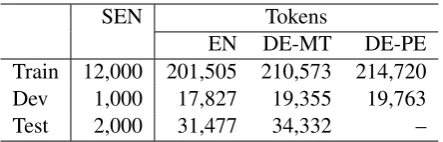
Table 1 presents the statistics of the train-ing, development and test sets released for the English–German APE Task organized in WMT-2016. These data sets did not require any prepro-cessing in terms of encoding or alignment.
SEN Tokens
[image:3.595.307.529.61.132.2]EN DE-MT DE-PE Train 12,000 201,505 210,573 214,720 Dev 1,000 17,827 19,355 19,763 Test 2,000 31,477 34,332 –
Table 1: Statistics of the the WMT-2016 APE Shared Task Data Set. SEN: Sentences, EN: En-glish and DE: German
4 Results
We set various APE system settings for our exper-iments. We start our experiment with the provide
T LM T output, considering as baseline.
In the set of experiments are reported in Ta-ble 2, first, three word alignment (one statistical based aligner i.e., Berkeley aligner (Liang et al., 2006) and two edit distance based aligners i.e., METEOR aligner (Lavie and Agarwal, 2007) and TER aligner (Snover et al., 2006)) models are in-tegrated separately within both the PB-SAPE as well as the HPB-SAPE systems. As a result, there are three different PB-SAPE (Experiment 2, 3 and 4 in Table 2) and HPB-SAPE (Experiment 5, 6 and 7 in Table 2) systems.
It is evident from Table 2 that the METEOR aligner is performed better than other two aligners. Therefore, our OSM coupled PB-SAPE model (‘OSM’ in Table 2) used METEOR based align-ment. The experiment result shows that compare to other systems in Table 2, our OSM based model performed better in terms of two evaluation met-ric BLEU (Papineni et al., 2002) and TER. Eval-uation result also shows that both PB-SAPE and HPB-SAPE system performed better over base-line system on development set data. The sub-mitted primary system (OSM in Table 2) achieves 3.06% relative (1.99 absolute BLEU points) im-provement over baseline2. The system also shows similar improvements is terms of TER evaluation measure.
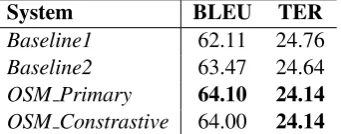
According to the test set evaluation, our sys-tem achieves similar improvements as appeared in development set data. Table 3 shows that, there are two types of baseline systems: (i) Baseline1 – based on raw MT output and (ii) Baseline2 – based on Statistical APE (Simard et al., 2007b) (a phrase-based system (Koehn et al., 2007) build
2In Table 2, the raw MT output of development set data is
System Exp. BLEU MET TER
Baseline WMT MT-PE 1 65.02 47.79 24.42
PB-SAPE Berkeley AlignerMETEOR Aligner 32 65.8965.97 48.23 24.5148.34 24.36 TER Aligner 4 65.14 47.85 24.96
HPB-SAPE
[image:4.595.146.453.61.190.2]Berkeley Aligner 5 66.09 48.31 24.56 METEOR Aligner 6 66.55 48.58 24.51 TER Aligner 7 65.19 47.91 24.97 OSM METEOR Aligner 8 67.01 48.80 24.04
Table 2: Systematic Evaluation on the WMT-2016 APE Shared Task Development Set
using MOSES3 with default settings). There are two different systems called OSM Primary and OSM Constrastive have been submitted to the WMT-2016 APE shared task. The differ-ence between the two submissions is that the OSM Primary system is tuned with all phrase-based setting parameters including OSM param-eters while OSM Constrastive is also tuned with similar parameters but excluding OSM parame-ters. The tuning process of the OSM parameters is conducted with MERT and optimized with MIRA. Our primary submission obtained a BLEU score of 64.10 (1.99 absolute points and 3.2% relative improvement in BLEU) and a TER score of 24.14 (0.66 absolute points and 0.25% relative improve-ment in TER) overBaseline1system. If we con-sider Baseline2 system, our primary submission achieved 0.63 absolute points and 0.99% relative improvement in BLEU and 0.50 absolute points and 0.20% relative improvement in TER.
System BLEU TER
Baseline1 62.11 24.76 Baseline2 63.47 24.64 OSM Primary 64.10 24.14
OSM Constrastive 64.00 24.14
Table 3: Evaluation on the WMT-2016 APE Shared Task Test Set
5 Conclusion and Future Work
This paper presents the USAAR system submit-ted in the English–German APE task at WMT-2016. The system demonstrates the crucial role METEOR-based alignment and OSM based SAPE can play in SAPE tasks. The use of statisti-cal aligners in PB-SAPE/HPB-SAPE pipeline suc-cessfully improve the APE system, however
per-3http://www.statmt.org/moses/
formances with respect to the translations pro-vided by the baseline are not promising. This is the reason behind use of edit distance-based word alignment into the pipeline. The reason for us-ing OSM model is that, the model tightly cou-ples translation and reordering. Apart from that, the OSM model also considers all possible re-orderings instead perform search only on a lim-ited number of pre-calculated orderings. The pro-posed system, OSM-based SAPE approach, was successful in improving over the PB-SAPE as well as HPB-SAPE performance.
The WMT-2016 APE shared task was a great opportunity to test APE methods that can be later applied in real-word post-editing and computer-aided translation (CAT) tools. We are currently working on implementing the APE methods de-scribed in this paper to CATaLog, a recently-developed CAT tool that provides translators with suggestions originated from MT and from trans-lation memories (TM) (Nayek et al., 2015; Pal et al., 2016). In so doing, we aim to provide better suggestions for post-editing and we would like to investigate how this impacts human post-editing performance by carrying out user studies.
Acknowledgments
We would like to thank the WMT-2016 APE shared task organizers for this interesting shared task and for prompt replies to all our inquiries.
The research leading to these results has re-ceived funding from the EU FP7 Project EXPERT - the People Programme (Marie Curie Actions), under REA grant agreement no. 317471.
References
[image:4.595.98.269.510.577.2]David Chiang. 2005. A Hierarchical Phrase-based Model for Statistical Machine Translation. In Pro-ceedings of ACL.
Nadir Durrani, Helmut Schmid, and Alexander Fraser. 2011. A joint sequence translation model with inte-grated reordering. InProceedings of ACL.
Nadir Durrani, Helmut Schmid, Alexander M. Fraser, Philipp Koehn, and Hinrich Schtze. 2015. The operation sequence model - combining n-gram-based and phrase-n-gram-based statistical machine transla-tion. Computational Linguistics, 41:185–214.
George Foster, Roland Kuhn, and Howard Johnson. 2006. Phrasetable Smoothing for Statistical Ma-chine Translation. InProceedings of EMNLP.
Michel Galley and Christopher D. Manning. 2008. A Simple and Effective Hierarchical Phrase Reorder-ing Model. InProceedings of EMNLP.
Ana Guerberof. 2009. Productivity and quality in the post-editing of outputs from translation memo-ries and machine translation. Localisation Focus, 7(1):133–140.
Kenneth Heafield. 2011. KenLM: Faster and Smaller Language Model Queries. InProceedings of WMT.
Kevin Knight and Ishwar Chander. 1994. Auto-mated Post-Editing of Documents. InProceedings of AAAI.
Philipp Koehn, Franz Josef Och, and Daniel Marcu. 2003. Statistical Phrase-based Translation. In Pro-ceedings of NAACL-HLT.
Philipp Koehn, Hieu Hoang, Alexandra Birch, Chris Callison-Burch, Marcello Federico, Nicola Bertoldi, Brooke Cowan, Wade Shen, Christine Moran, Richard Zens, Chris Dyer, Ondˇrej Bojar, Alexandra Constantin, and Evan Herbst. 2007. Moses: Open Source Toolkit for Statistical Machine Translation. InProceedings of ACL.
Alon Lavie and Abhaya Agarwal. 2007. METEOR: An Automatic Metric for MT Evaluation with High Levels of Correlation with Human Judgments. In
Proceedings of WMT.
Percy Liang, Ben Taskar, and Dan Klein. 2006. Align-ment by AgreeAlign-ment. In Proceedings of NAACL-HLT.
Tapas Nayek, Sudip Kumar Naskar, Santanu Pal, Mar-cos Zampieri, Mihaela Vela, and Josef van Genabith. 2015. CATaLog: New approaches to tm and post editing interfaces. InProceedings of the NLP4TM Workshop.
Franz Josef Och and Hermann Ney. 2003. A System-atic Comparison of Various Statistical Alignment Models.Computational Linguistics, 29(1):19–51.
Franz Josef Och. 2003. Minimum Error Rate Training in Statistical Machine Translation. InProceedings of ACL.
Santanu Pal, Mihaela Vela, Sudip Kumar Naskar, and Josef van Genabith. 2015. USAAR-SAPE: An English–Spanish Statistical Automatic Post-Editing System. InProceedings of WMT, September.
Santanu Pal, Marcos Zampieri, Sudip Kumar Naskar, Mihaela Vela, and Josef van Genabith. 2016. CATa-Log Online: Porting a Post-editing Tool to the Web. InProceedings of LREC.
Kishore Papineni, Salim Roukos, Todd Ward, and Wei-Jing Zhu. 2002. BLEU: A Method for Automatic Evaluation of Machine Translation. InProceedings of ACL.
Mirko Plitt and Franc¸ois Masselot. 2010. A productiv-ity test of statistical machine translation post-editing in a typical localisation context. The Prague Bul-letin of Mathematical Linguistics, 93:7–16.
Michel Simard, Cyril Goutte, and Pierre Isabelle. 2007a. Statistical Phrase-based Post-Editing. InIn Proceedings of NAACL-HLT.
Michel Simard, Nicola Ueffing, Pierre Isabelle, and Roland Kuhn. 2007b. Rule-Based Translation with Statistical Phrase-Based Post-Editing. In Proceed-ings of WMT.
Matthew Snover, Bonnie Dorr, Richard Schwartz, Lin-nea Micciulla, and John Makhoul. 2006. A Study of Translation Edit Rate with Targeted Human An-notation. InProceedings of AMTA.
Andreas Stolcke. 2002. Srilm – an extensible language modeling toolkit. InIN Proceedings of ICSLP.
Marco Turchi, Rajen Chatterjee, and Matteo Negri. 2016. WMT16 APE shared task data. LIN-DAT/CLARIN digital library at Institute of For-mal and Applied Linguistics, Charles University in Prague.