Rule Selection with Soft Syntactic Features
for String-to-Tree Statistical Machine Translation
Fabienne Braune and Nina Seemann and Alexander FraserCIS, Ludwig-Maximilians-Universit¨at M¨unchen Oettingenstraße 67, 80538 M¨unchen, Germany
[braunefe|seemanna]@ims.uni-stuttgart.de [email protected]
Abstract
In syntax-based machine translation, rule selection is the task of choosing the cor-rect target side of a translation rule among rules with the same source side. We de-fine a discriminative rule selection model for systems that have syntactic annota-tion on the target language side (string-to-tree). This is a new and clean way to integrate soft source syntactic constraints into string-to-tree systems as features of the rule selection model. We release our implementation as part of Moses.
1 Introduction
Syntax-based machine translation is well known for its ability to handle non-local reordering. Syntax-based models either use linguistic annota-tion on the source language side (Huang, 2006; Liu et al., 2006), target language side (Galley et al., 2004; Galley et al., 2006) or are syntactic in a structural sense only (Chiang, 2005). Recent shared tasks have shown that systems integrat-ing information on the target language side, also calledstring-to-treesystems, achieve the best per-formance on several language pairs (Bojar et al., 2014). At the same time, soft syntactic features significantly improve the translation quality of hi-erarchical systems (Hiero) as shown in (Marton et al., 2012; Chiang, 2010; Liu et al., 2011; Cui et al., 2010). Improving the performance of string-to-tree systems through the integration of soft syn-tactic constraints on the source language side is therefore an interesting task.
So far, all approaches on this topic include soft syntactic constraints into the rules of string-to-tree (Zhang et al., 2011; Huck et al., 2014) or string-to-dependency (Huang et al., 2013) systems and define heuristics to determine to what extent these constituents match the syntactic structure of the
source sentence. We propose a novel way to in-tegrate soft syntactic constraints into a string-to-tree system. We define a discriminative rule se-lection model for string-to-tree machine transla-tion. We consider rule selection as a multi-class classification problem where the task is to select the correct target side of a rule given its source side as well as contextual information about the source sentence and the considered rule. So far, such models have been applied to systems without syntactic annotation on the target language side. He et al. (2008), He et al. (2010) and Cui et al. (2010) apply such rule selection models to hier-archical machine translation, Liu et al. (2008) to tree-to-string systems and Zhai et al. (2013) to systems based on predicate argument structures. When target side syntactic annotations are taken into account, the task of rule selection has to be reformulated (see Section 2) while the same type of model can be used in approaches without target annotations. This work is the first attempt to define a rule selection model for a string-to-tree system. We make our implementation publicly available as part of Moses.1
We show in Section 2 that string-to-tree rule se-lection is different from the hierarchical case ad-dressed by previous work and define our rule se-lection model. In Section 3 we present the train-ing procedure before providtrain-ing a proof-of-concept evaluation in Section 4.
2 Rule selection for string-to-tree SMT
2.1 String-to-tree machine translation
We present string-to-tree machine translation as implemented in Moses (which is the framework that we use). String-to-tree rules have the form X/A → hα, γ,∼i. On the source language side,
1We use the string-to-tree component of Moses (Williams
and Koehn, 2012; Hoang et al., 2009) in which we integrate the high-speed classifier Vowpal Wabbithttp://hunch. net/˜vw/.
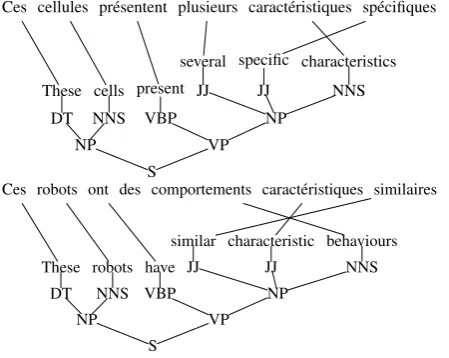
Ces cellules pr´esentent plusieurs caract´eristiques sp´ecifiques
S NP DT These
NNS cells
VP VBP present
NP JJ
several JJ specific
NNS characteristics
Ces robots ont des comportements caract´eristiques similaires
S NP DT These
NNS robots
VP VBP have
NP JJ
similar JJ characteristic
[image:2.595.71.296.65.244.2]NNS behaviours
Figure 1: Word-aligned sentence pairs with target-side parse.
Diverses caract´eristiques importantes
JJ Various
[image:2.595.114.250.295.349.2]JJ important
Figure 2: Partial translation during decoding.
all non-terminals have the unique label X while on the target language side non-terminals are an-notated with syntactic labels nt ∈ Nt. The left-hand sideX/Aconsists of source and target non-terminals. In the right hand side (rhs),αis a string of source terminal symbols and the non-terminal X. The string γ consists of target terminals and non-terminalsnt∈Nt. The alignment∼is a one-to-one correspondence between source and target non-terminal symbols. String-to-tree rules are ex-tracted from pairs of strings and trees as exempli-fied in Figure 1. Rulesr1andr2are example rules
extracted from this data.
(r1) X/NP→ hX1caract´eristiquesX2,JJ1JJ2 charac-teristicsi
(r2) X/NP → hX1 caract´eristiquesX2,NNS1 charac-teristicJJ2i
During decoding, CYK+ chart parsing (Chappe-lier et al., 1998) with cube pruning and language model scoring is performed on an input sentence such as F below. Each time a rule is applied to the input sentence, candidate target trees are built. Figure 2 shows the partial translations built after the segmentsDiversesandimportanteshave been decoded. Given these partial translations, ruler1
can be applied in a further decoding step.
F (Diverses)X1 caract´eristiques (importantes)X2 n’ont pas ´et´e prises en compte.
(Various)X1 characteristics (important)X2 were not considered.
2.2 String-to-tree rule selection
Rule selection is the problem of selecting the rule with the correct target side among rules with the same source side. For hierarchical machine trans-lation (Hiero), the rule selection problem consists of choosing, among r3 andr4, the rule that
cor-rectly applies toF(r3in our example).
(r3) X/X→ hX1caract´eristiquesX2,X1X2 characteris-ticsi
(r4) X/X→ hX1 caract´eristiquesX2,X1 characteristic X2i
Rule selection models disambiguate between these rules using context information about the source sentence and the shape of the rules.
In string-to-tree machine translation, the rule selection problem is different. Because the decod-ing process is guided by target side syntactic an-notation, partial trees built during decoding must be considered when new rules are applied. For instance, when a rule is selected to translate sen-tenceF given the partial translations in Figure 2, then the non-terminals in the target side of this rule must match the constituents selected so far. Consequently, rules r1 and r2 (Section 2.1) are
not competing during rule selection.2 Competing
rules forr1 would ber5 andr6below.
(r5) X/NP → h X1 caract´eristiquesX2, JJ1 properties JJ2i
(r6) X/NP → h X1 caract´eristiquesX2, JJ1 JJ2 fea-turesi
For consistency with decoding, we redefine the rule selection problem for the string-to-tree case. In this setup, it is the task of disambiguating rules with the same source sideand aligned target non-terminals. As a consequence, our rule selection model (presented next) is not only normalized over the source rhs of the rules but also takes target non-terminals into account. The default rule scor-ing procedure for strscor-ing-to-tree rules implemented in Moses uses the same normalization as we do. However, Williams and Koehn (2012) propose to normalize string-to-tree rules over the source rhs only.
2This is because their target side non-terminals are
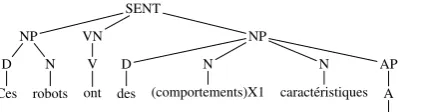
SENT NP
D Ces
N robots
VN V ont
NP D
des
N (comportements)X1
N caract´eristiques
[image:3.595.74.286.62.118.2]AP A (similaires)X2
Figure 3: French sentence with input parse tree.
2.3 Rule selection model
We denote string-to-tree rules with X/A → hα, γ,∼i, as in Section 2.1. By Nt˜ t, we de-note target non-terminals with their alignment to source non-terminals.3 C(f, α) is context
infor-mation in the source sentence f and the source side α. R(α, γ) represents features on string-to-tree rules. The rule selection model estimates P(γ | C(f, α), R(α, γ), α,Ntt)˜ and is normal-ized over the setG0of candidate target sidesγ0for a givenαandNt˜ t. The functionGT O :α →G0 generates, given the source sideαand target non-terminals Nt˜ t , the set G0 of all corresponding target sidesγ0. The estimated distribution can be written as:
P(γ|C(f, α), R(α, γ), α,Nt˜ t) =
exp(P
iλihi(C(f, α), R(α, γ), α,Nt˜ t))) P
γ0∈GT O(α,Ntt˜ )exp(Piλihi(C(f, α), R(α, γ0), α,Nt˜ t))
In the same fashion as (Cui et al., 2010) do for the hierarchical case, we define a global rule selec-tion model instead of a model that is local to the source side of each rule.
To illustrate the feature templates C(f, α) and R(α, γ) of our rule selection model, we suppose that rule r1 has been extracted from the French
sentence in Figure 3. The syntactic features are:
- Doesαmatch a constituent:no match - Type of matched constituent:None
- Lowest parent of unmatched constituent:NP - Span width covered byα:3
The rule internal features are:
- Source sideα:X1 caract´eristiques X2(one feature) - Target sideγ:JJ1 JJ2 characteristics
- Aligned terminals in α and γ: car-act´eristiques↔characteristics
- Aligned non-terminals inαandγ:X1↔JJ1 X2↔JJ2 - Best baseline translation probability:Most Frequent
Our rule selection model is integrated in the Moses string-to-tree system as an additional fea-ture of the log-linear model.
3For ruler1,r5andr6,Nt˜
twould beJJ1andJJ2.
3 Model Training
We create training examples using the rule extrac-tion procedure in (Williams and Koehn, 2012).4
We begin by generating a rule-table using this pro-cedure. Then, each time a rule r : X/A → hα, γ,∼ican be extracted from the training data, we generate a new training example. The target side γ of the extracted rule is a positive instance and gets a loss of 0. To generate negative sam-ples, we collect all rulesr2, . . . , rn that have the
same source language side asras well as the same aligned target non-terminals Nt˜ t. Each of these rules is a negative example and gets a cost of 1. As an example, suppose that ruler1introduced in
Section 2.1 has been extracted from the training example in Figure 1. The target side ”JJ1 JJ2
characteristics” is a correct class and gets a cost of 0. The target side of all other rules having the same source sideand aligned target non-terminals, such as ruler5andr6, are incorrect classes.
For model training, we use the cost-sensitive one-against-all-reduction (Beygelzimer et al., 2005) of Vowpal Wabbit (VW).5 We avoid
over-fitting to training data by employing early stop-ping once classifier accuracy decreases on a held-out dataset.6
4 Experiments
4.1 Experimental Setup
Our baseline system is a syntax-based system with linguistic annotation on the target language side (string-to-tree). We use the version implemented in the Moses open source toolkit (Hoang et al., 2009; Williams and Koehn, 2012) with standard parameters. Rule extraction is performed as in (Galley et al., 2004) with rule composition (Gal-ley et al., 2006; DeNeefe et al., 2007). Non-lexical unary rules are removed (Chung et al., 2011) and scope-3 pruning (Hopkins and Langmead, 2010) is performed. Rule scoring is done using relative frequencies normalized over the source rhs and aligned non-terminals in the target rhs. The con-trastive system is the same string-to-tree system but augmented with our rule selection model as a feature of the log-linear model.
4Which is based on (Galley et al., 2004; Galley et al.,
2006; DeNeefe et al., 2007).
5Specifically, the label dependent version ofCost
Sensi-tive One Against Allwhich uses classification.
6We use the development set which is also used for MIRA
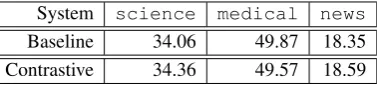
System science medical news
Baseline 34.06 49.87 18.35
[image:4.595.88.277.62.106.2]Contrastive 34.36 49.57 18.59
Table 2: String-to-tree system evaluation results.
We evaluate the baseline and our global model on three domains: (1) news, (2) medical, and (3) science. The training data for news
is taken from Europarl-v4. Development and test sets are from the news translation task of WMT 2009 (Callison-Burch et al., 2009). For
medical we use the biomedical data from EMEA (Tiedemann, 2009). Since this is a parallel corpus only, we first removed duplicate sentences and then constructed development and test sets by randomly selecting sentence pairs. As training data forsciencewe use the scientific abstracts data provided by Carpuat et al. (2013). Table 1 gives an overview of the corpora sizes.
Berkeley parser (Petrov et al., 2006) is used to parse the English side of each parallel corpus (for string-to-tree rule extraction) as well as for pars-ing the French source side (for feature extraction). We trained a 5-gram language model on the En-glish side of each training corpus using the SRI Language Modeling Toolkit (Stolcke, 2002). We train the model in the standard way and gener-ate word alignments using GIZA++. After train-ing, we reduced the number of translation rules by only keeping the 30-best rules with the same source side according to the direct rule transla-tion rule probability. Our rule selectransla-tion model was trained with VW. All systems were tuned using batch MIRA (Cherry and Foster, 2012). We mea-sured the overall translation quality with 4-gram BLEU (Papineni et al., 2002), which was com-puted on tokenized and lowercased data for all sys-tems. Statistical significance is computed with the pairwise bootstrap resampling technique of Koehn (2004).
4.2 Results
Table 2 displays the BLEU scores for our experi-ments. Onscienceandnews, small improve-ments are achieved while for medical a small decrease is observed. None of these differences is statistically significant.
An analysis of the system outputs for each do-main showed that the small improvements are due to the fact that in string-to-tree systems there is not
enough ambiguity between competing rules dur-ing decoddur-ing. To support this conjecture, we first analyzed rule diversity by looking at the negative samples collected during training example acqui-sition. In a second step, we compared the results of the string-to-tree systems in Table 2 with a sys-tem where the translation rules are much more am-biguous. To this aim, we applied our approach to a hierarchical system in the same line as (Cui et al., 2010). Finally, we further tested the ability of our system to disambiguate between competing rules by training a model on the concatenation of all do-mains.
4.3 Analysis of Rule Diversity
The amount of competing rules during decoding can be estimated by looking at the negative sam-ples collected for each training example. This analysis showed that the diversity of rules contain-ing non-terminal symbols is limited. We present rulesq1toq3 (taken fromscience) to illustrate
the poor diversity observed in our training exam-ples.
(q1) X/P P→ h`aX1X2 ´eventailX3, toDT1JJ2variety P P3i
(q2) X/P P→ h`aX1X2´eventailX3, toDT1JJ2range P P3i
(q3) X/P P→ h`aX1X2 ´eventailX3, toDT1JJ2 array P P3i
Rulesq1toq3are the only rules with source side`a
X1X2 ´eventailX3. This number is very low given
that the source side contains three non-terminal symbols out of which two are adjacent. More-over, the difference between these rules is limited to the lexical translation of ´eventail. This lack of diversity is due to the constraint that compet-ing strcompet-ing-to-tree rules must have the same aligned non-terminal symbols, which is taken into account when collecting negative samples. In other words, the ambiguity between translation rules in a string-to-tree system is heavily restricted by the target side syntax.
news medical science training data 4th EuroParl corpus (Tiedemann, 2009) (Carpuat et al., 2013) training data size 149,986 sentence pairs 111,081 sentence pairs 139,199 sentence pairs
development size 1,025 sentences 2,000 sentences 2,907 sentences
[image:5.595.95.504.61.134.2]test size 1,026 sentences 1,999 sentences 3,915 sentences
Table 1: Overview of the sizes of the three domains.
System science medical news
Baseline 31.22 48.67 17.28
Contrastive 32.27 49.66 17.38
Table 3: Hierarchical system evaluation results. The results in bold are statistically significant im-provements over the Baseline (at confidencep < 0.05).
grammars as in Huck et al. (2014).
4.4 Comparison with Hierarchical Rule Selection
We applied our approach in a hierarchical phrase-based setting (Hiero). To this end, we trained 3 Hi-ero baseline systems and 3 HiHi-ero systems aug-mented with our rule selection model on the data given in Section 4.1. The results of these ex-periments are shown in Table 3. Our augmented system largely outperforms the baselines. Inter-estingly, hierarchical rule selection significantly helps on the medical and scientific domain but still yields results that are significantly lower than those of the string-to-tree systems. This indicates that systems with target side syntax better disam-biguate than hierarchical models with improved rule selection. Overall, we find the results of both types of systems promising and we will consider how to introduce more diversity into the rules of string-to-tree systems.
4.5 Concatenation of Training Data
In order to further evaluate the ability of our model to disambiguate string-to-tree rules, we trained a system using the concatenated training data of all 3 domains as presented in Section 4.1. This global model was then used to tune and decode using the development and test data of each domain. The results in Table 4 show that even on concatenated data our rule selection model does not improve over the baseline.
System science medical news
Baseline 33.78 49.48 19.12
[image:5.595.87.280.173.217.2]Contrastive 33.87 49.14 19.00
Table 4: String-to-tree system evaluation results with concatenated training data.
5 Conclusion and future work
We presented the first attempt to define a rule se-lection model with syntactic features for string-to-tree machine translation. We have shown that in order to be applied to the string-to-tree case, the rule selection problem must be redefined. An ex-tensive evaluation on French-English translation tasks for different domains has shown that rule se-lection cannot significantly improve string-to-tree systems. An analysis of rule diversity and an em-pirical comparison with hierarchical rule selection indicate that the low improvements are due to the fact that the ambiguity between string-to-tree rules is too small to be improved with a rule selection model. In future work, we will use different tech-niques to improve the diversity of the string-to-tree rules considered during decoding in our system.
Acknowledgements
We thank all members of the DAMT team of the 2012 JHU Summer Workshop. We are especially grateful to Hal Daum´e III and Ales Tamchyna for their ongoing support in the implementation of our system. We also thank Andreas Maletti for his shared expertise on tree grammars. This project has received funding from the European Unions Horizon 2020 research and innovation programme under grant agreement No 644402 (HimL) and the DFG grantModels of Morphosyntax for Statistical Machine Translation (Phase 2), which we grate-fully acknowledge.
References
AAAI, pages 720–725.
Ondrej Bojar, Christian Buck, Christian Federmann, Barry Haddow, Philipp Koehn, Johannes Leveling, Christof Monz, Pavel Pecina, Matt Post, Herve Saint-Amand, Radu Soricut, Lucia Specia, and Aleˇs Tamchyna. 2014. Findings of the 2014 workshop
on statistical machine translation. In Ninth
Work-shop on Statistical Machine Translation, WMT,
pages 12–58, Baltimore, Maryland.
Chris Callison-Burch, Philipp Koehn, Christof Monz, and Josh Schroeder. 2009. Findings of the 2009 Workshop on Statistical Machine Translation. In Proc. 4th Workshop on Statistical Machine Trans-lation, pages 1–28.
Marine Carpuat, Hal Daum´e III, Katharine Henry, Ann Irvine, Jagadeesh Jagarlamudi, and Rachel Rudinger. 2013. Sensespotting: Never let your par-allel data tie you to an old domain. InProc. ACL.
Jean-C´edric Chappelier, Martin Rajman, et al. 1998. A generalized cyk algorithm for parsing stochastic cfg.
TAPD, 98(133-137):5.
Colin Cherry and George Foster. 2012. Batch tun-ing strategies for statistical machine translation. In
Proc. NAACL.
David Chiang. 2005. Hierarchical phrase-based trans-lation. InProc. ACL.
David Chiang. 2010. Learning to translate with source and target syntax. InProc. ACL.
Tagyoung Chung, Licheng Fang, and Daniel Gildea. 2011. Issues concerning decoding with synchronous
context-free grammars. InProc. ACL.
Lei Cui, Dongdong Zhang, Mu Li, Ming Zhou, and Tiejun Zhao. 2010. A joint rule selection model for hierarchical phrase-based translation. InProc. ACL.
Steve DeNeefe, Kevin Knight, Wei Wang, and Daniel Marcu. 2007. What can syntax-based mt learn from
phrase-based mt. InProc. EMNLP.
Michel Galley, Mark Hopkins, Kevin Knight, and Daniel Marcu. 2004. What’s in a translation rule?
InProc. HLT-NAACL.
Michel Galley, Jonathan Graehl, Kevin Knight, Daniel Marcu, Steve Deneefe, Wei Wang, and Ignacio Thayer. 2006. Scalable inference and training of context-rich syntactic translation models. InProc. ACL.
Zhongjun He, Qun Liu, and Shouxun Lin. 2008. Im-proving statistical machine translation using lexical-ized rule selection. InProc. COLING.
Zhongjun He, Yao Meng, and Hao Yu. 2010. Maxi-mum entropy based phrase reordering for hierarchi-cal phrase-based translation. InProc. EMNLP.
Hieu Hoang, Philipp Koehn, and Adam Lopez. 2009. A unified framework for phrase-based, hierarchical, and syntax-based statistical machine translation. In In Proceedings of the International Workshop on
Spoken Language Translation (IWSLT.
Mark Hopkins and Greg Langmead. 2010. Scfg
de-coding without binarization. InProc. EMNLP.
Zhongqiang Huang, Jacob Devlin, and Rabih Zbib. 2013. Factored soft source syntactic constraints for hierarchical machine translation. InProc. EMNLP. Liang Huang. 2006. Statistical syntax-directed
trans-lation with extended domain of locality. InIn Proc.
AMTA 2006.
Mathias Huck, Hieu Hoang, and Philipp Koehn. 2014. Preference grammars and soft syntactic constraints for ghkm syntax-based statistical machine transla-tion. InProc. SSST-8.
Philipp Koehn. 2004. Statistical significance tests for
machine translation evaluation. InProc. EMNLP.
Yang Liu, Qun Liu, and Shouxun Lin. 2006. Tree-to-string alignment template for statistical machine translation. InProc. ACL.
Qun Liu, Zhongjun He, Yang Liu, and Shouxun Lin. 2008. Maximum entropy based rule selection model for syntax-based statistical machine translation. In
Proc. EMNLP.
Lemao Liu, Tiejun Zhao, Chao Wang, and Hailong Cao. 2011. A unified and discriminative soft syn-tactic constraint model for hierarchical phrase-based
translation. In Proceedings of the 13th Machine
Translation Summit, pages 253–261.
Yuval Marton, David Chiang, and Philip Resnik. 2012. Soft syntactic constraints for arabic—english
hierar-chical phrase-based translation. Machine
Transla-tion, 26:137–157.
Kishore Papineni, Salim Roukos, Todd Ward, and Wei
jing Zhu. 2002. BLEU: a method for automatic
evaluation of machine translation. InProc. ACL. Slav Petrov, Leon Barrett, Romain Thibaux, and Dan
Klein. 2006. Learning accurate, compact, and inter-pretable tree annotation. InProc. ACL.
Andreas Stolcke. 2002. Srilm - an extensible language
modeling toolkit. In Proceedings of the
Interna-tional Conference on Spoken language Processing.
J¨org Tiedemann. 2009. News from opus : A collection of multilingual parallel corpora with tools and
in-terfaces. In Recent Advances in Natural Language
Processing V, volume V, pages 237–248. John
Ben-jamins.
Philip Williams and Philipp Koehn. 2012. Ghkm rule
extraction and scope-3 parsing in moses. InProc.
Feifei Zhai, Jiajun Zhang, Yu Zhou, and Chengqing Zong. 2013. Handling ambiguities of bilingual predicate-argument structures for statistical machine translation. InProc. ACL.