Disfluency Detection using Auto-Correlational Neural Networks
Paria Jamshid Lou Macquarie University
Sydney, Australia
Peter Anderson Macquarie University
Sydney, Australia [email protected]
Mark Johnson Macquarie University
Sydney, Australia [email protected]
Abstract
In recent years, the natural language process-ing community has moved away from task-specific feature engineering, i.e., researchers discovering ad-hoc feature representations for various tasks, in favor of general-purpose methods that learn the input representation by themselves. However, state-of-the-art ap-proaches to disfluency detection in sponta-neous speech transcripts currently still de-pend on an array of hand-crafted features, and other representations derived from the output of pre-existing systems such as language mod-els or dependency parsers. As an alterna-tive, this paper proposes a simple yet effec-tive model for automatic disfluency detection, called an auto-correlational neural network (ACNN). The model uses a convolutional neu-ral network (CNN) and augments it with a new auto-correlation operator at the lowest layer that can capture the kinds of “rough copy” dependencies that are characteristic of repair disfluencies in speech. In experiments, the ACNN model outperforms the baseline CNN on a disfluency detection task with a 5% in-crease in f-score, which is close to the previous best result on this task.
1 Introduction
Disfluency informally refers to any interruptions in the normal flow of speech, including false starts, corrections, repetitions and filled pauses.Shriberg
(1994) defines three distinct parts of a speech dis-fluency, referred to as the reparandum, interreg-numandrepair. As illustrated in Example 1, the reparandumto Boston is the part of the utterance that is replaced, the interregnumuh, I mean(which consists of a filled pauseuhand a discouse marker I mean) is an optional part of a disfluent struc-ture, and the repairto Denverreplaces the reparan-dum. The fluent version is obtained by removing reparandum and interregnum words although
dis-fluency detection models mainly deal with identi-fying and removing reparanda. The reason is that filled pauses and discourse markers belong to a closed set of words and phrases and are trivial to detect (Johnson and Charniak,2004).
I want a flight
reparandum
z }| {
to Boston, uh, I mean
| {z }
interregnum
to Denver
| {z }
repair
on Friday (1)
In disfluent structures, the repair (e.g., to Den-ver) frequently seems to be a “rough copy” of the reparandum (e.g.,to Boston). In other words, they incorporate the same or very similar words in roughly the same word order. In the Switch-board training set (Godfrey and Holliman,1993), over60%of the words in the reparandum are exact copies of words in the repair. Thus, this similarity is strong evidence of a disfluency that can help the model detect reparanda (Charniak and Johnson,
2001;Johnson and Charniak, 2004). As a result, models which are able to detect “rough copies” are likely to perform well on this task.
Currently, state-of-the-art approaches to disflu-ency detection depend heavily on hand-crafted pattern match features, specifically designed to find such “rough copies” (Zayats et al., 2016;
learn the input representation by themselves ( Col-lobert and Weston,2008).
In this paper, we hypothesize that LSTMs and CNNs cannot not easily learn “rough copy” depen-dencies. We address this problem in the context of a CNN by introducing a novel auto-correlation operator. The resulting model, called an auto-correlational neural network (ACNN), is a gener-alization of a CNN with an auto-correlation oper-ator at the lowest layer. Evaluating the ACNN in the context of disfluency detection, we show that introducing the auto-correlation operator increases f-score by 5% over a baseline CNN. Furthermore, the ACNN — operating only on word inputs — achieves results which are competitive with much more complex approaches relying on hand-crafted features and outputs from pre-existing systems such as language models or dependency parsers. In summary, the main contributions of this paper are:
• We introduce the auto-correlational neural network (ACNN), a generalization of a CNN incorporating auto-correlation operations,
• In the context of disfluency detection, we show that the ACNN captures important properties of speech repairs including “rough copy” dependencies, and
• Using the ACNN, we achieve competitive re-sults for disfluency detection without rely-ing on any hand-crafted features or other rep-resentations derived from the output of pre-existing systems.
2 Related Work
Approaches to disfluency detection task fall into three main categories: noisy channel mod-els, parsing-based approaches and sequence tagging approaches. Noisy channel models (NCMs) (Johnson and Charniak, 2004; Johnson et al.,2004) use complex tree adjoining grammar (TAG) (Shieber and Schabes, 1990) based chan-nel models to find the “rough copy” dependencies between words. The channel model uses the sim-ilarity between the reparandum and the repair to allocate higher probabilities to exact copy reparan-dum words. Using the probabilities of TAG chan-nel model and a bigram language model (LM) derived from training data, the NCM generates n-best disfluency analyses for each sentence at
test time. The analyses are then reranked us-ing a language model which is sensitive to the global properties of the sentence, such as a syn-tactic parser based LM (Johnson and Charniak,
2004; Johnson et al., 2004). Some works have shown that rescoring then-best analyses with ex-ternal n-gram (Zwarts and Johnson, 2011) and deep learning LMs (Jamshid Lou and Johnson,
2017) trained on large speech and non-speech cor-pora, and using the LM scores along with other features (i.e. pattern match and NCM ones) into a MaxEnt reranker (Johnson et al., 2004) improves the performance of the baseline NCM, although this creates complex runtime dependencies.
Parsing-based approaches detect disfluencies while simultaneously identifying the syntactic structure of the sentence. Typically, this is achieved by augmenting a transition-based de-pendency parser with a new action to detect and remove the disfluent parts of the sentence and their dependencies from the stack (Rasooli and Tetreault, 2013; Honnibal and Johnson, 2014;
Yoshikawa et al.,2016). Joint parsing and disflu-ency detection can compare favorably to pipelined approaches, but requires large annotated tree-banks containing both disfluent and syntatic struc-tures for training.
Our proposed approach, based on an auto-correlational neural network (ACNN), belongs to the class of sequence tagging approaches. These approaches use classification techniques such as conditional random fields (Liu et al., 2006; Os-tendorf and Hahn,2013;Zayats et al.,2014; Fer-guson et al., 2015), hidden Markov models (Liu et al.,2006;Schuler et al.,2010) and deep learn-ing based models (Hough and Schlangen, 2015;
Zayats et al., 2016) to label individual words as fluent or disfluent. In much of the previous work on sequence tagging approaches, improved per-formance has been gained by proposing increas-ingly complicated labeling schemes. In this case, a model with begin-inside-outside (BIO) style states which labels words as being inside or outside of edit region1 is usually used as the baseline se-quence tagging model. Then in order to come up with different pattern matching lexical cues for repetition and correction disfluencies, they ex-tend the baseline state space with new explicit re-pair states to consider the words at rere-pair region, in addition to edit region (Ostendorf and Hahn,
2013;Zayats et al.,2014, 2016). A model which uses such labeling scheme may generate illegal la-bel sequences at test time. As a solution, integer linear programming (ILP) constraints are applied to the output of classifier to avoid inconsisten-cies between neighboring labels (Georgila,2009;
Georgila et al., 2010; Zayats et al., 2016). This contrasts with our more straightforward approach, which directly labels words as being fluent or dis-fluent, and does not require any post-processing or annotation modifications.
The most similar work to ours is recent work by Zayats et al. (2016) that investigated the per-formance of a bidirectional long-short term mem-ory network (BLSTM) for disfluency detection.
Zayats et al. (2016) reported that a BLSTM op-erating only on words underperformed the same model augmented with hand-crafted pattern match features and POS tags by 7% in terms of f-score. In addition to lexically grounded features, some works incorporate prosodic information extracted from speech (Kahn et al., 2005; Ferguson et al.,
2015;Tran et al.,2018). In this work, our primary motivation is to rectify the architectural limitations that prevent deep neural networks from automat-ically learning appropriate features from words alone. Therefore, our proposed model eschews manually engineered features and other represen-tations derived from dependency parsers, language models or tree adjoining grammar transducers that are used to find “rough copy” dependencies. In-stead, we aim to capture these kinds of dependen-cies automatically.
3 Convolutional and Auto-Correlational Networks
In this section, we introduce our proposed correlation operator and the resulting auto-correlational neural network (ACNN) which is the focus of this work.
A convolutional or auto-correlational network computes a series of h feature representations X(0), X(1), . . . , X(h), where X(0) is the input data,X(h)is the final (output) representation, and each non-input representation X(k) for k > 0, is computed from the preceding representation X(k−1)using a convolution or auto-correlation op-eration followed by an element-wise non-linear function.
Restricting our focus to convolutions in one dimension, as used in the context of language
processing, each representation X(k) is a ma-trix of size (n, mk), where n is the number of
words in the input and mk is the feature
dimen-sion of representationk, or equivalently it can be viewed as a sequence of n row vectors X(k) = (x(1k), . . . ,xn(k)), wherex(tk) is the row vector of
lengthmkthat represents thetth word at levelk.
Consistent with the second interpretation, the input representation X(0) = (x(0)1 , . . . ,x(0)n ) is a
sequence of word embeddings, where m0 is the length of the embedding vector and x(0)t is the word embedding for thetth word.
Each non-input representation X(k), k > 0 is formed by column-wise stacking the output of one or more convolution or auto-correlation oper-ations applied to the preceding representation, and then applying an element-wise non-linear func-tion. Formally, we define:
Y(k)=
F(k,1)(X(k−1));. . .;F(k,mk)(X(k−1))
X(k)=N(k)(Y(k)) (2)
where F(k,u) is theuth operator applied at layer k, andN(k) is the non-linear operation applied at layerk. Each operatorF(k,u)(either convolution or auto-correlation) is a function from X(k−1), which is a matrix of size (n, mk−1), to a vector of length n. A network that employs only con-volution operators is a concon-volutional neural net-work (CNN). We call a netnet-work that utilizes a mix-ture of convolution and auto-correlation operators anauto-correlational neural network(ACNN). In our networks, the non-linear operation N(k) is always element-wise ReLU, except for the last layer, which uses asof tmaxnon-linearity.
3.1 Convolution Operator
A one-dimensional convolution operation maps an input matrixX = (x1, . . . ,xn), where eachxtis
a row vector of lengthm, to an output vector y
of lengthn. The convolution operation is defined by a convolutional kernel A, which is applied to a window of words to produce a new output rep-resentation, and kernel width parameters`andr, which define the number of words to the left and right of the target word included in the convolu-tional window. For example, assuming appropri-ate input padding where necessary, elementyt in
the output vectoryis computed as:
Figure 1: Cosine similarity between word embedding vectors learned by the ACNN model for the sentence “I know they use that I mean they sell those” (with disflu-ent words highlighted). In the figure, darker shades de-note higher cosine values. “Rough copies” are clearly indicated by darkly shaded diagonals, which can be de-tected by our proposed auto-correlation operator.
where
A is a learned convolutional kernel of dimension
(`+r, m),
Xi:j is the sub-matrix formed by selecting rowsi
tojfrom matrixX,
· is the dot product (a sum over elementwise mul-tiplications),
i, j are given by i = t−` and j = t+r, in-dicating the left and right extremities of the convolutional window effecting elementyt,
` >0 is the left kernel width, and
r >0 is right kernel width.
b is a learned bias vector of dimensionn,
3.2 Auto-Correlation Operator
The auto-correlational operator is a generalisation of the convolution operator:
yt = A·Xi:j+B·Xˆi:j,i:j+b (4)
whereyt,A,X,b,iandjare as in the convolution
operator, and
ˆ
X is a tensor of size(n, n, m)such that each vec-torXˆi,j,:is given byf(xi,xj),
f(u,v) is a binary operation on vectors, such as the Hadamard or element-wise product (i.e., f(u,v) =u◦v), and
ˆ
Xi:j,i:j is the sub-tensor formed by selecting
in-dicesitojfrom the first two dimensions of tensorXˆ,
B is a learned convolutional kernel of dimension
(`+r, `+r, m).
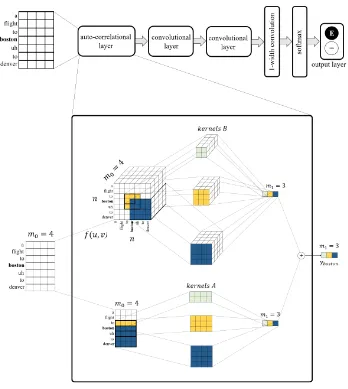
Unlike convolution operations, which are linear, the auto-correlation operator introduces second-order interaction terms through the tensor Xˆ (since it multiplies the vector representations for each pair of input words). This naturally encodes the similarity between input words when applied at level k = 1 (or the co-activations of multiple CNN features, if applied at higher levels). As il-lustrated in Figure1, blocks of similar words are indicative of “rough copies”. We provide an il-lustration of the auto-correlation operation in Fig-ure2.
4 Experiments
4.1 Switchboard Dataset
We evaluate the proposed ACNN model for disflu-ency detection on the Switchboard corpus of con-versational speech (Godfrey and Holliman,1993). Switchboard is the largest available corpus (1.2×
106 tokens) where disfluencies are annotated ac-cording to Shriberg’s (1994) scheme:
[ reparandum +{interregnum}repair ]
where (+) is the interruption point marking the end of reparandum and{} indicate optional interreg-num. We collapse this annotation to a binary clas-sification scheme in which reparanda are labeled as disfluent and all other words as fluent. We dis-regard interregnum words as they are trivial to de-tect as discussed in Section1.
Figure 2: ACNN overview for labeling the target word “boston”. A patch of words is fed into an auto-correlational layer. At inset bottom, the given patch of words is convolved with 2D kernelsAof different sizes. At inset top, an auto-correlated tensor of size(n, n, m0)is constructed by comparing each input vectoru=xtwith the input
vectorv = xt0 using a binary functionf(u,v). The auto-correlated tensor is convolved with 3D kernelsB of
different sizes. Each kernel groupAandBoutputs a matrix of size(n, m1)(here, we depict only the row vector
relating to the target word “boston”). These outputs are added element-wise to produce the feature representation that is passed to further convolutional layers, followed by a softmax layer. “E” = disfluent, “ ” = fluent andm0=
embedding size.
4.2 ACNN and CNN Baseline Models
We investigate two neural network models for dis-fluency detection; our proposed auto-correlational neural network (ACNN) and a convolutional neu-ral network (CNN) baseline. The CNN base-line contains three convolutional operators (lay-ers), followed by a width-1 convolution and a soft-max output layer (to label each input word as ei-ther fluent or disfluent). The ACNN has the same general architecture as the baseline, except that we have replaced the first convolutional operator with an auto-correlation operator, as illustrated in Fig-ure2.
architec-tural differences (which is what we wish to investi-gate). Finally, we note that the resulting maximum right kernel widthr1in the auto-correlational layer is 6. As illustrated in Figure 3, this is sufficient to capture almost all the “rough copies” in the Switchboard dataset (but could be increased for other datasets).
Configuration CNN ACNN
embedding dim 290 290
dropout rate 0.51 0.53
L2 regularizer weight 0.13 0.23
#kernels at each layer 570 120
#kernel sizes at each layer 3 2 #words at left context`1 [0,1,4] [5,3]
#words at left context`2 [1,2,3] [4,2]
#words at left context`3 [0,1,2] [3,2]
#words at right contextr1 [1,1,4] [6,3]
#words at right contextr2 [1,2,4] [5,3]
#words at right contextr3 [1,2,3] [4,2]
#parameters 4.9M 4.9M
Table 1: Configuration of the CNN and ACNN mod-els, where`k refers to the left kernel width at layerk,
andrk refers to the right kernel width at layerk. Both
models have a similar total number of parameters.
For the ACNN, we considered a range of possi-ble binary functionsf(u,v)to compare the input vectoru=xtwith the input vectorv =xt0 in the auto-correlational layer. However, in initial exper-iments we found that the Hadamard or element-wise product (i.e. f(u,v) = u ◦ v) achieved the best results. We also considered concatenat-ing the outputs of kernelsAandBin Equation4, but we found that element-wise addition produced slightly better results on the dev set.
4.2.1 Implementation Details
[image:6.595.308.523.61.223.2]In both models, we useReLU for the non-linear operation, all stride sizes are one word and there are no pooling operations. We randomly initial-ize the word embeddings and all weights of the model from a uniform distribution. The bias terms are initialized to be1. To reduce overfitting, we apply dropout (Srivastava et al., 2014) to the in-put word embeddings andL2regularization to the weights of the width-1 convolutional layer. For parameter optimization, we use the Adam opti-mizer (Kingma and Ba, 2014) with a mini-batch size of25and an initial learning rate of0.001.
Figure 3: Distribution over the number of words in between the reparandum and the interregnum in the Switchboard training set (indicating the distance be-tween “rough copies”).
5 Results
As in previous work (Johnson and Charniak,
2004), we evaluate our model using precision, re-call and f-score, where true positives are the words in the edit region (i.e., the reparandum words). As Charniak and Johnson (2001) observed, only
6%of words in the Switchboard corpus are disflu-ent, so accuracy is not a good measure of system performance. F-score, on the other hand, focuses more on detecting “edited” words, so it is more appropriate for highly skewed data.
Table 2 compares the dev set performance of the ACNN model against our baseline CNN, as well as the LSTM and BLSTM models proposed by Zayats et al. (2016) operating only on word inputs (i.e., without any disfluency pattern-match features). Our baseline CNN outperforms both the LSTM and the BLSTM, while the ACNN model clearly outperforms the baseline CNN, with a fur-ther 5% increase in f-score. In particular, the ACNN noticably improves recall without degrad-ing precision.
model P R F
BLSTM(words)∗ 87.8 71.1 78.6
LSTM(words)∗ 87.6 71.4 78.7
CNN 89.4 74.6 81.3
ACNN 90.0 82.8 86.2
[image:6.595.316.518.633.706.2]To further investigate the differences between the two CNN-based models, we randomly select
100 sentences containing disfluencies from the Switchboard dev set and categorize them accord-ing to Shriberg’s (1994) typology of speech re-pair disfluencies. Repetitions are repairs where the reparandum and repair portions of the disflu-ency are identical, whilecorrectionsare where the reparandum and repairs differ (so corrections are much harder to detect). Restarts are where the speaker abandons a sentence prefix, and starts a fresh sentence. As Table 3 shows, the ACNN model is better at detecting repetition and cor-rection disfluencies than the CNN, especially for the more challenging correction disfluencies. On the other hand, the ACNN is no better than the baseline at detecting restarts, probably because the restart typically does not involve a rough copy de-pendency. Luckily restarts are much rarer than repetition and correction disfluencies.
model Rep. Cor. Res. All
CNN 93.3 66.0 57.1 80.4
[image:7.595.307.527.224.443.2]ACNN 97.5 80.0 57.1 88.9
Table 3: F-scores for different types of disfluencies on a subset of the Switchboard dev set containing140 dis-fluent structures — including85repetitions (Rep.),51 corrections (Cor.) and4restarts (Res.).
We also repeated the analysis of (Zayats et al.,
2014) on the dev data, so we can compare our models to their extended BLSTM model with a 17-state CRF output and hand-crafted features, in-cluding partial-word and POS tag features that en-able it to capture some “rough copy” dependen-cies. As expected, the ACNN outperforms both the CNN and the extended BLSTM model, espe-cially in the “Other” category that involve the non-repetition dependencies.
model Rep. Other Either
CNN 92.2 66.7 81.3
BLSTM (17 states)∗ 94.1 66.7 85.8
ACNN 96.6 73.3 86.2
Table 4: F-scores for different types of disfluencies for the CNN, ACNN and BLSTM (17 states)∗(Zayats et al.,2016) using the Switchboard dev set.
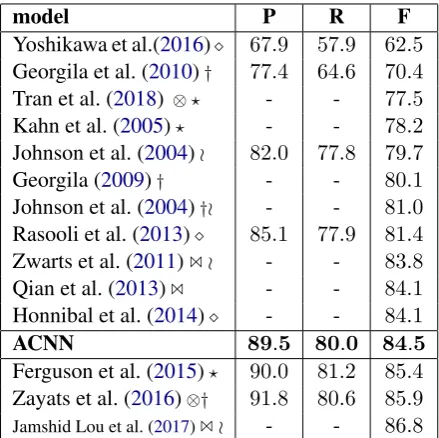
Finally, we compare the ACNN model to state-of-the-art methods from the literature, evaluated on the Switchboard test set. Table5shows that the
ACNN model is competitive with recent models from the literature. The three models that score more highly than the ACNN all rely on hand-crafted features, additional information sources such as partial-word features (which would not be available in a realistic ASR application), or ex-ternal resources such as dependency parsers and language models. The ACNN, on the other hand, only uses whole-word inputs and learns the “rough copy” dependencies between words without re-quiring any manual feature engineering.
model P R F
Yoshikawa et al.(2016) 67.9 57.9 62.5
Georgila et al. (2010)† 77.4 64.6 70.4
Tran et al. (2018) ⊗? - - 77.5
Kahn et al. (2005)? - - 78.2
Johnson et al. (2004)o 82.0 77.8 79.7
Georgila (2009)† - - 80.1
Johnson et al. (2004)†o - - 81.0
Rasooli et al. (2013) 85.1 77.9 81.4
Zwarts et al. (2011)1o - - 83.8
Qian et al. (2013)1 - - 84.1
Honnibal et al. (2014) - - 84.1 ACNN 89.5 80.0 84.5
Ferguson et al. (2015)? 90.0 81.2 85.4
[image:7.595.74.291.607.665.2]Zayats et al. (2016)⊗† 91.8 80.6 85.9 Jamshid Lou et al. (2017)1o - - 86.8
Table 5: Comparison of the ACNN model to the state-of-the-art methods on the Switchboard test set. The other models listed have used richer inputs and/or rely on the output of other systems, as well as pat-tern match features, as indicated by the following symbols: dependency parser, † hand-crafted con-straints/rules, ? prosodic cues, o tree adjoining gram-mar transducer, 1 refined/external language models and⊗partial words. P = precision, R = recall and F = f-score.
5.1 Qualitative Analysis
We conduct an error analysis on the Switchboard dev set to characterize the disfluencies that the ACNN model can capture and those which are dif-ficult for the model to detect. In the following examples, the highlighted words indicate ground truth disfluency labels and the underlined ones are the ACNN predictions.
population
2. They’re handy uh they they come in handy at the most unusual times
3. My mechanics loved it because it was an old it was a sixty-five buick
4. Well I I I think we did I think we did learn some lessons that we weren’t uh we weren’t prepared for
5. Uh I have never even I have never even looked at one closely
6. But uh when I was when my kids were young I was teaching at a university
7. She said she’ll never put her child in a in a in a in a in a preschool
8. Well I think they’re at they’re they’ve come a long way
9. I I like a I saw the the the the tapes that were that were run of marion berry’s drug bust
10. But I know that in some I know in a lot of rural areas they’re not that good
According to examples 1-10, the ACNN detects repetition (e.g. 1, 5) and correctiondisfluencies (e.g. 3, 6, 10). It also captures complex struc-tures where there are multiple or nested disfluen-cies (e.g. 2, 8) or stutter-like repetitions (e.g. 4, 7, 9).
11. My point was that there is for people who don’t want to do the military service it would be neat if there were an alternative. . .
12. I believe from what I remember of the literature they gave uh if you fail I believe they give you one more chance
13. Kind of a coarse kind of test
14. So we could pour concrete and support it with a a nice firm four by four posts
15. But uh I’m afraid I’m I’m probably in the minority
16. Same thing same thing that the her kids had
17. Did you you framed it in uh on on you framed in new square footage
18. And and and there needs to be a line drawn somewhere at reasonable and proper
19. . . . I think there’s a couple of levels of tests in terms of of drugs
20. See they have uh we have two the both c spans here
In some cases where repetitions are fluent, the model has incorrectly detected the first occurence of the word as disfluency (e.g. 13, 14, 15, 19). Moreover, when there is a long distance between reparandum and repair words (e.g. 11, 12), the model usually fails to detect the reparanda. In some sentences, the model is also unable to detect the disfluent words which result in ungrammatical sentences (e.g. 16, 17, 18, 20). In these exam-ples, the undetected disfluencies “the”, “did”, “at” and “two the” cause the residual sentence to be un-grammatical.
We also discuss the types of disfluency captured by the ACNN model, but not by the baseline CNN. In the following examples, the ACNN predictions (underlined words) are the same as the ground truth disfluency labels (highlighted words). The
boldedwords indicate the CNN prediction of dis-fluencies.
21. Uh wellIactually my dad’s my dad’s almost ninety
22. Not a man not a repair man but just a friend
23. we’refrom a county we’re from the county they marched in
24. Now let’s now we’re done
25. And they’ve most of them have been pretty good
26. I do as far as uh as far as uh as far as immi-gration as a whole goes
27. No need to use this to play around with this space stuff anymore
28. We couldn’t survivein ain a juror in a trial system without a jury
29. You stay within your uh within your means
The ACNN model has a generally better perfor-mance in detecting “rough copies” which are im-portant indicator of repetition (e.g. 21, 29), cor-rection(e.g. 22, 23, 24, 25, 27), and stutter-like (e.g. 26, 28, 30) disfluencies.
6 Conclusion
This paper presents a simple new model for disflu-ency detection in spontaneous speech transcripts. It relies on a new auto-correlational kernel that is designed to detect the “rough copy” dependencies that are characteristic of speech disfluencies, and combines it with conventional convolutional ker-nels to form an auto-correlational neural network (ACNN). We show experimentally that using the ACNN model improves over a CNN baseline on disfluency detection task, indicating that the auto-correlational kernel can in fact detect the rough copy dependencies between words in disfluencies. The addition of the auto-correlational kernel per-mits a fairly conventional architecture to achieve near state-of-the-art results without complex hand-crafted features or external information sources.
We expect that the performance of the ACNN model can be further improved in future by us-ing more complex similarity functions and by in-corporating similar kinds of external information (e.g. prosody) used in other disfluency models. In future work, we also intend to investigate other applications of the auto-correlational kernel. The auto-correlational layer is a generic neural net-work layer, so it can be used as a component of other architectures, such as RNNs. It might also be useful in very different applications such as im-age processing.
Acknowledgments
We would like to thank the anonymous review-ers for their insightful comments and sugges-tions. This research was supported by a Google award through the Natural Language Understand-ing Focused Program, and under the Australian Research Councils Discovery Projects funding scheme (project number DP160102156).
References
James Bergstra and Yoshua Bengio. 2012. Random search for hyper-parameter optimization. Journal of Machine Learning Research, 13(1):281–305.
Eugene Charniak and Mark Johnson. 2001. Edit detec-tion and parsing for transcribed speech. In Proceed-ings of the 2ndMeeting of the North American Chap-ter of the Association for Computational Linguistics on Language Technologies (NAACL’01), pages 118– 126, Stroudsburg, USA.
Ronan Collobert and Jason Weston. 2008. A uni-fied architecture for natural language processing: Deep neural networks with multitask learning. In
Proceedings of the 25th International Conference on Machine Learning (ICML’17), pages 160–167, Helsinki, Finland.
James Ferguson, Greg Durrett, and Dan Klein. 2015. Disfluency detection with a semi-Markov model and prosodic features. InProceedings of the Conference of the North American Chapter of the Association for Computational Linguistics: Human Language Technologies (NAACL’15), pages 257–262, Denver, USA.
Kallirroi Georgila. 2009. Using integer linear program-ming for detecting speech disfluencies. In Proceed-ings of the Conference of the North American Chap-ter of the Association for Computational Linguistics: Human Language Technologies (NAACL’09), pages 109–112, Boulder, USA.
Kallirroi Georgila, Ning Wang, and Jonathan Gratch. 2010. Cross-domain speech disfluency detection. In Proceedings of the 11th Annual Meeting of the Special Interest Group on Discourse and Dialogue (SIGDIAL’10), pages 237–240, Tokyo, Japan.
John Godfrey and Edward Holliman. 1993. Switchboard-1 release 2 LDC97S62. Published by: Linguistic Data Consortium, Philadelphia, USA.
Matthew Honnibal and Mark Johnson. 2014. Joint incremental disfluency detection and dependency parsing. Transactions of the Association for Com-putational Linguistics (TACL), 2(1):131–142.
Julian Hough and David Schlangen. 2015. Recurrent neural networks for incremental disfluency detec-tion. InProceedings of the 16th Annual Conference of the International Speech Communication Associ-ation (INTERSPEECH’15), pages 845–853, Dres-den, Germany.
Paria Jamshid Lou and Mark Johnson. 2017. Disflu-ency detection using a noisy channel model and a deep neural language model. InProceedings of the 55thAnnual Meeting of the Association for Compu-tational Linguistics (ACL’17), pages 547–553.
Mark Johnson and Eugene Charniak. 2004. A TAG-based noisy channel model of speech repairs. In
Proceedings of the 42ndAnnual Meeting on Associa-tion for ComputaAssocia-tional Linguistics (ACL’04), pages 33–39, Barcelona, Spain.
Jeremy Kahn, Matthew Lease, Eugene Charniak, Mark Johnson, and Mari Ostendorf. 2005. Effective use of prosody in parsing conversational speech. In
Proceedings of the Conference on Human Lan-guage Technology and Empirical Methods in Natu-ral Language Processing (HLT’05), pages 233–240, Tallinn, Estonia.
Diederik Kingma and Jimmy Ba. 2014. Adam: A method for stochastic optimization. CoRR, abs/1412.6980.
Yang Liu, Elizabeth Shriberg, Andreas Stolckeand, Dustin Hillard, Mari Ostendorf, and Mary Harper. 2006. Enriching speech recognition with auto-matic detection of sentence boundaries and disflu-encies. IEEE/ACM Transactions on Audio, Speech, and Language Processing, 14(5):1526–1540.
Mari Ostendorf and Sangyun Hahn. 2013. A sequential repetition model for improved disfluency detection. In Proceedings of the 14th Annual Conference of the International Speech Communication Associa-tion (INTERSPEECH’13), pages 2624–2628, Lyon, France.
Barbara Plank, Andersand Søgaard, and Yoav Gold-berg. 2016. Multilingual part-of-speech tagging with bidirectional long short-term memory models and auxiliary loss. In Proceedings of the 54th An-nual Meeting of the Association for Computational Linguistics (ACL’16), pages 412–418, Berlin, Ger-many.
Xian Qian and Yang Liu. 2013. Disfluency detection using multi-step stacked learning. In Proceedings of the Conference of the North American Chapter of the Association for Computational Linguistics: Human Language Technologies (NAACL’13), pages 820–825, Atlanta, USA.
Mohammad Sadegh Rasooli and Joel Tetreault. 2013. Joint parsing and disfluency detection in linear time. In Proceedings of the 2013 Conference on Em-pirical Methods in Natural Language Processing (EMNLP’13), pages 124–129, Seattle, USA.
William Schuler, Samir AbdelRahman, Tim Miller, and Lane Schwartz. 2010. Broad-coverage parsing us-ing human-like memory constraints. Computational Linguistics, 36(1):1–30.
Stuart Shieber and Yves Schabes. 1990. Synchronous tree-adjoining grammars. InProceedings of the 13th Conference on Computational Linguistics (COL-ING’90), pages 253–258, Helsinki, Finland.
Elizabeth Shriberg. 1994. Preliminaries to a theory of speech disfluencies. Ph.D. thesis, University of Cal-ifornia, Berkeley, USA.
Nitish Srivastava, Geoffrey Hinton, Alex Krizhevsky, Ilya Sutskever, and Ruslan Salakhutdinov. 2014. Dropout: A simple way to prevent neural networks from overfitting. Journal of Machine Learning Re-search, 15(1):1929–1958.
Trang Tran, Shubham Toshniwal, Mohit Bansal, Kevin Gimpel, Karen Livescu, and Mari Ostendorf. 2018. Parsing speech: A neural approach to integrating lexical and acoustic-prosodic information. In Pro-ceedings of the Conference of the North Amer-ican Chapter of the Association for Computa-tional Linguistics: Human Language Technologies (NAACL’18), pages 69–81, New Orleans, USA.
Masashi Yoshikawa, Hiroyuki Shindo, and Yuji Mat-sumoto. 2016. Joint transition-based dependency parsing and disfluency detection for automatic speech recognition texts. InProceedings of the Con-ference on Empirical Methods in Natural Language Processing (EMNLP’16), pages 1036–1041.
Xiang Yu, Agnieszka Falenska, and Ngoc Thang Vu. 2017. A general-purpose tagger with convolutional neural networks. InProceedings of the 1stWorkshop on Subword and Character Level Models in NLP, pages 124–129, Copenhagen, Denmark.
Victoria Zayats, Mari Ostendorf, and Hannaneh Ha-jishirzi. 2014. Multi-domain disfluency and repair detection. InProceedings of the 15thAnnual Confer-ence of the International Speech Communication As-sociation (INTERSPEECH’15), pages 2907–2911, Singapore.
Victoria Zayats, Mari Ostendorf, and Hannaneh Ha-jishirzi. 2016. Disfluency detection using a bidi-rectional LSTM. InProceedings of the 17thAnnual Conference of the International Speech Communica-tion AssociaCommunica-tion (INTERSPEECH’16), pages 2523– 2527, San Francisco, USA.