Polylingual Topic Models
David Mimno Hanna M. Wallach Jason Naradowsky
University of Massachusetts, Amherst Amherst, MA 01003
{mimno, wallach, narad, dasmith, mccallum}cs.umass.edu
David A. Smith Andrew McCallum
Abstract
Topic models are a useful tool for analyz-ing large text collections, but have previ-ously been applied in only monolingual, or at most bilingual, contexts. Mean-while, massive collections of interlinked documents in dozens of languages, such as Wikipedia, are now widely available, calling for tools that can characterize con-tent in many languages. We introduce a polylingual topic model that discovers top-ics aligned across multiple languages. We explore the model’s characteristics using two large corpora, each with over ten dif-ferent languages, and demonstrate its use-fulness in supporting machine translation and tracking topic trends across languages.
1 Introduction
Statistical topic models have emerged as an in-creasingly useful analysis tool for large text col-lections. Topic models have been used for analyz-ing topic trends in research literature (Mann et al., 2006; Hall et al., 2008), inferring captions for im-ages (Blei and Jordan, 2003), social network anal-ysis in email (McCallum et al., 2005), and expand-ing queries with topically related words in infor-mation retrieval (Wei and Croft, 2006). Much of this work, however, has occurred in monolingual contexts. In an increasingly connected world, the ability to access documents in many languages has become both a strategic asset and a personally en-riching experience. In this paper, we present the polylingual topic model (PLTM). We demonstrate its utility and explore its characteristics using two polylingual corpora: proceedings of the European parliament (in eleven languages) and a collection of Wikipedia articles (in twelve languages).
There are many potential applications for polylingual topic models. Although research liter-ature is typically written in English, bibliographic
databases often contain substantial quantities of work in other languages. To perform topic-based bibliometric analysis on these collections, it is necessary to have topic models that are aligned across languages. Such analysis could be sig-nificant in tracking international research trends, where language barriers slow the transfer of ideas. Previous work on bilingual topic modeling has focused on machine translation applications, which rely on sentence-aligned parallel transla-tions. However, the growth of the internet, and in particular Wikipedia, has made vast corpora oftopicallycomparable texts—documents that are topically similar but are not direct translations of one another—considerably more abundant than ever before. We argue that topic modeling is both a useful and appropriate tool for leveraging correspondences between semantically compara-ble documents in multiple different languages.
In this paper, we use two polylingual corpora to answer various critical questions related to polylingual topic models. We employ a set of di-rect translations, the EuroParl corpus, to evaluate whether PLTM can accurately infer topics when documents genuinely contain the same content. We also explore how the characteristics of dif-ferent languages affect topic model performance. The second corpus, Wikipedia articles in twelve languages, contains sets of documents that are not translations of one another, but are very likely to be about similar concepts. We use this corpus to explore the ability of the model both to infer similarities between vocabularies in different lan-guages, and to detect differences in topic emphasis between languages. The internet makes it possible for people all over the world to access documents from different cultures, but readers will not be flu-ent in this wide variety of languages. By linking topics across languages, polylingual topic mod-els can increase cross-cultural understanding by providing readers with the ability to characterize
the contents of collections in unfamiliar languages and identify trends in topic prevalence.
2 Related Work
Bilingual topic models for parallel texts with word-to-word alignments have been studied pre-viously using the HM-bitam model (Zhao and Xing, 2007). Tam, Lane and Schultz (Tam et al., 2007) also show improvements in machine translation using bilingual topic models. Both of these translation-focused topic models infer word-to-word alignments as part of their inference procedures, which would become exponentially more complex if additional languages were added. We take a simpler approach that is more suit-able for topically similar document tuples (where documents are not direct translations of one an-other) in more than two languages. A recent ex-tended abstract, developed concurrently by Ni et al. (Ni et al., 2009), discusses a multilingual topic model similar to the one presented here. How-ever, they evaluate their model on only two lan-guages (English and Chinese), and do not use the model to detect differences between languages. They also provide little analysis of the differ-ences between polylingual and single-language topic models. Outside of the field of topic mod-eling, Kawaba et al. (Kawaba et al., 2008) use a Wikipedia-based model to perform sentiment analysis of blog posts. They find, for example, that English blog posts about the Nintendo Wii of-ten relate to a hack, which cannot be mentioned in Japanese posts due to Japanese intellectual prop-erty law. Similarly, posts about whaling often use (positive) nationalist language in Japanese and (negative) environmentalist language in English.
3 Polylingual Topic Model
The polylingual topic model (PLTM) is an exten-sion of latent Dirichlet allocation (LDA) (Blei et al., 2003) for modeling polylingual document tu-ples. Each tuple is a set of documents that are loosely equivalent to each other, but written in dif-ferent languages, e.g., corresponding Wikipedia articles in French, English and German. PLTM as-sumes that the documents in a tuple share the same tuple-specific distribution over topics. This is un-like LDA, in which each document is assumed to have its own document-specific distribution over topics. Additionally, PLTM assumes that each “topic” consists of a set of discrete distributions
D N1
T NL
...
wα θ
w z z
...
φ1
φL
β1
[image:2.595.324.510.65.145.2]βL
Figure 1:Graphical model for PLTM.
over words—one for each languagel = 1, . . . , L. In other words, rather than using a single set of topicsΦ ={φ1, . . . ,φT}, as in LDA, there areL sets of language-specific topics,Φ1, . . . ,ΦL, each
of which is drawn from a language-specific sym-metric Dirichlet with concentration parameterβl.
3.1 Generative Process
A new document tuplew= (w1, . . . ,wL)is
gen-erated by first drawing a tuple-specific topic dis-tribution from an asymmetric Dirichlet prior with concentration parameterαand base measurem:
θ∼Dir(θ, αm). (1)
Then, for each language l, a latent topic assign-ment is drawn for each token in that language:
zl∼P(zl|θ) =Qnθzl
n. (2) Finally, the observed tokens are themselves drawn using the language-specific topic parameters:
wl ∼P(wl|zl,Φl) =Qnφlwl
n|zln. (3) The graphical model is shown in figure 1.
3.2 Inference
Given a corpus of training and test document tuples—W and W0, respectively—two possible inference tasks of interest are: computing the probability of the test tuples given the training tuples and inferring latent topic assignments for test documents. These tasks can either be accom-plished by averaging over samples ofΦ1, . . . ,ΦL
andαmfrom P(Φ1, . . . ,ΦL, αm| W0, β) or by evaluating a point estimate. We take the lat-ter approach, and use the MAP estimate forαm
and the predictive distributions over words for
Φ1, . . . ,ΦL. The probability of held-out
docu-ment tuples W0 given training tuples W is then approximated byP(W0|Φ1, . . . ,ΦL, αm).
Topic assignments for a test document tuple
sampling. Gibbs sampling involves sequentially resampling eachzl
nfrom its conditional posterior:
P(zln=t|w,z\l,n,Φ1, . . . ,ΦL, αm)
∝φlwnl|t
(PNt)\l,n+αmt
tNt−1 +α, (4)
wherez\l,nis the current set of topic assignments
for all other tokens in the tuple, while(Nt)\l,nis
the number of occurrences of topictin the tuple, excludingzl
n, the variable being resampled.
4 Results on Parallel Text
Our first set of experiments focuses on document tuples that are known to consist of direct transla-tions. In this case, we can be confident that the topic distribution is genuinely shared across all languages. Although direct translations in multi-ple languages are relatively rare (in contrast with comparable documents), we use direct translations to explore the characteristics of the model.
4.1 Data Set
[image:3.595.312.531.57.487.2]The EuroParl corpus consists of parallel texts in eleven western European languages: Danish, Ger-man, Greek, English, Spanish, Finnish, French, Italian, Dutch, Portuguese and Swedish. These texts consist of roughly a decade of proceedings of the European parliament. For our purposes we use alignments at the speech level rather than the sentence level, as in many translation tasks using this corpus. We also remove the twenty-five most frequent word types for efficiency reasons. The remaining collection consists of over 121 million words. Details by language are shown in Table 1.
Table 1: Average document length, # documents, and unique word types per 10,000 tokens in the EuroParl corpus.
Lang. Avg. leng. # docs types/10k
DA 160.153 65245 121.4
DE 178.689 66497 124.5
EL 171.289 46317 124.2
EN 176.450 69522 43.1
ES 170.536 65929 59.5
FI 161.293 60822 336.2
FR 186.742 67430 54.8
IT 187.451 66035 69.5
NL 176.114 66952 80.8
PT 183.410 65718 68.2
SV 154.605 58011 136.1
Models are trained using 1000 iterations of Gibbs sampling. Each language-specific topic– word concentration parameter βl is set to 0.01.
centralbank europæiske ecb s lån centralbanks
zentralbank ezb bank europäischen investitionsbank darlehen τράπεζα τράπεζας κεντρική εκτ κεντρικής τράπεζες
bank central ecb banks european monetary
banco central europeo bce bancos centrales keskuspankin ekp n euroopan keskuspankki eip banque centrale bce européenne banques monétaire banca centrale bce europea banche prestiti bank centrale ecb europese banken leningen banco central europeu bce bancos empréstimos centralbanken europeiska ecb centralbankens s lån
børn familie udnyttelse børns børnene seksuel kinder kindern familie ausbeutung familien eltern παιδιά παιδιών οικογένεια οικογένειας γονείς παιδικής
children family child sexual families exploitation
niños familia hijos sexual infantil menores lasten lapsia lapset perheen lapsen lapsiin enfants famille enfant parents exploitation familles bambini famiglia figli minori sessuale sfruttamento kinderen kind gezin seksuele ouders familie crianças família filhos sexual criança infantil barn barnen familjen sexuellt familj utnyttjande
mål nå målsætninger målet målsætning opnå ziel ziele erreichen zielen erreicht zielsetzungen στόχους στόχο στόχος στόχων στόχοι επίτευξη
objective objectives achieve aim ambitious set
objetivo objetivos alcanzar conseguir lograr estos
tavoite tavoitteet tavoitteena tavoitteiden tavoitteita tavoitteen objectif objectifs atteindre but cet ambitieux
obiettivo obiettivi raggiungere degli scopo quello doelstellingen doel doelstelling bereiken bereikt doelen objectivo objectivos alcançar atingir ambicioso conseguir mål målet uppnå målen målsättningar målsättning
andre anden side ene andet øvrige
anderen andere einen wie andererseits anderer άλλες άλλα άλλη άλλων άλλους όπως
other one hand others another there
otros otras otro otra parte demás muiden toisaalta muita muut muihin muun autres autre part côté ailleurs même altri altre altro altra dall parte
andere anderzijds anderen ander als kant outros outras outro lado outra noutros andra sidan å annat ena annan DA
DE EL EN ES FI FR IT NL PT SV
DA DE EL EN ES FI FR IT NL PT SV
DA DE EL EN ES FI FR IT NL PT SV
DA DE EL EN ES FI FR IT NL PT SV
Figure 2:EuroParl topics (T=400)
The concentration parameterα for the prior over document-specific topic distributions is initialized to0.01T, while the base measuremis initialized to the uniform distribution. Hyperparametersαm
are re-estimated every 10 Gibbs iterations.
4.2 Analysis of Trained Models
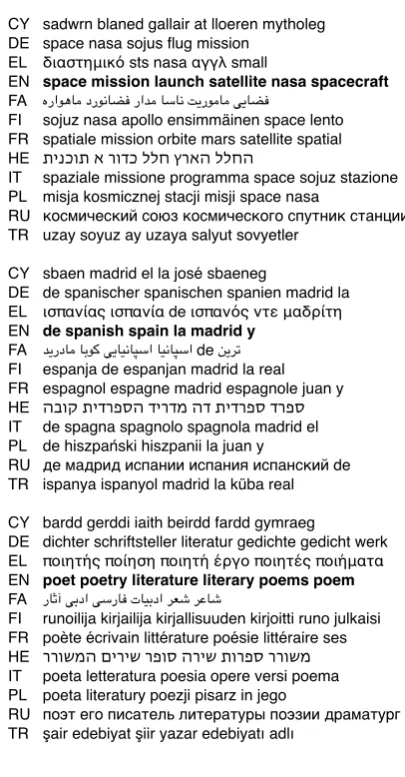
[image:3.595.100.266.586.709.2]related, they use etymologically unrelated words for children. (Interestingly, all languages except Greek and Finnish use closely related words for “youth” or “young” in a separate topic.) The third topic demonstrates differences in inflectional vari-ation. English and the Romance languages use only singular and plural versions of “objective.” The other Germanic languages include compound words, while Greek and Finnish are dominated by inflected variants of the same lexical item. The fi-nal topic demonstrates that PLTM effectively clus-ters “syntactic” words, as well as more semanti-cally specific nouns, adjectives and verbs.
Although the topics in figure 2 seem highly fo-cused, it is interesting to ask whether the model is genuinely learning mixtures of topics or simply assigning entire document tuples to single topics. To answer this question, we compute the posterior probability of each topic in each tuple under the trained model. If the model assigns all tokens in a tuple to a single topic, the maximum posterior topic probability for that tuple will be near to 1.0. If the model assigns topics uniformly, the maxi-mum topic probability will be near1/T. We com-pute histograms of these maximum topic prob-abilities for T ∈ {50,100,200,400,800}. For clarity, rather than overlaying five histograms, fig-ure 3 shows the histograms converted into smooth curves using a kernel density estimator.1 Although
there is a small bump around 1.0 (for extremely short documents, e.g., “Applause”), values are generally closer to, but greater than,1/T.
0.0 0.2 0.4 0.6 0.8 1.0
0
2
4
6
8
10
12
Smoothed histograms of max(P(t))
Maximum topic probability in document
Density
[image:4.595.315.508.436.552.2]800 topics 400 topics 200 topics 100 topics 50 topics
Figure 3: Smoothed histograms of the probability of the most probable topic in a document tuple.
Although the posterior distribution over topics for each tuple is not concentrated on one topic, it is worth checking that this is not simply be-cause the model is assigning a single topic to the
1We use the Rdensityfunction.
tokens in each of the languages. Although the model does not distinguish between topic assign-ment variables within a given docuassign-ment tuple (so it is technically incorrect to speak of different pos-terior distributions over topics for different docu-ments in a given tuple), we can nevertheless divide topic assignment variables between languages and use them to estimate a Dirichlet-multinomial pos-terior distribution for each language in each tuple. For each tuple we can then calculate the Jensen-Shannon divergence (the average of the KL di-vergences between each distribution and a mean distribution) between these distributions. Figure 4 shows the density of these divergences for differ-ent numbers of topics. As with the previous fig-ure, there are a small number of documents that contain only one topic in all languages, and thus have zero divergence. These tend to be very short, formulaic parliamentary responses, however. The vast majority of divergences are relatively low (1.0 indicates no overlap in topics between languages in a given document tuple) indicating that, for each tuple, the model is not simply assigning all tokens in a particular language to a single topic. As the number of topics increases, greater variability in topic distributions causes divergence to increase.
0.0 0.1 0.2 0.3 0.4 0.5
0
5
10
15
20
Smoothed histograms of inter−language JS divergence
Jensen−Shannon Divergence
Density
[image:4.595.81.272.521.637.2]800 topics 400 topics 200 topics 100 topics 50 topics
Figure 4: Smoothed histograms of the Jensen-Shannon divergences between the posterior probability of topics be-tween languages.
4.3 Language Model Evaluation
A topic model specifies a probability distribution over documents, or in the case of PLTM, docu-ment tuples. Given a set of training docudocu-ment tu-ples, PLTM can be used to obtain posterior esti-mates ofΦ1, . . . ,ΦLandαm. The probability of
Analytically calculating the probability of a set of held-out document tuples givenΦ1, . . . ,ΦLand
[image:5.595.318.505.122.225.2]αmis intractable, due to the summation over an exponential number of topic assignments for these held-out documents. However, recently developed methods provide efficient, accurate estimates of this probability. We use the “left-to-right” method of (Wallach et al., 2009). We perform five esti-mation runs for each document and then calculate standard errors using a bootstrap method.
[image:5.595.93.270.409.530.2]Table 2 shows the log probability of held-out data in nats per word for PLTM and LDA, both trained with 200 topics. There is substantial varia-tion between languages. Addivaria-tionally, the predic-tive ability of PLTM is consistently slightly worse than that of (monolingual) LDA. It is important to note, however, that these results do not imply that LDA should be preferred over PLTM—that choice depends upon the needs of the modeler. Rather, these results are intended as a quantitative analy-sis of the difference between the two models.
Table 2: Held-out log probability in nats/word. (Smaller magnitude implies better language modeling performance.) PLTM does slightly worse than monolingual LDA models, but the variation between languages is much larger.
Lang PLTM sd LDA sd
DA -8.11 0.00067 -8.02 0.00066 DE -8.17 0.00057 -8.08 0.00072 EL -8.44 0.00079 -8.36 0.00087 EN -7.51 0.00064 -7.42 0.00069 ES -7.98 0.00073 -7.87 0.00070 FI -9.25 0.00089 -9.21 0.00065 FR -8.26 0.00072 -8.19 0.00058 IT -8.11 0.00071 -8.02 0.00058 NL -7.84 0.00067 -7.75 0.00099 PT -7.87 0.00085 -7.80 0.00060 SV -8.25 0.00091 -8.16 0.00086
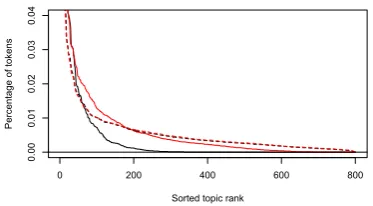
As the number of topics is increased, the word counts per topic become very sparse in mono-lingual LDA models, proportional to the size of the vocabulary. Figure 5 shows the proportion of all tokens in English and Finnish assigned to each topic under LDA and PLTM with 800 topics. More than 350 topics in the Finnish LDA model have zero tokens assigned to them, and almost all tokens are assigned to the largest 200 topics. En-glish has a larger tail, with non-zero counts in all but 16 topics. In contrast, PLTM assigns a sig-nificant number of tokens to almost all 800 top-ics, in very similar proportions in both languages. PLTM topics therefore have a higher granularity – i.e., they are more specific. This result is impor-tant: informally, we have found that increasing the
granularity of topics correlates strongly with user perceptions of the utility of a topic model.
0 200 400 600 800
0.00
0.01
0.02
0.03
0.04
Sorted topic rank
Percentage of tokens
Figure 5: Topics sorted by number of words assigned. Finnish is in black, English is in red; LDA is solid, PLTM is dashed. LDA in Finnish essentially learns a 200 topic model when given 800 topics, while PLTM uses all 800 topics.
4.4 Partly Comparable Corpora
An important application for polylingual topic modeling is to use small numbers of comparable document tuples to link topics in larger collections of distinct, non-comparable documents in multiple languages. For example, a journal might publish papers in English, French, German and Italian. No paper is exactly comparable to any other paper, but they are all roughly topically similar. If we wish to perform topic-based bibliometric analysis, it is vital to be able to track the same topics across all languages. One simple way to achieve this topic alignment is to add a small set of comparable doc-ument tuples that provide sufficient “glue” to bind the topics together. Continuing with the exam-ple above, one might extract a set of connected Wikipedia articles related to the focus of the jour-nal and then train PLTM on a joint corpus consist-ing of journal papers and Wikipedia articles.
In order to simulate this scenario we create a set of variations of the EuroParl corpus by treat-ing some documents as if they have no paral-lel/comparable texts – i.e., we put each of these documents in a single-document tuple. To do this, we divide the corpusW into two sets of document tuples: a “glue” setGand a “separate” setSsuch that|G|/|W|=p. In other words, the proportion of tuples in the corpus that are treated as “glue” (i.e., placed in G) is p. For every tuple inS, we assign each document in that tuple to a new single-document tuple. By doing this, every single-document in
doc-uments inG will be sufficient to align the topics across languages, and will cause comparable doc-uments inSto have similar distributions over top-ics even though they are modeled independently.
Table 3: The effect of the proportionpof “glue” tuples on mean Jensen-Shannon divergence in estimated topic distribu-tions for pairs of documents inSthat were originally part of a document tuple. Lower divergence means the topic distri-butions distridistri-butions are more similar to each other.
p Mean JS # of pairs Std. Err. 0.01 0.83755 487670 0.00018 0.05 0.79144 467288 0.00021 0.1 0.70228 443753 0.00026 0.25 0.38480 369608 0.00029 0.5 0.29712 246380 0.00030
Table 4: Topics are meaningful within languages but di-verge between languages when only 1% of tuples are treated as “glue” tuples. With 25% “glue” tuples, topics are aligned.
lang Topics atp= 0.01
DE rußland russland russischen tschetschenien sicherheit EN china rights human country s burma
FR russie tch´etch´enie union avec russe r´egion IT ho presidente mi perch´e relazione votato lang Topics atp= 0.25
DE rußland russland russischen tschetschenien ukraine EN russia russian chechnya cooperation region belarus FR russie tch´etch´enie avec russe russes situation
IT russia unione cooperazione cecenia regione russa
We train PLTM with 100 topics on corpora with p ∈ {0.01,0.05,0.1,0.25,0.5}. We use 1000 it-erations of Gibbs sampling with β = 0.01. Hy-perparameters αm are re-estimated every 10 it-erations. We calculate the Jensen-Shannon diver-gence between the topic distributions for each pair of individual documents inS that were originally part of the same tuple prior to separation. The lower the divergence, the more similar the distri-butions are to each other. From the results in fig-ure 4, we know that leaving all document tuples intact should result in a mean JS divergence of less than 0.1. Table 3 shows mean JS divergences for each value ofp. As expected, JS divergence is greater than that obtained when all tuples are left intact. Divergence drops significantly when the proportion of “glue” tuples increases from 0.01 to 0.25. Example topics forp = 0.01andp = 0.25
are shown in table 4. Atp= 0.01(1% “glue” doc-uments), German and French both include words relating to Russia, while the English and Italian word distributions appear locally consistent but
unrelated to Russia. Atp = 0.25, the top words for all four languages are related to Russia.
These results demonstrate that PLTM is appro-priate for aligning topics in corpora that have only a small subset of comparable documents. One area for future work is to explore whether initializa-tion techniques or better representainitializa-tions of topic co-occurrence might result in alignment of topics with a smaller proportion of comparable texts.
4.5 Machine Translation
Although the PLTM is clearly not a substitute for a machine translation system—it has no way to represent syntax or even multi-word phrases—it is clear from the examples in figure 2 that the sets of high probability words in different languages for a given topic are likely to include translations. We therefore evaluate the ability of the PLTM to gen-erate bilingual lexica, similar to other work in un-supervised translation modeling (Haghighi et al., 2008). In the early statistical translation model work at IBM, these representations were called “cepts,” short for concepts (Brown et al., 1993).
We evaluate sets of high-probability words in each topic and multilingual “synsets” by compar-ing them to entries in human-constructed bilcompar-ingual dictionaries, as done by Haghighi et al. (2008). Unlike previous work (Koehn and Knight, 2002), we evaluate all words, not just nouns. We col-lected bilingual lexica mapping English words to German, Greek, Spanish, French, Italian, Dutch and Swedish. Each lexicon is a set of pairs con-sisting of an English word and a translated word,
{we, w`}. We do not consider multi-word terms.
We expect that simple analysis of topic assign-ments for sequential words would yield such col-locations, but we leave this for future work.
For every topic twe select a small number K of the most probable words in English (e) and in each “translation” language (`): Wte andWt`,
“comitalogia”) that simply were not in the lexica. We also do not count morphological variants: the model finds EN “rules” and DE “vorschriften,” but the lexicon contains only “rule” and “vorschrift.” Results remain strong as we increase K. With K = 3, T = 800, 1349 of the 7200 candidate pairs for Spanish appeared in the lexicon.
● ●
●
●
●
200 400 600 800
0
100
200
300
400
500
Translation pairs at K=1
Topics
Correct translations
● ●
●
●
●
● ●
●
●
●
● ●
●
●
●
● ● ●
●
●
● ● ●
●
●
[image:7.595.318.502.57.178.2]ES FR IT DE SV EL
Figure 6: Are the single most probable words for a given topic in different languages translations of each other? The number of such pairs that appear in bilingual lexica is shown on the y-axis. ForT = 800, the top English and Spanish words in 448 topics were exact translations of one another.
4.6 Finding Translations
In addition to enhancing lexicons by aligning topic-specific vocabulary, PLTM may also be use-ful for adapting machine translation systems to new domains by finding translations or near trans-lations in an unstructured corpus. These aligned document pairs could then be fed into standard machine translation systems as training data. To evaluate this scenario, we train PLTM on a set of document tuples from EuroParl, infer topic distri-butions for a set of held-out documents, and then measure our ability to align documents in one lan-guage with their translations in another lanlan-guage.
It is not necessarily clear that PLTM will be ef-fective at identifying translations. In finding a low-dimensional semantic representation, topic mod-els deliberately smooth over much of the varia-tion present in language. We are therefore inter-ested in determining whether the information in the document-specific topic distributions is suffi-cient to identify semantically identical documents. We begin by dividing the data into a training set of 69,550 document tuples and a test set of 17,435 document tuples. In order to make the task more difficult, we train a relatively coarse-grained PLTM with 50 topics on the training set. We then use this model to infer topic distributions for each
40
50
60
70
80
90
100
Min query doc length
% of transl at rank
0 50 100 200
Rank 1 Rank 5 Rank 10
Rank 20
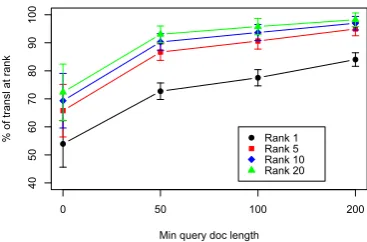
Figure 7: Percent of query language documents for which the target language translation is ranked at or above 1, 5, 10 or 20 by JS divergence, averaged over all language pairs.
of the 11 documents in each of the held-out doc-ument tuples using a method similar to that used to calculate held-out probabilities (Wallach et al., 2009). Finally, for each pair of languages (“query” and “target”) we calculate the difference between the topic distribution for each held-out document in the query language and the topic distribution for each held-out document in the target language. We use both Jensen-Shannon divergence and cosine distance. For each document in the query language we rank all documents in the target language and record the rank of the actual translation.
Results averaged over all query/target language pairs are shown in figure 7 for Jensen-Shannon divergence. Cosine-based rankings are signifi-cantly worse. It is important to note that the length of documents matters. As noted before, many of the documents in the EuroParl collection consist of short, formulaic sentences. Restrict-ing the query/target pairs to only those with query and target documents that are both longer than 50 words results in significant improvement and re-duced variance: the average proportion of query documents for which the true translation is ranked highest goes from 53.9% to 72.7%. Performance continues to improve with longer documents, most likely due to better topic inference. Results vary by language. Table 5 shows results for all tar-get languages with English as a query language. Again, English generally performs better with Ro-mance languages than Germanic languages.
5 Results on Comparable Texts
[image:7.595.80.273.180.295.2]cor-CY DE
EL EN
FA FI
FR
HE
IT
PL RU
TR
CY DE
EL EN
FA FI
FR
HE
IT
PL RU
TR
CY DE
EL EN
FA FI
FR
HE
IT
PL RU
[image:8.595.106.498.70.198.2]TR
Figure 8: Squares represent the proportion of tokens in each language assigned to a topic. The left topic,world ski km won, centers around Nordic counties. The center topic,actor role television actress, is relatively uniform. The right topic,ottoman empire khan byzantine, is popular in all languages but especially in regions near Istanbul.
Table 5:Percent of English query documents for which the translation was in the topn∈ {1,5,10,20}documents by JS divergence between topic distributions. To reduce the effect of short documents we consider only document pairs where the query and target documents are longer than 100 words.
Lang 1 5 10 20
DA 78.0 90.7 93.8 95.8 DE 76.6 90.0 93.4 95.5 EL 77.1 90.4 93.3 95.2 ES 81.2 92.3 94.8 96.7 FI 76.7 91.0 94.0 96.3 FR 80.1 91.7 94.3 96.2 IT 79.1 91.2 94.1 96.2 NL 76.6 90.1 93.4 95.5 PT 80.8 92.0 94.7 96.5 SV 80.4 92.1 94.9 96.5
pora – documents that are topically similar but are not direct translations of one another – consider-ably more abundant than true parallel corpora.
In this section, we explore two questions re-lating to comparable text corpora and polylingual topic modeling. First, we explore whether com-parable document tuples support the alignment of fine-grained topics, as demonstrated earlier using parallel documents. This property is useful for building machine translation systems as well as for human readers who are either learning new languages or analyzing texts in languages they do not know. Second, because comparable texts may not use exactly the same topics, it becomes cru-cially important to be able to characterize differ-ences in topic prevalence at the document level (do different languages have different perspectives on the same article?) and at the language-wide level (which topics do particular languages focus on?).
5.1 Data Set
We downloaded XML copies of all Wikipedia ar-ticles in twelve different languages: Welsh, Ger-man, Greek, English, Farsi, Finnish, French, He-brew, Italian, Polish, Russian and Turkish. These versions of Wikipedia were selected to provide a diverse range of language families, geographic ar-eas, and quantities of text. We preprocessed the data by removing tables, references, images and info-boxes. We dropped all articles in non-English languages that did not link to an English article. In the English version of Wikipedia we dropped all articles that were not linked to by any other lan-guage in our set. For efficiency, we truncated each article to the nearest word after 1000 characters and dropped the 50 most common word types in each language. Even with these restrictions, the size of the corpus is 148.5 million words.
We present results for a PLTM with 400 topics. 1000 Gibbs sampling iterations took roughly four days on one CPU with current hardware.
5.2 Which Languages Have High Topic Divergence?
[image:8.595.114.250.325.436.2]sadwrn blaned gallair at lloeren mytholeg space nasa sojus flug mission
διαστημικό sts nasa αγγλ small
space mission launch satellite nasa spacecraft ﻓ ﻀ ﺎﯾ ﯽ ﻣ ﺎ ﻣ ﻮ ﺭ ﯾ ﺖ ﻧﺎ ﺳ ﺎ ﻣ ﺪ ﺍ ﺭ ﻓ ﻀ ﺎﻧ ﻮ ﺭ ﺩ ﻣ ﺎ ﻫ ﻮ ﺍ ﺭ ﻩ
sojuz nasa apollo ensimmäinen space lento spatiale mission orbite mars satellite spatial
ה ח ל ל ה א ר ץ ח ל ל כ ד ו ר א ת ו כ נ י ת
spaziale missione programma space sojuz stazione misja kosmicznej stacji misji space nasa
космический союз космического спутник станции uzay soyuz ay uzaya salyut sovyetler
sbaen madrid el la josé sbaeneg
de spanischer spanischen spanien madrid la ισπανίας ισπανία de ισπανός ντε μαδρίτη de spanish spain la madrid y
ﺍ ﺳ ﭙﺎ ﻧﯿ ﺎ ﺍ ﺳ ﭙﺎ ﻧﯿ ﺎﯾ ﯽ 3 ﻮ ﺑﺎ ﻣ ﺎ ﺩ ﺭ ﯾ
ﺪ de ﻦﯾﺮﺗ
espanja de espanjan madrid la real espagnol espagne madrid espagnole juan y
ס פ ר ד ס פ ר ד י ת ד ה מ ד ר י ד ה ס פ ר ד י ת ק ו ב ה
de spagna spagnolo spagnola madrid el de hiszpański hiszpanii la juan y
де мадрид испании испания испанский de ispanya ispanyol madrid la küba real
bardd gerddi iaith beirdd fardd gymraeg
dichter schriftsteller literatur gedichte gedicht werk ποιητής ποίηση ποιητή έργο ποιητές ποιήματα poet poetry literature literary poems poem
ﺷ ﺎ ﻋ ﺮ ﺷ ﻌ ﺮ ﺍ ﺩ ﺑﯿ ﺎ ﺕ ﻓ ﺎ ﺭ ﺳ ﯽ ﺍ ﺩ ﺑ ﯽ ﺁﺛ ﺎ ﺭ
runoilija kirjailija kirjallisuuden kirjoitti runo julkaisi poète écrivain littérature poésie littéraire ses
מ ש ו ר ר ס פ ר ו ת ש י ר ה ס ו פ ר ש י ר י ם ה מ ש ו ר ר
poeta letteratura poesia opere versi poema poeta literatury poezji pisarz in jego
поэт его писатель литературы поэзии драматург şair edebiyat şiir yazar edebiyatı adlı
[image:9.595.77.280.63.452.2]CY DE EL EN FA FI FR HE IT PL RU TR CY DE EL EN FA FI FR HE IT PL RU TR CY DE EL EN FA FI FR HE IT PL RU TR
Figure 9:Wikipedia topics (T=400).
Overall, these scores indicate that although indi-vidual pages may show disagreement, Wikipedia is on average consistent between languages.
5.3 Are Topics Emphasized Differently Between Languages?
Although we find that if Wikipedia contains an ar-ticle on a particular subject in some language, the article will tend to be topically similar to the arti-cles about that subject in other languages, we also find that across the whole collection different lan-guages emphasize topics to different extents. To demonstrate the wide variation in topics, we cal-culated the proportion of tokens in each language assigned to each topic. Figure 8 represents the es-timated probabilities of topics given a specific lan-guage. Competitive cross-country skiing (left) ac-counts for a significant proportion of the text in Finnish, but barely exists in Welsh and the lan-guages in the Southeastern region. Meanwhile,
interest in actors and actresses (center) is consis-tent across all languages. Finally, historical topics, such as the Byzantine and Ottoman empires (right) are strong in all languages, but show geographical variation: interest centers around the empires.
6 Conclusions
We introduced a polylingual topic model (PLTM) that discovers topics aligned across multiple lan-guages. We analyzed the characteristics of PLTM in comparison to monolingual LDA, and demon-strated that it is possible to discover aligned top-ics. We also demonstrated that relatively small numbers of topically comparable document tu-ples are sufficient to align topics between lan-guages in non-comparable corpora. Additionally, PLTM can support the creation of bilingual lexica for low resource language pairs, providing candi-date translations for more computationally intense alignment processes without the sentence-aligned translations typically used in such tasks. When applied to comparable document collections such as Wikipedia, PLTM supports data-driven analysis of differences and similarities acrossalllanguages for readers who understandany onelanguage.
7 Acknowledgments
The authors thank Limin Yao, who was involved in early stages of this project. This work was supported in part by the Center for Intelligent formation Retrieval, in part by The Central In-telligence Agency, the National Security Agency and National Science Foundation under NSF grant number IIS-0326249, and in part by Army prime contract number W911NF-07-1-0216 and Uni-versity of Pennsylvania subaward number 103-548106, and in part by National Science Founda-tion under NSF grant #CNS-0619337. Any opin-ions, findings and conclusions or recommenda-tions expressed in this material are the authors’ and do not necessarily reflect those of the sponsor.
References
David Blei and Michael Jordan. 2003. Modeling an-notated data. InSIGIR.
David Blei, Andrew Ng, and Michael Jordan. 2003. Latent Dirichlet allocation. JMLR.
Peter F Brown, Stephen A Della Pietra, Vincent J Della Pietra, and Robert L Mercer. 1993. The mathemat-ics of statistical machine translation: Parameter
Aria Haghighi, Percy Liang, Taylor Berg-Kirkpatrick, and Dan Klein. 2008. Learning bilingual lexicons
from monolingual corpora. InACL, pages 771–779.
David Hall, Daniel Jurafsky, and Christopher D. Man-ning. 2008. Studying the history of ideas using
topic models. InEMNLP.
Mariko Kawaba, Hiroyuki Nakasaki, Takehito Utsuro, and Tomohiro Fukuhara. 2008. Cross-lingual blog analysis based on multilingual blog distillation from
multilingual Wikipedia entries. InICWSM.
Philipp Koehn and Kevin Knight. 2002. Learn-ing a translation lexicon from monolLearn-ingual corpora. In Proceedings of ACL Workshop on Unsupervised Lexical Acquisition.
Gideon Mann, David Mimno, and Andrew McCal-lum. 2006. Bibliometric impact measures leverag-ing topic analysis. InJCDL.
Andrew McCallum, Andr´es Corrada-Emmanuel, and Xuerui Wang. 2005. Topic and role discovery in social networks. InIJCAI.
Xiaochuan Ni, Jian-Tao Sun, Jian Hu, and Zheng Chen. 2009. Mining multilingual topics from Wikipedia.
InWWW.
Yik-Cheung Tam, Ian Lane, and Tanja Schultz. 2007. Bilingual LSA-based adaptation for statistical
ma-chine translation. Machine Translation, 28:187–
207.
Hanna Wallach, Iain Murray, Ruslan Salakhutdinov, and David Mimno. 2009. Evaluation methods for topic models. InICML.
Xing Wei and Bruce Croft. 2006. LDA-based docu-ment models for ad-hoc retrieval. InSIGIR. Bing Zhao and Eric P. Xing. 2007. HM-BiTAM: