Proceedings of NAACL-HLT 2019, pages 1239–1255 1239
Disentangling Language and Knowledge in Task-Oriented Dialogs
Dinesh Raghu∗1 2, Nikhil Gupta1 and Mausam1
1 IIT Delhi, New Delhi, India 2IBM Research, New Delhi, India
[email protected], [email protected], [email protected]
Abstract
The Knowledge Base (KB) used for real-world applications, such as booking a movie or restaurant reservation, keeps changing over time. End-to-end neural networks trained for these task-oriented dialogs are expected to be immune to any changes in the KB. However, existing approaches breakdown when asked to handle such changes. We propose an encoder-decoder architecture (BOSSNET) with a novel Bag-of-Sequences (BOSS) memory, which fa-cilitates the disentangled learning of the re-sponse’s language model and its knowledge incorporation. Consequently, the KB can be modified with new knowledge without a drop in interpretability. We find that BOSSNET out-performs state-of-the-art models, with consid-erable improvements (>10%) on bAbI OOV test sets and other human-human datasets. We also systematically modify existing datasets to measure disentanglement and show BOSSNET
to be robust to KB modifications.
1 Introduction
Task-oriented dialog agents converse with a user with the goal of accomplishing a specific task and often interact with a knowledge-base (KB). For example, a restaurant reservation agent (Henderson et al.,2014) will be grounded to a KB that contains the names of restaurants, and their details.
In real-world applications, the KB information could change over time. For example, (1) a KB associated with a movie ticket booking system gets updated every week based on new film releases, and (2) a restaurant reservation agent, trained with the knowledge of eateries in one city, may be deployed in other cities with an entirely different range of es-tablishments. In such situations, the system should have the ability to conform to new-found knowl-edge unseen during its training. Ideally, the training algorithm must learn to disentangle the language
∗
[image:1.595.313.522.209.326.2]D. Raghu is an employee at IBM Research. This work was carried out as part of PhD research at IIT Delhi.
Figure 1: Performance of various task-oriented dialog systems on the CamRest dataset as the percentage of unseen information in the KB changes.
model from the knowledge interface model. This separation will enable the system to generalize to KB modifications, without a loss in performance.
Moreover, for achieving good progress towards the user’s task, the agent must also retain the ability to draw inferences based on past utterances and the KB. Notably, we find that existing approaches either achieve this disentanglement or effective progress towards the task, but not both.
over long dialogs found in real-world datasets and its ability to learn the task gets hampered.
We propose BOSSNET, a novel network that ef-fectively disentangles the language and knowledge models, and also achieves state-of-the-art perfor-mance on three existing datasets.
To achieve this, BOSSNET makes two design
choices. First, it encodes the conversational input as abag of sequences(BOSS) memory, in which the input representation is built at two levels of abstraction. Thehigher levelflat memory encodes the KB tuples and utterances to facilitate effective inferencing over them. Thelower levelencoding of each individual utterance and tuple is constructed via a sequence encoder (Bi-GRU). This enables the model to maintain the sequential context surround-ing each token, aidsurround-ing in better interpretation of unseen tokens at test time. Second, we augment the standard cross-entropy loss used in dialog sys-tems with an additional loss term to encourage the model to only copy KB tokens in a response, in-stead of generating them via the language model. This combination of sequence encoding and addi-tional loss (along with dropout) helps in effective disentangling between language and knowledge.
We perform evaluations over three datasets – bAbI (Bordes and Weston,2017), CamRest (Wen et al.,2016), and Stanford Multi-Domain Dataset (Eric et al.,2017). Of these, the last two are real-world datasets. We find that BOSSNETis competi-tive or significantly better on standard metrics in all datasets as compared to state-of-the-art baselines. We also introduce aknowledge adaptability(KA) evaluation, in which we systematically increase the percentage of previously unseen entities in the KB. We find that BOSSNETis highly robust across all percentage levels. Finally, we also report a human-based evaluation and find that BOSSNETresponses are frequently rated higher than other baselines.
Overall, our contributions are:
1. We propose BOSSNET, a novel architecture to disentangle the language model from knowl-edge incorporation in task-oriented dialogs.
2. We introduce aknowledge adaptability evalu-ation to measure the ability of dialog systems to scale performance to unseen KB entities.
3. Our experiments show that BOSSNETis
com-petitive or significantly better, measured via standard metrics, than the existing baselines on three datasets.
Dialog History KB Tuples Encoder Decoder M em or y C el l R epr es ent at ions T oke n R epr es ent at ions
what is the food type they serve ? they serve indian food . Bag-of-Sequences (BoSs) Memory
𝑐"# 𝑐"$
{𝑐&$, 𝑐&#, ⋯ 𝑐")&$ , 𝑐")&# }
[image:2.595.308.529.69.254.2]{𝑘𝑏&, 𝑘𝑏-, ⋯ 𝑘𝑏.}
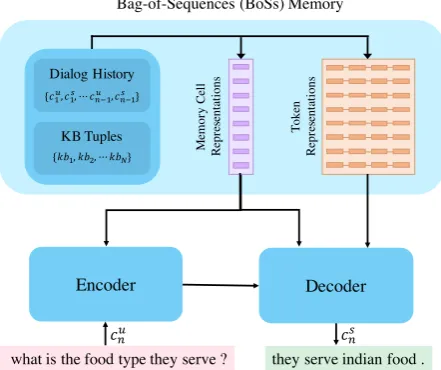
Figure 2: The dialog history and KB tuples stored in the memory have memory cell representations and to-ken representations. The encoder understands the last user utterance using only the memory cell representa-tions. The decoder generates the next response using both representations.
We release our code andknowledge adaptabil-ity(KA) test sets for further use by the research community.1
2 TheBOSSNET Architecture
The proposed Bag-of-Sequences Memory Network has an encoder-decoder architecture that takes as input (1) dialog history, which includes a sequence of previous user utterances{cu1, . . . , cun}and sys-tem responses{cs1, . . . , csn−1}, and (2) KB tuples {kb1, . . . , kbN}. The network then generates the next system responsecsn=hy1y2. . . yTi word-by-word. The simplified architecture of BOSSNETis
shown in Figure2.
In this section, we first describe the BOSS mem-ory which contains the dialog histmem-ory and KB tu-ples, followed by how the memory is consumed by the encoder and the decoder. We finally define the loss function, which, along with dropout, enables disentangled learning of language and knowledge.
2.1 Bag-of-Sequences Memory
The memory M contains the dialog history {cu1, cs1, . . . , cun−1, csn−1} and the KB tuples {kb1, . . . , kbN}. Each utterance in the dialog history and each KB tuple is placed in a memory cell. As utterances and tuples are inherently a sequence, we represent each memory cell mi as
an ordered sequence of tokenshw1
iw2i . . . w
|mi|
i i. For an utterance, the word tokens are followed by a temporal indicator and a speaker indicator {$u, $s}. For example, {good, morning, #1, $s} indicates this was the first utterance by the system. For a KB tuple, the tokens are sequenced as{subject, predicate, object}followed by temporal indicator and a kb indicator ($db).
Token representation is generated using a bidi-rectional GRU. Let the outputs of the forward and backward GRUs for the token wji be denoted as −
→
hji and ←−
hji respectively. Then the token represen-tationφ(wij)is given by Eq. 1. Memory cell rep-resentationψ(mi)is computed by concatenating the forward GRU output of its last token and the backward GRU output of its first token as in Eq.2.
φ(wij) = [
− →
hji;
←−
hji] (1)
ψ(mi) = [
−−→
h|mi|
i ; ←−
h1i] (2)
2.2 TheBOSSNETEncoder
The encoder used in BOSSNET is similar to the multi-hop attention encoder with layer-wise weights proposed bySukhbaatar et al.(2015). The encoder inSukhbaatar et al. (2015) uses two dif-ferent embedding matrices, whereas we use just one to reduce the number of parameters. The en-coder considers the last user utterance as the query
q =ψ(cun)and computes the reduced representa-tionqrusing the memoryM as follows:
pi = softmax(qTψ(mi)) (3)
o = Wr
X
ipiψ(mi) (4)
qr = o+Woq (5)
whereWr, Wo ∈Rd×dare learnable parameters.
The hop step can be re-iterated, by assigning the output of the previous hop as the new input query, i.e., settingq=qr. The output of the encoder after
K hops,qrk, is assigned as the initial state of the BOSSNETdecoder.
2.3 TheBOSSNETDecoder
BOSSNETmodels a copy-augmented sequence de-coder, which generates the response one word at a time. At any decode time stept, the decoder can eithergeneratea word from the decode vocabulary orcopya word from the memory. Consequently, the decoder computes: (1) generate distribution
Pg(yt) over the decode vocabulary, and (2) copy distributionPc(yt)over words in the memory.
The generate distribution is computed using a standard sequence decoder (Sutskever et al.,2014) by attending (Luong et al.,2015) over the memory cell representations ψ. The copy distribution is generated by using atwo-level attention. Given the decoder statest, it first computes attentionαt over the memory cells. Then it computes attention over the tokens in each memory cellmi. Finally it multiplies both these attentions to computePc(yt) as follows:
αti =softmax(stψ(mi)) (6)
etij =stφ(wji) (7)
βijt =αti∗ exp(e t ij)
P
kexp(etik)
(8)
Pc(yt=w) =
X
ij:wji=w
βtij (9)
The copy and generate distributions are com-bined using a soft gategst ∈[0,1]as inSee et al.
(2017).gstis a function of the decoder state at time
tand the word decoded in the previous time step.
2.4 Loss
The decoder is trained using cross-entropy loss. The loss per response is defined as:
Lce =− T
X
t=1
loggstPg(yt) + (1−gst)Pc(yt)
(10) whereT is the number of words in the sequence to be generated andytis the word to be generated at time stept. The decision to generate or copy is learnt implicitly by the network. However, to attain perfect disentanglement, the KB words should be copied, while the language should be generated. In other words, any word in the response that is present in the BOSSKB memory should have a low
gs. To obtain this behavior, we define a disentangle labelDlfor each word in the response. This label is set to1if the word is present in the BOSSKB memory and0otherwise. We define a disentangle loss as follows:
Ld=− T
X
t=1
gstlogDlt+ (1−gst)log(1−Dtl) (11)
copy KB words whenever possible, based on their surrounding words. The overall loss is given as:
L=Lce+γLd (12)
The relative weight of Ld in the overall loss is controlled using a hyper-parameter (γ). The dropout rate is also a hyper-parameter.
3 Experimental Setup
We perform experiments on three task-oriented di-alog datasets: bAbI Didi-alog (Bordes and Weston,
2017), CamRest (Wen et al.,2016), and Stanford Multi-Domain Dataset (Eric et al.,2017).
bAbI Dialogconsists of synthetically generated dialogs with the goal of restaurant reservation. The dataset consists of five different tasks, all grounded to a KB. This KB is split into two mutually exclu-sive halves. One half is used to generate the train, validation, and test sets, while the other half is used to create a second test set called the OOV test set.
CamRestis a human-human dialog dataset, col-lected using the Wiz-of-Oz framework, also aimed at restaurant reservation. It is typically used to evaluate traditional slot filling systems. In order to make it suitable for end-to-end learning, we stripped the handcrafted state representations and annotations in each dialog, and divided the 676 available dialogs into train, validation, and test sets (406, 135, and 135 dialogs, respectively).
Stanford Multi-Domain Dataset (SMD) is an-other human-human dialog dataset collected using the Wiz-of-Oz framework. Each conversation is between a driver and an in-car assistant. The other datasets consist of dialogs from just one domain (restaurant reservation), whereas SMD consists of dialogs from multiple domains (calendar schedul-ing, weather information retrieval, and navigation).
3.1 Knowledge Adaptability (KA) Test Sets
Each bAbI dialog task has an additional OOV test set, which helps to evaluate a model’s robustness to change in information in the KB. A model that per-fectly disentangles language and knowledge should have no drop in accuracy on the OOV test set when compared to the non-OOV test set. To measure the degree of disentanglement in a model, we gen-erated 10 additional test sets for each real-world corpus by varying the percentage (in multiples of 10) of unseen entities in the KB. We systematically picked random KB entities and replaced all their oc-currences in the dialog with new entity names. We
will refer to these generated dialogs as the Knowl-edge Adaptability(KA) test sets.
3.2 Baselines
We compare BOSSNET against several existing end-to-end task-oriented dialog systems. These in-clude retrieval models, such as the query reduction network (QRN) (Seo et al., 2017), memory net-work (MN) (Bordes and Weston,2017), and gated memory network (GMN) (Liu and Perez, 2017). We also compare against generative models such as a sequence-to-sequence model (Seq2Seq), a copy augmented Seq2Seq (Seq2Seq+Copy) (Gulcehre et al.,2016), and Mem2Seq (Madotto et al.,2018).2 For fairness across models, we do not compare against key-value retrieval networks (Eric et al.,
2017) as they simplify the dataset by canonicaliz-ing all KB words in dialogs.
We noticed that the reported results in the Mem2Seq paper are not directly comparable, as they pre-processed3 training data in SMD and bAbI datasets. For fair comparisons, we re-run Mem2Seq on the original training datasets. For completeness we mention their reported results (with pre-processing) as Mem2Seq*.
3.3 Evaluation Metrics
We evaluate BOSSNET and other models based on their ability to generate valid responses. The per-response accuracy (Bordes and Weston,2017) is the percentage of generated responses that ex-actly match their respective gold response. The per-dialog accuracy is the percentage of dialogs with all correctly generated responses. These ac-curacy metrics are a good measure for evaluating datasets with boilerplate responses such as bAbI.
To quantify performance on other datasets, we use BLEU (Papineni et al., 2002) and Entity F1 (Eric and Manning,2017) scores. BLEU measures the overlap of n-grams between the generated re-sponse and its gold rere-sponse and has become a popular measure to compare task-oriented dialog systems. Entity F1 is computed by micro-F1 over KB entities in the entire set of gold responses.
2We thank the authors for releasing a working code at
https://github.com/HLTCHKUST/Mem2Seq
3
3.4 Human Evaluation
We use two human evaluation experiments to com-pare (1) theusefulnessof a generated response with respect to solving the given task, and (2) the gram-matical correctnessandfluencyof the responses on a 0–3 scale. We obtain human annotations by creat-ing Human Intelligence Tasks (HITs) on Amazon Mechanical Turk (AMT). For each test condition (percentage of unseen entities), we sampled 50 di-alogs from Camrest and SMD each, and two AMT workers labeled each system response for both ex-periments, resulting in 200 labels per condition per dataset per system. We evaluate four systems in this study, leading to a total of 1600 labels per con-dition. The detailed setup is given in the Appendix.
3.5 Training
We train BOSSNET using an Adam optimizer (Kingma and Ba,2014) and apply gradient clip-ping with a clip-value of 40. We identify hyper-parameters based on the evaluation of the held-out validation sets. We sample word embedding, hid-den layer, and cell sizes from{64, 128, 256}and learning rates from{10−3, 5×10⁻⁴, 10−4}. The hyper-parameterγin the loss function is chosen be-tween [0-1.5]. The Disentangle Label Dropout rate is sampled from{0.1, 0.2}. The number of hops for multi-hop attention in the encoder is sampled from{1, 3, 6}. The best hyper-parameter setting for each dataset is reported in the Appendix.
4 Experimental Results
Our experiments evaluate three research questions. 1. Performance Study: How well is BOSSNET
able to perform the tasks of our three datasets as compared to the baseline models?
2. Disentanglement Study: How robust are the models in generalizing on the KA test sets? 3. Ablation Study: What is the performance gain
from each novel feature in BOSSNET?
4.1 Performance Study
Table1reports the per-response and per-dialog (in parentheses) accuracies on the bAbI dialog tasks. The multi-hop retrieval-based models such as QRN, MN and GMN perform well on the non-OOV test sets for tasks 1, 2, and 5, but fail to exhibit sim-ilar performance on the corresponding OOV test sets. This result is expected as these models are trained to retrieve from a pdefined set of re-sponses. Their poor non-OOV performance on
tasks 3 and 4 is attributed to an error in the bAbI dataset construction, due to which, the non-OOV and OOV test conditions are the same for these tasks (see Appendix).
A simple generative model (Seq2Seq) achieves accuracies comparable to the multi-hop retrieval models. Enabling it with the ability to copy from the context (Seq2Seq+Copy) shows a considerable increase in performance, especially on the OOV test sets (and non-OOV tests for tasks 3 and 4).
The strong performance of simple sequence en-coders when compared with multi-hop enen-coders (in retrieval models) raises a question about the value of multi-hop inference. Mem2Seq answers this question, by obtaining improvements in sev-eral tasks, specifically on their OOV test sets. This clearly shows that multi-hop inference and the copy mechanism are essentials for task-oriented dialogs. Despite gains from the Mem2Seq model, the performance difference between the non-OOV and OOV test sets remains large. BOSSNETsucceeds
to bridge this gap with its ability to better inter-pret unseen words, using their surrounding con-text. It obtains significant improvements on av-erage of about 34% per-dialog accuracy and 10% per-response accuracy for the bAbI OOV test sets. In Table2, we report results on the real-world datasets. BOSSNET greatly outperforms other
models in both Entity F1 metric and BLEU scores on CamRest. On SMD, BOSSNET achieves the best only in Entity F1. On further analysis of the generated responses we observe that BOSS -NETresponses often convey the necessary entity information from the KB. However, they consist of meaningful phrases with little lexical overlap with the gold response, reducing the BLEU scores. We investigate this further in our human evaluation.
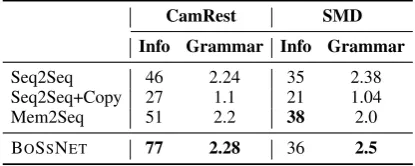
Human Evaluation: We summarize the human evaluation results for real-world datasets in Ta-ble 3. BOSSNET shows the best performance on Camrest, and is judged useful 77 times out of 100. Also, it has the highest average grammatical correctness score of 2.28 (very close to Seq2Seq and Mem2Seq). BOSSNETperforms on par with
Mem2Seq and Seq2Seq in its ability to relay appro-priate information to solve SMD dialog tasks, and has a slightly higher grammaticality score.
4.2 Disentanglement Study
Retrieval Models Generative Models
Task QRN MN GMN Mem2Seq* Seq2Seq Seq2Seq+Copy Mem2Seq BOSSNET
T1 99.9 (-) 99.6 (99.6) 100 (100) 100 (100) 100 (100) 100 (100) 100 (100) 100 (100) T2 99.5 (-) 100 (100) 100 (100) 100 (100) 100 (100) 100 (100) 100 (100) 100 (100) T3 74.8 (-) 74.9 (2.0) 74.9 (0) 94.7 (62.1) 74.8 (0) 85.1 (19.0) 74.9 (0) 95.2 (63.8) T4 57.2 (-) 59.5 (3.0) 57.2 (0) 100 (100) 57.2 (0) 100 (100) 100 (100) 100 (100) T5 99.6 (-) 96.1 (49.4) 96.3 (52.5) 97.9 (69.6) 97.2 (64.4) 96 (49.1) 97.7(66.3) 97.3 (65.6)
T1-OOV 83.1 (-) 72.3 (0) 82.4 (0) 94.0 (62.2) 81.7 (0) 92.5 (54.7) 94.0 (62.2) 100 (100) T2-OOV 78.9 (-) 78.9 (0) 78.9 (0) 86.5 (12.4) 78.9 (0) 83.2 (0) 86.5 (12.4) 100 (100) T3-OOV 75.2 (-) 74.4 (0) 75.3 (0) 90.3 (38.7) 75.3 (0) 82.9 (0) 75.2 (0) 95.7 (66.6) T4-OOV 56.9 (-) 57.6 (0) 57.0 (0) 100 (100) 57.0 (0) 100 (100) 100 (100) 100 (100) T5-OOV 67.8 (-) 65.5 (0) 66.7 (0) 84.5 (2.3) 67.4 (0) 73.6 (0) 75.6 (0) 91.7 (18.5)
Table 1: Per-response and per-dialog accuracies (in brackets) on bAbI dialog tasks of BOSSNETand baselines .
CamRest SMD
BLEU Ent. F1 BLEU Ent. F1
Mem2Seq* 12.7 39 12.6 33.4
Seq2Seq 11.4 40.6 8.7 34.9
Seq2Seq+Copy 4.7 32.2 3.23 16.9
Mem2Seq 12.7 39 10.3 31.8
BOSSNET 15.2 43.1 8.3 35.9
Table 2: Performance of BOSSNET and baselines on the CamRest and SMD datasets
CamRest SMD
Info Grammar Info Grammar
Seq2Seq 46 2.24 35 2.38
Seq2Seq+Copy 27 1.1 21 1.04
Mem2Seq 51 2.2 38 2.0
[image:6.595.77.285.386.469.2]BOSSNET 77 2.28 36 2.5
Table 3: AMT Evaluations on CamRest and SMD
and the other baselines to changes in the KB. We perform this experiment on 4 different tasks, namely bAbI tasks 1 and 5, CamRest, and SMD.
Figures3and4show the per-response accura-cies of the two bAbI dialog tasks plotted against the percentage of unseen entities in KA sets. From Figure3 we observe that BOSSNETremains
im-mune to any variablity in the KB content, whereas the performance of Mem2Seq and Seq2Seq models drops drastically due to their inability to capture semantic representations of the injected KB enti-ties. We see a similar trend in Figure4, but here all the models show a drop in performance, with BOSSNETappearing the most steady. We explain this trend using the example dialog in Table4. In the current dialog context, the system is required to provide the address of the selected restaurant, but since more than one restaurant in the KB is unseen, it becomes ambiguous for the network to identify
KB (restaurant—address)
r bangkok overpriced thai 8—r bangkok overpriced thai 8 addr r bangkok overpriced thai 7—r bangkok overpriced thai 7 addr r bangkok overpriced thai 4—r bangkok overpriced thai 4 addr r bangkok overpriced thai 2—r bangkok overpriced thai 2 addr
usr-1 may i have a table in anoverpricedprice range for
ninepeople withthaifood inbangkok?
sys-1 what do you think of :r bangkok overpriced thai 8?
usr-2 can you provide the address ?
Gold here it isr bangkok overpriced thai 8 addr
Seq2Seq+Copy here it isr bangkok overpriced thai 4 addr
Seq2Seq here it isr london moderate spanish 6 addr
Mem2Seq here it isr bangkok overpriced thai 4 addr
BOSSNET here it isr bangkok overpriced thai 4 addr
Table 4: Example from bAbI Task 5 KA test set with 100% OOV entities. Identifying the address of an un-seen restaurant is challenging for all models.
the correct restaurant and infer its address. In the end, the system is forced to pick a random address – the probability of which being correct decreases
as more restaurants become unseen.
The performance on the CamRest KA test sets is illustrated in Figures 1 and5. BOSSNET has
the best performance with even a slight increase in both BLEU and Entity F1 metrics as more OOV content is injected in the dialog, probably because it is clear that it needs to copy when processing unseen entities. Seq2Seq+Copy is unable to per-form well in CamRest as the length of the input (dialog history + KB tuples) is long and the size of the training set is also small. We believe that Seq2Seq+Copy works best in an environment with an abundance of short dialog training data (e.g., bAbI task 1 in Figure3).
CamRest SMD
Info Grammar Info Grammar
Seq2Seq 26 2.28 22 2.44
Seq2Seq+Copy 22 1.22 16 1.04
Mem2Seq 35 2.06 26 1.9
[image:7.595.77.288.64.146.2]BOSSNET 80 2.44 51 2.28
Table 5: AMT Evaluations on CamRest and SMD (50% unseen) KA datasets
its ability to inference efficiently on the large KB (Figure6). Mem2Seq shows the best BLEU score performance on the original test set, but its perfor-mance drop of 42.5%, from 10.3 at 0% unseen to 5.93 at 100% unseen, is a lot heavier than that of BOSSNET which only drops 7.6% – 8.27 at 0% unseen to 7.64 at 100% unseen.
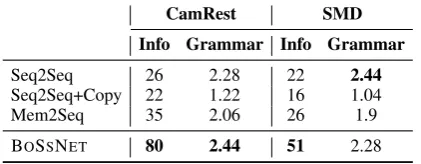
Human Evaluation: We summarize the human evaluation results for real-world datasets on the 50% unseen KA test set in Table5. BOSSNET
again outperforms the baselines and is labeled suc-cessfultwice more often than the next best model on both Camrest and SMD. Seq2Seq appears to pro-duce better sentence structures on the SMD dataset, primarily because it does not attempt to learn in-ference on the KB, allowing it to solely focus on learning the language model better.
4.3 Ablation Study
We assess the value of each model element, by removing it from BOSSNET. Table6reports the per-response accuracy scores for various configu-rations of BOSSNETon bAbI dialog tasks. It also reports the BLEU and entity F1 metric of various configurations on CamRest.
Without BoSs Memory:This configuration uses the Bag-of-Bags (BoB) Memory rather than BOSS
memory. The BoB memory is a simplified repre-sentation, similar to the one in the original Memory Networks. Here the token representation is the vec-tor embedding of the token with no influence from the surrounding words and the memory cell repre-sentation is the sum of all its token embeddings. As a result, each wordwrepresentation is influenced equally by all words in a memory cell, irrespec-tive of its distance fromw. This makes capturing context in the immediate neighbourhood harder. In-ability to capture the correct context prevents the configuartion from generalizing to OOV test sets.
Without Disentangled Loss: Disentangled Loss (Ld) plays an important role in enforcing that KB words be copied and other language be generated.
By removing this loss component, it achieves better BLEU score in CamRest, but with a drop in Entity F1. Without the disentangled loss, the model some-times learns to generate KB words. This severely affects OOV performance. As described earlier, an error in bAbI dataset construction tasks 3 and 4 effectively injects the validation set with a lot of OOVs. This anomaly in conjunction with the dropout (DLD), helps the configuration in achiev-ing an acceptable performance for those tasks.
Without Disentangled Label Dropout: BOSS -NET learns to generate language and copy KB words. Without DLD, the model learns to memo-rize words to be copied rather than learning the con-text under which a word should be copied. Hence, the performance on OOV test sets is much inferior compared to the non-OOV setting.
Overall, we notice that combining all three model elements is necessary in obtaining the best performance across all tasks.
4.4 Qualitative Evaluation
We qualitatively compare the performance of BOSSNETwith other baselines using examples.
Table7, demonstrates the ability of BOSSNET
to copy entities (restaurant name and address) in its response. The other baselines either generate unwanted or irrelevant entities in their response, or fail to copy altogether. BOSSNETalso best
cap-tures the language model effectively with a slight paraphrasing of the gold response.
Table8contains only unseen entities. This ex-ample highlights the shortcomings of the Seq2Seq model as it ends up predicting a restaurant encoun-tered during training. Mem2Seq copies a restaurant name without learning to sort the restaurants based on rating. BOSSNET, with its efficient memory addressing, is seen to be able to solve both issues.
5 Related Work
Compared to the traditional slot-filling based dia-log (Williams and Young,2007;Wen et al.,2017;
Figure 3: bAbI Task 1: Per-response accuracy compar-ison on KA sets
Figure 4: bAbI Task 5: Per-response accuracy compar-ison on KA sets
Figure 5: CamRest: Entity F1 comparison on KA sets Figure 6: SMD: Entity F1 comparison on KA sets
bAbI Dialog Tasks bAbI Dialog Tasks (OOV) CamRest
T1 T2 T3 T4 T5 T1 T2 T3 T4 T5 BLEU Ent. F1
BOSSNETw/o BOSSMemory 100 100 74.9 57.2 95.6 93.5 78.9 74.9 57 81.4 10.13 29 BOSSNETw/oLd 100 100 91.7 100 94.3 83.2 78.9 92.7 100 66.7 15.5 40.1 BOSSNETw/o DLD 100 100 93.4 100 95.3 79.2 84.6 90.7 100 78.1 12.4 40.45
BOSSNET 100 100 95.2 100 97.3 100 100 95.7 100 91.7 15.2 43.1
Table 6: Ablation study: impact of each model element on BOSSNET
Most of the existing end-to-end approaches re-trievea response from a pre-defined set (Bordes and Weston,2017;Liu and Perez,2017;Seo et al.,
2017). These methods are generally successful when they have to provide boilerplate responses – they cannot construct responses by using words in KB not seen during training. Alternatively, gen-erative approaches are used where the response is
generatedone word at a time (Eric and Manning,
2017;Madotto et al.,2018). These approaches mit-igate the unseen entity problem by incorporating the ability to copy words from the input (Vinyals et al.,2015;Gu et al.,2016). The copy mechanism has also found success in summarization (Nallapati et al.,2016;See et al.,2017) and machine transla-tion (Gulcehre et al.,2016). BOSSNETis also a copy incorporated generative approach.
For encoding, some approaches represent the
dialog history as a sequence (Eric and Manning,
[image:8.595.315.523.238.363.2] [image:8.595.71.285.238.363.2] [image:8.595.90.511.395.476.2]KB (restaurant—cuisine—address—phone)
pizza hut fen ditton—italian—cambridge retail park newmarket road fen ditton—01223 323737
usr-1 may i have information for anitalianrestaurant in theeastpart of town ?
sys-1 yes sure . there is only onitalianrestaurant calledpizza hut fen dittonin theeast. what else do you want to know ?
usr-2 what is their address please ?
Gold the address forpizza hut fen dittoniscambridge retail park newmarket road fen ditton. can i help you with anything else ?
Seq2Seq+Copy their address is at
Seq2Seq curry princeis at451 newmarket road fen ditton
Mem2Seq pizza hut fen dittonis located at7 barnwell road fen dittonis7 barnwell road fen dittonand the phone number is01223 244955
BOSSNET pizza hut fen dittonis located atcambridge retail park newmarket road fen dittonis there anything else i can help you with
Table 7: An example of responses generated by BOSSNETand baselines on the CamRest test set. Thia example has no unseen entities.
KB (restaurant—cuisine—price range—location—rating)
resto tokyo affordable vietnamese 8stars—vietnamese—affordable—tokyo—8 resto tokyo affordable vietnamese 7stars—vietnamese—affordable—tokyo—7 resto tokyo affordable vietnamese 6stars—vietnamese—affordable—tokyo—6 resto tokyo affordable vietnamese 5stars—vietnamese—affordable—tokyo—5
usr-1 can you book a table intokyowithvietnamesefood in aaffordableprice range ? sys-1 what do you think of this option :resto tokyo affordable vietnamese 8stars? usr-2 no this does not work for me .
sys-2 what do you think of this option :resto tokyo affordable vietnamese 7stars? usr-3 do you have something else ?
Gold what do you think of this option :resto tokyo affordable vietnamese 6stars
Seq2Seq+Copy what do you think of this option : what ?
Seq2Seq what do you think of this option :resto london moderate british 2stars?
Mem2Seq what do you think of this option :resto tokyo affordable vietnamese 5stars?
BOSSNET what do you think of this option :resto tokyo affordable vietnamese 6stars?
Table 8: An example of responses generated by BOSSNETand baselines on bAbI dialog Task-5. This example is from the KA test set with 100% unseen entities.
6 Conclusions
We propose BOSSNET for training task-oriented
dialog systems in an end-to-end fashion. BOSS -NETcombines a novel bag of sequences memory for storing a dialog history and KB tuples, with a copy-augmented generative decoder to construct di-alog responses. It augments standard cross entropy loss of a sequence decoder with an additional term to encourage the model to copy KB words. BOSS
memory and new loss term, in conjunction with a disentangle label dropout, enables the decoder to disentangle its language and knowledge models.
BOSSNETachieves the state of the art results on bAbI dialog dataset, outperforming existing mod-els by 10 points or more in its OOV conditions. In the knowledge adaptability test, we find that BOSSNET is highly robust to increasing the
per-centage of unseen entities at test time, suggesting a good language-knowledge disentanglement. Hu-man evaluations show that BOSSNET responses are highly informative and slightly more grammat-ical compared to baselines. We will release our code and all curated datasets for further research.
Acknowledgments
References
Antoine Bordes and Jason Weston. 2017. Learning end-to-end goal-oriented dialog. In International Conference on Learning Representations.
Mihail Eric, Lakshmi Krishnan, Francois Charette, and Christopher D. Manning. 2017. Key-value retrieval networks for task-oriented dialogue. InDialog Sys-tem Technology Challenges, Saarbr¨ucken, Germany, August 15-17, 2017, pages 37–49.
Mihail Eric and Christopher Manning. 2017. A copy-augmented sequence-to-sequence architecture gives good performance on task-oriented dialogue. In Pro-ceedings of the 15th Conference of the European Chapter of the Association for Computational Lin-guistics: Volume 2, Short Papers, pages 468–473. Association for Computational Linguistics.
Jiatao Gu, Zhengdong Lu, Hang Li, and Victor O.K. Li. 2016. Incorporating copying mechanism in sequence-to-sequence learning. In Proceedings of the 54th Annual Meeting of the Association for Com-putational Linguistics (Volume 1: Long Papers), pages 1631–1640. Association for Computational Linguistics.
Caglar Gulcehre, Sungjin Ahn, Ramesh Nallapati, Bowen Zhou, and Yoshua Bengio. 2016. Pointing the unknown words. InProceedings of the 54th An-nual Meeting of the Association for Computational Linguistics (Volume 1: Long Papers), pages 140– 149. Association for Computational Linguistics.
Matthew Henderson, Blaise Thomson, and Steve Young. 2014. Word-based dialog state tracking with re- current neural networks. InIn Proceedings of the 15th Annual Meeting of the Special Interest Group on Discourse and Dialogue (SIGDIAL), pages 292– 299.
Diederik P Kingma and Jimmy Lei Ba. 2014. Adam: Amethod for stochastic optimization. InProc. 3rd Int. Conf. Learn. Representations.
Fei Liu and Julien Perez. 2017. Gated end-to-end mem-ory networks. In Proceedings of the 15th Confer-ence of the European Chapter of the Association for Computational Linguistics: Volume 1, Long Papers, volume 1, pages 1–10.
Thang Luong, Hieu Pham, and Christopher D. Man-ning. 2015. Effective approaches to attention-based neural machine translation. In Proceedings of the 2015 Conference on Empirical Methods in Natural Language Processing, pages 1412–1421. Associa-tion for ComputaAssocia-tional Linguistics.
A. Madotto, CS. Wu, and P. Fung. 2018. Mem2seq: Ef-fectively incorporating knowledge bases into end-to-end task-oriented dialog systems. InProceedings of 56th Annual Meeting of the Association for Compu-tational Linguistics. Association for CompuCompu-tational Linguistics.
Ramesh Nallapati, Bowen Zhou, Cicero dos Santos, Caglar Gulcehre, and Bing Xiang. 2016. Abstrac-tive text summarization using sequence-to-sequence rnns and beyond. In Proceedings of The 20th SIGNLL Conference on Computational Natural Lan-guage Learning, pages 280–290. Association for Computational Linguistics.
Kishore Papineni, Salim Roukos, Todd Ward, and Wei-Jing Zhu. 2002. Bleu: a method for automatic eval-uation of machine translation. In Proceedings of the 40th annual meeting on association for compu-tational linguistics, pages 311–318. Association for Computational Linguistics.
Abigail See, Peter J. Liu, and Christopher D. Manning. 2017. Get to the point: Summarization with pointer-generator networks. InProceedings of the 55th An-nual Meeting of the Association for Computational Linguistics (Volume 1: Long Papers), pages 1073– 1083. Association for Computational Linguistics.
Minjoon Seo, Sewon Min, Ali Farhadi, and Hannaneh Hajishirzi. 2017. Query-reduction networks for question answering. InInternational Conference on Learning Representations.
Sainbayar Sukhbaatar, Jason Weston, Rob Fergus, et al. 2015. End-to-end memory networks. InAdvances in neural information processing systems, pages 2440–2448.
Ilya Sutskever, Oriol Vinyals, and Quoc V Le. 2014. Sequence to sequence learning with neural networks.
In Advances in neural information processing
sys-tems, pages 3104–3112.
Oriol Vinyals, Meire Fortunato, and Navdeep Jaitly. 2015. Pointer networks. InAdvances in Neural In-formation Processing Systems, pages 2692–2700.
TH Wen, D Vandyke, N Mrkˇs´ıc, M Gaˇs´ıc, LM Rojas-Barahona, PH Su, S Ultes, and S Young. 2017. A network-based end-to-end trainable task-oriented di-alogue system. In 15th Conference of the Euro-pean Chapter of the Association for Computational Linguistics, EACL 2017-Proceedings of Conference, volume 1, pages 438–449.
Tsung-Hsien Wen, Milica Gasic, Nikola Mrkˇsi´c, Lina M. Rojas Barahona, Pei-Hao Su, Stefan Ultes, David Vandyke, and Steve Young. 2016. Condi-tional generation and snapshot learning in neural dialogue systems. In EMNLP, pages 2153–2162, Austin, Texas. ACL.
Jason D Williams, Kavosh Asadi, and Geoffrey Zweig. 2017. Hybrid code networks: practical and efficient end-to-end dialog control with supervised and rein-forcement learning. InProceedings of the 55th An-nual Meeting of the Association for Computational Linguistics (Volume 1: Long Papers), volume 1, pages 665–677.
A Two-Level attention on BoSs Memory
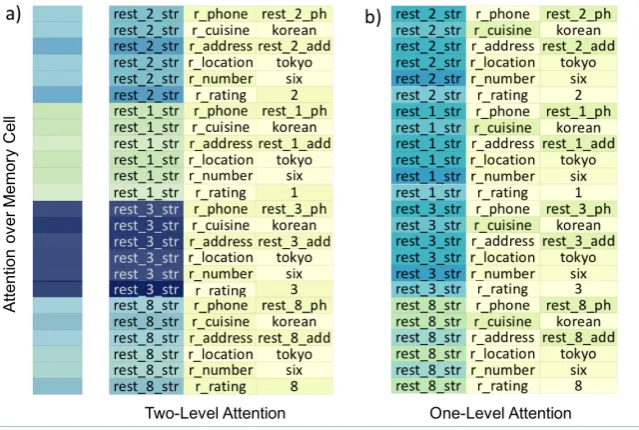
To visualize the benefit of two-level attention used on BOSS memory by the decoder, we compare
attention weights for two models: our proposed
two-level attentionand a variant with justone-level attention(over all the words in the memory). In the example of a sample dialog from bAbI Task 3, shown in Figure7, the decoder is aimed at predict-ing the second best restaurant3 stars, given that the restaurant with rating8 starshas already been suggested and rejected. We show attention only on the KB entries for brevity.
The models share some similarities in their dis-tribution of attention. First, the attention weights are localized over the restaurant names, indicating the preference of the system to point to a specific restaurant. This is supported by thegsvalues,3.14 x10−5and1.15x10−4for two-level attention and one-level attention respectively, i.e., both models prefer to copy rather than generate. Moreover, en-tries with the same restaurant name have similar attention weights, reflecting the robustness of the distribution.
We also observe that two-level attention is able to perform the difficult task ofsortingthe restaurant entries based on decreasing order of rating (number of stars). It gives more weight to entries with a high rating (3 stars>2 stars>1 star) and suppresses the weights of any previously suggested restaurant.
The attention over memory cells provides BOSS -NETwith the ability to infer over multiple sets of tuples. The ability to sort the restaurants and re-ject a previously seen restaurant can be observed by the attention heat map of Memory cells. Atten-tion over tokens on the other hand can push the attention weights towards either the subject or ob-ject in the KB tuple, based on the query’s request. Thus using both in conjunction helps BOSSNET
perform significantly better than the baselines and illustrates the importance of the BOSSmemory in
comparison to a flat memory layout.
B Reproducibility
We list out the complete set of hyperparameters used to train BOSSNET for the various datasets
in Table9. Our code will be made publicably ac-cessible for future research purposes. Our trained models and evaluation scripts will also be provided. We will also make our end-to-end reconstruced Camrest dataset along with our whole batch of knowledge adaptability test sets available.
C Example Predictions ofBOSSNET and Baselines
Examples from SMD is shown in Table12 respec-tively. Examples from KA test set with percentage of unseen entites set to 50 from CamRest and SMD are shown in Table11and Table13respectively. Examples from KA test set with percentage of un-seen entites set to 100 from bAbI dialog Task 1 is shown in Table10.
D Dataset Preprocessing and Faults
D.1 Mem2Seq Preprocessing
Mem2Seq paper used the following pre-processing on the data:
1. The subject (restaurant name) and object (rat-ing) positions of the rating KB tuples in bAbI dialogs are flipped, while the order remains the same for other tuples remains the same. This pre-processing is illustrated in Figure8
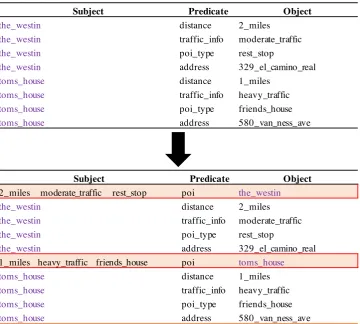
2. an extra fact was added to the navigation tasks in In-Car Assistant with all the properties (such as distance, address) combined together as the subject andpoias the object. This pre-processing is illustrated in Figure9
The pre-processing has major impact on the perfor-mance of Mem2Seq, as it can only copy objects of a KB tuple, while the subject and relation can never be copied.
D.2 bAbI Dataset Faults
The KB entities present in validation and non-OOV test sets for task 3 and 4 do not overlap with those in the train set. This effectively means that non-OOV and non-OOV test conditions are the same for tasks 3 and 4. This explains the low performance of baseline models on task 3 and 4 non-OOV test sets.
E AMT Setup
Figure 7: Visualization of attention weights on selected portions of memory in (a) BOSSNET with two-level attention vs (b) BOSSNETwith one-level attention
Task Learning Rate Hops Embedding Size Disentangle Loss Weight DLD
T1 0.001 1 128 1.0 0.2
T2 0.001 1 128 1.0 0.2
T3 0.0005 3 128 1.5 0.2
T4 0.001 1 128 1.0 0.2
T5 0.0005 3 256 1.0 0.2
CamRest 0.0005 6 256 1.0 0.2
[image:12.595.133.466.368.457.2]SMD 0.0005 3 256 1.0 0.1
Table 9: The hyperparameters used to train BOSSNETon the different datasets .
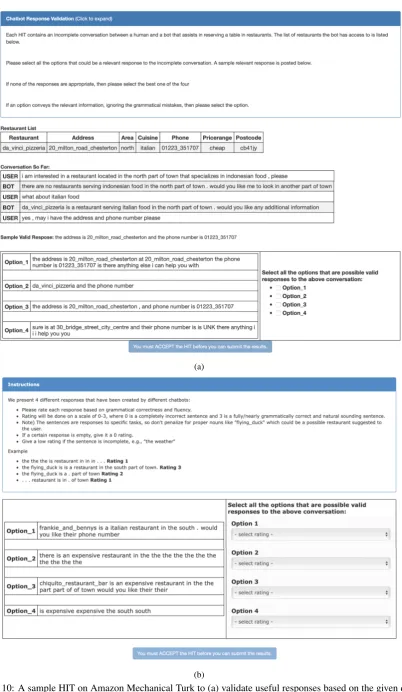
Response Grammar Test We show a sample of an Human Intelligence Task (HIT) on Amazon Me-chanical Turk in Figure 10b. We randomize the responses generated by the three baseline models and BOSSNETon the same dialog and ask the user to rate each response based on the grammatical correctness and natural flow of the sentence. The rating ranges from 0-3 where 0 being the worst and 3 being the best. Note) the sentences were not asked to be rated with respect to each other, but instead as individual occurrences. A total of 200 such annotations were collected for Camrest and
SMD each.
F Multi-Hop vs 1-Hop Encoders
usr-1 good morning
sys-1 hello what can i help you with today
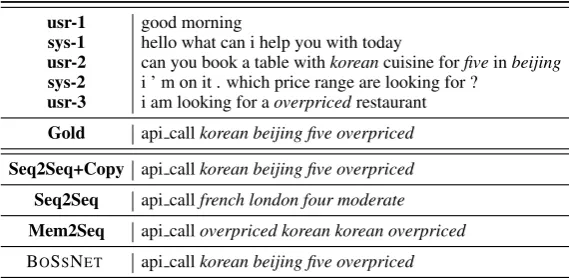
usr-2 can you book a table withkoreancuisine forfiveinbeijing
sys-2 i ’ m on it . which price range are looking for ? usr-3 i am looking for aoverpricedrestaurant
Gold api callkorean beijing five overpriced
Seq2Seq+Copy api callkorean beijing five overpriced
Seq2Seq api callfrench london four moderate
Mem2Seq api calloverpriced korean korean overpriced
[image:13.595.156.441.81.220.2]BOSSNET api callkorean beijing five overpriced
Table 10: Example from bAbI dialog Task 1 with 100% OOV.
KB (restaurant—cuisine—address—phone—postcode)
prezzo—ethiopian—22 atlantis road—01799 521260—cb30ad
usr-1 i want amoderately expensive ethiopianrestaurant in thesouthside of town
sys-1 i ’ m sorry . i can not find amoderately expensive ethiopianrestaurant in thesouthside of town usr-2 i would like to find amoderatelypriced restaurant in thewestpart of town
sys-2 prezzois a moderately pricedethiopianrestaurant in thewestpart of town . there is alsoindianand britishfood available in that area and price range . would you like more info ?
usr-3 yes can i get thier address and postcode ?
Gold of course ,prezzo’ s address is22 atlantis roadand postcode iscb30ad
Seq2Seq+Copy postcode a is is01223350688UNK there get i for for today
Seq2Seq the address is83 regent streetand their postcode iscb58aq
Mem2Seq the phone address iscb21uj
[image:13.595.83.525.289.477.2]BOSSNET the address is22 atlantis road at 22 atlantis roadthe postcode iscb30adis there anything else i can help you with
Table 11: Example from Camrest with 50% OOV. The OOV entities present in the dialog are {ethiopian,
22 atlantis road}
KB (location—distance—traffic info—address)
teavana—4 miles—no traffic—145 amherst st cafe venetia—5 miles—moderate traffic—269 alger dr town and country—3 miles—moderate traffic—383 university ave
usr-1 where can i get tea ?
sys-1 there is 2 tea shops near youteavanais4 milesaway andcafe venetiais5 milesaway which one do you want ?
usr-2 which one is the quickest is there any traffic ?
Gold teavanais the fastest journey because there isno trafficon the way there . cafe venetiahas moder-ate trafficshould we go toteavana
Seq2Seq+Copy there is
Seq2Seq there ismoderate trafficon the way topalo alto medical foundation
Mem2Seq there ismoderate trafficon our way
BOSSNET teavana there is a moderate traffic nearby but i might find another route to town and country town and countryaddress is383 university avei sent it on your screen
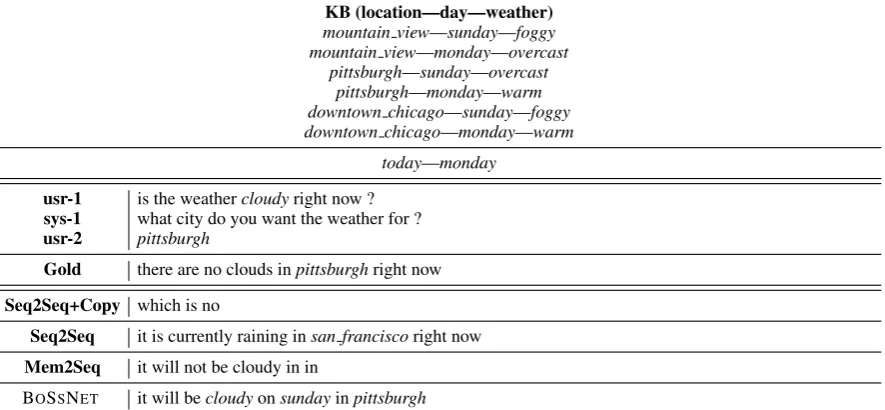
KB (location—day—weather)
mountain view—sunday—foggy mountain view—monday—overcast
pittsburgh—sunday—overcast pittsburgh—monday—warm downtown chicago—sunday—foggy downtown chicago—monday—warm
today—monday
usr-1 is the weathercloudyright now ? sys-1 what city do you want the weather for ? usr-2 pittsburgh
Gold there are no clouds inpittsburghright now
Seq2Seq+Copy which is no
Seq2Seq it is currently raining insan franciscoright now
Mem2Seq it will not be cloudy in in
[image:14.595.79.522.164.369.2]BOSSNET it will becloudyonsundayinpittsburgh
Table 13: Example from SMD with 50% OOV. The OOV entity present in the dialog is{pittsburgh}
bAbI Dialog Tasks bAbI Dialog Tasks (OOV) CamRest
T1 T2 T3 T4 T5 T1 T2 T3 T4 T5 BLEU Ent. F1
BOSSNETwith 1-Hop Encoder 100 100 92.3 100 90.5 100 100 91.4 100 89 10.5 36.9 BOSSNETwith Multi-Hop Encoder 100 100 95.2 100 97.3 100 100 95.7 100 91.7 15.2 43.1
Subject Predicate Object
resto_rome_cheap_indian_6stars R_phone resto_rome_cheap_indian_6stars_phone
resto_rome_cheap_indian_6stars R_cuisine indian
resto_rome_cheap_indian_6stars R_address resto_rome_cheap_indian_6stars_address
resto_rome_cheap_indian_6stars R_location rome
resto_rome_cheap_indian_6stars R_number eight
resto_rome_cheap_indian_6stars R_price cheap
resto_rome_cheap_indian_6stars R_rating 6
resto_rome_cheap_indian_7stars R_phone resto_rome_cheap_indian_7stars_phone
resto_rome_cheap_indian_7stars R_cuisine indian
resto_rome_cheap_indian_7stars R_address resto_rome_cheap_indian_7stars_address
resto_rome_cheap_indian_7stars R_location rome
resto_rome_cheap_indian_7stars R_number eight
resto_rome_cheap_indian_7stars R_price cheap
resto_rome_cheap_indian_7stars R_rating 7 (a) Original bAbI Data
Subject Predicate Object
resto_rome_cheap_indian_6stars R_phone resto_rome_cheap_indian_6stars_phone
resto_rome_cheap_indian_6stars R_cuisine indian
resto_rome_cheap_indian_6stars R_address resto_rome_cheap_indian_6stars_address
resto_rome_cheap_indian_6stars R_location rome
resto_rome_cheap_indian_6stars R_number eight
resto_rome_cheap_indian_6stars R_price cheap
6 R_rating resto_rome_cheap_indian_6stars resto_rome_cheap_indian_7stars R_phone resto_rome_cheap_indian_7stars_phone
resto_rome_cheap_indian_7stars R_cuisine indian
resto_rome_cheap_indian_7stars R_address resto_rome_cheap_indian_7stars_address
resto_rome_cheap_indian_7stars R_location rome
resto_rome_cheap_indian_7stars R_number eight
resto_rome_cheap_indian_7stars R_price cheap
7 R_rating resto_rome_cheap_indian_7stars
(a) Pre-Processed bAbI Data
(a) Original SMD Navigate Data
(a) Pre-Processed SMD Navigate Data
Subject Predicate Object
the_westin distance 2_miles
the_westin traffic_info moderate_traffic
the_westin poi_type rest_stop
the_westin address 329_el_camino_real
toms_house distance 1_miles
toms_house traffic_info heavy_traffic
toms_house poi_type friends_house
toms_house address 580_van_ness_ave
Subject Predicate Object
2_miles moderate_traffic rest_stop poi the_westin
the_westin distance 2_miles
the_westin traffic_info moderate_traffic
the_westin poi_type rest_stop
the_westin address 329_el_camino_real
1_miles heavy_traffic friends_house poi toms_house
toms_house distance 1_miles
toms_house traffic_info heavy_traffic
toms_house poi_type friends_house
[image:16.595.120.481.241.565.2]toms_house address 580_van_ness_ave
(a)
[image:17.595.99.502.55.748.2](b)