MT Tuning on RED: A Dependency-Based Evaluation Metric
Liangyou Li∗ Hui Yu† Qun Liu∗†
∗ ADAPT Centre, School of Computing
Dublin City University, Ireland
†Key Laboratory of Intelligent Information Processing
Institute of Computing Technology Chinese Academy of Sciences, China
{liangyouli,qliu}@computing.dcu.ie [email protected]
Abstract
In this paper, we describe our submis-sion to WMT 2015 Tuning Task. We integrate a dependency-based MT evalu-ation metric, RED, to Moses and com-pare it with BLEU and METEOR in con-junction with two tuning methods: MERT and MIRA. Experiments are conducted us-ing hierarchical phrase-based models on Czech–English and English–Czech tasks. Our results show that MIRA performs bet-ter than MERT in most cases. Using RED performs similarly to METEOR when tun-ing is performed ustun-ing MIRA. We submit our system tuned by MIRA towards RED to WMT 2015. In human evaluations, we achieve the 1st rank in all 7 systems on the English–Czech task and 6/9 on the Czech– English task.
1 Introduction
Statistical Machine Translation (SMT) is modeled as a weighted combination of several features. Tuning in SMT refers to learning a set of opti-mized weights, which minimize a defined trans-lation error on a tuning set. Typically, the er-ror is measured by an automatic evaluation met-ric. Thanks to its simplicity and language indepen-dence, BLEU (Papineni et al., 2002) has served as the optimization objective since the 2000s. Although various lexical metrics, such as TER (Snover et al., 2006) and METEOR (Lavie and Denkowski, 2009) etc., have been proposed, none of them can truly replace BLEU in a phrase-based system (Cer et al., 2010).
However, BLEU has no proficiency to deal with synonyms, paraphrases, and syntactic equivalent etc. (Callison-Burch et al., 2006). In addition, as a lexical andn-gram-based metric, BLEU may be not suitable for optimization in a syntax-based model.
In this paper, we integrate a reference dependency-based MT evaluation metric, RED1 (Yu et al., 2014), into the hierarchical phrase-based model (Chiang, 2005) in Moses (Koehn et al., 2007). In doing so, we explore whether a syntax-based translation system will perform better when it is optimized towards a syntax-based evaluation criteria. We compare RED with two other evaluation metrics, BLEU and ME-TEOR (Section 2). Two tuning algorithms are used (Section 3). They are MERT (Och, 2003), MIRA (Cherry and Foster, 2012). Experiments are conducted on Czech–English and English–Czech translation (Section 4).
2 Evaluation Metrics
An evaluation metric, which has a higher correla-tion with human judgments, may be used to train a better system. In this paper, we compare three metrics: BLEU, METEOR, and RED.
2.1 BLEU
BLEU is the most widely used metric in SMT. It is lexical-based and language-independent. BLEU scores a hypothesis by combining n-gram pre-cisions over reference translations with a length penalty.
An-gram precisionpn is calculated separately for different n-gram lengths. BLEU combines these precisions using a geometric mean. The re-sulting score is subsequently scaled by a length penalty, which penalizes a hypothesis if it is shorter than references. Equation (1) shows a for-mula for calculating BLEU scores:
BLEU =BP ·
YN
n=1
pwn n
, (1)
where,
BP = min{1.0,exp(1− |r|/|h|)}, 1REference Dependency
r andhare a reference and a hypothesis, respec-tively. In this paper, we useN = 4 and uniform weightswn= N1.
Even though widely used in SMT, BLEU has some pitfalls. Because of strictly relying on lexical sequences, BLEU cannot correctly score meaning equivalents, such as synonyms and paraphrases. It does not distinguish between content words and functional words as well. In addition, the penalty is not sufficient to be an equivalent replacement of
n-gram recall.
2.2 METEOR
METEOR relies on unigrams but considers both precision and recall. It evaluates a hypothesis by aligning it to a reference. METEOR identifies all possible matches between a hypothesis-reference pair with the following matchers:
• Exact: match words that have the same word form.
• Stem: match words whose stems are identi-cal.
• Synonym: match words when they are de-fined as synonyms in the WordNet database2.
• Paraphrase: match a phrase pair when they are listed as paraphrases in a paraphrase ta-ble.
Typically, there is more than one possible align-ment. In METEOR, a final alignment is obtained by beam search in the entire alignment space. Given the final alignment, METEOR calculates a unigram precision P and a unigram recall R by assigning different weights to function words and content words to distinguish them, as in Equation (2) and Equation (3).
P =
P
iwi·(δ·mi(hc) + (1−δ)·mi(hf))
δ· |hc|+ (1−δ)· |hf|
(2)
R=
P
iwi·(δ·mi(rc) + (1−δ)·mi(rf))
δ· |rc|+ (1−δ)· |rf|
(3) where mi is the ith matcher, hc and rc are con-tent words in a hypothesis and a reference,hf and
rf are functions words in a hypothesis and a ref-erence, respectively. Then the precision and recall are combined as in Equation (4).
2https://wordnet.princeton.edu/
F mean= α·P+ (1P·R−α)·R (4)
To consider differences in word order, a penalty is calculated on the basis of the total number (m) of matched words and the number (ch) of chunks. A chunk is defined as a sequence of matches, which are contiguous and have identical word or-der. The penalty is formulated as in Equation (5):
P en=γ·
ch m
β
. (5)
The final METEOR score is calculated as fol-lows:
Score= (1−P en)·F mean. (6)
α,β,γ,δandwi are constants, which can be op-timized to maximize the correlation with human judgments.
By considering synonym, paraphrases, ME-TEOR has shown to be highly correlated with human judgments. However, these resources are language-dependent. Besides, METEOR is unigram-based and thus has a lack of incorporat-ing syntactic structures.
2.3 RED
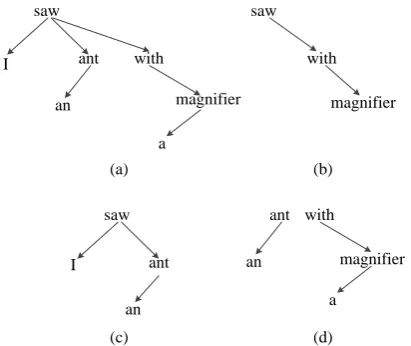
Instead of collecting n-grams from word se-quences as in BLEU, RED extracts n-grams ac-cording to a dependency structure of a refer-ence, calleddep-ngrams, which have two types: headword chain (Liu and Gildea, 2005) and fixed/floating structures (Shen et al., 2010). A headword chain is a sequence of words which cor-responds to a path in a dependency tree, while a fixed/floating structure covers a sequence of con-tiguous words. Figure 1 shows an example of dif-ferent types of dep-ngrams.
A F mean score is separately calculated for each different dep-ngram lengths. Then, they are linearly combined as follows:
RED=
N
X
n=1
wn·F meann (7)
Inspired by other metrics, such as TERp (Snover et al., 2009) and METEOR, RED inte-grates some resources as follows:
ant
an
with
magnifier
a saw
I ant
an
saw
with
magnifier I
magnifier saw
ant
an
with
a
(a) (b)
[image:3.595.79.285.61.234.2](c) (d)
Figure 1: An illustration of dep-ngrams. (a) is a dependency tree, (b) is a headword chain, (c) is a fixed structure and (d) is a floating structure.
different weights, this results in a scale factor for a dep-ngram as in Equation (8).
sm =
Pn
i=1wmi
n (8)
• Paraphrase: used for extracting
paraphrase-ngrams. In this case, RED ignores the depen-dency structure of a reference. A
paraphrase-ngram has a weightwpar.
• Function Word: used to distinguish content words from function words. The function word score of a dep-ngram or a
paraphrase-ngram can be calculated as follows:
sf = cntf ·wcntf +cntc·(1−wf) f +cntc , (9) wherecntf andcntcare the number of func-tion words and the number of content words.
Ideally, both a precision score P and a recall score R are based on the total number of
dep-ngrams in a hypothesis and a reference, respec-tively. However, in RED only dependency struc-tures on the reference are available. Therefore, it uses the length of the hypothesis to approximate the number of the dep-ngrams in the hypothesis to calculateP. Formulas forP andRare as follows:
P = scorepar|+c|scoredep, (10)
R = Countscorepar+scoredep
n(r) +Countn(par), (11)
where
scorepar=
X
par∈Pn
wpar·sf, (12)
scoredep=
X
d∈Dn
p(d, c)·sm·sf, (13)
r and care the reference and the hypothesis, Pn is the set of paraphrase-ngrams, Dn is the set of dep-ngrams.p(d, c)is a match score which is 0 if no match is found; otherwise, it is a value between 0 and 13.
3 Tuning Algorithms
Tuning algorithms in SMT are designed to op-timize decoding weights so that a defined trans-lation error, typically measured by an automatic metric, is minimal on a development set. In this paper, we compare two algorithms: MERT and MIRA.
First, we introduce some notations. Lethx, yi ∈ Dbe a tuning set, wherexandyare a source and a target, respectively. Letδy(dx)be an error made by a derivationdon the sourcexgivenyas a ref-erence. Let`m(D,w)be the total error measured by a metricmon the tuning setDwith parameters
w.
3.1 MERT
MERT learns weights to rank candidate transla-tions of each source sentence so that the final document-level score measured by a specific met-ric on the one-best translations is the highest. For-mally, it tries to minimize the document-level error on the translations produced by the highest scoring translation derivation for each source sentence, as in Equation 14.
`MERT(D,w) =⊕hx,yi∈Dδy(d∗x), (14)
where
d∗
x = argmax dx
w·Φ(dx), (15)
Φ are feature functions of the decoding model,
w·Φ(dx) is a score assigned to a deviation dx
3If a headword chainngramdin a referencerhas a match in a hypothesis c, p(d, c) = exp{−Pn−1
i=1distri−distci
n−1 },
wheredistri and distci are relative distances betweenith
by the decoding model, ⊕ represents the accu-mulation of potentially non-decomposable senten-tial errors, which then produces a document-level evaluation score.
3.2 MIRA
MIRA is an online large margin learning algo-rithm (Crammer and Singer, 2003). Its appli-cation to MT decoding model tuning was firstly explored by Watanabe et al. (2007) and then re-fined by Chiang et al. (2008) and Cherry and Fos-ter (2012). The MIRA we use tries to separate a “fear” derivation d−(x, y) from a “hope” one
d+(x, y)by a margin propositional to their metric difference (Chiang et al., 2008). The two deriva-tions are defined as follows:
d+(x, y) = argmax
d w·Φ(d)−δy(d) (16)
d−(x, y) = argmax
d w·Φ(d) +δy(d) (17) Their model-score difference and metric-score dif-ference are defined in Equation (18) and Equation (19), respectively.
∆s(x, y) =δy(d+(x, y))−δy(d−(x, y)) (18)
∆m(x, y) =w·(Φ(d+(x, y))−Φ(d−(x, y))}
(19) Cherry and Foster (2012) adapt a batch strategy in MIRA. The error, that batch MIRA tries to min-imize is defined as below:
`MIRA(D,w) = 21C||w−w0||+
X
hx,yi∈D
L(x, y)
(20) where C is a constant and L(x, y) is a loss over a sourcex and a referencey, which is defined in Equation (21).
L(x, y) = max{0,∆s(x, y)−∆m(x, y)} (21)
4 Experiments
We conduct experiments on Czech–English and English–Czech hierarchical phrase-based transla-tion systems built using Moses with default con-figurations and default feature functions.
We use WMT newstest2014 as our development data, while our test data consists of the concate-nation of newstest2012 and newstest2013, which
BLEU METEOR RED BLEU 18.90 28.38 19.91 METEOR 18.68 28.64 20.02
RED 18.07 28.17 19.97 BLEU 19.12 28.54 20.02
METEOR 19.10 28.56 20.05
RED 17.74 28.82 20.02
Train \ Eval.
MERT
[image:4.595.313.519.61.146.2]MIRA
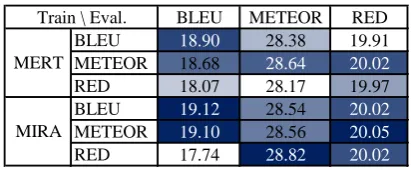
Table 1: Czech–English evaluation performance. In each column, the intensity of shades indicates the rank of values.
includes 6,003 sentence pairs in total4. English sentences are parsed into dependency structures by Stanford parser (Marneffe et al., 2006). Czech sentences are parsed by a Perl implementation5of the MST parser (McDonald et al., 2005).
4.1 Metrics Setting
As described in Section 2.1, we use the standard BLEU parameters6. We use METEOR 1.47 in our experiments with default optimized parame-ters. Specifically, for Czech to English translation, we adopt all four lexical matching strategies with parameter values: α = 0.85, β = 0.2, γ = 0.6,
δ = 0.75andwi = 1.0,0.6,0.8,0.6. For English to Czech translation, we use two lexical matching strategies, including exact and paraphrase, with parameter values: α = 0.95, β = 0.2, γ = 0.6,
δ= 0.8andwi = 1.0,0.4.
In RED, we use all four matchers in the Czech– English task while we do not use stem and syn-onym in the English–Czech task. The same pa-rameter values are used in both tasks. We set
N = 3, the correspondingwi = 0.6,0.5,0.1. We setwmi = 0.9,0.6,0.6for three matchers includ-ing exact, stem and synonym andwpar = 0.6for the paraphrase matcher. We setwf = 0.2for func-tion words andα= 0.9for combiningP andRin
F mean.
4.2 Results
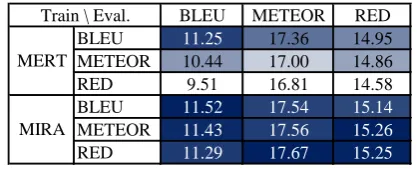
Table 1 and Table 2 show our experimental results on two tasks, respectively. We have several find-ings as below:
• In both tasks best scores are achieved when
4http://statmt.org/wmt14/ translation-task.html
5http://search.cpan.org/˜rur/ Treex-Parser-MSTperl
6i.e., up to 4-gram matching with uniform weighting of n-gram precisions.
BLEU METEOR RED BLEU 11.25 17.36 14.95 METEOR 10.44 17.00 14.86 RED 9.51 16.81 14.58 BLEU 11.52 17.54 15.14
METEOR 11.43 17.56 15.26
RED 11.29 17.67 15.25
Train \ Eval.
MERT
[image:5.595.76.285.62.147.2]MIRA
Table 2: English–Czech evaluation performance. In each column, the intensity of shades indicates the rank of values.
MIRA is used rather than MERT. In most cases, MIRA is better than MERT.
• When RED is used in MERT, we obtain a worse performance than that of BLEU and METEOR in almost all cases, especially in the English–Czech task.
• When BLEU is used as the evaluation metric, the best score is obtained by using BLEU as the optimization objective in tuning as well. This follows the findings in Cer et al. (2010).
• The best METEOR score is achieved when RED is used to tune our system while the best RED score is obtained when METEOR is used to tune. Taking that the same resources are used in the two metrics into considera-tion, this may indicate that the two metrics are correlated.
5 Submission
We submit our system tuned by MIRA towards RED. In human evaluations, we get 6th out of 9 systems on the Czech–English task and the 1st rank in all 7 systems on the English–Czech task.
Such human judgments suggest that RED per-forms better on Czech than English. We guess this is because dependencyn-grams have better capa-bility of handling free word order in Czech sen-tences. This hypothesis can be an avenue for fu-ture work.
6 Conclusion
In this paper, we describe our submissions to WMT 2015 tuning task on Czech–English and English–Czech tasks. They are hierarchical phrase-based models both tuned by MIRA to-wards a dependency-based metric, RED. In hu-man evaluations, our system gets the 1st rank in the English–Czech task.
Acknowledgements
This research has received funding from the Peo-ple Programme (Marie Curie Actions) of the Eu-ropean Union’s Seventh Framework Programme FP7/2007-2013/ under REA grant agreement no. 317471. The ADAPT Centre for Digital Con-tent Technology is funded under the SFI Research Centres Programme (Grant 13/RC/2106) and is co-funded under the European Regional Develop-ment Fund.
We thank Xiaofeng Wu for his discussion and anonymous reviewers for their insightful com-ments. In particular, we thank reviewer #2 for pro-viding detailed suggestions.
References
Chris Callison-Burch, Miles Osborne, and Philipp Koehn. 2006. Re-evaluating the Role of BLEU in Machine Translation Research. In Proceedings of the 11th Conference of the European Chapter of the Association for Computational Linguistics, pages 249–256.
Daniel Cer, Christopher D. Manning, and Daniel Ju-rafsky. 2010. The Best Lexical Metric for Phrase-based Statistical MT System Optimization. In Hu-man Language Technologies: The 2010 Annual Conference of the North American Chapter of the Association for Computational Linguistics, pages 555–563, Los Angeles, California.
Colin Cherry and George Foster. 2012. Batch Tun-ing Strategies for Statistical Machine Translation. In Proceedings of the 2012 Conference of the North American Chapter of the Association for Compu-tational Linguistics: Human Language Technolo-gies, NAACL HLT ’12, pages 427–436, Montreal, Canada.
David Chiang, Yuval Marton, and Philip Resnik. 2008. Online Large-margin Training of Syntactic and Structural Translation Features. InProceedings of the Conference on Empirical Methods in Natu-ral Language Processing, pages 224–233, Honolulu, Hawaii.
David Chiang. 2005. A Hierarchical Phrase-based Model for Statistical Machine Translation. In Pro-ceedings of the 43rd Annual Meeting on Association for Computational Linguistics, pages 263–270, Ann Arbor, Michigan.
Koby Crammer and Yoram Singer. 2003. Ultracon-servative online algorithms for multiclass problems. Journal of Machine Learning Research, 3:951–991, March.
Brooke Cowan, Wade Shen, Christine Moran, Richard Zens, Chris Dyer, Ondej Bojar, Alexandra Constantin, and Evan Herbst. 2007. Moses: Open Source Toolkit for Statistical Machine Translation. In Proceedings of the 45th Annual Meeting of the ACL on Interactive Poster and Demonstration Ses-sions, ACL ’07, pages 177–180, Prague, Czech Re-public.
Alon Lavie and Michael J. Denkowski. 2009. The Me-teor Metric for Automatic Evaluation of Machine Translation. Machine Translation, 23(2-3):105– 115, September.
Ding Liu and Daniel Gildea. 2005. Syntactic Features for Evaluation of Machine Translation. In Proceed-ings of the ACL Workshop on Intrinsic and Extrin-sic Evaluation Measures for Machine Translation and/or Summarization, pages 25–32.
Marie-Catherine de Marneffe, Bill MacCartney, and Christopher D. Manning. 2006. Generating Typed Dependency Parses from Phrase Structure Parses. In Language Resources and Evaluation.
Ryan McDonald, Koby Crammer, and Fernando Pereira. 2005. Online large-margin training of de-pendency parsers. In Proceedings of the 43rd An-nual Meeting on Association for Computational Lin-guistics, pages 91–98, Ann Arbor, Michigan.
Franz Josef Och. 2003. Minimum Error Rate Train-ing in Statistical Machine Translation. In Proceed-ings of the 41st Annual Meeting on Association for Computational Linguistics - Volume 1, pages 160– 167, Stroudsburg, PA, USA. Association for Com-putational Linguistics.
Kishore Papineni, Salim Roukos, Todd Ward, and Wei-Jing Zhu. 2002. BLEU: A Method for Automatic Evaluation of Machine Translation. InProceedings of the 40th Annual Meeting on Association for Com-putational Linguistics, ACL ’02, pages 311–318, Philadelphia, Pennsylvania.
Libin Shen, Jinxi Xu, and Ralph Weischedel. 2010. String-to-dependency Statistical Machine Transla-tion. Computational Linguistics, 36(4):649–671, December.
M. Snover, B. Dorr, R. Schwartz, L. Micciulla, and J. Makhoul. 2006. A Study of Translation Edit Rate with Targeted Human Annotation. InProceedings of Association for Machine Translation in the Amer-icas, pages 223–231, Cambridge, Massachusetts, USA, August.
Matthew Snover, Nitin Madnani, Bonnie J. Dorr, and Richard Schwartz. 2009. Fluency, Adequacy, or HTER?: Exploring Different Human Judgments with a Tunable MT Metric. In Proceedings of the Fourth Workshop on Statistical Machine Transla-tion, pages 259–268, Athens, Greece.
Taro Watanabe, Jun Suzuki, Hajime Tsukada, and Hideki Isozaki. 2007. Online Large-Margin Train-ing for Statistical Machine Translation. In Pro-ceedings of the 2007 Joint Conference on Empirical Methods in Natural Language Processing and Com-putational Natural Language Learning, pages 764– 773, Prague, June.