645
HUMAN ACTIVITIES RECOGNITION VIA FEATURES
EXTRACTION FROM SKELETON
1GHAZALI SULONG, 2AMMAR MOHAMMEDALI
1,2
UTM-IRDA Digital Media Centre (MaGIC-X),Faculty of Computing,
Universiti Teknologi Malaysia,UTM Skudai 81310,
Johor, Malaysia
E-mail:1
ABSTRACT
Human activities recognition (HAR) enabling the understanding of basic human actions from still images has overriding importance in computer vision and pattern recognition for sundry applications. We propose a novel method for HAR by taking out the skeleton from the image for extracting useful features. This approach comprised of two steps namely (i) an automatic skeletal feature extraction and partitioning into two parts as block that determines angles between terminals and (ii) HAR by using non-linear Support Vector Machine (SVM). The model performance is evaluated using three available challenging datasets such as INRIA, KTH and Willow-action all with seven activities and each possessing eight scenarios. The images are normalized in (64x128) pixels format from digital silhouette via circle algorithm. Our method efficiently achieves a recognition rate as much as 86% with excellent features. The proposed model being highly promising compared to the existing one may contribute towards the development of computer vision architecture.
Keywords— HAR, Features, Skeleton, Support Vector Machine, Still Image.
1. INTRODUCTION
In the information technology era the Human Activity Recognition (HAR) play a paramount role in widespread computer applications and vision studies. Generally, HAR is based on still image or video recording. Recently, HAR using video has widely been carried out without much difficulty [1],[2],[3],[4],[5]. However, HAR using still images is not only intricate but pose many challenges [6]. Recognition using video recording is implemented by extracting the picture frames following a process that compares current frame (one movement) with the next or previous frame to predict activities. Still image based recognition is tricky due to the absence of any prior knowledge regarding the features of event and thereby complicated to predict all the important fixed features from the captured image.
The main goal of HAR using still images is to develop an automatic analysis scheme for collected data to precisely determine the human behavior in an efficient manner. The appropriate implementation using suitable human computer interfaces significantly depend on such image analyses useful for diversified applications from surveillance to security systems to automation. Despite much effort on HAR using video recording
the feature extraction from still image are not widely investigated in the domain of computer vision due to its inherent complexity.
646 action recognition from depth image taken from single commodity depth camera and proposed Random Occupancy Pattern (ROP) features [11] to develop Depth Motion Maps (DMM) for projected map. DMM is a binary map which is generated by computing and thresholding the difference of two consecutive frames and then summing them for each projective view. Often, the analysis of human activities are difficult not only because of human body is highly articulated but people also tend to wear complex textured clothing which could confuse and hide the important features needed for distinguishing the poses.
In this paper, we attempt to address some important issues related to the features extraction using still image. The object inside the still image has high amount of articulation that requires precise classification and in-depth understanding. The computer vision development using still image by extracting features from the object and classifying them to determine the correct activities is the main concern. A novel method for HAR by taking out the skeleton from the image for extracting useful features is proposed. This approach consists of feature extraction and partitioning using non-linear Support Vector Machine. Simulation is performed on a set of test datasets to evaluate the recognition rate.
The paper is organized as follows. In section 2 the detailed methodology consisting of three major steps such as preprocessing (noise reduction and segmentation), features extraction (based on skeleton and partitioning human body) and skeletonization together with the estimations of joints are described. Section 3 underscores results and discussion. Section 4 concludes the paper. Some suggestions regarding future works are underlined in Section 5.
2. METHODOLOGY
Each system for HAR are achieved using three main stages, firstly preprocessing including noise reduction and segmentation, secondly the feature extraction which is our main concern, and finally the classification via an appropriate classifier [12]HAR from still images captured by camera or scanned by any scanner devices are used as input to the system. These images may contain some noise which needs to be removed before segmentation can take place. The noise reduction properties is decided by the involved neighborhood in the smoothing
process that has chosen large enough to reduce it by averaging [13]. Simple and powerful expression for noise reduction yields,
, ∑, ∈ೣ ,
where Sxy is a neighborhood of size (MN) associated with a co-ordinate (x,y) in the image I, Id is the remaining gray-level values where
smallest
and largest detected.
Datasets such as INRIA, KTH and Willow-action from public domain are used for seven activities such as walking, running, jogging, boxing, clapping, waving and clapping with eight scenarios for each activity. The images are normalized as to estimate recognition rate. It is obtained by dividing the number of items correct activities classified over the number of tested image and is g iven by:
Recognition rate
100%
2.1 Feature Extraction
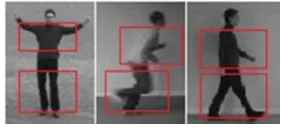
[image:2.595.329.470.568.632.2]Skeleton shaped object is essential for extracting features and the properties from the segment object. One of the aims of using the system proposed is to specify different parts and its position for human body. Each part is separately analyzed for feature extraction. We are interested in three main parts of the body such as head, arms and legs. The present method divides the body into two blocks each one consist of different pose known by the system. The first block includes the arms and the upper half of the body and the second block contains the legs only as shown in Fig.1.
Figure 1: The two partitioning blocks
648 block acts same as running and vertical distance become 900 with the ground level. In contrast, for walking activity the extracted angles for upper and lower block become more than jogging and running. The same procedure is followed for the rest of the actions. Fig. 5 shows the approach for extracting features from various activities.
Figure 5: (A) Skeleton For Jogging Activity (B) Angles Extracted From A And C (C) Skeleton For Running
Activity 3. RESULTS AND DISCUSSION
The performance of the proposed model is evaluated by applying it to three challenging datasets obtained from public domain. These datasets are INRIA, KTH and Willow-action all with seven activities such as walking, running, jogging, boxing, clapping, waving, and clapping and each activity consists of eight scenarios. The images are normalized as (64x128) pixels. For waving and jogging activities the front sight is considered and for the rest of the activities the side views (left or right) are utilized. These activities are purposely chosen due to their well-admired popularity in still images and datasets.
This dynamic method for feature extraction facilitates the classification of these activities easier and very accurately determines the recognition rate when using non linear SVM classifier. The activities such as running, walking and jogging generate high recognition rate because these features are more accurately extracted from skeleton angles using two blocks. Meanwhile, the boxing and waving activities produce expected less recognition rate than others due to their extraction from one block (upper block). The applicability of our developed approach is limited by online recognition and associated computational time which is somewhat longer than others. Conversely, this method is very accurate for features extraction from still images and is highly satisfactory in terms
[image:4.595.303.503.207.338.2]of richness. The recognition rate as high as 86 % obtained by us is much improved compare to the existing one.
Figure 6: Confusion Matrix Showing Recognition Rate For Five Activities.
The results for the confusion matrix with supervised method are furnished in Fig. 6. Interestingly, for activities such as walking, running and jogging the system is capable of recognizing the features extracted from two parts of the body (arm and leg) and a high recognition rate is accomplished. In contrast, the activities such as boxing and waving achieves relatively lower recognition rate because the features are extracted from one part of the body (arm).
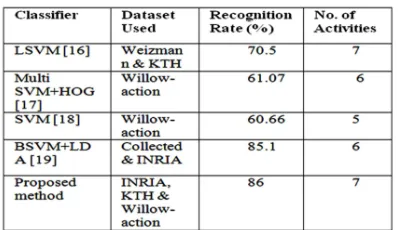
The training data for given images using dataset INRIA and KTH for five activities in the present classifier produced notable features when compared and summarized in Table 1.
Table 1 Comparison Of Recognition Rate Of The Proposed Method With Others.
[image:4.595.93.269.225.323.2] [image:4.595.304.503.593.708.2]649 because some activities are available in a particular dataset and some belong to another. Training set with INRIA and Willow dataset are found to be much more computationally time consuming than with KTH because each image is changed to gray scale followed by noise reduction, segmentation and so on. Meanwhile, training with INRIA dataset consisting of 780 images of (64 128) pixels format of each activity takes longer time for the machine to learn. A classifier performs a set of steps to define the feature classes or categories. Classifiers are trained by running samples of known classes to identify the unknown one. Finally, by executing these trained classifiers on unknown activities or feature vectors the belongingness of a particular class can be determined.
Firstly, the classes on a set of training content are defined. Then, the classifier uses those classes to analyze other content and performs classification. The classifier performs the features analyses following,
,
|
∈ ,
∈ 1,1
ୀଵ
where each x is an n-dimensional real vector and y
being either +1 or -1 indicate the classes in which the feature x belongs. This allows us to determine
the best split line (for linear) or curve (for non-linear) that divides the features having y = 1 (class
A) from those of y = -1 (class B). The best line
between the classes can be achieved for linearly separabledata.
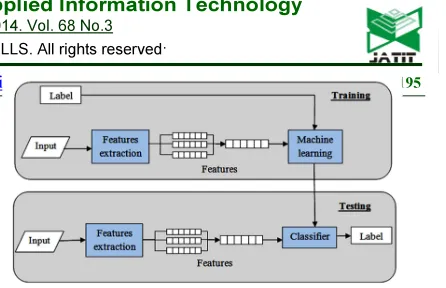
Every classification machine learning algorithm operates using the training and testing phase. The notion of classification is to create a decision rule dx: R→ w
, w, … , w to
classify d-dimensional observation (point) X into one of the classes. Generally, the rule is built using the observation from a training set.
[image:5.595.297.520.74.218.2]In the testing (or prediction) phase a given image supported to the system is already learnt by training mode. HAR system captures this image and administers the procedures similar to the training mode including segmentation, feature extraction and so on. Finally, the system compares the features of given image with features extracted from dataset images during training mode to discover the suitable match (or closest counterpart) in recognizing the specific activity as depicted in Fig. 7.
Figure 7: Training And Testing Mode of HAR system. The number of pores used as features [16] with 408 images and LSVM classifier is limited by features. Meanwhile, the pose of human body (skeleton) with HOG and Multi-SVM classifier [17] and SVM in [18] possess poor features compatibility. Good features with suitable classifier (BOF+LSVM+Inte) are acquired [19]. However, our proposed method stands on the advantage of the previous methods and neglects their disadvantages by using powerful features extraction procedures. Consequently, features are extracted from skeleton by partitioning human body. Different challenging datasets (1220 training images and 420 testing images) those are used in our non-linear SVM classifier make the result more accurate in comparison to those exist in the literature as listed in Table 1.
4. CONCLUSION
650 the features which are extracted accurately from human body to enable the system in recognizing them more accurately than before.
5. FUTURE WORKS
Despite our current HAR system is reasonably efficient still there is a need for faster and efficient method. Furthermore, the proposed system is time consuming and unsuitable for on-line applications because it deals with still images. It is worthy to use special HOG features with INRIA dataset where the image conversion into grayscale is not needed. Finally, a versatile system with more than seven activities is worth developing to cover large number of actions for security and industrial applications.
ACKNOWLEDGEMENTS
Ammar is grateful to the Ministry of Science and Technology, Iraq for the study leave and Universiti Teknologi Malaysia for technical assistance.
REFERENCES:
[1] Abdel-Badeeh M. Salem, Adel A. Sewisy, and Usama A. , “A Vertex Chain Code Approach for Image Recognition,” ICGST-GVIP Journal, vol. 5, Mar. 2005.
[2] A.Bandera, C. Urdiales, and F. Sandoval, “2D object recognition based on curvature functions obtained,” Pattern Recognition Letters, vol. 20, pp.49-55, Oct.1999.
[3] Y. Du, F. Chen, W. Xu, and W. Zhang,” Activity recognition through multi-scale motion detail analysis,”. Science Direct, vol. 71,pp. 3561–3574, Oct. 2008.
[4] C. Gu, P. Arbel, Y. Lin, K. Yu, and J. Malik,” Multi-Component Models for Object Detection,” NEC Labs America, vol. 13, pp.123-133,Nov.2012.
[5] C. Zhu, and W. Sheng,” Motion- and location-based online human daily activity recognition,”. Science Direct, vol. 7, pp. 156-26, Apr. 2011.
[6] C. Thurau and V. Hlavac,” Pose primitive based human action recognition in videos or still images,” IEEE Computer Society Press, vol. 7,pp. 1-8, Jun. 2008.
[7] S. Min Yoon, A Kuijper,” Human action recognition based on skeleton splitting,”
Science Direct, vol. 40,pp. 9848-6855, Aug. 2013.
[8] N. Ikizler, R. Gokberk, S Pehlivan and P. Duygulu,” Recognizing Actions from Still Images,” IEEE, vol. 7, pp. 1-4, Dec. 2008. [9] J. K. Aggarwal and M. S. Ryoo,” Human
Activity Analysis: A Review,” ACM Computing Surveys, vol. 43, pp. 1-16, Apr. 2011.
[10] Megavannan, V. , Agarwal, B. , and Venkatesh Babu, R.,” Human action recognition using depth maps,” IEEE, vol.5, pp. 1-5, Jul.2012.
[11] C. Chen, K. Liu, and N. Kehtarnavaz,” Real- time human action recognition based on depth motion maps,” Springer, vol. 20, Aug. 2013. [12] F. Luisier, and T. Blu,” Image Denoising in
Mixed Poisson Gaussian Noise,” IEE, vol. 20, pp. 165-172, Mar. 2013.
[13] A. Buades, B. Cool, and J.M. Morel,” A review of Image Denoising Algorithms, with A new One” SIAM Journal on Multiscale Modeling and Simulation, vol. 4, pp. 490-530, Aug. 2005.
[14] T. Horiuchi and S. Hirano,” Colorization algorithm for grayscale image by propagating seed pixels” IEEE, vol. 1, pp.1-60,Sept. 2003. [15] J. Ding, Y. Wang, and L Yu,” Extraction of
human Body Skeleton Based on Silhouette Images” IEEE, vol. 1, pp. 71-74, Mar. 2010. [16] S. Malathi and C. Meena,” Fingerprint
Matching Based on Pore Centeroid”, vol. 1, ICTACT, pp. 220 – 223, May 2011.
[17] W. Yang , Y. Wang , and G. Mori,” Recognizing Human Actions from Still Images with Latent Poses,” IEEE, vol. 1, pp. 2030-2037,Jun. 2010.
[18] V. Delaitre, Josef Sivic, and Ivan Laptev,” Learning person-object interactions for action recognition in still images,” NIPS, vol. 24, Oct. 2011.