1Mr. N.SIVANESAN, 2Dr.S.MURUGAVALLI
1
Research Scholar, Faculty of Computer Science & Engineering, Sathyabama University, Chennai, India
2
Professor & Head, Department of CSE, Panimalar Engineering College, Chennai, India
Email: 1skec.cshod @ gmail.com, [email protected]
ABSTRACT
This paper proposes a new data hiding technique which is based on the human skin segmentation and for that a reliable human skin detection method that is adaptable to different human skin colors and illumination conditions is essential. Even though several human skin detection methods have been successfully applied, but they are prone to false skin detection and are not able to cope with the variety of human skin colors across different ethnic. High computational cost is required for existing methods. A skin classifier defines a decision boundary in the color space based on a training database of skin-color pixels. A 2-D histogram with smoothened densities and a Gaussian model are used to model the skin and non skin distributions respectively. This is for the first time to employ fusion strategy for this purpose. The main objective of this proposed approach is to secure the data based on skin region. Secret data is embedded within skin region of image and that too in the high frequency sub bands that will provide an excellent secure location for data hiding. Additionally secret data embedding is performed using frequency domain approach - IWT (Integer Wavelet Transform), IWT outperforms than DCT (Discrete Cosine Transform). Cropping results into an enhanced security because cropped region works as key at decoding side. Embedding is done based on singular value decomposition. And also satisfactory PSNR (Peak- Signal-to-Noise Ratio) is obtained.
Keywords: 2D-Histogram, Gaussian model, IWT, SVD, PSNR.
1. INTRODUCTION
There are several problems that have arisen when it comes to steganalysis. Stegnalysis it is a relatively new and growing field, all the problems have not quite been worked out. One of the biggest problems is getting a high number of false positives[1]. Another big problem is that many times steganography programs also encrypt the information. Therefore, it is exceptionally difficult to retrieve this information, even if someone was able to detect . steganographic images[4]. Multilayer perceptron, Bayesian classifier, and random forest that use single features, although, successfully applied to human skin detection;[6] they still suffer from the following:
1.1 Low Accuracy: False skin detection is a
common problem when there is a wide variety of skin colors across different ethnicity, complex backgrounds and high illumination in image.
1.2 Luminance-Invariant Space: Some robustness may be achieved via the use of luminance invariant color space, however, such an approach can
withstand only changes that skin-color distribution undergo within a narrow set of conditions and also degrades the performance.
1.3 Requires Large Training Sample: For detecting human skin, most of the state-of-the-art work requires a training stage. Existing system is unable to cope with variety of human skin colors so is prone to false skin detection and requires large training sample so computational cost is very high [5].
Spatial domain technique is used so it is easy to hack. HSV color conversion technique is used which leads to loss in image depth around lightest parts of image. Normal image steganography technique leads to a change in the stegoimage.[8] This paper describes the design and development of a new and efficient skin detection technique for embedding the secret image in the skin region.
In this work, a fusion framework method has been proposed for efficient human skin detection. It is a new approach for secure data hiding based on
HUMAN SKIN DETECTION METHOD FOR SECRET IMAGE
skin region. And outperforms state-of-the-art methods in terms of accuracy in different conditions 2D Histogram and Gaussian model is used to get the exact skin region. To embed the data within skin region that provides an excellent secure location. Achieve expected result and reduces the cost. Data Hiding techniques based on Human skin detection method can be used in a wide range of applications such as:
(i) In face tracking system to identify a human face from a digital image or a video frame.
(ii) In the process of setting up controlled audio distribution and to provide efficient means for copyright protection.
(iii) To providing hidden Communication, where
communication is made possible using
watermarking technology known as steganography.
1.3 SCOPE
Skin detection is the process of finding skin-color pixels and regions in an image or video. In images and videos, skin color is an indication of the
existence of humans in media. Skin detection is a
very popular and useful technique for detecting and tracking human-body parts. There is a wide range of applications such as, face detection and tracking, gesture analysis, content-based image retrieval systems to various human–computer interaction domains, hence it receives much attention. With this view we proposed a novel method in steganography using skin color detection scheme.
2. PROPOSED SYSTEM
Proposed method introduces a new method of embedding secret data within skin region as it is not that much sensitive to HVS (Human Visual System).This takes advantage of biometrics features such as skin tone, data will be embedded in selected regions, instead of embedding data anywhere in image. The figure shows the complete architecture of the proposed system.
2.1 Skin Tone Detection
The skin tone detection is done by using the 2D
histogram and the Gaussian model. This
preprocessing stage distinguish the pixel intensities between smooth region i.e., skin and non smooth regions i.e., non skin regions. This histogram represents skin region with smoothening intensities and this analysis will be done in different color space. This describes color spaces for the human visual perception to segment the skin regions. Guassian model is a sophisticated model that is
capable of describing complex-shaped distributions
modeling skin regions
.
The threshold skin-color distribution in the 2-D histogram is modeled through elliptical Gaussian joint probability distribution functions defined as
(1)
Where , are the mean of the red and
green values and , are the standard
deviation of red and green values respectively .
2.2 Cropping
Cropping has to be performed interactively on mask image, after this original image is also cropped of same area. Cropped area must be in an exact form as wavelet transformation is to be performed later and cropped area should contain skin region such as areas in face.
Figure 2: Skin Pixel Distribution
Cropping results into an enhanced security because cropped region acts as a key at decoding side. Steps to perform cropping are:
• load the skin Image (M x N).
• Cropped Image (Mc x Nc) creation from
Input Image.
• Apply IWT to only cropped area (Mc×Nc)
not whole image (M×N). This yields 4 sub-bands denoted as LL,LH,HL,HH . (All 4 sub-band are of same size of Mc/2,Nc/2). Number of skin pixels present in high frequency sub-band in which data will be hidden, will be used to determine Payload of image to hold secret data.
• Embedding in LL sub-band affects image
quality greatly. So high frequency sub-band is selected. While embedding, secret data will not be embedded in all pixels of IWT subband but to only cropped pixels.
• Perform IIWT to combine 4 sub-bands.
• A cropped stego image of size Mc×Nc is
obtained in above step.
The stegoimage should be similar to original image after visual inspection but at this stage it is of size Mc× Nc, So merge the cropped stego image with original image to get the stego image of size M×N. To perform merging, coefficients of first and last pixels of cropped area are required in original image.
2.2.1 Wavelet Transformation
The skin detection from image is utilized to sharing the secret image from one place to another for secret data sharing. This Technology involves Wavelet transform, which provides the low frequency and high frequency coefficients.
Wavelet Transform is a type of signal
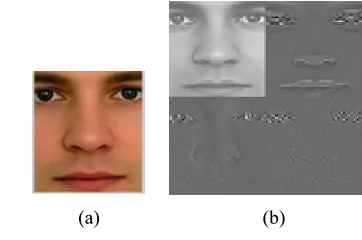
representation that can give the frequency content of the signal at a particular instant of time or spatial location. IWT decomposes the image into different sub band images, namely, LL, LH, HL, and HH for embedding the messages in the pixel coefficients of sub bands. LL sub bands contain the significant part of the spatial domain image. High-frequency sub band contains the edge information of input image. Integer wavelet transform can be obtained through lifting scheme. To convert DWT coefficients to Integer coefficients without losing information Lifting scheme technique is used.
(a) (b)
Figure3: (a) Cropped Image (b) Image After Wavelet Ttransformation
2.2.2 Image Embedding
Singular Value Decomposition is a numerical technique for diagonalizing the image matrices in the transformed domain for image
embedding.SVD is applied on each of frequency
subbands and the secret image is hided into singular
matrix of the subbands.SVD of an M*N real matrix
A is a factorization of the form,
A = USV T (2)
Where U &V are orthogonal matrices and S denotes Singular Values. The secret image will be decomposed into singular and two orthogonal matrices. These values are concealing into singular values of high frequency subbands by modifying it through key value which should be selected as least value to reduce the embedding error. The singular value of subband will be modified by,
Ms = Cs + (Ws * K) (3)
Figure 4: Flowchart - Embedding Process
2.3 Image Extraction
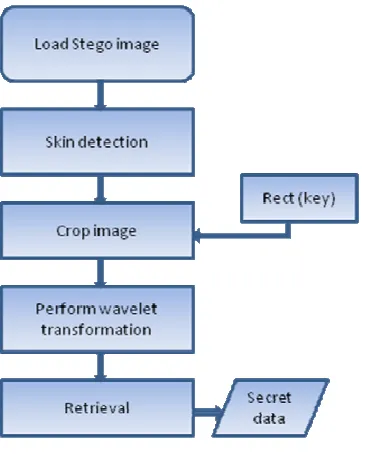
In this module the stego image is extracted. The methods used for embedding the secret image is reversed here to get the secret image. Initially fusion based approach i.e the combination of 2D Histogram an Guassian model is applied to the stego image to get the skin region.
All steps of Decoder are opposite to Encoder
.
[image:4.595.100.284.469.696.2]Stego image of size M×N is the input to decoding process.
Figure 5: Image Extraction
At the receiver end the skin detection method is applied to the stego image to obtain the skin region. Cropping is performed to get the proper
region and wavelet transformation is applied on it. The secret image can be extracted from the embedding image with help of least factor which is
used in an embedding. Integer wavelet
transformation will be performed to stego image. Extraction proces is opposite to data embedding, the coefficients before embed and least factor are used here with singular value of decomposed subbands for extraction of secret image.
2.4 Performance Parameter Evaluation
Peak signal is used to noise ratio (PSNR) to evaluate quality of stego image after embedding the secret message. PSNR is an expression for the ratio between the maximum possible value (power) of a signal and the power of disturbing noise that affects the quality of its representation. The performance in terms of capacity and PSNR (in dB) is
demonstrated for the method. PSNR is defined as
per the equations.
The value of MSE and PSNR are obtained as
PSNR = 10 log10 (2552/MSE) (4)
MSE = (1/ (M ×N)) Σ ( Xij - Yij)2 (5)
Where,
M, N - Number of Rows and Columns i- Represents index of Row
j- Represents index of Column
Xij – Input Image and Yij – Reconstructed Image
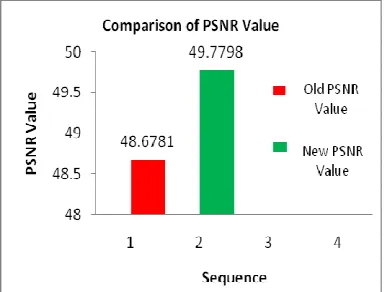
[image:4.595.305.523.531.711.2]After having performed the analysis of the algorithm the resulting value of the PSNR is obtained as 49.7798 and the Mean Square Error value is obtained as 0.68407, which is found to be the enhanced value for obtaining a better quality image as shown in the graph below.
Figure 7: Comparison of PSNR values
3. CONCLUSION
The proposed system is to secure the data based on skin region. Secret data is embedded within skin region of image that will provide an excellent secure location for data hiding. Secret data embedding is performed based on singular value decomposition and the secret image is hidden in one of the high frequency sub band of IWT by tracing skin pixels in that sub band. A better value of Peak Signal Noise Ratio and Mean Square error value has also been achieved.
The concept can further be enhanced in the future by including watermark encryption schemes before hiding to increase security and the human skin detection model can be further improved to recognize the face to identify the name of person for cine application.
REFERENCES:
[1] Wei Ren Tan, Chee Seng Chan, Pratheepan
Yogarajah, and Joan Condell “A Fusion Approach for Efficient Human Skin Detection” IEEE transactions on Industrial Informatics, vol. 8, no. 1, February 2012.
[2] A. Cheddad, J. Condell, K. Curran, and P.
McKevitt, “Askin tone detection algorithm for
an adaptive approach to steganography,” J.
SignalProcess., vol. 89, pp. 2465– 2478, 2009.
[3] P. Vadakkepat, P. Lim, L. De Silva, L. Jing,
and L. L.Ling, “Multimodal approach to
human-face detection and tracking,” IEEE
Trans.Ind. Electron., vol. 55, no. 3, pp. 1385– 1393, Mar. 2008
[4] Min Wu, Member, IEEE, and Bede Liu,
Fellow, IEEE “Data Hiding in Image and Video: Part I—Fundamental Issues and
Solutions” IEEE Transactions On Image
Processing, Vol. 12, No. 6, June 2003.
[5] P. Kakumanua, S. Makrogiannisa, and N.
Bourbakis, “A Survey of skin-color modeling
and detection methods,” IEEE Transactions On
Pattern Recognition., vol. 40, no. 3, pp. 1106– 1122, 2007.
[6] N. Sebe, I. Cohen, T. S. Huang, and T. Gevers,
“Skin detection: A Bayesian network
approach,” in Proc. Int. Conf. Pattern
Recognit., 2004, pp. 903–906.
[7] I. Fasel, B. Fortenberry, and J. Movellan, “A
generative framework for real time object
detection and classification,” Comput. Vis.
Image Underst., vol. 98, pp.182–210, Apr. 2005.
[8] Gouenou Coatrieux, Nora Cuppens-Boulahia,
Wei Pan, Frederic Cuppens and Christian Roux “Reversible Watrmarking Based on Invariant Image Claasification and Dynamis Histogram
Shifting,” IEEE transactions on Information
Forensics and Security., vol. 8, No.1,January 2013.
[9] G.Coatrieux, C.Le Guillou, G.M.Cauvin and
C.Roux, “Reversible Watrmarking for
Knowledge Digest Embedding and Reliability
Control in Medical Images” IEEE trans. Inf .
Technol .Biomed., vol.13, no.2, pp. 158-165, Mar.2009.
[10]L.Kamstra and. H.J.A.M. Heijmans,
“Reversible Data Embedding into Images using
Wavelet Techniques and Sorting,” IEEE trans.
Image Process., vol.14, no.12, pp. 2082-2090, Dec.2005.
[11] Coatrieux, C.Le Guillou, J.M.Cauvin &
C.Roux, “Reversible Watermarking for
Knowledge Digest Embedding and Reliability
Control in Medical Images” IEEE trans. Inf .
Technol .Biomed., vol.13, no.2, pp. 158-165, Mar.2009.
[12]L.Luo, Z.Chen, M.Chen, X.Zeng and Z.Xiong,
“Reversible Image Watermarking using
Interpolation Technique,” IEEE trans. Inf.
Forensic Security, vol.5, no.1, pp. 187-193, Mar. 2010.
[13] Kaushal Solanki, student member, IEEE, Noah
[image:5.595.88.281.225.371.2]Member, IEEE, and Bede Liu, Fellow, IEEE “Data Hiding in Image and Video: Part I—Fundamental Issues and Solutions” IEEE Transactions On Image Processing, Volume. 12, No. 6, June 2003.
[14]B S.Manjunath, senior member, IEEE,
Upamanyu Madhow, senior member, IEEE, and Shivkumar Chandrasekaran “Robust Image-Adaptive Data Hiding Using Erasure
and Error Correction” IEEE transactions on
image processing, vol. 13, no. 12, December 2004.
[15]Ersin Esen and A.Aydin Alatan, Member,
IEEE “Robust Video Data Hiding Using
Forbidden Zone Data Hiding and Selective
Embedding” IEEE Transactions on circuits
and systems for video technology, volume.,21, No 8, August 2011.