Classifying Student’s Faces for Teaching Assistant System
NOR SURAYAHANI.B.S, LEE B.S, IDA LAILA A., MASNANI M.
Department of Computer Engineering
University Tun Hussein Onn Malaysia
Parit Raja, 86400 Batu Pahat, Johor
MALAYSIA
[email protected]
,
[email protected]
,
[email protected]
,
[email protected]
http://www.uthm.edu.my
Abstract: - This paper describes the facial emotion recognition to determine the student’s conditions. The facial emotion recognition could be envisioned to sense the student’s attention state through a CCD camera. Therefore, facial images were analyzed to extract the features to characterize the variations between two categories of student’s faces (understand or unsure/confused) images. The features extraction techniques apply was Principal Component Analysis (PCA), this algorithm finds the principle components of the covariance matrix of a set of face images. Then, the eigenvalues component will be used as an input to the Minimum Distance classifier. The ultimate goal of this research is to develop an intelligent system to investigate the relation between teaching quality contents and comprehension in learning according to the specific emotion state.
Key-Words: - Face Recognition, Principal Component Analysis (PCA), (6 - 10 words)
1 Introduction
In the process of learning, the main objective of the learning is to understand what has been taught by the lecturer or teacher. Currently, teaching and learning evaluation are evaluated using questionnaire given at the end of academic session. Meanwhile, student’s academic performances are analyzed after the test or final examinations. Then, lecturers store the student’s feedback and strengthen their knowledge for a better teaching delivery. They acquire new ideas and methods in the next coming academic session. However, they are shortcoming with this feedback strategy. Although questionnaires ask intentional questions and they are suitable for gathering information about what student wants to learn, it is difficult to determine which parameters of learning contents affect their understanding in teaching and learning process.
Therefore, the understand level of the students are quite important during the learning process. It determined how much the knowledge has been gained by them during the lecture. If the students do not understand during the learning process, meaning that the quality of the teaching technique will still not suit the students’ level enough and the teacher or lecturer in charge should change their techniques or sharpening their skill during give lecturing.
In this paper, we proposed a system using CCD camera to capture student’s faces and classify the
image under two categories of student’s faces (understand or unsure/confused). Besides that, a few surveys will be conducted to the students to support their faces representation. In this context, we used Principal Component Analysis (PCA) to extract the facial features and classify the images using Euclidean Distance Classifier. This facial recognition and classification can be used in a real-time system as a computer aided teaching assistant system which will have an indicator of the current student’s understanding status during the class hour.
In the next section, we describe some related works and the differences between our study and existing research. We show the experimental setup in Section 4.We discuss the details of the analysis and the results in Section 5 and indicate our conclusion and future work in Section 6.
2 Related Works
used to analyze the facial images through estimation of optical flow [4], holistic spatial analysis [2], such as principal component analysis, independent component analysis, local feature analysis [7], and linear discriminant analysis (LDA); and methods based on the outputs of local filters [3], such as Gabor wavelet [4] representations and local principal components [5, 6]. This paper used the most popular technique for facial recognition which is Principal Component Analysis (PCA).
3 Principal Component Analysis
PCA is mathematically defined as an orthogonal linear transformation that transforms the data to a new coordinate system such that the greatest variance by any projection of the data comes to lie on the first coordinate (called the first principal component), the second greatest variance on the second coordinate, and so on.
The main idea of using PCA was a 2-D facial image can be represented as 1-D vector by concatenating each row (or column) into a long thin vector. Let’s suppose we have M vectors of size N (= rows of image x columns of image) representing a set of sampled images. pj’s represent the pixel values.
xi =[p1....pN]T,i=1....M (1)
The images are mean centered by subtracting the mean image from each image vector. Let m
represent the mean image.
∑
= = M i i x M m 1 1 (2)And let wi be defined as mean centered image
w
i=
x
i−
m
(3)Our goal is to find a set of ei’s which have the largest possible projection onto each of the wi’s. We wish to find a set of M orthonormal vectors ei for which the quantity
∑
= = M n n T ii e w
M 1
2 ) ( 1
λ
(4)is maximized with the orthonormality constraint
elTek =
δ
lk (5)It has been shown that the ei’s and λi’s are given
by the eigenvectors and eigenvalues of the covariance matrix
C =WWT (6)
where W is a matrix composed of the column vectors
wiplaced side by side. The size of C is N x N which could be enormous. A common theorem in linear algebra states that the vectors eiand scalars λican be obtained by solving for the eigenvectors and eigenvalues of the M x M matrix WTW. Let diand µi be the eigenvectors and eigenvalues of WTW, respectively.
i i i T
d Wd
W =
µ
(7)By multiplying left to both sides by W
WWT(Wdi)=
µ
i(Wdi) (8)which means that the first M - 1 eigenvectors eiand eigenvalues ¸i of WWT are given by Wdi and µi, respectively. Wdineeds to be normalized in order to be equal to ei. A facial image can be projected onto
M’(≤M) dimensions by computing
Ω
=
[
v
1v
2...
v
M']
T (9)where vi =eiTwi. viis the i th
coordinate of the facial image in the new space, which came to be the principal component. the face class k that minimizes the Euclidean distance
ε
k=
Ω
−
Ω
k (10)where Ωkis a vector describing the kthface class. If
εkis less than some predefined threshold θε, a face is classified as belonging to the class k.
The kth class
ω
k is represented by its meanvector
m
kand covariance matrix which can be estimated from the training samples.)
,...,
1
(
1
1 ) (c
k
x
N
m
k N i k i kk
=
∑
=
= (11) and
∑
=−
−
=
∑
k N i T k k i k k i kk
x
m
x
m
A given pattern of unknown class is classified to
k
ω
if its Mahalanobis distance toω
kis smaller than those to all other classes.
= =
∈ iff D x D x i c
X ωk M( ,ωk) min M( ,ωi) 1,...,
(13) For simplicity, the distance
D
L(
x
,
m
i)
can beused to replace
D
M(
x
,
ω
i)
above. As now only the mean vector of each class is used, the classification does not take into account how the classes are distributed in the feature space.
4 Facial Emotions Recognition
In this paper, the training set consists of the features extracted from known images of different persons. Thus, the task of the face detector is to find the most similar feature vector among the training set to the feature vector of a given test image. Here, the system will try to recognize image using PCA as a feature extraction and classify the image into (understand or unsure/confused) faces using minimum distance classifier.
In this project, the student’s faces images were collected by using CCD camera. The CCD camera will be used to record the situation during the lecture. A questionnaire will also be give on the same time to investigate the emotion or face expression showed by the student was compatible with the image in the video. The image will be crop out in the dimension of 480x640. The images that collect must be in front side of the face to ensure the PCA give a better performance.
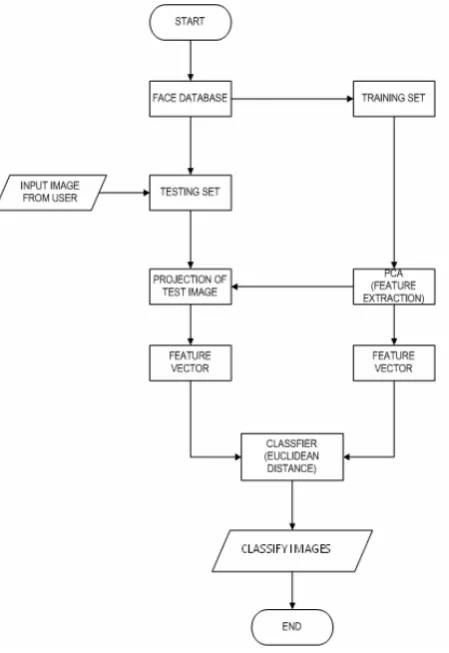
[image:3.595.314.539.70.397.2]According to Fig. 1, the original face images were set as the training data and the eigenfaces was calculated from the training set. A face space was defined by these 75 images. Then, by projecting the face images onto the “face space”, the corresponding distribution in 480x640 dimensional weight spaces for each known expression image was calculated. The contribution of each eigenfaces in represented the face image was described by the vector formed by the weight spaces. These vectors were a predefined face classes. Based on the eigenfaces values, a vector was formed by a set of weight that used in a standard pattern recognition algorithm to find which of a number of predefined faces classes. Finally, Euclidean distance was used to classify the image which had minimizes distance between the input face and train set.
Figure 1: System Development Process
5 Classifications and Analysis
Testing images for classification were taken by these 30 images. Fig. 2 shows sample original image for understand and confused/unsure face image.
[image:3.595.332.515.536.688.2]
(a) (b)
Figure 2: Original Images (a) understand (b) confused/unsure
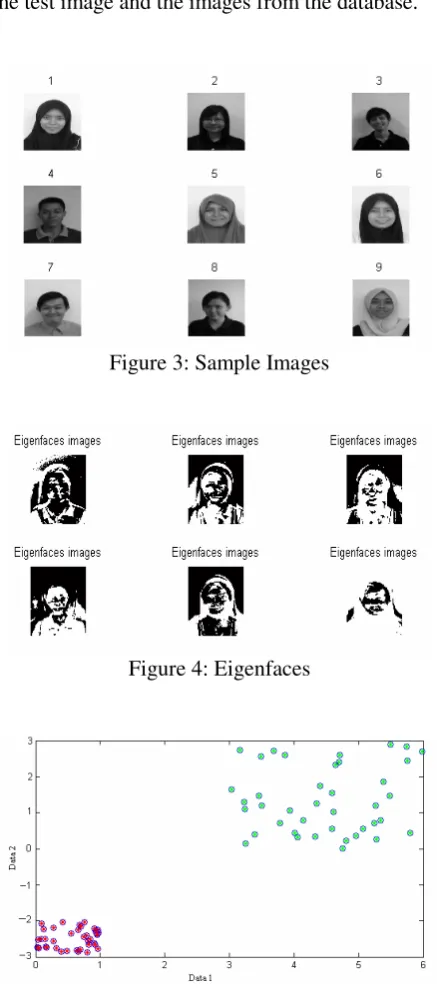
be approximately reconstructed using a mean of the eigenfaces obtained in Fig. 4. The mean values form a feature vector for face representation and recognition. Classification of an object is provided by minimum distance classifier. When a new test image is given, the weights are computed by projecting the image onto the eigenface vectors. Fig.5 shows the feature space form the projected images. The classification is then carried out by comparing the distances between the weight vectors of the test image and the images from the database.
[image:4.595.322.530.89.147.2]
Figure 3: Sample Images
Figure 4: Eigenfaces
Figure 5: 2D feature space representation of hypothetical data
Table 1: Performance of Minimum Distance Classifiers
Emotions Success Failure Success Rate
Understand 13 2 86.67% Unsure/Confused 10 5 66.67%
Table 1 below represents the result of classifying student’s facial emotions image using Minimum Distance Classifier. The lower success rate for unsure/confused faces is due to the head orientation, while the most images have very significant features around their forehead.
6 Conclusion and Future Works
As a conclusion, PCA give good effect in recognizing emotions images. Other technique like local point feature detector could be used to enhance the performance for this classifier. However, this paper has successfully produced results for the first stage in investigating student’s behavioral and their learning conditions by detecting the facials emotions thus design the human-computer interaction of teaching and learning process for future education systems.
Acknowledgment
This work has been supported financially by the Research Management and Innovation Centre, Universiti Tun Hussein Onn Malaysia (UTHM).
References:
[1] Christine L. Lisetti Diane J. Schiano, “Automatic Facial Expression Interpretation: Where Human-Computer Interaction, Artificial Intelligence and Cognitive Science Intersect”, Pragmatics and Cognition, Special Issue on
Facial Information Processing: A
Multidisciplinary, 2000, pp 85-89.
[2] S. T. Gandhe, K. T. Talele, and A.G.Keskar,” Face Recognition Using Contour Matching”
International Journal of Computer Science,
2008, pp 34-37
[3] Kyungnam Kim, “Face Recognition using Principle Component Analysis”, unpublished. [4] B. Nikolaus, F. Stefan, A. Elisabeth, “Relations
[image:4.595.70.289.204.705.2] [image:4.595.76.284.243.415.2]Computer Vision and Pattern Recognition, 2009. pp 101-107.
[5] Fulong W, Cheng H, Xiaoliang L, “A Fusion of Face Symmetry of Two-Dimensional Principal Component Analysis and face Recognition”,
IEEE Conf. of Computational Intelligence
Security, 2009. pp 368-371.
[6] Fengjun C, Zhiliang W.,Xu Z, Yujie W, Fang L, “A Facial Expression Recognition Algorithm Based on Feature Fusion”, IEEE Conf. of
Computational Intelligence and Industrial
Application, 2008. pp 381-385.