Adequacy Assessment of Time of Dispatch Rules
using Fuzzy TOPSIS Method
Ali Alibeigi
1, Adeleh Asemi
2, Abu Bakar Munir
3, Unaizah Hanum Obaidellah
4 1,3Faculty of Law, University of Malaya,
2,4
Dept. Artificial Intelligence, FCSIT, University of Malaya, Corresponding addresses
{[email protected] (corresponding author), [email protected], [email protected], [email protected]}
Abstract: Adequacy assessment of the existing Time of Dispatch (TD) rules is an academic primary step to improve the regulation of electronic commerce laws. This study aims to evaluate the ASEAN countries based on the adequacy of their TD rules. We propose an extended Fuzzy Technique for Order Preference by Similarity to Ideal Solution (TOPSIS) method for evaluation of ASEAN countries’ TD based on experts’ judgments. Fuzzy TOPSIS is initially a Multi Criteria Decision Making (MCDM) method. In this study, we extend it to a one criterion group decision making method. A group of academic experts is assigned for the judgment of the adequacy of TD in considering countries. The result shows that Singapore has the maximum adequacy in its TD rule among eight ASEAN countries.
Keywords: Electronic Commerce Law, Fuzzy TOPSIS, Group Decision Making, ASEAN, Time of Dispatch, Evaluation.
1.
Introduction
The emergence and advancements of information and communication technology (ICT) have changed the traditional paper based way of commercial transactions into electronic commerce. Nowadays e-commerce plays a significant role in business domain [1]. During the last decades, the unification of international trade laws received a remarkable significance and practical actions by international organizations like UN and states as well [2]. However, due to the extra - border feature of the ICT, and the widespread use of e-commerce, unification of the Electronic Commerce Laws (ECLs) got a serious concern. Hence, the regional organizations like the European Union, adopted the EU Directive on Electronic Commerce in 2000 to unify their e-commerce laws. Unification of e-commerce laws will decrease the legal disharmony among the countries and consequently will minimize the legal conflicts. It will affect the rate of international e-commerce transactions by increasing the traders and consumers’ trust.
The Association of Southeast Asian Nations (ASEAN) is one of the first regions in the world, which tried to adopt a unified legal framework for e-commerce through international collaborative projects [3]. However, the analysis of e-commerce laws in ASEAN region shows some inconsistency and silent features. This incompatibility of laws is against the ASEAN initiative to unify commercial rules for the member states in line with regional economic integration. On the other hand, it may hinder the pace and scale of international trade of the ASEAN member states. Therefore, it is essential for the ASEAN countries to unify the context of their ECLs in order to complete the harmonization process.
The Time of Dispatch (TD) rule is a critical factor in
regulation of electronic commerce. Therefore, the unification of TD rules for all ASEAN members can smooth the ECLs’ unification process.
Group Decision Making is based on considering the judgments of an expert team in the evaluation and ranking of alternatives. The researchers use group decision making to increase the accuracy of decision results [4-7].
This study aims to evaluate and rank eight ASEAN countries with respect to their current TD rules. Among ten ASEAN countries, Lao PDR lacks any English translation of her Act and Cambodia has provided a draft. Hence, we have excluded these two members. This evaluation can be formulated as a decision making problem that the time of dispatch is the only criterion, the experts are decision makers and eight ASEAN countries are alternatives. The fuzzy TOPSIS method has potential to deal with our problem based on two reasons:
It is an applicable decision making method in decision makings with discrete environment [8]. The experts express their opinion through
uncertain and imprecise linguistic variables. Fuzzy TOPSIS method by using fuzzy set theory can address the uncertainty of the decision makers.
However, Fuzzy TOPSIS is initially a Multi Criteria Decision Making (MCDM) method [9]. In this study, we convert it to a one criterion group decision making method. The main change of this method is assigning the columns of comparison matrix to decision makers instead of the criteria. An expert team, including five academic experts in ECLs is assigned for judgment of TD in considering countries. The remainder of this paper is organized as follows. The concept of time of dispatch is provided in section 2. The extended fuzzy TOPSIS method is proposed in section 3. In section 4, the achieved results are shown and discussed. Section 5 concludes the paper.
2.
Time of Dispatch
of dispatch. The United Nations Commission on International Trade Law (UNCITRAL) proposed the MLEC with a recommendatory feature and later, the UNCUECIC which is binding upon its signatories.
Under Article 15 (1) of the MLEC, “Unless otherwise agreed between the originator and the addressee, the dispatch of a data message occurs when it enters an information system outside the control of the originator or of the person who sent the data message on behalf of the originator”. However, under Article 10 (1) of the UNCUECIC which is subsequent to the MLEC, “The time of dispatch of an electronic communication is the time when it leaves an information system under the control of the originator or of the party who sent it on behalf of the originator or, if the electronic communication has not left an information system under the control of the originator or of the party who sent it on behalf of the originator, the time when the electronic communication is received”.
The UNCUECIC continues with a hypothesis in which the electronic communication does not leave the originator's information system. In this scenario which is not in the MLEC, the time of dispatch and the time of receipt coincide [10].
3.
Method
The Technique for Order Preference by Similarity to Ideal Solution (TOPSIS) method is basically a Multi-Criteria Decision Making Method (MCDM) that use the calculation of distance for determination of preferences [11]. The TOPSIS method has two criteria for determination of preferences [12]:
1. Calculation of shortest distance from the positive ideal solution (PIS)
2. Calculation of farthest distance from the negative ideal solution (NIS)
3.1 Fuzzification of linguistic variables
Fuzzy set theory is an extension of classical set theory proposed by Prof. Zadeh which utilizes to defuzzify and computerize Linguistic or fuzzy variables [13]. Linguistic variables are variables with linguistic term values. The concept of a linguistic variable is very useful in dealing with situations which are too complex or too ill-defined to be reasonably described in conventional quantitative expressions [9, 13]. A fuzzy set F̃ in a universe of discourse X is characterized by a membership function µF̃(x) that is associated with every element x in X a real number in the interval [0, 1]. The function value µF̃(x) is termed the grade of membership of x in 𝐹̃ [14].
We use a triangular fuzzy number to fuzzify the linguistic variable terms. A triangular fuzzy number f̃ defines through a trio (h, m, l). The membership function µf̃(x) is defined.
µf̃(x) = {
(x − h) (m − h), h ≤ x ≤ m ⁄
(l − x) (l − m), m ≤ x ≤ l ⁄
0, x < ℎ 0 x > 𝑙
(1)
Let f̃1 and f̃2 be two triangular fuzzy numbers that are defined through the trio (h1, m1, l1) and (h2, m2, l2) respectively, then the following equations are used for mathematical operations of fuzzy numbers [14]:
f̃1+ f̃2= (h1, m1, l1) + (h2 , m2 , l2) = (h1+ h2 , m1+ m2 , l1+ l2 ), (2)
f̃1 − f̃2= (h1, m1, l1) − (h2 , m2 , l2) = (h1− h2 , m1− m2 , l1− l2 ), (3)
f̃1× f̃2= (h1, m1, l1) × (h2 , m2 , l2) = (h1. h2 , m1. m2 , l1. l2 ), (4)
f̃1 / f̃2= (h1, m1, l1) / (h2 , m2 , l2) = (h1/l2 , m1/ m2 , l1/ h2 ), (5)
The multiplication of a crisp number “ b” and fuzzy number “ f ̃ ” is calculated as:
b ∗ f̃ = (b. h, b. m , b. l). (6)
Also, the vertex method is defined to calculate the distance between two fuzzy numbers f̃1, f̃2 [14].
d( f̃1, f̃2) = √13 [(h1− h2 )2+ ( m1− m2 )2+ ( l1− l2 )2]
(7)
We assigned a team of experts to rate the adequacy of TD rules in eight ASEAN states. It is suggested that the experts easily use the linguistic scales shown in table 1 to evaluate the rating of countries with respect to their TD rules. The linguistic variables can be expressed in triangular fuzzy numbers as Tables 1. A seven point linguistic scales is adapted from Chen [15]. The fuzzification of linguistic variables in preferences matrix is based on the following table.
Table1. Seven point linguistic scales
Linguistic variables Related TFN
Excellent (EX) (0.9, 1, 1) Very good (VG) (0.7, 0.9,1)
Fairly good (FG) (0.5, 0.7, 0.9)
Good (GD) (0.3, 0.5, 0.7) Preferred (PF) (0.1, 0.3, 0.5)
Not bad (NB) (0, 0.1, 0.3)
Poor (PO) (0, 0, 1)
3.2 Multiple Criteria Decision Making using Fuzzy TOPSIS
When multiple criteria should be considered in an evaluation of alternatives, the Fuzzy TOPSIS method constructs a P matrix (Fig 1), preferences matrix, with a set of alternative performing of A = [Aj]J with regard to criteria 𝐶 = [Ci]n as:
P = [ p̃ij]n∗J i = 1, 2, … , n, j = 1, 2, … . , J. (8)
Criteria
Al
ter
n
at
ives
P
C1 … CnA1
p̃
11 …p̃
1𝑛… … …
[image:3.595.88.276.146.312.2]AJ
p̃
𝐽1 …p̃
𝐽𝑛Figure 1. The preferences matrix P of Fuzzy TOPSIS
In Fuzzy TOPSIS, the first step is constructing P matrix. Because of fuzzy numbers, there is no need for normalization of P matrix. If the criteria have different weights, then the weight of criteria should be multiplied in corresponding columns. Then the best fuzzy numbers in the rows of P matrix construct the ideal solution and the worst numbers construct the negative ideal solution. The best fuzzy number is the minimum number for cost criteria and the maximum number for benefit criteria. Also, the worst fuzzy number is the minimum number for benefit criteria and the maximum number for cost criteria. Finally, the Fuzzy TOPSIS method calculates the similarity of alternatives with PIS and NIS by measuring the distance of each alternative from PIS and NIS.
3.3 Group Decision Making using Fuzzy TOPSIS
In this study, we evaluate the ASEAN countries in their current time of dispatch rules and based on experts’ judgment. It can be formulated as a decision making problem that the time of dispatch is the only criterion, the experts are decision makers and the eight ASEAN countries are alternatives. Fuzzy TOPSIS is initially a MCDM method. In this study, we convert it to a one criterion Group decision making method. So, we customize the Fuzzy TOPSIS method for decision making with the following attributes:
One criterion,
Multi decision makers,
Multi alternatives.
The proposed customized Fuzzy TOPSIS includes the following steps:
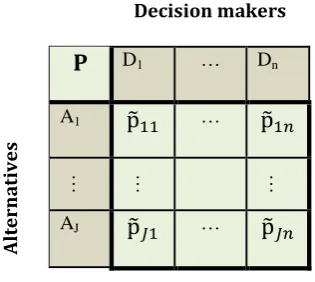
Step 1: Construct matrix P (Fig 2), with n columns and J rows where there are n decision makers and J
alternatives as:
P = [ p̃ij]n∗J i = 1, 2, … , n, j = 1, 2, … . , J. (9)
Where,D = [Di]n is a group of decision makers that judge the A = [Aj]J as a set alternatives.
The elements of P, are the fuzzy linguistic performance rating ( p̃ij) of “alternative i” in view point of “decision maker j”. They are defuzzified TFNs so, the matrix is a normalized.
Decision makers
Al
ter
n
at
ives
P
D1 … DnA1
p̃
11 …p̃
1𝑛… … …
AJ
p̃
𝐽1 …p̃
𝐽𝑛Figure 2. The preferences matrix P of customized Fuzzy TOPSIS
Step 2: If the experts have different weight, then effect the weights of decision makers on P. The weighted normalized value Ẽij calculated by Ẽij= p̃ij∗ wdi where, wdi is the weight of Di , i = 1, 2, …, n and n= number of decision makers.
Step 3: Identify positive-ideal (S∗) and negative ideal
(S−) solutions using following equations:
Positive ideal solution (S∗) = [ Ẽ
i
∗]
n= [max Ei]n (10)
Negative ideal solution (S−) = [ Ẽ
i
−]n= [min Ei]n
(11)
Step 4: Measure the distance of each alternative from S∗ and S− using these equations:
DISj∗ = ∑Jj=1d( Ẽij, Ẽi∗) i = 1,2, … , n, j = 1,2, … , J , (12)
DISj− = ∑Jj=1d( Ẽij, Ẽi−) i = 1,2, … , n, j = 1,2, … , J. (13)
Step 5: Calculate the similarity to ideal solution.
SIMj−= DISj−
DISj∗+DISj− j = 1, 2, … , J. (14)
[image:3.595.355.513.226.367.2]Finally we rank the alternatives according to SIMj− in descending order. It means that, the alternative witch has the maximum distance from negative ideal solution, is the best alternative.
4.
Results and Discussion
This study evaluated eight ASEAN member countries as Indonesia, Malaysia, Philippines, Singapore, Thailand, Brunei, Burma (Myanmar) and Vietnam based on their Time of Dispatch rules by the following stages:
1. The evaluation is formulated as a decision making problem with one criterion (time of dispatch), eight alternatives (eight ASEAN countries) and group decision making (five academic expert in electronic commerce law).
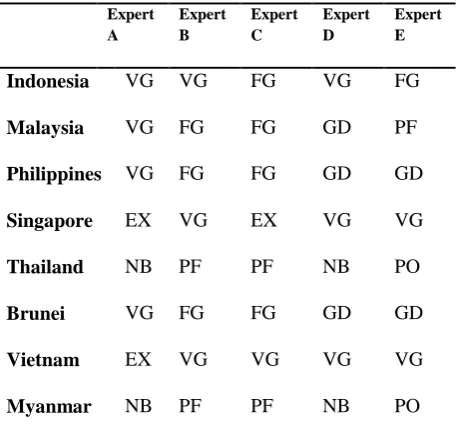
[image:4.595.317.547.62.295.2]2. We prepared table 2 and asked the experts to rate the countries based on following linguistic variables: Excellent (EX), Very good (VG), Fairly good (FG), Good (GD), Preferred (PF), Not bad (NB), Poor (PO).
Table 2. Rating the countries by experts
Expert A Expert B Expert C Expert D Expert E
Indonesia VG VG FG VG FG
Malaysia VG FG FG GD PF
Philippines VG FG FG GD GD
Singapore EX VG EX VG VG
Thailand NB PF PF NB PO
Brunei VG FG FG GD GD
Vietnam EX VG VG VG VG
Myanmar NB PF PF NB PO
3. The preferences matrix is constructed according to equation (9). We converted the linguistic variables (see table 2) to triangular fuzzy numbers that is presented in table 3. This is based on replacing the linguistic variables with their corresponding TFNs determined in table 1.
Table 3. Preferences matrix (P)
Expert A Expert B Expert C Expert D Expert E
Indonesia (0.7,
0.9,1 ) (0.7, 0.9,1) (0.5, 0.7, 0.9) (0.7, 0.9,1) (0.5, 0.7, 0.9)
Malaysia (0.7,
0.9,1 (0.5, 0.7, (0.5, 0.7, (0.3, 0.5, (0.1, 0.3,
) 0.9) 0.9) 0.7) 0.5)
Philippines (0.7, 0.9,1 ) (0.5, 0.7, 0.9) (0.5, 0.7, 0.9) (0.3, 0.5, 0.7) (0.3, 0.5, 0.7)
Singapore (0.9,
1,1) (0.7, 0.9,1) (0.9,1,1 ) (0.7, 0.9,1) (0.7, 0.9,1)
Thailand (0,
0.1, 0.3) (0.1, 0.3, 0.5) (0.1, 0.3, 0.5) (0, 0.1, 0.3) (0, 0, 1)
Brunei (0.7,
0.9,1 ) (0.5, 0.7, 0.9) (0.5, 0.7, 0.9) (0.3, 0.5, 0.7) (0.3, 0.5, 0.7)
Vietnam (0.9,
1,1) (0.7, 0.9,1) (0.7, 0.9,1) (0.7, 0.9,1) (0.7, 0.9,1)
Myanmar (0,
0.1, 0.3) (0.1, 0.3, 0.5) (0.1, 0.3, 0.5) (0, 0.1, 0.3) (0, 0, 1)
4. The positive and negative ideal solution is obtained by equation (10) and (11).
S*= [(0.9, 1, 1) (0.7, 0.9, 1) (0.9, 1, 1) (0.7, 0.9, 1) (0.7, 0.9, 1)]
S- = [(0, 0.1, 0.3) (0.1, 0.3, 0.5) (0.1, 0.3, 0.5) (0, 0.1, 0.3) (0, 0, 1)]
5. The distance of each country from S∗ and S− is calculated by equations (7), (12) and (13).
[image:4.595.45.275.357.577.2]6. The similarity of the distance of each country from PIS and NIS is measured using equation (14). The results are illustrated in table 4. The ranks of countries are determined according obtained number of similarities.
Table 4. Rank of countries in adequacy of their TD
Country 𝐒𝐈𝐌𝐣− Rank
Singapore 1.000 1
Viet Nam 1.000 1
Indonesia 0.826 2
Philippines 0.638 3
Brunei 0.638 3
Malaysia 0.317 4
Thailand 0.194 5
Myanmar 0.194 5
[image:4.595.336.559.581.711.2]
obtained the lowest rank with SIMj−= 0.194. Also, Philippines and Brunei have the same rank since they have a high similarity in their written TD rules.
The analysis of TD rules in the MLEC and the UNCUECIC clears that in 1996, the drafters affected by the current technologies like Electronic Data Interchange (EDI) and in 2005, the tried to be more adaptive with new technologies like internet [16]. Furthermore, the TD rule under Article 10 (1) is similar to the rule in ordinary contracts [10]. Under the MLEC, the time of dispatch is when the data message enters the information system which is not under the control of the originator. However, the convention provides that the time of dispatch is the time when electronic communication leaves the originators’ information system.
The majority of ASEAN countries in drafting their electronic commerce Acts, followed the MLEC provisions. In case of TD rules also they adopted the principle of Article 15 (1) of the MLEC. However, they have some differences in the context of TD provisions which considered by experts and resulted in different ranking. With regard to Singapore and Vietnam, they followed Article 10 (1) of the UNCUECIC and considered the time when electronic communication leaves the originators’ information system as TD rule. This is the main reason to obtain the first place among all ASEAN members.
5.
Conclusion
In this study, we presented an extended Fuzzy TOPSIS method, by considering one criterion, multiple decision makers and alternatives. We employed fuzzy set theory for fuzzification of TOPSIS method to deal with uncertain and subjective data and environment.
The proposed method is applicable for group decision making with one criterion. The ASEAN countries have evaluated in adequacy of TD rule by the proposed method. From the obtained results we conclude that the first strongest countries in TD rule adequacy are Singapore and Vietnam. The Thailand and Myanmar have the lowest rank in comparison with other sis eight countries.
Those states which obtained lower ranks, can modify their TD rules in line with Singapore and Vietnam approaches.
Acknowledgement
This research work has been funded by the University of Malaya Research Grant (UMRG), Project No: RP006/13ICT. The authors would like to thank the University of Malaya for financial support.
References
1. Efendioglu, A.M. and V.F. Yip, Chinese culture and e-commerce: an exploratory study. Interacting with Computers, 2004. 16(1): p. 45-62.
2. Kalenský, P., Trends of private international law. 1971: Brill Archive.
3. UNCTAD, Review of e-Commerce Legislation Harmonization in the Association of Southeast Asian Nations. 2013, UNCTAD United Nations: Geneva. p. i-58.
4. Boran, F.E., et al., A multi-criteria intuitionistic fuzzy group decision making for supplier selection
with TOPSIS method. Expert Systems with Applications, 2009. 36(8): p. 11363-11368. 5. Dursun, M., E.E. Karsak, and M.A. Karadayi, A
fuzzy multi-criteria group decision making framework for evaluating health-care waste disposal alternatives. Expert Systems with Applications, 2011. 38(9): p. 11453-11462. 6. Guha, D. and D. Chakraborty, Fuzzy multi attribute
group decision making method to achieve consensus under the consideration of degrees of confidence of experts' opinions. Computers & Industrial Engineering, 2011. 60(4): p. 493. 7. Li, T., J. Jin, and C. Li, Refractured Well Selection
for Multicriteria Group Decision Making by Integrating Fuzzy AHP with Fuzzy TOPSIS Based on Interval-Typed Fuzzy Numbers. Journal of Applied Mathematics, 2012.
8. Anojkumar, L., M. Ilangkumaran, and V. Sasirekha,
Comparative analysis of MCDM methods for pipe material selection in sugar industry. Expert Systems with Applications, 2014. 41(6): p. 2964-2980.
9. Chen, C.T., Extensions of the TOPSIS for group decision-making under fuzzy environment. Fuzzy Sets and Systems, 2000. 114(1): p. 1-9.
10. UNCITRAL, United Nations Convention on the Use of Electronic Communications in International Contracts with Explanatory Note by the UNCITRAL Secretariat U. Nations, Editor. 2005, United Nations Publication: New York.
11. Hwang, C.L. and K. Yoon, Multiple attribute decision making: methods and applications: a state-of-the-art survey. Vol. 13. 1981: Springer-Verlag New York.
12. Abo-Sinna, M.A. and A.H. Amer, Extensions of TOPSIS for multi-objective large-scale nonlinear programming problems. Applied Mathematics and Computation, 2005. 162(1): p. 243-256.
13. Zadeh, L.A., Fuzzy sets. Information and Control, 1965. 8(3): p. 338-353.
14. Zimmermann, H.J., Fuzzy set theory--and its applications. 2001: Springer.
15. Chen-Tung, C., A fuzzy approach to select the location of the distribution center. Fuzzy Sets and Systems, 2001. 118(1): p. 65-73.
16. Chong Kah, W. and J. Chao Suling, United Nations Convention on the Use of Electronic
Communications in International Contracts-A New Global Standard. SAcLJ, 2006. 18: p. 116.