in Multi-biometric Fusion
dem Fachbereich Informatik der Technischen Universität Darmstadt
vorzulegende
DISSERTATION
zur Erlangung des akademischen Grades eines Doktor-Ingenieurs (Dr.-Ing.)
von
M.Sc. Naser Damer
geboren in Amman, JordanienReferenten der Arbeit: Prof. Dr. Arjan Kuijper
Technische Universität Darmstadt
Prof. Dr. Dieter W. Fellner Technische Universität Darmstadt
Prof. Dr. Raghavendra Ramachandra
Norwegian University of Science and Technology
Tag der Einreichung: 22/01/2018 Tag der mündlichen Prüfung: 05/03/2018
Darmstädter Dissertation D 17
Jahr der Veröffentlichung der Dissertation auf TUprints: 2018 URN: urn:nbn:de:tuda-tuprints-73248
Tag der mündlichen Prüfung: 05.03.2018
Veröffentlicht unter CC BY-SA 4.0 International https://creativecommons.org/licenses/
Hiermit versichere ich die vorliegende Dissertation selbständig nur mit den angegebenen Quellen und Hilfsmit-teln angefertigt zu haben. Alle Stellen, die aus Quellen entnommen wurden, sind als solche kenntlich gemacht. Diese Arbeit hat in gleicher oder ähnlicher Form noch keiner Prüfungsbehörde vorgelegen.
Biometric recognition is the automated recognition of individuals based on their behavioral or biological charac-teristics. Beside forensic applications, this technology aims at replacing the outdated and attack prone, physical and knowledge-based, proofs of identity. Choosing one biometric characteristic is a tradeoff between universal-ity, acceptabiluniversal-ity, and permanence, among other factors. Moreover, the accuracy cap of the chosen characteristic may limit the scalability and usability for some applications. The use of multiple biometric sources within a unified frame, i.e. multi-biometrics, aspires to tackle the limitations of single source biometrics and thus en-ables a wider implementation of the technology. This work aims at presenting application-driven advances in multi-biometrics by addressing different elements of the multi-biometric system work-flow.
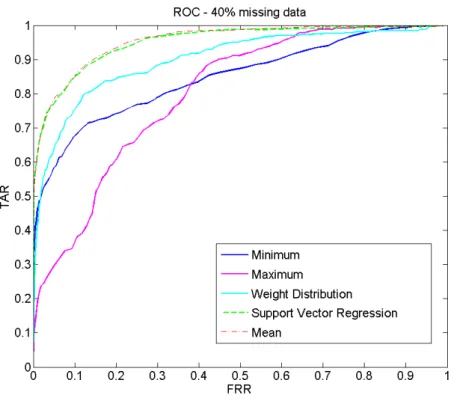
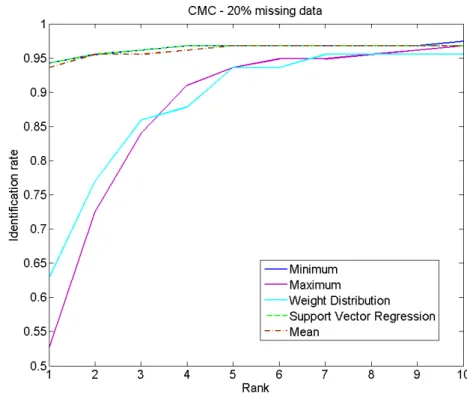
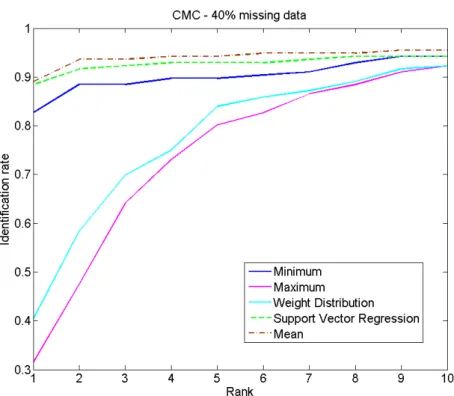
At first, practical oriented pre-fusion issues regarding missing data imputation and score normalization are discussed. This includes presenting a novel performance anchored score normalization technique that aligns certain performance-related score values in the fused biometric sources leading to more accurate multi-biometric decisions when compared to conventional normalization approaches. Missing data imputation within score-level multi-biometric fusion is also addressed by analyzing the behavior of different approaches under different operational scenarios.
Within the multi-biometric fusion process, different information sources can have different degrees of relia-bility. This is usually influenced in the fusion process by assigning relative weights to the fused sources. This work presents a number of weighting approaches aiming at optimizing the decision made by the multi-biometric system. First, weights that try to capture the overall performance of the biometric source, as well as an indication of its confidence, are proposed and proved to outperform the state-of-the-art weighting approaches. The work also introduces a set of weights derived from the identification performance representation, the cumulative match characteristics. The effect of these weights is analyzed under the verification and identification scenarios.
To further optimize the multi-biometric process, information besides the similarity between two biometric captures can be considered. Previously, the quality measures of biometric captures were successfully integrated, which requires accessing and processing raw captures. In this work, supplementary information that can be reasoned from the comparison scores are in focus. First, the relative relation between different biometric com-parisons is discussed and integrated in the fusion process resulting in a large reduction in the error rates. Secondly, the coherence between scores of multi-biometric sources in the same comparison is defined and integrated into the fusion process leading to a reduction in the error rates, especially when processing noisy data.
Large-scale biometric deployments are faced by the huge computational costs of running biometric searches and duplicate enrollment checks. Data indexing can limit the search domain leading to faster searches. Multi-biometrics provides richer information that can enhance the retrieval performance. This work provides an opti-mizable and configurable multi-biometric data retrieval solution that combines and enhances the robustness of rank-level solutions and the performance of feature-level solutions.
Furthermore, this work presents biometric solutions that complement and utilize multi-biometric fusion. The first solution captures behavioral and physical biometric characteristics to assure a continuous user authentication. Later, the practical use of presentation attack detection is discussed by investigating the more realistic scenario of cross-database evaluation and presenting a state-of-the-art performance comparison. Finally, the use of multi-biometric fusion to create face references from videos is addressed. Face selection, feature-level fusion, and score-level fusion approaches are evaluated under the scenario of face recognition in videos.
Biometrische Erkennung bezeichnet die automatische Erkennung von Personen auf Grundlage ihres Verhaltens oder ihrer biologischen Eigenschaften. Neben forensischen Anwendungen zielt diese Technologie darauf ab, die traditionellen, wissensbasierten und angriffsanfälligen Identitätsnachweise zu ersetzen. Die Wahl eines biome-trischen Merkmals ist neben anderen Faktoren vor allem ein Kompromiss zwischen Universalität, Akzeptanz und Dauerhaftigkeit. Darüber hinaus kann die Genauigkeitsobergrenze des gewählten Merkmals die Skalierbar-keit und NutzbarSkalierbar-keit für einige Anwendungen einschränken. Die Nutzung mehrerer biometrischer Merkmale innerhalb eines einheitlichen Rahmens (Multi-Biometrie) zielt darauf ab, die Beschränkungen der Biometrie ein-zelner Merkmale anzugehen und somit eine breitere Implementierung der Technologie zu ermöglichen. Diese Arbeit präsentiert Fortschritte in der Multi-Biometrie, indem sie verschiedene Schritte des multi-biometrischen Workflows genauer untersucht.
Zunächst werden praxisorientierte Fragen in Bezug auf Imputation fehlender Daten und Vergleichswert-Nor-malisierung vor der Fusion diskutiert. Dies umfasst die Vorstellung einer neuartigen leistungsverankerten Ver-gleichswert-Normalisierungstechnik, die bestimmte leistungsbezogene Vergleichswerte in den zu fusionierenden biometrischen Quellen ausrichtet, was zu einer präziseren multi-biometrischen Entscheidungsfindung im Ver-gleich zu herkömmlichen Normalisierungsansätzen führt. Ebenfalls wird die Imputation fehlender Daten inner-halb der wertebasierenden multi-biometrischen Fusion durch die Analyse des Verhaltens verschiedener Ansätze in verschiedenen operativen Szenarien untersucht.
Innerhalb des multi-biometrischen Fusionsprozesses können verschiedene Informationsquellen unterschiedli-che Zuverlässigkeitsgrade aufweisen. Dies wird in der Regel durch die Zuordnung von relativen Gewichten zu den zu fusionierenden Quellen in den Fusionsprozess erreicht. Diese Arbeit präsentiert eine Reihe von Gewich-tungsansätzen zur Optimierung der Entscheidungsfindung des biometrischen Systems. Dabei werden Gewichte, die auch als Vertrauensindikator fungieren, zur Erfassung der Gesamtleistung der biometrischen Quelle vorge-schlagen und deren Überlegenheit gegenüber aktueller Gewichtungsansätze unter Beweis gestellt. Diese Arbeit führt ebenfalls einige Gewichte ein, die aus der Darstellung des Identifikationsleistung abgeleitet wurden. Die Auswirkungen dieser Gewichte werden sowohl im Verifikations- als auch im Identifikationsszenario analysiert.
Zur weiteren Optimierung des multi-biometrischen Prozesses können auch Informationen außer der Ähnlich-keit zweier biometrischer Aufnahmen berücksichtigt werden. Bisher wurden die Qualitätsmaße der biometri-schen Aufnahmen erfolgreich integriert, wenn Rohdaten der Aufnahmen zur Verarbeitung zur Verfügung stan-den. In dieser Arbeit stehen ergänzende Informationen, die sich aus den Vergleichswerten ableiten lassen, im Fokus. Zunächst wird die relative Beziehung zwischen den verschiedenen biometrischen Vergleichen diskutiert und in den Fusionsprozess integriert, was zu einer erheblichen Reduzierung der Fehlerraten führt. Weiterhin wird die Kohärenz zwischen den Werten der multi-biometrischen Quellen im selben Vergleich definiert und in den Fusionsprozess integriert. Dies führt dazu, dass es zu einer weiteren Verringerung der Fehlerraten kommt, insbesondere bei der Verarbeitung verrauschter Daten.
Beim Einsatz großskalierter biometrischer Anwendungen werden diese mit enormen Kosten konfrontiert, die bei biometrischen Suchvorgängen und bei der doppelten Registrierungsprüfung entstehen. Die Datenindexierung kann die Suchdomäne einschränken, was zu schnelleren Suchvorgängen und verringerten Kosten führt. Dabei liefert die Multi-Biometrie umfangreichere Informationen, die die Suchleistung verbessern können. Diese Arbeit
Darüber hinaus werden in dieser Arbeit neue biometrische Lösungen vorgestellt, die die multi-biometrische Fusion ergänzen und nutzen. Die erste Lösung erfasst verhaltensbezogene und physikalische biometrische Merk-male, um kontinuierliche Authentisierung zu gewährleisten. Später wird die praktische Anwendung der Erken-nung von Präsentationsangriffen diskutiert, indem das realistischere Szenario der datenbankübergreifenden Aus-wertung untersucht wird. Weiterhin werden Leistungsvergleiche auf dem neuesten Stand der Technik präsentiert. Zum Abschluss wird die Verwendung der multi-biometrischen Fusion zur Erzeugung von Gesichtstemplates aus Videos diskutiert. Gesichtsauswahl, Fusion auf Feature-Ebene und Fusionsverfahren auf Score-Ebene werden im Rahmen des Szenarios der Gesichtserkennung in Videos ausgewertet, um die Vorteile der multi-biometrischen Fusion hervorzuheben.
First and foremost I would like to thank my supervisor Prof. Dr. Arjan Kuijper for having the patience and wisdom to guide me throughout this work. His positive leadership and imperative advice have made this journey an exceptional learning experience. I would like to express my gratitude to Prof. Dr. techn. Dieter W. Fellner for co-refereeing this work and for building a thriving atmosphere for scientific excellence at Fraunhofer IGD. Special thanks go to Prof. Dr. Ramachandra Raghavendra for acting as co-referee and for the many fruitful discussions we had over the past few years.
I would like to express my great appreciation to Alexander Nouak and Dr. Andreas Braun. From my first day at Fraunhofer IGD, Alexander has provided me with the full support and trust that always sparked my self-motivation. Andreas constant support and creative leadership gave me the chance to grow scientifically and professionally. I would also like to thank all my friends and colleagues at the Competence Center for Smart Living & Biometric Technology, and previously at the Competence Center for Identification and Biometrics, of the Fraunhofer IGD. Their thoughts and mind-provoking discussions have been an integral part of my life over the past few years. My gratitude extends to the research and non-research staff at Fraunhofer IGD and the Interactive Graphics Systems Group of TU Darmstadt who have taken part in supporting me and have made my work the worthwhile experience that it was. Special thanks are extended to Andreas Braun, Alexander Opel, Aidmar Wainakh, and Philipp Terhörst for their effort in reviewing this thesis.
My greatest thanks go to my students, whom I have learned from the most. Their excellent work, dedication, self involvement, and the many in-depth discussions that we had, made this work possible. Thank you, Philipp, Kristiyan, Yaza, Steffen, Timotheos, Dirk, Hazem, Viola, Christian, Fadi, Benedikt, Chadi, Veronica, Fabian, Aidmar, Tina, Wael, and Matthias.
During my work on this thesis, I worked on a number of European, national, and industrial projects at Fraun-hofer IGD. Many thanks go to the project partners at different organizations and institutions. The valuable discussions we had provided me with the clarity and practical relevance much-needed for my research. I am particularly grateful for the many talented minds in the biometrics research community. Their hard work and innovative research have always driven my aspiration, and I am happy to consider many of them friends.
My appreciation is extended to all my friends, across time and space, for the continuous encouragement. Last but not least, I would like to thank my dear family. My brother and sister that I will always look up to, my late father whose wisdom still guides me today, and my mother for her constant and unquestionable support. Looking at my parents personal, academic, and professional lives made this work always feels achievable.
1 Introduction 1 1.1 Towards multi-biometrics . . . 1 1.2 Research questions . . . 3 1.2.1 Pre-fusion processes . . . 4 1.2.2 Fusion optimization . . . 5 1.2.3 Reference database . . . 6
1.2.4 Miscellaneous multi-biometric processes . . . 7
1.3 This thesis . . . 8 1.4 Conclusion . . . 10 2 Background 11 2.1 Biometrics. . . 11 2.2 Multi-biometric fusion . . . 13 2.2.1 Information fusion . . . 13 2.2.2 Multi-biometrics . . . 14 2.3 Performance metrics . . . 18
2.3.1 Verification performance metrics. . . 18
2.3.2 Identification performance metrics . . . 19
2.4 Summary . . . 20
3 Pre-fusion processes 21 3.1 Introduction . . . 21
3.2 Related work . . . 22
3.3 Performance anchored score normalization. . . 24
3.3.1 Baseline normalization . . . 24
3.3.2 Proposed score normalization . . . 25
3.3.3 Experimental setup . . . 26
3.3.4 Results . . . 29
3.4 Missing data imputation . . . 30
3.4.1 Methodology . . . 30
3.4.2 Experimental setup . . . 31
3.4.3 Results . . . 32
3.5 Summary . . . 34
4 Multi-biometric source weighting 37 4.1 Introduction . . . 37
4.2 Related work . . . 38
4.3 Confident biometric source weighting . . . 40
4.3.2 Experimental setup . . . 41
4.3.3 Results . . . 43
4.4 CMC curve properties and biometric source weighting . . . 46
4.4.1 Methodology . . . 46
4.4.2 Experimental setup . . . 48
4.4.3 Results . . . 49
4.5 Summary . . . 50
5 Integrating supplementary information 55 5.1 Introduction . . . 55
5.2 Related work . . . 56
5.3 Biometric neighbors distance ratio . . . 57
5.3.1 Baseline solution . . . 57
5.3.2 Neighbors distance ratio . . . 58
5.3.3 Weighted NDR integration . . . 60
5.3.4 Experimental setup . . . 61
5.3.5 Results . . . 61
5.4 Multi-biometric score coherence . . . 64
5.4.1 Defining score coherence. . . 64
5.4.2 Static weights . . . 64
5.4.3 Fusion. . . 65
5.4.4 Experimental setup . . . 65
5.4.5 Results . . . 66
5.5 Summary . . . 69
6 Multi-biometric data retrieval 71 6.1 Introduction . . . 71
6.2 Related work . . . 72
6.3 Methodology . . . 73
6.3.1 Single iris indexing . . . 73
6.3.2 Multi-biometric indexing . . . 74
6.4 Experimental setup . . . 77
6.5 Results. . . 78
6.6 Summary . . . 81
7 Miscellaneous multi-biometric processes 85 7.1 Introduction . . . 85
7.1.1 Multi-biometric continuous authentication. . . 85
7.1.2 Face presentation attack detection . . . 86
7.1.3 Face reference from video . . . 87
7.2 Multi-biometric continuous authentication . . . 87
7.2.1 Related work . . . 88
7.2.2 Database . . . 90
7.2.3 Methodology . . . 90
7.2.4 Experimental setup . . . 94
7.2.5 Results . . . 95
7.3.1 Related work . . . 99
7.3.2 Databases . . . 99
7.3.3 Methodology . . . 100
7.3.4 Experimental setup . . . 102
7.3.5 Results . . . 102
7.4 Face Reference from video: key-face selection and feature-level fusion. . . 106
7.4.1 Related work . . . 106
7.4.2 Methodology . . . 107
7.4.3 Experimental setup . . . 111
7.4.4 Results . . . 112
7.5 Summary . . . 115
8 Conclusions and future work 117 8.1 Conclusion . . . 117
8.2 Future work . . . 121
A Publications and talks 123 A.1 Publications . . . 123
A.2 Talks. . . 125
A.3 Posters. . . 126
A.4 Submitted papers . . . 126
B Supervising activities 127 B.1 Diploma and master thesis . . . 127
B.2 Bachelor thesis . . . 127
C Curriculum vitae 129
BFW Brute force weighting
BSSR1 Biometric scores set BSSR1
CMC Cumulative match characteristic CNN Convolutional neural networks
DCT Discrete cosine transform
DPW D-Prime weighting
EER Equal error rate
EERW Equal error rate weighting
ERM Empirical risk minimization FAR False acceptance rate
FDR Fisher discriminant ratio
FDRW Fisher discriminant ratio weighting
FIR False identification rate FNR False negative rate
FPR False positive rate FRR False rejection rate
GBC General Borda count
GDBC General distance Borda count
GMM Gaussian mixture model
HOOF Histogram of oriented optical flow HTER Half-total error rate
ID Identity
LBP Local binary pattern
LBLDA Local binary linear discriminant analysis LDA Linear discriminant analysis
LFW Labeled faces in the wild database LSH Locality sensitive hashing
MAD Median absolute deviation
MEW Mean-to-extrema weighting
MLDF Multilobe differential filters
MSU Michigan state university
NBIS National institute of standards and technology biometric image software
NCW Non-confidence width
NCWW Non-confidence width weighting
NDR Neighbor distance ratio
NN Neural network
OLD Overlap deviation
OLDW Overlap deviation weighting
OM Ordinal measures
PAD Presentation attack detection
PAN Performance anchored normalization
PCA Principle component analysis
RBF Radial basis function
RIR Rotation invariant representation
ROC Receiver operating characteristic
SIFT Scale-invariant feature transform SRM Structural risk minimization
SVM Support vector machines
SVR Support vector regression
TAR True acceptance rate
TIR True identification rate
XM2VTS Multi Modal Verification for Teleservices and Security applications database
Z-score Zero mean normalization
Biometric recognition is defined as the automated recognition of individuals based on their behavioral or bi-ological characteristics [Int12]. Biometrics were originally used within forensic investigations. However, the application scenarios evolved into other security and convenience aspects. This strong link between individuals and identities is utilized with a focus on security, as in border control and forensic applications, or on conve-nience, as in automatic log-in and smart-home personalization.
The identity recognition tasks are conventionally achieved by knowledge proofs of identity (e.g. user-names and passwords) and/or physical proofs of identity (e.g. tokens). The knowledge and physical proofs can be easily forgotten, stolen, and imitated. On the other hand, biometric characteristics are developed individually for each person as a fetus by a large extend result of a random process and remain relatively constant for the entire adult lifespan.
In a study provided by Verizon investigators analyzing 47000 security incidents in 2012, 76% of network intrusions studied involved weak credentials [Ver13]. Attacks involving guessing passwords, trying out other passwords related to the same system, and cracking authentication using special tools, made up around four out of five of the hacking breaches in 2012. Verizon estimates that 80% of these breaches could have been avoided if "suitable replacement" to password authentication was used. Biometric authentication is a frontrunner as a candidate for such a replacement.
The advances in the technology and the growth of political and social acceptance resulted in the initiation of much-needed large-scale biometric systems. An obvious example of such projects is the Indian e-Aadhaar project started by the unique identification authority of India (UIDAI) [e-A15]. e-Aadhaar aims at registering the demographic and biometric data of all residents of India, where an estimated 500 million people have no form of reliable identification [Rom11]. e-Aadhaar will grant these people the access to governmental benefits, banking, and the formal economy. A European example of large-scale biometric system is the European union visa information system (VIS) [CotEU04]. The VIS contains biometric information of third country nationals applying for a visa to enter the Schengen area. This allows verifying that the visa holder is the person who applied for it.
This need for more accurate, convenient, and large-scale biometric solutions drove the interest in combining multiple sources of information to form biometric decisions, i.e. multi-biometrics. This work tackles a number of research questions raised by the practical goals of multi-biometrics and offers solutions that help achieve these goals. This chapter will present a more structured motivation for multi-biometric solutions. This is followed by stating the research questions on which this dissertation is based. Finally, an outlook for the next chapters is presented.
1.1 Towards multi-biometrics
In order to discuss the current challenges in the field of applied biometrics, and more specifically in multi-biometrics, the main desired properties of biometric based solution have to be presented. These properties [JBP99] are grouped in seven points:
• Universality: a biometric system has to be designed to cover the largest possible ratio of the population. Related problems can include the absence or degraded quality of a certain biometric characteristic in a number of the population.
• Uniqueness: a biometric system has to assure to represent different individuals in highly distinct manner.
• Performance: the decision errors produced by biometric system is minimized and the computational
effi-ciency is maximized.
• Permanence: the performance of a biometric system should be consistent over time. The aging of certain
biometric characteristics is a major challenge.
• Collectability: the biometric characteristics should be measurable and the quantitative results are
repro-ducible.
• Acceptability: the convenience for the user is considered and the usability is maximized.
• Circumvention: collecting and replicating a fake biometric sample/template is hard.
Two main and rabidly growing application scenarios are raising the demand on the aforementioned seven properties. The first is the socially and security driven aspect of large-scale biometric systems, such as systems related to identity management, immigration, or criminal investigations. This aspect requires covering numerous number of individuals and be highly accurate. The accuracy especially comes into perspective when discussing open-set identification tasks and duplicate enrollment checks, as the errors grow linearly with the database size. The second demanding use scenario is focused on the aspect of convenience and is driven by individual and industrial users. Such a system can be seen in biometric authentication of smart-devices users, biometric autho-rized payments, or smart living applications. These solutions have to insure acceptable level of accuracy while maintaining the convenience and usability and adhering to the limitations of device manufacturers. This usually results in a sub-optimal capture conditions and thus pressure the performance requirements.
Biometric systems in different applications conventionally used one biometric information source (character-istic, algorithm, instance, or capture) to verify or identify a subject identity. This has limited the accuracy of such systems to the cap accuracy of the considered source. Pushing biometric systems to the border of their
per-formancetriggered the use of multiple biometric information sources within a unified decision-making process
aiming at more accurate, universal, convenient, and secure systems.
Using multiple biometric sources increases the universality by offering more options for the users, e.g. a user with a low quality fingerprint (unusable) can still use a multi-biometric system that also considers the iris.
Uniquenessis also improved by multi-biometrics in the cases where multiple individuals share a very similar
biometric characteristic but are unique in another.
Having more information in hand, from multiple biometric sources, enables creating more accurate decisions and thus achieving higherPerformance. The higher accuracy affect other desired properties such aspermanence, where a number of biometric sources with varying ageing problems may combine into an accurate single decision. Constructing a multi-biometric system with higher accuracy will allow to ease the restrictions on capture con-ditions compared to conventional biometric systems, this will result in a highercollectabilityandacceptability. Attacking a biometric system that uses multiple biometric sources would require increased effort and knowledge from the attacker and thus would make thecircumventionharder.
Most of the discussed properties are enhanced inherently by the concept of multi-biometrics. This leaves the focus of research on enhancing the performance of such a system and tackling the functionality challenges. The research efforts will be categorized in this work based on the point of effect in the multi-biometric system structure. The main points of focus are the pre-fusion operations, the optimization of the fusion process by source weighting and the integration of supplementary information, multi-biometric data retrieval, and discussing a number of processes that complement and utilize the multi-biometric fusion process.
1.2 Research questions
Based on the current state-of-the-art, this dissertation tries to enhance multi-biometric technologies through an-swering a set of open research questions. These questions aim at improving the overall performance and func-tionality of multi-biometric systems. In order to put these questions in a broader perspective, they will be grouped based on their point of effect in the multi-biometric decision-making process. The first group will focus on the operations performed in preparation to the actual fusion process. The second group will deal with the optimiza-tion of the fusion process to achieve higher biometric accuracy. The third is concerned with biometric reference databases in large-scale biometric systems. Finally, the last group covers specific applications that complement biometric systems and utilize multi-biometric fusion to enhance their performance.
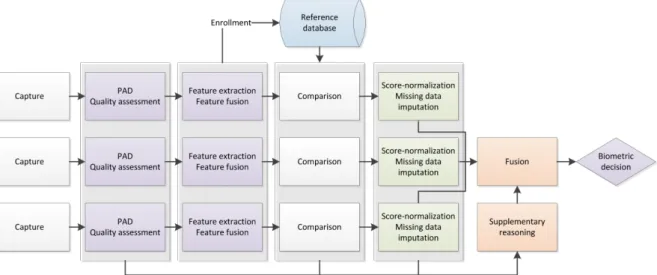
To illustrate the relation of the research questions to the mutli-biometric system processes, Figure1.1presents a standard multi-biometric system work-flow. This aims at providing the basic understanding of such a system and enabling a structured reasoning of the research questions. As shown in the figure, a number of biomet-ric characteristics are captured then checked for quality compliance, as well as for the possibilities of being a presentation attack on the system, rather than a bonafide presentation. The samples that pass this check are processed to extract representative features (templates), and in some cases, a number of templates are fused to create a more informative and stable one. At this point, the resulting templates are either passed to the reference database in case of user enrollment, or further processed in the biometric system for verification or identification. In case of a verification or identification scenario, these templates are compared to one or more of the reference templates, resulting in a set of comparison scores. These scores are normalized into a common space and any missing scores are accounted for and further processed for completeness. The resulting complete set of normal-ized scores is optimally fused to achieve the best possible accuracy. The fused scores can be complemented by further information resulting from the presentation attack detection, the quality assessment, or information from the comparison scores, before or after normalization. The result of the fusion process is further processed to make the verification or identification decision of the multi-biometric system.
Figure 1.1: typical work-flow of a multi-biometric system. The four research question groups are in different colors, the pre-fusion processes in green, the fusion optimization in orange, the reference database in blue, and the miscellaneous multi-biometric processes in purple.
1.2.1 Pre-fusion processes
Multi-biometric systems integrate information provided by different sources in the fusion process. These sources might depend on different biometric characteristics, capturing sensors, feature extraction methods, or compara-tors. Therefore, each of these sources will result in similarity scores in a different space of reasoning. A well-designed solution to unify the reasoning space of these scores largely affect the performance of the whole fusion system.
Typically, each biometric comparison is expected to produce a comparison score, describing the similarity between the feature representation of the captured characteristic and a reference representation. Due to failures to pass the comparison or any earlier step, some expected similarity scores might be missing. For a fusion approach that expects a full set of comparison scores, a proper solution to deal with such cases is essential to maintain the functionality while achieving the highest possible performance.
Keeping this in mind, the following research questions are drawn to tackle these issues in information prepa-ration for the fusion process.
• Performance aligned normalization: to enable a clear and predictable score-level fusion process, the
fused comparison scores have to be brought into a comparable range, this is performed by score normaliza-tion. Score normalization techniques heavily affect the performance of multi-biometric systems [JNR05] and thus are an active research field within the study of multi-biometrics. Ideally, a normalized score value has to point out a certain decision in a comparable confidence level regardless of the score source. Jain et al. presented a comparison between different score normalization methods for multi-biometric fu-sion [JNR05]. However, normalization approaches used in multi-biometric fufu-sion aim only at unifying the range of the scores and, in some cases, their distribution properties. Achieving score normalization that is related to the biometric decision inference of a score value will require building a connection between the operational properties of a biometric source and the normalization process. This leads to the first research question tackled in this work and it can be stated as follows
"RQ1: how can an operation-related score normalization approach be
de-signed and what would be its effect on the overall biometric performance?".
• Missing data imputation: a perfect scenario where all the fused biometric sources provide their
com-parison scores for the fusion process is not always the case. In some cases, the failure to capture a biometric characteristic with the required quality or the failure to extract representative features from the capture can lead to missing part of the fused scores. Previous works dealt with the problem of missing values and their imputation, although, most of the works considered only the verification sce-nario [FKP08,Lit92,PWM∗10]. These approaches had different levels of complexity without a consistent advantage of complex approaches. The different nature of the identification process may result in different performance reactions for different imputation methods. This motivates one of the driving questions in this work
"RQ2: what would be the effect of different data imputation methods on the identification performance in comparison to the verification scenario? and
how much gain can a complex imputation method bring?".
In an effort to answer these questions, this work presents a performance anchored normalization scheme that aims at aligning the interpretation of the scores provided by different biometric sources. A study of different
miss-ing scores imputation approaches and their relative effect into the verification and identification performances is also discussed.
1.2.2 Fusion optimization
As shown in Figure1.1, a number of scores results from the different comparisons between the captured biomet-ric characteristics and the enrolled references. These scores are fed into the fusion process where they should be optimally joined to produce an accurate biometric decision. The fusion of these scores is commonly controlled by assigning a relative measure, i.e. weights, for the different sources to control their individual contribution to the fusion result. Therefore, assigning these weights has a strong influence on the multi-biometric system per-formance. The fusion process also includes supplementary reasoning in the final decision in an effort to enhance the overall accuracy and robustness to sub-optimal capture conditions or environment. This supplementary in-formation can be captured from an early stage in the process, such as detecting presentation attacks or estimating the capture quality. However, such systems are not always reliable and this early access to raw data may not always be granted to the system integrators. Therefore, the information gathered at post-comparison stages can be valuable to supplement the comparison scores and achieve more accurate biometric decisions.
The questions listed in the following aim at further optimize the fusion process to enhance the overall biometric performance.
• Multi-biometric source weighting: simple information fusion approaches such as the sum rule
score-level fusion proved to achieve high performance compared to more sophisticated approaches [RJ03]. An optimization of that would be the weighted-sum rule, where each biometric source is weighted to indicate its relative importance, and thus contribution, to the final fused biometric decision.
Weighting based on the equal error rate of biometric sources is widely used [JNR05] along with approaches based on D-Prime calculations [SUM∗05] and Fisher discriminant ratio [PB04]. However, these weights might not capture the different properties that make a biometric source more reliable than another, there-fore, they might not achieve dependable generalization. This opens the next question
"RQ3: what weight can be derived, so that it captures the absolute performance
of a biometric source as well as its confidence?".
A number of previously proposed multi-biometric source weighting methods were based on verification performance metrics, such as the equal error rate [JNR05] and the properties of the receiver operating char-acteristics [TKL08,VP09]. These weights are then used generically for both verification and identification tasks. This raises the next question
"RQ4: what could be good multi-biometric source weighting candidates based on identification performance? Would such a weight positively affect the
multi-biometric identification performance?".
• Supplementary information in multi-biometric fusion: conventionally, score-level multi-biometric
fu-sion exclusively uses the biometric comparison scores provided by the fused biometric sources and general information about these sources (e.g. weights). Previous works extended this concept to include sample quality information related to each biometric comparison [NCJD06,PK08,PMK09]. One source of pos-sible supplementary information is the relative relation between different comparisons, which leads to the next question
"RQ5: what discriminant information can be derived from the relative relations between different comparisons? Does integrating this information enhances
the multi-biometric performance?".
Also on the score-level, the relation between the scores from different sources in the same multi-biometric comparison, rather than different comparisons, can contain rich information leading to a better control over the fusion process. This view leads to the question
"RQ6: what discriminant information can be derived from the relation between the scores of different sources in a multi-biometric comparison? Does inte-grating this information enhances the multi-biometric performance? Does this make the multi-biometric system more robust to the realistic scenario where noisy captures occur?".
Focusing on the weighted-sum score-level fusion, this work presents a weighting approach that aims at repre-senting both, the accuracy and the confidence of the fused biometric sources. Under the same scheme, weights based on the properties of the cumulative match characteristic curve were suggested and their effect on the iden-tification performance was discussed. Supplementary information in the form of neighbor distance ratios and score coherence measures were suggested and introduced into the fusion process in this work.
1.2.3 Reference database
Whether under the verification or identification scenario, a captured biometric characteristic is compared with one or more reference templates to measure their similarity. The reference templates are stored during enrollment in a reference database. Performing a 1:N identification search in such a database can require a huge computational effort and time. Indexing structure can help limit the space of these searches, however with some accuracy loss. The availability of multi-biometric references can help enhance the performance of reference database indexing. Aiming at enhancing the search speed while maintaining high accuracy by utilizing multi-biometric sources, the following research question is stated.
• Multi-biometric data retrieval:previous multi-biometric indexing solutions focused either on the feature
or the rank-level fusion. The feature-level is limited by the possible combinations of modalities and algo-rithms used by each biometric source. Moreover, it might face challenges in situations where some sources are missing. Solutions focusing on the rank-level are more flexible in terms of different biometric sources and missing data. However, these solutions disregard in-depth information and treat every rank and every biometric source equally [GR09,GR12]. Moreover, errors in indexing-based multi-biometric data retrieval are usually caused by the cases where single source candidate lists are of low quality. However, no pre-vious work targeted or analyzed these situations. The pursue of a flexible and optimized multi-biometric indexing solution leads to the following question
"RQ7: how to design a multi-biometric data retrieval structure that bene-fits of the rank-level fusion flexibility while still being optimizable to different sources? What supplementary information can be added to enhance the index-ing performance? How would this affect the critical cases where sindex-ingle sources
With a focus on the flexibility of rank-level multi-biometric data retrieval, this work presents a solution that can be adapted to biometric sources of different nature. By proposing the use of efficiently calculated index-based approximated distances, more information is fed into the retrieval process. This aims at maintaining low computational cost while enhancing the accuracy of the retrieval, especially when fusing candidate lists of low quality.
1.2.4 Miscellaneous multi-biometric processes
Besides conventional biometric verification and identification tasks, multi-biometric fusion is used within dif-ferent biometric processes. These processes complement the multi-biometric framework seen in Figure1.1. An example of such a process is the presentation attack detection used to verify the validity of the capture. Another example is the feature-level fusion that can be used to fuse a number of biometric templates into one. Such a process can also change the application perspective of the multi-biometric fusion, an asynchronous fusion can allow fusing different types of biometric sources to achieve a continuous authentication over time.
• Multi-biometric continuous authentication: biometric authentication is typically used to gain access
(e.g. log-in) to a system/service. This means that the individual is recognized once at the start of a process that might span over a period of time. However, an attacker could gain access to the system after this initial log-in. Continuous authentication can be used to protect from such attacks. Continuous authentication also introduces some constraints to a typical biometric system as it should collect biometric samples contin-uously and conveniently (no user collaboration). Previous works focused on using behavioral biometric characteristics such as keystroke dynamics [BW12,ZD15,BM15]. Using multi-biometrics, including bi-ological characteristics, might help enhance the convenience and security of such systems. The question here is
"RQ8: how is such a system designed? What would be its effects on the per-formance compared to single source solutions? What would be the main
chal-lenges in developing and deploying such a system in realistic scenarios?".
• Face presentation attack detection: the recent availability of very accurate and efficient face
recogni-tion algorithms leaves the vulnerability to presentarecogni-tion attacks as the major challenge to face recognirecogni-tion solutions. Previous works showed good performances on research databases. However, face presentation attacks are still an open problem in practical scenarios [WHJ15]. Biometric fusion might help enhance the performance of presentation attack detection. However, some open questions are still to be answered, such as
"RQ9: how well a presentation attack detection performs under realistic condi-tions? What is the effect of feature and score-level fusion on the performance? and how long (time) should the face capture last to saturate the fusion perfor-mance?".
• Face selection and template fusion:face recognition from videos can be used for surveillance and
con-venience applications. Creating a face reference from a video capture can benefit from the multiple images available in a video, and thus create a more informative representation. Having a single reference represent-ing a video sequence enhances the computational efficiency of such a system. However, some questions regarding this process are left unanswered, and they can be stated as
"RQ10: how should faces be selected from a video sequence? What is the best approach to fuse their features into a unified template? and would this
outperform simple, but not computationally efficient, score-level fusion?".
Getting beyond the standard recognition role of multi-biometrics, different biometric processes are presented in this work that utilized and complimented muti-biometric fusion to achieve their goals. Later in this dissertation, applications focused on continuous authentication, face presentation attack detection, and face recognition in videos are discussed.
1.3 This thesis
After motivating and introducing the research focus of this work, the rest of the thesis will be organized as follows:
Chapter2presents the essential background information regarding the typical structure of an automated bio-metric system. A more detailed look into multi-biobio-metric systems and information fusion is discussed along with a high-level view over the related works in the literature. The biometric performance metrics commonly used in the literature are also presented.
Chapter3discusses two issues of pre-fusion processes in multi-biometric score-level fusion. These issues are the performance related normalization and the missing data imputation. First, as a response toRQ1, this chapter presents a novel normalization technique that tries to align the inference of different score sources by aligning a certain performance-related point in the score distributions. The performance anchored normalization (PAN) algorithms proposed in this chapter are evaluated along conventional score normalization techniques and used combination fusion rules to produce the fused scores. Chapter3will then focus on missing data imputation within score-level multi-biometric fusion. Different solutions are presented and their effect on the overall performance is compared between the identification and verification scenarios. A solution based on support vector regression was proposed and compared to simpler approaches. The work on missing data imputation aimed at answering RQ2 stated in Section1.2.1.
Chapter4proposes a number of biometric source weighting approaches and evaluates them along with the state-of-the-art and best-practice techniques. These weights are utilized to optimize the effect of different bio-metric sources on the final biobio-metric decision. Within this prospect, two paths are followed as an answer toRQ3
andRQ4. First that considers the properties of the genuine and imposter scores distributions to capture the overall performance of the biometric source, as well as an indication of its confidence. This solution aims at avoiding the shortcomings of previously proposed solutions such as low generalization abilities and sensitiveness to outliers. The second path focuses on deriving the biometric source weights from an identification performance represen-tation, the cumulative match characteristic curve. Different features of this curve are evaluated as candidates for being optimal weights in a weighted-sum fusion biometric approach.
Chapter5is concerned with introducing supplementary information into the multi-biometric fusion process to further optimize its decisions. Beside comparison scores from multiple biometric sources, this chapter proposes another evidence on the genuinity of a comparison. This evidence is based on the relation of the fused scores to other comparisons scores. An initial approach demonstrates the effect of integrating this supplementary in-formation on the performance. A more optimized solution is also presented and it includes taking advantage of biometric source weighting (discussed in Chapter4) in an initial fusion process. This provides answers to the previously statedRQ5. This chapter also presents supplementary information based on the relative relation
be-tween the scores in one multi-biometric comparison. This relation is modelled as coherence information bebe-tween these scores and integrated into the fusion process as a response toRQ6.
Chapter6presents a generalized solution for multi-biometric data retrieval. This can include indexing struc-tures of different nature in an optimized manner. The presented approach generalizes Borda count approach by adapting it to different biometric indexing sources. This is also extended to include efficiently calculated approx-imated distances based on each source indexes. This is evaluated over combinations of single-source candidate lists of different qualities and proved to largely enhance the retrieval performance when faced by low quality candidate lists. The proposed approach is evaluated under the multi-instance iris identification scenario and com-pared to a number of state-of-the-art and best-practice approaches. Chapter6responds to RQ7by presenting, discussing, and evaluating this solution.
Chapter7 focuses on different application where multi-biometric fusion is used to complement the conven-tional verification/identification scenario. Three applications are discussed where the multi-biometric fusion plays a major role in enhancing the overall performance. First application aims at using behavioral and physical biometric characteristics to assure a continuous author authentication. In this scope, a database was collected and an asynchronous fusion approach is presented, evaluated, and discussed as a response toRQ8. The second application deals with the problem of face presentation attack detection. The practical use of presentation attack detection is discussed by investigating the more realistic scenario of cross-database evaluation and presenting a state-of-the-art performance comparison. The relation between the video duration and the detection perfor-mance is also investigated. This is done along with presenting an optical flow based approach that benefited from different multi-biometric fusion approaches. The second application is directly related to RQ9. Chapter 7, as a response toRQ10, then discusses utilizing multi-biometric fusion to create face references from videos. Face selection, feature-level fusion, and score-level fusion solutions were evaluated under the scenario of face recognition in videos.
Chapter8concludes this work by highlighting its contributions, elaborating its practical benefits, and giving an outlook for future research.
Figure1.2links the technical chapters of this work and the research questions they answer to the components of the multi-biometric work-flow, previously presented in Figure1.1.
1.4 Conclusion
This introduction provided a motivation leading to a set of research questions that established a structure for the contributions in the rest of the thesis. The listed questions aimed at advancing the state-of-the-art, related to different blocks of the multi-biometric system work-flow, in an effort to enhance the overall performance and usability. These advances were grouped in four categories namely, the pre-fusion processes, fusion optimization by source weighting and integrating supplementary information, multi-biometric reference data retrieval, and miscellaneous multi-biometric processes that complement and utilize multi-biometric fusion.
The research questions within the pre-fusion processes focused on the validity of building a link between score normalization and its inference on the biometric performance. It also targeted the issue of missing data imputation within score-level multi-biometric fusion. The second group of research questions focused on optimizing the score-level fusion operation by motivating weighting approaches that consider single source confidence as well as investigating identification performance metrics behavior as fusion weights. Optimizing the fusion process drove a second set of questions that are concerned with introducing supplementary information derived from the relation between comparison scores in different biometric comparisons and within the same multi-biometric comparison set.
The third focus of the presented research questions was concerned with the multi-biometric data retrieval by stating the need for an indexing structure that takes advantage of the flexibility of rank-level fusion, while maintaining essential information available on the feature-level. The fourth research questions group targeted processes at the edges of the multi-biometric system work-flow, the processes that utilize and complement con-ventional multi-biometric systems. Three questions were stated about multi-biometric continuous authentication, face presentation attack detection, and creating face reference templates from video sequences.
The previous chapter presented a motivation and a structure for the research problems dealt with in this thesis. To facilitate a better understanding of the following chapters, this chapter presents the typical properties of an automated biometric solution. This includes a more detailed insight into multi-biometric fusion while presenting a high-level discussion of the related works in the literature. Biometric performance metrics commonly used in the literature are also discussed. This chapter is partially based the published work [DOS13].
2.1 Biometrics
Individual characteristics are used by people in their daily life as the mean of intra-human recognition. Overtime, these discriminant characteristics found an application in forensic subject identification. This initially started in the late 19th century by using a set of body measurements by Alphonse Bertillon of the Paris police department [Rho56]. By the beginning of the 20th century, fingerprint analysis has become a main tool in solving many crimes [Hue09] .
Modern biometric recognition, as seen from a computer science perspective, is defined as the automated recog-nition of individuals based on their behavioral or biological characteristics [Int12]. In order to choose a certain characteristic, it has to be evaluated in terms of the desired properties. These properties [JBP99], as mentioned in Chapter1are:
• Universality: a biometric system has to be designed so that it is able to cover the largest possible ratio
of the population. Related problems can include the absence or degraded quality of a certain biometric characteristic in a number of the population.
• Uniqueness: a biometric system has to assure to represent different individuals in highly distinct manner.
• Performance: the decision errors produced by biometric system is minimized and the computational
effi-ciency is maximized.
• Permanence: the performance of a biometric system should be consistent over time. The ageing of certain
biometric characteristics is a major challenge.
• Collectability: the biometric characteristics should be measurable and the quantitative results are
repro-ducible.
• Acceptability: the convenience for the user is considered and the usability is maximized.
• Circumvention: collecting and replicating a fake biometric sample/template is hard.
The mentioned properties are associated differently with different possible biometric characteristics. This was previously discussed [JBP99] and is presented in Table2.1. For example, face biometrics are highly acceptable and measurable, but it is less accurate than other characteristics like fingerprint and iris. Fingerprint, on the other hand, suffers from relatively lower universality because of the low fingerprint quality that might be a result of erosion by intense physical contact. Iris is less acceptable and measurable as, until recently, it required user collaboration to perform infrared scans.
Characteristic Uni
v
ersality
Uniqueness Permanence Measurability Performance Acceptability Circumv
ention DNA H H H L H L L Ear M M H M M H M Face H L M H L H H Facial thermogram H H L H M H L Fingerprint M H H M H M M Gait M L L H L H M Hand geometry M M M H M M M Hand vein M M M M M M L Iris H H H M H L L Keystroke L L L M L M M Odor H H H L L M L Palmprint M H H M H M M Retina H H M L H L L Signature L L L H L H H Voice M L L M L H H
Table 2.1: comparison of biometric characteristics (H: high, M: medium, L: low) [JBP99].
A biometric sensor captures the biometric characteristics. In a typical biometric work-flow, a set of features are then extracted from each captured sample. This feature set (template) is either stored in a database as a reference in the enrollment process or compared to a previously acquired biometric feature set (reference template) stored in a database. A comparison results in a similarity score. Analyzing the similarity score (or a set scores) results in a biometric decision.
A biometric decision, and thus a biometric system, can be a verification one or an identification one. Biometric verification is the use of biometrics information to verify a person claimed identity. The identity can be claimed using a smart card, a user name, or an identification number. Here, the system will verify that the claimed identity belongs to the user by comparing his/her biometric characteristics with a stored (and associated to this identity) biometric template. Therefore, the comparison (similarity measure) is only performed once for each identity claim and thus, the verification problem is usually referred to as a 1 : 1 comparison process.
Biometric identification tries to assign an identity to an unknown person based on the captured biometric char-acteristics. This requires comparing the captured biometric characteristic to all the enrolled subjects. Therefore, the identification is referred to as a 1 :Ncomparison process, whereNis the number of the enrolled subjects.
Biometric identification can be categorized into open-set and close-set identification. Close-set identification system is confident that the captured subject is one of the enrolled subjects, and thus can report the best matching identity as the identified one. Open-set identification implies that the system does not guarantee that the captured subject is already enrolled. Therefore, the open-set identification system has to verify one of the top matched identities to be the identity of the captured subject or to point out the fact that the subject is not enrolled.
To include a subject in a database, an enrollment process has to take place. Enrollment includes providing a trusted identity, capturing and quality proofing a biometric characteristic, feature extraction, and finally storing
the identity information and the extracted features (template) in a database. Figure2.1illustrates the three typical operations of a biometric system, enrollment, verification, and identification.
Figure 2.1: the main operations of a biometric system: enrollment, verification, and identification [JRP04].
2.2 Multi-biometric fusion
2.2.1 Information fusion
Information fusion is the integration of multiple information concerning a certain aspect to produce a more accurate description or decision. Information fusion aims at building more accurate decisions (descriptions) by obtaining synergy [Mit12]. Synergy here points out that a grouped representation of an object is better and more complete than an individual component representation. According to Bellot et al. [BBC02], the effect of information fusion can be summarized in the following points:
• Accuracy gain: decisions and representations obtained after the fusion process are more accurate. Noise and errors are reduced in comparison to single source information.
• Completeness gain: the information represented by fusion is more complete and less redundant.
• Representation gain: fused information should be more granular compared to each of the initially fused information.
• Certainty gain: fusion induces an increase of the belief in information after the fusion process. This set of gains can be utilized to improve the desired characteristics of a biometric system.
2.2.2 Multi-biometrics
Multi-biometrics uses more than one biometric information source in a unified frame in an effort to solve prob-lems faced by the conventional uni-modal biometrics. The multi-biometric approach aims at improving biomet-rics by increasing accuracy, and robustness to intra-person variations and to noisy data. It also intends to solve uni-modal biometrics problems with universality and vulnerability to spoof attacks.
Information fusion in multi-biometrics is used to build an identification/verification decision based on the information collected from different biometric sources. The fusion can be done on different levels, which can be seen as a tradeoff between information loss and integrability. Data and feature-level fusion maintain a large proportion of the original information but force limitations on the design and implementation. Only a limited combination of information sources can be fused and building a system out of different hardware components might be impossible. On the other hand, decision-level fusion can be seen as naive and lacking the opportunity to use important information. Based on this, the score-level fusion makes a good tradeoff between integrability and maintaining important decision information. Score here refers to the comparison score (similarity) between each biometric capture and a stored reference. Figure2.2presents an overview of multi-biometric systems with different levels of fusion. The different biometric information sources can be based on different characteristics, algorithms, instances, sensors, or presentations.
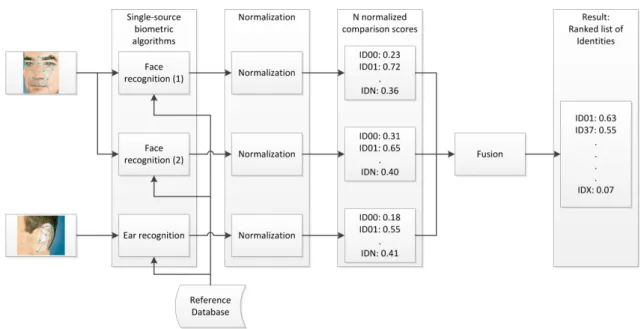
Figure2.3presents an overview of multi-biometric identification system using score-level fusion. Scores are produced by comparing captured characteristics to stored reference ones. The resulting scores from different sources (algorithms and modalities) are normalized into a comparable domain, then passed into a fusion algo-rithm. The fusion then results in fused scores that a verification/identification decision can be built upon by thresholding and/or ranking.
In the following, topics covering different stages of the multi-biometric fusion process are discussed and connected to the literature. This section aims at serving as a general description of multi-biometric fusion while presenting a high-level discussion of related works. Deeper insight into related work concerning the specific contributions of this dissertation will be presented in the respective chapters.
Biometric sources: multi-biometric systems are categorized depending on the nature of the fused biometric
sources from which a unified final decision is built. The main approaches are multi-modalities, multi-algorithmic, multi-instance, multi-sensorial, and multi-presentation.
Multi-modalities is the use of more than one biometric characteristic as an identity measure. Some works combined fingerprints and face images [KNR09,TWL10,KTT10], others fused fingerprints and iris biomet-rics [BBKQ09]. Using face images along with iris biometbiomet-rics was also introduced [WTJ03]. One of the most interesting multi-modal approaches is the use of ear and face biometrics, as they can be easily and non-intrusively captured using same or similar devices [CBSV03,Yan06]. Other combinations were also introduced, such as ear and fingerprint biometrics [RKBT06].
Figure 2.2: multi-biometric fusion at different levels [JRP04].
Many works dealt with multi-algorithmic biometrics, such as using multiple face matchers [KNR09,BKTR10, KTT10], or ear identifiers [MSV99,YB05]. Multi-instance fusion was also studied, such as two different fin-gerprints [YB05,BKTR10,KTT10], multi-sensorial [AH06], and multi-presentation biometric fusion [CTG11] were also discussed in the literature. However, the nature of the fused biometric sources is usually limited by the application scenario and goals.
Score normalization: the scores to be processed by the score-level fusion algorithms are usually not
homo-geneous as they are produced by different sources. These scores have to be brought into a common comparable range by a normalization process. Some of the most common normalization techniques are min-max normal-ization, z-score normalnormal-ization, double sigmoid, TanH-estimator, and median absolute normalization. The pa-rameters that rule the normalization process are determined based on the statistical properties of the training data. The performances of normalization techniques are not directly comparable as they depend on the overall multi-biometric system.
Figure 2.3: a high level structure of a multi-biometric identification system using score-level fusion. Comparison results are produced by different algorithms and modalities then normalized. The sets of normalized scores feed the fusion algorithm to produce a final set ranked by fused comparison scores. The algorithms block encapsulates quality assessment, feature extraction, and template comparison.
The min-max normalization depends on the range that the scores span regardless of the distribution properties and aims to map the scores into a range of [0,1]. This normalization scheme was used successfully by many works dealing with score-level multi-biometric fusion [NS09,VIM∗07]. The min-max normalization scheme is highly sensitive to outliers [JNR05] as it depends on single minimum and maximum values. Z-score nor-malization is a more sophisticated score nornor-malization method and was used in several works [NS09,VIM∗07]. Here, the arithmetic mean (µ) and the standard deviation (σ) of the score values are considered. This method assumes a Gaussian distribution of the score values. This normalization method has low robustness as well, as the parametersµandσare sensitive to outliers.
The median absolute deviation normalization method is similar to the z-score normalization method but uses the median and median absolute deviation instead of the mean and standard deviation. This method is more robust to outliers but it also assumes a near Gaussian distribution of the comparison score values.
The double sigmoid function is another normalization method. This normalization maps the scores into a range of [0,1] and requires fine-tuning of its parameters. The double sigmoid normalization was used to combine finger print comparison scores by Cappelli et al. [CMM00]. Marsico et al. recently proposed a novel normal-ization approach named the Quasi-Linear Sigmoid (QLS) [DNRT11]. This approach aimed at overcoming the sensitiveness of the traditional normalization algorithms to outliers.
The selection of a proper normalization method is a tradeoff between efficiency and robustness, and it depends largely on the nature of the application. Methods like min-max normalization and z-score normalization tend to be more efficient. On the other hand, median absolute deviation normalization and double sigmoid function normalization are usually more robust but require higher computational effort [JNR05].
Score-level fusion: score-level fusion algorithms can be categorized into two main types, combination rules and classification based fusion. Combination rules are simple operations performed on the normalized scores. These rules produce a combined score, and a classification decision is made based on this combined score value. Main combination rules are the sum rule, weighted-sum rule, product rule, max rule, min rule and median rule.
Some works discussed the difference in performance between the combination rules. Most studies showed the superiority of sum and product combination rules [HS12,NCJD06,CBFC04]. One must keep in mind that different combination of sum rules and normalization techniques produce different results [LL11].
Classification based fusion considers the input score values as a feature vector. Given these vectors, a classifier is trained to classify a new given vector into genuine or imposter class. Different types of classifiers can be used, just as neural networks [Als10], k-nearest neighbors (K-NN) [JSH04], support vector machines (SVM) [SVN07,GMAD05], Adaboost [IKWY10,MP09], or as likelihood ratio [NCDJ08,IR10] classifiers. Some works showed comparable results between combination rules and classification based fusion [RCLM08,MVSM12]. Other works showed the superiority of combination rules [SVN07].
However, dealing with a small number of inputs using complex classification-based fusion techniques, can only estimates separation lines optimal for the separation of overlapping classes while having small degree of liberty [RDRK11]. Simpler fusion approaches, such as weighted-sum rule, proved to achieve comparable performances to more complex approaches [NCDJ08,RNJ06] while maintaining simpler and easily integrable design.
Supplementary quality information: in order to improve accuracy and compensate for missing information
when moving from feature-level fusion to score-level fusion, the quality of the biometric samples is considered
assupplementary informationin the fusion process.
The quality of the captured biometric sample (image/scan/recording) has an effect on the comparison score values and the confidence of these values as the features extracted from these samples are not reliable [NCJD06]. This reflects on the role that a certain score value plays in the fusion process, and therefore, taking the qual-ity measures into account will enhance the performance of the fused multi-biometric system [NCJD06,PK08, PMK09].
Nandakumar et al. [NCJD06] proposed a fusion algorithm that takes into account the sample quality into their likelihood ratio-based fusion scheme. Their experiments proved a highly positive impact of considering the quality measures. Poh et al. [PMK09] proposed a classifier based fusion algorithm that considers the biometric sample quality, as well as, the biometric capture device information. Their experiments clearly showed the effect of including the quality measures on performance.
Missing data: in practice, some comparison scores can bemissingbecause of a missing modality or a low
qual-ity capture. To build a robust multi-biometric system, the possibilqual-ity of missing score values must be considered and dealt with so that a reliable biometric decision is made.
Many works considered the problem of missing data and proposed solutions for robust fusion algorithms [PWM∗10,KNR09,DDV07]. However, most of these works dealt explicitly with the fusion problem under the verification scenario. Nandakumar et al. proposed a robust fusion solution for multi-biometric fusion under the identification scenario that aims to produce an identification decision regardless of the partially missing data [KNR09]. The authors extended the likelihood ratio-based score fusion (originally designed for verification problems) to perform under the identification scenario.
2.3 Performance metrics
While most biometric characteristics are theoretically discriminant, automatic biometric systems make wrong verification or identification decisions in some cases. To build a performance comparison between different biometric systems, a set of performance metrics are defined for different operational scenarios. This section presents the relevant metrics and is largely based on the international standard ISO/IEC 2382-37:2012 [Int12].
Some of the errors in biometric systems occur in an early stages of their operation, namely in the capture or feature extraction stages. These errors are:
• Failure to capture rate (FTC): proportion of failures of the biometric capture process to produce a captured biometric sample that is acceptable for use.
• Failure to extract rate (FTX): proportion of failures of the feature extraction process to generate a template from the captures sample.
• Failure to acquire rate (FTA): proportion of verification or identification attempts for which the system fails to capture or locate an image or signal of sufficient quality.
FTA is a result of FTC or FTX and can be given as:
FTA=FTC+FT X∗(1−FTC). (2.1)
The FTC, FTX, and FTA are related to the performance of the complete biometric system and thus are usually neglected when measuring the performance of the biometric algorithms.
Performance metrics of the biometric algorithms can be categorized depending on the operational mode, veri-fication or identiveri-fication.
2.3.1 Verification performance metrics
Biometric verification builds its binary decision (genuine/imposter) by thresholding the level of similarity be-tween the probe and the reference samples (comparison score). Assigning a threshold value is a tradeoff bebe-tween security and convenience. Security requires a low rate of imposter users accepted as genuine (false positives) and convenience requires a low rate of genuine users rejected as imposters (false negatives). This tradeoff can be summarized by the following biometric verification metric:
• False match rate (FMR): rate of zero-effort imposter attempt samples falsely verified as genuine (match) to the compared sample.
• False non-match rate (FNMR): rate of zero-effort genuine attempt samples falsely verified as imposter (non-match) to the compared sample.
The genuine match rate (GMR) is another metric used in the literature and points out to the same properties as the FNMR. The GMR is given by
GMR=1−FNMR. (2.2)
The discussed FMR, FNMR, and GMR are error rates that describe the algorithm verification performance. Therefore, they do not consider errors introduced by the whole system, i.e. FTA. A set of similar verification metrics that theoretically consider FTA errors is also used in the literature, these metrics are the false acceptance rate (FAR) and false rejection rate (FRR) and are given by
FAR=FMR∗(1−FTA) (2.3) and
FRR=FTA+FNMR∗(1−FTA). (2.4)
The true acceptance rate (TAR) is derived from the FRR and is given as
TAR=1−FRR. (2.5)
FAR and FMR are often used interchangeably in the literature, as well as FNMR and FRR [PCK∗12]. As in Equ. 2.3and2.4, the only difference is that FAR and FRR consider samples failed to be acquired. This work follows the trend in literature and uses FAR and FRR interchangeably with FMR and FNMR as the FTA is considered to equal zero with the work focusing on developing more accurate algorithms rather than systems.
The so-far discussed verification metrics are dependent on the comparison score threshold used to make the genuine/imposter decision. This threshold builds a tradeoff between the FAR and FRR (FMR and FNMR). Therefore, the performance of biometric algorithms is only comparable by fixing one of both error rates and comparing the other. To avoid this and provide one generalized metric, the equal error rate (EER) is used. EER is the common value of FAR or FRR at the operational point (threshold) where they are equal.
This tradeoff between error rates are interesting because different applications require different levels of se-curity and convenience from the same biometric algorithm/system. To present a wide range of performance operation points, receiver operating characteristic (ROC) and detection error tradeoff (DET) curves plots the performance at different decision threshold points.
An ROC curve plots FAR (x-axis) versus TAR (y-axis) (or FMR vs. 1-FNMR) at all possible decision thresh-olds. This allows the system integrator to informatively choose the threshold that best fits the required security-convenience tradeoff. A DET curve provides the s
![Figure 2.1: the main operations of a biometric system: enrollment, verification, and identification [JRP04].](https://thumb-us.123doks.com/thumbv2/123dok_us/1107290.2647327/29.892.128.692.207.740/figure-main-operations-biometric-enrollment-verification-identification-jrp.webp)
![Figure 2.2: multi-biometric fusion at different levels [JRP04].](https://thumb-us.123doks.com/thumbv2/123dok_us/1107290.2647327/31.892.142.682.152.693/figure-multi-biometric-fusion-at-different-levels-jrp.webp)
![Figure 3.1: genuine (blue) and imposter (red) score distribution of normalized scores for face (DCTb-GMM) [PB06] using different normalizers.](https://thumb-us.123doks.com/thumbv2/123dok_us/1107290.2647327/43.892.78.740.282.807/figure-genuine-imposter-distribution-normalized-scores-different-normalizers.webp)
![Figure 3.2: genuine (blue) and imposter (red) score distribution of normalized scores for voice (LFCC-GMM) [PB06] using different normalizers.](https://thumb-us.123doks.com/thumbv2/123dok_us/1107290.2647327/44.892.152.814.289.808/figure-genuine-imposter-distribution-normalized-scores-different-normalizers.webp)