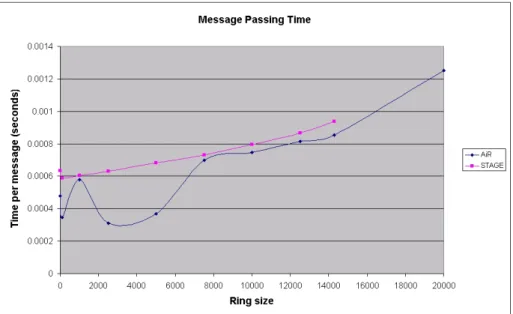
AiR: Actor inspired Ruby
MEng Individual Project Report
Alisdair Johnstone
Supervisor: Susan Eisenbach
Second marker: Emil Lupu
Imperial College London
June 27, 2008
Abstract
The last few years have seen a fundamental shift towards multi-core systems. This is true for desktops, where two or four cores are standard, and especially true for servers, where as many as thirty two or sixty four cores may be resident on a single processor.
It is important the new found potential for parallelism afforded by this new generation of processors is fully exploited; this requires that software developed for such systems be written with concurrency in mind. Traditional concurrency abstractions such as threads have proven to be cumbersome to work with, and the requirement that explicit locking constructs be used is often a source of error.
Carl Hewitt’s actor model has been suggested as a better abstraction to dealing with the issue of concurrency. This report details the development of AiR, a modern actor-based domain specific language and supporting runtime environ-ment that can used by Ruby programmers. AiR aims to provide a rich feature set, such as built in support for distribution and mobility, and at the same time tries to retain the elegance and ease-of-use that Ruby has come to be known for.
Acknowledgements
I would first like to give special thanks to my supervisor, Professor Susan Eisen-bach, for her continual support and encouragement throughout the course of the project. Secondly, I would also like to thank my second marker, Dr Emil Lupu, for providing feedback on an early version of the project. Additionally I would like to thank John Ayres for answering the multitude of questions I sent him, and for suggesting a number of sample applications.
Lastly, I would like to thank my parents who have always given their full support throughout my time spent at university.
Contents
1 Introduction 1
1.1 Contributions . . . 2
2 Background 3 2.1 Actor Model . . . 3
2.2 Ruby Programming Language . . . 5
2.2.1 Language Introduction . . . 5
2.2.2 Concurrency Features . . . 6
2.3 Actor Languages & Libraries . . . 9
2.3.1 Erlang . . . 9
2.3.2 Scala . . . 12
2.3.3 SALSA . . . 15
2.3.4 Stage . . . 18
2.3.5 Ruby: Erlectricity . . . 19
2.3.6 Ruby: Omnibus Concurrency Library . . . 20
3 Specification 23 3.1 Integration with Ruby . . . 23
3.2 Message Passing Abstraction . . . 23
3.3 Distribution . . . 23
3.4 Mobility . . . 24
3.5 Scalability . . . 24
4 Implementation 25
4.1 Runtime Overview . . . 25
4.2 Theatre . . . 26
4.2.1 Master Theatre . . . 27
4.2.2 Slave Theatre . . . 29
4.2.3 Theatre Design Choices . . . 31
4.3 Actors . . . 32
4.3.1 Achieving Concurrent Execution . . . 32
4.3.2 Message Passing Abstraction . . . 33
4.4 Mobility . . . 37 4.5 Naming . . . 38 4.6 Summary . . . 39 5 Language 41 5.1 Getting started . . . 41 5.2 Actors . . . 41 5.2.1 Behaviour definition . . . 41 5.2.2 Instantiation . . . 42 5.3 Theatres . . . 43 5.4 Message passing . . . 43 5.4.1 Two-way messaging . . . 43 5.4.2 One-way messaging . . . 44
5.4.3 Priority message passing . . . 44
5.4.4 Composite message configuration . . . 45
5.5 Futures . . . 45 5.5.1 Synchronization . . . 45 5.5.2 Status Check . . . 46 5.5.3 Selective Wait . . . 46 5.6 Message Chains . . . 47 5.6.1 Specification of a chain . . . 47
5.6.2 Further uses of message chains . . . 49
5.7.1 Receive Blocks . . . 50
5.7.2 Chords . . . 53
5.8 Naming . . . 55
5.8.1 Specifying a nameserver . . . 55
5.8.2 Standard naming operations . . . 55
5.8.3 Capability Tags . . . 56 5.9 Migration . . . 57 5.10 Exception Handling . . . 58 5.10.1 Tradition approach . . . 58 5.10.2 Linked Actors . . . 58 5.11 Summary . . . 59 6 Evaluation 62 6.1 Correctness . . . 62 6.2 Performance . . . 64 6.2.1 Execution Speed . . . 64 6.2.2 Scalability . . . 67 6.3 Effectiveness . . . 69
6.3.1 Distributed Chat Application . . . 70
6.3.2 News website . . . 71 6.4 Conclusions . . . 73 7 Conclusion 75 7.1 Further Work . . . 77 7.2 Closing remarks . . . 78 A Syntax 83 A.1 Scala . . . 83 A.2 SALSA . . . 84
A.3 AiR API & Grammar . . . 84
A.4 Monte Carloπapproximation . . . 87
A.4.2 Parallel AiR Version . . . 88
A.4.3 Benchmark results . . . 89
A.5 Armstrong Challenge . . . 90
A.5.1 AiR implementation . . . 90
A.5.2 Spawn time benchmark results . . . 91
A.5.3 Average message passing time benchmark results . . . 91
A.6 Distributed Chat . . . 91
A.6.1 AiR Implementation . . . 91
A.6.2 Java Implementation . . . 92
Chapter 1
Introduction
The traditional computing landscape has recently undergone a dramatic trans-formation. Whilst just a few years ago it was taken as a given that a typical home computer would have a single processor core, this is no longer the case -with dual-core and quad-core processors now being the norm. In this years to come it is highly likely that an exponential increase in cores will be seen, just as how we had been used to seeing exponential increases in clock rates for single core systems before the shift.
Although the ability to execute applications with true parallelism is certainly welcome, it has left a fundamental problem for the software industry which for too long has simply ignored the issue of concurrency. When the issue is dealt with, the standard approach is to build applications that consist of multiple threads that communicate with each other through items in shared memory. To ensure that integrity of such shared data items is maintained, programmers must resort to using low level locking mechanisms such as semaphores and monitors. When such mechanisms are not handled correctly it is extremely easy to run into problems such as deadlocks and race conditions.
The design of computationally intensive software need not be bound by the local processing power available on any one machine, but indeed with innovations such as the Internet being in such wide spread usage it is possible to envisage software that is distributed between thousands or even millions of systems. The actor model, first proposed by Carl Hewitt, Peter Bishop, and Richard Steiger [41], provides a model of computation that inherently exploits parallelism and that is well suited for distributed environments. Actors are autonomous entities that operate concurrently and communicate using asynchronous message passing. Actors each have their own unique behaviour, and posses a private data store.
Advantages of using the actor model over a shared memory threaded approach are copious, and include: increased scalability, built-in concurrency, and the
removal of the need for low level locking mechanisms such as semaphores and monitors. Section 2.1 gives a more in depth discussion of the model and its benefits.
To date there have been numerous implementations of the actor model, with the most well know example being Erlang. It is unfortunate however that these languages are typically not friendly towards object-oriented programmers, and as such are oft overlooked by the majority. Another pitfall is that scalability is often not fully considered, with languages often resorting to assigning ac-tors heavyweight native threads or even entire system processes. An in-depth overview of the state-of-the-art in actor languages is given in section 2.3.
1.1
Contributions
The core contribution of this project is the development of a new object-oriented actor-based library for Ruby; this library, known as AiR, provides a domain specific language for writing concurrent applications and a supporting runtime environment for such applications. The aim of AiR is to make available the actor model in a manner accessible to object-oriented programmers, avoid the pitfalls of other similar efforts, and at the same time offer a rich feature set that can be used in a clear and intuitive manner.
Ruby was chosen because of its pure object-oriented semantics and the inherent beauty and conciseness of the code that is produced by those well versed in the language. The author of this report has had several encounters with the language before and can attest these claims. Section 2.2 gives a fuller discussion of the Ruby programming language and the standard concurrency primitives that it offers.
AiR provides in-built support for distribution and mobility, and provides a num-ber of novel approaches to tackling problems such as interface restriction. The design and implementation details of AiR are discussed in chapter 4, and an overview of the language from a developers perspective is given in chapter 5. Besides creating AiR itself, numerous applications were built using the lan-guage. These examples allowed AiR to be tested as development progressed, highlighting failing and areas of improvement. They should also prove indis-pensable to any programmer wishing to try AiR, and as such are included with the library. In chapter 6 a number of these sample applications are discussed for the purposes of evaluating AiR’s performance and effectiveness as a language. Chapter 7 presents the conclusions of the project and details a number of areas that could be looked at to expand and improve upon the current implementation.
Chapter 2
Background
2.1
Actor Model
The Actor model is a concurrent model of computation first introduced by Carl Hewitt [40, 41] in the 1970s and later developed Gul Agha [17] and others. In recent years there has been renewed interest in the model due to the current trend towards multi-core and multi-processor systems.
The basic unit of computation in the Actor model is referred to as an ‘ac-tor’. Actors are self-contained entities that communicate through asynchronous (non-blocking) message passing. Each actor has its own unique thread of con-trol, providing for concurrent execution of actors, and an associated behaviour which defines how it is to act in response to incoming messages. Actors do not share any state between themselves, and hence a number of problems commonly associated with shared memory systems can be avoided.
The behaviour of an actor, as outlined in [19], can be defined through a combi-nation of the following actions (forming a ‘script’ [44]):
• Sending messages to acquaintance actors (send)
• Creating new actors (create).
• Specifying its replacement behaviour (become).
The first two actions are self explanatory. Thebecomeprimitive allows an actor to define a new actor which will process the next message that arrives (with the original actor forwarding communications to the new actor); this allows message processing to be pipelined, thus increasing potential parallelism.
Actors each have a unique ‘mailing address’ which is used to identify an actor when performing a send. There are three methods by which an actor can become acquainted with another actor (i.e. learn its mailing address), namely:
• Receiving the address in an incoming message.
• Being passed the address as part of initialization.
• Creating the other actor using the create action.
Actor systems constantly undergo a process of evolution; at any point in time actors may be added to the system, removed from the system, or change their acquaintances. The term ‘open systems’ [42] is used in the actor community to refer to such dynamic topologies.
In the world of actor theory, everything is an actor. Three types of actors exist, as outlined in [31]:
Primitive Actors Such actors are used to model data item (a character for example) and procedure primitives, providing a way to bottle-out compu-tations.
Unserialized Actors These are actors which maintain a fixed local state. An example of such an actor is an actor which calculates factorials.
Serialized Actors Unlike their brethren, serialized actors can modify their local state. An example of such an actor is an actor which represents a bank account.
Due to the fact that the actor model was first created in the 1970s - the age of the mainframe, the initial version did not focus on aspects of distribution or mobility. The model does however scale naturally for both of these, and as a result many recent implementations have support for one or both.
The following list highlights some of the advantages of the actor model over other approaches to concurrency:
• Actors are inherently concurrent.
• An actor can be conceptualized as the fusion of an object and a thread, and therefore control flow of the application need not be considered separately from actors themselves.
• The model is highly scalable, as exemplified by Erlang (2.3.1).
• Low-level locking constructs such as semaphores and monitors are not needed, with locking being built into the communication model.
• Asynchronous messaging increases parallelism, due to the fact that it re-moves a source of blocking.
• There are no low level race conditions, since each message is processed atomically.
2.2
Ruby Programming Language
This section will give a brief introduction to the Ruby language, followed by a discussion of the standard approach to concurrency used by Ruby programmers at present.
2.2.1
Language Introduction
Ruby was created by Japanese programmer Yukihiro “Matz” Matsumoto in 1993. Outside of its native Japan the language was relatively unknown until around the turn of the century when it began rising to prominence elsewhere. In the last few years especially the language has seen an explosion of growth – due in part to the Ruby on Rails web framework.
The language itself follows a dynamic, pure-object oriented approach; every-thing is an object, including: classes, methods, integers, floats, etc. Functional features such as closures, anonymous functions, and continuations are also made available – as with many other dynamic languages; this mix works very well, as will later be demonstrated by some examples.
Ruby offers extremely powerful meta-programming support as standard. Op-erations such as adding new methods or classes at runtime can be achieved with ease. Likewise, introspection – listing all methods offered by an object for example – is extremely simple. This facet in particular has meant that Ruby has been a popular choice for the implementation of embedded domain specific languages, allowing developers to easily extend and modify the original seman-tics of Ruby to suit a particular domain. Active Record, the object-relationship mapping package included with Rails, is a particularly prominent example in which such techniques are employed for the purpose of database interaction [50]. Blocks (closures) are a widely used and much cherished feature of Ruby. The primary purpose blocks serve is to act as a callback mechanism from a called method to the calling context; the called method need not terminate to do this however, it simply has to call the ‘yield’ method on the block, and arguments can additionally be given to the block as part of the yield call. The following simple example demonstrates a trivial usage of blocks:
1 def e a c h _ c o u n t r y 2 p r i n t " - > I n s i d e e a c h _ c o u n t r y " 3 y i e l d (" J a p a n ") 4 y i e l d (" E n g l a n d ") 5 p r i n t " - > E x i t i n g e a c h _ c o u n t r y " 6 end 7 8 g r e e t i n g = " H e l l o " 9 e a c h _ c o u n t r y {| c o u n t r y | p r i n t "#{ g r e e t i n g } #{ c o u n t r y }"}
-> Inside each_country Hello Japan
Hello England
-> Exiting each_country
Description: After the each_country method has been defined, a call to the method is made, passing in the code block {|country| print “Hello #{country}”} as an (implicit) argument. Once inside the method a regular call to print is made, printing the text “-> Inside each_country”.
The next line is more interested, here the yield method is called, passing in the text “Japan”, and at this point control is passed to the block, with the given text being bound to the block argument “country”. Inside the block we print out the concatenation of the greeting object (note how this originates from the caller’s context) and the country object.
Control now returns to the “each_country” method, where the process is re-peated with a different string, before finally printing “-> Exiting each_country” and returning. Blocks provide an elegant approach to common tasks such as iteration, and also simplify tasks such as reading files - the read method opens the file descriptor, returns it as a block argument, and then closes it once the block returns (thus freeing the programmer from explicit opening or closing). This final example - mimicking the first - demonstrates the use of blocks with the built-in ‘each’ method defined upon Arrays:
1 [" J a p a n " , " E n g l a n d "]. e a c h {| c o u n t r y | p u t s " H e l l o #{ c o u n t r y }"}
Ruby’s light-weight programming style, combined with its rich and powerful feature set make it an excellent language choice for rapid (and enjoyable) devel-opment. The main drawback of Ruby is that it is a directly interpreted language, and as such can have rather slow execution speeds, as compared to Java say -not a problem if being used prototyping purposes; this is however changing, with an official migration to a alternative virtual machine “YARV” planned. YARV first compiles code to a byte-code format as to speed up execution.
2.2.2
Concurrency Features
Like most other modern programming languages, the two primary abstractions offered by Ruby for concurrency are threads and processes.
Threads
Threads are a mechanism in which several streams of control (an instruction pointer plus a stack) can be specified for a single program instance. When
a thread is executing a piece of code that accesses a shared area of memory, it is important to ensure mutual exclusion through use of constructs such as semaphores or monitors.
Ruby specifically offers what are known as a ‘green threads’. Green threads, un-like native threads, are scheduled by the Ruby virtual machine itself, as opposed to being scheduled by the operating system. The advantage of this approach is that context switching is a relatively light-weight operation, and relatively little memory is used up per thread. The disadvantage of green threads is that each Ruby virtual machine instance resides on a single CPU core, and as such any chances for true parallelism are lost.
The below code shows the creation of a thread which prints out the numbers one through ten before terminating.
1 T h r e a d . new do
2 1. u p t o ( 1 0 ) {| i | p u t s i }
3 end
The standard construction method ‘new’ is called on the Thread class, passing in a code block – uspassing the do/end alternative to curly bracket notation -which represents the code to execute when the thread is started. Any method or variable available to the context in which the thread was created will also be available within the code block passed to the thread – as demonstrated in previous code block examples.
Classes are additionally available for the creation of semaphores, monitors, and the like. These constructs may also be ‘mixed-in’ to other classes as a means to ensure mutual exclusion of method execution within instances of such classes.
Processes
Processes are similar to threads in that they each represent a unique stream of control. They differ in that processes share nothing with each other – whereas threads share code and data. A process is in fact nothing more than a program instance with a single thread.
Since processes do not share memory with each other there is no need to try and ensure mutual exclusion to protect against shared memory violations. Processes in Ruby can be created through calling built-in methods of the Pro-cess module, such as ‘fork’ - which creates a duplicate of the current proPro-cess. See
http://ruby-doc.org/core/classes/Process.html for more details about this module.
Each Ruby process has its own virtual machine instance. This has the advantage that true parallelism can be achieved by executing multiple processes on several cores at once. The disadvantage of this is that processes are extremely heavy weight – instances of the Ruby virtual machine use a lot of memory.
Conclusion
Concurrency in Ruby is a tricky issues, with neither processes nor threads offer-ing an ideal solution. The advantages and disadvantages of each are the mutual inverses of the other, and therefore the actor library which is to be built on-top of these constructs should aim for an intersection of the positive aspects of each, while at the same time attempting to minimize or eliminate the negative aspects.
2.3
Actor Languages & Libraries
The discussion shall now turn focus to the the current generation of actor lan-guages and libraries. Some have been tried and tested in industry settings, while others are more experimental in nature. To be genuinely useful and usable, all of the languages and libraries work at a higher level of abstraction than the pure actor model introduced in section 2.1. Many interesting and innovative features are offered, and these will act as inspiration for AiR’s own feature set.
2.3.1
Erlang
Erlang is a concurrent functional programming language designed for the cre-ation of real-time, distributed fault-tolerant systems [23].
The language was initially developed at Ericsson to investigate the suitabil-ity of declarative programming in the context of developing telecommunication switching devices. The original prototype interpreter for Erlang was written in Prolog; this however was later changed for efficiency purposes and because the language was moving more in the direction of the functional programming style [28].
In 1998 Erlang was released as an open-source project, making it available to the wider world outside its native environment at Ericsson. Since this time it has enjoyed moderate success, being used at companies such as Amazon, Nortel, and T-Mobile [4]. There is currently much talk about Erlang in the development community as a whole, and just recently the Pragmatic Bookshelf published a new book “Programming Erlang, Software for a Concurrent World” [22] by Joe Armstrong, one of the original creators of Erlang.
Light-weight Processes
Erlang has no inherent notion of an actor, instead its currency of concurrency comes in the form of a compatible concept known as processes.
Processes represent independent threads of execution. The difference between processes and regular threads however is that the former share no state and in-stead communicate through message passing, as in the actor model. Processes in Erlang are not managed by the host operating system, but instead are man-aged by the Erlang environment itself, making them extremely light-weight in terms of memory consumption.
Erlang code is not structured into independent processes, rather an Erlang pro-gram consists of a collection of functions, each of which can act as a starting point in the creation of a new process. This therefore requires careful thought in regards to code organization on the programmers behalf to ensure that the runtime behaviour of each process can easily be discerned from the source.
Creation of a new process takes place through a call to the ‘spawn’ function, using the following format:
spawn(<module>, <function>, <arguments>)
Each function has an associated module, similar to a package in Java, and when a process is spawned a set of initial arguments are given to the seed function. The return value of a call to spawn is a Process Identifier (PID) which can be used to send messages to the newly created process.
Messages can be sent between Erlang processes using the ! operator, as shown below:
<recipient PID> ! <message>
Message sends in Erlang do not directly map to a function invocation at the receiver; To receive a message an Erlang process must instead make use of a special ‘receive’ construct. Such constructs consist of a number of patterns, each attempting to catch certain Erlang terms, and associated code blocks.
Distributed programming
Since Erlang originated from the domain of telecommunications, it is therefore only natural that it should have excellent support for distributed programming; This is indeed the case.
Once a process has been created it can be given a unique identifier through the use of the ‘register’ function. Processes operating in external systems may now communicate with such registered processes by sending messages to{<registered process identifier>, <node identifier>}, where<node identifier> consists of a node name (a node being a host environment for a collection of actors) and a hostname of the machine on which it resides. Processes may be started on the current node, or alternatively they can be started directly on a remote node. To start a process on a remote node sim-ply requires that an additional argument, giving the remote node identifier, be passed to the spawn function.
A deficiency of the distribution model present in Erlang is that it does not allow for the migration of processes between hosts. This is a feature present in several other concurrency oriented languages such as SALSA.
Example
The use of processes and distributed communication in Erlang will now be demonstrated through a simple echo service example.
Listing 2.1: Echo Server in Erlang 1 -m o d u l e( e c h o ). 2 -e x p o r t([s e r v e r /0 , c l i e n t /1]). 3 4 s e r v e r () - > 5 io : f o r m a t ( " S t a r t i n g e c h o s e r v e r ..~ n " , [ ]) , 6 s e r v e r ( r e a d y ). 7 8 s e r v e r ( r e a d y ) - > 9 r e c e i v e 10 {echo , T e x t} - > 11 io : f o r m a t ( " ~ p " , [T e x t]) , 12 s e r v e r ( r e a d y ); 13 t e r m i n a t e - > 14 e x i t( n o r m a l ) 15 e n d. 16 17 c l i e n t ( E c h o _ S e r v e r ) - > 18 E c h o _ S e r v e r ! {echo , " h e l l o "}, 19 E c h o _ S e r v e r ! {echo , " w o r l d "}, 20 E c h o _ S e r v e r ! t e r m i n a t e . 21 22 s t a r t () - > 23 r e g i s t e r( e c h o _ s e r v e r , s p a w n( n o d e 1 @ r e m o t e h o s t , echo , server , [ ]) , 24 s p a w n( echo , client , [ {e c h o _ s e r v e r , n o d e 1 @ r e m o t e h o s t} ].
The code (Listing 2.1) is initiated by typing “echo:start().” into an instance of the Erlang shell, ensuring that we have a additional node, “node1”, already running on the machine with hostname remotehost.
When the start function is initiated it begins by spawning a remote process on the node identified by node1@remotehost. This remote process is given the server function as a starting point and registered to the unique name ‘echo_server’. Upon creation, the server will print “Starting echo server” and then suspend inside the following receive block. After receiving a message of the format{echo, Text}the server will print the given text to the standard out-put and again re-enter the receive loop by means of calling theserver(ready)
function. If the message received is a terminate message, however, the server will call the built-in exit function.
The next line of the start function creates an additional process on the local node (as no node was explicitly given to spawn). This process is seeded with the client function, which sends the messages “hello” and “world” to the re-mote echo service before telling it to terminate. The argument{echo_server, node1@remotehost} given to the client function serves to identify the remote server process.
Evalution
Erlang represents functional programming at its best, with all the features -such as good support for pattern matching - that functional programmers have become accustomed to. Its main strengths are its light-weight process model, which is naturally highly scalable, and its support for distribution. Erlang’s success in the telecom industry has proven the power of asynchronous message passing architectures.
As mentioned previously, it is however important that careful consideration is given in regards to structuring of code, if one would like to be able to easily determine the runtime behaviour of an application from looking at its source. The other main drawback of Erlang is its lack of support for mobility of processes between nodes; it does however offer the ability to ‘hot-swap’ code without halting the system, but this gives the developer the extra burden of explicitly passing around higher-order functions.
2.3.2
Scala
Scala is statically typed, pure object-oriented programming language developed at EPFL. Functional programming is additionally supported [48], with features such as higher-order functions, pattern matching, and currying, being made available to the programmer.
Scala code is compiled to run on the Java VM, with previous versions also inter-operating with the .NET CLR [29]. Scala shares much of its type system and control structures with those of Java and C# [36]. An advantage of the interoperability with Java is that the plethora of libraries/frameworks available to Java programmers may also be accessed via Scala.
Actors are not a core component of the Scala language, but instead can be made available by use of a library written by Phillip Haller [16]. The remainder of this overview shall focus on said library.
Haller’s library offers two actor implementations: a traditional thread-based approach, and Haller’s own event-based approach. Each approach has associated advantages and disadvantages, as will now be discussed.
Note: See Appendix A.1 for an introduction to Scala’s basic syntax.
Thread-based Actors
In this approach each actor is assigned a unique thread from the host envi-ronment [38]. When one would like to suspend or resume an actor, they need simply suspend or resume the respective thread.
Thread-based actors benefit from a relatively simple implementation, and through assigning each actor a unique thread, problems of system deadlock which might
otherwise arise when performing blocking operations are eliminated; actors do not wait on each other, and therefore all actors besides the blocking actor can continue operations as normal.
The drawback of this approach however is that assigning each actor its own native thread takes a big hit on system resources. Since each thread in Java is recognized as an independent process, this means that resources are consumed further still.
Event-based Actors
Using this second approach an actor is decoupled from any unique thread of control. When an actor is suspended – following a receive - a closure representing its remaining computation is saved; contrast with the previous approach in which the execution state of an actor is managed by its respective thread’s stack and program counter. A sleeping actor is then woken by “piggy-backing” the execution of the closure on the thread of an actor attempting to send a message to the sleeping actor [37].
Although it is possible to run a group of Event-based actors on a system with only a single thread, this has a number of shortcomings, most notably:
• If an executing actor decides to perform any sort of blocking operation – besides a receive – then the whole system grinds to a halt.
• Potential parallelism, such as that offered by multi-core processors, is lost. To deal with the problems of the single-threaded approach a ‘thread pool’ is introduced. Each worker thread in the pool is capable of running a ‘task’, where a task represents the resumption of a previously suspended actor; Actors can again be detached from the assigned thread in the case that they perform an unsuccessful receive.
In the case that all threads are in use when a new task comes in, then a new thread will be created assuming all in-use threads are blocked; if a single worker thread is active (not blocked), however, the task will be queued as to prevent the creation of too many threads [37].
Since we do not assign each actor a native thread in this approach, but instead have a limited size thread pool, event-based actors therefore benefit from high scalability. In [38] Haller notes that when using a Java heap size of 512MB, the VM runs out of memory once 5500 threads have been created; 5500 is therefore a limit on the number of thread-based actors in such a system; with the event-base actor approach, however, it is possible to have up to 1.2 million simultaneously active actors using the same size heap.
The implementation is complicated by introducing new factors such as a thread pool, task objects, and a scheduler to assign such tasks to worker threads. Event-based actors in Scala suffer from a restricted programming model. This stems from the fact that because Java does not support first-class continuations or explicit stack management, it is therefore not possible return from a receive call [37].
The scheduler in an event-based actor system is only called upon a send, or when an executing actor detaches from its worker thread [37]. Combine this with the scheduling policy mentioned previously (i.e. no new threads are created if an actor is still executing) and problems of reduced concurrency can incur. Take for example the following scenario:
An event-based actor system exists with two worker threads in its thread pool. Two actors, A and B, are created and assigned to these worker threads. Some-time during there execution A and B spawn two new Actors C and D and continue there own execution. Since A and B are still running, the execution of C and D will be queued in the task queue. Once C and D are queued, A and B then call blocking I/O operations. The system now grinds to a halt until these blocking operations are completed, even though C and D are ready and willing to execute.
Unification
Scala allows developers to take advantage of both approached by unifying thread-based actors and event-thread-based actors in a single programming model [38]. The default ‘receive’ privative corresponds to a thread-based actor. An additional primitive ‘react’ can be used instead of receive if the programming would like to follow the event-based model.
Evaluation
Scala is a modern programming language with mounting support. Its ambi-tious aims to fuse both object-oriented programming and functional program-ming gives the developer increased power - through constructs such as pattern matching, but at the same time could seem confusing to those coming from a Java background, where such features do not exist.
Implementing the actor model as an external library, as opposed to part of the core language itself, was a wise decision; Scala provides good support for adding new language constructs through external libraries, and at the same time this means that a custom build of Scala is not required to exploit the Actor model - assuming it wouldn’t have otherwise been merged into the main repository. The library itself is quite flexible in that it offers two implementations of the actor model, but a tough decision needs to be made as to whether increased
scalability should come at the cost of the potential for reduced parallelism and a more restricted programming model. The library offers support for distribution, however this does not appear to be well documented.
2.3.3
SALSA
SALSA [15] is an ‘actor-oriented’ programming language. The language inher-ently supports the Actor model while at the same time it attempts to retain the benefits of an object-oriented language [27].
After creating a SALSA application, the code is fed into a preprocessor which outputs an equivalent Java source file. The Java source code, which makes use of a special Actor library [52], can then be compiled to Java Bytecode and executed on the Java VM. As in the case of Scala, this makes existing Java libraries/frameworks available to the SALSA programmer.
SALSA does not have any explicit notion of specifying replacement behaviour of an actor through the ‘become’ keyword, as seen in [17]. Changes to behaviour are instead implicit and result from changes to an actor’s internal state; Inter-nal state can be modified by giving new values to interInter-nal variables through assignments or local method invocations [52].
Messages in Scala are mapped directly into method invocation at the receiving actor; This is an instance of the ‘active object’ pattern [43]. Traditionally mes-sages in actor languages are pattern matched at the receiver in a special ‘receive block’. The author believes that the active object approach is a lot more natural for object-oriented programmers and is therefore well placed in SALSA. Note: See Appendix A.2 for an introduction to basic SALSA syntax.
Continuation Passing Style
Due to the one-way asynchronous nature of actor systems, coordinating inter-actions between multiple actors can be complicated. A trivial example of such coordination would be where some actor A sends a message to an actor B ask-ing for some value to be computed and would then like the computed value forwarded to a third actor C.
To handle the issue of coordination, SALSA makes heavy use of continuations; a continuation being the code representing the remaining computation to be carried out once a message has been processed.
Three types of continuations are available in SALSA: token passing continua-tions, join blocks, and first-class continuations. These different flavours shall now be discussed.
Token-Passing Continuations Token-passing continuations allow the pro-grammer to specify chains of message sends, where the output of one link in the chain can be fed as input into to the next link by means of a special ‘token’ keyword. Since message processing for a link in the chain must complete before its successor is invoked, this allows a partial ordering of message processing to be specified [27].
The following example demonstrates the usage of token-passing continuations in SALSA:
1 f i l e S y s t e m < - r e a d ( ’ g r a p h i c . jpg ’) @
2 i m a g e P r o c e s s o r < - t r a n s f o r m ( t o k e n ) @
3 f i l e S y s t e m < - w r i t e ( ’ t r a n s f o r m e d - g r a p h i c . jpg ’ , t o k e n );
In the first line of the above code the current actor sends a ‘read’ message to the fileSystem actor, specifying that it would like to read the contents of ‘graphic.jpg’. Continuations are identified by a preceding ‘@’, with a ‘;’ de-limiting the end of a ‘continuation chain’. The read data is now passed to an imageProcessor actor by using the ‘token’ keyword. Finally the transformed data, also specified by the token keyword, is written to the filesystem.
A subtlety with continuations in SALSA is where message sends specified in a continuation chain are actually executed. Although it may appear that the current actor executes all three message sends specified in the example, this is not the case. The current actor only initiates the first send in the chain (i.e. the read message) and then continues with its remaining computation following the ‘;’ delimiter. The second message send will be initiated by the fileSystem actor following processing of the read message, and similarly the final message send will be initiated by the imageProcessor actor after transforming the image data it was given.
To demonstrate behaviour of message sends in SALSA without the ordering im-posed by using token-passing continuations we refer to a simple example given in [27]:
1 s t a n d a r d O u t p u t < - p r i n t ( ’ H e l l o ’); s t a n d a r d O u t p u t < - p r i n t ( ’ World ’);
The behaviour of the above code is indeterministic as there is no guarantee that the first print message will get processed before the second. The data printed to the screen could therefore either be “Hello World”, or alternatively “WorldHello “.
Join Continuations Join continuations are a mechanism by which a barrier can be placed on the completion of several parallel activities before computation can proceed. Results from the parallel activities are merged into a single object
array which is accessible in continuations following the join using the ’token’ keyword mentioned previously.
Assuming an array containing three URLs, a search engine could distribute crawling of the URLs by using a join continuation and then store the results in the following continuation as follows:
1 j o i n {
2 c r a w l e r O n e < - c r a w l ( u r l s [ 0 ] ) ;
3 c r a w l e r T w o < - c r a w l ( u r l s [ 1 ] ) ; 4 c r a w l e r T h r e e < - c r a w l ( u r l s [ 2 ] ) ;
5 } @ s e a r c h I n d e x < - s t o r e ( t o k e n )
First-Class Continuations First-class continuations give the receiving actor explicit access to the current continuation through the keyword ‘currentCompu-tation’. This explicit access allows the actor to delegate computation to a third party independently of the current message processing context [52].
The follow examples, taken from [27], illustrate the effect of using the current-Computation keyword in the context of a simple Hello World application:
1 .. 2 v o i d s a y S o m e t h i n g 1 () { 3 s t a n d a r d O u t p u t < - p r i n t (" H e l l o ") @ 4 s t a n d a r d O u t p u t < - p r i n t (" W o r l d ") @ 5 c u r r e n t C o n t i n u a t i o n ; 6 } 7 8 s a y S o m e t h i n g 1 () @ s t a n d a r d O u t p u t < - p r i n t (" S A L S A "); 9 ..
This example is guaranteed to print “Hello World SALSA”.
1 .. 2 v o i d s a y S o m e t h i n g 2 () { 3 s t a n d a r d O u t p u t < - p r i n t (" H e l l o ") @ 4 s t a n d a r d O u t p u t < - p r i n t (" W o r l d "); 5 } 6 7 s a y S o m e t h i n g 2 () @ s t a n d a r d O u t p u t < - p r i n t (" S A L S A "); 8 ..
This example could result in either “Hello World SALSA” or “SALSAHello World ” being printed. The second combination is possible because as soon as the first print message has been sent in saySomething2() control returns to the caller (i.e. the last line of the code) and the message to print “SALSA” is sent without waiting.
Distributed Programming
Computing in SALSA is not restricted to a single machine, but instead can be spread across a highly distributed environment.
Distribution is possible through the use of ‘Universal Actors’. Universal Actors are capable of migrating between ‘theatres’ (a host environment for a group of actors) and may be referenced by actors in external theatres.
Referencing a Universal Actor is possible thanks to ‘Univeral Actor Names’ (UANs). Each Universal Actor has a UAN which is unique throughout its lifetime. Once an actor’s UAN is known, a reference can be created through the use of the ‘getReferenceByName’ method offered by SALSA; the reference can then be used in a manner analogous to that of local references.
A Universal Actor can be migrated to a different theatre by sending it a ‘migrate’ message containing the location of the new theatre in the form of a ‘Universal Actor Location’ (UAL). The UAL consists of a messaging protocol, a hostname, and a port number.
Evaluation
SALSA represents the state-of-the-art in the current generation of actor lan-guages. The language does a good job of bringing the actor model to the world of object-oriented programming; with actor definition, instantiation, modifica-tion and message passing following a style which will be intuitive to programmers with an object-oriented background.
Continuations provide for a powerful mechanism by which multiple actors can be coordinated. Determining where a particular piece of code will be executed at runtime can be somewhat confusing at first however - it is not always in the actor where the code was defined, and continuations are not a feature that will be familiar to most Java programmers.
SALSA has excellent support for both distribution and mobility of actors, thanks to the Universal Actor concept discussed previously. The approach for regis-tering actor names and retrieving remote references should come naturally to anyone who has previously developed distributed applications - e.g. using Java RMI.
2.3.4
Stage
Stage is an actor-based language embedded in Python and was created by former Imperial College student John Ayes for his final year individual project [24]. Embedding the language in Python means that most of the constructs and features of Python are retained. There are however a few features which have been prohibited, these fall into the categories of: threading, first-class functions, and external interaction. The reasons for such prohibitions are that the features
are either redundant with the introduction of actors, or because they could leave actors in an unresponsive state/leave local resources in an inconsistent state [24]. Actor definition is performed by extending the built-in Actor class. Rather than defining behaviour inside a receive block, Stage has taken an active-object [43] based approach in which message sends map directly to method invocations at the receiving actor.
The following code shows the definition of a simple actor which multiplies two numbers together:
1 c l a s s M u l t i p l i e r ( A c t o r ):
2
3 def m u l t i p l y ( self , lhs , rhs ):
4 r e t u r n lhs * rhs
When a message is sent to an actor -which happens in a manner analogous to a method call, the result of such a send is a future. A future is a place-holder for a computation which will be filled when the result is available; taking such an approach allows the calling process to continue its own computation until the return value is actually needed, thus increasing potential concurrency. It is possible for a calling actor to explicitly wait for the computation to complete by using the ‘sync’ function, as shown:
1 ...
2 r e s u l t = m u l t i p l i e r . m u l t i p l y (2 , 2) # s e n d s r e q u e s t
3 s y n c ( r e s u l t ) # w a i t s for r e s u l t to r e t u r n
4 ..
Actors in Stage each reside in a ‘theatre’, this is a concept similar to an Erlang node. Actors residing on different theatres may remotely communicate with each other - through a concept known as ‘networked singleton actors’, and it is also possible to implement a special type of ‘Mobile Actor’ that can move between different theatres.
In conclusion, Stage boasts a rich feature set and its usage should come naturally to developers who are already versed in Python. Unfortunately the project has not released any deliverables to the public yet, and there is no sign that this will happen in the future either.
2.3.5
Ruby: Erlectricity
Erlectricity [32] is an effort by Ruby developer Scott Fleckenstein to build a bi-directional communication bridge between Ruby and Erlang. The work is currently in very early phases, and there is at present no documentation provided for the project and only a limited number of examples available - two to be exact.
From the examples [5], it is evident that there is a Ruby implementation of Erlang’s ‘receive’ block and the ‘!’ operator for sending messages to Erlang processes. A ‘match’ method has been introduced for use in pattern matching incoming messages inside a receive block; since Ruby does not have atoms like Erlang, match instead uses Ruby symbols [45] as a replacement.
The library does not offer a ‘spawn’ primitive as in Erlang, but rather each Ruby program using the library represents a single Erlang process. There is therefore no concurrency benefits to gain from using the library - on the Ruby side at least.
Looking at the examples, the following code was given in a sample Erlang pro-cess:
1 Cmd = " r u b y ./ g r u f f _ p r o v i d e r . rb " , P o r t = o p e n _ p o r t ({ spawn , Cmd } ,
2 [{ packet , 4} , u s e _ s t d i o , e x i t _ s t a t u s , b i n a r y ]) ,
This seems to suggest that an Erlectricity program (here ‘gruff_provider.rb’) cannot be executed independently, but instead must be started from within the Erlang process with which it is to communicate. There is therefore a strong binding between the Erlang process which calls open_port and the Erlectricity process, and from my understanding this binding must remain fixed throughout the life of the Erlectricity process.
In summary, the library in its current form offers a nice local communication bridge between a Ruby application and a single Erlang process, but it is not helpful in terms of bringing a better concurrency model to Ruby, nor does it offer anything as far as migration or distributed programming are concerned.
2.3.6
Ruby: Omnibus Concurrency Library
The Omnibus concurrency library [10] attempts to fully bring the Actor model to the Ruby world. Like Erlectricity, it is currently in very early phases of development, with little documentation and only a few pieces of example code available.
The below is a piece of code found on a Ruby message board [1], posted by the library creator, MenTaLguY:
Listing 2.2: Omnibus Example
1 r e q u i r e ’ c o n c u r r e n t / actors ’ 2 i n c l u d e C o n c u r r e n t :: A c t o r s 3 4 R e q u e s t G r e e t i n g = S t r u c t . new : r e p l y _ t o 5 G r e e t i n g = S t r u c t . new : v a l u e 6 7 # s p a w n i n g a new a c t o r 8 o r a c l e = A c t o r . s p a w n do
9 g r e e t i n g = " H e l l o " 10 l o o p do 11 # g u a r d e d r e c e i v e ( d o e s case - l i k e m a t c h i n g via # = = = ) 12 A c t o r . r e c e i v e do | f | 13 f . w h e n G r e e t i n g do | m | 14 g r e e t i n g = m . v a l u e . dup . f r e e z e 15 end 16 # c a l l b a c k p a r t 1 17 f . w h e n R e q u e s t G r e e t i n g do | m | 18 m . r e p l y _ t o < < G r e e t i n g [ g r e e t i n g ] 19 end 20 end 21 end 22 end 23 24 # s e n d i n g a m e s s a g e to an a c t o r 25 o r a c l e < < G r e e t i n g [" H o w d y "] 26 27 # g e t t i n g a r e f e r e n c e to the c u r r e n t a c t o r 28 c u r r e n t = A c t o r . c u r r e n t 29 30 # c a l l b a c k p a r t 2 31 o r a c l e < < R e q u e s t G r e e t i n g [ c u r r e n t ] 32 A c t o r . r e c e i v e do | f | 33 f . w h e n G r e e t i n g do | m | 34 p u t s "#{ m . v a l u e } , B i l l !" 35 end 36 end
From this code we can see that a Ruby class called ‘Actor’ has been introduced, and a corresponding spawn command is offered for the definition/creation of new actors. Like Erlang, messages are received inside a receive block, with a new method ‘when’ being used for pattern matching.
When the static spawn method is called it is given a Proc (code block) and the result is that we simultaneously define an Actor and create a single instance of such an Actor. Actors therefore follow the prototype style of programming, and if one would like to create multiple instances of an identical actor they must either duplicate the code, encapsulate it in a method, or call clone on a created actor. Considering that Ruby itself is not naturally a prototype style program-ming language, this decision therefore seems quite confusing if the library is going to be used for anything other than small on-the-fly actors (anonymous actors). The alternative would have been to let developers extend the Actor class when they want to define a new breed of actor.
The above code shows that a message can consist of a single Object only - in the example above a Struct instance. This appears to be a very cumbersome approach to message passing. Take for example an ‘addition’ actor which com-putes the result of adding two integers together; before this can happen, the developer must first define a new Struct to hold two integers, and whenever a message is to be sent to the actor an instance of the Struct must be instantiated with the two integers to be added.
The ‘when’ method provided allows incoming messages to be patterned matched based upon class - as in this example, or alternatively based upon the content of the struct object if using MenTaLguY’s ‘Case’ package [10]. Pattern matching is not familiar territory in the Ruby community, being more commonly found in functional programming languages, however it none the less proves a useful feature in this instance - given that only a single object can be passed.
Besides the features offered above, the Omnibus concurrency library also sup-ports the use of Futures. A future in the Omnibus library is not a placeholder for the result of a message sent to an actor, as in Stage (2.3.4), but rather a fu-ture represents a standalone computation which can be started asynchronously and synchronized when its return value is needed. The below code, taken from [6], shows this: 1 r e q u i r e ’ c o n c u r r e n t / f ut u re s ’ 2 i n c l u d e C o n c u r r e n t :: F u t u r e s 3 4 f = F u t u r e . a s y n c { 3 * 3 } # the b l o c k r u n s in a new t h r e a d 5 f . i n s p e c t # = > # < T h u n k # < T h r e a d :0 x d e a d c a f e run > > 6 f + 1 # w a i t s for t h r e a d to c o m p l e t e , t h e n = > 10 7 f . i n s p e c t # = > 9
The Omnibus concurrency library shows that other Ruby developers see the potential benefits that the Actor model could bring to Ruby. It is unfortunate however that it mixes in concepts from the functional programming realm or concepts that are otherwise unfamiliar in the Ruby world. Additionally, it does not scale to multiple cores (all actors run in a single VM instance), and like Erlectricity it offers nothing in the way of distribution or migration.
Chapter 3
Specification
This chapter of the report outlines a number of high-level requirements for the AiR library. The aims for AiR were given in section 1.1.
3.1
Integration with Ruby
AiR provides a language for concurrency that can be used by Ruby program-mers, i.e. an internal domain specific language [33]. Ruby offers a wealth of powerful features, and has a large number of third party libraries to perform a number of common tasks. It is therefore important that applications built with AiR are capable of taking advantage of this and should not be executed in isolation from the host language.
3.2
Message Passing Abstraction
Message passing between actors in AiR should be provided in a manner that is consistent with the object-oriented programming model, avoiding the usage of features typically found in the functional programming world such as pattern matching. When a request is made for some data this should be returned in a transparent manner, without requiring the definition of additional logic to handle the incoming response message.
3.3
Distribution
Applications built with AiR should not be bounded by the computational re-sources of a single machine. Instead, it should be possible to create large dis-tributed actor systems across multiple computers that are connected to each other via a network. To permit this, it will be required that a method by which actors can initiate communication with each other be implemented. This process should be as pain-free as possible, and should take into account the possibility for the distributed system to dynamically change and evolve over its lifetime. Communication between distributed actors should be transparent and appear no different from communication between actors running in the same host environment.
3.4
Mobility
The implementation should provide the infrastructure needed to allow actors to migrate from one location to another. [35] highlights a number of key reasons why mobility is a good idea, amongst them are the support it offers for:
• Fault-tolerance
• Load balancing
• Maintenance and upgrades
• Service customization
3.5
Scalability
AiR applications should automatically scale to all available cores of systems on which they are resident. This is important as one of the key benefits of the actor model is that actors operate concurrently, and so not providing such scalability would seriously limit the efficacy of the language.
In addition to exploiting all available processing resources, it should also be pos-sible to produce applications in which large numbers of actors are in operation at anyone point in time without this having a detrimental effect on performance.
3.6
Security
When operating in a networked environment it is important that mechanism are put in place to shield software systems from attacks by malicious users. AiR should provide facilities to support for this; for example, actors should be allowed to specify those components in the system that they trust and are willing to accept communications from.
Chapter 4
Implementation
This chapter will attempt to describe the various components present in a system created with AiR, and additionally will give insight into the implementation of important features such as naming and mobility. Rationale behind design choices made will also be given where appropriate.
When creating a piece of software there will be numerous criteria driving its design, and trade-offs will often have to be made based upon the relative im-portance of each. In AiR, the following factors impacted heavily on the design:
• Resulting ease of use for AiR developers
• Extensibility and modularization
• Scalability
• Performance
• Fault-tolerance
• Exploitation of parallel computing resources
• Ability to operate in a distributed, dynamically changing environment For a detailed overview of AiR’s usage from a developers perspective please refer to Chapter 5 of the report.
4.1
Runtime Overview
An executing AiR application consists of a number of interacting actors, each of which resides in a host environment known as a ‘theatre’ - as is also the case
Figure 4.1: High-level view of an AiR system
in SALSA (2.3.3) and STAGE (2.3.4). Actors forming a particular system may all exist within the context of a single theatre, or alternatively may communi-cate across theatre boundaries assuming a common nameserver is used by the theatres.
Figure 4.1 gives a top down look at an AiR system, and the roles of the individual components will subsequently be discussed in further depth.
4.2
Theatre
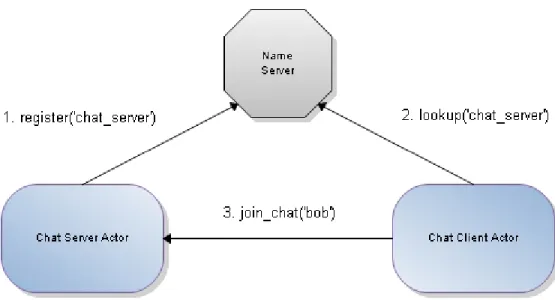
As mentioned, a theatre is the host environment in which a collection of actors executes. An actor system may consist of a single standalone theatre, or alter-natively may consist of several interlinked theatres forming a distributed actor system. Theatres forming a distributed actor system all share a common name server; this is a directory service which can allow actors to associate a unique system-wide name with their mailing address, which can subsequently be used by actors in distinct theatres to initiate remote communication with each other. Naming is described further in section 4.5.
Supporting the open systems concept [42], theatres and actors can dynamically join and leave an AiR system. Theatres forming a distributed actor system need not all be resident on a single computer, as this would be rather limiting, but rather they are able to form systems across any computer network. Actors are vagrants that may travel between theatres as they see fit during the course of their lifetime; this is described further in section 4.4, where the implementation details of mobility are covered.
Figure 4.2: Configuration of a theatre
Theatres as described thus far are conceptual entities. In the actual implemen-tation of AiR a theatre is composed of a concrete (i.e. mapped to a system process) ‘master theatre’ and a collection of concrete ‘slave theatres’. The ratio-nale for this is discussed in section 4.2.3. A developer of an actor system built with AiR need not worry themselves with these details, but instead can think of a theatre as a single unit. Figure 4.2 illustrates the internal configuration of a theatre, with actors being represented by circles at the slave theatres. From this point on the conceptual view of a theatre will be referred to as the ‘logical theatre’ or simply as a ‘theatre’.
4.2.1
Master Theatre
The master theatre primarily acts as a coordinator and has the following re-sponsibilities:
• Execution of theatre script.
• Initialization of slave theatres.
• Distribution of actors.
Execution of theatre script
When a developer writes an object-oriented piece of software they must define a number of classes, and additionally they must define a piece of entry code
that creates initial objects and gets executed when the system is initialized. In Java this is a method with the signature ‘public static void main(String args[])’ defined in the class given to the Java VM, and in Ruby it is a standalone piece of code - transparently added into the top-level ‘main’ object - enclosed in an if statement that checks whether the current file is the one given to the interpreter. In AiR the situation is analogous; the developer defines a number of Actor classes, and they also define entry code to create the initial actors at the (logical) theatre. We refer to the entry code as the ‘theatre script’ and individual actor class definitions as ‘actor scripts’.
When a program that uses the AiR library is executed, it will be in the initial Ruby virtual machine instance that the master theatre resides. It will also be here that the theatre script, which in effect is nothing more than Ruby code that uses the AiR library, will be executed. An example theatre script is given in section 5.3.
Initialization of slave theatres
In AiR each slave theatre operates in its own virtual machine instance, as dis-cussed further in 4.2.3. Since the master theatre is bound to the initial virtual machine instance it is therefore tasked with the job of starting the slave theatres, one (or more) per CPU core.
It was unfortunate to find that there was no platform independent way to do this in Ruby, and so a number of operating system specific libraries were made use of. Fortunately this was the only part of the code that required platform dependencies, making the task of providing versions for both Windows and Linux trivial. It should be noted that it is still possible to build actor systems that comprise of interacting actors running under both Windows and Linux. The following code is taken from the Windows version of AiR and shows the library call that act to spawn the slave theatres:
1 .. 2 @ c o r e s . t i m e s do | i | 3 P r o c e s s . c r e a t e : cwd = > F i l e . d i r n a m e ( _ _ F I L E _ _ ) + " /. . /" , 4 : a p p _ n a m e = > " r u b y s p a w n _ s l a v e . rb s l a v e _ #{ i } #{ @ u r i } 5 ’#{ m a i n _ f i l e } ’ #{ @ n a m e _ s e r v e r _ u r i }" 6 end 7 ..
Process.create tells the operating system to start a new process with the given command (:app_name), starting in a specific directory (:cwd). In this case the application is the Ruby virtual machine, which is fed a script that loads the slave instance (‘spawn_slave.rb’) along with a number of additional parameters for initialization and callback communication with the master theatre.
Distribution of actors
When a request is made for a new actor to be spawned, or for an existing actor to be migrated to the current logical theatre, it is the responsibility of the master theatre to choose a slave theatre to host the actor. Requests to spawn an actor may be found in the theatre’s script, and additionally inside an actor’s own script; for example, an actor that performs a scientific calculation may decide to split the calculation into a number of independent computations that could be distributed to newly created worker actors. An actor in a remote theatre is able to migrate to a different theatre given that the destination theatre has registered a name that can be looked up at the nameserver.
The distribution strategy employed in AiR is to uniformly distribute actors among the slave theatres. This is rather simplistic, however for the examples implemented it has proven satisfactory. A possible extension, not implemented due to time constraints, would be to allow developers to define their own custom (domain specific) distribution strategies that could be specified upon initializa-tion of a theatre.
4.2.2
Slave Theatre
Slave theatres represent the environment under which actor instances are actu-ally executed. To provide this, the slave must perform the following duties:
• Creation and destruction of actors
• Coordinating communication between actors
• Provide support for migration (4.4)
Creation and destruction of actors
Upon receiving a request to spawn an actor from a master theatre a slave the-atre must instantiate the requested actor, making sure to allocate the actor a unique ID amongst all actors at the slave. This unique ID, along with the address of the theatre itself will then serve as the actors mailing address. The slave maintains a registry of all actors that it hosts, indexed by ID - for later interaction. Once started, an actor runs autonomously in its own green thread, as discussed in 4.3.1, interacting with the slave theatre when it needs services such as communication with other actors.
When an actor is destroyed, for example through a call to the ‘kill’ method (5.10.2), or after migration to a new theatre, the slave theatre will remove any references to the actor and ensure that any associated threads are destroyed. The memory used by the actor will then be automatically reclaimed by the Ruby garbage collector. A log is kept of of such events, for example to allow forwarding of messages to migrated actors.
Coordinating communication Between Actors
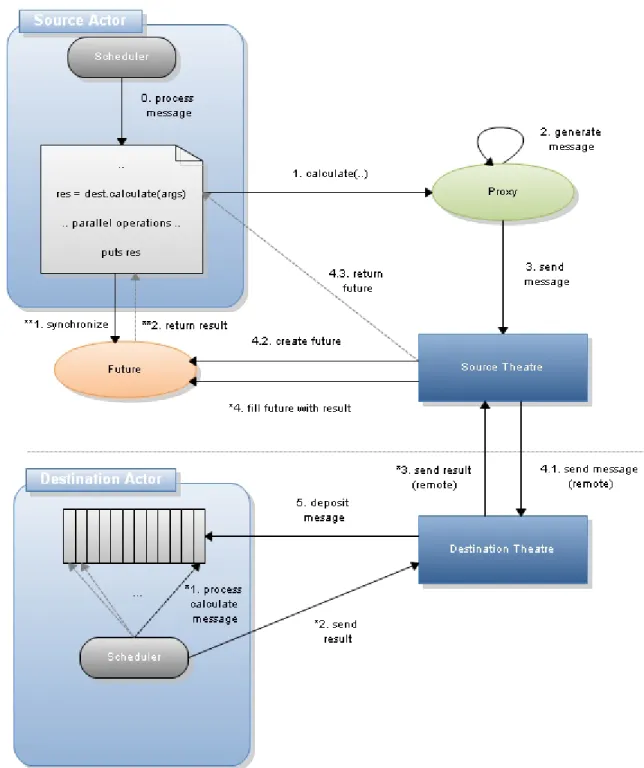
When one actor wishes to send a message to another actor it is the responsibility of the associated slave theatre(s) to ensure that it is delivered to the destination actor’s mailbox. After a message send request, generated using a proxy as discussed in 4.3.2, has been received from an actor by the slave there are a number of alternative courses of action that might be taken. For now we shall consider the case of a one way communication (i.e. when a return value is not required).
One-way Communication
Should the communicating actors reside on the same slave theatre this is a simple case of using the destination ID included in the message to retrieve the corresponding actor’s reference from the registry and to then deposit the message in the actor’s mailbox, by calling the actor’s ‘deposit_mesmessage’ method -something all actor instances posses. It should be noted that any arguments passed in messages between actors are first marshalled (flattened into byte se-quence) and then reconstructed on receipt as to prevent shared state, which is prohibited by the actor model.
If the destination actor resides in a separate slave theatre then a custom com-munication library is used to pass the message between the two theatres, after which point a similar process is performed. The first attempt at making a com-munication library was based upon the DRb (Distributed Ruby) RMI library [8] which is available for Ruby. It was soon discovered, however, that due to the synchronous nature of DRb this would have a huge impact on performance; if the destination theatre’s communication thread suspends before a message has been deposited, then this would mean that the source theatre’s communication thread must also suspend.
To improve performance, the decision was made to write a new asynchronous RMI library from scratch, using the TCP socket classes provided by Ruby, that would return immediately after a remote call is made. Although no official benchmarks were taken, from running a number of sample AiR systems, such as a simple Ping Pong application, the resulting speed-up was evident. Allowing methods to be invoked on a remote theatre, rather than having the receiver pattern match raw messages received over a socket, allowed for a smoother transition as communication protocols between collaborating theatres matured during AiR’s evolution; it will also mean that any extensions or modifications to AiR in the future will be as pain free as possible from the perspective of communication.
Two-way Communication
Two-way communication in AiR is performed in a similar manner to SALSA and Stage, whereby a placeholder object is returned to the sender immediately upon dispatch of a request. This approach draws heavily on the related concept of a ‘future’; a future is an actor that represents the value of a parallel computation, being created when appropriate, thus freeing the creator to do other work, and being synchronized if/when the value is required [44][39].
In AiR we refer to the placeholders mentioned as ‘futures’, however in reality they are not real actors, but rather they are objects shared between the host theatre and the actor that performed the message send. The future object is created by the theatre upon receipt of the message send request, and it is then stored along with an ID that is included in the message that eventually ends up at the destination actors mailbox. When a message has been processed by an actor, a check will be performed to see if the message requires a result (i.e. a future was issued), and if so the result will be returned to the originating theatre accordingly. Once back at the theatre the future will be filled, thus making the result available to the actor. The future object will deal with any additional work that is required such as awaking the actor’s thread if it went to sleep after attempting to synchronize the future.
4.2.3
Theatre Design Choices
One of the motivations for developing the Actor model was the prospect of highly parallel computation devices [31]. With the mass adoption of multi-core and multi-processor machines it is therefore vital that AiR should fully exploit the potential parallelism afforded.
The simplest way to achieve maximum parallelism between actors, and to thus exploit the potential of these new chips, is to assign each actor a native system thread to process messages in its message queue. Due to the share-nothing approach of the Actor model, these threads can then be executed completely independently from each other, making use of any available cores.
As previously mentioned in 2.2, Ruby makes use of green threads. While native threads are scheduled by the underlying operating system, green threads are scheduled by the virtual machine itself; the Ruby virtual machine is only ever resident on a single core at any given time, and as such any parallelism afforded by a multi-core system is not taken advantage of by default. It was for this reason that the approached detailed above, in which master and slave theatres each execute in their own virtual machine instance, was taken. This gives an actor system the potential to execute in true parallelism on all cores of the host system, instead of limiting it to run under single core inside a single virtual machine instance.