Improving Clustering
Methods By Exploiting
Richness Of Text Data
by
Abdul Wahid
A thesis
submitted to the Victoria University of Wellington in fulfilment of the
requirements for the degree of Doctor of Philosophy in Computer Science. Victoria University of Wellington
Abstract
Clustering is an unsupervised machine learning technique, which involves discovering different clusters (groups) of similar objects in unlabeled data and is generally considered to be a NP hard problem. Clustering methods are widely used in a verity of disciplines for analyzing different types of data, and a small improvement in clustering method can cause a ripple effect in advancing research of multiple fields.
Clustering any type of data is challenging and there are many open research questions. The clustering problem is exacerbated in the case of text data because of the additional challenges such as issues in capturing semantics of a document, handling rich features of text data and dealing with the well known problem ofthe curse of dimensionality.
In this thesis, we investigate the limitations of existing text clustering methods and address these limitations by providing five new text cluster-ing methods–Query Sense Clustercluster-ing (QSC), Dirichlet Weighted K-means (DWKM), Multi-View Multi-Objective Evolutionary Algorithm (MMOEA), objective Document Clustering (MDC) and Objective Multi-View Ensemble Clustering (MOMVEC). These five new clustering meth-ods showed that the use of rich features in text clustering methmeth-ods could outperform the existing state-of-the-art text clustering methods.
The first new text clustering method QSC exploits user queries (one of the rich features in text data) to generate better quality clusters and cluster labels.
The second text clustering method DWKM uses probability based weight-ing scheme to formulate a semantically weighted distance measure to im-prove the clustering results.
evolutionary algorithm. MMOEA exploits rich features to generate a di-verse set of candidate clustering solutions, and forms a better clustering solution using a cluster-oriented approach.
The fourth and the fifth text clustering method MDC and MOMVEC address the limitations of MMOEA. MDC and MOMVEC differ in terms of the implementation of their multi-objective evolutionary approaches.
All five methods are compared with existing state-of-the-art methods. The results of the comparisons show that the newly developed text clus-tering methods out-perform existing methods by achieving up to 16% im-provement for some comparisons. In general, almost all newly developed clustering algorithms showed statistically significant improvements over other existing methods.
The key ideas of the thesis highlight that exploiting user queries im-proves Search Result Clustering(SRC); utilizing rich features in weighting schemes and distance measures improves soft subspace clustering; uti-lizing multiple views and a multi-objective cluster oriented method im-proves clustering ensemble methods; and better evolutionary operators and objective functions improve multi-objective evolutionary clustering ensemble methods.
The new text clustering methods introduced in this thesis can be widely applied in various domains that involve analysis of text data. The contri-butions of this thesis which include five new text clustering methods, will not only help researchers in the data mining field but also to help a wide range of researchers in other fields.
Acknowledgments
All praises unto Allah, the most merciful and the beneficent, for all his blessings. I am thankful to all my family members, relatives, friends and colleagues for their kind support, encouragement and love. They where the key people who motivated me to purse a PhD. Also, thanks to my friends who made sure I keep fit and healthy by organizing weekly cricket activities.
I am also thankful for my supervisors Dr. Xiaoying Gao and Dr. Pe-ter Andreae for their guidance throughout my PhD. I will always remain grateful to them for considering me as their student.
Special thanks to Dr. Mengjie Zhang for proof reading some of my work and providing fruitful suggestions. I am honored to be the part of ECRG group which provided me the chance to learn about other student research and an opportunity to make new friends.
Lastly, I would like to thank Victoria University of Wellington for their generous financial support. I am grateful to Victoria University of Welling-ton for the scholarship and travel grant for the top conferences in different countries. Visiting different conferences provided me an opportunity to present my research work, meet leading scholars of my research area and get the feedback to improve my research work.
List of Figures
1.1 Example of multiple possible clusterings . . . 2
1.2 Example of overlapping clusters and outliers . . . 2
1.3 Examples of disjoint views in supspace . . . 7
1.4 Generation of multiple clustering . . . 13
4.1 Comparison of SRC methods based on different evaluation measures . . . 57
4.2 S-recall@k on all queries . . . 58
4.3 S-precision@r on all queries . . . 59
4.4 Processing Time for All Queries . . . 61
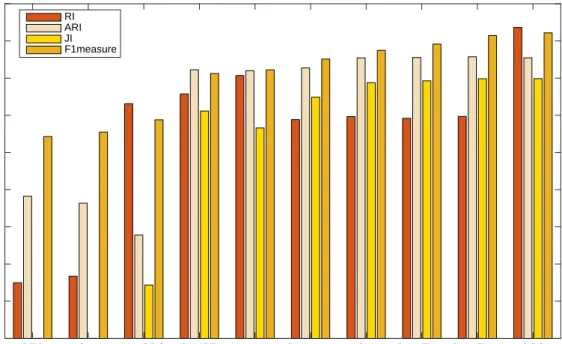
4.5 RI, ARI and JI Analysis . . . 62
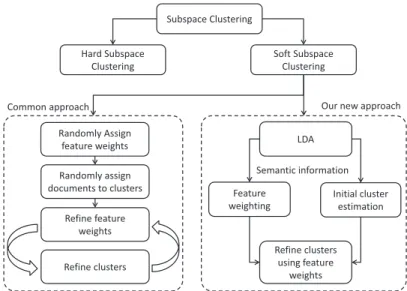
5.1 Traditional subspace vs our clustering approach . . . 66
5.2 A common LDA graphical model using plate notation. . . . 69
5.3 System diagram of DWKM . . . 70
6.1 Process of generating 24 different clustering solutions. . . 89
6.2 Sample Clustering . . . 91
6.3 matrix based binary encoding . . . 92
6.4 Precision of the final solution on all datasets . . . 96
6.5 Recall of the final solution on all datasets . . . 97
6.6 F1-measure on all datasets . . . 98
6.7 Rand Index on all datasets . . . 99 v
7.1 Example of row-wise crossover method. . . 109
7.2 Example of column-wise crossover method. . . 110
7.3 Example of split and merge mutation method. . . 111
7.4 Overview of MOMVEC clustering method . . . 114
7.5 Analysis of MDC . . . 121
7.6 CA on combined dataset . . . 122
7.7 F1 on combined dataset . . . 123
7.8 RI on combined dataset . . . 124
7.9 Component wise analysis of MOMVEC . . . 129
7.10 box plot of Clustering Accuracy on combined dataset . . . . 130
7.11 box plot of F1-measure values on combined dataset . . . 131
List of Tables
4.1 Weight distribution of the Sense Document Similarity
Mea-sure . . . 50
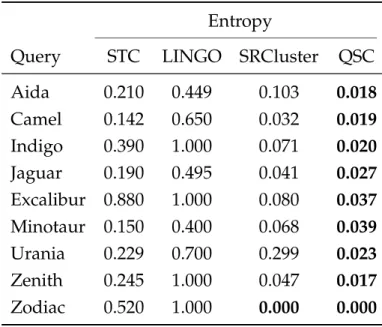
4.2 The Values of Entropy on a subset of AMBIENT Dataset . . 55
4.3 The Values of Purity on a subset of AMBIENT Dataset . . . . 56
4.4 Cluster labels of STC, LINGO and QSC of the query Jaguar . 60 5.1 Six real world datasets created from 20-Newsgroup dataset . 77 5.2 Comparison of clustering methods on synthetic dataset . . . 78
5.3 Comparison of clustering methods on real dataset . . . 79
5.4 Percentage improvement of DWKM . . . 80
5.5 Percentage improvement of DWKM over FGKM . . . 81
5.6 P-values of unpaired ttest of DWKM and FGKM . . . 82
6.1 Average ranking of clustering methods of MMOEA . . . 101
7.1 Clustering Accuracy computed on 10 two view datasets. . . 118
7.2 F1-measure computed on 10 two view datasets . . . 119
7.3 Rand Index computed on 10 two view datasets . . . 119
7.4 Improvement of clustering quality of MDC compare . . . 120
7.5 Statistical significance test for MDC . . . 125
7.6 Values of CA computed on 10 two-view datasets . . . 125
7.7 Values of F1-measure computed on 10 two-view datasets . . 126
7.8 Values of Rand Index computed on 10 two-view datasets . . 126
7.10 Statistical significance test for MOMVEC . . . 128 vii
Abbreviations
AHC Agglomerative Hierarchical Clustering. 27
API Application Programming Interface.Glossary: API
BOW Bag Of Words. 22,Glossary: bag of words
DWKM Dirichlet Weighted K-mean. 16
EWKM Entropy Weighted K-means Subspace Clustering. 10
FGKM Feature Group K-means Subspace Clustering. 10
FWKM Feature Weighted K-means Subspace Clustering. 10
LDA Latent Dirichlet Allocation. 16
MDC Multi-objective Document Clustering. 17
MMOEA Dirichlet Weighted K-mean. 16
MMOEA Multi-objective Multi-View Ensemble Clustering. 17
Mock Multi-objective clustering algorithm with K-determination. 85
MOEA Multi-objective Evolutionary Algorithm. 33
NMI Normal Mutual Information. 43 ix
NSGA-II Non-dominated Sorting Genetic Algorithm. 17, 86
QSC Query Sense Clustering. 15
SL Average Link Agglomerate Hierarchical Clustering Ensemble. 97
SL Complete Link Agglomerate Hierarchical Clustering Ensemble. 97
SL Single Link Agglomerate Hierarchical Clustering Ensemble. 97
SPEA-II Strength Pareto Evolutionary Algorithm. 17
SRC Search Result Clustering. xi, 8
TFIDF Term Frequency Inverse Document Frequency. 48
Contents
List of Figures v
List of Tables vii
Abbreviations ix
1 Introduction 1
1.1 Clustering . . . 2
1.2 Clustering Text Data . . . 4
1.2.1 Richness of text data . . . 4
1.2.2 Multi-View Data . . . 5
1.3 Scope . . . 7
1.3.1 Search Result Clustering . . . 8
1.3.2 Subspace Document Clustering . . . 9
1.3.3 Clustering Ensembles . . . 10
1.4 Research Goals . . . 13
1.5 Major Contributions . . . 15
1.6 Published Papers and Presentations . . . 17
1.7 Organization of the thesis . . . 18
2 Background 21 2.1 Applications for Text Clustering . . . 21
2.2 Text Representation . . . 22
2.3 Similarity Measures . . . 25 xi
2.4 Clustering Methods . . . 25
2.5 Agglomerative Hierarchical Clustering . . . 27
2.6 Centroid Based Clustering Methods . . . 27
2.7 Search Result Clustering . . . 28
2.8 Subspace Clustering . . . 30
2.8.1 Hard Subspace Clustering . . . 30
2.8.2 Soft Subspace Clustering . . . 30
2.9 Clustering Ensembles . . . 31
2.10 Clustering as an Optimization Problem . . . 32
2.11 Evolutionary algorithms for optimization problems . . . 33
2.12 Multi-View Clustering . . . 34
2.13 Summary . . . 35
3 Evaluation of Clustering Algorithms 37 3.1 Datasets . . . 38
3.2 Evaluation Methodology . . . 40
4 Search Result Clustering 45 4.1 Introduction . . . 45
4.2 Existing SRC Methods . . . 46
4.3 Representation and Similarity Measure . . . 48
4.3.1 Document Representation . . . 48
4.3.2 Document Similarity Measure . . . 49
4.3.3 Query Sense Representation . . . 49
4.3.4 Sense Document Similarity Measure . . . 50
4.4 The Algorithm . . . 50
4.4.1 Step 1: Initial Cluster Generation . . . 51
4.4.2 Step 2: Cluster Optimization . . . 52
4.4.3 Step 3: Cluster Ranking . . . 54
4.5 Results . . . 54
4.5.1 Comparison 1 . . . 54
CONTENTS xiii
4.5.3 Comparison 3 . . . 56
4.5.4 Further Analysis . . . 58
4.6 Summary . . . 63
5 Soft Subspace Clustering 65 5.1 Introduction . . . 65
5.2 Existing Soft Subspace Clustering Algortihms . . . 67
5.2.1 Latent Dirichlet Allocation . . . 68
5.3 Our LDA Weighted K-Means Model . . . 70
5.3.1 Gibbs Sampling . . . 70 5.3.2 Generatingθandφ . . . 72 5.3.3 Objective Function . . . 72 5.3.4 Our Algorithm: DWKM . . . 74 5.4 Experimental Setup . . . 75 5.4.1 Datasets . . . 76 5.4.2 Evaluation Measures . . . 76 5.5 Results . . . 76 5.5.1 Comparison . . . 78 5.5.2 Statistical Analysis . . . 82 5.6 Summary . . . 83 6 MMOEA 85 6.1 Introduction . . . 85
6.2 Existing Multi-Objective Clustering Methods . . . 87
6.3 Our Multi-View Multi-Objective Evolutionary Approach . . 88
6.3.1 Initialization Method . . . 89 6.3.2 Genetic Representation . . . 91 6.3.3 Objective Functions . . . 91 6.3.4 Crossover . . . 93 6.3.5 Algorithm: MMOEA . . . 94 6.4 Evaluation Experiments . . . 97
6.5.1 Statistical Analysis . . . 100
6.6 Summary . . . 102
7 Improving MMOEA 105 7.1 Introduction . . . 105
7.2 Common Elements of MDC and MOMVEC . . . 106
7.2.1 Fitness Evaluation . . . 107
7.2.2 Selection . . . 109
7.2.3 Crossover . . . 109
7.2.4 Mutation . . . 111
7.2.5 Tuning . . . 111
7.3 Multi-objective Document Clustering (MDC) . . . 112
7.4 Multi-objective Multi-View Ensemble Clustering (MOMVEC)112 7.5 Experimental Setup . . . 117
7.5.1 Datasets . . . 117
7.5.2 Evaluation Measure . . . 117
7.6 Experimental Setup for MDC . . . 117
7.6.1 Comparison on Two View Datasets . . . 120
7.6.2 Comparison on Three View Datasets . . . 122
7.6.3 Statistical Analysis . . . 123
7.7 Experimental Setup for MOMVEC . . . 124
7.7.1 Comparison on Two View Datasets . . . 125
7.7.2 Comparison on Three View Datasets . . . 130
7.7.3 Statistical Analysis . . . 131
7.8 Single vs Multi-Objective Analysis . . . 132
7.9 Summary . . . 133
8 Conclusions 135 8.1 Objectives and the Contributions . . . 135
8.2 Main Conclusions . . . 138
8.3 Limitations and Future Work . . . 141
CONTENTS xv 8.4 Closing Remarks . . . 143
Appendices 145
Glossary 147
Chapter 1
Introduction
Organizing similar objects into different groups provides an opportunity to learn about the structure of the data. Generally, objects are grouped together by considering the common characteristics of the objects. For example documents that share common words can be clustered together and the records of patients that provide similar symptoms can be clustered together. The former example, can be useful to create a library catalog whereas the later example can be useful to prescribe similar treatments for patients.
In computer science, clustering or cluster analysis is an unsupervised machine learning technique inspired from the human ability to group sim-ilar objects in unlabeled data. Unlabeled data generally refers to raw data or data without the information of the groups or classes. Clustering an-alyzes the data and discovers hidden structure of the data by grouping similar data objects based on some notion of similarity. The main aim of clustering is to have better understanding of the data by learning from the structure of data obtained from clustering.
Clustering has received enormous attention in the research commu-nity because of its challenging problems and a wide range of applications [52, 61]. It has been investigated for decades and research is still going on in a wide range of disciplines such as data mining, machine learning,
!"#$%"$&'()$"*%+&',$-,./%)0/1
2*%+"3$4 2*%+"3$5 26
Figure 1.1: Example of multiple pos-sible clusterings
!"#$%&' !(&'$)**%+,
Figure 1.2: Example of overlapping clusters and outliers
pattern recognition, image analysis, information retrieval, bioinformatics, theoretical computer science and statistics. General applications that can benefit from such clustering include document analysis, gene expression analysis, sensor surveillance, customer segmentation and image segmen-tation [52]. Since clustering methods are widely applied in various fields of science to perform data analysis, a small step towards improving clus-tering methods can be a catalyst for advancement in different fields and can initiate new directions for the researchers.
1.1
Clustering
Grouping similar objects into different clusters is generally referred as the clustering problem or the clustering task. In 1957, Stuart Lloyd developed a clustering method namedk-means[91] for automatically finding groups in data and to address the clustering problem. Since then thousands of variations of k-means and new clustering methods have been proposed. However, due to the ill-posed nature of the clustering problem, clustering still has many challenges [75]. For example, Figure 1.1 depicts the problem of multiple possible clustering solutions with different levels (i.e. three big clusters or five small clusters) of the same data. Figure 1.2 depicts the problem of overlapping objects in clusters and objects that do not belong to any clusters (generally referred to as outliers).
1.1. CLUSTERING 3 In Figure 1.1, there are two possible clustering solutions (option 1 and option 2) to the clustering problem. Deciding which option is better than the other does not have a straightforward solution. In some cases, hav-ing big clusters is preferred and in other cases, havhav-ing small clusters are preferred. One way to address this issue is to check the compactness (sim-ilarity of objects within clusters) of the clusters in a clustering solution. Determining the compactness of the clusters depends upon the way of measuring the distance between objects. A poor choice of a distance mea-sure may lead to grouping of objects that are not very similar to each other, and results in a bad quality clustering solution. Furthermore, even with a good choice of a distance measure, in some cases different clustering solutions might have the same compactness. Hence, the problem of mul-tiple clustering solutions still lingers. Also the two clustering solutions in Figure 1.1 might provide two different insights of the data and it may be better to produce two clustering solutions instead of one.
Since real world objects can belong to more than one cluster, it is of-ten desired for a clustering method to produce overlapping clusters. The overlapping cluster depicted in Figure 1.2 often requires a threshold pa-rameter. The value of this threshold depends on the question how much overlapping should be allowed.
Traditional algorithms such as k-means restrict objects to only one clus-ter to avoid setting the value of a threshold. Other clusclus-tering methods generally choose the value of a threshold based on intuition or after con-ducting various experiments on the datasets. This might not be a good approach as different datasets will need different threshold values.
Figure 1.2 depicts an object, which is not assigned or covered by any cluster, referred as an outlier. Outliers are very common in noisy data1and
can result in poor compactness of the overall clustering solution. Hence, a clustering method also has to address the outliers in such a way that the compactness of a clustering solution is not compromised.
1.2
Clustering Text Data
Traditional clustering methods generally address data described in terms of numeric or nominal attributes [58, 74, 79, 103, 150, 91]. Traditional clus-tering methods can be extended to cluster text data such as documents. Text can be represented as a binary data, where a word in a document (or text segment) is treated as a binary feature based on the presence/absence of the word in the document. Clustering methods for nominal data can use this binary representation to cluster the documents [79]. A better text representation which involves weighting schemes based on the frequen-cies of the words in a document and frequenfrequen-cies of words in the collection of all the documents can also be used in traditional clustering methods to group similar documents.
However, a recent survey of text clustering methods argues that gen-eral purpose clustering methods such as k-means should not be used to cluster text data [4]. The survey is mainly focused on describing existing text clustering methods. However, it also highlights that text has rich fea-tureswith unique characteristics which need to be considered in clustering text data, and raises unanswered questions such aswhat are the rich features in text?,how do we represent rich features? andhow can we exploit rich features for improving clustering methods?
Upon further study, we observed that the existing literature only touches the tip of an iceberg when it comes to exploiting rich features for clustering text data.
1.2.1
Richness of text data
The richness of text data involves syntactic, semantic and structural fea-tures of the text [44]. An example of syntactic feafea-tures are word-frequencies (number of time a word occurred) in the documents. Examples of seman-tic features are synonyms (words having same meaning), phrases, am-biguous words/phrases (words/phrases with multiple meanings),
top-1.2. CLUSTERING TEXT DATA 5 ics (meta features), contextual information of the text etc. An example of structural features are markups of the text such as title, headings, hy-pertext (weblinks) etc. In addition, text data can have domain specific features, for example, a user query in a result set return by search engines, hashtags in twitter text data, citations in research articles etc.
Since clustering text involves rich data [44], it exacerbates the cluster-ing problem by addcluster-ing the extra challenges of dealcluster-ing with rich features. One of the key challenges in dealing with text data is to transform or rep-resent the rich data. Another major challenge is to measure the similarity between two documents.
Representing text data using Vector Space Model (VSM) assumes words are independent, unordered and have no context (i.e. it ignores the seman-tic information) [11]. However, these assumptions are not realisseman-tic and often mislead and result in poor quality clustering solutions.
The different representations of the text data can result in different clus-tering solutions e.g. clusclus-tering research articles by only considering the citations of the articles will produce one possible set of clusters and clus-tering research articles by only considering the contents of the article could result in another possible sets of clusters. Also, both clustering solutions could provide different insights about the research articles. Unfortunately in different clustering methods, the different representation of the text data or the rich features (which can be used to represent data) are not generally utilized, therefore, a poor quality clustering solutions is often produced by the clustering methods.
1.2.2
Multi-View Data
Documents in text data are generally represented using only syntactic fea-tures. Recent approaches have used semantic and structural features along with syntactics features for document representations. However, the use of multiple features at the same time in text clustering is rare. The multiple
representations of data are also known asmulti-viewdata [143, 121]. Multi-view data or multiple views refer to different representations or perspectives of the same data instance. Generally each view may have distinct statistical properties or formulations that lead to different insights of the data. Following are the examples of views in different domains.
• In analysis of scientific documents, the views are syntactical features such as words of documents, network graph of references/citations, description of the documents such as title, author, conferences and all other possible ways to represent a document.
• In customer segmentation, the views are the different set of cus-tomer behavior such as attributes related to sports activities, food consumption, and music genre etc.
• In a gene expression analysis, the views are different functional roles of genes.
• In sensor surveillance, the views are different measurements of sen-sor nodes.
• In image segmentation, the views are different subsets of pixel fea-tures.
In general, objects that can be represented in multiple ways by different features can provide different perspectives or views of the data. Further-more, views can be based on homogeneous data with different subsets of features or heterogeneous data of different types of features. Hetero-geneous data of different features in web pages include: words in docu-ments; publishing date of a web page; average visitor time on the web page; and revenue generated per month from displaying ads on the web page. Another example of heterogeneous data of different features is sci-entific publication analysis, where documents can be represented in a vec-tor space (word-frequency) as well as graph space (based on the citations).
1.3. SCOPE 7 ݂ଵ ݂ଶ ݂ଷ ݂ସ ݂ହ ݂ ܥଵ,ଵ ܥଵ,ଶ ܥଵ,ଷ ܥଵ,ସ View 1 View 2 ݂ଵ ݂ଶ ݂ଷ ݂ସ ݂ହ ݂ ܥଶ,ଵ ܥଶ,ଶ ܥଶ,ଷ ܥଶ,ସ ݂ଵ ݂ଶ ݂ଷ ݂ସ ݂ହ ݂ ܥଶ,ଵ ܥଵ,ଶ ܥଵ,ଷ ܥଵ,ସ View 1 View 2 ݂ଵ ݂ଶ ݂ଷ ݂ସ ݂ହ ݂ ܥଶ,ଵ ܥଶ,ଶ ܥଶ,ଷ ܥଶ,ସ
Disjoint views with subspace clusters Overlapping views with subspace clusters
Figure 1.3: Examples of disjoint and overlapping views in subspace (a sub-set of features).
In addition, a subset of features or subspaces can also provide a distinct perspective of the data. Hence, the views can also be based on subsets of features.
Figure 1.3 shows different types of views that can be found in the sub-set of features. The black squares on the first row show the specific feature is present in all clusters. Whereas, the light gray squares on the first row show the specific feature is present in particular clusters. A black square next to the clusters (rows 2-5) show that a featurefis present in the cluster
C. The disjoint views consist of different subset of features (f1, f2, f3
repre-sent one view andf4, f5, f6 represent another view) and do not share any
features. Overlapping views, share one or more features that are already included in the different views.
As said earlier, different views may lead to a different set of clusters and can provide different insights of the data. Generally previous text clustering approaches only considered one view of the data for cluster-ing. This thesis will focus on using multiple views to improve clustering methods.
1.3
Scope
Addressing all the challenges of clustering data is too broad for this thesis. Therefore, the scope of this thesis is restricted to the following clustering
approaches for text data.
1.3.1
Search Result Clustering
The rich features vary from domain to domain in the development of spe-cial purpose text clustering methods. For example, user query in Search Result Clustering (SRC)is a rich feature which is not present in general clus-tering of documents. SRC is a special purpose clusclus-tering approach which groups the results of a user query in such a way that each cluster repre-sents a set of related results. To be useful to the user, the different cluster should contain the results corresponding to different possible meanings of the user query and the cluster labels should reflect these meanings. How-ever, existing SRC methods often ignore the utilization of the user query and group the results based on the similarity of search results.
Limitations of Search Result Clustering
Existing SRC methods are vulnerable to the two problems:low quality clus-ter, where the results within a single cluster are related to different mean-ings of the query; andpoor cluster labels, where the label of the cluster does not reflect the query meaning associated with the results in the cluster.
Furthermore, the similarity between two documents is often based on word frequency i.e. only syntactic features of the documents are consid-ered. Such similarity measures are regarded as syntactic measures because they only consider counts of words. Since documents contain both syntac-tic and semansyntac-tic features, the under utilization of rich features (semansyntac-tic features) can degrade the overall cluster quality (low compactness of clus-ters).
SRC clustering methods can be improved by addressing the problems of low cluster quality, poor cluster labels and under utilization of rich fea-tures. Hence, a new SRC method is desired which can address the current problems of existing SRC methods.
1.3. SCOPE 9
1.3.2
Subspace Document Clustering
Subspace document clustering approach has been widely applied on gen-eral purpose document clusterings. The documents in gengen-eral purpose clustering are assumed to have medium length, the clusters are unbal-anced, the data is noisy and unlike Search result clustering, there is no user query. The documents can be the collection of news articles, web pages, emails, research articles etc.
Traditional clustering methods such as k-means, consider all features at the same time to cluster the data and are only suitable for data with a small number of features. In text datasets, the number of features is very large and it is more suitable to find clusters in subsets of features (subspaces) instead of considering all the features at once (full space). The most popular clustering approach which tries to find clusters in subspaces is called subspace clustering.
Subspace clustering is often divided into two sub-steps. The step one determines the subspaces and step two clusters the data. Based on how these steps are performed, there are two main categories of subspace clus-tering methods: hard subspace clustering and soft subspace clustering [26, 135]. In hard subspace clustering, a feature in a subspace is either present or not present (1 or 0), whereas in soft subspace clustering, a feature in a subspace is determined by its degree of presence (i.e. a weight between 0-1). A feature is considered relevant if its weight is high in a subspace and considered irrelevant if its weight is low in a subspace.
In text datasets, some features can be considered to be partially pre-sented in subspaces. Therefore, soft subspace clustering methods are be-coming more popular in text clustering.
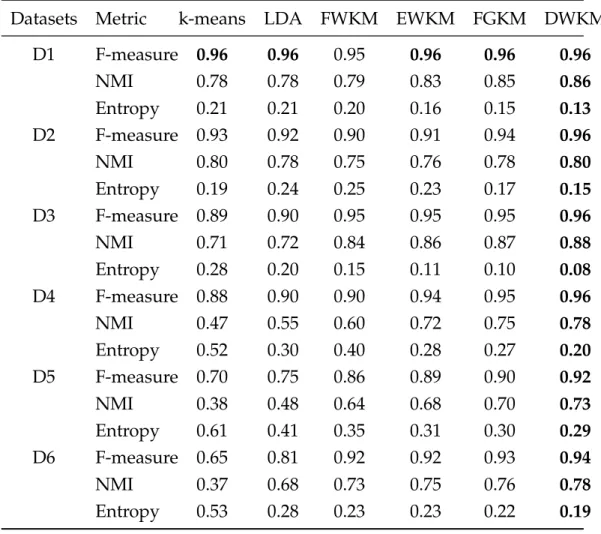
The most popular soft subspace methods are Feature Weighted K-means Subspace Clustering (FWKM) [78], Entropy Weighted K-means Subspace Subspace Clustering (FGKM) [77] and Feature Group K-means Subspace Clustering (FGKM) [26]. These methods use modified versions of k-means algorithm for clustering the data in different subspaces based on their
fea-ture weights. These methods mainly differ in terms of how they compute the feature weights.
Limitations of Subspace Document Clustering
Common subspace clustering methods are heavily dependent upon the distance measure for grouping the objects. The previous approaches in applying subspace clustering in documents only use the syntactic infor-mation and ignore the rich features of the text (semantic inforinfor-mation of the documents). Therefore, we believe that clustering documents using subspace clustering approach requires a special distance measure which not only considers the syntactic information of the documents but also takes the semantic information into account.
1.3.3
Clustering Ensembles
Thousands of clustering methods have been proposed in the last 50 years [75]. Each clustering method is unique in its own way and generally pro-duces different sets of clusters. To leverage the advantages of different clustering methods, researchers have been trying different techniques for combining different clustering methods. This type of clustering approach is commonly known as clustering ensembles. Clustering ensembles is an emerging clustering approach which aims at deriving a superior solution (having better compactness) by considering the multiple clustering solu-tions that are generated from different clustering methods.
Limitations of Clustering Ensembles
Clustering ensembles methods for text clustering include two important steps: 1) generating a set of candidate clustering solutions and 2) combin-ing the set of candidate clustercombin-ing solutions to generate a final clustercombin-ing solution. Therefore, the key issues that clustering ensemble approaches
1.3. SCOPE 11 address are how to generate different candidate solutions and how to combine them.
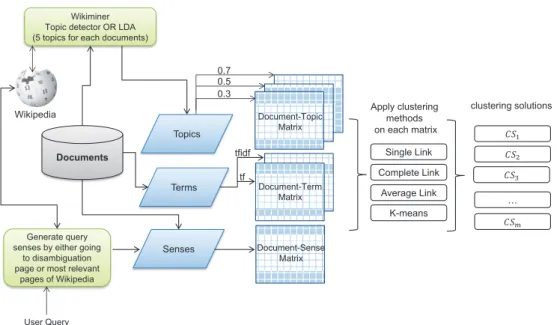
A common practice for step 1 is to use different clustering methods (kmeans, Agglomerate Hierarchical Clustering, etc) with different param-eters to generate multiple clustering solutions. This is a good strategy if the data can only be represented from one view. However, in the case of textual data, a document can be represented by multiple views e.g., se-mantic view (i.e. topics, title, hypertext etc.) and a syntactic view (i.e. term frequencies). Considering multiple views at the same time has al-ready proven to result in better cluster quality [13]. Therefore, it seems reasonable that using multiple views for generating different candidate in a clustering ensembles method will result in generating a diverse set of candidate clustering solutions.
The use of multiple views in clustering raises a third issue of how to detect multiple views in the data. Generally, the views are pre-defined by the domain experts. However, in the absence of domain experts the views needs to be automatically generated. The detailed description of the three issues of clustering ensembleshow to generate different candidate solutions,
how to combine them, andhow to detect multiple viewsare as follows.
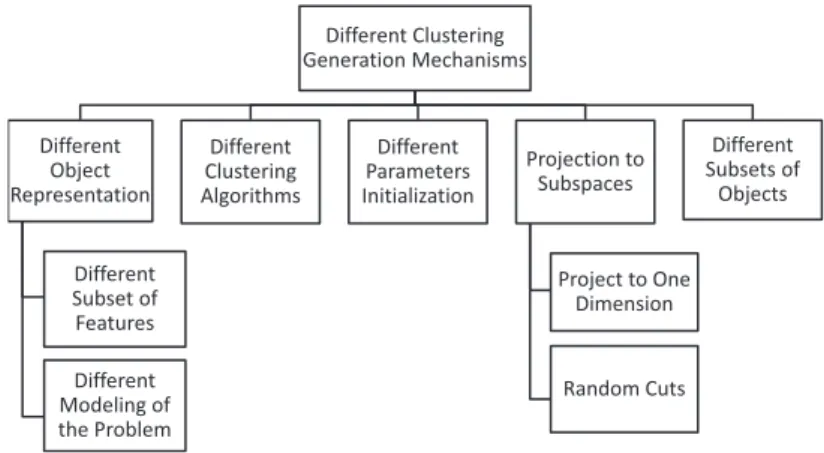
• How to generate different candidate solutions?Different clustering methods or the same method with different parameters can be used along with different representations, a subset of objects, and pro-jections on subspaces of the objects to generate different clustering solutions. Figure 1.4 shows different ways for generating the clus-tering solutions. However, these methods may produce redundant clusters. Also, candidate clustering solutions are generally mixture of high quality and low quality clusters. In order to achieve high quality clusters and avoid redundant clusters, the candidate cluster-ing solutions need to provide additional knowledge for performcluster-ing cluster analysis from different perspectives.
on these views different candidate clustering solutions could be gen-erated. The different candidate clustering solutions provides differ-ent insights about the data and could be useful to analyze the data from different perspectives. Therefore, it seems reasonable to de-velop a new clustering method which can use multiple views of the data to generate a diverse set of candidate clustering solutions. • how to combine different candidate solutions? In clustering
en-sembles, these different candidate clustering solutions are merged to one single solution by deriving a consensus between the clustering solutions. There are different approaches for developing a consensus function for clustering ensembles. The most prominent and success-ful approach for consensus function for the clustering ensembles is called median partition.
The median partition approach tries to solve an optimization prob-lem of themedian partitionwith respect to the clustering. In cluster-ing, the median partition is defined as a clustering solution that is most similar to all clustering solutions.
Generally all clustering ensemble based consensus approaches, ig-nore a key point that a set of candidate clustering solutions are com-posed of high quality2 and low quality clusters. Moreover, the
cur-rent approaches try to select a single candidate clustering solution, instead of generating a final clustering solutions by considering only high quality clusters from different candidate clustering solutions. In order to generate a better clustering solution, a new consensus function is desired, which considers only high quality clusters from different candidate clustering solutions.
• how to detect multiple views? Given that multiple views are good for generating candidate clustering solutions, one interlinked chal-2high quality clusters are the ones that have high intra-cluster similarity and are
1.4. RESEARCH GOALS 13 Different Clustering Generation Mechanisms Different Object Representation Different Subset of Features Different Modeling of the Problem Different Clustering Algorithms Different Parameters Initialization Projection to Subspaces Project to One Dimension Random Cuts Different Subsets of Objects
Figure 1.4: Generation of multiple clustering
lenge in utilizing the rich features in clustering methods is to de-termine the multiple representations of views of the data. Detecting views which provide the different representations of the data is quite hard and there is no known method that can accurately address this problem. The best way to detect multiple views is to use domain ex-perts. Therefore, we restrict the scope of this thesis to use predefined views by domain experts.
1.4
Research Goals
The overall goal of this thesis is to develop new and improved cluster-ing methods for text data and demonstrate that exploitcluster-ing the richness of text data can improve the performance of clustering methods. In order to achieve this goal, not only we must address the general challenges in-volved in developing clustering methods but also we must address the challenges in handling text data. We set the following research objectives to guide the research work in this thesis that addresses the limitations of existing clustering approaches:
1. Develop a new clustering method to exploit user queries for Search Result Clustering(SRC).
The thesis addresses this objective by developing a new SRC method that exploits the user query and uses both syntactic and semantic features of the search results to construct clusters and labels. The newly developed SRC method is compared with existing state-of-the-art SRC methods to show that our SRC method which uses dif-ferent query senses generates a good candidates (more semantically meaningful labels) for the cluster labels and can also lead to high quality clusters.
2. Develop a new subspace clustering method for text data that uses semantic information in its distance measure.
The thesis addresses this objective by developing a new soft sub-space clustering method based on semantic feature weighting and developing a semantically weighted distance measure. The thesis also discusses different weighting schemes for soft subspace cluster-ing methods and present results of comparcluster-ing our newly developed soft subspace clustering method against existing soft subspace clus-tering methods.
3. Use multiple views of text data to generate diverse candidate clustering so-lutions for clustering ensemble methods.
The thesis addresses this objective by developing a new clustering ensemble method that exploits multiple views to generate different clustering solutions. The thesis also describes the results of compari-son between our newly developed clustering ensemble with existing methods to proof the assumption that multiple views can influence the overall quality of the clustering solution.
4. Develop a new approach for combining different candidate clustering solu-tions to generate the final clustering solution for clustering ensemble meth-ods.
The thesis addresses this objective by developing a new method for clustering ensembles based on evolutionary approach which derives
1.5. MAJOR CONTRIBUTIONS 15 a final clustering solution by selecting a combination of high quality clusters from candidate clustering solutions instead of selecting the single candidate clustering solution. The thesis also presents results of comparing our newly developed method with existing clustering approaches.
1.5
Major Contributions
This thesis contributed five newly developed text clustering methods which not only address some of the general issues in text clustering but also use the richness of the text to produce improved clustering solutions. The the-sis points to new prospects in clustering the text data by considering the richness of features and exploiting multiple views of the text data. The following are the main contributions of the thesis.
1. The first contribution is a new description-centric search result clus-tering method Query Sense Clustering (QSC) which exploits query senses to generate meaningful cluster labels and uses syntactic and semantic features of documents to generate quality clusters [131]. QSC outperforms existing state-of-the-art Search Result clustering methods. QSC is computationally inexpensive and provides better quality clusters with meaningful labels as compared to other algo-rithms, hence it has the potential to be applied to real time search result clustering applications.
2. The second contribution is a new soft subspace clustering method
Dirichlet Weighted K-mean (DWKM), which uses the Latent Dirichlet Allocation (LDA) model to weight the features in the subspaces for clustering the documents [135]. The LDA model was implemented using a standard Gibbs sampling algorithm. Two matrices, topic-term and topic-documents, were generated. We used the topic-topic-term matrix to develop a new weighted distance measure, where topics
are used as subspaces. The algorithm is initialized using the topic-document matrix, where topics are considered as initial clusters. The main innovation of DWKM is the use of semantic information in fea-ture weighting and a novel semantically weighted distance measure. Experiments show that DWKM has made a include statistically sig-nificant improvement over recently developed soft subspace cluster-ing methods on both synthetic and real-world datasets.
3. The third contribution is a multi-objective approach for clustering ensembles ,Multi-view Multi-objective Evolutionary Algorithm (MMOEA), which uses multiple views to generate a set of candidate solutions and selects high-quality overlapping clusters from the candidate so-lutions to form a superior clustering solution [132]. MMOEA uses multiple views to generate an initial set of candidate clustering so-lutions. This results in diverse candidate clustering solutions hav-ing mixtures of very high quality clusters and low quality clusters. MMOEA provides a novel method for generating a final clustering solution by selecting and combining the individual clusters from different candidate clustering solutions. Another major novelty of MMOEA is to use the multi-objective ranking system from NSGA-II to guide the optimization to address the conflict between the ob-jective criteria used in MMOEA algorithm. The experiments have shown that MMOEA outperformed other existing cluster ensemble methods.
4. The fourth contribution is two new clustering ensemble methods Multi-objective Document Clustering (MDC) and Multi-objective Mul-ti-View Ensemble Clustering (MOMVEC) based on Strength Pareto Evolutionary Algorithm (SPEA-II) and Non-dominated Sorting Ge-netic Algorithm (NSGA-II) respectively [133, 134]. The new methods have four new innovations: weighted intra-cluster distance in ob-jective functions, row/column wise crossover methods, split/merge
1.6. PUBLISHED PAPERS AND PRESENTATIONS 17 mutation methods and a tuning method in the multi-objective evo-lutionary process for refining the clustering solution.
Both MDC and MOMVEC are able to produce both overlapping and non-overlapping clusters and are able to automatically determine the number of clusters for final clustering solution.
MOMVEC outperformed all other clustering ensemble methods in-cluding MMOEA and showed a slightly better performance than MDC.
1.6
Published Papers and Presentations
Parts of this thesis were published and presented in the conferences during the course of research. The list is as follows:
1. Wahid, Abdul, Xiaoying Gao, and Peter Andreae. “Multi-Objective Clustering Ensemble for High-Dimensional Data based on Strength Pareto Evolutionary Algorithm (SPEA-II).”Data Science and Advanced Analytics (DSAA), 2015. 36678 2015. IEEE International Conference on.
IEEE, 2015.
2. Wahid, Abdul, Xiaoying Gao, and Peter Andreae. “A Soft Subspace Clustering Method for Text Data using Latent Dirichlet Allocation based Feature Weighting Scheme.”Web Information Systems Engineer-ingWISE 2015.Springer International Publishing, 2015. 124-138.
3. Wahid, Abdul, Xiaoying Gao, and Peter Andreae. “Multi-Objective Multi-View Clustering Ensemble based on Evolutionary Approach.”
Evolutionary Computation (CEC), 2015 IEEE Congress on. IEEE, 2015.
4. Wahid, Abdul, Xiaoying Gao, and Peter Andreae. “Multi-view clus-tering of web documents using the multi-objective genetic algorithm.”
5. Wahid, Abdul, Xiaoying Gao, and Peter Andreae. “Exploiting User Queries for Search Result Clustering.”Web Information Systems Engi-neeringWISE 2013.Springer Berlin Heidelberg, 2013. 111-120.
6. Wahid, Abdul, Xiaoying Gao, and Peter Andreae. “Context Aware Web Page Clustering.”New Zealand Computer Science Research Student Conference-NZCSRSC 2013.
1.7
Organization of the thesis
The thesis is organized into multiple chapters and a brief description of the chapters are as follows:
Chapter 2discusses the general terminologies, the background of gen-eral clustering techniques for text data. It will also include the basic intro-duction of Subspace clustering, Multi-view clustering and Ensemble clus-tering.
Chapter 3 describes an overall methodology for evaluating the newly developed clustering methods. It includes the description of text datasets and evaluation measures for all experiments. Specific experimental pa-rameters for the experiments are discussed in their relevant chapters.
Chapter 4describes the first problem in more detail with relevant liter-ature review. It describes a new clustering method named Query Sense Clustering (QSC) and a comparative study of its results with other clus-tering methods. It also includes a discussion section which describes the contribution and achievements of the first goal of the thesis.
Chapter 5 focuses on the problem of high-dimensionality in text data and semantic distance measures. It includes the relevant literature review, a new clustering method named Dirichlet Weighted k-means (DWKM) and a comparative study of its results with other clustering methods. The contribution and achievements of the second goal of the thesis are also provided at the end of the chapter.
1.7. ORGANIZATION OF THE THESIS 19
Chapter 6discusses the multiple views in text data and presents a new clustering ensemble method named MMOEA. It outlines the relevant re-lated work and discuss the implementation of MMOEA. The comparison of MMOEA and other existing clustering methods are also included in this chapter along with a discussion of the achievements of third and fourth objectives.
Chapter 7 provides two improved version of the ensemble clustering method MMOEA called MDC and MOMVEC. The implementation of MDC highlights the importance of better genetic operators and the fitness func-tion used in the evolufunc-tionary process. The chapter describes the imple-mentation of MDC and its performance comparison with other existing methods including MOMVEC and MMOEA. The last section of the chap-ter discusses on the contribution of the research work, and its relevance to third and fourth objectives of the thesis.
Chapter 8 concludes the thesis by summarizing all the presented clus-tering methods. Also, the chapter discusses major findings of the exper-iments and highlight the important contributions. The last section of the chapter points out limitation, further research directions for this thesis and new pointers for text clustering.
Chapter 2
Background
This chapter presents the basic concepts and methods of text clustering. In particular, this chapter describes different ways of representing text data, different similarity measures to compare documents and an overview of general text clustering methods.
2.1
Applications for Text Clustering
Generally, text clustering is applied as a first step in different real world applications to learn the structure of the data. However, text clustering is also used for dimensionality reduction and topic modeling. The most prominent applications for text clustering includesearch engines,document analysis,topic modelinganddocument summarization.
In search engines, text clustering plays a vital role in improving the performance of document retrieval by indexing or grouping similar doc-uments. A typical search engine takes a user query as input, searches the complete corpus and shows the matched or relevant documents as a re-sult. However, when text clustering method is applied for indexing, the search engine only searches the small chunk or the small corpus which is relevant to the user query. Hence, the response time of the search engine is heavily reduced. Almost all modern search engines apply some sort of
clustering algorithms for fast information retrieval.
In document analysis, text clustering is generally applied to learn the structure of the data and organize documents into different categories. Ex-amples of document analysis involve categorizing news under different topics, grouping users feedback under different product features, and an initial step for various opinion mining tasks.
In topic modeling, text clustering is generally applied using a bilistic method to discover different topics of the document. These proba-bilistic methods can also be applied to discover a cluster of words or sen-tences, which is then further used in generating a document summary.
Text clustering is not limited only to the previously mentioned applica-tions, it can be applied in many different applications which involve text data.
2.2
Text Representation
Generally, text data is represented using Bag Of Words (BOW). Other ap-proaches for text representations include phrases, n-grams, bag of con-cepts, and hybrid approaches.
In the bag of words model, documents are like bags that have different words and the words can occur multiple times in a document. In a mathe-matical context, a bag is a multi-set which allows duplicate elements. For example B = {a, b, b, b, c, c} is a bag containing a, b and c. In a bag, the order of the element is not important. A bag can also be represented as a vector. For example V = h1,3,2iis a vector representation of the bag B. Likewise, documents can be represented as vectors based on the word fre-quencies. The document representation where documents are represented as vectors is generally formed in Vector Space Model (VSM) [115].
The bag of words model is widely applied in various fields which re-quire text analysis e.g., information retrieval, clustering, classifications etc. Although the bag of words model is commonly used, it has many
limita-2.2. TEXT REPRESENTATION 23 tions. The following are the cases which shows the limitations of the bag of words representation.
• Synonymy: Two or more words might be synonyms to each other. For example the synonyms for the worddogcan be a puppy, doggy, pooch, pup, hound etc. However, the bag of words model would treat them as separate features.
• Polysemy: A word can be ambiguous i.e. a word can have more than one meaning. The meaning of the word is usually determined by the context or the sentence of the word. For example the word
jaguar could mean car, cat, fender etc. The bag of words approach will represent all different meanings (or features) as one feature and will ignore the context of the word.
• Interconnectedness:The bag of words model assumes all words are independent of each other. In real life, the words are interconnected with each other and different combinations of the words might pro-duce different meanings of the sentences. This is a general issue, which involves both synonyms and polysemy of the words to dis-cover the relatedness of two or more words. For example the con-nection between the wordbankand the wordmanageror the connec-tion between the word bank and the river. Another example of the interconnectedness can be seen in the wordsdark horse.
The use of phrases or n-grams to represent text is also very common in literature. It is often argued that the use of phrases or n-grams can reduce the ambiguity in text data [32]. For example, the wordjaguaris an ambiguous word and it is not clear whether it means the car, the animal or the musical instrument. However, the phrases jaguar car, jaguar cator
jaguar guitarclarify the meaning of the word jaguar.
In phrase based text representation, we assume that the two segments of text or documents are more similar if they share the same phrases in-stead of words. Another similar text representation of text is based on
word co-occurrence i.e. representing text using word pairs occurring to-gether in the same sentence. Phrases are also referred as n-grams where the value ofnspecifies the number of words in a phrase.
Text representation using phrases is widely used in different text min-ing fields [3, 97, 4]. In text clustermin-ing, phrases can be used to represent features [64, 60] and the cluster labels [147, 60, 148, 116, 10] or both.
The use of phrases improves the quality of clusters and suggests that words are not the ideal features for text representation. Phrases are rel-atively better in capturing the semantics and avoiding the ambiguity of the documents than words. However, phrases consist of a sequence of words, they do not completely remove the ambiguity in the documents. For example, the phrase ’wild card’ can refer to the name of a movie, a special character or a person in a reality shows. Another example can be the phrase ‘access point’ which may refer to the device of a computer net-work or may refer to a rocky point on the Anvers Island of Antarctica. Although, the use of phrases reduces the number of features, phrases in different documents are less likely to match than words. Hence, phrases result in much more sparse data than words [32].
Another text representation is a concept based representation. Con-cepts are considered to be unambiguous and each represents a unique meaning. In a concept based representation, the synonyms of a word are considered as the same feature and the different meanings or senses of one word is considered as different features. For example, the word car
and vehicle are considered as one feature and the multiple senses of the wordjaguarare considered as multiple features.
Lastly, text can be represented using the topics or context of the text segments or documents in text data. In other words, a document is rep-resented by its topic or most prominent keywords. A document can have more than one topic and the documents are clustered by considering the number of shared topics of the documents.
2.3. SIMILARITY MEASURES 25
2.3
Similarity Measures
A clustering method is heavily dependent upon a similarity measure. A similarity measure determines how far or close the objects are from each other. A clustering method generally tries to form groups of objects that are close to each other. Generally, the clustering methods use pre-computed similarity matrix of all pairs of documents or compute a similarity be-tween the documents while forming the clusters.
Computing similarities is not only the critical part of a clustering method, but also the most computation-intensive part. For a few thousands doc-uments, the number of similarity computation can be in millions. The overall performance of the clustering algorithm can be largely degraded if one similarity measure takes more time than the other.
A very well organized survey about the similarity measures can be seen in [57]. However, the most popular and commonly used similar-ity measures are the cosine similarsimilar-ity measure and the euclidean distance [115, 69]. The cosine similarity measure computes the similarity between two documents by considering the cosine value of the angle between two feature vectors of documents using VSM in a high-dimensional space. Let
D={d1, d2, d3, ...dn}be a collection of documents andT ={t1, t2, t3, ...tm}
be the terms in documents. Then the cosine similarity between document
di anddj can be calculated as
cosine(di, dj) = Pm t=1f(dit)·f(djt) pPm t=1f(dit)2· pPm t=1f(djt)2 (2.1) where f(dit)and f(djt) specify the frequency of the termtin document i
andj respectively.
2.4
Clustering Methods
Cluster Analysis or Clusteringcan be defined as grouping a set of similar objects into groups without any prior information [76]. Clustering
meth-ods are desired to find distinct groups of similar objects in the data. Clus-tering is categorized as unsupervised learning and can be viewed as an optimization problem where the goal is to maximize some criterion mea-suring the quality of the clusters given some similarity measures.
Text clustering generally refers to clustering methods which provide groups of similar documents. These clustering methods can be broadly categorized based on their search approaches to the clustering problem, their cluster structures and their cluster memberships. The following are the main ways to categorize them.
• Agglomerative or DivisiveAgglomerative clustering methods follow a bottom-up approach for forming a set of clusters. Initially all docu-ments are considered as clusters and then iteratively the clusters are merged based on a similarity threshold until a stopping criterion is fulfilled. In contrast, the divisive clustering methods follow a top-down approach, where all the documents are initially considered to be in one big cluster and then the cluster is iteratively divided into smaller clusters until a stopping criterion is met.
• Hierarchical or Partition Hierarchical clustering methods generate a hierarchy of clusters, where documents are clustered into a tree struc-ture and have parent child relationships [74]. The partition clustering methods produce a flat set of clusters [91].
• Hard or SoftHard clustering methods restrict documents to only one cluster. In contrast, soft clustering methods allow partial member-ships of the documents to the clusters and they are often categorized as fuzzy clustering methods.
There are thousands of clustering methods and covering all of them is out of the scope of this thesis. However, the following are the most popular clustering methods for text clustering.
2.5. AGGLOMERATIVE HIERARCHICAL CLUSTERING 27
2.5
Agglomerative Hierarchical Clustering (AHC)
In Agglomerative Hierarchical Clustering (AHC), all the documents are initially considered as based clusters and then using a bottom up approach clusters are merged iteratively until all documents are merged into one big cluster. There are three common cluster merging techniques: 1) single link 2) complete link and 3) average link.In single link the clusters are merged based on the closest pairs of docu-ments that do not belong to the same cluster. In complete link, the clusters are merged based on the farthest pairs of documents that do not belong to the same cluster. In average link clusters are merged based on the middle (or average) pairs of documents that do not belong to the same cluster.
2.6
Centroid Based Clustering Methods
A typical centroid based clustering methods is k-mean clustering algo-rithm [91]. K-means algoalgo-rithm first performs an initialization step to ran-domly partition the data intok different clusters. Then the k-mean algo-rithm performs an assignment and an update step in a loop until a specific condition is achieved1. In the assignment step, documents are assigned
to their nearest cluster by computing the euclidean distance between a document and a cluster mean. A cluster mean is usually a hypothetical document or a vector based on the average distances of all the documents in a cluster. In the update step, all mean points of clusters are updated.
Forn number of documents{d1, d2, d3, ..., dn}in a dataset, the k-mean
algorithm will try to minimize within-cluster sum of squares (WCSS) of k
clusters by formulating the following objective function:
1a stopping criteria of the algorithm, for example no change in mean values of clusters
argmin C k X i=1 X d∈ci ||d−µi||2 (2.2)
where µi is a hypothetical documents based on the average distances
of all the documents in clusterci.
2.7
Search Result Clustering
Search result clustering aims to improve searching for information on the internet. Instead of simply listing search results of a query as a list of pages, clustering search engines present the search results as clusters of similar web pages for users to browse [7, 65]. It is desirable for the clusters to represent different meanings of the user query, hence lexical ambiguity and polysemy issues are given a special consideration.
In search result clustering, the input is generally a list of search results. These search results consist of a URL, a title, and a snippet (a description or summary) of a web page.
The output of a search result clustering method is a set of clusters and cluster labels representing different clusters. A user typically selects a clus-ter label to view a list of search results related to that specific clusclus-ter label. Search result clustering is considered to be a special case of document clustering because of its following unique challenges:
• Meaningful cluster labels
The search result clustering methods need to address the polysemy issue and be able to produce semantically meaningful cluster labels. Traditional clustering methods generally use common keywords of the web pages in a cluster as a cluster label. However, the common keywords might not be meaningful or represent all the web pages in a cluster.
2.7. SEARCH RESULT CLUSTERING 29 • Computational efficiency
Since fast retrieval is one of the primary concerns in a web search, search result clustering methods are desired to have a quick response time. Generally, an online clustering approach is encouraged in de-veloping a search result clustering methods.
• Limited data
Unlike document clustering, limited data is available for search re-sult clustering methods. Generally, the data consists of a URL, a ti-tle and a small description or snippet of a web page. The limited amount of data makes a clustering task more difficult because of the unavailability of the rich features such as hyperlinks, meta informa-tion, markups and other contextual information.
• Unknown number of clusters
Traditional clustering methods avoid having to determine the num-ber of clusters by predefining the numnum-ber of clusters. However, in search clustering methods, different sizes and number of clusters can result from different user queries. Therefore, it is important for search clustering methods to have a mechanism which can deter-mine the number of clusters in the data.
• Overlapping clusters
It is a natural phenomena that a document can be organized under multiple topics, therefore it is often desired for search result cluster-ing methods to have overlappcluster-ing clusters. The overlappcluster-ing clusters facilitates in finding a document using multiple path or browsing through multiple clusters.
Further details of existing search result clustering methods that address some of these challenges and limitations are provided in chapter 4.
2.8
Subspace Clustering
Subspace clustering methods are widely applied when the number of fea-tures is very large. They try to group similar objects using a subset of features (i.e. subspace) instead of all features. In subspace clustering, each cluster represents a set of objects clustered according to a subspace of fea-tures. As stated in introduction chapter, subspace clustering methods can be further categorized into two main sub-categories: hard subspace cluster-ingandsoft subspace clustering.
2.8.1
Hard Subspace Clustering
In hard subspace clustering methods, the feature space is divided into dif-ferent subspaces where each feature is either present or absent in a sub-space. Hard subspace clustering methods can be further categorized by their search approach i.e. up and top-down. Examples of bottom-up hard subspace clustering methods are CLIQUE [5], ENCLUS [27], MAFIA [56] and FINDIT [139]. Examples of top-down hard subspace clustering methods are PROCLUS [1], ORCLUS [2] andδ-Clusters [144].
2.8.2
Soft Subspace Clustering
In soft subspace clustering, each feature is assigned a different weight for different subspaces. Hence some proportion of a feature is present in all subspaces. In the clustering process, features that have higher weight val-ues in a subspace contribute more to form a cluster than the features that have lower weights. Generally, soft subspace clustering methods employ variable weighting schemes and iteratively update the feature weights in the clustering process.
Variable weighting schemes are widely applied in data mining [37, 98, 34, 35, 92]. Some of the variable weighting methods, such as k-means type variable weighting, can be extended to develop soft subspace clustering
2.9. CLUSTERING ENSEMBLES 31 algorithms [50, 23, 78, 51, 40, 48].
The main limitation of these feature weighting schemes is that they ignore the semantic aspect of the text. Further details about recent soft subspace clustering methods and their limitations are provided in chapter 5.
2.9
Clustering Ensembles
A key challenge in clustering is that it is possible to have more than one good solution. In the last 50 years, thousands of different clustering meth-ods have been proposed. In recent years, researchers have focused on get-ting better results by utilizing the fusion of different clustering methods. Clustering methods that try to combine different clustering solutions are commonly referred as Clustering Ensembles [129].
Clustering ensemble methods use a two step clustering process: step 1 generates candidate clustering solutions, and step 2 constructs a single candidate clustering solution from the generated candidate clustering so-lutions.
There are different variations for clustering ensembles, but median par-tition based clustering ensembles is the best approach so far for step 2 of the clustering ensembles [9]. The median partition approach forms a fi-nal solution by selecting a single candidate clustering solution from the set of candidate clustering solutions. A common way of selecting the fi-nal clustering solution is to pick the candidate clustering solution that has a maximum average similarity to all generated candidate clustering solu-tions.
Existing clustering ensemble methods include co-association matrix based methods [47], Bayesian approaches [136], hyper-graph partitioning [119, 53], mixture models [125, 124] and evolutionary approach [145, 87]. Apart from rare methods like [66] and [67], many of the above mentioned methods only select from candidate clustering solutions and are not able to
construct new solutions out of the candidates. For example, by selecting some clusters from one candidate clustering solution and other clusters from another candidate clustering solution. This means that, clusters that went undetected in initial steps can never be present in final solutions [62]. Furthermore, many of the methods follow a single objective approach and implement conflicting criteria as a single function, which is argued to be a bad practice in [62].
These limitations of clustering ensembles mean that they are not able to explore the full potential of clustering ensembles. Recent clustering en-semble methods are further discussed in chapter 6.
2.10
Clustering as an Optimization Problem
Clustering problems are optimization problems, the goal of clustering is to maximize some criterion measuring the quality of the clusters given some similarity measure. Real life optimization problems are mostly multi-objective in nature and often have conflicting objectives. The goal of multi-objective optimization is to search for a set of solutions that optimize a number of functions along with satisfying some constraints. These solutions are of-ten called Pareto optimaland their plotted form provides Pareto front. The solutions are callednondominatedif they are on Pareto front. Nondominatedsolutions mean that there is no other feasible solutions which will provide better results on one objective without affecting another.
There are many techniques for multi-objective optimization problems, however only a few of them are not sensitive to the continuity and shape features of the Pareto front. Evolutionary Algorithms are considered to be very useful for multi-objective optimization problems because they are able to work with all types of Pareto fronts. Furthermore they can find multiple Pareto optimal solutions in single iteration of the algorithm and they can provide good approximation of the true Pareto front [28].
prob-2.11. EVOLUTIONARY ALGORITHMS FOR OPTIMIZATION PROBLEMS33 lems and optimize only one criterion function. However, it would be bet-ter to formulate clusbet-tering as a objective problem and to use ple criterion functions through ensemble methods [89, 119] or using multi-objective optimization algorithms [62, 81].
2.11
Evolutionary algorithms for optimization
prob-lems
Evolutionary algorithmsare search and optimization techniques inspired by biological evolution [43]. There are numbers of clustering ensemble meth-ods which uses evolutionary algorithms to perform the clustering. Initial candidate clustering solutions in clustering ensemble are represented as initial population and then at each iteration selection, crossover (or recom-bination) andmutationare performed to generate a new population (a set of new candidate clustering solutions). The iteration is usually terminated by a fixed limit for maximum number of iterations.
Generally the set of candidate clustering solutions (also called individ-uals) are randomly generated in the initial population. Afitness function, which is based on the objective function and constraints, evaluates each individual (candidate clustering solution) to determine its fitness value, based on the quality of clusters in a clustering solution.
Traditional clustering methods based on evolutionary algorithms are mostly single objective. However, recent trend for clustering methods based on evolutionary algorithms are generally formulated as multi-objective optimization problem.
The main aim of Multi-objective Evolutionary Algorithm (MOEA) is to approximate the true Pareto front as accurate as possible. Therefore, identifying and keeping the non-dominated solutions in different itera-tions along with preserving diversity becomes an important factor for the algorithm. MOEAs generally include adominance based rankingprocess in
selection the step along with an external archive (elitism) to keep the non-dominated solutions that are found during the number of iterations.
Chapter 6 and 7 show how multi-objective evolutionary algorithms can be used effectively for clustering.
2.12
Multi-View Clustering
Documents have rich features which are distinct from each other, differ-ent multi-view learning methods can be used to improve the clustering of a text data. These learning methods can be broadly classified into four groups: co-training, co-reg