University of Pennsylvania
ScholarlyCommons
Publicly Accessible Penn Dissertations
1-1-2015
Steering Contexts for Autonomous Agents Using
Synthetic Data
Cory Boatright
University of Pennsylvania, [email protected]
Follow this and additional works at:http://repository.upenn.edu/edissertations
Part of theComputer Sciences Commons
This paper is posted at ScholarlyCommons.http://repository.upenn.edu/edissertations/1614
For more information, please [email protected]. Recommended Citation
Boatright, Cory, "Steering Contexts for Autonomous Agents Using Synthetic Data" (2015).Publicly Accessible Penn Dissertations. 1614.
Steering Contexts for Autonomous Agents Using Synthetic Data
Abstract
Data-driven techniques have become synonymous with replication of real-world phenomena. Efforts have been underway to use these techniques in crowd simulation through a mapping of pedestrian trajectories onto virtual agents using a similarity of circumstance. These works have exposed two fundamental issues with data-driven crowds.
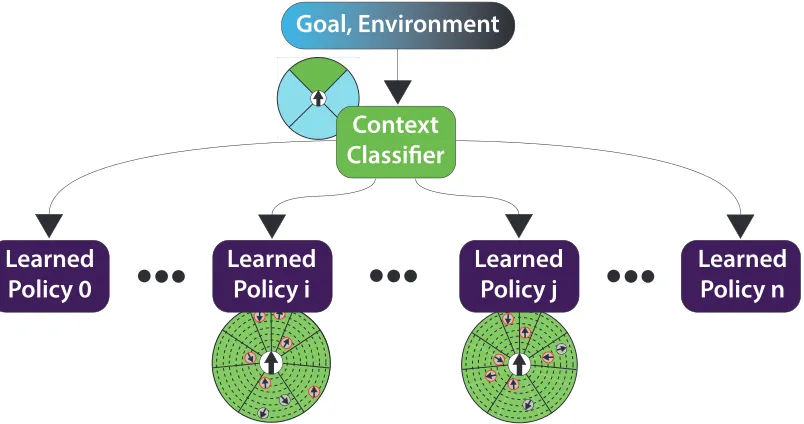
First, robust real-world data is logistically difficult to accurately collect and filled with unknown variables, such as a person's mental state, which change behavior without providing a means to replicate their effects. Second, current data-driven approaches store and search the entire set of training data to decide the next course of action for each agent. A straightforward single-model system would alleviate the burden of storing and searching the data. The problem with a monolithic model, though, is that a single steering policy cannot handle all possible scenarios. To counter this we propose the splitting of possible scenarios into separable contexts, with each context in turn learning a model. The model used by an agent can then be dynamically swapped at runtime based on the evolving conditions around the agent. This results in a more scalable approach to data-driven simulation.
In lieu of tracked data from real pedestrians, we propose the use of an oracle steering algorithm. This algorithm stands in for real data and can be queried for a steering decision for any combination of factors. This allows us to more thoroughly explore the problem space as needed. Furthermore, we can control all variables and capture behavior from scenarios that are otherwise infeasible to adequately sample in reality. This synthetic source of training data allows for a scalable and structured approach to training machine-learned models which virtual agents can use to navigate at runtime.
Degree Type
Dissertation
Degree Name
Doctor of Philosophy (PhD)
Graduate Group
Computer and Information Science
First Advisor
Norman I. Badler
Subject Categories
Computer Sciences
STEERING CONTEXTS FOR AUTONOMOUS AGENTS USING SYNTHETIC DATA
Cory D. Boatright
A DISSERTATION
in
Computer and Information Science
Presented to the Faculties of the University of Pennsylvania in Partial
Fulfillment of the Requirements for the Degree of Doctor of Philosophy
Supervisor of Dissertation
Norman I. Badler, Professor,
Computer and Information Science
Graduate Group Chairperson
Lyle Ungar, Professor,
Computer and Information Science
Dissertation Committee
Petros Faloutsos, Associate Professor, York University
(External Committee Member)
Ladislav Kavan, Assistant Professor, Computer and Information Science
Stephen H. Lane,
Associate Professor of Practice, Computer and Information Science
STEERING CONTEXTS FOR AUTONOMOUS AGENTS USING SYNTHETIC DATA
COPYRIGHT
To my grandfathers, Howard D. Boatright and James C. Kuntz, and my cousin Ryan
C. Boatright who unexpectedly joined them far too young. They did not see me finish
my education in Person, but I know they are watching in Spirit.
Acknowledgements
While it’s common to thank “all the little people” who contributed in our
accom-plishments, but I would like to thank two by name. Kimberly Detwiler sat next to
me in Intro to Comp Sci so many years ago and her request for help kicked off my
interest in teaching. Costel Ionita was the first to tell me getting a PhD is notthat
big a deal and that I should consider it, even though he’d just found me skipping his
Calc III class. Looking back, there’s a fair chance he got the last laugh on that one.
These two people inadvertently started the ripples that would lead to this day.
Once the ripples started, I have Oberta Slotterbeck and Ellen Walker from Hiram
College to thank for pushing me to the University of Pennsylvania, and my advisor
Norm Badler to thank for taking a chance and pulling me in. I have often thought
he lost the GRE page of my application. His humble approach to mentoring a young
wannabe professor was often exactly what I needed. While at UPenn I’ve been the
beneficiary of support from many amazing people: Aline Normoyle, Amy Calhoun,
Ben Sunshine-Hill, and Chris Czyzewicz to name a few in particular. I also have major
appreciation for Jennie Shapira’s assistance. She and I would agree Icouldhave done
all this without her, but it would not have been anywhere near as fun. She made all
the figures in this dissertation that required more effort than hitting “prt sc” which
is where my illustrative abilities abruptly end.
Finally my family’s unwavering support has been a blessing on which I can always
depend. My Mom, Dad, and sisters Cari and Dayna, who have supported me my
whole life in all of my endeavors, even when they didn’t really understand them.
Of course I’ve saved the best for last, my wife Dr. Kaitlyn Boatright. She has seen
me at my best, got me through my worst, and never had trouble with believing in
me…something I cannot claim of myself. Thanks, princess.
ABSTRACT
STEERING CONTEXTS FOR AUTONOMOUS AGENTS USING SYNTHETIC DATA
Cory D. Boatright
Norman I. Badler
Data-driven techniques have become synonymous with replication of real-world
phe-nomena. Efforts have been underway to use these techniques in crowd simulation
through a mapping of pedestrian trajectories onto virtual agents using a similarity of
circumstance. These works have exposed two fundamental issues with data-driven
crowds.
First, robust real-world data is logistically difficult to accurately collect and filled
with unknown variables, such as a person’s mental state, which change behavior
without providing a means to replicate their effects. Second, current data-driven
ap-proaches store and search the entire set of training data to decide the next course of
action for each agent. A straightforward single-model system would alleviate the
bur-den of storing and searching the data. The problem with a monolithic model, though,
is that a single steering policy cannot handle all possible scenarios. To counter this
we propose the splitting of possible scenarios into separable contexts, with each
con-text in turn learning a model. The model used by an agent can then be dynamically
swapped at runtime based on the evolving conditions around the agent. This results
in a more scalable approach to data-driven simulation.
In lieu of tracked data from real pedestrians, we propose the use of an oracle
steering algorithm. This algorithm stands in for real data and can be queried for a
steering decision for any combination of factors. This allows us to more thoroughly
explore the problem space as needed. Furthermore, we can control all variables and
capture behavior from scenarios that are otherwise infeasible to adequately sample in
reality. This synthetic source of training data allows for a scalable and structured
ap-proach to training machine-learned models which virtual agents can use to navigate
at runtime.
Contents
Acknowledgements iv
Abstract vi
Contents viii
List of Tables xii
List of Figures xiii
List of Algorithms xv
Introduction
. Population Versus Realism . . . .
. Machine Learning as Precomputation . . . .
. Data Sources . . . .
. Context-Sensitive Steering . . . .
. Dissertation Structure . . . .
Related Work
. Agent Steering and Collision Avoidance . . . .
. Crowd Evaluation . . . .
. Data-Driven Systems . . . .
. . Best-Match Search . . . .
. . Regression on Similar Data . . . .
. A New Machine-Learned Approach . . . .
Steering Contexts
. Terminology . . . .
. Decomposition of Scenario Space . . . .
. . Computational Impacts . . . .
. . Context Approximation . . . .
. Context Identification . . . .
. . Intuitively Derived Contexts . . . .
Synthetic Data
. Nature of Real-World Data . . . .
. . Collection Techniques . . . .
. . Processing Data . . . .
. . Noise in the Data . . . .
. Algorithmic Alternative . . . .
. . Stochastic Scenario Generation . . . .
. . Oracle Algorithm . . . .
. . Data Collection . . . .
Initial Application
. Framework . . . .
. Initial Machine Learning . . . .
. . Feature Spaces . . . .
. . Runtime . . . .
. Performance . . . .
. . Classifier Accuracy . . . .
. . Frames per Second . . . .
. . Qualitative Analysis . . . .
. Summary of Performance . . . .
Refinements Through Data Mining
. Context Identification . . . .
. . Unsupervised Learning Algorithms . . . .
. . Principal Component Analysis . . . .
. . Evaluating Cluster Results . . . .
. Generating Policies for Contexts . . . .
. . Application of a Mixture of Experts . . . .
. . Feature Space . . . .
. . Action Space . . . .
. . Classification Algorithms Used . . . .
. . Evaluation Metrics . . . .
. Experiments and Results . . . .
. . Clustering Contexts . . . .
. . Policies for Clustered Contexts . . . .
Improved Application
. Oracle Improvement . . . .
. . Collisions . . . .
. . Action Space . . . .
. Classification Improvements . . . .
. . Context Classifier . . . .
. . Specialized Classifiers . . . .
. . Model Interface . . . .
. . Emergency Stop Action . . . .
. Performance . . . .
. . Frames per Second . . . .
. . Policy Use . . . .
. . Qualitative Analysis . . . .
Conclusions and Future Work
. Conclusions . . . .
. . Strengths . . . .
. . Limitations . . . .
. . Suggested Uses . . . .
. Future Work . . . .
. . Further Oracle Improvements . . . .
. . Failure-Based Context Generation . . . .
. . Purpose-Dependent Context Sets . . . .
A Original Context ID Numbers
B Details of the Final Oracle Planner
B. Basis . . . .
B. Domain-Specific Considerations . . . .
B. Algorithm Alterations . . . .
Bibliography
List of Tables
. Parameters for Defining Contexts . . . .
. Oracle vs. Model Time . . . .
. Clustering on Original Data . . . .
. Clustering on PCA Data . . . .
. Percent Incorrect . . . .
. Weighted F-measure . . . .
. Weighted MCC . . . .
. Cluster Centroids (No Obstacles) . . . .
. Cluster Centroids (With Obstacles) . . . .
. Algorithm-Policy Pairing . . . .
. New Oracle and Decision Tree Baseline . . . .
List of Figures
. Common Artificial Scenario . . . .
. Steering Contexts’ Virtual Environment . . . .
. Context Feature Space . . . .
. Context Examples . . . .
. Regions for Scenario Generation . . . .
. Our Framework . . . .
. Multi-level Model . . . .
. Feature Spaces . . . .
. Classifier Error Rates . . . .
. Steering Time for Agent Count . . . .
. Rendering at Runtime . . . .
. Collision Counts . . . .
. Steering Time for Agent Populations . . . .
. Randomized Scenario . . . .
. Per-Agent Decision Times . . . .
. Urban Scenario . . . .
. Hallway Scenario . . . .
. Hierarchical Model Usage . . . .
. Lane-Forming . . . .
. Orbiting Agent . . . .
List of Algorithms
Oracle Planner . . . .
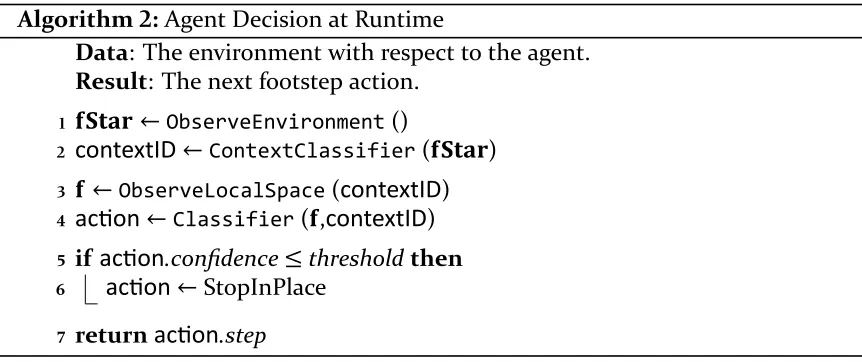
Agent Decision at Runtime . . . .
Chapter
Introduction
And so it begins…
Gandalf the White
Simulations of pedestrian behavior range from “multiagent simulations” of a few
people to “crowd simulation” with thousands to millions of virtual agents all vying
for system resources. This pressure on compute power creates a tense battle between
the scale of the simulation and the algorithms needed to display acceptably realistic
behavior. As the number of agents increases, the algorithms must be leaner in their
resource use to accommodate the population. Adding to the challenge, more robust
steering algorithms require the agent to be capable of handling an increasing number
of possible situations. In this dissertation we explore our hypothesis that appropriate
machine learning techniques can address the problem of crowd steering while also
mitigating scalability problems and leveraging the realism benefits of empirical,
.
Population Versus Realism
Two dominant forces continuously push the development of crowd simulation.
Both of these factors are manifest through a problem of scalability. When we
ordi-narily think of scale, we think of the number of inputs to a system. However with a
goal as complex as crowd simulation, we must also consider scale with respect to the
possible behaviors produced by the artificial intelligence.
The first force is the count of agents in the simulated scene. We want and need
to simulate ever-higher numbers of simulated humans. With larger populations, we
can simulate more complex scenarios and move towards duplicating the crowding
phenomena of the real world and what we witness in day-to-day life. Modeling more
agents strains against the available processing power of a single machine, as each
agent requires processor time to make navigation decisions and to avoid collisions to
ensure that, just as in reality, the population as a whole moves to its target
configu-ration without agents striking one another.
The second force is realism. The practice of simulating large numbers of humans
is not complete with just the existence of a massive population. Each member of
that population, a priori, is expected to navigate in a manner consistent with our
intuition of human action such as through use of individualized strategies or
poli-cies that lead to some goal or destination. In short, typical steering challenges do
not cause confusion in a human, and thus a simulated person should be capable of
appropriately handling the same challenges. Creating computational solutions for
such a complex system often rely on ad hoc mathematical models or preconceived
designer intuitions. Both generalizations may be lacking in correctness and require
scalable, efficient algorithms to be effective on typically tight runtime and hardware
needed to replicate plausible human behavior in order to allow more people to be
simulated within the targeted, often real-time , framerate.
.
Machine Learning as Precomputation
To properly extend the science of crowd simulation we need an efficient, scalable
strategy for steering given a virtual environment. Cognitive algorithms have shown
promise, but ultimately suffer from a combinatorial explosion of the possible factors
contributing to the decision-making process. Rather than striving to replicate the
true thought processes of a human and subsequently devoting resources to carry out
these thoughts for every agent in the simulation, we instead model input stimuli
and observe the decision-making which uses these stimuli. While human factors
such as personality and emotional factors likely influence results, we can set those
variations aside in favor of explicitly computable navigation directives. In essence
we treat cognition as a “black box” such that external influences are input, decisions
are the output, and the mechanics behind producing those decisions only matters
insofar that the decisions are reasonable upon inspection. Thus we abstract away
the complexities of a true-to-life thought process.
Precalculating information for caching and future lookup helps improve the speed
of many algorithms by reducing the amount of computation required at runtime by
replacing it with a lookup to the cached results. In this spirit, data-driven tools have
been demonstrated which select proper behavior via a best-match search against a
database of samples. These samples serve as a surrogate for past experience which
can be consulted when a similar situation arises. However, these techniques suffer
from scalability issues of their own. The phrase “throw more data at it” cannot handle
action space since unobserved behavior cannot be represented by the system.
Fur-ther complicating matters, numerous scenarios can have different actions because of
factors not accounted for by the current feature space in use by the agents. Expanding
the feature space creates an arms race between possible outcomes and unique
com-binations of features, ultimately making generalization impractical without machine
learning algorithms.
With machine learning, general models can be fit rather than using all data for
a best-first match. Learning fits hyperplanes and other hypersurfaces around the
data with three key advantages. First, the model itself can be saved and loaded into
memory rather than the full collection of samples. This can drastically reduce the
size of the memory footprint. Second, the trained models can be executed faster
than an extensive database can be searched. Finally, the machine-learned models
allow predictions in novel situations where the input is only approximate compared
to samples acquired during observation. Generating these models are not without
its challenges. We gain these benefits but still have an issue of generalization versus
memorization, where the algorithm overtrains to the data. We break apart the
prob-lem space into what we have named “steering contexts.” These steering contexts can
allow the training of smaller models on more manageable amounts of data.
.
Data Sources
To create the best models, training samples should be of the highest possible
quality. Tracked trajectories of real-world pedestrians have thus far been the gold
standard of training examples, however this type of data is logistically challenging
to collect, likely incomplete with respect to behavior coverage, and at times simply
In naïve pedestrian observation, discrete cameras are placed to record an unaware
population. While those seen in the recordings are not affected by the observation,
uncommon scenarios may never be encountered and factors unanticipated and
unac-counted for by the researchers may lead to hidden influences. For instance, a person’s
navigational goal may change due to meeting a friend on the street, receiving a phone
call, or reacting to an event outside of the camera’s view.
Another option for data collection is to gather volunteers and take direct control
through the assignment of starting positions and end goals. Unlike the naïve case
detailed above, the artificial nature of the scenario leads to the observer effect and
thus calls into question the resulting behavior of participants. In particular we must
question if we are seeing truly natural behavior, or instead what the participantsthink
should be natural.
With the advances made in crowd simulation over the past decades, we find at our
disposal numerous software systems which have been published as suitable
repre-sentations of human behavior while steering through crowded environments. These
artificial humans provide us with a powerful opportunity. The computer agents do
not care—or know—if they are being observed yet can be given any start and goal
configuration needed. These virtual agents’ behavior can be used to supply data to
in turn generate training data for machine learning algorithms.
.
Context-Sensitive Steering
This dissertation explores the next push forward in multiagent steering by
ad-dressing each of the following issues.
• Scalability, both in the space of possible situations and in the number of agents.
• Finding reliable training data.
We have developed a framework which uses a novel context-sensitive approach to
create a collection of machine-learned models for multiagent steering. This process
starts with a slow, offline algorithm and produces a faster algorithm based on the
slower algorithm’s results. The workflow consists of the following steps.
. An algorithm derived from Iterative Deepening A⋆ (IDA⋆), which we call our
oracle algorithm, is used to create a nearly optimal plan for stochastically
gen-erated simulations.
. The recorded simulations are grouped into steering contexts and mined for
training samples.
. Models are fit to the data for each steering context, and an additional model is
used to dynamically switch between models as the situation merits.
. At runtime the agent uses the model matched to its current situation to choose
its next action .
.
Dissertation Structure
Chapter surveys the literature most pertinent to this work. We then define
steering contexts and our initial set of intuitively-defined contexts in Chapter .
Sub-sequently, Chapter begins the detailed explanation of this dissertation’s use of
syn-thetically generated data to stochastically sample scenarios from each context. With
contexts defined, a pipeline which uses this context-sensitive technique to steering is
detailed in Chapter along with a preliminary implementation of the pipeline. We
learning in Chapter , which includes both the introduction of clustering to define
contexts and an analysis of various classification algorithms. An adjusted
implemen-tation of the pipeline which takes these improvements into account is presented in
Chapter . We conclude and speculate upon future avenues of research based on the
framework established by this dissertation in Chapter .
Notes
A minimum of frames per second, or ms per frame. An interactive framerate is
approxi-mately frames per second, or ms per frame.
In this dissertation all agents share the same model, however the models could theoretically vary
Chapter
Related Work
If I have seen further it is only by
standing on the shoulders of giants.
Isaac Newton
Crowd simulation is a well-developed field of research with several focus areas.
Of particular interest to this dissertation are those of agent steering and evaluation
of the generated crowd with respect to real-world fidelity. A general overview of
some key milestones in the field is given in Sections . and Section . . Additional,
broader surveys of steering and behavior can be found in [ , , ]. In Section
. we specifically focus on data-driven approaches which are more relevant to this
dissertation.
.
Agent Steering and Collision Avoidance
The most basic crowds model pedestrians walking from waypoint to waypoint in
the virtual world. They can appear to wander as they walk towards randomly assigned
how an individual selects its goals, how it creates its path to the goal, and how the
agent decides on actions when it encountered obstacles—and other agents—along
its path. An agent needs a technique for selecting goals to give them a destination
for walking. This can be done stochastically [ ], through utility functions which can
give the agent needs [ ], or can simply be hardcoded as experimental arrangements
[ , ]. The path an agent will follow can be generated in a myriad of ways ranging
from geometrically-oriented [ ], to flow-based [ , ], and to cognitively-driven
[ ] algorithms. Once decided, the agents’ paths are not necessarily guaranteed to
be safe, as previously unknown obstacles may be discovered which invalidate the
plan. Other agents may also move into the path and thus invalidate it. Adjusting for
these new environmental constraints adds to the overall complexity and apparent
randomness of the scene.
Crowd simulation was launched with the seminal work of Reynolds [ ] on
an-imating grouped movement behaviors of collections of agents. He focused on
pop-ulations of animals, especially birds, to drive a particle-system approach to crowd
simulation. His “boids” paved the way for studying the group dynamics of human
crowds and animating substantial populations of interacting agents. This rule-based
approach also serves as one of the first examples of emergent behaviors, which are
characteristics of a simulation that are a result of agents’ individual decision-making
but has the appearance of higher-level coordination. Boids may fly in a common path
but each agent is not consciously trying to create an ordered flock. This work was
followed by [ ] where human maneuvering was defined. These definitions led to
boids with more natural behavior in a pedestrian simulation by providing building
blocks for more complex behaviors, but the complex behaviors are not emergent and
instead identified by the programmer at design-time.
other research has focused almost exclusively on collision avoidance during a
sim-ulation through purely geometric solutions. Velocity obstacles [ ] are a common
approach that look at velocity-space for potential collisions and avoid them by
navi-gating around the troublesome velocities themselves. This allows an agent to reduce
or increase their speed in advance of a collision and make other natural adjustments.
A drawback to this approach is oscillation inherent in each agent constantly
adjust-ing to the other agents’ adjustments. By changadjust-ing one’s speed, the velocity obstacle
changes which leads to a different viable solution. The technique was improved upon
by [ ] to create reciprocal velocity obstacles (RVO) which extended agent
consider-ations to that of the colliding agents’ response. This alleviated most of the oscillation
problems associated with the original method but at the cost of making true—but
poorly justified—assumptions in their model. In the RVO algorithm, it is assumed
that an approaching agent is also using the RVO algorithm. While this is true in
a homogenous simulation and leads to orderly passing of one another in cramped
conditions, real life is not so symmetric. The ClearPath algorithm [ ] further
trans-forms velocity obstacles into a truncated cone and presents a highly parallel solution
supporting hundreds of thousands of agents in a matter of milliseconds, also with
a symmetric assumption. The environment has also been used to provide hints to
agents as to the behavior needed for better navigation, as seen in [ ].
Anticipating crowd densities and planning around them is the tactic used in the
work by Kapadia et al. [ ]. Their algorithm also adds some human factors
into consideration when planning an agent’s next steering decision. A coarser view
of the world exists further away from the agent, and a path through occupied space
is planned and refined as the agent gets closer to its goal. While a step forward, the
algorithm lacks a viewing frustum so obstacles all around the agent are always
person is surprised by an unanticipated obstacle suddenly entering their perception.
Such a startled reaction occurs because the new obstacle must be rapidly assessed
and accommodated for without the benefit of long-term planning. This work has
just recently been parallelized in [ ].
Until very recently, steering and collision avoidance algorithms have worked with
path-planning and with animation handled as a separate process. Singh et al.
pub-lished a new algorithm which considers actual footsteps when steering [ ]. This
not only supports a new level of realism in steering and collision avoidance but also
provides an improvement for the visualization of the simulation itself. Instead of
depending on potentially poorly matched or interpolated walk cycles the animation
can be derived for each footstep. This also allows for sidestepping during collision
avoidance, which is an almost universally overlooked strategy to resolving such a
problem.
Higher-level abstractions exist. Viewing crowds as a collection of people under
the effect of social forces is a common simplification that casts a crowd into a less
autonomous space as in [ , , , ]. In this area of the literature particle physics
is adapted to use social forces rather than natural forces like gravity [ ]. Each
par-ticipant in the simulation is treated as a particle subject to these forces and moved
accordingly with each time step. The crowd becomes a unified organism with no
individual drives, making specific breakout characters harder to motivate and inject
into the simulation without partially abandoning the very assumption made by the
underlying rules of the simulation. For instance, [ ] allowed for agents to trip and
fall and thus become static obstacles for others to navigate around, but the falling
itself is a factor of the forces on the agent, not an individual trigger. Note that while
any algorithm can have special events of this nature permitted through the use of
the algorithm. Each special case adds to the complexity not only from its own
exis-tence, but how other agents will need to handle the agents in the “special” condition.
Pelechano et al. handled this well by treating fallen agents as static obstacles.
Cognitive modeling aims to provide more “human-like” responses to perceptual
input. Cognitive modeling is often considered with respect to high-level thinking
such as goal selection [ , ] but also exists for basic steering and navigation. In the
work of Ondřej et al. [ ], synthetic vision is used to grant agents the ability to
navigate their environment using human-like anticipation of impending collisions.
Agents visualize fields corresponding to the rate of change for other agents’ bearings
and use these fields to calculate a time-to-intersection. Adjustments to an agent’s
velocity only takes place when a collision is likely and imminent, much like human
behavior. This framework is highly parallelizable and included the use of GPU
pro-gramming for higher throughput, allowing agents to be simulated in real time
at the time of publication. More cognition-oriented features such as personality [ ]
add to the randomness experienced in a scene as different personalities tune
low-level parameters to adjust how an agent moves.
.
Crowd Evaluation
To be used as a scientifically valid experimental framework, a crowd simulation
needs to be evaluated for correctness. A properly vetted simulation can be used in
training simulations requiring crowds of people and provide a higher sense of
pres-ence to the subjects. The crowd must behave naturally to not draw undue attention
from what the trainer intends to be important. The problem then is how to define
natural behavior and quantify deviation from it.
Re-Figure 2.1: A common stress-test scenario for steering algorithms. While it will test the collision-avoidance of an algorithm and force a densely-packed scene, the situ-a on itself is completely situ-ar ficisitu-al. Opposing situ-agents, illustrsitu-ated here with the ssitu-ame
color, have the goal of swapping posi ons.
searchers and reviewers must decide whether or not a system appears to recreate
plausible human behavior in test scenarios. A general “ground truth” is unlikely to
exist because of the number of uncontrollable variables to human behavior. In fact,
humans do not even always act rationally; we make real mistakes and these mistakes
would have to be accounted for by the performance metric used. This high-variance
nature of human activity aside, one of the other main problems with subjective
anal-ysis of crowd simulations is that many of the most popular test scenarios are artificial
examples. A classic scenario is that seen in Figure . . Most subjective evaluation
fo-cuses on emergent behaviors as proof of recreating real behavior. Lane formation,
the organization of the crowd into polarized lines of agents, is one of the most
com-monly sought emergent behaviors in crowd navigation literature but in the extreme
can create degenerate behavior through strict rules forcing pedestrians to one side of
Lerner et al. used a data-driven evaluation algorithm in [ ]. A database is
con-structed from manually tracked video of an intersection with sparse crowding and a
walkway with dense crowding. This database is used to compare examples from the
real world with agent states in the simulation using database queries. A metric from
– is given to each agent based on how closely it matches normal behavior as
de-fined by that behavior present in the database. Actual queries are formulated based
on a density metric. Significantly low ratings can automatically indicate what the
authors have deemed “curious” behavior, such as a person walking towards a cluster
or odd evasive maneuvers.
The drawbacks of this early quantitative measurement is that anomalous
behav-ior is dictated by the sample video used for comparison without any considerations
for why the anomalous behavior exists. Furthermore, only densities are taken into
account which is a very transient feature. Random wandering with the right random
densities will pass the test. Most of these problems were alleviated in [ ], where
long-term decision metrics were introduced along with with the addition of
proxim-ity and flocking components to the metrics. A drawback of the system is that the
flocking behavior requires a flocking video input for analysis; it is not automatically
generated. Furthermore, the determination of what is natural and what is not
de-pends only on the trajectories witnessed in the training videos. A similar data-driven
approach is used as a component of [ ], with the main difference being that input
data is pulled using very specific tracking of known persons with known goals.
Some of the latest work has been from Kapadia et al. [ ]. Their work takes the
quantitative analysis a step further by also describing a state space for the scenarios
that steering algorithms can encounter. This space can then be sampled to derive
scenario sets to test a steering algorithm in a structured and rigorous fashion. Static
scenario generator and a run of the simulation is performed. Success or failure, due to
agent stalemate or actual collision, will give a representation for the types of scenarios
that a given algorithm is competent in handling and where it falls short. This work
is beneficial for multiple reasons. First, we now have a way to test algorithms in
a structured manner that does not rely solely on creating handmade scenarios to
target specific behaviors as previously mentioned with the circle-crossing scenario.
We can instead sample the scenario space using whatever strategy best analyzes the
algorithm. Second, there is a way to get a clear idea of the conditions that will cause
an algorithm to fail. Finally, it can be shown that no one algorithm can universally
solve all agent navigation problems. By having a good sense of a failing scenario
multiple algorithms can be used to create a more robust system.
.
Data-Driven Systems
Data-driven algorithms choose an agent’s next action by matching the current
environment against examplar scenarios. The data can be used directly by
best-match as seen in Section . . , or machine learning algorithms can be used with the
training data to create the final steering behaviors, such as Naïve Bayes in [ ] and
locally-weighted linear regression in Section . . . Computer vision has been used to
drive agents based on real-world data [ , ], which provides one of the best “gold
standards” for training data. Information theory [ ] has been used to analytically
manipulate characteristics of agent behavior based on global trends to better tune
overall behavior rather than relying on low-level agent-to-agent interactions. The
data used for a system can come from the designer or user in lieu of real-world
stud-ies. Recently, the idea of a crowd as flowing agents has been used with user-generated
another algorithm to create a database or annotating video feeds of street corners,
Patil et al. [ ] use a discretized world with either precalculated or hand-drawn
pref-erences for their agents to follow. Recent work [ ] uses discretized pieces of real-world
trajectories as the basis for navigation and manipulates these trajectories based on
the possibility of future collisions.
. .
Best-Match Search
One of the first data-driven pipelines [ ] for steering has been an inspiration for
our own. The authors manually tracked videos from an urban setting, and generated
examples to populate a database. This database can be very large as each person in
view can create one example in each frame of the video. At runtime, the example
database is then queried by each agent based on its surrounding influences. A
tra-jectory from the database best matching the situation is then returned and used by
the agent.
To best mimic the behavior of a real person, the influences of a real person need
to be modeled appropriately. The authors created a region of influence around an
agent. Any person and static obstacle in this field is registered as a factor in the
re-sulting trajectory. This brute-force approach creates an interesting, continuous state
space, but results in a heavy computational burden for finding the best match and
also requires maintaining the full collection of examples at runtime. Finally, as only
external influences are considered the internal state of mind for the person cannot
be a factor, which is detail that cannot be recovered from a video. We note that no
current technology could use such input to derive a computer model, which means
this is a problem inherent in the use of real-world data by its very nature. Ad hoc
decisions and interaction with entities not in view of the video can cause otherwise
motivat-ing phone call may be absent in the recreated behavior, causmotivat-ing a sharp trajectory
change with no obvious cause. Due to the burden of finding the best-match in a
continuous state space, runtimes were not generally favorable for interactive use as
frames of simulation with agents could be processed in minutes, while
agents required a full hour for simulation.
. .
Regression on Similar Data
Lee et al. [ ] provided an alternative to brute-force matching at about the same
time Lerner’s group proposed their pipeline. The approach was reproduced and
ex-tended by Torrens et al. [ ]. These works use multiple samples from a database to
construct better results at runtime. Instead of a direct copy-paste trajectory,
candi-date trajectories are merged via regression into a final steering selection. Most
im-portantly, discrete state spaces were used to handle the otherwise unlimited amount
of possible configurations of stimuli. Each agent populates a feature vector to access
a kd-tree of examples and extract the nearest neighbors.
Data found in the search is clustered by k-means into clusters to get a high-level
feel for the kinds of decisions available to the agent. For example, steering around
a wall may have a right and left possibility and these should be separated for the
regression step. Clusters are tested for suitability and the least fit is thrown out. A
winning cluster is chosen from the remaining two either at random or by strongly
favorable fitness to the current environment. This cluster selection is passed to the
regression phase. Locally-weighted regression is used to take the data and calibrate
.
A New Machine-Learned Approach
Currently, some of the most promising reproductions of human activity in crowd
simulations have been the results from data-driven engines. This is not surprising as
the data itself is an exact representation of human response to comparable stimuli.
However, these simulations have been held back by the computational overhead of
the very data they require. In particular, the works by Lerner and Torrens in
Sec-tion . relied on maintaining a full database of samples, which reduces scalability
over time as more information is collected and assimilated into the database. Part of
the scalability issue lies in data beginning to contradict other examples, which was
observed by Torrens et al. and relieved by the use of clustering. Small sampling of
behavior simulated according to [ ] was also tested as a basis for generating data.
Their pilot use of an artificial algorithm as a source of training data has motivated
our own work. Replication of the mechanical behavior of the source algorithm was
achieved, but this dissertation extends the concept by using a nearly-optimal
space-time algorithm as the source of our own training data. Optimal space-space-time planning
has been used in recent work [ , ] to produce solutions to complex navigational
situations, but is constrained to only a few agents because of the heavy computational
overhead.
This dissertation extends this idea of grouping otherwise contradictory data into
a key component of the steering pipeline. Another data-driven method seen in [ ]
focuses on capturing the dynamics of the overall crowd, while we focus on the
in-dividual agents. This dissertation also extends the work of Becket [ ] who
previ-ously showed a single-policy system is insufficient to cover general steering. Becket
used online learning techniques to adjust the agents’ behavior during the
for-malize the concept of a steering policy. We use a two-layer hierarchy as a
divide-and-conquer approach to the general steering problem, which is different from how
others have used hierarchies to iteratively refine the planning process [ ].
Hierar-chical machine learning has also seen use for other AI-based problem solving [ , ]
and in robotics [ ].
The potential of a data-driven approach in conjunction with the ideas of scenario
space in [ ] allow for stochastic sampling and coverage analysis of real versus
syn-thetic data. Scenario space also motivates the definition of an algorithm’s failure set
to characterize the type of scenario the algorithm is incapable of handling. We use
the complement of this idea in our work to better focus the machine learning we use
for simulation. Similar to Ahn et al. [ ] our basic algorithm [ , ] is not
Chapter
Steering Contexts
Our job is to remind us that there are
more contexts than the one that we’re
in—the one that we think is reality.
Alan Kay
In this chapter, we define the concept of a steering context. This similarity-based
grouping is performed to give a high-level perspective on the agents’ current
situ-ations. For an agent to properly steer, a policy is required for each context. While
these could be handwritten rulesets, achieving generality by identifying contexts and
creating their corresponding policies for each is a task which quickly becomes
work-bound. We use machine learning to offset this burden and automatically generate
models to serve as a policy for each context, which is further detailed in Chapter .
.
Terminology
We must first establish some terminology to serve as a basis for further
in a virtual environment. The space of all possible scenarios is referred to as
sce-nario space [ ] and denoted 𝕊. The high-dimensionality of scenario space makes
it inherently intractable to exhaustively precompute solutions for all scenarios, thus
requiring a more general model of steering behavior in the face of the diverse
possi-ble challenges. Each agent in a frame of simulation encounters its ownsituation𝑆
based on its local perspective. In essence a situation is a scenario transformed to a
local space with respect to a particular agent. Situations which are similar, based on
some quantitative metric, are grouped together to form asteering contextor more
succinctly context, 𝐶. Finally, a steering policy or simply policy is an approach
to finding a steering solution to a situation. Multiple policies may be present in an
overall algorithm to account for such things as special cases.
A key difference between our use of the term “context” and that of the related
lit-erature is we focus on the context as an egocentric concept. Each agent experiences
its own context. Previous works have instead treated context to mean the
charac-teristics of the group or entire population as a whole. While this better allows for a
centralized solution to the steering of many agents, such a treatment of contexts does
not take into account the fact that not all perspectives are the same in the simulation.
In a densely crowded hallway, for instance, one person attempting to walk against a
large crowd is experiencing a very different scenario than the others, even though
from a macroscopic perspective one could just refer to the hall as densely crowded.
.
Decomposition of Scenario Space
We propose breaking the space of all possible scenarios, and by their related
def-inition all possible situations, into more manageable groupings. This is possible by
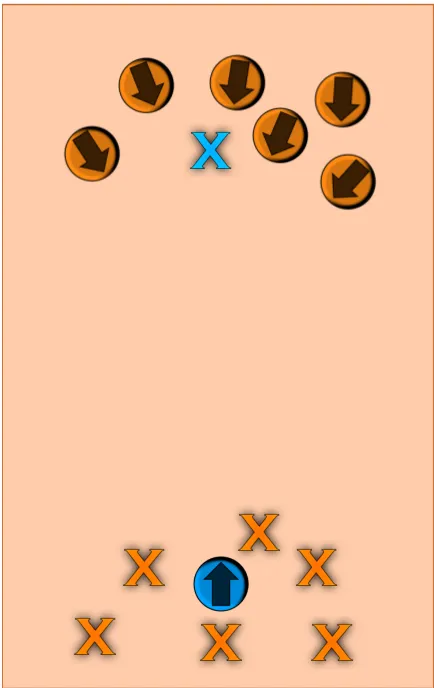
Figure 3.1: An illustra ve example of steering contexts and situa ons. This bird’s-eye view of the scene represents the scenario, which consists of one group of agents which must pass a single agent. The blue agent, however, only sees the scene as a situa on where it must pass a group of other agents. The orange agents see the situa on where they only have one agent moving towards them. Similar situa ons
context spaceℂis a projection of𝕊onto the coordinate system of𝐅∗. As a result of
the projection from 𝕊to ℂ qualitatively similar scenarios will be mapped relatively
closely compared to scenarios showing less similarity. Specific features from𝐅∗thus
become axes for a high-dimensional space, which allows values of the features to be
used for classification. While potentially high, the number of features used can be
smaller than the total number used for defining all scenarios and thus the overall
dimensionality advantageously decreases.
Context space can be split along features’ values to form a classification of
spe-cific contexts. Steering contexts could also be derived from the features of𝕊but the
“curse of dimensionality” [ ] makes the process much more difficult as even similar
situations are increasingly sparse as the number of dimensions increases, limiting the
usefulness of grouping situations quantitatively. Similar situations should be
man-ageable with a similar approach, motivating our identification and use of a collection
of policies to handle subsets of situations rather than confronting the general steering
problem with a single-policy approach.
Formally then, an individual context 𝐶 ⊆ ℂis defined in Equation . with
re-spect to the success of steering policy𝑖in handling a group of situations. A policy is
successful if it can produce a valid action from the provided action space 𝔸for the
situation, which is one where a collision does not occur and the overall situation
pro-gresses towards its final frame. This in theory permits some agents to stop moving
in some situations provided the result is other agents continue to move, which could
be seen in a scenario involving two agents approaching a narrow doorway which
re-quires one to yield to the other.
Thus a simulation can be considered a sequence of situations and actions with
some transition function𝛿 (𝑆, 𝑎)moving from one situation to the next. Since a
the overall environment can change the agent’s situation even if they are a passive,
stationary participant. Two situations can be considered equal if the agents,
obsta-cles, and goal are all in the same location and orientation, and we denote the set of
all previous situations as𝑆 . Past situations need to be prevented as they will induce
a cycle into the agent’s behavior. It is not sufficient to only ensure that𝛿 (𝑆, 𝑎) ≠ 𝑆
as simple oscillation would meet the criteria but not lead to the agent reaching its
goal.
𝐶 = 𝑆 ∈ ℂ | ∃𝑎 ∶ ⟨𝐟, 𝑎⟩ , 𝐟 ∈ 𝐅 , 𝑎 ∈ 𝔸, 𝑆 ∉ 𝑆 ( . )
A situation is guaranteed membership in at least one context because in the worst
case, it could have a special-case policy defined for it. Additionally, the steering
pol-icy is an analog for the transition function 𝛿, which allows the objective of policy
creation to be framed as one of finding the appropriate function. A main application
of machine learning is fitting functions, making the technique especially suitable for
automating the derivation of specific policies for each context. Note it is also
per-missible for a situation to be a valid member of multiple contexts, as several policies
may produce valid actions for the same situation.
. .
Computational Impacts
We have used the concept of scenario space to initially frame the concept of
steer-ing contexts, but we can also use the contexts to redefine scenario space in terms of
a union of sets, seen in Equation . . This alternative definition yields important
insight into not only the data-driven process of this dissertation but also the
pur-suit of any generalized steering algorithm. The general applicability stems from the
with different approaches, such as activating more costly collision avoidance in the
presence of other agents, exists as a collection of policies and thus contexts.
𝕊 = 𝐶 ( . )
The set definition of 𝕊 presents contexts as equivalence classes of all possible
situations. Since they are equivalence classes, by necessity an equivalence relation
must exist. Such a relation exposes another function-based aspect of steering
con-texts, and again motivates the use of machine learning. By fitting a function for the
equivalence relation, we can attempt to classify a situation’s context. An equivalence
relation should partition scenario space into disjoint subsets, but recall we stated in
Section . that multiple policies could be viable for a situation. This can be trivially
remedied by picking an arbitrary candidate context for the scenario to be a member.
Steering algorithms all view the virtual environment in terms of its features in
some space, and thus strive to identify and handle contexts. Due to the fundamental
set theory nature of situations and contexts two very desirable aspects of formulating
a generalized steering algorithm, optimality and coverage, are difficult to confirm.
Both of these are𝒩𝒫-Complete set problems [ ].
Optimal Contexts
The ultimate challenge to a steering algorithm is to handle any situation in the
best possible way. To achieve such a goal, a steering algorithm needs to handle every
situation by the policy best suited to it. In this case, the underlying contexts
theoret-ically need to partition scenario space according to optimal contexts. As Equation .
allows for situations to exist in multiple contexts, one would need to select only those
The problem then is one where the input is a collection of subsets for some
mas-ter set, and task is the selection of those subsets which partition the full set. This
is a direct application of the exact cover problem, one of the classic 𝒩𝒫-Complete
problems.
Number of Contexts
With optimality of context selection out of computational reach, the next
analyt-ical question we would want to know is how many contexts are necessary for full
cov-erage of scenario space. Full covcov-erage means that all situations are handled, which as
previously mentioned could be done with a situation-per-context approach although
not in a practical manner. We only care that all situations are dealt with, not that
they are optimally solved.
However, finding the minimum number of contexts, and thus the minimum
num-ber of policies, is also 𝒩𝒫-Complete. The problem consists of selecting the
mini-mum number of subsets from a collection such that all elements of the full set are
represented at least once. This is a direct application of the set cover problem.
. .
Context Approximation
Although steering contexts yield disappointing conclusions for optimality, these
same conclusions are applicable to any steering algorithm consisting of multiple
poli-cies. A specifically context-cognizant approach to steering still has the advantage of
better structure and scalability. Furthermore, by using a suite of data-driven
tech-niques we can strive to approximate the underlying context space. This more
pur-poseful exploration of all possible situations opens the door for more strategic
devel-opment of algorithms, while also creating a framework which is more modular and
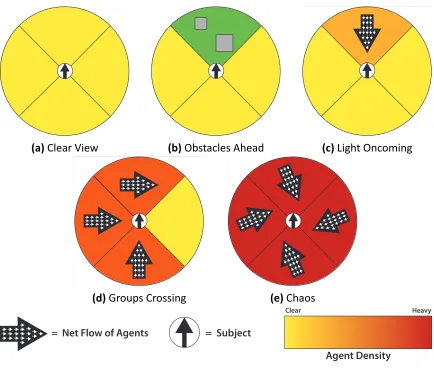
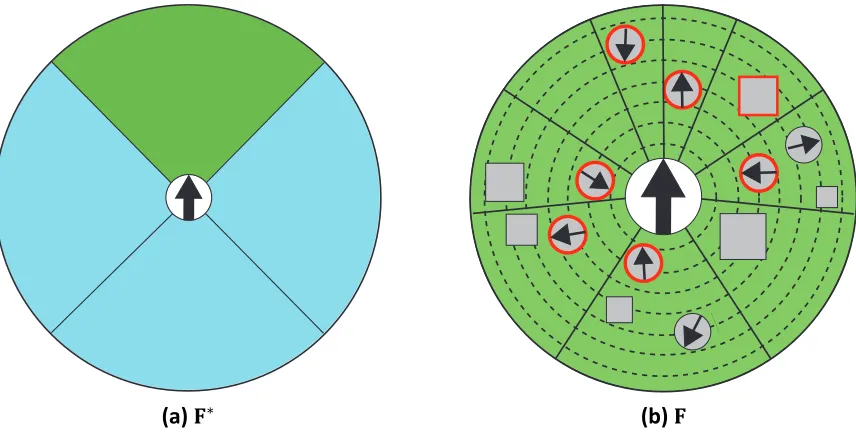
Figure 3.2: 𝐅∗for our set of contexts. The region ahead of the agent checks for the presence of obstacles. All four regions track the density of nearby agents as well as
the general flow of traffic.
necessarily affecting the rest.
.
Context Identification
We divide the possible scenarios by qualitatively different pedestrian traffic
pat-terns inspired by those observed in real pedestrians. Another strategy would use
un-supervised machine learning to cluster the scenarios. Our objective then would be to
approximate contexts based on computable separability rather than human-centric
qualitative differences. This alternative approach is explored in detail in Chapter .
. .
Intuitively Derived Contexts
For our first set of contexts we selected typical traffic patterns seen in pedestrian
activity. A feature space visualized in Figure . was also developed to characterize
these patterns . This space’s origin is locked on the particular agent currently
sec-tions, one for each cardinal direction. Furthermore each section tracks three pieces
of data: the density of neighbors in that area as well as their general velocity relative
to the agent’s own movement divided into heading and speed. The northern section
also acknowledges the presence of static obstacles in the scene. This gives us a total
of dimensions for𝐅∗.
There are four primary types of steering context in this set based on traffic pattern.
Clear
Very sparse neighbors, the agent is predominantly free to move.
Oncoming
Nearby neighbors are generally moving towards the agent from the forward
direction.
Crossing
Nearby neighbors are moving perpendicular to the agent’s own path. This could
be from the agent’s left or right side.
Chaos
Very dense neighbors with no obvious pattern to their movement with respect
to the agent.
Additionally, multiple divisions of Oncoming and Crossing are defined. These
subdivisions take into account the density of the scenario including neighbors
travel-ing along with the agent rather than just those caustravel-ing potential steertravel-ing challenges.
Light
Medium
– agents total in the scenario’s environment. A “noise” agent not fitting the
traffic pattern is permitted to promote generalization.
Heavy
– agents total in the scenario’s environment. Depending on the total
popu-lation, – “noise” agents are permitted.
Group
Scenarios where two groups of approximately equal size are navigating the
en-vironment, with the agent part of one of the groups.
Winning-Side
The mirrored scenarios compared toMediumandHeavy. The agent is a member
of the large group in the environment rather than in the minority.
In total, these variations provide us with steering contexts, which are assigned
numerical IDs in this dissertation. The full matching of IDs to context definitions
is provided in Appendix A. Duplicate contexts with the added presence of static
obstacles raise the total to . Examples of the contexts from this section and how
they are represented in the feature space are provided in Figure . with a full index
in Table . .
Notes
The symmetry of this space is a convenience for prototyping a proof-of-concept. Any other
(a)Clear View (b)Obstacles Ahead (c)Light Oncoming
(d)Groups Crossing (e)Chaos
= Net Flow of Agents = Subject
Clear Heavy
Agent Density
(f)Symbols Key
Figure 3.3:Examples from our set of contexts. Net flow is represented by the arrow in each region, density of the region is depicted by darker shades of red, and obstacles are gray boxes. Each of these contexts was stochas cally generated with overlap in the permissible values for density. Chaos was generated randomly without regard to
Chapter
Synthetic Data
Ours may be the last generation that
can see a difference between real and
virtual things.
Norman I. Badler
In this chapter we explore some of the sources for training data available to crowd
simulation. Real-world data is a commonly used source when using data-driven
techniques, but collecting that data has challenges, which we discuss. Regardless
of whether or not the pedestrians know they are being observed the subsequent
re-sults are likely flawed. In contrast, we use synthetic data in an attempt to mitigate
those flaws.
.
Nature of Real-World Data
Real-world data is limited in efficacy due to “noise” in observations as well as the
. .
Collection Techniques
While the specifics of real-world observations vary widely, ultimately such
exper-iments fall in one of two categories based on the awareness of the pedestrians that
surveillance is occurring. Ultimately these two options available to researchers create
a need to compromise between the results’ robustness and its accuracy.
Overt Data Collection
Possibly the most direct way to observe pedestrian behavior is to have volunteers
“solve” situations presented by an experimenter. The key benefit to being overt with
data collection is the essentially complete control researchers have over the
circum-stances. Scenarios key to the intended purpose of the simulation can be replicated
for the participants, complete with obstacles arranged and other participants given
specific targets to create the necessary situation. Thus over time a more robust set of
data can be compiled with common situations including queuing, groups of
pedestri-ans crossing, and groups of pedestripedestri-ans passing each other. Additional consideration
can be given to the sensors used to collect the data itself such as unique clothing for
each individual or other features to enhance tracking of a particular pedestrian over
time.
Such an approach to observing pedestrian behavior is not without its limitations.
The participants in these experiments are particularly vulnerable to the observer
ef-fect. They can become self-conscious about their own behavior, being more careful
to exhibit what they think is the expected result. The net result of this effect is a
reduced accuracy provided by the observations. There is also a great amount of
over-head in adding new data to the set. Volunteers must be found and coordinated, a
for the participants. This overhead is not only prohibitive for adding new scenarios,
but even repeating previous scenarios. Such repetition is scientifically desired for
re-ducing bias and confirming previous results. While the overhead is unfortunate and
inconvenient, the impacts are secondary to the inherent tradeoff of reduced accuracy
in favor of robustness.
Covert Data Collection
Pedestrians are not difficult to locate; people walk along streets and through
stores all the time. Security cameras already monitor these pedestrians with minimal
intrusion and people have acclimated to these recordings taking place. Researchers
can gather data from these low-impact views to collect very accurate data. In
ad-dition to existing monitoring systems, researchers have set up video surveillance in
targeted locations to observe different types of crowds. Since there is no direct
inter-vention on the part of researchers, this technique offers low overhead for the initial
data collection, as the camera simply needs to record the location even without the
researchers present.
While more accurate in terms of natural responses to stimuli, the lack of control
offered by such a covert system reduces the robustness of the resulting data. We are
restricted only to behavior which coincidentally takes place, diminishing the
likeli-hood of a variety of observations. In particular those situations which could be more
important from a simulation standpoint, such as a building evacuation, may never
be witnessed in the time window provided to the researcher.
. .
Processing Data
Regardless of method, the data must be processed into a form suitable for
factors affecting their actions. Algorithms have been shown [ ] that are capable of
automating this process but they are imperfect. For example, the algorithms may be
unable to differentiate between a person and their reflection in a specular surface,
leading to overlapping routes and conflicting data.
Manually tracking of the data is a common solution, but suffers from scalability.
When data is collected overtly smaller groups are used, making the task tedious but
within the capability of a single person. Busy urban areas, however, lead to more
demand on the observer to account for large numbers of individuals as missing any
is not only a lost trajectory for the database, but also a missing influence on others’
actions. Multiple observers can be used to reduce an individual’s workload, but there
remains a fundamental disconnect between the data and its origins in a recording.
. .
Noise in the Data
In either paradigm of data collection, there is noise inherent in the data. Extra
fac-tors not being monitored by the observers can influence a person’s steering decisions,
leading to a mismatch between the stimuli being used to later replicate the
behav-ior and that which actually caused it. Loss of focus through distracting thoughts or
attention-grabbing environmental factors can cause delays in processing the current
situation, such as when two pedestrians nearly—or actually—collide because neither
saw the other. Sound is usually not considered and is particularly prevalent during
covert data collection. Individuals’ personalities, concept of personal space, cultural
background and norms, and more can also affect a myriad of variation in steering
behavior.
When these factors are not being tallied and accounted for in the eventual
data-driven reconstruction of behavior, they become noise in the system. Consequently as
the equivalent of a signal-to-noise ratio (SNR). The signal consists of the important
factors leading to steering behavior, while the noise also affects the results. To
im-prove the SNR of the source data we need to either carefully and thoroughly learn as
much about the noise as possible to filter it out, or we can generate data where the
noise is absent by algorithmically creating synthetic samples.
.
Algorithmic Alternative
In this dissertation, we explore the efficacy of using the trajectories of a crowd
simulation as a source of synthetic data. The simulation used serves as ouroracle
algorithm, since it can be consulted for the solution to an arbitrary scenario. Using
simulation in this manner can help mitigate the issues with real-world recordings
because we possess a crowd where we control the initial conditions but avoid
in-troducing an observer effect. New results can be generated as needed with minimal
overhead and these results do not require potentially lossy tracking. The use of crowd
simulation to create an alternative to real-world data has been used for training
com-puter vision [ ], and here we use the same concept to take a slow algorithm and train
faster models on that algorithm.
. .
Stochastic Scenario Generation
In order to keep completion time of the oracle practical, we used a relatively small
virtual world in our stochastic sampling. An agent is placed in the center of the space,
and the virtual environment is divided into five key sections with respect to this
cen-trally placed subject. Four of the regions are seen in Figure . . By identifying these
regions as North, South, East, West, and Central to the subject, we can randomly
N
E
W
S
C
Figure 4.1:A rela vely small virtual environment was subdivided into five regions for North, South, East, and West. The “subject” agent, which will be sampled to gen-erate training data, is placed near the center and its goal placed anywhere to the North. Depending on the parameters needed for the simula on, agents were ran-domly generated in the other regions with goals set as-needed. The Central region
was only used to allow the subject to be ini ally placed with some varia on.
goals inside other regions to create likely traffic patterns. For instance, the subject
can have the goal to move into the North region, while a group of agents in the North
section have the task of navigating to goals in the South. Obstacles can be placed
throughout the environment.
As was further explored in Section . . , the division of the virtual scene into
log-ically separate areas was based on an intuitively-derived set of initial contexts. We
wished to use these areas to force random generation according to some overall
pat-terns which we identified as likely steering scenarios for an agent to encounter
dur-ing simulation. We also introduced some imperfections durdur-ing the random scenario
generation to prevent the resulting data from being too clean. For instance, while
generating random scenarios where the bulk of the agents in the scene are moving