ROLE OF KATIBASTI IN GRIDHRASI (LUMBAGO SCIATICA SYNDROME)
Padmakiran C.1 Ramachandra R.2 Prasad U. N.3 Rao Niranjan1
1
Dept. of Panchakarma, SDM College of Ayurveda, Udupi, Karnataka, India
2
Dept. of Kayachikitsa, Sri JGCHS College of Ayurveda, Ghataprabha, Karnataka, India
3
Principal, SDM College of Ayurveda, Udupi, Karnataka, India
INTRODUCTION
The most common disorder which affects the movements of the leg is low back pain, out of which 40% of persons will have radicular pain which comes under sciatic syndrome. Back symptoms are the most common cause of disability in patients under 45 years of age. 50% of the working adults admitted to having a back injury each year.1According to another survey, low back pain is the second only to headache as a frequent source of pain in the body and most common disease affecting 60-75% of the working population.2 Depending on the underlying pathology, the symptoms of sciatica may vary from radiating pain to that
of severe motor weakness. The chronicity of the pain is a frustrating symptom. All these need an effective treatment at the earliest.
Low back pain with radiation is known as Gridhrasi. The line of management includes basti chikitsa, Agnikarma and siravyadha3. As Vata
involvement is evident with or without
kapha as pain and disability, snehana and
swedana chikitsa is also advised as a treatment4.
Kati basti is a snigdha sweda and possesses both snehana and swedana effect.
Vajigandhadi taila having vata kaphahara
property is selected for the study5.
Research Article International Ayurvedic Medical Journal ISSN:2320 5091
ABSTRACT
Gridhrasi is a disease with radiating pain and disability dominance and affects the walking and routine work. Low back pain is the second only to headache as a frequent source of pain in the body and most common disease affecting 60-75% of the working population. The increasing incidence of this disease alerts for the need for safe and effective treatment. Gridhrasi
symptoms may be of vata or vata kapha dominance where snehana and swedana has a role in the treatment. So in this study, Kati basti – a combination of snehana and swedana is selected with vajigandhadi taila since it is having kapha and vatahara effect. Present study is a single blind clinical study where in kati basti with Vajigandhadi taila was advised for 6 days in 24 patients of Gridhrasi. The signs and symptoms were assessed before and after the treatment based on the grading. Results obtained were analyzed for the statistical significance using paired t test. The statistical analysis revealed that there is statistically significant improvement in symptoms of vataja gridhrasi. So Vajigandhadi taila Katibasti can be best advised in treating the
Gridhrasi.
2
www.iamj.in IAMJ: Volume 1; Issue 4; July – Aug 2013 AIMS AND OBJECTIVESTo evaluate the therapeutic effect of kati basti in patients of Gridhrasi
MATERIALS AND METHODS
Source of the data: 24 patients of
Gridhrasi who attended the IPD & OPD of SDM College of Ayurveda Hospital, Udupi were selected for the study.
Drug: Medicines required for the katibasti
were prepared in SDM Ayurveda pharmacy, Udupi. This contained (For each patient) - Wheat flour-1Kg, Vajigandhadi taila– 1litre. Method of collection of the data: Patients of Gridhrasi admitted in the IPD were screened for the inclusion criteria and randomly selected irrespective of sex and socio - economic state.
Inclusion criteria: Patients aged between 20-70years, with pratyatma lakshanas of
Gridhrasi, with positive physical signs/special tests of radicular pain and with intervertebral disc prolapsed herniation, lumbar spondylosis, lumbo sacral strain. Exclusion criteria: Traumatic conditions of the spine, Infective conditions of the spine and Neoplastic conditions of the spine. Investigations: Routine hematological investigations like Hb%, TC, DC, ESR and RBS; radiological examination of the spine in Antero posterior and lateral view.
Study design: Single blind clinical study with Pre test and Post test design.
Duration of treatment: 6 days Duration of follow up: 30 days Interventions
Poorva karma: Patient is advised to take
laghu bhojana 2 hrs before treatment. 250ml of taila is made lukewarm by placing it in water bath. 300g of wheat flour is mixed with required amount of water to prepare a soft dough and kept aside for 10 minutes. Then it is kneaded properly and a circular
ring is prepared and kept ready. (Same dough is reused for 2 days. Wheat flour is mixed daily to get a required cosistancy. On the 4th day fresh dough is used).
Pradhaana karma: Patient is advised to lie
down in the prone posture. Low back area is exposed properly. The prepared circular ring is placed over the kati pradesha so that the most tender part will be the mid point of the circle. Then both the inner and outer side of the ring is fixed properly to the skin so that there should not be leakage during the procedure. After checking the temperature of the taila, luke warm taila is filled inside the ring with the help of a spoon. Freequently taila is rotated using finger. Once the temperature decreases, Lukewarm
taila is replaced with the same method. The procedure was continued till samyak swinna lakshanas are seen which usually takes upto 40-50 minutes. Same oil was reused for another 2 days. On 4th day fresh oil is used.
Paschat karma: The oil was removed
completely with the help of spoon and cotton. Dough ring was removed. Mild
abhyanga was done in kati pradesha. Patient was advised bath after 15 minutes of rest.
Assessment criteria: Patients were
evaluated thoroughly before and after the intervention and after 15 days of follow up on the basis of:
Greenough and Fraser scoring method.
Herron and Turner’s rating.
Sugarbaker and Barofsky clinical mobility scale.
Oswestry Disability assessment
Questionnaire.
Subjective parameters:
Symptoms of Gridhrasi. (grading for each symptom was given)
3
www.iamj.in IAMJ: Volume 1; Issue 4; July – Aug 2013 Objective parameters: Was assessed bymaneuvers and signs like: Straight leg raising test, Bowstrings sign (Lasegue’s sign), Flip test and Schobers test.
OBSERVATION
The effect of Vajigandhadi taila kati basti was studied in 24 patients suffering from Gridhrasi, fulfilling the inclusion criteria. All the selected patients completed the study. Other observations recorded are: Age: Maximum numbers (29%) of the patients belong to the age group of 51-60, followed by 25% each belong to the age grope of 41–50 and 21-30. Occupation: Majority of the patients (33%) were manual labors, followed by 17% house wife, 13% office. Duration of illness: 50% of patients gave the history of 1-3 months, and 32% gave the history of 3-6 months, followed by the history of 8-15 days, above 6 months, 1 week and 4 weeks. Presenting complaint: Maximum patients (80%) presented with low backache as a chief complaint where as 20% presented with Radiation of the pain as a chief complaint. Limb involved: maximum number of the patients (50%) complained of radiation of the pain to the right lower limb, followed by 40% to left lower limb and 10% to both lower limbs. Associated complaint:
83% of the patients complained of
sthambha, Ruja in 100% patients, Gruhnati
in 75%, 79% patients complained of toda, 20% of the patients complained of Gaurava
and arochaka, Tandra found in 3pts, 18% patients complained of Numbness. Type of
Gridhraasi-80% of the patients presented with symptoms of Vataja Gridhrasi and 20% with symptoms of Vata kaphaja Gridhrasi. SLR: In maximum number of the Pts (42%), SLR was in the range 51-60, followed by 12% in 31-40.
RESULTS
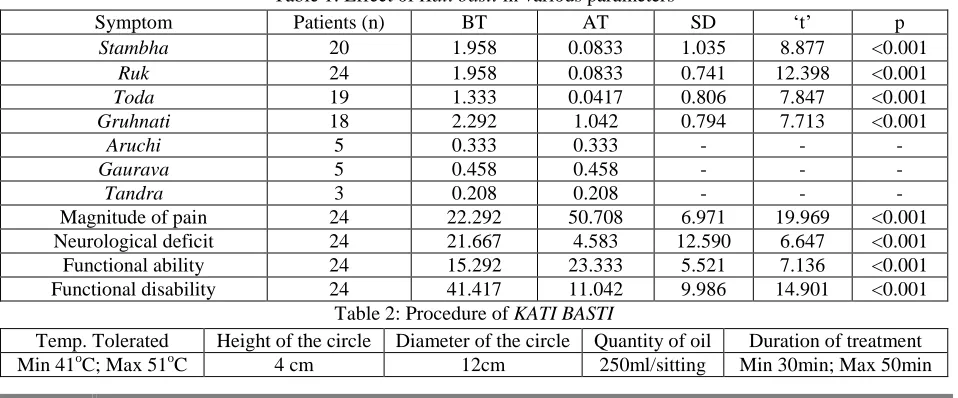
The effect of the Kati basti on different parameters of Gridhrasi was assessed using Paired t test, based on the pre (BT), post treatment (AT) and follow up (AT-1) scorings. After a course of the kati basti, the analysis of the patients revealed that there is a statistically significant improvement seen in the parameters like
sthambha, Ruk, toda, gruhnati, magnitude of pain, neurological deficit, functional ability, and functional disability. Symptoms tandra, gaurava and arochaka remained unchanged.
As the (n) value was less in these 3 parameters, statistical application was not possible. The different values are:
Table 1: Effect of Kati basti in various parameters
Symptom Patients (n) BT AT SD ‘t’ p
Stambha 20 1.958 0.0833 1.035 8.877 <0.001
Ruk 24 1.958 0.0833 0.741 12.398 <0.001
Toda 19 1.333 0.0417 0.806 7.847 <0.001
Gruhnati 18 2.292 1.042 0.794 7.713 <0.001
Aruchi 5 0.333 0.333 - - -
Gaurava 5 0.458 0.458 - - -
Tandra 3 0.208 0.208 - - -
Magnitude of pain 24 22.292 50.708 6.971 19.969 <0.001
Neurological deficit 24 21.667 4.583 12.590 6.647 <0.001
Functional ability 24 15.292 23.333 5.521 7.136 <0.001
Functional disability 24 41.417 11.042 9.986 14.901 <0.001
Table 2: Procedure of KATI BASTI
Temp. Tolerated Height of the circle Diameter of the circle Quantity of oil Duration of treatment
4
www.iamj.in IAMJ: Volume 1; Issue 4; July – Aug 2013 DISCUSSIONKati basti
Temperature tolerance: The patients having Vata pradhana and kapha pradhana prakruti tolerated temperature more than other prakruti persons (Maximum of 510C as recorded using Pyrometer). Patient with
pitta pradhana prakruti showed minimum tolerance (410C).
Quantity of Oil: During this study, it has been observed and standardized that minimum of 250ml of oil is required per procedure. Less than 250ml showed minimum improvement in the pain and more than 250ml of oil shows the clinical improvement similar to that of 250ml.
Height of dough: After repeated
experiments, it is concluded that the height of the dough must be 4cm. if it is less than 4cm, 250ml of oil cannot be retained properly. If the height is more than 4cm it is also of no use.
Diameter: Different diameters ranging from 6cm to 15cm were tried in this study. Ultimately 12cm of diameter was considered as the ideal diameter. 12cm diameter with 4cm height circular ring is able to retain 250ml of oil and spillage was not observed. Less than this could not able to retain 250ml of oil. Hence spillage was observed during the procedure.
Duration: During this series, minimum of 30 minutes, maximum of 50 minutes time was observed. Minimum duration observed in Pitta predominant prakruti whereas maximum duration seen in Vata Kapha
predominance. But Samyak Swinna
Lakshanas are the end points. Hence it is not possible to put a maximum or minimum time barrier for all the patients. A range of minimum of 30 minutes and maximum of 50
minutes may be considered as standard as by this time some of the samyak swinna lakshanas can be noted.
Samyak swinna lakshana: As kati basti is
ekanga, snigdha, mrudu, shaman swedana
procedure, it is difficult to identify all the
samyak swinna lakshanas in the patient. However, Sheeta vyuparama, and shoola vyuparama (to some extent) can be identified. After removing the oil and dough, we can see sweda pradurbhava and redness in the skin. If the procedure is continued beyond this, then daha (burning sensation) at the site may be identified which is one of the atiswinna lakshana. So after noting the time, we can identify the proper duration in which samyak lakshanas
can be seen. So in this study, it was between 30 min to 50 min.
Clinical study
Gridhrasi, a pain and disability dominant disease needs an energetic treatment. The line of management depends on dosha and dhatu involved in the pathogenesis which in turn depends on the
nidana. Dhatu kshaya, vata prakopa are the inevitable conditions and involvement of
asti, sandhi, upadhatus are evident in any pathogenesis of Gridhrasi. In Abhighata,
this effect is acute where as in aharaja nidana, this may be a slower process. However in all these situations, snehana and
swedana chikitsa has got an important role in vata shaman. So the selection of katibasti
is justified here. The drugs in Vajigandhadi taila are vata kaphahara, Shotahara, vedanasthapaka, balya, brumhana. Eranda taila is specifically vata kapha shamaka and
5
www.iamj.in IAMJ: Volume 1; Issue 4; July – Aug 2013application of Ricinoleic acid, the main component of castor oil, exerts remarkable anti-inflammatory effects. It has potential interaction on sensory neuropeptide-mediated neurogenic inflammation.6 The combination of the procedure and
taila are helpful in controlling vata and thus the symptoms are reduced in the patient. As noted in the incidence, maximum patients were in the age group of 51-60, with strenuous work, wherein vata prakopa and
dhatukshaya are common. Dashamoola, Eranda reduces shoola and stambha, Ashwagandha also has a significant anti inflammatory property both in acute and chronic inflammations. These drugs are
balya and brumhana too which is more required in the degenerated state.
The symptoms like tandra, and
arochaka showed no improvement the reason may be, kati basti is a bahi parimarjana chikitsa. It is also an ekanga, snigdha and mrudu sweda. So action at this
agni level is very minimum. The symptom
gaurava did not show any improvement may be because, the treatment required may be a prolonged and repeated course of katibasti
with oral Shamana chikitsa may also be required.
In the overall effect of the treatment none of the patients showed complete cure of the illness. The reason would be the short duration of the treatment than the required one. Other contributing factors like occupation, posture, travel may slower the improvement during follow up period. When the disease is chronic, with Dhatu kshaya
and gambheera dhatugata avasta, bahya snehana swedana alone is not sufficient to treat the disease and repeated course of kati basti may yield better.
CONCLUSION
The present study revealed that
katibasti with vajigandhadi taila is effective in treating Gridhrasi. As kati basti is ekanga, mrudu, snigdha sweda, the improvement in tandra gaurava and
arochaka are not so marked one.
REFERENCES
1. Anthony S Fauci, et al, Harrison’s principles of internal medicine,14th edition, Vol I, R R Donnelly and sons publication, p 1406, p 73
2. Sureshwar pandey, Anil Kumar Pandey, Clinical Orthopaedic Diagnosis, 3rd edition, Jaypee brothers medical publishers (p) Ltd, New Delhi, p-729, 306
3. Agnivesha, Charaka samhita, Acharya Jadavaji Trikamaji, 5th edition, Choukabha publication Varanasi. p 738, 621
4. Agnivesha, Charaka samhita, Acharya Jadavaji Trikamaji, 5th edition, Choukabha publication Varanasi. p 738, 620
5. Yogaratnakara, Dr Indradeva Tripati, 1st edition, 1998, Oriantal publishers, Varanasi, p 894, 415, 416
6. www.ncbi.nlm.nih.gov/pubmed/1153485 9, Vieira C, Fetzer S, Sauer SK, et al, Pro- and anti-inflammatory actions of ricinoleic acid: similarities and differences with capsaicin, 2001 Aug; 364(2): pp 87-95.
CORRESPONDING AUTHOR
Dr. Padmakiran C.
Asst. Prof. of Panchakarma
SDM College of Ayurveda, Kuthpady, Udupi, Karnataka, India
Email: [email protected]