ISSN (e): 2250-3021, ISSN (p): 2278-8719
Vol. 08, Issue 4 (April. 2018), ||VIII|| PP 85-89
International organization of Scientific Research
85 |
Determination of the Bending Strength of Sisal/Jute Hybrid
Polymer Composite for Lightweight Structural Application.
Anaidhuno U. P
1; Edelugo S.O
2, Owuama C. K.
3Ezeokoli A.A.
41Department of Mechanical Engineering, Federal University of Petroleum Resources, Effurun, Nigeria 2
Department of Mechanical Engineering, University of Nigeria, Nsukka, Nigeria,
3,4Department of Mechanical Engineering, Chukwuemeka Odumegwu Ojukwu University,Uli, Nigeria,
Corresponding author’s E-mail: [email protected]
Abstract:
This research work investigated the bending strength of sisal/jute polymer hybrid produced with unsaturated polyester resins for lightweight structural application. In this research work, hybrid composites have been developed using hand layup technique based on percentage combination of Sisal and Jute fibers in the form of laminates prepared from – Unsaturated polyester . The prepared laminate samples were subjected to bending test to evaluate their strength which was based on orientations and fibre percentage combination. Specimen sample designated B4 with composite of Sisal: Jute (50%:50%) - percentage combination laid at 450 /-450 orientation demonstrated the highest bending strength of 50MPa.Keywords:
Sisal, Jute, Hybrid, Bending, Strength.
--- --- Date of Submission: 23-04-2018 Date of acceptance: 11-05-2018 --- ---
I.
INTRODUCTION
The bending strength or flexural strength of a material is defined as its ability to resist deformation under load. For materials that deform significantly but do not break, the load at yield, which is a typically measured of deformation/strain of the outer surface, is reported as the flexural strength. The test beam is under compressive stress at the concave surface and tensile stress at the convex surface. Strength refers to the capacity of the section or member to resist a certain types of external action. It depends on the shape and size of cross section, stress strain relationship for the material of which the section or member is made and sometimes on member properties such as unsupported length, end conditions etc. Overall, it indicates the magnitude of the external force that the section or member can resist. If you are considering limit state behaviour and are using a suitable stress strain relation, this capacity could be an ultimate capacity.
The incorporation of several different types of fibres into a single matrix has led to the development of hybrid bio-composites. The behavior of hybrid composites is a weighed sum of the individual components in which there is a more favorable balance between the inherent advantages and disadvantages. Also, using a hybrid composite that contains two or more types of fibres, the advantages of one type of fibre could complement with what are lacking in the other. As a consequence, a balance in cost and performance can be achieved through proper material design ( Liao 2003).The properties of a hybrid composite mainly depend upon the fibre content, length of individual fibres, orientation, extent of intermingling of fibres, fibre to matrix bonding and arrangement of both the fibres. The strength of the hybrid composite is also dependent on the failure strain of individual fibres. Maximum hybrid results are obtained when the fibres are highly strain compatible, (Thomas, 2002).
Several studies have been reported on the use of sisal/jute fibers as reinforcements in polymer matrices. Parandaman and Joyaraman (2015) investigated the mechanical properties of Jute/Sisal/Glass and Jute/Banana/Glass Hybrid composite materials on Epoxy resin, the study in an attempt to analyze the effect of hybridization of natural fibres with glass fibres on the mechanical behavior of the composites conducting test to evaluate their tensile, hardness, impact strengths, the results of the hybrid composite samples shown: for Jute/Sisal/Glass (JSG), Tensile modulus of 23.29MPa, Flexural strength of 59.8MPa, Impact strength of 15.01KJ/m2, compared to that of Jute/Banana/Glass (JBG) which shows maximum Tensile modulus of 42.24MPa, maximum flexural strength of 72.93MPa, maximum impact strength of 26.35KJ/m2.
International organization of Scientific Research
86 | P a g e
performance can be achieved with non-exotic materials through hybrid combinations assembled in optimized hybrid hierarchical configurations, (Mohanty, 2002).II.
MATERIALS AND METHOD
Materials
The materials used for the preparation of the composite were: unsaturated polyester resin (matrix), methyl ethyl ketone peroxide (catalyst), cobalt naphthalene (accelerator), Vaseline (releasing agent) bought from Pascal Scientific Laboratory, Akure, Ondo state. Sisal plant fiber was obtained from Ogbemena garden, Ineni town, Anambra State. Jute plant was obtained from Tiawo Farm, Owode, Ogun state Nigeria.
Equipment
The equipment used include: the metal mould, Bending/Strut Rig Testing Machine in Petroleum Training Institute Effurun strength of materials laboratory, grinding machine, Oven model OV-420 by Gallankamp, Digital weighing balance in Federal University of Petroleum, Effurun, Mechanical Engineering strength of materials laboratory. Other equipment used are: conical flasks, beakers, measuring cylinders, thermometer, stirring rod, volumetric flask and Hand roller.
Method
The fabrication of the various composite materials is carried out through hand lay-up technique. Sisal and jute fibre strands are the reinforcement in the unsaturated polyester, Methyl ethyl ketone accelerator and Cobalt catalyst at a ratio of 10:1:0.5. The laminate samples for bending test were prepared. Each laminate were loaded in resin fraction, arranged in the orientation of 900/900, 900/ 450, 00/00, -450/450, 300/ 600and in fibres combination percentage ratio of sisal to jute at 50:50, 67:33, 33:67, sisal alone, jute alone, with reference to a control sample of nil fibre (resin alone) and mild steel. The prepared laminate samples were allowed to cure under room temperature after been consolidated with a roller load weight of 50g, at 4hrs before sample is removed from the mould. Then, specimens are cured in the air for another 12hrs after removing from the mould.
III.
EXTRACTION OF FIBRES
Retting and Hand Isolation of fibresThe process involves steeping and keeping the bast plant of Jute and the leaf plant of the sisal in submerged in water for a period of time not less than 30 days, allowing the immersion to be 10-15cm from the top. Through this process, bacteria act on the soak plant. The bacteria acting on it releases enzymes which also act and allows the plant to soften as much as possible. The fiber was properly washed with ordinary water and re-soaked for total removal of the lignin still attached. The fibre was then dried, brushed. Proper drying is important as fibre quality depends largely on moisture content. Dried fibres are combed and sorted.
Fibre Surface Treatment
Plate 4: Bending test sample on fix support at both ends.
International organization of Scientific Research
88 | P a g e
Plate 6: Deflection of Bending test samplePlate 7: Samples after bend test
Sisal /Jute Hybrid Percentage Combination
Maximum hybrid results are obtained when the fibres are highly strain compatible. According to rule of mixture,
XH = X1V1 + X2V2 (1.)
where, XH is property of the hybrid, X1 and V1 shows the property as well as the volume fraction of the first fibre, and X2 and V2 ,as that of the second fibre. Properties of the hybrid composite may not follow from a direct consideration of the independent properties of the individual components. A positive or negative hybrid effect can be defined as a positive or negative deviation of a certain mechanical property from the rule of mixture behavior respectively. When bulk properties are combined in a hybrid, as in structural composites, the best that can be obtained is often the arithmetic average of the properties of the components, weighed by their volume fractions.
IV.
BENDING TEST RESULTS
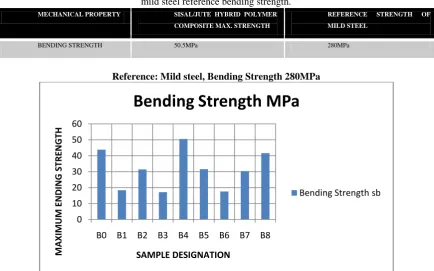
Table 1. Summarized test results of developed maximum sisal/jute hybrid polymer strength in comparison to mild steel reference bending strength.
MECHANICAL PROPERTY SISAL/JUTE HYBRID POLYMER
COMPOSITE MAX. STRENGTH
REFERENCE STRENGTH OF
MILD STEEL
BENDING STRENGTH 50.5MPa 280MPa
Reference: Mild steel, Bending Strength 280MPa
Fig. 1.: Graph of Bending Test Samples of Sisal/Jute Fibres Percentage Combination Prepared at 0.4 Volume Fractions Using Unsaturated Polyester Resin result.
Discussion of Bending Test results
The bending test was conducted in accordance with samples according to ASTM D790 with specimen dimension of 300mm X 20mm X 5mm using the strut/bend testing rig. The machine model is SM105 and the
0 10 20 30 40 50 60
B0 B1 B2 B3 B4 B5 B6 B7 B8
M
A
X
IM
UM
E
N
D
ING
S
TRE
N
GTH
SAMPLE DESIGNATION
Bending Strength MPa
International organization of Scientific Research
89 | P a g e
serial number is Z4076/5. The induced load was 200N and the calculated buckling/bend load is 2738N. It was observed that the unreinforced specimen sample designated B0 demonstrated the highest bending strength of 43.83MPa. Specimen sample B4 with composite of Sisal: Jute (50%:50%) - percentage combination laid at 450 /-450 orientation demonstrated the highest bending strength of 50.55MPa. This is 15.3% improvement over the virgin unreinforced specimen sample B0. This when compared to the bending strength of mild steel is 18%. This was followed by specimen sample designated B8 with composite of Sisal: Jute (33%:67%) - percentage combination laid at 900/900 orientation demonstrated the bending strength of 41.66 Map. This was followed by specimen sample designated B2 with composite of Sisal: Jute (0%:100%) - percentage combination laid at 900/900 orientation demonstrated the bending strength of 31.4MPa.APPLICATION: From the bending test results on laminates which demonstrate good bending strength of 50MPa with the capacity to be used the production of automobile body parts such as Rear suspension tower, Front suspension attachment, Bumper.
V.
CONCLUSION
It was observed that increase in percentage combination of sisal and Jute fibers exhibited superior bending strength at balance of 50:50 percentage of Sisal: Jute fibers. The bending strength of the composite depend to a large extent on the interfacial bonding strength between the matrix and fiber reinforcement, the orientation of fiber, other reinforcement(ribs, wire mesh), and the inherent properties of the composite ingredients. Improvement in the bending strength of composite helps the composite to withstand more stress while being used in lightweight structural parts.
REFERENCES
[1]. Anaidhuno U. P., Ologe. O. S., Maduike. F. (2017)The effect of orientation and fibre combination ratio of sisal/jute hyrid polymer composite tensile property using unsaturated polyester and Bisphenol A resin, Imperial Journal of Interdisciplinary Research (IJIR) Vol. 3, pp. 454-465,
[2]. Anaidhuno U.P, Edelugo S.O, Nwobi-Okoye C.C. (2017) “Evaluation of the mechanical properties and simulation of sisal/Jute hybrid polymer composite failure in automobile chassis panel”, IOSR Journal of Engineering Vol. 3, Issue 9, 2017 Pp 56-64.
[3]. Edelugo S. O. (2010), ― The Behaviour of Polymer Composite Plates During and After Cure and Consequent Immersion in Water. Journal of Advanced Materials, JAM, SAMPE Pub, (USA). Vol. 42, 3, pp 25-30.
[4]. Edelugo S. O. (2004), ―Effect of Reinforcements Combination on the Mechanical strength of Glass Reinforced Plastic (GRP) Handlay-up Laminates with Regards to Increased Temperature Conditions. Nigerian Journal of Technology.Vol. 23.No. 1.pp 39 – 47
[5]. Liao K & Thwe M.M. (2003) Comp. Sci. Tech, 63, 375
[6]. Mohanty, A. K., Misra, M., &Drzal, L. T. (2002). Sustainable bio-composites from renewable resources: opportunities and challenges in the green materials world. Journal of Polymer and Environment, 10, 19– 26
[7]. Parandaman P. and Jayaraman M., (2015), Experimental Investigation on the mechanical properties of Jute/Sisal/Glass and Jute/Banana/Glass Hybrid composite materials., European Journal of Applied Sciences 7(3): 138-144, 2015.
[8]. Thomas S., Sreekala M.S, George J., & Kumaran M.G. (2002) Comp. Sci. Tech, 62, 339