© 2015, IRJET.NET- All Rights Reserved Page 533
Ergonomically Analysis the Moderate Work for determining
The rest period
Shara khursheed, Summaiya Javed, Dr. K.M.Moeed
1
M.tech Student, Mechanical Engineering, Integral University, Lucknow, India.
2
Student, Mechanical Engineering, Integral University, Lucknow, India.
3
Associate Professor, Mechanical Engineering, Integral University, Lucknow, India.
---***---Abstract -
Ergonomics is the study of human comfort and the relaxation from the exertion. In this paper a Basal Metabolism Methodology was used to reduce workload and improve the working conditions by providing proper rest breaks. The study was conducted in workshop on three females and seven males who are asked to perform the shovelling operation. The results indicate that rest period is very important in keeping the body healthy and to avoid musculoskeletal disorder of the body.The main objective of this study is to analyse the rest periods for the persons having varying physical properties. The metabolism is a process which converts food into the chemical energy and basal metabolism deals with the physical activities of a person when he is lying empty stomach and the calories spent is known as leisure calories.
Key Words:
rest period, basal metabolism rate,
human comfort and exertion.
1. INTRODUCTION
Wojciech Jastrzebowski, Polish scholar, first use the term ergonomics in 1857 meaning science of doing work. Since then it is like a bottom like opportunity which has effect on business and today its impact was seen in our daily lives also. In business terms ergonomics remove barrier to productivity, quality and safe human performance by fitting equipment, tools, tasks and working environment according to the people [1]. Ergonomics applies information about human behaviour, abilities and limitations and other characteristics to the design of tools, machines, tasks, jobs and environments for productive, safe, comfortable and effective human use”[2]. The aim of ergonomics is to give maximum productivity with the minimum cost where cost is expressed in terms of the physiological or health cost of the worker.
The primary focus of ergonomics is design of task and allocation of work according to person’s
strength and capability. The capability of worker is matched with the requirement of job in order toreduce the risk of musculoskeletal injuries resulting from handling materials manually.
1.1 Human Exertion and Comfort
When the work duration or physical activity increases than there is an increase demand of oxygen the metabolism and this demand is met by increasing the breath rate and the heart rate. If this demand of body is not fulfilled (metabolic energy expenditure rate exceeds the body’s energy producing and lactic acid removal rate) than physical fatigue or exertion occurs. If this happens in a specific body part than it is termed as the localised fatigue and if it happens to the whole body than it is termed as the whole body fatigue [3].
Human comfort may be defined as both the state of body and mind when it feels satisfied with the present working and environmental conditions. Metabolic rate of the body is one of the parameter that will define the comfort of the human body. Metabolic rate fluctuates from person to person due to different working and environmental conditions.
1.2 Musculoskeletal Disorder and its Causes
Work-related MSDs occur when there is mismatch between physical capabilities of the worker and the job requirements. A long time exposure to ergonomic risk factors can cause damage a worker’s body and lead to MSD. Factors that are responsible for MSD are as following-
i)
Excessive exertion force.© 2015, IRJET.NET- All Rights Reserved Page 534
iii)
Excessive vibration, usually from vibrating tools,can decrease blood flow, damage nerves, and contribute to muscle fatigue.
iv)
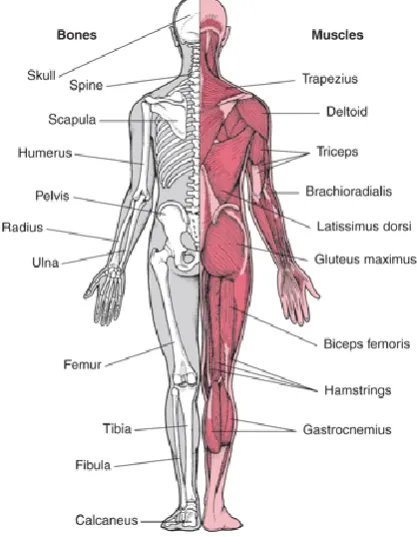
Inadequate recovery time due to overtime, lack of breaks, and failure to vary tasks can leave insufficient time for tissue repair [4].Fig 1.View of MSD from Backside.
2. METABOLISM-
Metabolism can be defined as the term containing all chemical reactions that occur in a human body including digestion and these reactions are responsible for maintaining living state of cells [5].
Chart -1: Metabolism of body
2.1 BASAL METABOLISM
When a person is resting with the empty stomach than the quantity of energy possessed by the person is known as basal metabolism. This metabolism leads to the
conversion of all chemical energy of nutrients into the heat [6].
2.2 ENERGY CONSUMPTION
The energy consumption of body is directly dependent on the amount of oxygen consumed. This energy consumption can be determined by the following formula-
Energy Consumption= Oxygen consumed in litres*4.8 kcal.
3. WORK CALORIES
Physical work requires the contraction of muscles which requires the energy. This energy consumption due to the physical work is known as work calories. The work calories can be given by the following formula-
Work calories=energy consumption while working-basal metabolism [7].
These work calories play an important role in determining rest periods and in comparing different work arrangements.
3.1 LEISURE CALORIES
The calories consumed in everyday work are known as leisure calories.
4.EXPERIMENT
© 2015, IRJET.NET- All Rights Reserved Page 535 Table 1 ANTHROPOMETRIC DATA
Subjects Age Height
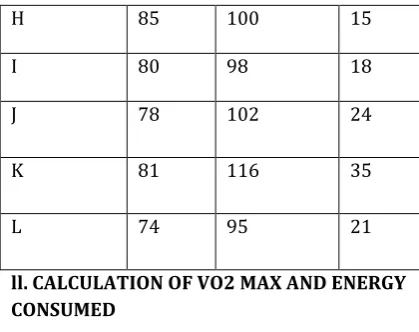
The heart rate of the participants is measured before and after the filling operation with the help of digital heart rate monitor. The details of heart rate is given in the table 2-
TABLE 2 : HEART RATE CALCULATIONS
SUBJECTS HRR
ll. CALCULATION OF VO2 MAX AND ENERGY CONSUMED
The energy consumed can be directly given the quantity of oxygen consumed by the human body during the working activity [9]. The energy consumed by the human is measured by the formula-
Ec= VO2 max x 4.8 kacl [10].
The maximum heart rate of the human body is calculated by the online software and this heart rate is used to obtain the energy consumed by the body [11]. The VO2 max and the energy consumed by the various participants in the filling operation is shown in table 3-
TABLE 3: ENERGY CONSUMED DUIRING WORK
© 2015, IRJET.NET- All Rights Reserved Page 536
J 15 33.46 160.62
K 15 33.00 158.40
L 15 36.49 175.14
CALCULATION OF REST PERIOD
The rest period for the participants is calculated by the formula-
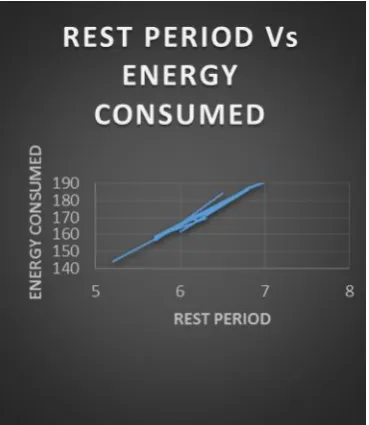
Trp = (Ec/4-1) of working time [12]. The working time is shown in the table 4.
TABLE 4
SUBJECTS DURATION
(MINS)
REST PERIOD (MINS)
A 15 5.2
B 15 6.8
C 15 6.0
D 15 6.8
E 15 7.0
F 15 6.8
G 15 5.7
H 15 5.7
I 15 5.8
J 15 5.8
K 15 5.7
L 15 6.4
5 CONCLUSIONS
The following conclusions have been derived from the study of human comfort and exertion for the analysis of optimum rest period-
a) It was concluded that for the duration of 15 minutes of activity in ‘18-52’ ages (four females and eight males) the heart rate varies between the values ‘11-33’ irrespective of age groups. It was
contradictory to the conventional belief that metabolic rate decreases with the age. This variation of heart rate shows even an old age man with a healthy metabolic system can work for a longer duration.
b) The analysis of optimal calculation of rest period for the moderate work (filling) also establishes a relation between heart rates before and after the activity. The average readings of heart rate and age groups is shown in the table 2. From calculations it was concluded that in an average there is a variation of 20 heart beats per minute variation for the duration of 15 minutes.
© 2015, IRJET.NET- All Rights Reserved Page 537
REFERENCES
I. http://www.darcor.com/technical/caster-white-pape.
II. Health and Safety Executive, 2000, Moving food and drink, Manual handling solutions for the food and drink industries: HSG196, HSE Books.
III. Observation Analysis of the Hand and Wrist – Quantifies hand exertions associated with risk factors of pinch grip, high force, wrist
flexion/extension/ulnar deviation, power tool exertion, and use of hand to strike object (Stetson et al., 1991).
IV. Bárány, Michael (2002). "SMOOTH MUSCLE". Retrieved 2008-11-19.
V. Pace NR (January 2001). "The universal nature of biochemistry"
(https://www.ncbi.nlm.nih.gov/pmc/articles/PM C33372). Proc. Natl. Acad. Sci. U.S.A. 98 (3): 805Bi bcode:2001PNAS...98..805P (http://adsabs.harvar d.edu/abs/2001PNAS...98..805P).doi:10.1073/pn as.98.3.805 (https://dx.doi.org/10.1073%2Fpnas. 98.3.805). PMC 33372
(https://www.ncbi.nlm.nih.gov/pmc/articles/PM C33372). PMID 11158550.
VI. Hulbert A.J. 2000. Thyroid hormones and their effects: a new perspective. Biol Rev 75:519–631.
VII. Darveau C.A., R.K. Suarez, R.D. Andrews, and P.W. Hochachka. 2002. Allometric cascades as a unifying principle of body mass effects on metabolism. Nature 417:166–170.
VIII. Khan .M.I. 2010, Industrial Ergonomics, PHI, page 69.
IX. American College of Sports Medicine (ACSM) 2006. ACSM’s Guidelines for Exercise Testing and Prescription, 7th edition. Lippencott, Williams & Wilkins, Philadelphia, PA.
X. Khan .M.I. 2010, Industrial Ergonomics, PHI, page 65.
XI. Bland MB< Altman DG (1986) Statistical Methods for assessing agreement between two methods of clinical measurements. Lancet 1: 307-310.