A Maximum Likelihood Approach to Least Absolute
Deviation Regression
Yinbo Li
Department of Electrical and Computer Engineering, University of Delaware, Newark, DE 19716 3130, USA Email:[email protected]
Gonzalo R. Arce
Department of Electrical and Computer Engineering, University of Delaware, Newark, DE 19716 3130, USA Email:[email protected]
Received 7 October 2003; Revised 22 December 2003
Least absolute deviation (LAD) regression is an important tool used in numerous applications throughout science and engineer-ing, mainly due to the intrinsic robust characteristics of LAD. In this paper, we show that the optimization needed to solve the LAD regression problem can be viewed as a sequence of maximum likelihood estimates (MLE) of location. The derived algorithm reduces to an iterative procedure where a simple coordinate transformation is applied during each iteration to direct the opti-mization procedure along edge lines of the cost surface, followed by an MLE of location which is executed by a weighted median operation. Requiring weighted medians only, the new algorithm can be easily modularized for hardware implementation, as op-posed to most of the other existing LAD methods which require complicated operations such as matrix entry manipulations. One exception is Wesolowsky’s direct descent algorithm, which among the top algorithms is also based on weighted median operations. Simulation shows that the new algorithm is superior in speed to Wesolowsky’s algorithm, which is simple in structure as well. The new algorithm provides a better tradeoffsolution between convergence speed and implementation complexity.
Keywords and phrases:least absolute deviation, linear regression, maximum likelihood estimation, weighted median filters.
1. INTRODUCTION
Linear regression has long been dominated by least squares (LS) techniques, mostly due to their elegant theoretical foun-dation and ease of implementation. The assumption in this method is that the model has normally distributed errors. In many applications, however, heavier-than-Gaussian tailed distributions may be encountered, where outliers in the mea-surements may easily ruin the estimates [1]. To address this problem, robust regression methods have been developed so as to mitigate the influence of outliers. Among all the ap-proaches to robust regression, the least absolute deviations (LADs) method, orL1-norm, is considered conceptually the
simplest one since it does not require a “tuning” mechanism like most of other robust regression procedures. As a result, LAD regression has drawn significant attentions in statistics, finance, engineering, and other applied sciences as detailed in a series of studies onL1-norm methods [2,3,4,5]. LAD
regression is based on the assumption that the model has Laplacian distributed errors. Unlike the LS approach though, LAD regression has no closed-form solution, hence numeri-cal and iterative algorithms must be resorted to.
The simple LAD regression problem is formulated as fol-lows. Consider N observation pairs (Xi,Yi) modelled in a linear fashion
Yi=aXi+b+Ui, i=1, 2,. . .,N, (1)
where ais the unknown slope of the fitting line,b the in-tercept, andUi are unobservable errors drawn from a ran-dom variableUobeying a zero-mean Laplacian distribution
f(U)=(1/2λ)e−|U|/λwith varianceσ2 =2λ2. The LAD
re-gression is found by choosing a pair of parametersaandb that minimizes the objective function
F(a,b)=
N
i=1
Yi−aXi−b, (2)
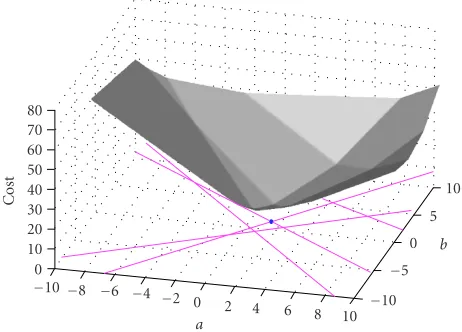
which has long been known to be continuous and convex [1]. Moreover, the cost surface is of a polyhedron shape, and its edge lines are characterized by the sample pairs (Xi,Yi).
Notably, the minimization of the LAD cost function (2) is closely related to the location estimation problem defined as follows. Let the random variableVbe defined asV=U+µ, whereµis an unknown constant location andUobeys the Laplacian distribution. The maximum likelihood estimate (MLE) of location on the sample set{Vi|Ni=1}is
The solution to the above minimization problem is well known to be the sampleMedian
µ∗=MEDV iNi=1
. (4)
The striking similarity between (2) and (3) infers that, for a fixeda = a0, the minimizer of (2), sayb∗a0, is essentially an MLE for location under the Laplacian assumption. For reasons that will be explained shortly inSection 2, the mini-mizer of (2)a∗b0, givenb=b0, is also an MLE for location
un-der the Laplacian assumption with certain extensions. Thus, a very intuitive way of solving the LAD regression problem can be constructed as a “seesaw” procedure: first, hold one of the parameters a or b constant, optimize the other us-ing the MLE concept, then alternate the role of the parame-ters, and repeat this process until both parameters converge. It will soon be shown in the paper that this method suffers from some intrinsic limitations that often leads to nonglobal optimal solutions despite its attractive simplicity. However, further inspection on this initial algorithm reveals that, with some specific guidance on how to do the MLE optimiza-tion and one simple coordinate transformaoptimiza-tion, a similar but more accurate algorithm can be formulated where the global optimum can be reached. In fact, in this paper, we derive a fast iterative solution where the concept of ML is applied jointly with coordinate transformations. It is also shown that the proposed method is comparable with the best algorithms used to date in terms of computational complexity, and has a greater potential to be implemented in hardware.
2. ALGORITHM DERIVATION
2.1. Basic understanding
Consider the linear regression model in (1). If the value of
ais fixed at first, saya=a0, the objective function (2) now
becomes a one-parameter function ofb:
F(b)=N i=1
Yi−a0Xi−b. (5)
Assuming a Laplace distribution for the errorsUi, the above cost function reduces to an ML estimator of location forb. That is, we observe the sequence of random samples{Yi−
a0Xi}, and the goal is to estimate the fixed but unknown
lo-cation parameterb. Thus according to (4), the parameterb∗ in this case can be obtained by
b∗=MEDY
Again, if the error random variable Ui obeys a Laplacian distribution, the observed samples {(Yi−b0)/Xi} are also
Laplacian distributed, but with the difference that each sam-ple in this set has different variance. The reason is obvious since for each knownXiand zero-meanUi,Ui/Xiremains a zero-mean Laplacian with variance scaled by 1/Xi2. Thus the parameter a∗ minimizing the cost function (7) can still be seen as the ML estimator of location fora, and can be calcu-lated out as theweighted median
a∗=MED
where is the replication operator. For a positive inte-ger|Xi|,|Xi| Yi meansYiis replicated|Xi|times. When the weights |Xi| are not integers, the computation of the
weighted median is outlined in the appendix.
A simple and intuitive approach to the LAD regression problem is through the following iterative algorithm.
(1) Setk=0. Find an initial valuea0fora, such as the LS
10
5
0
−5
−2 −1 0 1 2
(X1,Y1) b∗
(X5,Y5)
a∗
X Y
(a)
10
5
0
−5
−10
−10 −5 0 5 10
−X1
(a∗,b∗)
−X5
a b
(b)
Figure1: Illustration of (a) the sample space and (b) the parameter space in the simple linear regression problem. The circles in (a) represent the samples; the dot in (b) represents the global minimum.
Since the median and weighted median operations are both ML location estimators under the least absolute criterion, the cost functions will be nonincreasing throughout the iterative procedure, that is,
Fak−1,bk−1
≥Fak−1,bk≥Fak,bk. (11)
The algorithm then converges iteratively. Since the objective functionF(a,b) is continuous and convex, one may readily conclude that the algorithm converges to the global mini-mum. However, careful inspection reveals that there are cases where the algorithm does not reach the global minimum. To see this, it is important to describe the relationship between the sample space and the parameter space.
As shown inFigure 1, the two spaces are dual to each other. In the sample space (Figure 1a), each sample pair (Xi,Yi) represents a point on the plane. The solution to the problem (1), namely (a∗,b∗), is represented as a line with slopea∗and interceptb∗. If this line goes through some sam-ple pair (Xi,Yi), then the equationYi = a∗X
i+b∗ is
satis-fied. On the other hand, in the parameter space (Figure 1b), (a∗,b∗) is a point on the plane, and (−Xi,Yi) represents a line with slope (−Xi) and interceptYi. Whenb∗=(−Xi)a∗+
Yi holds, it can be inferred that the point (a∗,b∗) is on
the line defined by (−Xi,Yi). As can be seen in Figure 1,
the line going through (X1,Y1) and (X5,Y5) in the sample
space has a slope a∗ and an intercept b∗, but in the pa-rameter space, it is represented as a point which is the in-tersection of two lines with slopes (−X1) and (−X5),
respec-tively. The sample set used to generateFigure 1is, in a (Xi,Yi) manner, [(−1.4,−0.4), (0.6, 8.3), (1.2, 0.5), (−0.7,−0.9), (0.8, 2.6)].
80 70 60 50 40 30 20 10 0
−10 −8 −6 −4 −2 0
2 4 6 8 10 −10
−5 0
5 10
Co
st
a
b
Figure2: The cost surface of the LAD regression problem. The dot at an intersection on thea-bplane represents the global minimum. To better illustrate the inner topology of the function, the half sur-face that is towards the viewers is cut off.
8
4
0
−4
0 3 6
a b
(a)
4
2
0
−2
−2 0
a
2
b
(b)
Figure3: The parameters’ trajectories during the iterations. Vertical dashed lines representbupdates, while horizontal dotted lines represent aupdates; (a) zigzag case, (b) nonoptimal case. The marked dots represent the global minima. To better illustrate, the initial values foraand bare not set from the LS solution.
To describe the dynamics of this simple iterative method, consider Step (2) in the procedure, where a new estimatebkis calculated based on a fixed, previously obtainedak−1through
a median operation. Since the median is of selection type, its output is always one of the inputs. Without loss of general-ity, assumebk =Yj−ak−1Xj, which means that the newly
estimated parameter pair (ak−1,bk) is on the edge line
de-fined by (−Xj) andYj. Thus, the geometrical interpretation
of Step (2) can be derived as follows: draw a vertical line at
a =ak−1in the parameter space and mark all the
intersec-tions of this line withNedge lines.1The intersection on the
edge line defined by (−Xj) andYj is vertically the median of all; thus itsb-coordinate value is accepted asbk, the new update forb. Similar interpretation can be made for Step (3), except that the chosen intersection is a weighted median out-put, and there may be some edge lines parallel to thea-axis.
The drawback of this algorithm is that the convergence dynamics depends on the geometry of the edge lines in the parameter space. As can be seen in Figure 3a, the it-eration is carried on between edge lines in an inefficient zigzag manner, needing infinite steps to converge to the global minimum. Moreover, as illustrated in Figure 3b, it is possible that vertical optimization and horizontal op-timization on the edge lines can both give the same re-sults in each iteration. Thus the algorithm gets stuck in a nonoptimal solution. The sample set used for Figure 3a is [(−0.1,−3.2), (−0.9,−2.2), (0.4, 5.7), (−2.4,−2.1), (−0.4, −1.0)], and the initial values for a and b are 5 and 6. The sample set used for Figure 3b is [(0.3, −1.0),
1Since all meaningful samples are finite, no edge lines will be parallel to
theb-axis; hence there must beNintersections.
(−0.4,−0.1), (−2.0,−2.9), (−0.9,−2.4), (−1.1, 2.2)], and the initial values foraandbare−1 and 3.5.
2.2. New algorithm
To overcome these limitations, the iterative algorithm must be modified exploiting the fact that the optimal solution is at an intersection of edge lines. Thus, if the search is di-rected along the edge lines, then a more accurate and more efficient algorithm can be formulated. The approach pro-posed in this paper is through coordinates transformation. The basic idea is as follows. In the parameter space, if the coordinates are transformed so that the edge line contain-ing the previous estimate (ak−1,bk−1) is parallel to thea-axis
at heightbk− 1, then the horizontal optimization based upon
b
k−1 is essentially an optimization along this edge line. The
resultant (ak,bk) will be one of the intersections that this line has with all other edge lines, thus avoiding possible zigzag dynamics during the iterations. Transforming the obtained parameter pair back to the original coordinates results in (ak,bk). This is illustrated inFigure 4. The only requirement for this method is that the shape of the cost surface must be preserved upon transformation; thus the same optimization result can be achieved. Notice that, if an edge line is horizon-tal, its slope (−Xj) has to be 0. We will show shortly that a
simple shifting in the sample space can satisfy the require-ment.
The following is the proposed algorithm for LAD regres-sion.
(1) Setk=0. Initializebto beb0using the LS solution
b0= N i=1
Xi−X¯YX¯ i−XY¯ i N
i=1
Xi−X¯2 .
3
0
−3
1 1.5 2
a b
(aK−1,bk−1)
(aK,bk)
(a)
5
2
−1
1 1.5 2
a
b
(aK−1,bk−1)
(aK,bk)
(b)
Figure4: Illustration of one iteration. The previous estimate (ak−1,bk−1) is mapped into the transformed coordinates as (ak−1,bk−1); (ak,bk)
is obtained through ML estimation in the transformed coordinates; the new estimate (ak,bk) is formed by mapping (ak,bk) back into the
original coordinates. The sample set is [(1.6, 2.8), (−1.4,−3.8), (1.2, 3.5), (−4.3,−4.7), (−1.8,−2.2)].
Calculatea0by a weighted median
a0=MED
XiYi−b0
Xi N
i=1
. (13)
Keep the index jwhich satisfiesa0=(Yj−b0)/Xj. In
the parameter space, (a0,b0) is on the edge line with
slope (−Xj) and interceptYj.
(2) Setk =k+ 1. In the sample space, right shift the co-ordinates byXj so that the newly formedy-axis goes through the original (Xj,Yj). The transformations in the sample space are
X
i =Xi−Xj, Yi=Yi, (14)
and the transformations in the parameter space are
a
k−1=ak−1, bk=bk− 1=bk−1+ak−1Xj. (15)
The shifted sample space (X,Y) corresponds to a new parameter space (a,b), where (−X
j,Yj) represents a
horizontal line.
(3) Perform a weighted median to get a new estimate ofa:
a
k=MED
X iY
i −bk
X i
N
i=1
. (16)
Keep the new indextwhich givesak=(Yt−bk)/Xt. (4) Transform back to the original coordinates
ak=ak, bk=bk−akXj. (17)
(5) Setj=t. Ifakis identical toak−1within the tolerance,
end the program. Otherwise, go back to step (2).
It is simple to verify that the transformed cost function is the same as the original one using the relations in (14) and (15). For fixedbk,
F(a)=N i=1
Y
i −aXi−bk
= N
i=1
Yi−a
Xi−Xj−aXj+bk
= N
i=1
Yi−aXi−bk=F(a).
(18)
This relationship guarantees that the new update in each it-eration is correct.
3. SIMULATIONS
The major part of the computational power of the proposed algorithm is consumed in the weighted median operation at each iteration. Essentially, it is a sorting problem, which, for
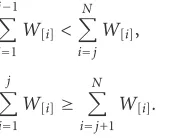
Consider a weighted median defined as follows:
ith order statisticZ(i)is often referred to as the concomitant
W[i] [15]. In this way, the weighted mediana∗ can always
be identified asZ(j)whose indexjsatisfies the following
in-equalities:
Comparing to (16), we should notice that the weightsWi and samplesZiin every LAD iteration are different. Suppose that the previous estimateak−1, which is also the output of a
weighted median, corresponds toZj. We do not have to fully order all these samples, but classify them into two categories, the ones smaller than it and the ones larger. Check the in-equalities to see if they still hold. If not, transfer the boundary sample and its weight into another group and recheck until the new weighted median output is found.
Two criteria are often used to compare LAD algorithms: speed of convergence and complexity. Most of the effi -cient algorithms, in terms of convergence speed (except for Wesolowsky’s and its variations), are derived from linear pro-gramming (LP) perspectives, such as simplex and interior point. Take Barrodale and Roberts’ algorithm2[10], for
ex-ample; its basic idea is to apply row and column operations on a constructed (N+K)×(K+1) matrixA. The initial value
where Y is anN ×1 vector of observations of the depen-dent variable and X is an N×K matrix of the indepen-dent variables. For the simple regression case, K = 2. BR-like algorithms usually consist of two phases: Phase I forms a set of independent edge direction vectors, Phase II updates the variable basis until it converges. In general, BR-like al-gorithms are slightly faster than other alal-gorithms with sim-pler structures. Their computational complexity, however, is significantly higher. The complicated variable definition and
2which can be considered as the basic form of the other two best
simplex-type algorithms, namely, Bloomfield and Steiger’s [1], and Arm-strong, Frome, and Kung’s [11], according to [2].
logical branches used in BR-like algorithms cause tremen-dous efforts in their hardware implementations and are thus less attractive in such cases. Focusing on efficient algorithms that have a simple structure for ease of implementation, Wesolowsky’s direct descent algorithm stands out. The algo-rithm is summarized below.
Step1. Setk=0. Choose the initial valuesa0,b0. Choose j
so that|Yj−a0Xj−b0|is a minimum.
Step2. Setk=k+ 1. Use the weighted median structure to get the update forb,
The major difference between Wesolowsky’s algorithm and ours is that the weighted median operations in their case are used for intercept b updates, while in our algo-rithm, they are used for slope aupdates. Since the realiza-tion of the weighted median in both algorithms can bene-fit from the partial sorting scheme stated above, to compare them, we only need to count the iteration times. Also no-tice that in the initialization ofStep 1, there is a minimum-finding procedure, which can be considered a sorting op-eration thus treated as having the same order of complex-ity as a weighted median, even though they may be imple-mented with totally different structures. For this reason, this step in Wesolowsky’s algorithm will be counted as one it-eration. Figure 5depicts the comparison of the newly pro-posed algorithm and Wesolowsky’s direct descent algorithm in terms of number of iterations. It can be observed from Figure 5that, for large sample sets, the newly proposed LAD regression method needs 5% less iterations, and about 15% less for small sample sets.
4. CONCLUSIONS
9
Figure 5: Comparison on the average number of iterations of Wesolowsky’s and LA algorithms. The dimensions of the sample sets are chosen as [20, 50, 200, 1000, 5000], each having 1000 averaging runs.
having a set of positive real weights, can be computed out as follows.
(1) Calculate the thresholdW0=(1/2) Ni=1Wi.
(2) Sort all the samples intoX(1),. . .,X(N)with the
corre-sponding concomitant weightsW[1],. . .,W[N].
(3) Sum the concomitant weights beginning with W[1]
and continuing up in order.
(4) The weighted median output is the sampleX(j)whose
weight causes the inequality i=j 1W[i] ≥ W0to hold
first.
ACKNOWLEDGMENT
This work was supported in part by the Charles Black Evans Endowment and by collaborative participation in the Com-munications and Networks Consortium sponsored by the US Army Research Laboratory under the Collaborative Technol-ogy Alliance Program, Cooperative Agreement DAAD19-01-2-0011.
REFERENCES
[1] P. Bloomfield and W. L. Steiger, Least Absolute Deviations: Theory, Applications, and Algorithms, Progress in Probability and Statistics, Birkh¨auser Boston, Boston, Mass, USA, 1983.
[2] Y. Dodge, Ed.,Statistical Data Analysis Based on theL1-Norm
and Related Methods, Elsevier Science Publishers (North-Holland), Amsterdam, The Netherlands, 1987.
[3] Y. Dodge, Ed., L1-Statistical Analysis and Related
Meth-ods, North-Holland Publishing, Amsterdam, The Nether-lands, 1992.
[4] Y. Dodge, Ed.,L1-Statistical Procedures and Related Topics,
In-stitute of Mathematical Statistics, Hayward, Calif, USA, 1997. [5] Y. Dodge and W. Falconer, Eds.,Statistical Data Analysis Based on theL1-Norm and Related Methods, Barika Photography &
Productions, New Bedford, Mass, USA, 2002.
[6] F. Y. Edgeworth, “A new method of reducing observations relating to several quantities,” Philosophical Magazine (Fifth Series), vol. 24, pp. 222–223, 1887.
[7] R. W. Hawley and N. C. Gallagher Jr., “On edgeworth’s method for minimum absolute error linear regression,”IEEE Trans. Signal Processing, vol. 42, no. 8, pp. 2045–2054, 1994. [8] T. E. Harris, “Regression using minimum absolute
devia-tions,” The American Statistician, vol. 4, no. 1, pp. 14–15, 1950.
[9] A. Charnes, W. W. Cooper, and R. O. Ferguson, “Optimal es-timation of executive compensation by linear programming,” Management Science, vol. 1, no. 2, pp. 138–151, 1955. [10] I. Barrodale and F. D. K. Roberts, “An improved algorithm for
discretel1linear approximation,”SIAM Journal on Numerical
Analysis, vol. 10, no. 5, pp. 839–848, 1973.
[11] R. D. Armstrong, E. L. Frome, and D. S. Kung, “A revised sim-plex algorithm for the absolute deviation curve fitting prob-lem,”Communications in Statistics, Simulation and Computa-tion, vol. B8, no. 2, pp. 175–190, 1979.
[12] P. Bloomfield and W. Steiger, “Least absolute deviations curve-fitting,”SIAM Journal on Scientific and Statistical Com-puting, vol. 1, no. 2, pp. 290–301, 1980.
[13] G. O. Wesolowsky, “A new descent algorithm for the least ab-solute value regression problem,” Communications in Statis-tics, Simulation and Computation, vol. B10, no. 5, pp. 479– 491, 1981.
[14] Y. Zhang, “Primal-dual interior point approach for com-putingl1-solutions, andl∞-solutions of overdetermined
lin-ear systems,”Journal of Optimization Theory and Applications, vol. 77, no. 2, pp. 323–341, 1993.
[15] H. A. David, “Concomitants of order statistics,” Bulletin de l’Institut International de Statistique, vol. 45, no. 1, pp. 295– 300, 1973.
Yinbo Liwas born in Mudanjiang, China, in 1973. He received the B.S. degree and M.S. degree in underwater acoustic and electri-cal engineering, both with the highest hon-ors, from the Harbin Engineering Univer-sity, Harbin, China, in 1994 and 1997, re-spectively. From 1997 to 1998, he was with the Institute of Acoustics, Chinese Academy of Sciences, Beijing, China, mainly focus-ing on signal processfocus-ing and automatic
Gonzalo R. Arcereceived the Ph.D. degree from Purdue University, West Lafayette, in 1982. Since 1982, he has been with the fac-ulty of the Department of Electrical and Computer Engineering at the University of Delaware, where he is the Charles Black Evans Professor and Chairman of Electrical and Computer Engineering. His research interests include statistical and nonlinear signal processing, multimedia security,