A Multi-Domain Web-Based Algorithm for
POS Tagging of Unknown Words
Shulamit Umansky-Pesin Institute of computer science
The Hebrew University [email protected]
Roi Reichart ICNC
The Hebrew University [email protected]
Ari Rappoport Institute of computer science
The Hebrew University [email protected]
Abstract
We present a web-based algorithm for the task of POS tagging of unknown words (words appearing only a small number of times in the training data of a super-vised POS tagger). When a sentence s containing an unknown word u is to be tagged by a trained POS tagger, our algo-rithm collects from the web contexts that are partially similar to the context ofuin s, which are then used to compute new tag assignment probabilities for u. Our algorithm enables fast multi-domain un-known word tagging, since, unlike pre-vious work, it does not require a corpus from the new domain. We integrate our algorithm into the MXPOST POS tagger (Ratnaparkhi, 1996) and experiment with three languages (English, German and Chinese) in seven in-domain and domain adaptation scenarios. Our algorithm pro-vides an error reduction of up to 15.63% (English), 18.09% (German) and 13.57% (Chinese) over the original tagger.
1 Introduction
Part-of-speech (POS) tagging is a fundamental NLP task that has attracted much research in the last decades. While supervised POS taggers have achieved high accuracy (e.g., (Toutanova et al., 2003) report a 97.24% accuracy in the WSJ Penn Treebank), tagger performance on words appear-ing a small number of times in their trainappear-ing corpus (unknown words) is substantially lower. This effect is especially pronounced in the do-main adaptation scenario, where the training and
test corpora are from different domains. For ex-ample, when training the MXPOST POS tagger (Ratnaparkhi, 1996) on sections 2-21 of the WSJ Penn Treebank it achieves 97.04% overall accu-racy when tested on WSJ section 24, and 88.81% overall accuracy when tested on the BNC cor-pus, which contains texts from various genres. For unknown words (test corpus words appearing 8 times or less in the training corpus), accuracy drops to 89.45% and 70.25% respectively.
In this paper we propose an unknown word POS tagging algorithm based on web queries. When a new sentencescontaining an unknown worduis to be tagged by a trained POS tagger, our algo-rithm collects from the web contexts that are par-tially similar to the context ofuins. The collected contexts are used to compute new tag assignment probabilities foru.
Our algorithm is particularly suitable for multi-domain tagging, since it requires no information about the domain from which the sentence to be tagged is drawn. It does not need domain specific corpora or external dictionaries, and it requires no preprocessing step. The information required for tagging an unknown word is very quickly col-lected from the web.
This behavior is unlike previous works for the task (e.g (Blitzer et al., 2006)), which require a time consuming preprocessing step and a corpus collected from the target domain. When the target domain is heterogeneous (as is the web itself), a corpus representing it is very hard to assemble. To the best of our knowledge, ours is the first paper to provide such an on-the-fly unknown word tagging algorithm.
fast multi-domain learner, we experiment in three languages (English, German and Chinese) and several domains. We implemented the MXPOST
tagger and integrated it with our algorithm. We show error reduction in unknown word tagging of up to 15.63% (English), 18.09% (German) and 13.57% (Chinese) over MXPOST. The run time overhead is less than 0.5 seconds per an unknown word in the English and German experiments, and less than a second per unknown word in the Chi-nese experiments.
Section 2 reviews previous work on unknown word Tagging. Section 3 describes our web-query based algorithm. Section 4 and Section 5 describe experimental setup and results.
2 Previous Work
Most supervised POS tagging works address the issue of unknown words. While the general meth-ods of POS tagging vary from study to study – Maximum Entropy (Ratnaparkhi, 1996), con-ditional random fields (Lafferty et al., 2001), perceptron (Collins, 2002), Bidirectional Depen-dency Network (Toutanova et al., 2003) – the treatment of unknown words is more homoge-neous and is generally based on additional fea-tures used in the tagging of the unknown word.
Brants (2000) used only suffix features. Rat-naparkhi (1996) used orthographical data such as suffixes, prefixes, capital first letters and hyphens, combined with a local context of the word. In this paper we show that we improve upon this method. Toutanova and Manning (2000), Toutanova et al. (2003), Lafferty et al. (2001) and Vadas and Cur-ran (2005) used additional language-specific mor-phological or syntactic features. Huihsin et al. (2005) combined orthographical and morpholog-ical features with external dictionaries. Naka-gawa and Matsumoto (2006) used global and local information by considering interactions between POS tags of unknown words with the same lexical form.
Unknown word tagging has also been explored in the context of domain adaptation of POS tag-gers. In this context two directions were explored: a supervised method that requires a manually an-notated corpus from the target domain (Daume III, 2007), and a semi-supervised method that uses an
unlabeled corpus from the target domain (Blitzer et al., 2006).
Both methods require the preparation of a cor-pus of target domain sentences and re-training the learning algorithm. Blitzer et al. (2006) used 100K unlabeled sentences from the WSJ (source) domain as well as 200K unlabeled sentences from the biological (target) domain. Daume III (2007) used an 11K words labeled corpus from the target domain.
There are two serious problems with these ap-proaches. First, it is not always realistically pos-sible to prepare a corpus representing the target domain, for example when that domain is the web (e.g., when the POS tagger serves an application working on web text). Second, preparing a cor-pus is time consuming, especially when it needs to be manually annotated. Our algorithm requires no corpus from the target data domain, no prepro-cessing step, and it doesn’t even need to know the identity of the target domain. Consequently, the problem we address here is more difficult (and ar-guably more useful) than that addressed in previ-ous work1.
The domain adaptation techniques above have not been applied to languages other than English, while our algorithm is shown to perform well in seven scenarios in three languages.
Qiu et al. (2008) explored Chinese unknown word POS tagging using internal component and contextual features. Their work is not directly comparable to ours since they did not test a do-main adaptation scenario, and used substantially different corpora and evaluation measures in their experiments.
Numerous works utilized web resources for NLP tasks. Most of them collected corpora us-ing data minus-ing techniques and used them off-line. For example, Keller et al., (2002) and Keller and Lapata (2003) described a method to obtain frequencies for unseen adjective-noun, noun-noun and verb-object bigrams from the web by
query-1
ing a Web engine.
On-line usage of web queries is less frequent and was used mainly in semantic acquisition ap-plications: the discovery of semantic verb rela-tions (Chklovski and Pantel, 2004), the acquisi-tion of entailment relaacquisi-tions (Szpektor et al., 2004), and the discovery of concept-specific relation-ships (Davidov et al., 2007). Chen et al. (2007) used web queries to suggest spelling corrections.
Our work is related to self-training (McClosky et al., 2006a; Reichart and Rappoport, 2007) as the algorithm used its own tagging of the sen-tences collected from the web in order to produce a better final tagging. Unlike most self-training works, our algorithm is not re-trained using the collected data but utilizes it at test time. More-over, unlike in these works, in this work the data is collected from the web and is used only dur-ing unknown words taggdur-ing. Interestdur-ingly, previ-ous works did not succeed in improving POS tag-ging performance using self-training (Clark et al., 2003).
3 The Algorithm
Our algorithm utilizes the correlation between the POS of a word and the contexts in which the word appears. When tackling an unknown word, the al-gorithm searches the web to find contexts similar to the one in which the word appears in the sen-tence. A new tag assignment is then computed for the unknown word based on the extracted contexts as well as the original ones.
We start with a description of the web-based context searching algorithm. We then describe how we combine the context information col-lected by our algorithm with the statistics of the
MXPOST tagger. While in this paper we imple-mented this tagger and used it in our experiments, the context information collected by our web-query based algorithm can be integrated into any POS tagger.
3.1 Web-Query Based Context Collection
An unknown word usually appears in a given sen-tence with other words on its left and on its right. We use three types of contexts. The first includes all of these neighboring words, the second in-cludes the words on the left, and the third inin-cludes
the words on the right.
For each context type we define a web query us-ing two common features supported by the major search engines: wild-card search, expressed using the ‘*’ character, and exact sentence search, ex-pressed by quoted characters. The retrieved sen-tences contain the parts enclosed in quotes in the exact same place they appear in the query, while an asterisk can be replaced by any single word.
For a word u we execute the following three queries for each of its test contexts:
1. Replacement: "u−2u−1∗u+1u+2". This
re-trieves words that appear in the same context asu.
2. Left-side: "∗ ∗ u u+1 u+2". This retrieves
alternative left-side contexts for the word u and its original right-side context.
3. Right-side: query "u−2 u−1 u ∗ ∗". This
retrieves alternative right-side contexts foru and its original left-side context.
Query Type Query Matches (Counts) Replacement "irradiation and * heat (15)
treatment of" chemical (7) the (6) radiation (1) pressure (1) Left-side "* * H2O2 by an (9)
treatment of" indicated that (5) enhanced by (4) familiar with (3) observed after (3) Right-side "irradiation and in comparison (3)
H2O2 * *" on Fe (1) treatment by (1) cause an (1) does not (1)
Table 1: Top 5 matches of each query type for the word ‘H2O2’ in the GENIA sentence: “UV irradiation and H2O2 treatment of T lymphocytes induce protein tyrosine phospho-rylation and Ca2+ signals similar to those observed following biological stimulation.”. For each query the matched words (matches) are ranked by the number of times they occur in the query results (counts).
multiple times in the results, the algorithm main-tains for each match a counter denoting the num-ber of times it appeared in the results, and sorts the results according to this number.
Seeing the table, readers might think of the fol-lowing algorithm: take the leading match in the Replacement query, and tag the unknown word us-ing its most frequent tag (assumus-ing it is a known word). We have experimented with this method, and it turned out that its results are worse than those given byMXPOST, which we use as a base-line.
The web queries are executed by Yahoo! BOSS2, and the resulting XML containing up to a 1000 results (a limit set by BOSS) is processed for matches. A list of matches is extracted from the abstract and title nodes of the web results along with counts of the number of times they appear. The matches are filtered to include only known words (words that appear in the training data of the POS tagger more than a threshold) and to ex-clude the original word or context.
Our algorithm uses a positive integer parameter Nweb: only the Nweb top-scoring unique results
of each query type are used for tagging. If a left-side or right-left-side query returns less thanNweb
re-sults, the algorithm performs a ‘reduced’ query: "∗ ∗ u u+1" for left-side and "u−1u ∗ ∗" for the
right side. These queries should produce more re-sults than the original ones due to the reduced con-text. If these reduced queries do not produceNweb
results, the web query algorithm is not used to as-sist the tagger for the unknown word u at hand. If a replacement query does not produce at least Nweb unique results, only the left-side and
right-side queries are used.
For Chinese queries, search engines do their own word segmentation so the semantics of the ‘*’ operator is supposedly the same as for English and German. However, the answer returned by the search engine does not provide this segmen-tation. To obtain the words filling the ‘*’ slots in our queries, we take all possible segmentations in which the two words appears in our training data. The queries we use in our algorithm are not the only possible ones. For example, a possible query
2
http://developer.yahoo.com/search/boss/
we do not use for the worduis "∗∗u−1uu+1u+2".
The aforementioned set of queries gave the best results in our English, German and Chinese de-velopment data and is therefore the one we used.
3.2 Final Tagging
The MXPOST Tagger. We integrated our algo-rithm into the maximum entropy tagger of (Rat-naparkhi, 1996). The tagger uses a sethof con-texts (‘history’) for each wordwi (the index iis
used to allow an easy notation of the previous and next words, whose lexemes and POS tags are used as features). For each such word, the tagger com-putes the following conditional probability for the tagtr:
p(tr|h) =
p(h, tr) P
t′r∈T p(h, t′r)
(1)
whereTis the tag set, and the denominator is sim-plyp(h). The joint probability of a historyhand a tagtis defined by:
p(h, t) =Z
k Y
j=1
αfj(h,t)
j (2)
where α1, . . . , αk are the model parameters,
f1, . . . , fkare the model’s binary features
(indica-tor functions), andZ is a normalization term for ensuring thatp(h, t)is a probability.
In the training phase the algorithm performs maximum likelihood estimation for theα param-eters. These parameters are then used when the model tags a new sentence (the test phase). For words that appear 5 times or less in the training data, the tagger extracts special features based on the morphological properties of the word.
Combining Models. In general, we use the same equation asMXPOSTto compute joint prob-abilities, and our training phase is identical to its training phase. What we change are two things. First, we add new contexts to the ‘history’ of a word when it is considered as unknown (so Equa-tion (2) is computed using different histories). Second, we use a different equation for comput-ing the conditional probability (below).
When the algorithm encounters an unknown word wi in the contexth during tagging, it
each of the Nweb top resulting matches for each
query, {h′n|n ∈ [1, Nweb]}, the algorithm creates
its corresponding history representationhn.
Con-verting h′n to hn is required since in MXPOST a
history consists of an ordered set of words to-gether with their POS tags, whileh′nis an ordered set of words without POS tags. Consequently, we define hn to consist of the same ordered set of
words ash′
n, and we tag each word using its most
frequent POS tag in the training corpus. Ifwi−1or
wi−2are unknown words, we do not tag them,
let-tingMXPOSTuse its back-off technique for such a case (which is simply to compute the features that it can and ignore those it cannot).
For each possible tag t ∈ T, its final assign-ment probability towi is computed as an average
between its probability given the various contexts:
˜
p(tr|h) =
porg(tr|h) +PnQN=1webpn(tr|hn)
QNweb+ 1
(3)
whereQis the number of query types used (1, 2 or 3, see Section 3.1).
During inference, we use the two search space constraints applied by the originalMXPOST. First, we apply a beam search procedure that consid-ers the 10 most probable different tag sequences of the tagged sentence at any point in the tagging process. Second, known words are constrained to be annotated only by tags with which they appear in the training corpus.
4 Experimental Setup
Languages and Datasets. We experimented with three languages, English, German and Chi-nese, in various combinations of training and test-ing domains (see Table 2). For English we used the Penn Treebank WSJ corpus (WSJ) (Marcus et al., 1993) from the economics newspapers do-main, the GENIA corpus version 3.02p (GENIA) (Kim et al., 2003) from the biological domain and the British National Corpus version 3 (BNC) (Burnard, 2000) consisting of various genres. For German we used two different corpora from the newspapers domain: NEGRA (Brants, 1997) and TIGER (Brants et al., 2002). For Chinese we used the Penn Chinese Treebank corpus version 5.0 (CTB) (Xue et al., 2002).
All corpora except of WSJ were split using random sampling. For the NEGRA and TIGER corpora we used the Stuttgart-Tuebingen Tagset (STTS).
According to the annotation policy of the GE-NIA corpus, only the names of journals, authors, research institutes, and initials of patients are an-notated by the ‘NNP’ (Proper Name) tag. Other proper names such as general people names, tech-nical terms (e.g. ‘Epstein-Barr virus’) genes, pro-teins, etc. are tagged by other noun tags (‘NN’ or ‘NNS’). This is in contrast to the WSJ corpus, in which every proper name is tagged by the ‘NNP’ tag. We therefore omitted cases where ‘NNP’ is replaced by another noun tag from the accu-racy computation of the GENIA domain adapta-tion scenario (see analysis in (Lease and Charniak, 2005)).
In all experimental setups except of WSJ-BNC the training and test corpora are tagged with the same POS tag set. In order to evaluate the WSJ-BNC setup, we converted the WSJ-BNC tagset to the Penn Treebank tagset using the comparison table provided in (Manning and Schuetze, 1999) (pages 141–142).
Baseline. As a baseline we implemented the
MXPOSTtagger. An executable code forMXPOST
written by its author is available on the internet, but we needed to re-implement it in order to in-tegrate our technique. We made sure that our implementation does not degrade results by run-ning it on our WSJ scenario (see Table 2), which is very close to the scenario reported in (Ratna-parkhi, 1996). The accuracy of our implementa-tion is 97.04%, a bit better than the numbers re-ported in (Ratnaparkhi, 1996) for a WSJ scenario using different sections.
Parameter Tuning. We ran experiments with three values of the unknown word thresholdT: 0 (only words that do not appear in the training data are considered unknown), 5 and 8. That is, the al-gorithm performs the web context queries and uti-lizes the tag probabilities of equation 3 for words that appear up to 0 ,5 or 8 times in the training data.
Our algorithm has one free parameterNweb, the
Language Expe. name Training Development Test
English WSJ sections 2-21 (WSJ) section 22 (WSJ) section 23 (WSJ)
(2.4%,6.7%,8.4%) English WSJ-BNC sections 2-21 (WSJ) 2000 BNC sentence 2000 BNC sentences
(8.4%,14.9%,17%) English WSJ-GENIA WSJ sections 2-21 2000 GENIA sentences 2000 GENIA sentences
(22.7%,30.65%,32.9%) German NEGRA 15689 NEGRA sentences 1746 NEGRA sentences 2096 NEGRA sentences
(11.1%,24.7%,28.7%) German NEGRA-TIGER 15689 NEGRA sentences 2000 TIGER sentences 2000 TIGER sentences
(16%,27.3%,30.6%) German TIGER-NEGRA 15689 TIGER sentences 1746 NEGRA sentences 2096 NEGRA sentence
(16.2%,27.9%,31.6%)
Chinese CTB 14903 CTB sentences 1924 CTB sentences 1945 CTB senteces
(7.4%,15.7%,18.1%)
Table 2: Details of the experimental setups. In the ‘Test’ column the numbers in parentheses are the fraction of the test corpus words that are considered unknown, when the unknown word threshold is set to 0, 5 and 8 respectively.
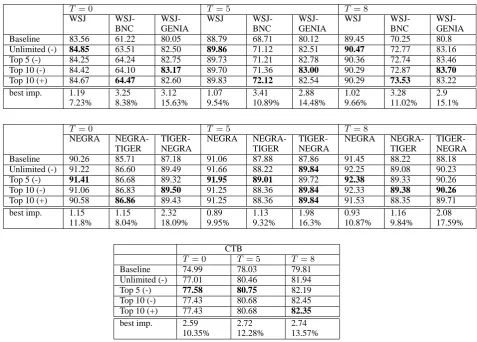
T= 0 T = 5 T = 8
WSJ WSJ- WSJ- WSJ WSJ- WSJ- WSJ WSJ-
WSJ-BNC GENIA BNC GENIA BNC GENIA
Baseline 83.56 61.22 80.05 88.79 68.71 80.12 89.45 70.25 80.8
Unlimited (-) 84.85 63.51 82.50 89.86 71.12 82.51 90.47 72.77 83.16
Top 5 (-) 84.25 64.24 82.75 89.73 71.21 82.78 90.36 72.74 83.46
Top 10 (-) 84.42 64.10 83.17 89.70 71.36 83.00 90.29 72.87 83.70
Top 10 (+) 84.67 64.47 82.60 89.83 72.12 82.54 90.29 73.53 83.22
best imp. 1.19 3.25 3.12 1.07 3.41 2.88 1.02 3.28 2.9
7.23% 8.38% 15.63% 9.54% 10.89% 14.48% 9.66% 11.02% 15.1%
T= 0 T = 5 T = 8
NEGRA NEGRA- TIGER- NEGRA NEGRA- TIGER- NEGRA NEGRA-
TIGER-TIGER NEGRA TIGER NEGRA TIGER NEGRA
Baseline 90.26 85.71 87.18 91.06 87.88 87.86 91.45 88.22 88.18
Unlimited (-) 91.22 86.60 89.49 91.66 88.22 89.84 92.25 89.08 90.23
Top 5 (-) 91.41 86.68 89.32 91.95 89.01 89.72 92.38 89.33 90.26
Top 10 (-) 91.06 86.83 89.50 91.25 88.36 89.84 92.33 89.38 90.26
Top 10 (+) 90.58 86.86 89.43 91.25 88.36 89.84 91.53 88.35 89.71
best imp. 1.15 1.15 2.32 0.89 1.13 1.98 0.93 1.16 2.08
11.8% 8.04% 18.09% 9.95% 9.32% 16.3% 10.87% 9.84% 17.59%
CTB
T = 0 T= 5 T = 8
Baseline 74.99 78.03 79.81
Unlimited (-) 77.01 80.46 81.94
Top 5 (-) 77.58 80.75 82.19
Top 10 (-) 77.43 80.68 82.45
Top 10 (+) 77.43 80.68 82.35
best imp. 2.59 2.72 2.74
10.35% 12.28% 13.57%
in the probability computation of equation 3. For each setup (Table 2) we ran several combinations of query types and values ofNweb. We report
re-sults for the four leading combinations:
• Nweb = 5, left-side and right-side queries
(Top 5 (-)).
• Nweb = 10, left-side and right-side queries
(Top 10 (-)).
• Nweb= 10, replacement, left-side and
right-side queries (Top 10 (+)).
• Nweb = Unlimited (in practice, this means
1000, the maximum number of results pro-vided by Yahoo! Boss), left-side and right-side queries (Unlimited (-) ).
The order of the models with respect to their performance was identical for the development and test data. That is, the best parameter/queries combination for each scenario can be selected us-ing the development data. We experimented with other parameter/queries combinations and addi-tional query types but got worse results.
5 Results
The results of the experiments are shown in Ta-ble 3. Our algorithm improves the accuracy of the
MXPOSTtagger for all three languages and for all values of the unknown word parameter.
Our experimental scenarios consist of three in-domain setups in which the model is trained and tested on the same corpus (the WSJ, NEGRA and CTB experiments), and four domain adap-tation setups: WSJ-GENIA, WSJ-BNC, TIGER-NEGRA and TIGER-NEGRA-TIGER.
Table 3 shows that our model is relatively more effective in the domain adaptation scenar-ios. While in the in-domain setups the error reduc-tion values are 7.23% – 9.66% (English), 9.95% – 11.8% (German) and 10.35% – 13.57% (Chinese), in the domain adaptation scenarios they are 8.38% – 11.02% BNC), 14.48% – 15.63% (WSJ-GENIA), 8.04% – 9.84% (NEGRA-TIGER) and 16.3% – 18.09% (TIGER-NEGRA).
Run Time. As opposed to previous approaches to unknown word tagging (Blitzer et al., 2006; Daume III, 2007), our algorithm does not contain a step in which the base tagger is re-trained with a
corpus collected from the target domain. Instead, when an unknown word is tackled at test time, a set of web queries is run. This is an advantage for flexible multi-domain POS tagging because pre-processing times are minimized, but might cause an issue of overhead per test word.
To show that the run time overhead created by our algorithm is small, we measured its time per-formance (using an Intel Xeon 3.06GHz, 3GB RAM computer). The average time it took the best configuration of our algorithm to process an un-known word and the resulting total addition to the run time of the base tagger are given in Table 4. The average time added to an unknown word tag-ging is less than half a second for English, even less for German, and less than a second for Chi-nese. This is acceptable for interactive applica-tions that need to examine a given sentence with-out being provided with any knowledge abwith-out its domain.
Error Analysis. In what follows we try to ana-lyze the cases in which our algorithm is most ef-fective and the cases where further work is still required. Due to space limitations we focus only on the (Top 10 (+), T = 5) parameters setting, and report the patterns for one English setup. The corresponding patterns of the other parameter set-tings, languages and setups are similar.
We report the errors of the base tagger that our algorithm most usually fixes and the errors that our algorithm fails to fix. We describe the base tagger errors of the type ‘POS tag ‘a’ is replaced with POS tag ‘b’ (denoted by: a -> b)’ using the following data: (1) total number of unknown words whose correct tag is ‘a’ that were assigned ‘b’ by the base tagger; (2) the percentage of un-known words whose correct tag is ‘a’ that were assigned ‘b’ by the base tagger; (3) the percentage of unknown words whose correct tag is ‘a’ that were assigned ‘b’ by our algorithm; (4) the per-centage of mistakes of type (1) that were corrected by our algorithm.
WSJ WSJ- WSJ- NEGRA NEGRA- TIGER- CTB
BNC GENIA TIGER NEGRA
Total addition 00:28:26 00:31:53 1:37:32 00:57:03 00:19:10 00:36:54 2:29:13
Avg. time per word 0.42 0.32 0.33 0.36 0.11 0.21 0.95
Table 4: The processing time added by the web based algorithm to the base tagger. For each setup results are presented for the best performing model and for the unknown word threshold of 8. Results for the other models and threshold parameters are very similar. The top line presents the total time added in the tagging of the full test data (hours:minutes:seconds). The bottom line presents the average processing time of an unknown word by the web based algorithm (in seconds).
JJ (97, 6.17%, 5.3%, 27.8%); (4) JJ -> NN (69, 9.73%, 7.76%, 33.3%). The errors that were not handled well by our algorithm are: (1) IN -> JJ (70, 46.36% , 41%, 8.57%); (2) VBP -> NN (25, 19.5%, 21.9% , 0%).
In this setup, ‘CD’ is a cardinal number, ‘IN’ is a preposition, ‘JJ’ is an adjective, ‘NN’ is a noun (singular or mass), ‘NNS’ is a plural noun, ‘VBP’ is a verb in non-third person singular present tense and ‘VBZ’ is a verb in third person, singular present tense.
We can see that no single factor is responsible for the improvement over the baseline. Rather, it is due to correcting many errors of different types. The same general behavior is exhibited in the other setups for all languages.
Multiple Unknown Words. Our method is ca-pable of handling sentences containing several un-known words. Query results in which ‘*’ is re-placed by an unknown word are filtered. For queries in which an unknown word appears as part of the query (when it is one of the two right or left non-‘*’ words), we let MXPOST invoke its own unknown word heuristics if needed3.
In fact, the relative improvement of our algo-rithm over the baseline is better for adjacent un-known words than for single words. For ex-ample, consider a sequence of consecutive un-known words as correctly tagged if all of its words are assigned their correct tag. In the WSJ-GENIA scenario (Top 10 (+), T = 5), the error reduction for sequences of length 1 (un-known words surrounded by (un-known words, 8767 sequences) is 8.26%, while for 2-words (2620 sequences) and 3-words (614 sequences) it is 11.26% and 19.11% respectively. Similarly, for TIGER-NEGRA (same parameters setting) the
er-3
They are needed only if the word is on the left of the word to be tagged.
ror reduction is 6.85%, 8.07% and 18.18% for se-quences of length 1 (4819) ,2 (1126) and 3 (223) respectively.
6 Conclusions and Future Work
We presented a web-based algorithm for POS tag-ging of unknown words. When an unknown word is tackled at test time, our algorithm collects web contexts of this word that are then used to improve the tag probability computations of the POS tag-ger.
In our experiments we used our algorithm to en-hance the unknown word tagging quality of the
MXPOST tagger (Ratnaparkhi, 1996), a leading
state-of-the-art tagger, which we implemented for this purpose. We showed significant improvement (error reduction of up to 18.09%) for three lan-guages (English, German and Chinese) in seven experimental setups. Our algorithm is especially effective in domain-adaptation scenarios where the training and test data are from different do-mains.
Our algorithm is fast (requires less than a sec-ond for processing an unknown word) and can handle test sentences coming from any desired un-known domain without the costs involved in col-lecting domain-specific corpora and retraining the tagger. These properties makes it particularly ap-propriate for applications that work on the web, which is highly heterogeneous.
In future work we intend to integrate our al-gorithm with additional POS taggers, experiment with additional corpora and domains, and improve our context extraction mechanism so that our al-gorithm will be able to fix more error types.
References
correspon-dence learning. EMNLP ’06.
Brants, Sabine, Stefanie Dipper, Silvia Hansen, Wolf-gang Lezius and George Smith, 2002. The TIGER Treebank. Proceedings of the Workshop on
Tree-banks and Linguistic Theories.
Brants, Thorsten, 1997. The NEGRA Export Format.
CLAUS Report, Saarland University.
Brants, Thorsten, 2000. Tnt: a statistical part-of-speech tagger. In The Sixth Conference on Applied
Natural Language Processing.
Burnard, Lou, 2000. The British National Corpus
User Reference Guide. Technical Report, Oxford
University.
Chen, Qing, Mu Li, and Ming Zhou. 2007. Improving query spelling correction using web search results. In EMNLP-CoNLL ’07.
Chklovski, Timothy and Patrick Pantel. 2004. Ver-bocean: Mining the web for fine-grained semantic verb relations. EMNLP ’04.
Clark, Stephen, James Curran and Miles Osborne. 2003. Bootstrapping POS-taggers using unlabeled data. CoNLL ’03.
Collins, Michael. 2002. Discriminative training meth-ods for hidden markov models: theory and experi-ments with perceptron algorithms. EMNLP ’02.
Daume III, Hal. 2007. Frustratingly easy domain adaptation. ACL ’07.
Davidov, Dmitry, Ari Rappoport, and Moshe Koppel. 2007. Fully unsupervised discovery of concept-specific relationships by web mining. ACL ’07.
Huihsin, Tseng, Daniel Jurafsky, and Christopher Manning. 2005. Morphological features help pos tagging of unknown words across language vari-eties. The Fourth SIGHAN Workshop on Chinese
Language Processing.
Jin–Dong Kim, Tomoko Ohta, Yuka Teteisi and Jun’ichi Tsujii, 2003. GENIA corpus – a seman-tically annotated corpus for bio-textmining.
Bioin-formatics, 19:i180–i182, Oxford University Press,
2003.
Lafferty, John D., Andrew McCallum, and Fernando C. N. Pereira. 2001. Conditional random fields: Probabilistic models for segmenting and labeling sequence data. The Eighteenth International
Con-ference on Machine Learning.
Keller, Frank, Mirella Lapata, and Olga Ourioupina. 2002. Using the Web to Overcome Data Sparseness.
EMNLP ’02.
Keller, Frank, Mirella Lapata. 2003. . Computational
Linguistics, 29(3):459–484.
Lease, Matthew and Eugene Charniak. 2005. Pars-ing Biomedical Literature. ProceedPars-ings of the
Sec-ond International Joint Conference on Natural Lan-guage Processing..
Manning Chris and Hinrich Schuetze. 1999. Foun-dations of Statistical Natural Language Processing.
MIT Press..
Marcus, Mitchell P., Beatrice Santorini, and Mary Ann Marcinkiewicz. 1993. Building a large annotated corpus of english: The penn treebank.
Computa-tional Linguistics, 19(2):313–330.
McClosky, David, Eugene Charniak, and Mark John-son, 2006a. Effective self-training for parsing.
HLT-NAACL ’06.
Nakagawa, Tetsuji and Yuji Matsumoto. 2006. Guess-ing parts-of-speech of unknown words usGuess-ing global information. ACL-COLING ’06 .
PennBioIE. 2005. Mining the Bibliome Project..
http://bioie.ldc.upenn.edu.
Qiu, Likun, Changjian Hu and Kai Zhao. 2008. A method for automatic POS guessing of Chinese un-known words. COLING ’08.
Ratnaparkhi, Adwait. 1996. A maximum entropy model for part-of-speech tagging. EMNLP ’96.
Reichart, Roi and Ari Rappoport. 2007. Self-Training for Enhancement and Domain Adaptation of Statis-tical Parsers Trained on Small Datasets. ACL ’07.
Reynolds, Sheila M. and Jeff A. Bilmes. 2005. Part-of-speech tagging using virtual evidence and nega-tive training. EMNLP ’06.
Szpektor, Idan, Hristo Tanev, Ido Dagan, and Bonaven-tura Coppola. 2004. Scaling web-based acquisition of entailment relations. EMNLP ’04.
Toutanova, Kristina and Christopher D. Manning. 2000. Enriching the knowledge sources used in a maximum entropy part-of-speech tagger. EMNLP
’00.
Toutanova, Kristina, Dan Klein, Christopher D. Man-ning, and Yoram Singer. 2003. Feature-rich part-of-speech tagging with a cyclic dependency network.
NAACL ’03.
Vadas, David and James R. Curran. 2005. Tagging un-known words with raw text features. Australasian
Language Technology Workshop 2005.