Identification Protocols and Signature Schemes Based on Supersingular
Isogeny Problems
Steven D. Galbraith1, Christophe Petit2, and Javier Silva3 1
Mathematics Department, University of Auckland, [email protected] 2
School of Computer Science, University of Birmingham, [email protected] 3
Universitat Pompeu Fabra, Barcelona, [email protected]
Abstract. We present signature schemes whose security relies on computational assumptions relating to isogeny graphs of supersingular elliptic curves. We give two schemes, both of them based on interactive identification protocols. The first identification protocol is due to De Feo, Jao and Plˆut. The second one, and the main contribution of the paper, makes novel use of an algorithm of Kohel, Lauter, Petit and Tignol for the quaternion version of the`-isogeny problem, for which we provide a more complete description and analysis, and is based on a more standard and potentially stronger computational problem. Both identification protocols lead to signatures that are existentially unforgeable under chosen message attacks in the random oracle model using the well-known Fiat-Shamir transform, and in the quantum random oracle model using another transform due to Unruh. A version of the first signature scheme was independently published by Yoo, Azarderakhsh, Jalali, Jao and Soukharev. This is the full version of a paper published at ASIACRYPT 2017.
1
Introduction
A recent research area is cryptosystems whose security is based on the difficulty of finding a path in the isogeny graph of supersingular elliptic curves [10, 12, 18, 24, 26]. Unlike other elliptic curve cryptosystems, the only known quan-tum algorithm for these problems, due to Biasse, Jao and Sankar [8], has exponential complexity. Hence, additional motivation for the study of these cryptosystems is that they are possibly suitable for post-quantum cryptography.
The work of Charles, Goren and Lauter [10] gave a collision-resistant hash function. Jao and De Feo [24] gave a key exchange protocol, De Feo, Jao and Plˆut [18] gave a public key encryption scheme and an interactive identifi-cation protocol, Jao-Soukharev [26] gave an undeniable signature, Xi, Tian and Wang [47] gave a designated verifier signature.
In this paper we present two public key signature schemes whose security relies on computational problems related to finding a path in the isogeny graph of supersingular elliptic curves.
The first scheme is obtained relatively simply from the De Feo-Jao-Plˆut [18] interactive identification protocol by using the Shamir transform to turn it into a non-interactive signature scheme. We also use a variant of the Fiat-Shamir transform due to Unruh to obtain a post-quantum signature scheme. Essentially the same signature scheme was independently published by Yoo, Azarderakhsh, Jalali, Jao and Soukharev [48], but our version has improved signature size. This scheme has the advantage of being simple to describe, at least to a reader who is familiar with the previous work in the subject, and easy to implement. On the other hand, it inherits the disadvantages of [18], in particular it relies on a non-standard isogeny problem using small isogeny degrees, reveals auxiliary points, and uses special primes.
The fastest classical attack on the first scheme has heuristic running time ofO˜(p1/4)bit operations, and the fastest quantum attack (see Section 5.1 of [18]) has running time ofO˜(p1/6). Galbraith, Petit, Shani and Ti [21] and Petit [36] showed that revealing auxiliary points may be dangerous in certain contexts. It is therefore highly advisable to build cryptographic schemes on the most general, standard and potentially hardest isogeny problems.
that is very similar to the proof of graph isomorphism. One obtains a signature scheme by applying the Fiat-Shamir transform or Unruh’s transform. We now briefly sketch the main ideas behind our second scheme. The public key is a pair of elliptic curves(E0, E1)and the private key is an isogenyϕ: E0 → E1. To interactively prove knowledge ofϕone chooses a random isogenyψ : E1 →E2 and sendsE2to the verifier. The verifier sends a bitb. Ifb = 0 the prover revealsψ. Ifb= 1the prover reveals an isogenyη : E0→E2. In either case, the verifier checks that the response is correct. The interaction is repeated a number of times until the verifier is convinced that the prover knows an isogeny fromE0toE1. However, the subtlety is that we cannot just setη=ψ◦ϕ, as thenE1would appear on the path in the graph fromE0toE2and so we would have leaked the private key. The crucial idea is to use the algorithm of Kohel-Lauter-Petit-Tignol [32] to produce a “pseudo-canonical” isogenyη : E0 → E2that is independent ofϕ. The mathematics behind the algorithm of Kohel-Lauter-Petit-Tignol goes beyond what usually arises in elliptic curve cryptography.
The paper is organized as follows. In Section 2 we give preliminaries on isogeny problems, random walks in isogeny graphs, security definitions and the Fiat-Shamir transform. Sections 3 and 4 describe our two signature schemes and Section 5 concludes the paper. In a first reading to get the intuition of our schemes without all im-plementation details, one can safely skip parts of the paper, namely Sections 2.3, 2.4, 2.5, 2.7, 4.3 and 4.4.
2
Preliminaries
2.1 Quaternion Algebras
We summarize the required background on quaternion algebras. For a more detailed exposition of the theory, see [43, 44].
The quaternion algebras used in this paper are quaternion algebras overQramified at a primepand at infinity, where moreoverp= 3 mod 4. Such an algebra can be represented asBp,∞ := Qhi,ji, wherei2 =−1,j2 =−p, k=ij=−ji. The canonical involution onBp,∞is given by
α=x0+x1i+x2j+x3k7−→α¯=x0−x1i−x2j−x3k. from which the reduced trace and norm take the form
Trd(α) =α+ ¯α= 2x0and Nrd(α) =αα¯=x20+x 2 1+px
2 2+px
2 3.
AnidealofBp,∞is aZ-lattice of rank 4. Ideals can be multiplied in the obvious way. Thenormof an idealIis the gcd of the reduced norms of its elements. AnorderofBp,∞is an ideal that is also a ring. Amaximal orderis an order
that is not strictly contained in any other order. Order elements areintegers, namely their reduced norm and trace are in inZ. Orders and ideals inBp,∞are conveniently represented by aZ-basis, namely 4 elementsω0, ω1, ω2, ω3∈Bp,∞.
For orders we can always takeω0= 1. The quaternion algebraBp,∞has a maximal orderO0 =h1,i,1+2k,i+2jithat will be of particular interest in this paper.
For any idealI, theleft orderofIis the set{h∈Bp,∞|hI ⊂I}. We also say thatIis a left ideal ofO. Right
orders and ideals are defined in a similar way. For any orderO, any left ideal ofOcan be written asI =On+Oα wherenis the norm of the ideal, andα∈Ois such thatn|Nrd(α). For any orderOand any prime`6=p, there are `+ 1left ideals ofOwith norm`.
We define equivalence classes of ideals and orders as follows. Two ordersO1andO2are equivalent if and only if there existsq∈B∗p,∞such thatO1q=qO2. For any orderOand anyI1,I2left ideals ofO0,I1andI2are equivalent if and only there existsq∈B∗p,∞such thatI1q=I2. These equivalence classes are compatible in the sense that the left idealsI1andI2are equivalent if and only if their right orders are equivalent. The number of equivalence classes is independent ofOand is called the class number.
2.2 Hard Problem Candidates Related to Isogenies
as a morphism. An isogeny of degree`is called an`-isogeny. Ifϕis separable, thendegϕ= # kerϕ. If there is a separable isogeny between two curves, we say that they areisogenous. Tate’s theorem is that two curvesE, E0 over Fqare isogenous overFqif and only if#E(Fq) = #E0(Fq).
A separable isogeny can be identified with its kernel [46]. Given a subgroupGofE, we can use V´elu’s formulae [40] to explicitly obtain an isogenyϕ:E→E0with kernelGand such thatE0 ∼=E/G. These formulas involve sums over points inG, so using them is efficient as long as#Gis small. Kohel [31] and Dewaghe [16] have (independently) given formulae for the V´elu isogeny in terms of the coefficients of the polynomial defining the kernel, rather than in terms of the points in the kernel. Given a prime`, the torsion groupE[`]contains exactly`+ 1cyclic subgroups of order`, each one corresponding to a different isogeny.
A composition ofnseparable isogenies of degrees`i for1 ≤i ≤ngives an isogeny of degreeN =Qi`iwith kernel a groupGof orderN. Conversely any isogeny whose kernel is a group of smooth order can be decomposed as a sequence of isogenies of small degree, hence can be computed efficiently. For any permutationσon{1, . . . , n}, by considering appropriate subgroups ofG, one can write the isogeny as a composition of isogenies of degree`σ(i). Hence, there is no loss of generality in the protocols in our paper of considering chains of isogenies of increasing degree.
For each isogenyϕ:E →E0, there is a unique isogenyϕˆ :E0 →E, which is called thedual isogenyofϕ, and which satisfiesϕϕˆ= ˆϕϕ= [degϕ]. If we have two isogeniesϕ:E→E0andϕ0 :E0→Esuch thatϕϕ0andϕ0ϕare the identity in their respective curves, we say thatϕ, ϕ0areisomorphisms, and thatE, E0areisomorphic. Isomorphism
classes of elliptic curves overFq can be labeled with theirj-invariant [38, III.1.4(b)]. An isogenyϕ:E →E0 such thatE = E0 is called anendomorphism. The set of endomorphisms of an elliptic curve, denoted byEnd(E), has a ring structure with the operations point-wise addition and function composition.
Elliptic curves can be classified according to their endomorphism ring. Over the algebraic closure of the field, End(E)is either an order in a quadratic imaginary field or a maximal order in a quaternion algebra. In the first case, we say that the curve is ordinary, whereas in the second case we say that the curve is supersingular. Indeed, the endomorphism ring of a supersingular curve over a field of characteristicpis a maximal orderOin the quaternion algebraBp,∞ramified atpand∞.
In the case of supersingular elliptic curves, there is always a curve in the isomorphism class defined overFp2, and
thej-invariant of the class is also an element ofFp2. A theorem by Deuring [15] gives an equivalence of categories
between thej-invariants of supersingular elliptic curves overFp2 up to Galois conjugacy inFp2, and the maximal
orders in the quaternion algebraBp,∞ up to the equivalence relation given byO ∼ O0if and only ifO =α−1O0α
for someα∈Bp,∗∞. Specifically, the equivalence of categories associates to everyj-invariant a maximal order that is
isomorphic to the endomorphism ring of any curve with thatj-invariant.
Furthermore, if E0 is an elliptic curve withEnd(E0) = O0, there is a one-to-one correspondence (which we call theDeuring correspondence) between isogeniesϕ:E0 →Eand leftO0-idealsI. More details on the Deuring correspondence can be found in Chapter 42 of [44]. The key concept is that the idealIis akernel idealfor the isogeny ϕ, meaning that the groupE0[I] := {P ∈ E0(Fp) : α(P) = 0,∀α∈ I}is equal to ker(ϕ). In Section 4 we will heavily use kernel ideals. In particular we will use the following result: Letϕ : E0 → Er be an isogeny of degree
Q
1≤j≤r` ej
j that can be factored as a sequence of isogeniesφi:Ei−1→Eiof degree`eii. WriteIifor the kernel ideal of the compositionφi◦ · · · ◦φ1, which is an isogeny fromEtoEiof degreeQ1≤j≤i`
ej
j . ThenIi=Ii−1`eii+Ii−1α whereα∈End(E0)is an element such thatker(ϕ)∩E0[`eii]⊆ker(α)andgcd(deg(α), `
ei+1 i ) =`
ei i .
We now present some hard problem candidates related to supersingular elliptic curves, and discuss the related algebraic problems in the light of the Deuring correspondence.
Problem 1 Letp, `be distinct prime numbers. LetE, E0be two supersingular elliptic curves overFp2with#E(Fp2) =
#E0(Fp2) = (p+ 1)2, chosen uniformly at random. Findk∈Nand an isogeny of degree`kfromEtoE0.
The fastest classical algorithm known for this problem uses a meet-in-the-middle strategy, and has heuristic running time ofO˜(p1/2)bit operations.
Problem 2 Letp, `be distinct prime numbers. LetEbe a supersingular elliptic curve overFp2, chosen uniformly at random. Findk1, k2 ∈ N, a supersingular elliptic curveE0 overFp2, and two distinct isogenies of degrees`k1 and
The hardness assumption of the second problem has been used in [10] to prove collision-resistance of a proposed hash function. Slightly different versions of the first problem, in which some extra information is provided, were used in [18] to build an identification scheme, a key exchange protocol and a public-key encryption scheme.
More precisely, the identification protocol of De Feo-Jao-Plˆut [18] relies on problems 3 and 4 below (which De Feo, Jao and Plˆut call theComputational Supersingular Isogeny (CSSI)andDecisional Supersingular Product (DSSP)
problems). In order to state them we need to introduce some notation. Letpbe a prime of the form`e1
1 ` e2
2 ·f±1, and let
Ebe a supersingular elliptic curve overFp2. Let{R1, S1}and{R2, S2}be bases forE[`e11]andE[`e22], respectively.
Problem 3 (Computational Supersingular Isogeny) Letφ1:E→E0be an isogeny with kernelh[m1]R1+[n1]S1i,
wherem1, n1 are chosen uniformly at random fromZ/`1e1Z, and not both divisible by `1. GivenE0 and the
val-uesφ1(R2), φ1(S2), compute a compact representation of the isogenyφ1(such as a point inE(Fp2)that generates
h[m1]R1+ [n1]S1i).
The fastest known algorithms for this problem use a meet-in-the-middle argument. The classical and quantum algorithms have heuristic running time respectively ofO˜(`e1/2
1 )andO˜(` e1/3
1 )bit operations, which is respectively ˜
O(p1/4)andO˜(p1/6)in the context of De Feo-Jao-Plˆut [18].
Problem 4 (Decisional Supersingular Product) LetE, E0be supersingular elliptic curves over
Fp2such that there exists an isogenyφ:E→E0of degree`e1
1 . Fix generatorsR2, S2∈E[`e22]and supposeφ(R2)andφ(S2)are given.
Consider the two distributions of pairs(E2, E20)as follows:
– (E2, E02)such that there is a cyclic groupG⊆E[` e2
2 ]of order` e2
2 andE2∼=E/GandE20 ∼=E0/φ(G).
– (E2, E02)whereE2is chosen at random among the curves having the same cardinality asE0, andφ0:E2→E20
is a random`e1
1 -isogeny.
The problem is, given(E, E0)and the auxiliary points (R2, S2, φ(R2), φ(S2)), plus a pair (E2, E20), to determine
from which distribution the pair is sampled.
We stress that Problems 3 and 4 are potentially easier than Problems 1 and 2 because special primes are used and extra points are revealed. Furthermore, it is shown in Section 4 of [21] that ifEnd(E)is known and one can find any isogeny fromEtoE0then one can compute the specific isogeny of degree`e1
1 . The following problem, on the other hand, offers better foundations for cryptography based on supersingular isogeny problems.
Problem 5 Letpbe a prime number. LetEbe a supersingular elliptic curve overFp2, chosen uniformly at random. Determine the endomorphism ring ofE.
Note that it is essential that the curve is chosen randomly in this problem, as for special curves the endomorphism ring is easy to compute. Essentially, Problem 5 is the same as explicitly computing the forward direction of Deuring’s correspondence. This problem was studied in [31], in which an algorithm to solve it was obtained, but with expected running timeO˜(p). It was later improved by Galbraith to O˜(p12), under heuristic assumptions [20]. Interestingly,
the bestquantumalgorithm for this problem runs in timeO˜(p14), only providing a quadratic speedup over classical
algorithms. This has largely motivated the use of supersingular isogeny problems in cryptography.
Problem 6 Letpbe a prime number. LetE, E0 be supersingular elliptic curves over
Fp2, chosen uniformly at ran-dom.4Find an isogenyE→E0.
Heuristically, if we can solve Problem 1 or Problem 6, then we can solve Problem 5. To compute an endomorphism ofE, we take two random walksφ1:E→E1andφ2:E→E2, and solve Problem 6 on the pairE1, E2, obtaining an isogenyψ:E1→E2. Then the compositionφˆ2ψφ1is an endomorphism ofE. Repeating the process, it is plausible to find four endomorphisms that are linearly independent, thus generating a subring ofEnd(E). Repeating the process further, we expect to obtain aZ-basis of the full endomorphism ring after at mostO(logp+ logD), whereD is a bound on the degree of the isogenyψ. Indeed the subring indexN is bounded by the product of the degrees of its
4
generators which is(pD)O(1), any randomly chosen new element will be in that subring with a probability1/N, and every new element not in the subring will decrease the index by at least a factor of 2.
For the converse, suppose that we can compute the endomorphism rings of bothE andE0. The strategy is to
compute a moduleIthat is a left ideal ofEnd(E)and a right ideal ofEnd(E0)of appropriate norm, and to translate it back to the geometric setting to obtain an isogeny. This approach motivated the quaternion`-isogeny algorithm of Kohel-Lauter-Petit-Tignol [32, 35], which solves the following problem:
Problem 7 Let p, ` be distinct prime numbers. Let O0,O1 be two maximal orders in Bp,∞, chosen uniformly at random. Findk∈Nand an idealIof norm`ksuch thatIis a leftO0-ideal and its right order is isomorphic toO1.
The algorithm can be adapted to produce ideals ofB-powersmooth norm (meaning the norm isQ
i` ei
i where the `iare distinct primes and`eii ≤B) forB ≈
7
2logpand usingO(logp)different primes, instead of ideals of norm a power of`. We will use that version in our second signature scheme.
For completeness we mention that ordinary curve versions of Problems 1 and 5 are not known to be equivalent, and in fact there is a subexponential algorithm for computing the endomorphism ring of ordinary curves [9], whereas the best classical algorithm known for computing isogenies is still exponential. There is, however, a subexponential quan-tum algorithm for computing an isogeny between ordinary curves [11], which is why the main interest in cryptography is the supersingular case.
2.3 Random Walks in Isogeny Graphs
Letp≥5be a prime number. There areNp :=b12pc+psupersingularj-invariants in characteristicp, withp = 0,1,1,2whenp= 1,5,7,11 mod 12respectively. For any prime`6=p, one can construct a so-called isogeny graph, where each vertex is associated to a supersingular j-invariant, and an edge between two vertices is associated to a degree`isogeny between the corresponding vertices.
Isogeny graphs are regular5 with regularity degree`+ 1; they are undirected since to any isogeny fromj1toj2 corresponds a dual isogeny fromj2toj1. Isogeny graphs are also very goodexpander graphs[23]; in fact they are optimal expander graphs in the following sense:
Definition 1 (Ramanujan graph).LetGbe ak-regular graph, and letk, λ2,· · ·, λrbe the eigenvalues of the
adja-cency matrix sorted by decreasing order of the absolute value. ThenGis aRamanujan graphif
λ2≤2 √
k−1.
This is optimal by the Alon-Boppana bound: given a family{GN}ofk-regular graphs as above, and denoting byλ2,N the corresponding second eigenvalue of each graphGN, we have lim infN→∞λ2,N ≥ 2
√
k−1. The Ramanujan property of isogeny graphs follows from the Weil conjectures proved by Deligne [14, 37].
Letpand`be as above, and letjbe a supersingular invariant in characteristicp. We define a random step of degree `fromjas the process of randomly and uniformly choosing a neighbour ofjin the`-isogeny graph, and returning that vertex. For a composite degreen=Q
i`i, we define a random walk of degreenfromj0as a sequence ofj-invariants jisuch thatjiis a random step of degree`ifromji−1. We do not require the primes`ito be distinct.
The output of random walks in expander graphs converges quickly to a uniform distribution. In our signature scheme we will be using random walks ofB-powersmoothdegreen, namelyn=Q
i` ei
i , with all prime powers` ei i smaller than some boundB, withBas small as possible. To analyse the output distribution of these walks we will use the following generalization6of classical random walk theorems [23]:
Theorem 1 (Random walk theorem).Letpbe a prime number, and letj0be a supersingular invariant in
charac-teristicp. Let j be the finalj-invariant reached by a random walk of degreen = Q
i` ei
i fromj0. Then for every
j-invariant˜jwe have
Pr[j= ˜j]− 1 Np
≤Y
i
2√`
i `i+ 1
ei
.
5One needs to pay close attention to the casesj= 0andj= 1728when counting isogenies, but this has no effect on our general schemes.
6
PROOF: Letvtj be the probability that the outcome of the firsttrandom steps is a given vertexj, and letvt= (vtj)j be vectors encoding these probabilities. Letv0correspond to an initial state of the walk atj0 (so thatv0j0 = 1and
v0j = 0for alli6=j0). LetA`ibe the adjacency matrix of the`i-isogeny graph. Its largest eigenvalue iski. By the Ramanujan property the second largest eigenvalue is smaller thankiin absolute value, so the eigenspace associated to λ1 =kiis of dimension 1 and generated by the vectoru:= (Np−1)j corresponding to the uniform distribution. Let λ2ibe the second largest eigenvalue ofA`iin absolute value.
If steptis of degree`iwe havevt = k1iA`ivt−1. Moreover we have||vt−u||2 ≤ 1
kiλ2i||vt−1−u||2 since the eigenspace associated tokiis of dimension 1. Iterating on all steps we deduce
||vt−u||2≤
Y
i |1
kiλ2i| ei||v
0−u||2≤
Y
i |1
kiλ2i| ei
since||v0−u||22= (1− 1 Np)
2+Np−1 Np (
1 Np)
2≤1− 2 Np +
2 N2
p <1. Finally we have
Pr[j= ˜j]− 1 Np
=||vt−u||∞≤ ||vt−u||2≤
Y
i |1
kiλ2i|
ei ≤Y
i
2√`
i `i+ 1
ei
,
where we have used the Ramanujan property to bound the eigenvalues.
In our security proof we will want the right-hand term to be smaller than(p1+)−1for an arbitrary positive constant
, and at the same time we will want the powersmooth boundBto be as small as possible. The following lemma shows that takingB≈2(1 +) logpsuffices asymptotically.
Lemma 1. Let >0. There is a functioncp=c(p)such thatlimp→∞cp= 2(1 +), and, for eachp,
Y
`iprime
ei:=max{e∈N|`ei<cplogp}
`
i+ 1 2√`i
ei
> p1+.
PROOF: LetBbe an integer. We have
Y
`iprime ei:=max{e∈N|`e
i<B}
`
i+ 1 2√`i
ei
> Y `i<B `iprime
`
i+ 1 2√`i
> Y `i<B `iprime
√`
i 2
.
Taking logarithms, using the prime number theorem and replacing the sum by an integral we have
log Y `i<B `iprime
√`
i 2
= X `i<B `iprime
1
2log`i−
X
`i<B `iprime
log 2≈1 2
Z B
1
logx 1
logxdx− B
logB =
= 1 2B−
B
logB ≈
1 2B.
ifBis large enough. TakingB =clog(p)wherec= 2(1 +)gives 12B = (1 +) logp= log(p1+)which proves the lemma.
2.4 Efficient Representations of Isogeny Paths and Other Data
efficiency of our signature schemes. As these paths will be sent from one party to another, the second party needs an efficient way to verify that the bitstring received corresponds to an isogeny path between the right curves.
Letpbe a prime number. Every supersingularj-invariant is defined overFp2. A canonical representation ofFp2
-elements is obtained via a canonical choice of degree 2 irreducible polynomial overFp. Canonical representations in any other extension fields are defined in a similar way. Although there are only aboutp/12supersingularj-invariants in characteristicp, we are not aware of an efficient method to encode these invariants intologpbits, so we represent supersingularj-invariants with the2 logpbits it takes to represent an arbitraryFp2-element.
Elliptic curves are defined by theirj-invariant up to isomorphism. Hence, rather than sending the coefficients of the elliptic curve equation, it suffices to send thej-invariant. For any invariantj there is a canonical elliptic curve equationEj :y2 =x3+17283j−jx+17282j−j whenj 6= 0,1728,y2 =x3+ 1whenj = 0, andy2 =x3+xwhen j = 1728. If one needs a particular group order then one might need to take a twist, which is why we use the curve y2=x3+Axin our second signature scheme.
We now turn to representing chainsE0, E1, . . . , En of isogeniesφi :Ei−1→Eieach of prime degree`iwhere 1≤i≤n. Here`iare always very small primes. A useful feature of our protocols is that isogeny chains can always be chosen such that the isogeny degrees are increasing`i≥`i−1. First we need to discuss how to represent the sequence of isogeny degrees. If all degrees are equal to a constant`(e.g.,`= 2) then there is nothing to send. If the degrees are different then the most compact representation seems to be
N= n
Y
i=1
`i
which might be a global system parameter, or may be sent as part of the protocol. The receiver can recover the sequence of isogeny degrees fromN by factoring using trial division and ordering the primes by size. This representation is possible due to our convention the isogeny degrees are increasing and since the degrees are all small.
Now we discuss how to represent the curves themselves in the chain of isogenies. We give several methods.
1. There are two naive representations. One is to send all thej-invariantsji =j(Ei)for0 ≤i≤n. This requires 2(n+ 1) log2(p)bits. Note that the verifier is able to check the correctness of the isogeny chain by checking that Φ`i(ji−1, ji) = 0for all1≤i≤n, whereΦ`iis the`i-th modular polynomial. The advantage of this method is that verification is relatively quick (just evaluating a polynomial that can be precomputed and stored).
The other naive method is to send thex-coordinate of a kernel pointPi ∈ Eji on the canonical curve. Given
ji−1and the kernel pointPi−1one computes the isogenyφi : Eji−1 →Eji using the V´elu formula and hence deducesji. Note that the kernel point is not unique and is typically defined over an extension of the field. Both these methods require huge bandwidth.
A refinement of the second method is used in our first signature scheme, where`is fixed and one can publish a point that defines the kernel of the entire isogeny chain. Precisely a curveEand pointsR, S ∈E[`n]are fixed. Each integer0 ≤α < `n defines a subgrouphR+ [α]Siand hence an`n isogeny. It suffices to sendα, which requireslog2(`n)bits. In the case`= 2this is justnbits, which is smaller than all the other suggestions in this section.
2. One can improve upon the naive method in several simple ways. One method is to send every secondj-invariant. The Verifier accepts this as a valid path if, for all odd integersi, the greatest common divisor overFp2[y]
gcd(Φ`i(ji−1, y), Φ`i+1(y, ji+1))
is a non-constant polynomial, which will almost always be(y−ji).
Another method is to send only some least significant bits (more thanlog2(`i+ 1)of them) of thejiinstead of the entire value. The verifier can reconstruct the isogeny path by factoringΦ`i(ji−1, y)overFp2 (it will always split completely in the supersingular case) and then selectingjito be the root that has the correct least significant bits (depending on how many bits are used there may occassionally be a non-unique choice of root, but considering the path globally the compressed representation should lead to a unique sequence ofj-invariants).
3. An optimal compression method seems to be to define a well-ordering onFp2 (e.g., lexicographic order on the
Φ`i(ji−1, y)are written in order,ji is thek-th root. It is clear that the verifier can reconstruct the valuejiand hence can reconstruct the whole chain from this information. The sequence of integersk can be encoded as a single integer in terms of a “baseQi
j=1(`i+ 1)” representation.
If the walk is non-backtracking and the primes `i are repeated then one can remove the factor(y−ji−2)that corresponds to the dual isogeny of the previous step, this can save some bandwidth.
We call this method “optimal” since it is hard to imagine doing better than log2(`i + 1)bits for each step in general,7though we have no proof that one cannot do better. However, note that the verifier now needs to perform
polynomial factorisation, which may cause some overhead in a protocol. Note that in the case where all`i = 2 and the walk is non-backtracking then this method also requiresnbits, which matches the method we use in our first signature scheme (mentioned in item 1 above).
4. A variant of the optimal method is to use an ordering on points/subgroups rather thanj-invariants. At each step one sends an indexksuch that the isogenyφ : Ei−1 → Ei is defined by thek-th cyclic subgroup ofEji−1[`i].
Again the verifier can reconstruct the path, but this requires factoring`i-division polynomials.
To be precise: Given a canonical ordering on the field of definition ofE[`], one can define a canonical ordering of the cyclic kernels, hence represent them by a single integer in{0, . . . , `}. One can extend this canonical ordering to kernels of composite degrees in various simple ways (see also [3, Section 3.2]). If two curves are connected by two distinct isogenies of the same degree then either one can be chosen (it makes no difference in our protocols), so the ambiguity in exceptional cases is never a problem for us.
In practice, since these points may be defined over an extension of Fp2, we believe that ordering the roots of
Φ`i(ji−1, y)is significantly more efficient than ordering kernel subgroups.
For future reference we now discuss how to efficiently represent the quaternion algebra and a special orderO0. Whenp = 3 mod 4, the quaternion algebraBp,∞ ramified atpand∞can be canonically represented asQhi,ji, wherei2 =−1,j2 =−pandk := ij = −ji. The maximal orderO
0withZ-basis{1,i,1+2k,
i+j
2 }corresponds to the curveE0withj-invariantj0:= 1728under Deuring’s correspondence, and there is an isomorphism of quaternion algebrasθ:Bp,∞→End(E0)⊗Qsending(1,i,j,k)to(1, φ, π, πφ)whereπ: (x, y)→(xp, yp)is the Frobenius endomorphism, andφ: (x, y)→(−x, ιy)withι2=−1 modp(see Lemma 2 of [32]).
Finally we give a brief analysis of the complexity of the basic operations required for our schemes, assuming fast (quasi-linear) modular and polynomial arithmetic.
As discussed above, an isogeny step of prime degree`can be described by a single integer in{0, . . . , `}. Similarly, by combining integers in a product, an isogeny of degreeQ
i` ei
i can be described by a single positive integer smaller thanQ
i(`i+ 1)ei. This integer can define either a list of subgroups (specified in terms of some ordering), or a list of supersingularj-invariants (specified in terms of an ordering on the roots of the modular polynomial). In the first case, the verifier will need at each step given aj-invariant to compute the curve equation, then its full`itorsion (which may be over a large field extension), then to sort with respect to some canonical ordering the cyclic subgroups of order`i to identify the correct one, and finally to compute the nextj-invariant with V´elu’s formulae [40]. In the second case the verifier will need at each step given aj-invariant, to specialize one variable of the`i-th modular polynomial, then to compute all roots of the resulting univariate polynomial and finally to sort the roots to identify the correct one. The second method is more efficient as it does not require running V´elu’s formulae over some large field extension, and the root-finding and sorting routines are applied on smaller inputs. We assume that the modular polynomials are precomputed.
In our second signature scheme we will have`ei
i =O(logp). The cost of computing an isogeny increases with the size of`i. Hence it suffices to analyse the larger case, for whichei= 1and`i=O(logp). Assuming precomputation of the modular polynomials and using [45] for polynomial factorization, the most expensive part of an isogeny step is evaluating the modular polynomialsΦ`i(x, y)atx=ji−1, as these polynomials are bivariate with degree`i in each variable they haveO(`2
i)monomials and so this requiresO(log 2
p)field operations for a total cost ofO˜(log3p)bit operations sincej-invariants are defined overFp2. In our first signature scheme based on the De Feo-Jao-Plˆut protocol
we have`i=O(1)so each isogeny step costsO˜(logp)bit operations.
Alternatively, isogeny paths can be given as a sequence of j-invariants. To verify the path is correct one must computeΦ`i(ji−1, ji), which still requiresO˜(log
3
p)bit operations. However, in practice it would be much quicker to 7
In the most general case, when all primes`iare distinct, then there areQi(`i+ 1)possible isogeny paths and thus one cannot expect to represent an arbitrary path using fewer thanlog2(
Q
not require root-finding algorithms. Also, all the steps can be checked in parallel, and all the steps of a same degree are checked using the same polynomial, so we expect many implementation optimizations to be possible.
2.5 Identification Schemes and Security Definitions
In this section we recall the standard cryptographic notions of sigma-protocols and identification schemes. A good general reference is Chapter 8 of Katz [27] and the lecture notes of Damg˚ard [13] and Venturi [41]. A sigma-protocol is a three-round proof of knowledge of a relation. An identification scheme is an interactive protocol between two parties (a Prover and a Verifier). We use the terminology and notation of Abdalla-An-Bellare-Namprempre [1] (also see Bellare-Poettering-Stebila [5]). We also introduce a notion of “recoverability” which is implicit in the Schnorr signature scheme and seems to be folklore in the field. All algorithms below are probabilistic polynomial-time (PPT) unless otherwise stated.
Definition 2. Letλbe a security parameter and letX=X(λ)andY =Y(λ)be sets. LetRbe a relation onY ×X
that defines a languageL={y∈Y :∃x∈X, R(y, x) = 1}. Giveny ∈L, an elementx∈Xsuch thatR(y, x) = 1
is called awitness. LetKbe a PPT algorithm such thatK(1λ)outputs pairs(y, x)such thatR(y, x) = 1.
A sigma-protocol for the relationRis a 3-round interactive protocol between a proverPand a VerifierV. BothP
andV are PPT algorithms with respect to the parameterλ. The prover holds a witnessxfory ∈Land the verifier is giveny. The prover first sends a valueα(the commitment) to the verifier, the verifier responds with a challenge
β (chosen from some set of possible challenges), and the prover answers withγ. The verifier outputs1if it accepts the proof and zero otherwise. The triple(α, β, γ)is called atranscript. Formally the protocol runs asα← P(y, x);
β← V(y, α);γ← P(y, x, α, β);b← V(y, α, β, γ)is such thatb∈ {0,1}.
A sigma-protocol iscompleteif the verifier outputs1with probability 1. A transcript for which the verifier outputs
1is called avalid transcript.
A sigma-protocol is2-special soundif there is anextractoralgorithmX such that for anyy∈L, given two valid transcripts(α, β, γ)and(α, β0, γ0)for the same first messageαbutβ06=β, thenX(α, β, γ, β0, γ0)outputs a witness
xfor the relation.
A sigma-protocol ishonest verifier zero-knowledge (HVZK)if there is an efficient simulatorSthat on inputy∈L
generates valid transcripts(α, β, γ)that are distributed identically to the transcripts of the real protocol. Formally, there exists a PPT simulatorSsuch that for all PPT adversariesA, we have
|Pr[(y, x)←K(1λ); (α,ST0)← P(y, x); (β,ST)← A(y);
γ← P(y, x,ST0, α, β) :A(ST, y, α, γ) = 1]
−Pr[(y, x)←K(1λ); (β,ST)← A(y); (α, γ)← S(y, β) :A(ST, y, α, γ) = 1]| ≤negl(λ).
An identification scheme is an interactive protocol between two parties (a Prover and a Verifier), where the Prover aims to convince the Verifier that it knows some secret without revealing anything about it. This is achieved by the Prover first committing to some value, then the Verifier sending a challenge, and finally the Prover computing a response that depends on the commitment, the challenge and the secret.
Definition 3. Acanonical identification schemeisID= (K,P,V, c)whereKis a randomised algorithm (key gener-ation) that on input a security parameterλoutputs a pair(PK,SK);P is an algorithm taking inputSK, random coins
rand state informationSTand returns a message,cis the length of the challenge (a function of the parameterk) and
V is a deterministic verification algorithm that takes as inputPKand a transcript and outputs0or1. Atranscript of an honest executionof the schemeIDis the sequence:CMT← P(SK, r),CH← {0,1}c,RSP← P(SK, r,CMT,CH). On an honest execution we require thatV(PK,CMT,CH,RSP) = 1.
AnimpersonatorforIDis an algorithmIthat plays the following game:Itakes as input a public keyPKand a set of transcripts of honest executions of the schemeID;IoutputsCMT, receivesCH← {0,1}cand outputsRSP. We say
thatIwins ifV(PK,CMT,CH,RSP) = 1. The advantage ofIis|Pr(Iwins)− 1
2c|. We say thatIDissecure against impersonation under passive attacksif the advantage is negligible for all probabilistic polynomial-time adversaries.
An ID-schemeIDisnon-trivialifc≥λ.
An ID-scheme isrecoverableif there is a deterministic algorithm Rec such that for any transcript(CMT,CH,RSP)
One can transform any2-special sound ID scheme into a non-trivial scheme by runningtsessions in parallel, and this is secure for classical adversaries (see Section 8.3 of [27]). We will not need this result in the quantum case. One first generatesCMTi ← P(PK,SK)for1≤i≤t. One then samplesCH← {0,1}ctand parses it asCHi∈ {0,1}cfor 1≤i≤t. Finally one computesRSPi← P(PK,SK,CMTi,CHi). We define
V(PK,CMT1,· · ·,CMTt,CH,RSP1,· · · ,RSPt) = 1
if and only ifV(PK,CMTi,CHi,RSPi) = 1for all1≤i≤t. The successful cheating probability is then improved to 1/2ct, which is non-trivial whent≥λ/c.
An ID-scheme is a special case of a sigma-protocol with respect to the relation defined by the instance generator Kas(PK,SK)←K, where we think ofSKas a witness forPK. More generally, any sigma-protocol for a relation of a certain type can be turned into an identification scheme.
Definition 4. (Definition 6 of [41]; Section 6 of [13]; Definition 15 of [39], where it is called “hard instance gener-ator”) Ahard relationRonY ×X is one where there exists a PPT algorithmKthat outputs pairs(y, x)∈Y ×X
such thatR(y, x) = 1, but for all PPT adversariesA
Pr[(y, x)←K(1λ);x0← A(y) :R(y, x0) = 1]≤negl(λ).
The following result is essentially due to Feige, Fiat and Shamir [17] and has become folklore in this generality. For the proof see Theorem 5 of [41].
Theorem 2. LetRbe a hard relation with generatorKand let(P,V)be the prover and verifier in a sigma-protocol forRwithc-bit challenges for some integerc≥1. Suppose the sigma-protocol is complete,2-special sound, and hon-est verifier zero-knowledge. Then(K,P,V, c)is a canonical identification scheme that is secure against impersonation under (classical) passive attacks.
PROOF: The only difference between the sigma protocol and the ID-scheme is a change of notation from(y, x)← K(1λ)to(PK,SK)←K(1λ),αtoCMT,βtoCHandγtoRSP. For details see Theorem 5 of [41].
2.6 Signatures and the Fiat-Shamir Transform
For signature schemes we use the standard definition ofexistential unforgeability under chosen message attacks[28] (we sometimes abbreviate this tosecure). An adversary can ask for polynomially many signatures of messages of his choice to a signing oracleSignSK(·). Then, the attack is considered successful if the attacker is able to produce a valid pair of message and signature for a message different from those queried to the oracle.
Definition 5. A signature schemeΠ = (Gen,Sign,Verify)is said to beexistentially unforgeable under adaptive chosen-message attacks(or secure, for short) if for all probabilistic polynomial time adversariesAwith access to
SignSK(·),
Pr
(PK,SK)←Gen(1λ);σi ←SignSK(mi)for1≤i≤k;
(m, σ)← A(PK,(mi)ki=1,(σi)ki=1) :
VerifyPK(m, σ) = 1andm6∈ Q
≤negl(λ).
whereQ={m1, . . . , mk}is the set of messages queried byAto the oracle, andk= #Qis polynomial inλ. We now discuss the Fiat-Shamir transform [19] to build a signature scheme from an identification scheme. The idea is to make the interactive protocolID= (K,P,V, c)non-interactive by using a random oracle to produce the challenges. Suppose the protocolIDmust be executed in parallelttimes to be non-trivial (with soundness probability 1/2tc). LetHbe a random oracle that outputs a bit string of lengthct.
– Sign(SK, m): Compute the commitmentsCMTi← P(SK, ri)for1≤i≤t. Computeh=H(m,CMT1,· · · ,CMTt). Parsehas thetvaluesCHi∈ {0,1}c. ComputeRSPi← P(SK, ri,CMTi,CHi)for1≤i≤t. Output the signature σ= (CMT1, . . . ,CMTt,RSP1, . . . ,RSPt).
– Verify(m, σ,PK): compute h = H(m,CMT1,· · ·,CMTt). Parseh as the t values CHi ∈ {0,1}c. Check that V(PK,CMTi,CHi,RSPi) = 1for all1≤i≤t. IfVreturns1for allithen output1, else output0.
Abdalla-An-Bellare-Namprempre [1] (also see Bellare-Poettering-Stebila [5]) have proved the security of the Fiat-Shamir transform to a high degree of generality.
Theorem 3. ( [1]) Let ID be a non-trivial canonical identification protocol that is secure against impersonation under passive attacks. LetS be the signature scheme derived fromIDusing the Fiat-Shamir transform. ThenS is secure against chosen-message attacks in the random oracle model.
Remark 1. If the ID-schemeIDis recoverable then one can obtain a more compact signature scheme. Recall that
“recoverable” means there is a deterministic algorithm Rec such that for any transcript of an honest execution we have Rec(PK,CH,RSP) =CMT. We now describe the signature scheme.
– (PK,SK)←K(λ).
– Sign(SK, m): Compute the commitmentsCMTi← P(SK, ri)for1≤i≤t. Computeh=H(m,CMT1,· · · ,CMTt). Parsehas thetvaluesCHi∈ {0,1}c. ComputeRSPi← P(SK, ri,CMTi,CHi)for1≤i≤t. Output the signature σ= (h,RSP1, . . . ,RSPt).
– Verify(m, σ,PK): Parsehas thetvaluesCHi ∈ {0,1}c. ComputeCMTi = Rec(PK,CHi,RSPi)for1 ≤i ≤ t. Check thath=H(m,CMT1,· · ·,CMTt)and thatV(PK,CMTi,CHi,RSPi) = 1for all1 ≤i≤t. IfV returns1 for allithen output1, else output0.
An attacker against this signature scheme can be turned into an attacker on the original signature scheme (and vice versa), which shows that both schemes have the same security. This is addressed in the following result.
Theorem 4. LetIDbe a non-trivial canonical recoverable identification protocol that is secure against
imperson-ation under passive attacks. LetS be the signature scheme derived from ID using the Fiat-Shamir transform of
Remark 1. ThenSis secure against chosen-message attacks in the random oracle model.
PROOF: LetAbe an algorithm that forges signatures against the signature scheme of Remark 1. We will convert Ainto an algorithmB that forges signatures for the original Fiat-Shamir signature scheme that is proved secure in Theorem 3.
LetB be given as input a public key PK, and callAon that key. WhenAmakes a sign query or a hash query, pass these on as queries made byB. Results of hash queries are forwarded to A. When B gets back a signature (CMT1, . . . ,CMTt,RSP1, . . . ,RSPt)for messagemwe computeh = H(m,CMT1, . . . ,CMTt,)and return toAthe signatureσ= (h,RSP1, . . . ,RSPt).
Finally Aoutputs a forgeryσ∗ = (h∗,RSP∗1, . . . ,RSP∗t)on messagem. This is different from previous outputs of the sign oracle, which means that σ 6= (h,RSP1, . . . ,RSPt) for every output of the sign oracle. Note that this non-equality means eitherRSP∗i 6=RSPi for someiorh6=h∗. Parseh∗as a sequence of challengesCH∗i. Compute
CMT∗i = Rec(PK,CHi∗,RSP∗i) for1 ≤ i ≤ t and return(CMT∗1, . . . ,CMT∗t,RSP∗1, . . . ,RSP∗t) as a forgery on mes-sagemfor the original scheme. We claim that this is also distinct from all other signatures that have been returned toB: if equal to some previous signature(CMT1, . . . ,CMTt,RSP1, . . . ,RSPt)on messagemthenRSP∗i = RSPiand h∗=H(m,CMT∗1, . . . ,CMT∗t) =h, which violates the fact thatσ∗was a valid forgery onm.
which is essentially computing a second-preimage in the hash function. As a result, in most practical settings and if H behaves like a random oracle, then one can taket =λ. This optimisation was already mentioned in the original paper on Schnorr signatures, and has been discussed in detail by Neven-Smart-Warinschi [33]. It is known (see Sec-tion 6.2 of [7]) that sponge hash funcSec-tions behave like a random oracle, as do truncated Merkle-Hellman funcSec-tions. Hence, with a well-chosen hash function one can taket=λ. On the other hand,t=λwould not be sufficient for a Merkle-Damg˚ard functions [30, 33].
2.7 Post-Quantum Alternatives To Fiat-Shamir
If one considers a quantum adversary who can make quantum queries to the random oracle then arguments in the clas-sical random oracle model are not necessarily sufficient. Fortunately, an alternative transform was recently provided by Unruh [39], which converts a sigma-protocol into a signature scheme that is secure against a quantum adversary. The transform is also discussed by Goldfeder, Chase and Zaverucha [22].
Definition 17 of [39] gives a notion of security for signature schemes in the quantum random oracle model. The definition is identical to Definition 5 except that queries to the hash function (random oracle) may be quantum (note that queries to the Sign oracle remain classical).
We now set the scene for Unruh’s transform. Let Kbe a generator for a hard relation as in Definition 4. LetP andV be a sigma-protocol for the relation, where the set of challenges is{0,1}cand where2c is polynomial in the security parameter. Suppose the sigma-protocol is complete,n-special sound, and honest verifier zero-knowledge. Let tbe a parameter so that2ctis exponential in the security parameter and letH :{0,1}∗→ {0,1}tcbe a hash function that will be modelled as a random oracle. LetΓ be the set of possible responsesγ(also denotedRSP) in the sigma-protocol.The transform also requires a quantum random oracleG :Γ → Γ which should be injective or at least be such that every element has at most polynomially many pre-images.
Unruh first gives a construction for a NIZK proof (Figure 1 of [39]) and then gives a construction for a signature scheme (Definition 16 of [39]). We collapse these into a single transform and use an optimisation from [22], essentially to define the challenges to be fixed bitstringsj =CHi,jso that they do not need to be hashed or checked.
– Gen(1λ):(PK,SK)←K(1λ).
– Sign(SK, m): Compute the commitmentsCMTi← P(PK,SK)for1≤i≤t.
Now, for eachiand all0≤j <2csetCHi,jto be the binary representation ofj. In other words{CHi,j : 0≤j < 2c}is the set of allc-bit binary strings, and so is the set of all possible challenges.
For all1≤i≤tand0≤j <2ccomputeRSPi,j←P(PK,SK,CMTi,CHi,j)andgi,j=G(RSPi,j)(note that this ist2cvalues).
LetT (the transcript) be a bitstring representing all commitments, challenges and the valuesgi,j, so that T = (CMT1, . . . ,CMTt,CH1,0, . . . ,CHt,2c−1, g1,0, . . . , gt,2c−1).
Leth=H(PK, m, T)and parse it asCH1, . . . ,CHtwhere each value is in{0,1}c. More precisely, writeJi for the integer whose binary representation is thei-th block ofcbits in the hash value and thenCHi = CHi,Ji. The signature is
σ= (T,RSP1,J1, . . . ,RSPt,Jt).
– Verify(m, σ,PK): Computeh=H(PK, m, T)and parse it astintegersJ1, . . . , Jt. Check that the challenges are correctly formed inT, thatgi,Ji =G(RSPi,Ji), and thatV(PK,CMTi,CHi,Ji,RSPi,Ji) = 1for all1≤i≤t. If all checks are correct then output1, else output0.
Theorem 5. ( [39]) LetRbe a hard relation with generatorKand let(P,V)be the prover and verifier in a sigma-protocol for R withc-bit challenges for some integerc ≥ 1. Suppose the sigma-protocol is complete, n-special sound, and honest verifier zero-knowledge. Then the signature scheme obtained by applying the Unruh transform is existentially unforgeable under an adaptive chosen-message attack in the quantum random oracle model.
If the scheme is recoverable then the signature may be compressed in size by computingCMTi=Rec(PK,CHi,Ji,RSPi,Ji) for1≤i≤t. However, compared with the original Fiat-Shamir transform, the saving in signature size is negligible since it is necessary to send all thegi,jas part of the signature.
Remark 3. In Unruh [39] the setΓ is of a fixed size and all responses have the same length. The quantum random oracleGis used to commit to all responses at the same time, and its domain and image sets have the same size to ensure thatGis biding in an unconditional or at least statistical sense (i.e. a computationally binding commitment would not suffice). In our protocols however, the challenges are just one bit, and the responses to challenges 0 and 1 have different lengths. We therefore use two quantum random oraclesG0 andG1to hide responses to challenges 0 and 1 respectively.
Remark 4. In practice we will replace the random oracle by a concrete hash function with a certain output lengtht. The correct choice oftin the quantum setting is still a subject of active research. As mentioned in Remark 2, a first question is whether one is concerned with chosen-message forgery/repudiation. The next question is to what extent quantum algorithms speed up collision finding. The third question is to consider a concrete analysis of the security proof for Unruh’s transform, and any other factors in the security reduction that may be influenced by the hash output size. One conservative option is to assume that Grover’s algorithm gives the maximal speedup for quantum algorithms, in which case one could taket = 3λto ensure collision-resistance. Bernstein [6] has questioned the practicality of quantum collision-finding algorithms. Following his arguments, Goldfeder, Chase and Zaverucha [22] choset = 2λ, and a similar choice was made in Yoo et al. [48]. On the other hand, Beals et al. [4] suggest there may be a quantum speedup that would require increasingt.
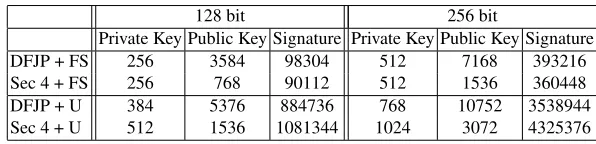
We keeptas a parameter that can be adjusted as more information comes to light. The tables in Section 4.7 are computed using the conservative choicet= 3λ.
2.8 Heuristic Assumptions used in this Paper
This paper makes use of several heuristic assumptions. All these assumptions say that some forms of the following approximations are valid.
Approximation 1 LetN1 be a set and letN2 ⊂ N1. Letχ be a probability distribution onN1. We approximate Pr[x∈ N2|x←χ]≈ |N2|/|N1|.
In several cases,N1 will be the set of positive integers up to some bound, and N2 will be a subset of integers with some factorization pattern. In this case, we will approximate|N2|/|N1|by the value naturally expected from the density of primes.
Approximation 2 LetBbe a positive integer and letN1:={1,2, . . . , B}. LetN2⊂ N1be the subset of integers in N1satisfying some factorization pattern. We approximatePr[x∈ N2|x ←χ]by the expected value of|N2|/|N1|
following the density of primes.
More precisely:
– In Section 4.3, Step 2c, the existence ofβ2is guaranteed if some linear system is invertible overZN. HereN is an integer of cryptographic size, and the system is randomized through the selection ofαandβ1in Steps 2a and 2b. We assume that the probability of having a non invertible system is negligible.
– In Lemma 6, we generate candidates for the idealsIiaccording to some distribution on the solution of a quadratic form. Here there areO(logp)candidate ideals, and we assume that onlyO(logp)trials are needed to find the correct one.
– In Section 4.3, Step 1, we construct a random element in an idealIaccording to a specific distribution, and assume the reduced norm of this element will be a prime with a probability as given by the prime number theorem.
All assumptions except for the second one come from our use of (the powersmooth variant of) the quaternion isogeny algorithm in [32].
We expect that the first two assumptions above can be removed with a finer analysis, maybe together with some minor algorithmic changes and a moderate efficiency loss. In the case of the second assumption, trying all possible solutions to the quadratic form will maintain a polynomial complexity, though of a slightly bigger degree. One might then reduce that degree by exploiting the structure of all solutions leading to the same ideals.
On the other hand, a rigorous proof for the remaining assumptions seem to be beyond the reach of existing analytic number theory techniques. We stress that these sorts of assumptions are generally believed to be true by analytic number theory experts “unless there is a good reason for them to be false”, such as some congruence condition. In the later case, we expect that simple tweaks to our algorithms will restore their correctness and improve their complexity.
3
First Signature Scheme
This section presents a signature scheme obtained from the interactive identification protocol of De Feo-Jao-Plˆut [18]. First we describe their scheme. The independent work [48] presents a signature scheme which is obtained in the same way, by applying the Fiat-Shamir or Unruh transformation to the De Feo-Jao-Plˆut identification protocol. Nevertheless, in this paper we obtain a smaller signature size.
3.1 De Feo-Jao-Pl ˆut Identification Scheme
Letpbe a large prime of the form`e1
1 ` e2
2 ·f±1, where`1, `2are small primes (typically`1= 2and`2= 3). We start with a supersingular elliptic curveE0defined overFp2 with#E0(Fp2) =`1e1`e22·fand a primitive`e11-torsion point
P1. DefineE1=E0/hP1iand denote the corresponding`e11-isogeny byϕ:E0→E1.
LetR2, S2be a pair of generators ofE0[`e22]. The public key is(E0, E1, R2, S2, ϕ(R2), ϕ(S2)). The private key is the pointP1. The interaction goes as follows:
1. The prover chooses a random primitive`e2
2 -torsion pointP2asP2=aR2+bS2for some integers0≤a, b < `e22. Note thatϕ(P2) =aϕ(R2) +bϕ(S2). The prover defines the curvesE2 =E0/hP2iandE3 =E1/hϕ(P2)i=
E0/hP1, P2i, and uses V´elu’s formulae to compute the following diagram.
E0 E1
E2 E3
ϕ
ψ0 ψ
ϕ0
The prover sendsE2andE3to the verifier.
2. The verifier challenges the prover with a random bitCH← {0,1}. 3. IfCH= 0, the prover revealsP2andϕ(P2).
IfCH= 1, the prover revealsψ(P1).
In both cases, the verifier accepts the proof if the points revealed have the right order and are the kernels of isogenies between the right curves. We iterate this process to reduce the cheating probability.
Note that the response to challenge0is two points while the response to challenge 1 is one point. In other words, at first sight, the responses have different lengths. Compression techniques can be used in this case to ensure that responses all have the same length (see Section 4.2 of [48]).
Theorem 6. If Problems 3 and 4 are computationally hard, then the interactive protocol defined above, repeated t
times in parallel for a suitable parametert, is a non-trivial canonical identification protocol that is secure against impersonation under passive attacks.
PROOF: It is straightforward to check that the scheme is correct (in other words, the sigma protocol is complete). We now show that parallel executions of the sigma protocol are sound and honest verifier zero knowledge.
For soundness: SupposeAis an adversary that takes as input the public key and succeeds in the identification pro-tocol with noticeable probability. Given a challenge instance(E0, E1, R1, S1, R2, S2, ϕ(R2), ϕ(S2))for Problem 3 we runAon this tuple as the public key. In the first round,Aoutputs commitments(Ei,2, Ei,3)for1 ≤i ≤t. We then send a challengeCH ∈ {0,1}ttoAand, with probabilityoutputs a response
RSPthat satisfies the verification algorithm. Now, we use the standard replay technique: RewindAto the point where it had output its commitments and then respond with a different challengeCH0 ∈ {0,1}t. With probability,Aoutputs a valid responseRSP0.
Now, choose some indexisuch thatCHi 6= CH0i. We now restrict our focus to the componentsCMTi,RSPiand
RSP0i. It meansAsentE2, E3and can answer both challengesCH = 0andCH = 1successfully. Hence we have the following diagram.
E0 E1
E2 E3
ϕ
˜
ϕ
ψ0 ψ
ϕ0
From this, one has an explicit description of an isogenyϕ˜= ˆψ0◦ϕ0◦ψfromE
0toE1. The degree ofϕ˜is`e11` 2e2
2 . One can determineker( ˜ϕ)∩E0[`e1
1 ]by iteratively testing points inE0[` j
1]forj = 1,2, . . .. Hence, one determines the kernel ofϕ, as desired. This proves soundness.
Now we show honest verifier zero-knowledge. For this it suffices to show that one can simulate transcripts of the protocol without knowing the private key. Whenb = 0we simulate correctly by choosingu, v ∈ Z`e2
2 and setting
E2 = E0/huR2+vS2iandE3 = E1/huϕ(R2) +vϕ(S2)i. When b = 1 we choose a random curveE2 and a random point R ∈ E2[`e1
1 ] and we publish E2, E3 = E2/hRiand answer with the point R (hence defining the isogeny). Although(E2, E3)are a priori not distributed correctly, the computational assumption of Problem 4 implies it is computationally hard to distinguish the simulation from the real game. Hence the scheme has computational zero knowledge.
Finally we prove the identification scheme is secure against impersonation under passive attacks. Let I be an impersonator for the scheme. Given a challenge instance(E0, E1, R1, S1, R2, S2, ϕ(R2), ϕ(S2))for Problem 3 we runIon this tuple as the public key. We are required to provide Iwith a set of transcripts of honest executions of the scheme, but this is done using the simulation method used to show the sigma protocol has honest verifier zero knowledge. IfIis able to succeed in its impersonation game then it breaks the soundness of the sigma protocol. We have already shown that if an adversary can break soundness then we can solve Problem 3. This completes the proof.
3.2 Classical Signature Scheme based on De Feo-Jao-Pl ˆut Identification Protocol
One can apply the Fiat-Shamir transform from Section 2.6 to the De Feo-Jao-Plˆut identification scheme to obtain a signature scheme. One can also check that the scheme is recoverable and so one can apply the Fiat-Shamir variant from Remark 1. In this section we fully specify the signature scheme resulting from the transform of Remark 1, together with some optimisations.
Several approaches were considered in Section 2.4. For the pair of vertical isogenies it seems to be most compact to represent them using a representation of the kernel (this is more efficient than specifying two paths in the isogeny graph), however this requires additional points in the public key. For the horizontal isogeny there are several possible approaches, but we think the most compact is to use the representation in terms of specifying roots of the modular polynomial. One can easily find other implementations that allow different tradeoffs of public key size versus signature size.
Key Generation Algorithm: On input a security parameterλgenerate a primepwith at least4λbits, such thatp=
`e1
1 ` e2
2 f±1, with`1, `2, fsmall (ideallyf = 1,`1= 2,`2= 3) and`e11≈` e2
2 . Choose8a supersingular elliptic curve
E0 withj-invariantj0. Fix pointsR2, S2 ∈ E0(Fp2)[`2e2]and a random primitive `e11-torsion pointP1 ∈ E0[`e11].
Compute the isogenyϕ:E0→E1with kernel generated byP1, and letj1be thej-invariant of the image curve. Set
R0
2 =ϕ(R2),S20 =ϕ(S2). Choose a hash functionH witht = 2λbits of output (see Remark 2). The secret key is
P1, and the public key is(p, j0, j1, R2, S2, R20, S20, H). One can reduce the size of the public key by using different representations of isogeny paths, but for simplicity we use this variant.
Signature Algorithm: Fori= 1, . . . , t, choose random integers0≤αi < `2e2. Compute the isogenyψi :E0→E2,i with kernel generated byR2 + [αi]S2 and letj2,i = j(E2,i). Compute the isogenyψi0 : E1 → E3,i with kernel generated by R02 + [αi]S20 and letj3,i = j(E3,i). Compute h = H(m, j2,1, . . . , j2,t, j3,1, . . . , j3,t) and parse the output astchallenge bitsbi. Fori= 1, . . . , t, ifbi= 0then setzi=αi. Ifbi= 1then computeψi(P1)and compute a representation zi of thej-invariant j2,i ∈ Fp2 and the isogeny with kernel generated by ψi(P1) (for example,
as a sequence of integers representing which roots of the`1-division polynomial to choose at each step of a non-backtracking walk, or using a compact representation ofψi(P1)in reference to a canonical basis ofE2,i[`e11]). Return the signatureσ= (h, z1, . . . , zt).
Verification Algorithm: On input a messagem, a signatureσand a public keyP K, recover the parametersp, E0, E1. For each1≤i≤t, using the information provided byzi, one recomputes thej-invariantsj2,i, j3,i. In the casebi= 0 this is done usingzi =αiby computing the isogeny fromE0with kernel generated byR2+ [αi]S2and the isogeny fromE1with generated byR02+ [αi]S20. Whenbi = 1then the valuej2,iis provided as part ofzi, together with a description of the isogeny fromE2,itoE3,i.
One then computes
h0=H(m, j2,1, . . . , j2,t, j3,1, . . . , j3,t)
and checks that the value equalshfrom the signature. The signature is accepted if this is true and is rejected otherwise.
Theorem 7. If Problems 3 and 4 are computationally hard then the first signature scheme is secure in the random oracle model under a chosen message attack.
PROOF: This follows immediately from Theorem 4, Theorem 2 and Theorem 6.
Efficiency: As isogenies are of degree roughly√p, the scheme requires to use primespof size4λto defeat meet-in-the-middle attacks. AssumingHis some fixed hash function and therefore not sent, the secret key is simplyx(P1)∈Fp2.
A trivial representation requires2 logp= 8λbits; however with a canonical ordering of the cyclic subgroups this can be reduced to12logp= 2λbits.
The public key ispand thenj0, j1, x(R2), x(S2), x(R02), x(S20) ∈ Fp2 which requires 13 log2(p) ≈ 52λbits.
The values ofj0,x(R2)andx(S2)can be canonically fixed by the protocol, in which case the public key is only 7 logp≈28λbits. The values ofx(R20)andx(S20)can also be avoided but at the expense of larger signature sizes. The signature size is analysed in Lemma 2.
In terms of computational complexity. The basic operations are repeatedO(λ)times (one for each challenge bit) and each operation requires computing isogenies that are a composition of aroundO(λ)isogenies of degree`1 or
8
`2, each of which is a small number of field operations. De Feo et al [18] showed how to compute an`e-isogeny in aroundelog(e)exponentiations/V´elu computations using what they call an “optimal strategy”. Assuming quasi-linear costO˜(log(p2)) = ˜O(λ)for the field operations, the total computational complexity of the signing and verifying algorithms isO˜(λ3)bit operations.
Lemma 2. The average signature size of this scheme is
t + t 2dlog2(`
e2
2 )e+2t(2dlog2(p)e+dlog2(` e1
1 )e)≈6λ 2
bits.
PROOF: On average half the bitsbiof the hash value are zero and half are one. Whenbi = 0we send an integer αisuch that0≤αi< `2e2, which requiresdlog2(`
e2
2 )ebits. Whenbi= 1we need to sendj2,i∈Fp2, which requires
2dlog2(p)ebits, followed by a representation of the isogeny. One can represent a generator of the kernel of the isogeny with respect to some canonical generatorsP10, Q01ofE2,i[`e11]asβisuch that0≤βi< `1e1, thus requiringdlog2(`
e1
1 )e bits. Alternatively one can represent the non-backtracking sequence ofj-invariants in terms of an ordering on the roots of the`1-th modular polynomial. This also can be done indlog2(`
e1
1 )ebits. For security levelλone can take
t=λ(as explained in Remark 2), giving`e1
1 ≈` e2
2 ≈22λ,p≈24λand so signatures are around6λ2bits. The more conservative choicet= 2λgives signatures of around12λ2bits.
3.3 Post-Quantum Signature Scheme based on De Feo-Jao-Pl ˆut Identification Protocol
Next, we describe the signature scheme resulting from applying Unruh’s transform to the identification scheme of De Feo-Jao-Plˆut, and we discuss its efficiency.
Key Generation Algorithm: On input a security parameterλgenerate a primepwith at least6λbits, such thatp=
`e1
1 ` e2
2 f±1, with`1, `2, f small (ideallyf = 1,`1= 2,`2= 3) and`e11 ≈` e2
2 >2
3λ. Choose a supersingular elliptic curveE0withj-invariantj0. Fix a canonical basis{R2, S2}forE0(Fp2)[`e22]and a random primitive`e11-torsion point
P1 ∈E0[`e11]. Compute the isogenyϕ: E0 →E1with kernel generated byP1, and letj1 be thej-invariant of the image curve. SetR20 = ϕ(R2),S20 = ϕ(S2). Choose a hash functionH : {0,1}∗ → {0,1}t witht = 3λbits of output (see Remark 4), and two hash functionsGi : {0,1}Ni → {0,1}Ni fori = 0,1, such that every element has polynomially many preimages. HereNiis an upper bound on the bitlength of the responses in the protocol when the challenge bit isi. The secret key isP1, and the public key is(p, j0, j1, R2, S2, R02, S20, H, G). One can reduce the size of the public key by using different representations of isogeny paths, but for simplicity we use this variant.
Signing Algorithm: Fori= 1, . . . , t, choose random integers0 ≤αi < `2e2. Compute the isogenyψi :E0 →E2,i with kernel generated byR2 + [αi]S2 and letj2,i = j(E2,i). Compute the isogenyψi0 : E1 → E3,i with kernel generated by R02+ [αi]S02 and letj3,i = j(E3,i). Fori = 1, . . . , t, setzi,0 = αi andzi,1 as a representation of thej-invariantj2,i ∈ Fp2 and the isogeny with kernel generated byψi(P1)(for example, as a sequence of integers representing which roots of the`1-modular polynomial to choose at each step of a non-backtracking walk, or using a compact representation ofψi(P1)in reference to a canonical basis ofE2,i[`e11]).
Computegi,0=G0(zi,0)andgi,1=G1(zi,1)for1≤i≤t. Compute
h=H(m, j2,1, . . . , j2,t, j3,1, . . . , j3,t, g1,0, g1,1, . . . , gt,0, gt,1)
and parse the output astchallenge bitshi. Fori= 1, . . . , t, setRSPi=zi,hi. Return the signature
Verification Algorithm: On input a messagem, a signatureσand a public keyP K, recover the parametersp, E0, E1. For each1 ≤ i ≤ t, using the information provided byRSPi, one recomputes thej-invariantsj2,i, j3,i. In the case
hi= 0this is done usingRSPi=αiby computing the isogeny fromE0with kernel generated byR2+ [αi]S2and the isogeny fromE1with generated byR02+ [αi]S20. Whenhi= 1then the valuej2,iis provided as part ofRSPi, together with a description of the isogeny fromE2,itoE3,i.
The verifier computesgi,hi =Ghi(RSPi)for1≤i≤t(padding toNbits using zeros) and checks that the hash value
h0=H(m, j1, j2,1, . . . , j2,t, g1,0, g1,1, . . . , gt,0, gt,1).
is the same ashfrom the signature. In this case the verifier accepts the proof, otherwise it is rejected. We now show that this scheme is a secure signature.
Theorem 8. If Problems 3 and 4 are computationally hard then the first signature scheme is secure in the quantum random oracle model under a chosen message attack.
PROOF: This follows immediately from Theorem 5, Theorem 2 and Theorem 6.
Efficiency: There are four reasons why the post-quantum variant of the signature is less efficient than the variant in Section 3.2. First, the primepis larger in the post-quantum case due to the quantum attack on the isogeny problem due to Biasse, Jao and Sankar [8]. Second, one must compute responses to both values of the challenge bit, which essentially doubles the computation compared with the non-post-quantum case. Thirdly, one needs to send the values gi,j as part of the signature, which increases signature size. Note that we have introduced an optimisation that only sends half the valuesgi,j, since the missing values can be recomputed by the verifier. And fourth, the chosen value of twill be larger when aiming for quantum security, as per Remark 4.
We now compute the average signature size. When hi = 0, responses are of the formαi for a random integer 0≤αi < `e22, and thus requiringN0≈log`2e2 ≈ 12logpbits each. Whenhi = 1, responses encode thej-invariant j2,i, which takesd2 logpebits to represent, and the isogeny with kernel generated byψi(P1), which has degree`e11, and thus requiresdlog`e1
1 ebits, for a total ofN1≈52logp. Finally, we note that the average response length 3 2logpis doubled as in Unruh transform a commitmentgi,1−hi =G1−hi(zi,1−hi)to the other challenge value is simultaneously transmitted. The average size of signatures is thereforet+t·3 logp. Forλbits of security, we chooselogp= 6λand t= 3λ, obtaining an average signature size of54λ2.
4
Second Signature Scheme
We now present our main result. The main advantage of this scheme compared with the one in the previous section is that its security is based on the general problem of computing an isogeny between two supersingular curves, or equivalently on computing the endomorphism ring of a supersingular elliptic curve. Unlike the scheme in the previous section, the prime has no special property and no auxiliary points are revealed.
4.1 Identification Scheme Based on Endomorphism Ring Computation
The concept is similar to the graph isomorphism identification scheme, in which we reveal one of two graph isomor-phisms, but never enough information to deduce the secret isomorphism.
As recalled in Section 2.4, although it is believed that computing endomorphism rings of supersingular elliptic curves is a hard computational problem in general, there are some particular curves for which it is easy.
The following construction is explained in Lemma 2 of [32]. We chooseE0:y2=x3+Axover a fieldFp2where
p= 3 mod 4and#E0(Fp2) = (p+ 1)2. We havej(E0) = 1728. Whenp= 3 mod 4, the quaternion algebraBp,∞
ramified atpand∞can be canonically represented asQhi,ji=Q+Qi+Qj+Qk, wherei2 =−1,j2 =−pand k:=ij=−ji. The endomorphism ring ofE0is isomorphic to the maximal orderO0withZ-basis{1,i,1+2k,
i+j