Impossible Differential Attack on Simpira v2
Rui Zong1, Xiaoyang Dong1, and Xiaoyun Wang2
1 Key Laboratory of Cryptologic Technology and Information Security, Ministry of Education,
ShandongUniversity, China
{zongrui,dongxiaoyang}@mail.sdu.edu.cn
2
Institute for Advanced Study, Tsinghua University, China
Abstract. Simpira v2 is a family of cryptographic permutations proposed at ASIACRYPT 2016 which can be used to construct high throughput block ciphers using the Even-Mansour construc-tion, permutation-based hashing and wide-block authenticated encryption. In this paper, we give a 9-round impossible differential of Simpira-4, which turns out to be the first 9-round impossible differential. In order to get some efficient key recovery attacks on its block cipher mode (EM con-struction with Simpira-4), we use some 6/7-round shrunken impossible differentials. Based on eight different 6-round impossible differentials, we propose a series of 7-round key recovery attacks on the block cipher mode, each 6-round impossible differential helps to recover 32-bit of the master key (512-bit) and totally half of the master key bits are recovered. The attacks need 257 chosen plaintexts and 2577-round encryptions. Furthermore, based on ten 7-round impossible differentials, we add one round on the top or at the bottom to mount ten 8-round key recovery attacks on the block cipher mode, which recover the full key space (512-bit) with the data complexity of 2170
chosen plaintexts and time complexity of 2170 8-round encryptions. Those are the first attacks on
round-reduced Simpira v2 and do not threaten the EM mode with the full 15-round Simpira-4.
Keywords:Simpira-4, impossible differential attack, Super S-box, the Even-Mansour construction, security claim
1
Introduction
Since the block cipher Rijndael [1] designed by Daemen and Rijmen was selected as the Advanced En-cryption Standard (AES) in 2001 by NIST, it has been researched worldwide by various cryptanalysis methods, e.g., impossible attack [2,3,4], SQUARE attack [5], collision attack [6] and meet-in-the-middle attack [7,8,9] et al. Although the full versions of AES-192 and AES-256 have been theoretically broken under the related-key model [10,11], the attacks do not threaten the practical use of AES. Recently, some new 5-round distinguishers of AES are proposed [12,13], and extend the long standing 4-round distinguisher by 1 round.
Nowadays, Intel, AMD and ARM all introduce AES instructions to their modern processors to reduce the encryption overheads. To design a permutation based on the AES round function becomes a mean-ingful project as when used in software implementation, it can introduce the AES instruction directly. As there are proposed cipher suites that allows the message blocks can be processed independently for encryption, the fixed block size of AES becomes a limitation.
To achieve a higher throughput, Shay Gueron and Nicky Mouha proposed Simpira in ASIACRYPT 2016[14]. It is a family of cryptographic permutations that accepts arbitrarily large input sizes of x× 128 bits, x ∈ N+. Meanwhile, to take advantage of the security of AES round function and the AES instructions set for well optimized software implementations, Simpira uses two rounds of AES as the basic building block and use a Feistel Structure forx≥2 that operates onxinput subblocks of 128 bits each.
One application of Simpira recommended by the designer is to be used as the permutation in the Even-Mansour construction [15,16] to construct a block cipher without round keys. The Even-Mansour construction has a trade-off security claim that whenDplaintext-ciphertexts are available, the secret key
claim about the permutation that Simpira can be used in constructions where a adversary can not query a distinguisher more than 2128times.
There are two related works both focus on Simpira v1. In SAC 2016 [17], Dobraunig et al showed that, for Simpira v1, the underlying assumptions of independence and thus the derived bounds are incorrect. They provided differential trails with only 40 ( instead of 75) active S-boxes for Simpira v1 withx= 4. Based on these trails, they propose full-round collision attacks on the proposed Davies-Meyer hash constructions based on Simpira v1 with x= 4. In addition, Sondre Rønjom reported on invariant subspaces in Simpira v1 withx= 4 [18]. He showed that the whole coset of dimension 56 overF64
28, and
these invariant subspaces result from the AES based round function together with the particular choice of Feistel configuration.
To solve these problems, the designer give Simpira v2 by ensuring that every subblock will only be operated once. Simpira v2 has more complex round constants and uses a more logical Feistel Structure. Without other statements, we use Simpira to denote Simpira v2 for short in the following.
In this paper, we explore the security of Simpira v2 against impossible differential cryptanalysis. Impossible differential cryptanalysis was independently proposed by Knudsen [19] and Biham [20]. Its main idea is to use impossible differentials that hold with probability zero to discard the wrong keys until only one key is left. Recently, inspired by Sun’s work [21,22], a new automatic search tool [23] for searching impossible differentials is proposed.
Our Contribution. In this paper, we will focus on the block cipher mode of Simpira v2 with four branches (x = 4), i.e. the Even-Mansour construction with Simpira-4. We first present a 9-round impossible distinguisher which turns out to be the first 9-round impossible differential on Simpira v2 with
x= 4. In addition, we mount two impossible differential key recovery attacks: one is on 7-round Simpira with x = 4 with a data complexity of 257 plaintexts and a time complexity of 257 encryption units to recover 256 of 512 key bits with 6-round impossible differentials, and the other is on 8-round Simpira with x= 4 with a data complexity of 2170 plaintexts and a time complexity of 2170 encryption units to recover all 512 key bits with a 7-round impossible differentials.
2
Preliminaries
2.1 Notation
L
bitwise XOR
P the plaintext
C the ciphertext
S the internal state
F the basic building block of Simpira
∆S the difference betweenS andS0
Sh the input of thehth round,h≥0
Si theithsubblock ofS,i∈ {0,1,2,3}
Si[j] thejthbyte ofSi,j∈ {0,1,2,· · ·,15}
Simpira-x Simpira withxsubblocks,x∈N+
0 nibbles and subblocks with zero difference
* nibbles and subblocks with nonzero difference
f−1 the inverse operation of functionf
a,b,α,β to express the difference pattern of a subblock
2.2 Description of Simpira
We will only give the detail of Simpira-4 as all attacks are on it. For more about Simpira, we refer to [14].
F2i+1,4 F2i+2,4
3 1 i S
2 1 i S
1 1 i S 0
1 i S
0 i
S 1
i
S 2
i
S Si3
Fig. 1.Round Function of Simpira-4
The round function of Simpira-4 is as shown in Figure 1, so the state update rule will be as follows with 0≤i≤14:
S0i+1=Si1⊕F2i+1,4(Si0),
S1i+1=Si2,
S2i+1=Si3⊕F2i+2,4(Si2),
S3i+1=Si0.
Note that when the number of rounds is not a multiple of 4, the state words are output in a permuted order to allow for more efficient implementations.
The Feistel update function is represented as F = Fc,x where x is the number of subblocks, i.e. 4 for Simpira-4 and c is a counter counted from 1. It is made up of two rounds of AES while omitting the second AddRoundKey operation. The only difference is that the specific round constant updating process, i.e. AddRoundKey in AES round function. But beyond that, SubBytes, ShiftRows, MixColumns are identical as AES. For more detail, we refer to [1].
Every subblock can be expressed as a 4×4 matrix of bytes as:
S= (s0, s1, s2, s3, s4, s5, s6, s7, s8, s9, s10, s11, s12, s13, s14, s15) =
s0s4 s8 s12
s1s5 s9 s13
s2s6s10s14
s3s7s11s15
We also refer tosi asS[i].
To be convenient when referring to the internal states inside theF function for an inputS, we use the same notation as in [17]:
S−−→SB SSB1 −−→SR SSR1 −−→M C SM C1−−→AC SAC −−→SB SSB2−−→SR SSR2 −−→M C SM C2 =F(S).
2.3 The Even-Mansour Construction
The (single-key) Even-Mansour construction[16] encrypts a plaintext P to a ciphertext under a secret keyK as follows:
C=EK(P) =π(P⊕K)⊕K,
2.4 Our Attack Assumptions
In this paper, we focus on the impossible differential cryptanalysis of round-reduced Simpira-4. As rec-ommended by the designer, Simpira-4 can be used as a permutation to construct block ciphers without round keys such as the Even-Mansour scheme with 512-bit key.
In 2012 [15], Dunkelman and Shamir gave a security claim that when D plaintext-ciphertexts are available, the secret key Kof the Even-Mansour construction can be recovered in 2n/D(off-line) evalua-tions of the permutationπ. If we use Simpira-4 as the permutation in the Even-Mansour scheme, then the product of the time complexity and the data complexity of an attack must be less than 2512 encryption units.
Meanwhile, the designer also gave a security claim about Simpira [14]: Simpira can be used in con-struction that require a random permutation, however no statements can be made for adversaries that exceed 2128queries. Due to this occasion, the data complexity and the time complexity of the attack both should be less than 2128.
As a result, for different security claims, we mount two attacks of the Simpira-4 basing Even-Mansour construction: one is on 7-round Simpira-4 with a data complexity of 257plaintexts and a time complexity of 257encryption units and the other one is on 8-round Simpira-4 with a data complexity of 2170plaintexts and a time complexity of 2170 encryption units.
3
Impossible Differential Attacks on Simpira-4
In this section, we firstly present some useful observations and properties of Simpira-4, and then present the impossible differential distinguisher and the attack procedure.
3.1 Some Observations
In [24], Daemen and Rijmen introduce the structure of Super Sbox to analyze the two-round differentials of AES. For clarity, we quote the definition of Super S-box.
Definition (Super Sbox). The AES Super Sbox maps a 4-byte array (s0, s1, s2, s3) to a 4-byte array (e0, e1, e2, e3) and takes a 4-byte key k. It consists of the sequence of four transformations: Subbytes, MixColumns, AddRoundKey and SubBytes.
Property(Differential Property of Super Sbox)Given ∆input and ∆output two non-zero difference in F32
2 , the equation of Super Sbox:
Super−S(x)⊕Super−S(x⊕∆input) =∆output,
has one solution in average for each key value.
Observation 1.Consider the computational process ofF-function: If there exists that at least one column of ∆SSR1 is inactive, the number of all possible values of∆F will be not but less than2128.
Proof. Without loss of generality, we set the difference pattern of∆S:
∆S= (0,∗,0,0,0,0,∗,0,0,0,0,∗,∗,0,0,0)
and swap the order of the first SubBytes operation and the first ShiftRows operation (Figure 2) to obtain an integrated Super Sbox structure.
Then after the ShiftRows operation, the difference pattern will be:
S
SR SuperSbox SR MC
F
2 SB
S
Fig. 2.Super Sbox of AES
The difference pattern of the output of the Super Sbox will be:
∆SSB2 = (0,0,0,0,0,0,0,0,0,0,0,0,∗,∗,∗,∗),
so although all 16 bytes of ∆F are active, the number of possible values is only 232 instead of 2128.
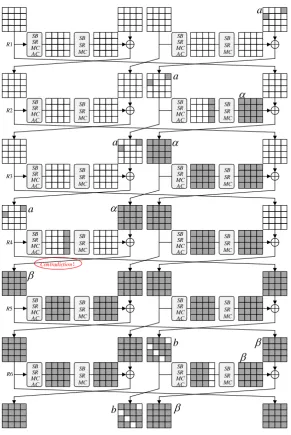
Observation 2. (The 9-round Impossible Differential) If ∆S1
0 is the one and only active subblock of the input difference ∆S0 and∆S90 is the only active subblock of the output difference ∆S9, the differen-tial:
(0, ∆S01,0,0) 9R
−−→(∆S90,0,0,0)
is impossible when the difference pattern ofSR−1◦M C−1(∆F(S10))andSR−1◦M C−1(∆F(S90))are not same.
For example, when the difference pattern of ∆S1 0 is
(∗,0,∗,∗,∗,∗,0,∗,∗,∗,∗,0,0,∗,∗,∗),
the difference pattern ofSR−1◦M C−1(∆F(S1 0)) is
(∗,∗,∗,∗,∗,∗,∗,∗,∗,∗,∗,∗,0,0,0,0);
when the difference pattern of∆S0 9 is
(0,∗,0,0,0,0,∗,0,0,0,0,∗,∗,0,0,0),
the difference pattern ofSR−1◦M C−1(∆F(S0 9)) is
(0,0,0,0,0,0,0,0,0,0,0,0,∗,∗,∗,∗).
In this case, as there exists i that SR−1◦M C−1(∆F(S01))[i] is zero but SR−1◦M C−1(∆F(S09)[i] is nonzero, or vice versa, we say their difference patterns are different.
Proof. We denote the difference pattern of ∆S1
0 as a and the difference pattern of F(∆S01) as α, e.g.,
α=F(a). Similarly, we use b andβ to denote the difference patterns of ∆S0
9 andF(∆S09) respectively, thenβ =F(b).
In the forward direction, when the input difference pattern:
∆S0= (0, ∆S01,0,0),
the first 4-round difference pattern will be as follows:
∆S0= (0, a,0,0)→(a,0,0,0)→(α,0,0, a)→(F(α),0, a, α)→(F2(α), a, α, F(α)) =∆S4;
and in the backward direction, when the output difference of the 9-round distinguisher:
SB SR MC AC SB SR MC SB SR MC AC SB SR MC SB SR MC AC SB SR MC SB SR MC AC SB SR MC SB SR MC AC SB SR MC SB SR MC AC SB SR MC SB SR MC AC SB SR MC SB SR MC AC SB SR MC SB SR MC AC SB SR MC SB SR MC AC SB SR MC SB SR MC AC SB SR MC SB SR MC AC SB SR MC SB SR MC AC SB SR MC SB SR MC AC SB SR MC SB SR MC AC SB SR MC SB SR MC AC SB SR MC SB SR MC AC SB SR MC SB SR MC AC SB SR MC R0 R1 R2 R3 R4 R5 R6 R7 R8
b
Contradiction!a
a
a
a
b
b
b
b
the last 4-round differential will be:
∆S9= (b,0,0,0)→(0, b,0,0)→(0,0, b, β)→(β, F(β),0, b)→(b, β, F(β), F2(β)) =∆S5.
AsS2
4 =S51, the difference pattern of∆S42will be same as the difference pattern of∆S51, that means there exists at least one value of S2
4 that has the difference pattern α, and S51 that has the difference patternβ, satisfying that∆S2
4 =∆S15, e.g.∆F(S01) =∆F(S90).
Since the inverse of ShiftRows and MixColumns are both linear operations, values of the same differ-ence pattern will also share a same differdiffer-ence pattern through these operations, e.g.
SR−1◦M C−1(∆F(S01)) =SR−1◦M C−1(∆F(S90)).
That is contradict to our assumption, so the observation is proved.
As shown in the above example, when we suppose that the difference pattern ofaas:
(∗,0,∗,∗,∗,∗,0,∗,∗,∗,∗,0,0,∗,∗,∗)
and the difference pattern ofb as:
(0,∗,0,0,0,0,∗,0,0,0,0,∗,∗,0,0,0),
the difference pattern ofSR−1◦M C−1(F(a)) will be:
SR−1◦M C−1(α) = (∗,∗,∗,∗,∗,∗,∗,∗,∗,∗,∗,∗,0,0,0,0)
and the difference pattern ofSR−1◦M C−1(F(b)) will be:
SR−1◦M C−1(β) = (0,0,0,0,0,0,0,0,0,0,0,0,∗,∗,∗,∗).
Obviously, they are different, then
(0, a,0,0)−−→9R (b,0,0,0)
is an impossible differential.
3.2 Attack on 7-round Simpira-4
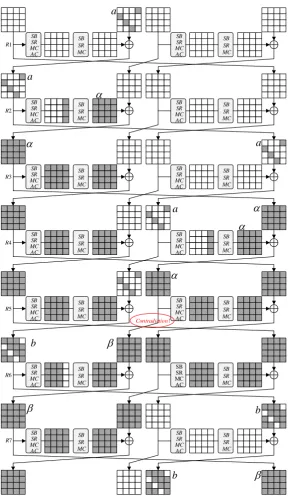
Because of the security claim about Simpira that an adversary can not query the distinguisher more than 2128times, we can not directly use the 9-round distinguisher to mount an attack. Instead, using the idea of the contradiction in the 9-round distinguisher, we deduce a 6-round impossible distinguisher.
As shown in Figure 4,S3
1 is the one and only active subblock ofS1, then after a 3-round encryption, the difference pattern ofS4 will be:
(∆S40, ∆S41, ∆S24, ∆S43) = (a, α, F(α),0).
So as∆S0
5 =∆F(S40)
L∆S1
4, the difference pattern of∆S50will beα.
WhenS7 satisfies that∆S71 =b and ∆S72 =β, in the backward direction, the difference pattern of
∆S50will beβ after a 2-round decryption.
As a result,α=β, we get the contradiction proved in the 9-round distinguisher, so the differential in Figure 4 is impossible.
By adding one round on the top of the 6-round distinguisher, we achieve a 7-round attack on Simpira-4 under the Even-Mansour construction. The differential of the first round is depicted in Figure 5.
The attack process is as follows:
(1) Construct 2n structures that each structure is made up of 248plaintexts. We setP0[1,12] andSR−1◦
SB SR MC AC SB SR MC SB SR MC AC SB SR MC SB SR MC AC SB SR MC SB SR MC AC SB SR MC SB SR MC AC SB SR MC SB SR MC AC SB SR MC SB SR SB SB SR SB SB SR MC AC SB SR MC SB SR MC AC SB SR MC SB SR MC AC SB SR MC SB SR MC AC SB SR MC R1 R2 R3 R4 R5 R6
a
a
b
a
b
MC AC SRMC MCAC
SR MC
Contradiction!a
Fig. 4.A 6-Round Impossible Differential
(2) Encrypt the plaintexts and only choose the pairs that satisfy∆C1=band∆C2=β. This is a 64-bit filter, after this step, about 2n+95−64= 2n+31 pairs leave in total. (3) For each remaining pair, ∆S0
0 is equal to ∆P0. When ∆F(S00) is equal to ∆P1, we get the input difference of the distinguisher. As ShiftRows and MixColumns are both linear operations, with the property of Super S-Box, we get the value ofS0
0[1,6,11,12]. Xor the value ofS00[1,6,11,12] with the value ofP0[1,6,11,12] to deduceK0[1,6,11,12] which should be eliminated.
(4) Repeat the step(3) until there are only one value of the 32-bit key value left and that is the right value ofK0[1,6,11,12].
By changing the positions of active nibbles of the structure, we can get all 256-bit value of K0 and
K2. Table 1 lists the positions of active nibbles with their corresponding key values.
SB SR MC AC
SB SR MC
SB SR MC AC
SB SR MC R0
1
P 2
P P3
2 1
S 3
1
S
0 1
S
0
P
0
K 1
K 2
K K3
1 1
S
Fig. 5.First Round of the 7-Round Attack
Table 1.Corresponding Key Bytes of the 7-Round Attack
∆P0(∆P2) ∆C1(∆C3) Responding Bytes ofK0(K2)
(*00000000000000*) (0****0****0****0) [0,5,10,15]
(0*0000000000*000) (*0****0****00***) [1,6,11,12]
(00*0000000000*00) (**0****00****0**) [2,7,8,13]
(000*0000000000*0) (***00****0****0*) [3,4,9,14]
obviously dominated by encrypting the plaintexts, so it is 254 encryption units. Similarly, to recover the other 224-bit value ofK0 andK2, we need to repeat a similar attack procedure eight times. That is, to recover K0 and K2, the data complexity is 257 chosen plaintexts, the time complexity is 257 encryption units.
3.3 Attack on 8-round Simpira-4
As the security claim of the Even-Mansour scheme, we could not use the 9-round distinguisher to attack Simpira-4 either. To attack 8-round Simpira-4, we propose a 7-round distinguisher. Its key idea is also same as that in the 9-round distinguisher. When the input difference ∆S1 = (0, a,0,0) and the output difference∆S8= (∗,0, b, β), we will get the contradiction.
Using the 7-round impossible differential, we recover all 512-bit key value of Simpira-4 under the Even-Mansour construction. The attack can be partitioned into two phases:
(a) By adding one round on the top of the 7-round impossible differential, we mount an 8-round attack to recover 256-bit key;
(b) Recover the other 256-bit key by adding one round on the bottom of the distinguisher.
The difference characteristic of the first round is depicted in Figure 7. The process of the first phase is as follows:
Phase a:
(1) Construct 2nstructures that plaintexts in each structure traverses 8 bytes:P2[1,6,11,12] andSR−1◦
M C−1(P3)[12,13,14,15].
As a result, in each structure, there are 264 plaintexts providing 2127pairs.
(2) Encrypt the plaintexts in each structure and only choose the pairs that satisfy:(a) ∆C1 = 0; (b)
∆C2=b; (c)∆C3=β.
SB SR MC AC SB SR MC SB SR MC AC SB SR MC SB SR MC AC SB SR MC SB SR MC AC SB SR MC SB SR MC AC SB SR MC SB SR MC AC SB SR MC SB SR MC AC SB SR MC SB SR MC AC SB SR MC SB SR MC AC SB SR MC SB SR MC AC SB SR MC R1 R2 R3 R4 R7
a
a
a
a
b
SB SR MC AC SB SR MC AC SB SR MC SB SR MC AC SB SR MC R5 R6
b
b
Contradiction! SB SR MC SB SR MC AC SB SR MC
Fig. 6.The 7-Round Distinguisher
(3) For each left pair, we can directly get the value of ∆S02 and∆S03 from ∆P2 and ∆P3 respectively. When∆F(S2
0) =∆S03,S11 will be the only active subblock inS1, thus we get the input difference of the distinguisher.
By applying the differential property of the Super Sbox, we can easily get the value ofS2
0[1,6,11,12]. CombiningS2
0[1,6,11,12] and P2[1,6,11,12], we get one wrong value ofK2[1,6,11,12].
SB SR MC AC
SB SR MC
SB SR MC AC
SB SR MC R0
1
P 2
P 3
P
2 1
S 3
1
S
0 1
S
0
P
0
K 1
K 2
K K3
1 1
S
Fig. 7.First Round of Phase a
By changing the position of active bytes of P2 and C2, we can recover all 256-bit value ofK2 as shown in Table 2.
Table 2.Corresponding Key bytes of Phase a
∆P2(∆P0) ∆C2(∆C0) Responding Bytes ofK2(K0)
(0*0000*0000**000) (*0****0****00***) [1,6,11,12]
(00*0000**0000*00) (**0****00****0**) [2,7,8,13]
(000**0000*0000*0) (***00****0****0*) [3,4,9,14]
(*0000*0000*0000*) (0****0****0****0) [0,5,10,15]
Complexity.To recover K2[1,6,11,12], we need to analyze 2n−65 pairs. The number of remaining 32-bit key values isN = 232×(1−2−32)2n−65. In order to make sure that N ≈1, we choose n= 102, then the data complexity is 2166 chosen plaintexts; the time complexity of the attack is also 21668-round encryptions. Similarly, to recover all bits of andK0 andK2, we repeat the same procedure eight times. So the data complexity is 2169 chosen plaintexts and the time complexity is 2169 encryption units.
Till now, we recover all 256-bit value ofK0 andK2. In the following we mount an attack to recover
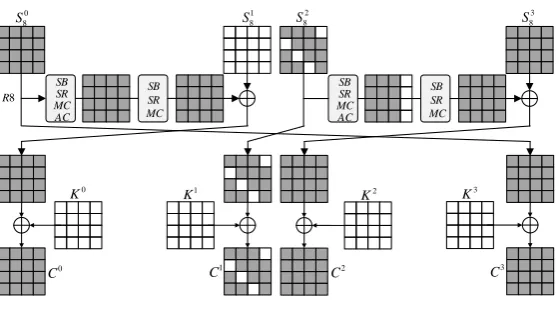
K1andK3by adding one round on the bottom of the 7-round distinguisher. The differential trail of the last round is shown in Figure 8.
Phase b:
(1) Construct 2nstructures that each structure is made up of 232plaintexts that traversesP1[1,6,11,12]. We expected to get 2n+63 pairs in total.
(2) Encrypt the plaintexts and only choose the pairs that satisfy:(a)∆C1=b; (b)∆C2=β. This step performs a 64 bits filter, so after this step, about 2n−1 pairs leave.
(3) For each remaining pair, we set ∆F(S0
8) =∆C0, then ∆S81 = 0, we get the output difference of the impossible distinguisher. By using the property of the Super Sbox, we get the value ofS3
9. Xor the value ofS3
9 with the value of C3, we get the value ofK3 and delete it. (4) Repeat the step(3) until there is only one value ofK3remaining.
Similarly as phase a, we can recover all 256-bit value of K1 and K3 by mounting two analogous attacks.
SB SR MC AC
SB SR MC
SB SR MC AC
SB SR MC R8
0
C C1 C2 3
C
0
K 1
K 2
K K3
1 8
S 2
8
S 3
8
S
0 8
S
Fig. 8.Last Round of Phase b
the data complexity is about 2168 chosen plaintexts, the time complexity is about 2168 encryption units to encrypt the plaintexts. As we need to mount two attack process to recover all 256-bit ofK1 andK3, so the data complexity is 2169plaintexts, the time complexity is 2169encryption units.
So in total, we need a data complexity of 2170 chosen plaintexts and a time complexity of 2170 to recover all 512-bit key value.
4
Conclusion
In this paper, we propose a 9-round impossible differential on Simpira-4, to our best knowledge, this is the first impossible distinguisher of Simpira-4. By using the same contradiction as in the 9-round distinguisher, we propose a 6-round distinguisher and achieve a 7-round attack on Simpira-4 under the Even-Mansour construction with a data complexity of 257 plaintexts and a time complexity of 257 encryption units to recover 256 bits key. After that, we present an attack on 8-round Simpira-4 under the Even-Mansour construction. By using 2170 plaintexts and 2170 encryption units, we recover all 512-bit key. These two attacks aim at two different security claims of the Even-Mansour scheme and the Simpira-4 permutation respectively. As far as we know, this is the first result of impossible differential attacks on Simpira v2.
References
1. Daemen J, Rijmen V. The Design of Rijndael. AES-the Advanced Encryption Standard. Springer, 2002. 2. Mala H, Dakhilailian M, Rijmen V, et al. Improved impossible differential cryptanalysis of 7-round AES-128.
In: INDOCRYPT, Berlin/Heidelberg: Springer-Verlag, 2010. 282-291
3. Lu J Q, Dunkelman O, Keller N, et al. New impossible differential attacks on AES. In: INDOCRYPT, Berlin/Heidelberg: Springer-Verlag, 2008, 5365: 279-293
4. Zhang W T, Wu W L, Feng D G. New results on impossible differential cryptanalysis of reduced AES. In: ICISC, Berlin/Heidelberg: Springer-Verlag, 2007, 4817: 239-250
5. Daemen J, Knudsen L, Rijmen V. The block cipher Square. In: FSE, Haifa: Springer-Verlag, 1997, 1267: 149-165
6. Gilber H, Minier M. A collision attack on 7 rounds of Rijndael. In: AES Candidate Conference, 2000. 230-241 7. Dunkelman O, Keller N, Shamir A. Improved single-key attacks on 8-round AES-192 and AES-256. In:
ASIACRYPT2010, Berlin/Heidelberg: Springer-Verlag, 2010, 6477: 158-176
8. Derbez P, Fouque P, Jean J. Improved key recovery attacks on reduced-round AES in the single-key setting. In: EUROCRYPT2013, Berlin/Heidelberg: Springer-Verlag, 2013, 7881: 371-387
10. Biryukov A, Khovratovich D. Related-key cryptanalysis of the full AES-192 and AES-256. In: ASIACRYPT, Berlin/Heidelberg: Springer-Verlag, 2009, 5912: 1-18
11. Biryukov A, Khovratovich D, Nikoli´cI. Distingsuiher and related-key attack on the full AES-256. In: CRYP-TO, Berlin/Heidelberg: Springer-Verlag, 2009, 5677: 231-249
12. Sun B, Liu M C, Guo J, et al. New Insights on AES-Like SPN Ciphers*. In: CRYPTO2016, Berlin/Heidelberg: Springer-Verlag, 2016. 605-624
13. Grassi L, Rechberger C, Rønjom S. Subspace Trail Cryptanalysis and its Applications to AES - Extended Version. In: FSE2017, in press.
14. Gueron S, Mouha N. Simpira v2: a family of efficient permutations using the AES round function. In ASI-ACRYPT, Berlin/Heidelberg: Springer-Verlag, 2016, 10031: 95-125
15. Dunkelman O, Keller N, Shamir A. Minimalism in cryptography: the Even-Mansour scheme revisited. In: EUROCRYPT, Berlin/Heidelberg: Springer-Verlag, 2012, 7237: 336-354
16. Even S, Mansour Y. A construction of a cipher from a single pseudorandom permutation. J Cryptology, 1997, 10: 151-161
17. Dobraunig C, Eichlseder M, Mendel F. Cryptanalysis of Simpira v1. Cryptology ePrint Archieve, Report 2016/244(2016), http://eprint.iacr.org/, in press.
18. Rønjom S. Invariant subspaces in Simpira. Cryptology ePrint Archive, Report 2016/248(2016), http://eprint.iacr.org/2016/248.pdf
19. Knudsen L R. DEAL - a 128-bit block cipher. Complexity, 258(2), 1988.
20. Biham E,Biryukov A, Shamir A. Cryptanalysis of Skipjack reduced to 31 rounds using impossible differentials. In: Cryptanalysis Conference on the Theory and Applications of Cryptographic Techniques, Springer Berlin Heidelbert, 1999. 12-23
21. Sun S W, Hu L, Wang M Q, et al. Constructing mixed-integer programming models whose feasible region is exactly the set of all valid differential characteristics of SIMON. http://eprint.iacr.org/2015/122.pdf 22. Sun S W, Hu L, Wang M Q, et al. Mixed integer programming models for finite automaton and its application
to additive differential patterns of exclusive-or. http://eprint.iacr.org/2016/338.pdf
23. Cui T T, Jia K T, Fu K, et al. New automatic search tool for impossible differentials and zero-correlation linear approximations. http://eprint.iacr.org/2016/689.pdf