Revisiting Non-Malleable Secret Sharing
Saikrishna Badrinarayanan UCLA
Akshayaram Srinivasan University of California, Berkeley
August 18, 2019
Abstract
A threshold secret sharing scheme (with thresholdt) allows a dealer to share a secret among a set of parties such that any group oftor more parties can recover the secret and no group of at mostt−1 parties learn any information about the secret. A non-malleable threshold secret sharing scheme, introduced in the recent work of Goyal and Kumar (STOC’18), additionally protects a threshold secret sharing scheme when its shares are subject to tampering attacks. Specifically, it guarantees that the reconstructed secret from the tampered shares is either the original secret or something that is unrelated to the original secret.
In this work, we continue the study of threshold non-malleable secret sharing against the class of tampering functions that tamper each share independently. We focus on achieving greater
efficiencyand guaranteeing astrongersecurity property. We obtain the following results:
• Rate Improvement. We give the first construction of a threshold non-malleable secret sharing scheme that has rate>0. Specifically, for everyn, t≥4, we give a construction of a
t-out-of-nnon-malleable secret sharing scheme with rate Θ(n13). In the prior constructions,
the rate was Θ(nlog1m) where m is the length of the secret and thus, the rate tends to 0 asm→ ∞. Furthermore, we also optimize the parameters of our construction and give a concretely efficient scheme.
• Multiple Tampering. We give the first construction of a threshold non-malleable secret sharing scheme secure in the stronger setting of bounded tampering wherein the shares are tampered by multiple (but bounded in number) possibly different tampering functions. The rate of such a scheme is Θ( 1
k3n3) where k is an apriori bound on the number of
tamperings. We complement this positive result by proving that it is impossible to have a threshold non-malleable secret sharing scheme that is secure in the presence of an apriori unbounded number of tamperings.
Contents
1 Introduction 3
1.1 Our Results . . . 5
1.1.1 Rate Improvement . . . 5
1.1.2 Multiple Tampering . . . 5
1.1.3 General Access Structures . . . 6
2 Our Techniques 7 2.1 Rate Improvement . . . 7
2.2 Multiple Tampering . . . 12
2.3 General Access Structures . . . 13
3 Preliminaries 13 3.1 Threshold Non-Malleable Secret Sharing Scheme . . . 14
3.2 Non-Malleable Codes . . . 16
4 k-out-of-n Leakage Resilient Secret Sharing Scheme 18 4.1 k-out-of-k Leakage Resilient Secret Sharing . . . 19
4.2 Perfect Hash Function Family . . . 20
4.3 Construction of k-out-nLeakage Resilient Secret Sharing . . . 21
4.4 Conditional Independence . . . 24
5 Non-Malleable Secret Sharing for Threshold Access Structures 27 5.1 Construction . . . 27
5.2 Proof of Theorem 5.1 . . . 28
5.3 Rate Analysis . . . 33
6 Unbounded Tamperings: Impossibility Result 33 6.1 Proof . . . 34
7 NMSS for General Access Structures with Multiple Tampering 34 7.1 Definitions . . . 34
7.2 Construction . . . 36
7.3 Proof of Theorem 7.5 . . . 38
7.4 Rate Analysis . . . 43
1
Introduction
At-out-of-nthreshold secret sharing scheme [Sha79, Bla79] allows a dealer to share a secret among
n parties such that any subset of t or more parties can recover the secret but any subset oft−1 parties learn no information about the secret. Threshold secret sharing schemes are central tools in cryptography and have several applications such as constructing secure multiparty computation protocols [GMW87,BGW88,CCD88], threshold cryptographic systems [DF90,Fra90,DDFY94] and leakage resilient circuit compilers [ISW03, FRR+10, Rot12] to name a few.
Most of the threshold secret sharing schemes in literature are linear. This means that if we multiply each share by a constantc, we get a set of shares that correspond to a new secret that is
c times the original secret. This property has in fact, been crucially leveraged in most of the ap-plications including designing secure multiparty computation protocols and constructing threshold cryptosystems. However, this highly desirable feature becomes undesirable if our primary goal is to protect the shares against tampering attacks. More specifically, this linearity property allows an adversary to tamper (or maul) each share independently and output a new set of shares that reconstruct to a related secret (for example, two times the original secret). Indeed, if the shares of the secret are stored on a device such as a smart card, an adversary could potentially tamper with the smart card and change the value of the share that is being stored by overwriting it with a new value or maybe flipping a few bits. Notice that in the above tampering attack, the adversary need not learn the actual secret. However, the adversary is guaranteed to produce a set of shares that reconstruct to a related secret. Such an attack could be devastating when the shares, for example, correspond to a cryptographic secret key (such as a signing key) as it allows an adversary to mount related-key attacks (see [BDL01]). In fact, most of the known constructions of threshold signatures use Shamir’s secret sharing to distribute the signing key among the parties and hence they are all susceptible to such attacks.
Non-Malleable Secret Sharing. To protect a secret sharing scheme against such share tam-pering attacks, Goyal and Kumar [GK18a, GK18b] introduced the notion of Non-Malleable Secret Sharing. Roughly, a secret sharing scheme (Share,Rec) is non-malleable against a tampering func-tion class F if for everyf ∈ F and every secrets,Rec(f(shares)) whereshares←Share(s) is either
s or something that is unrelated to s.1 Of course, we cannot hope to protect against all possible tampering functions as a function can first reconstruct the secret from the shares, multiply it by 2 and then share this value to obtain a valid sharing of a related secret. Thus, the prior works placed restrictions on the set of functions that can tamper the shares. A natural restricted family of tampering functions that we will consider in this work is Find which consists of the set of all
functions that tamper each share independently.
Connection to Non-Malleable Codes. Non-malleable secret sharing is related to another cryptographic primitive called as Non-Malleable Codes which was introduced in an influential work by Dziembowski, Pietrzak and Wichs [DPW10].2 A non-malleable code relaxes the usual notion of error correction by requiring that the decoding procedure outputs either the original message or something that is independent of the message when given a tampered codeword as
1
See Section 3 for a precise definition.
2We refer the reader to [GK18a, GK18b] for a thorough discussion on the connection between non-malleable secret
input. A beautiful line of work, starting from [DPW10], has given several constructions of non-malleable codes with security against various tampering function classes [LL12, DKO13, FMNV14, FMVW14, ADL14, AGM+15, FMNV15, JW15, CKR16, CGM+16, AAG+16, CGL16, BDKM16, Li17, KOS17, CL17, KOS18, BDKM18, GMW17, OPVV18, KLT18, BDG+18].
We now elaborate on the connection between non-malleable codes and non-malleable secret sharing. A tampering function family in the literature of non-malleable codes that is somewhat similar to Find is the k-split-state function family. A k-split-state function compartmentalizes a codeword into k-parts and applies a tampering function to each part, independent of the other parts. Seeing the similarity between Find and k-split-state functions, it might be tempting to
conclude that a non-malleable code against a k-split-state function family is in fact a k-out-of-k
non-malleable secret sharing. However, as demonstrated in [GK18a], this might not be true in general. In particular, [GK18a] showed that even a 3-split-state non-malleable code need not be a 3-out-of-3 non-malleable secret sharing as non-malleable codes may not always protect the secrecy of the message. In particular, the first few bits of the codeword could reveal some bits of the message and still, this coding scheme could be non-malleable. Nevertheless, for the special case of 2, Aggarwal et al. [ADKO15] showed that any split-state non-malleable code is indeed a 2-out-of-2 non-malleable secret sharing scheme. In the other direction, we note that any k-out-of-k
non-malleable secret sharing scheme against Findis in fact a k-split-state non-malleable code.
Rate of Non-Malleable Secret Sharing. One of the main efficiency parameters in any secret sharing scheme is its rate which is defined as the ratio between the length of the secret and the maximum size of a share. In the prior work, Goyal and Kumar [GK18a] gave an elegant construction of t-out-of-nnon-malleable secret sharing from any 2-split-state non-malleable code. However, the rate of this scheme is equal to O(nlog1 m) wherem is the length of the secret. The rate tends to 0 as the length of the secret mtends to ∞ and hence, a natural question to ask is:
Can we obtain a construction of threshold non-malleable secret sharing with rate >0?
The problem of improving the rate was mentioned as an explicit open question in [GK18a].
Multiple Tamperings. In the real world, a tampering adversary could potentially mount more than one tampering attack. In particular, if each share of a cryptographic secret key is stored on a small device (such as smart cards), the adversary could potentially clone these devices to obtain multiple copies of the shares. The adversary could then apply a different tampering function on each copy and obtain information about related secrets. Thus, a more realistic security definition would be to consider multiple tampering functions f1, . . . , fk ∈ F, and require that for every secret s,
the joint distribution (Rec(f1(shares)), . . . ,Rec(fk(shares))) whereshares←Share(s) is independent
of s.3 For the case of non-malleable codes, security against multiple tamperings has already been considered in [FMNV14, JW15, CGL16, OPVV18]. However, for the case of non-malleable secret sharing, the prior work [GK18a] only considered a single tampering function and a natural question would be:
Can we obtain a construction of threshold non-malleable secret sharing against multiple tamperings?
3
1.1 Our Results
In this work, we obtain the following results.
1.1.1 Rate Improvement
We give the first construction of a threshold non-malleable secret sharing scheme that has rate>0. Specifically, the rate of our construction is Θ(n13) wherenis the number of parties. More formally,
Theorem 1.1 For any n, t ≥ 4 and any ρ > 0, there exists a construction of t-out-of-n non-malleable secret sharing scheme against Find for sharing m-bit secrets for any m > logn with rate Θ(n13) and simulation error2
−Ω(log1+ρ mm )
.The running times of the sharing and reconstruction algorithms are polynomial in n and m.
Local Leakage Resilient Secret Sharing. One of the main tools used in proving Theorem 1.1 (which may be of independent interest) is an efficient construction oflocal leakage-resilientthreshold secret sharing scheme [GK18a, BDIR18]. A t-out-of-n secret sharing scheme is said to be local leakage-resilient (parameterized by a leakage bound µ and set size s), if the secrecy holds against any adversary who might obtain at most t−1 shares in the clear and additionally, for any set
S ⊆[n] of size at most s, the adversary obtains µbits from each share belonging to a party in the set S. Goyal and Kumar [GK18a] gave a construction of a 2-out-of-nlocal leakage resilient secret sharing scheme. In this work, we give an efficient construction of t-out-of-n local leakage resilient secret sharing scheme whentis a constant. This result must be contrasted with a recent result by Benhamouda et al. [BDIR18] who showed that the Shamir’s secret sharing scheme is local leakage resilient when the field size is sufficiently large and the thresholdt=n−o(logn). A more precise statement of our construction of local leakage resilient secret sharing scheme appears below.
Theorem 1.2 For any ε >0, t, n∈N, and parametersµ∈N, s≤n, there exists an efficient
con-struction oft-out-of-nsecret sharing scheme for sharingm-bit secrets that is (µ, s)-local leakage re-silient with privacy errorε. The size of each share whentis a constant isO((m+sµ+ log(logn/ε)) logn).
Comparison with [GK18a]. When compared to the result of [GK18a] which could support thresholds t≥2, our construction can only support thresholdt ≥4. However, getting a rate >0 non-malleable secret sharing scheme for threshold t= 2 would imply a 2-split-state non-malleable code with rate > 0 which is a major open problem. For the case of t = 3, though we know constructions of 3-split-state non-malleable codes with rate > 0 [KOS18, GMW17], they do not satisfy the privacy property of a 3-out-of-3 secret sharing scheme. In particular, given two states of the codeword, some information about the message is leaked. Thus, getting a 3-out-of-n non-malleable secret sharing scheme with rate>0 seems out of reach of the current techniques and we leave this as an open problem.
1.1.2 Multiple Tampering
the number of tamperings (also called as the tampering degree) is apriori unbounded. This result generalizes a similar result for the case of a split-state non-malleable codes. Formally,
Theorem 1.3 For any n, t ∈ N, there does not exist a t-out-of-n non-malleable secret sharing scheme against Find that can support an apriori unbounded tampering degree.
When the tampering degree is apriori bounded, we get constructions of threshold non-malleable secret sharing scheme. Formally,
Theorem 1.4 For any n, t≥4, andK ∈N, there exists a t-out-of-n non-malleable secret sharing scheme with tampering degree K for sharing m-bit secrets for a large enough4 m againstFind with rate= Θ(K31n3) and simulation error 2−m
Ω(1)
. The running time of the sharing and reconstruction algorithms are polynomial in n and m.
1.1.3 General Access Structures
We extend our techniques used in the proof of Theorems 1.1,1.4 to give constructions of non-malleable secret sharing scheme for more general monotone access structures rather than just threshold structures. Before we state our result, we give some definitions.
Definition 1.5 An access structure A is said to be monotone if for any set S ∈A, any superset of S is also in A. A monotone access structure A is said to be 4-monotone if for any set S ∈ A,
|S| ≥4.
We also give the definition of a minimal authorized set.
Definition 1.6 For a monotone access structure A, a set S ∈ A is a minimal authorized set if any strict subset of S is not inA. We denotetmax to be max|S| where S is a minimal authorized set of A.
We now state our extension to general access structures.
Theorem 1.7 For any n,K ∈N and 4-monotone access structure A, if there exists a statistically
private (with privacy error ε) secret sharing scheme for A that can share m-bit secrets for a large enough m with rate R, there exists a non-malleable secret sharing scheme for sharing m-bit se-crets for the same access structure A with tampering degree K againstFind with rate Θ(K3Rn3) and simulation error ε+ 2−mΩ(1).
Thus, starting with a secret sharing scheme for monotone span programs [KW93] or for more general access structures [LV18], we get non-malleable secret sharing schemes for the same access structures with comparable rate.
Comparison with [GK18b]. In the prior work [GK18b], the rate of the non-malleable secret sharing for general access structures also depended on the length of the message and thus, even when
R is constant, their construction could only achieve a rate of 0. However, unlike our construction, they could support all monotone access structures (and not just 4-monotone) and they could even start with a computational secret sharing scheme for an access structure A and convert it to a non-malleable secret sharing scheme for A.
4
Concurrent Work. In a concurrent and independent work, Aggarwal et al. [ADN+18] consider the multiple tampering model and give constructions of non-malleable secret sharing for general access structures in this model. There are three main differences between our work and their work. Firstly, the rate of their construction asymptotically tends to 0 even for the threshold case. However, the rate of our construction is greater than 0 when we instantiate the compiler with a rate
>0 secret sharing scheme. Secondly, their work considers a stronger model wherein each tampering function can choose a different reconstruction set. We prove the security of our construction in a weaker model wherein the reconstruction set is the same for each tampering function. We note that the impossibility result for unbounded tampering holds even if the reconstruction set is the same. Thirdly, their construction can give non-malleable secret sharing scheme for any 3-monotone access structure whereas our construction can only work for 4-monotone access structure. In another concurrent and independent work, Kumar et al. [KMS18] gave a construction of non-malleable secret sharing in a stronger model where the tampering functions might obtain bounded leakage from the other shares.
2
Our Techniques
In this section, we give a high level overview of the techniques used to obtain our results.
2.1 Rate Improvement
Goyal and Kumar [GK18a] approach. We first give a brief overview of the construction of threshold non-malleable secret sharing of Goyal and Kumar [GK18a] and then explain why it could achieve only a rate of 0. At a high level, Goyal and Kumar start with any 2-split-state non-malleable code and convert it into a t-out-of-n non-malleable secret sharing scheme. We only explain their construction for the case when t ≥ 3, and for the case of t = 2, they gave a slightly different construction. For the case when t ≥ 3, the sharing procedure does the following. The secret is first encoded using a 2-split-state non-malleable code to obtain the two states L and R. L is now shared using any t-out-of-n secret sharing scheme, say Shamir’s secret sharing to get the shares SL1, . . . ,SLn and Ris shared using a 2-out-of-nlocal leakage resilient secret sharing scheme to get
the shares SR1, . . . ,SRn. The share corresponding to party i includes (SLi,SRi). To recover the
secret given at least t shares, the parties first use the recovery procedures of the threshold secret sharing scheme and local leakage resilient secret sharing scheme to recover L and R respectively. Later, the secret is obtained by decodingLandRusing the decoding procedure of the non-malleable code. The correctness of the construction is straightforward and to argue secrecy, it can been seen that given any set oft−1 shares,Lis perfectly hidden and this follows from the security of Shamir’s secret sharing. Now, using the fact that any 2-split-state non-malleable code is a 2-out-of-2 secret sharing scheme, it can be shown that the right state Rstatistically hides the secret.
To argue the non-malleability of this construction, Goyal and Kumar showed that any tampering attack on the secret sharing scheme can be reduced to a tampering attack on the underlying 2-split-state non-malleable code. The main challenge in designing such a reduction is that the tampering functions against the underlying non-malleable code must be split-state, meaning that the tampering function against L (denoted by f) must be independent of R and the tampering function against R (denoted by g) must be independent ofL. To make the tampering function g
parameters used for secret sharingLand R. Specifically, sinceRis shared using a 2-out-of-nsecret sharing scheme, the tampered right state Re can be recovered from any two tampered shares, say
f
SR1,SRf2. Now, since L is shared using a t-out-of-n secret sharing scheme and t ≥ 3, the shares
SL1 and SL2 information theoretically provides no information aboutL. This, in particular means
that we can fix the shares SL1 and SL2 independent of L and the tampering function g could use
these fixed shares to output the tampered right state R. Now, whene f is given the actual L, it
can sample SL3, . . . ,SLn as a valid secret sharing of L that is consistent with the fixed SL1,SL2.
This allowed them to argue one-sided independence i.e., gis independent ofL. On the other hand, making the tampering function f to be independent of Ris a lot trickier. This is because any two shares information theoretically fixes Rand in order to recover eL, we need at least t(≥3) shares.
Hence, we may not be able to argue thatf is independent ofR. To argue this independence, Goyal and Kumar used the fact that Ris shared using a local leakage resilient secret sharing scheme. In particular, they made the size of SRi to be much larger than the size of SLi and showed that even
when we leak |SLi|bits from each share SRi, R is still statistically hidden. This allowed them to
define leakage functionsleak1, . . . ,leaknwhereleaki hadSLi hardwired in its description, it applies
the tampering function on (SLi,SRi) and outputs the tampered SLfi. Now, from the secrecy of
the local leakage resilient secret sharing scheme, the distribution fSL1, . . . ,SLfn (which completely
determines eL) is independent of R and thus eL is independent of R. This allowed them to obtain
two-sided independence.
A drawback of this approach is that the rate of this scheme is at least as bad as that of the underlying 2-split-state malleable code. As mentioned before, obtaining a 2-split-state non-malleable code with rate>0 is a major open problem. Thus, this construction could only achieve a rate of 0.
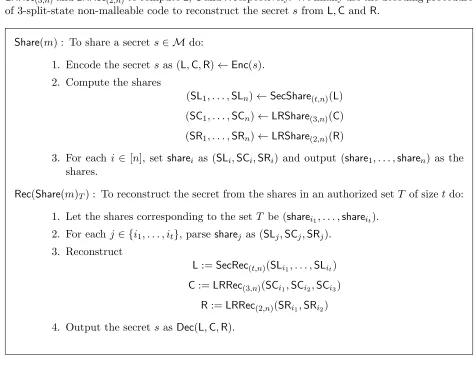
Our Approach. While constructing 2-split-state non-malleable code with rate > 0 has been notoriously hard, significant progress has been made for the case of 3-split-state non-malleable codes. Very recently, independent works of Gupta et al. [GMW17] and Kanukurthi et al. [KOS18] gave constructions of 3-split-state non-malleable codes with an explicit constant rate. The main idea behind our rate-improved construction is to use a constant rate, 3-split-state non-malleable code instead of a rate 0, 2-split-state non-malleable code. To be more precise, we first encode the secret using a 3-split-state non-malleable code to get the three states (L,C,R). We then share the first state L using a t-out-of-n secret sharing scheme to get (SL1, . . . ,SLn) as before. Then, we
share C using a t1-out-of-n secret sharing scheme to get (SC1, . . . ,SCn) and Rusing a t2-out-of-n
secret sharing scheme to get (SR1, . . . ,SRn). Here,t1, t2 are some parameters that we will fix later.
The share corresponding to party iincludes (SLi,SCi,SRi). While the underlying intuition behind
this idea is natural, proving that this construction is a non-malleable secret sharing scheme faces several barriers which we elaborate below.
Kanukurthi et al. [KOS18] and Gupta et al. [GMW17] are not 3-out-of-3 secret sharing schemes. The main trick that we use to solve this challenge is that, while these constructions [KOS18, GMW17] are not 3-out-of-3 secret sharing schemes, we observe that there exist two states (let us call themC and R) such that these two states statistically hide the message. This means that we can potentially share these two states using secret sharing schemes with smaller thresholds and may use it to argue one-sided independence.
Second Challenge. The second main challenge is in ensuring that the tampering functions we design for the underlying 3-split-state non-malleable code are indeed split-state. Let us call the tampering functions that tamper L,C, and R as f, g, and h respectively. To argue that f, g and
h are split-state, we must ensure f is independent of C and R and similarly, g is independent of L and R and h is independent of L and C. For the case of 2-split-state used in the prior work, this independence was achieved by using secret sharing with different thresholds and relying on the leakage resilience property. For the case of 3-split-state, we need a more sophisticated approach of
stratifyingthe three secret sharing schemes so that we avoid circular dependence in the parameters. We now elaborate more on this solution.
To make g and h to be independent ofL, we choose the thresholds t1 and t2 to be less than t.
This allows us to fix a certain number of shares independent of L and use these shares to extract
e
C andR. Similarly, to makee h to be independent of C, we choose the thresholdt2 < t1. This again
allows us to fix certain sharesCand use them to extracteR. Thus, by choosingt > t1 > t2, we could
achieve something analogous to one-sided independence. Specifically, we achieved independence of g from L and independence of h from (L,C). For complete split-state property, we still need to make sure that f is independent of (C,R) and g is independent of R. To make the tampering functionf to be independent ofC, we rely on the local leakage resilience property of thet1-out-of-n
secret sharing scheme. That is, we make the size of the shares SCi to be much larger than SLi
such that, in spite of leaking |SLi| bits from each share SCi, the secrecy of C is maintained. We
can use this to show that the joint distribution (SLf1, . . . ,SLfn) (which completely determineseL) is
independent of C. Now, to argue that both f and g are independent of R, we rely on the local leakage resilience property of thet2-out-of-nsecret sharing scheme. That is, we make the shares of
SRi to be much larger than (SLi,SCi) so that, in spite of leaking|SLi|+|SCi|bits from each share
SRi, the secrecy ofRis maintained. We then use this property to argue that the joint distribution
(SLf1,SCf1), . . . ,(SLfn,SCfn) is independent of R. Thus, the idea of stratifying the three threshold
secret sharing schemes with different parameters as described above allows to argue that f,g and
h are split-state. As we will later see, this technique of stratification is very powerful and it allows us to easily extend this construction to more general monotone access structures.
Third Challenge. The third and the more subtle challenge is the following. To reduce the tampering attack on the secret sharing scheme to a tampering attack on the underlying non-malleable code, we must additionally ensure consistencyi.e., the tampered message output by the split-state functions must be statistically close to the message output by the tampering experiment of the underlying secret sharing scheme. To illustrate this issue in some more detail, let us consider the tampering functions f and g in the construction of Goyal and Kumar [GK18a] for the simple case when n = t = 3. Recall that the tampering function g samples SR1,SR2 such that it is a
valid 2-out-of-n secret sharing of R and uses the fixed SL1,SL2 (independent of L) to extract the
of R. In particular, it must also satisfy the property that the tampering function applied onSL1,
SR1 gives the exact sameSLf1 that f uses in the reconstruction (a similar condition for position 2
must be satisfied). This is crucial, as otherwise there might be a difference in the distributions of the tampered message output by the split-state functions and the message output in the tampering experiment of the secret sharing scheme. In case there is a difference, we cannot hope to use the adversary against the non-malleable secret sharing to break the underlying non-malleable code. This example illustrates this issue for a simple case when t = n = 3. To ensure consistency for larger values of n and t, Goyal and Kumar fixed (SL1, . . . ,SLt−1) (instead of just fixing SL1,SL2)
and the function g ensures consistency of each of the tampered shares fSL1, . . . ,SLft−1. However,
this approach completely fails when we move to 3 states. For the case of 3-states, the tampering function, sayh, must sampleSR1, . . . ,SRnsuch that it is consistent withSLf1, . . . ,SLft−1 used by f.
However, even to check this consistency,h would need the sharesSC1, . . . ,SCt−1 which completely
determines C. In this case, we cannot argue thath is independent of C.
To tackle this challenge, we deviate from the approach of Goyal and Kumar [GK18a] and have a new proof strategy that ensures consistency and at the same time maintains the split-state property. In this strategy, we only fix the values (SL1,SL2,SL3) for the first secret sharing scheme, (SC1,SC2)
for the second secret sharing scheme and fix SR3 for the third secret sharing scheme. Note that
we consider t ≥ 4, t1 ≥ 3 and t2 ≥ 2 and thus, the fixed shares are independent of L, C, and R
respectively.5 We design our split-state functions in such a way that the tampering functionf need not do any consistency checks, the tampering function g has to do the consistency check only on
f
SL3 (which it can do since SL3 and SR3 are fixed) and the function h needs to do a consistency
check only on{SLfi,SCfi}i∈[1,2] (which it can do sinceSL1,SC1,SL2,SC2 are fixed). This approach of
reducing the number of checks to maintain consistency helps us in arguing independence between the tampering functions. However, this approach creates additional problems in extractingeLas the
tampering functionf needs to use the shares (SR4, . . . ,SRn) and (SC4, . . . ,SCn) (which completely
determinesCandRrespectively). We solve this by lettingf extracteLusing shares of some arbitrary
values of C and R and we then use the leakage resilience property to ensure that the outputs in the split-state tampering experiment and the secret sharing tampering experiment are statistically close.
Completing the Proof. This proof strategy helps us in getting a rate > 0 construction of a
t-out-of-nnon-malleable secret sharing scheme fort≥4. However, there is one crucial block that is still missing. Goyal and Kumar [GK18a] only gave a construction of 2-out-of-nlocal leakage resilient secret sharing scheme. And, for this strategy to work we also need a construction of t1-out-of-n
local leakage resilient secret sharing scheme for some t1 > 2. As mentioned in the introduction,
the recent work by Benhamouda et al. [BDIR18] only gives a construction of local leakage resilient secret sharing when the threshold value is large (in particular, n−o(logn)). To solve this, we give an efficient construction of a t-out-of-n local leakage resilient secret sharing scheme when t is a constant. This is in fact sufficient to get a rate > 0 construction of non-malleable secret sharing scheme. We now give details on the techniques used in this construction.
Local Leakage Resilient Secret Sharing Scheme. The starting point of our construction is the 2-out-of-2 local leakage resilient secret sharing from the work of Goyal and Kumar [GK18a] based on the inner product two-source extractor [CG88]. We first extend it to a k-out-of-k local
5
leakage resilient secret sharing scheme for any arbitrary k. Let us now illustrate this for the case whenkis even i.e.,k= 2p. To share a secrets, we first additively secret sharesintos1, . . . , sp and
we encode eachsi using the 2-out-of-2 leakage resilient secret sharing scheme to obtain the shares (share2i−1,share2i). We then give sharei to party i for each i∈ [k]. Note that given t−1 shares,
at most p−1 additive secret shares can be revealed. We now rely on the local leakage resilience property of the 2-out-of-2 secret sharing to argue that the final additive share is hidden even when given bounded leakage from the last share. This helps us in arguing the k-out-k local leakage resilience property. The next goal is to extend this to a k-out-of-n secret sharing scheme. Since we are interested in getting good rate, we should not increase the size of the shares substantially. A na¨ıve way of doing this would be to share the secret nk times (one for each possible set of
k-parties) using the k-out-of-ksecret sharing scheme and give the respective shares to the parties. The size of each share in this construction would blow up by a factor k−n1when compared to the
k-out-of-k secret sharing scheme. Though, this is polynomial in n when k is a constant, this is clearly sub-optimal when n is large and would result in bad concrete parameters. We note that Goyal and Kumar [GK18a] used a similar approach to obtain a 2-out-of-n local leakage resilient secret sharing.
In this work, we use a very different approach to construct a k-out-of-nlocal leakage resilient secret sharing from a k-out-of-k local leakage resilient secret sharing. The main advantage of this transformation is that it is substantially more rate efficient than the na¨ıve solution. Our transformation makes use of combinatorial objects called as perfect hash functions [FK84].6 A family of functions mapping {1, . . . , n} to {1, . . . , k} is said to be a perfect hash function family if for every set S ⊆ [n] of size at most k, there exists at least one function in the family that is injective onS. Let us now illustrate how this primitive is helpful in extending a k-out-of-k secret sharing scheme to ak-out-of-nsecret sharing scheme. Given a perfect hash function family{hi}i∈[`]
of size `, we share the secret s independently ` times using the k-out-of-k secret sharing scheme to obtain (sharei1, . . . ,shareik) for each i ∈ [`]. We now set the shares corresponding to party i as (share1h1(i), . . . ,share`h`(i)). To recover the secret from some set ofkshares given byS={s1, . . . , sk},
we use the following strategy. Given any subsetS of sizek, perfect hash function family guarantees that there is at least one index i∈[`] such that hi is injective on S. We can now use{shareihi(s1),
. . . ,shareihi(sk)} = {sharei1, . . . ,shareik} to recover the secret using the reconstruction procedure of thek-out-of-k secret sharing.
We show that this transformation additionally preserves local leakage resilience. In particular, if we start with ak-out-of-klocal leakage resilient secret sharing scheme then we obtain ak-out-of-n
local leakage resilient secret sharing. The size of each share in ourk-out-of-nleakage resilient secret sharing scheme is ` times the share size of k-out-of-k secret sharing scheme. Thus, to minimize rate we must minimize the size of the perfect hash function family. Constructing perfect hash function family of minimal size for all k ∈ N is an interesting and a well-known open problem in combinatorics. In this work, we give an efficient randomized construction (with good concrete parameters) of a perfect hash function family for a constant kwith size O(logn+ log(1/ε)) where
εis the error probability. Alternatively, we can also use the explicit construction (which is slightly less efficient when compared to the randomized construction) of sizeO(logn) (whenkis a constant) given by Alon et al. [AYZ95]. Combining either the randomized/explicit construction of perfect
6
hash function family with a construction ofk-out-of-klocal leakage resilient secret sharing scheme, we get an efficient construction of k-out-of-n local leakage resilient secret sharing scheme when k
is a constant.
In fact, in order to use the local leakage resilient secret sharing scheme in our construction of non-malleable secret sharing, we require a stronger property from it called conditional independence. We discuss more about this additional property and how to achieve it using the notion of augmented perfect hash functions inSection??.
2.2 Multiple Tampering
We also initiate the study of non-malleable secret sharing under multiple tamperings. As discussed in the introduction, this is a much stronger model when compared to that of a single tampering.
Negative Result. We first show that when the number of tampering functions that can maul the secret sharing scheme is apriori unbounded, there does not exist any threshold non-malleable secret sharing scheme. This generalizes a similar result for the case of split-state non-malleable code (see [GLM+04, FMNV14] for details) and the main idea is inspired by these works. The underlying intuition behind the negative result is simple: we come up with a set of tampering functions such that each tampering experiment leaks one bit of a share. Now, given the outcomes of t·s such tampering experiments wheresis the size of the share, the distinguisher can clearly learn every bit oftshares and thus, learn full information about the underlying secret and break non-malleability. For the tampering experiment to leak one bit of the share of party i, we use the following simple strategy. Let us fix an authorized set of sizetsay, {1, . . . , t}. We choose two sets of shares:
{share1, . . . ,sharei, . . . ,sharet} and{share1, . . . ,share0i, . . . ,sharet}such that they reconstruct to two
different secrets. Note that the privacy of a secret sharing scheme guarantees that such shares must exist. Whenever the particular bit of the share of party iis 1, the tampering function fi outputs share0i whereas the other tampering functions, sayfj will output sharej. On the other hand, if the
particular bit is 0 then the tampering functionfi outputssharei and the other tampering functions
still output sharej. Observe that the reconstructed secret in the two cases reveals the particular
bit of the share of partyi. We can use a similar strategy to leak every bit of all thet shares which completely determine the secret.
2.3 General Access Structures
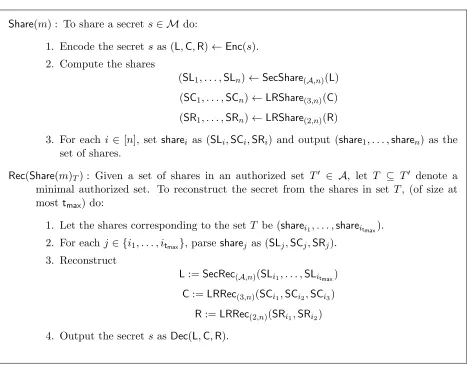
To obtain a secret sharing scheme for more general access structures, we start with any statistically secure secret sharing scheme for that access structure, and use it to share L instead of using a threshold secret sharing scheme. We require that the underlying access structure to be 4-monotone so that we can argue the privacy of our scheme. Recall that a 4-monotone access structure is one in which the size of every set in the access structure is at least 4. Even in this more general case, the technique of stratifying the secret sharing schemes allows us to prove non-malleability in almost an identical fashion to the case of threshold secret sharing. We remark that the work of [GK18b] which gave constructions of non-malleable secret sharing scheme for general monotone access structures additionally required their local leakage resilient secret sharing scheme to satisfy a security property called as strong local leakage resilience. Our construction does not require this property and we show that “plain” local leakage resilience is sufficient for extending to more general monotone access structures.
Organization. We give the definitions of non-malleable secret sharing and non-malleable codes in Section 3. In Section 4, we present the construction of the k-out-of-n leakage resilient secret sharing scheme. In Section 5, we describe our rate-efficient threshold non-malleable secret sharing scheme for the single tampering. We give the impossibility result for unbounded many tamperings in Appendix 6. Finally, in Section 7, we describe our result on non-malleable secret sharing for general access structures against multiple bounded tampering. Note that the result in Section 7 implicitly captures the result for threshold non-malleable secret sharing against bounded tampering. We present this more general result for ease of exposition.
3
Preliminaries
Notation. We use capital letters to denote distributions and their support, and corresponding lowercase letters to denote a sample from the same. Let [n] denote the set {1,2, . . . , n}, and Ur
denote the uniform distribution over {0,1}r. For any i ∈ [n], let xi denote the symbol at the i-th co-ordinate of x, and for any T ⊆ [n], let xT ∈ {0,1}|T| denote the projection of x to the
co-ordinates indexed byT. We write ◦to denote concatenation.
Standard definitions of min-entropy and statistical distance are given below.
Definition 3.1 (Min-entropy) The min-entropy of a source X is defined to be
H∞(X) = min
s∈support(X)
{log(1/Pr[X =s])}
A (n, k)-source is a distribution on {0,1}n with min-entropy k.
Definition 3.2 (Statistical distance) Let D1 and D2 be two distributions on a setS. The
sta-tistical distance between D1 and D2 is defined to be:
|D1−D2|= max
T⊆S|D1(T)−D2(T)|=
1 2
X
s∈S
|Pr[D1 =s]−Pr[D2=s]|
We will use the notation D1 ≈εD2 to denote that the statistical distance betweenD1 and D2
is at most ε.
Lemma 3.3 (Triangle Inequality) If D1 ≈ε1 D2 and D2≈ε2 D3 thenD1 ≈ε1+ε2 D3.
We now recall the definition of (average) conditional min-entropy [DORS08].
Definition 3.4 ( [DORS08]) The average conditional min-entropy is defined as
e
H∞(X|W) = log
Ew←W
h
max
x Pr[X=x|W =w] i
=−logEh2−H∞(X|W=w)i
We recall some results on conditional min-entropy from [DORS08].
Lemma 3.5 ( [DORS08]) If a random variable B can take at most ` values, then He∞(A|B) ≥
H∞(A)−log`.
Seeded Extractors. We now recall the definition of a strong seeded extractor.
Definition 3.6 (Strong seeded extractor) A function Ext : {0,1}n × {0,1}d → {0,1}m is called a strong seeded extractor for min-entropy k and error ε if for any (n, k)-source X and an independent uniformly random string Ud, we have
|Ext(X, Ud)◦Ud−Um◦Ud|< ε,
where Um is independent of Ud.
An average case seeded extractor requires that if a source X has average case conditional min-entropy ˜H∞(X|Z) ≥ k then the output of the extractor is uniform even when Z is given. We
recall the following lemma from [DORS08] which states that every strong seeded extractor is also an average-case strong extractor.
Lemma 3.7 ( [DORS08]) For anyδ >0, ifExtis a(k, ε)-strong seeded extractor then it is also a (k+ log 1δ
, ε+δ) average case strong extractor.
Guruswami et al. [GUV09] gave a construction of (strong) seeded extractor with near optimal parameters and we recall the result below.
Theorem 3.8 ( [GUV09]) For any constant α > 0, and all integers n, k > 0 there exists a polynomial time computable strong seeded extractor Ext : {0,1}n× {0,1}d → {0,1}m with d = O(logn+ log(1ε)) and m= (1−α)k.
3.1 Threshold Non-Malleable Secret Sharing Scheme
Definition 3.9 (Sharing Function) Let [n] = {1,2, . . . , n} be a set of identities of n parties. Let M be the domain of secrets. A sharing function Share is a randomized mapping from M to
S1×S2×. . .×Sn, whereSi is called the domain of shares of party with identityi. A dealer distributes a secret m ∈ M by computing the vector Share(m) = (S1, . . . ,Sn), and privately communicating each shareSi to the partyi. For a setT ⊆[n], we denoteShare(m)T to be a restriction ofShare(m) to its T entries.
Definition 3.10 ((t, n, εc, εs)-Secret Sharing Scheme) Let M be a finite set of secrets, where
|M| ≥ 2. Let [n] = {1,2, . . . , n} be a set of identities (indices) of n parties. A sharing function
Sharewith domain of secretsMis a(t, n, εc, εs)-secret sharing scheme if the following two properties hold :
• Correctness: The secret can be reconstructed by anyt-out-of-nparties. That is, for any set T ⊆[n]such that|T| ≥t, there exists a deterministic reconstruction functionRec:⊗i∈TSi →
Msuch that for every m∈ M,
Pr[Rec(Share(m)T) =m] = 1−εc
where the probability is over the randomness of theSharefunction. We will slightly abuse the notation and denoteRecas the reconstruction procedure that takes inT andShare(m)T where T is of size at leastt and outputs the secret.
• Statistical Privacy: Any collusion of less than tparties should have “almost” no informa-tion about the underlying secret. More formally, for any unauthorized set U ⊆[n] such that
|U| < t, and for every pair of secrets m0, m1 ∈ M, for any distinguisher D with output in
{0,1}, the following holds :
|Pr[D(Share(m0)U) = 1]−Pr[D(Share(m1)U) = 1]| ≤εs
We define the rate of the secret sharing scheme as
lim
|m|→∞
|m|
maxi∈[n]|Share(m)i|
Definition 3.11 (Threshold Non-Malleable Secret Sharing [GK18a]) Let(Share,Rec)be a
(t, n, εc, εs)-secret sharing scheme for message space M. Let F be some family of tampering func-tions. For eachf ∈ F,m∈ Mand authorized setT ⊆[n]containingtindices, define the tampered distribution Tamperf,Tm as Rec(f(Share(m))T) where the randomness is over the sharing function
Share. We say that the(t, n, εc, εs)-secret sharing scheme,(Share,Rec) isε0-non-malleable w.r.t. F
if for each f ∈ F and any authorized set T consisting of t indices, there exists a distribution Df,T over M ∪ {same?} such that:
|Tamperf,Tm −copy(Df,T, m)| ≤ε0
where copy is defined by copy(x, y) =
(
x if x6=same?
Many Tampering Extension. We now extend the above definition to capture multiple tam-pering attacks. Informally, we say that a secret sharing scheme is non-malleable w.r.t. family F
with tampering degree K if for any set of K functions f1, . . . , fK ∈ F, the output of the following
tampering experiment is independent of the shared message m: (i) we first share a secret m to obtain the corresponding shares, (ii) we tamper the shares usingf1, . . . , fK, (iii) we finally, output
theK-reconstructed tampered secrets. Note that in the above experiment the messagemis secret shared only once but is subjected to K (possibly different) tamperings.
Definition 3.12 (Non-Malleable Secret Sharing against Multiple Tampering) Let(Share,
Rec) be a (t, n, εc, εs)-secret sharing scheme for message space M. Let F be some family of tam-pering functions. For −→f = (f1, . . . , fK) ∈ FK, m ∈ M and authorized set T where T contains t
indices, we define the tampered distributionTamper
− →
f ,T
m as(Rec(f1(shares)T), . . . ,Rec(ft(shares)T) :
shares ← Share(m)) where the randomness is over the sharing function Share. We say that the
(t, n, εc, εs)-secret sharing scheme, (Share,Rec) is ε0-non-malleable with tampering degree K w.r.t.
F if for each −→f ∈ FK and any authorized set T where each elements consists of t indices, there
exists a distribution D
− →
f ,T over (M ∪ {same?})K such that:
|Tamper
− →
f ,T
m −copy(g D
− →
f ,T, m)| ≤ε0
where copyg is defined by copy(g −→x , y) = (z1, ..., zn) where zi =
(
xi if xi 6=same? y if xi =same? ..
Remark 3.13 It is possible to further strengthen the above definition by requiring the output of every tampering function fi to use a different authorized set Ti for reconstruction. Our construc-tion does not satisfy this stronger definiconstruc-tion. However, we note that the impossibility of apriori unbounded number of tamperings holds even with respect to the weakened definition of using the same authorized set for reconstruction in every tampering.
3.2 Non-Malleable Codes
We start with the definition of a coding scheme.
Definition 3.14 (Coding scheme) Let Enc :{0,1}m → {0,1}n be a randomized algorithm and
Dec : {0,1}n → {0,1}m∪ {⊥} be a deterministic function. We say that (Enc,Dec) is a coding
scheme with code length nand message length m if for all s∈ {0,1}m, Pr[Dec(Enc(s)) =s] = 1, where the probability is taken over the randomness of Enc. The rate of the coding scheme is mn.
Dziembowski, Pietrzak and Wichs [DPW10] introduced the notion of non-malleable codes which generalizes the usual notion of error correction. In particular, it guarantees that when a codeword is subject to tampering attack, the reconstructed message is either the original one or something that is independent of the original message.
Definition 3.15 (Non-Malleable Codes [DPW10]) Let Enc:{0,1}m → {0,1}n and Dec:{0,
1}n→ {0,1}m∪ {⊥}be (possibly randomized) functions, such thatDec Enc(s)
(Enc,Dec) is ε−non-malleable w.r.t. F if for every f ∈ F, there exists a random variable Df on
{0,1}m∪ {same?}, such that for all s∈ {0,1}m,
|Dec(f(Xs))−copy(Df, s)| ≤ε
where Xs ←Enc(s) and copy is defined bycopy(x, y) = (
x if x6=same?
y if x=same? . We call n the length
of the code and m/n the rate.
Chattopadhyay, Goyal and Li [CGL16] defined a stronger notion of non-malleability against multiple tampering and we now recall this definition.
Definition 3.16 (Non-Malleable Codes against Multiple Tampering [CGL16]) A coding scheme(Enc,Dec)with code length nand message length mis a non-malleable code with tampering degree tw.r.t. a family of tampering functions F ⊂(Fn)t and error εif for every (f1, . . . , ft)∈ F, there exists a random variable D−→
f on({0,1}
m∪ {same?})t such that for all messages s∈ {0,1}m, it holds that
|(Dec(f1(X)), . . . ,Dec(ft(X)))−copy(g D−→f, s)| ≤ε
where X =Enc(s). We refer to tas the tampering degree of the code.
Split-state Tampering Functions. We focus on the split-state tampering model where the encoding scheme splits sinto cstates: Enc(s) = (S1, . . . ,Sc) ∈ S1× S2. . .× Scand the tampering
family isFsplit=
(f1, . . . , fc)
fi :Si→ Si . We will call such a code asc-split-state non-malleable
code.
Augmented Non-Malleable Codes. We recall the definition of augmented, 2-split-state non-malleable codes [AAG+16].
Definition 3.17 (Augmented Non-Malleable Codes [AAG+16]) A coding scheme(Enc,Dec)
with code length 2n and message length m is an augmented 2-split-state non-malleable code with error ε if for every function f, g : {0,1}n → {0,1}n, there exists a random variable D
(f,g) on
{0,1}n×({0,1}m∪ {same?}) such that for all messages s∈ {0,1}m, it holds that
|(L,Dec(f(L), g(R)))− S(D(f,g), s)| ≤ε
where (L,R) = Enc(s), (L,me) ← Df,g and S((L,me), s) outputs (L, s) if me = same
? and otherwise outputs (L,me).
Explicit Constructions. We now recall the constructions of split-state non-malleable codes.
Theorem 3.18 ( [Li17]) For anyn∈N, there exists an explicit construction of2-split-state
non-malleable code with efficient encoder/decoder, code length 2n, rate O(log1n) and error2−Ω(lognn).
Theorem 3.20 ( [CGL16]) There exists a constant γ > 0 such that for every n ∈ N and t ≤ nγ, there exists an explicit construction of 2-split-state non-malleable code with an efficient encoder/decoder, tampering degreet, code length 2n, rate nΩ(1)1 and error 2
−nΩ(1) .
Theorem 3.21 ( [GKP+18]) There exists a constantγ >0such that for everyn∈Nandt≤nγ,
there exists an explicit construction of an augmented, split-state non-malleable code with an efficient encoder/decoder, tampering degreet, code length 2n, rate nΩ(1)1 and error 2
−nΩ(1) .
Theorem 3.22 There exists a constantγ >0such that for everyn∈Nandt≤nγ, there exists an explicit construction of 3-split-state non-malleable code with an efficient encoder/decoder, tampering degree t, code length 3n, rate Θ(1t) and error2−nΩ(1).
We give the proof of this theorem in Appendix B.
Additional Property. We show in Appendix A that the construction given in [KOS18,GMW17] satisfies the property that given two particular states of the codeword, the message remains statis-tically hidden.
4
k
-out-of-n Leakage Resilient Secret Sharing Scheme
In this section, we give a new, rate-efficient construction ofk-out-of-nleakage resilient secret sharing scheme for a constant k. Later, in Section 5, we will use this primitive along with a 3-split-state non-malleable code with explicit constant rate (see Theorem 3.19) from the works of Kanukurthi et al. [KOS18] and Gupta et al. [GMW17] to construct a t-out-of-n non-malleable secret sharing scheme with the above mentioned rate.
We first recall the definition of a leakage resilient secret sharing scheme from [GK18a].
Definition 4.1 (Leakage Resilient Secret Sharing [GK18a]) A(t, n, εc, εs)(fort≥2) secret sharing scheme(Share,Rec) for message spaceM is said to beε-leakage resilient against a leakage family F if for all functions f ∈ F and for any two messages m0, m1∈ M:
|f(Share(m0))−f(Share(m1))| ≤ε
Leakage Function Family. We are interested in constructing leakage resilient secret sharing schemes against the specific function familyFk,k,−→µ ={fK,K,−→µ :K ⊆[n],|K|=k, K ⊆K,|K| ≤k}
where fK,K,−→µ on input (share1, . . . ,sharen) outputssharei for eachi∈K in the clear and outputs
fi(sharei) for every i∈ K\K such that fi is an arbitrary function outputting µi bits. When we
just writeµ (without the vector sign), we mean that every functionfi outputs at mostµbits.
Organization. The rest of this section is organized as follows: we first construct a k-out-of-k
leakage resilient secret sharing scheme againstFk,k−1,µ (in other words,k−1 shares are output in
the clear and µ bits are leaked from the k-th share) in Section 4.1. In Section 4.2, we recall the definition of a combinatorial object called as perfect hash function family and give a randomized construction of such a family. Next, in section 4.3, we combine the construction of k-out-of-k
leakage resilient secret sharing scheme and a perfect hash function family to give a construction of
4.1 k-out-of-k Leakage Resilient Secret Sharing
In this subsection, we will construct ak-out-kleakage resilient secret sharing scheme againstFk,k−1,µ
for an arbitrary k ≥2 (and not just for a constant k). As a building block, we will use a 2-out-of-2 leakage resilient secret sharing which was constructed in [GK18a]. We first recall the lemma regarding this construction.
Lemma 4.2 ( [GK18a]) For any ε > 0 and µ, m∈ N, there exists a construction of (2,2,0,0)
secret sharing scheme for sharing m-bit secrets that is ε-leakage resilient against F2,1,µ such that the size of each share is O(m+µ+ log1ε). The running time of the sharing and reconstruction procedures arepoly(m, µ,log(1/ε)).
Let us denote the secret sharing scheme guaranteed by Lemma 4.2 as (LRShare(2,2),LRRec(2,2)).
We will use this to construct a k-out-of-k leakage resilient secret sharing scheme fork >2.
Lemma 4.3 For any ε > 0, k≥ 2 and µ, m∈ N, there exists a construction of (k, k,0,0) secret
sharing scheme for sharing m-bit secrets that is ε-leakage resilient against Fk,k−1,µ such that the size of each share is O(m+µ+ log1ε). The running time of the sharing and the reconstruction procedures arepoly(m, µ, k,log(1/ε)).
Proof We will use a ε/2-leakage resilient (LRShare(2,2),LRRec(2,2)) as the main building block. We consider two cases depending on whetherk is odd ork is even.
• Case-1: k is odd. Let k = 2k0+ 1. To share a secret s ∈ {0,1}m, we first choose k0 + 1
strings s1, . . . , sk0+1 randomly from {0,1}m such that s1 ⊕s2 ⊕. . .⊕sk0+1 = s. For each
i ∈ [k0 + 1], we share si using LRShare(2,2) to obtain (share2i−1,share2i). The k-shares are
given by (share1,share2, . . . ,share2k0kshare2k0+1,share2k0+2). To reconstruct the secret from the shares, we first reconstructsi from (share2i−1,share2i) for eachi∈[k0+ 1] usingLRRec(2,2)
and then reconstructsass1⊕s2. . .⊕sk0+1. The fact that this is a (k, k,0,0) secret sharing scheme follows directly from the fact that (LRShare(2,n),LRRec(2,n)) is a (2,2,0,0) secret sharing scheme. We now argue that this sharing scheme isε-leakage resilient againstFk,k−1,µ.
Let us fix an arbitrary functionfK,K,µ∈ Fk,k−1,µ. Without loss of generality, we assume that
|K|=k−1 as the distinguisher sees strictly more information in this case. By a simple pigeon hole argument, we infer that there exists ani∈[k0+ 1] such that either share2i−1 orshare2i is
not insharesK. Let us assume thatshare2i−1 6∈sharesK and the case where share2i 6∈sharesK
is identical. We now consider a hybrid distribution where si is replaced with a random and
independent string instead of fixing it as s⊕s1⊕. . . si−1 ⊕si+1. . .⊕sk0+1. It now follows from the leakage resilience of LRShare(2,2) that this hybrid is ε/2-close to the real hybrid
distribution where a secretsis shared. By the same argument, we can show that this hybrid isε/2-close to a hybrid where the secrets0 is shared. This completes the proof.
• Case-2: kis even. Letk= 2k0. To share a secrets∈ {0,1}m, we choosek0stringss
1, . . . , sk0 uniformly at random from{0,1}n subject to s
1⊕. . .⊕sk0 =s. For each i∈[k0], we sharesi using LRShare(2,2) to obtainshare2i−1,share2i. Thek-shares are given by share1, . . . ,share2k0. To reconstruct the secret from the shares, we first reconstruct si from share2i−1,share2i for
is a (2,2,0,0) secret sharing scheme. We now apply a similar argument as in Case-1 to show that this is ε-leakage resilient against Fk,k−1,µ.
Let us fix an arbitrary functionfK,K,µ∈ Fk,k−1,µ. Without loss of generality, we assume that
|K|= k−1 as the distinguisher sees strictly more information in this case. As in Case-1, we infer that there exists an i ∈ [k0] such that either share2i−1 or share2i is not in sharesK.
Let us assume that share2i−1 6∈ sharesK and the case where share2i 6∈ sharesK is identical.
We now consider a hybrid distribution where si is replaced with a random and independent string instead of fixing it as s⊕s1⊕. . . si−1⊕si+1. . .⊕sk0. It now follows from the leakage resilience of LRShare(2,2) that this hybrid isε/2-close to the real hybrid distribution where a secret sis shared. By the same argument, we can show that the same hybrid is ε/2-close to a hybrid where the secrets0 is shared. This completes the proof.
4.2 Perfect Hash Function Family
In this subsection, we recall the definition of the combinatorial objects called asperfect hash function familyand give an efficient randomized construction for constant k.
Definition 4.4 (Perfect Hash Function Family [FK84]) For every n, k ∈ N, a set of hash functions {hi}i∈[`] where hi : [n]→ [k] is said to be (n, k)-perfect hash function family if for each subset S⊆[n]of size k there exists an i∈[`]such that hi is injective on S.
Before we give the randomized construction, we will state and prove the following useful lemma.
Lemma 4.5 For every ε > 0, n, k ∈ N, the set of functions {hi}i∈[`] where each hi is chosen randomly from the set of all functions mapping [n]→ [k] is a perfectly hash function family with probability 1−ε when `= log(
n k)+log
1 ε
log 1
1−k!
kk
. Specifically, when k is constant, we can set `=O(logn+
log1ε).
Proof Let us first fix a subsetS ⊆[n] of sizek. Let us choose a functionh uniformly at random from the set of all functions mapping [n]→[k].
Pr[h is not injective overS] = 1− k!
kk
Let us now chooseh1, . . . , h` uniformly at random from the set of all functions mapping [n]→[k].
Pr[∀ i∈[`],hi is not injective over S] = (1− k!
kk) `
By union bound,
Pr[∃ S s.t.,∀i∈[`], hi is not injective overS] =
n k
(1− k!
kk) `
Randomized Construction for constant k. For any k, n and some error parameter ε, set `
as in Lemma 4.5. Choose a function hi : [n] → [k] uniformly at random for each i ∈ [`]. From
Lemma 4.5, we infer that{hi}i∈[`]is a perfect hash function family except with probabilityε. The
construction is efficient since the number of random bits needed for choosing eachhi isnlogkwhich
is polynomial innwhen k is a constant.
Explicit Construction. Building on the work of Schmidt and Siegal [SS90], Alon et al. [AYZ95] gave an explicit construction of (n, k)-perfect hash function family of size 2O(k)logn. We now recall
the lemma from [AYZ95].
Lemma 4.6 ( [AYZ95, SS90]) For every n, k ∈ N, there exists an explicit and efficiently
com-putable construction of (n, k)-perfect hash function family {hi}i∈[`] where `= 2O(k)logn.
The explicit construction is obtained by brute forcing over a small bias probability space [NN93] and finding such a family is not as efficient as our randomized construction. On the positive side, the explicit construction is error-free unlike our randomized construction.
4.3 Construction of k-out-n Leakage Resilient Secret Sharing
In this subsection, we will use ak-out-of-kleakage resilient secret sharing scheme from Section 4.1 and a perfect hash function family from Section 4.2 to construct a k-out-of-n leakage resilient secret sharing scheme against Ft,k−1,−→µ for an arbitrary t≤n (recall the definition of Fk,k,−→µ from
Definition 4.1). We give the description in Figure 2.
Theorem 4.7 For every εc, εs >0, n, k, m∈ N and −→µ ∈Nn, the construction given in Figure 2
is a (k, n, εc,0) secret sharing scheme for sharing m-bit secrets that is εs-leakage resilient against leakage functions Ft,k−1,−→µ for any t ≤ n. The running times of the sharing and reconstruction algorithms are poly(n, m,P
iµi,log(1/εcεs)) when k is a constant. In particular, when εs =εc=
2−m, the running times are poly(n, m,P
iµi). The size of each share when k is a constant is O((m+ maxT
P
i∈T ,T⊆[n],|T|=tµi+ log(logn/εs)) logn).
Proof We first argue correctness. That is, we show that the reconstruction always succeeds except with probabilityεc (over the randomness of the sharing procedure). We then prove perfect
privacy and the leakage resilience.
Correctness. We first note that if we set ` = O(logn) and ε = 1/2, then each trial of the for loop (lines 1.(a)-(c) in Figure 2) fails to find a perfect hash function with probability 1/2. It now follows that the probability that log(1/εc) independent trials fail to find a perfect hash function family is at most εc. Thus, with probability at least 1−εc, we find a perfect hash function family
at the end of the for loop. It now follows from the definition of perfect hash function family that for every set ofk-sharessharej1, . . . ,sharejk, there exists ani∈[`] s.t. hi is injective on{j1, . . . , jk}.
In this case, we infer thatsharej1, . . . ,sharejk containssharei,1,sharei,2, . . . ,sharei,k. The correctness
now follows from the correctness ofk-out-of-k leakage resilient secret sharing scheme.
Perfect Privacy. We first observe that for any set of at mostk−1 shares (sharej1, . . . ,sharejk−1),
we have that for each i∈[`], |{hi(j1), . . . , hi(jk−1)}| ≤k−1. We can now use the perfect privacy
Let (LRShare(k,k),LRRec(k,k)) be a k-out-of-kleakage resilient secret sharing scheme.
LRShare(k,n): To share a secrets:
1. For eachtrial∈[1,log(1/εc)] do:
(a) Setε= 1/2 and`=O(logn). Sample a (candidate) (n, k)-perfect hash function family{hi}i∈[`] as described in Section 4.2
(b) Check if {hi}i∈[`] is a family of (n, k)-perfect hash functions. That is, for each
setS ⊂[n] and |S|=k, check if there exists ani∈[`] such that hi is injective onS.
(c) If yes, exit the loop. Otherwise, go to the beginning.
2. If the above loop fails to find a perfect hash function family then abort.
3. For eachi∈[`], samplesharei,1, . . . ,sharei,k ←LRShare(k,k)(s).
4. For each j ∈[n], set sharej = (h1(j),share1,h1(j))◦(h2(j),share2,h2(j))◦. . .◦(h`(j),
share`,h`(j)).
LRRec(k,n): Given the shares sharej1,sharej2, . . . ,sharejk do:
1. Choose an i∈[`], such that {hi(j1), hi(j2), . . . , hi(jk)}={1, . . . , k}.
2. Recover sasLRRec(k,k)(sharei,1, . . . ,sharei,k).
Figure 1: (k, n, εc,0) Leakage Resilient Secret Sharing Scheme
Leakage Resilience. We instantiate the k-out-of-k ε0-leakage resilient secret sharing scheme against leak functions Fk,k−1,µ0 with µ0 = maxT P
i∈T,T⊆[n],|T|=tµi and ε
0 = εs/`. We now show
the construction given in Figure 2 isε-secure against leakage function familyFt,k−1,µ fort≤n.
Let us fix a function fK,K,µ ∈ Ft,k−1,µ. We assume without loss of generality that|K|=k−1
as the distinguisher sees strictly more information in this case. LetK ={j1, . . . , jt} andK ={j1,
. . . , jk−1}.
Let us assume that theSharefunction samples a perfect hash function family{hi}i∈[`] as
other-wise, leakage resilience trivially holds. Let sharej = (h1(j),share1,h1(j))◦(h2(j),share2,h2(j))◦. . .◦
(h`(j),share`,h`(j)) for every j ∈K. We partition the set [`] into S1 and S2 defined as follows. S1
consists of the set of indices i∈[`] s.t.,|{hi(j1), . . . , hi(jt)}| ≤k−1 and S2= [`]\S1. Intuitively,
for indexes in S1, the i-th component of{sharej}j∈K perfectly hides the secret since only at most k−1 shares are available. We argue that the secret s is hidden in indexes inS2 from the leakage
resilience of k-out-of-ksecret sharing scheme. We now formalize this argument.
We define a sequence of hybrids Hybi where we use the modified sharing procedure LRShare0 described below.
LRShare0(i,k,n):
2. For alli≤i0 ≤`, sample sharei0,1, . . . ,sharei0,k ←LRShare(k,k)(s).
3. For eachj ∈[n], setsharej = (h1(j),share1,h1(j))◦(h2(j),share2,h2(j))◦. . .◦(h`(j),share`,h`(j)).
The output of Hybi is fK,K,µ(share1, . . . ,sharej). Notice that in Hyb1 the distribution of the
shares given as input tofK,K,µis identical to a valid secret sharing ofsand inHyb`+1is distribution
of the shares given as input to fK,K,µ is identical to a valid secret sharing of s0. In order to prove the leakage resilience property, it is sufficient to show that Hyb1 ≈εs Hyb`+1. We now show the following claim.
Claim 4.8 For every i∈[`], we have Hybi ≈ε0 Hyb
i+1 where ε0 =εs/`.
Proof We consider two cases whetheri∈S1 or if i∈S2.
• Case-1: i∈S1. In this case, the number of shares ofsharei present in{sharej}j∈K is at most k−1 and thus it follows from the perfect privacy of LRShare(k,k) thatHybi≡Hybi+1.
• Case-2: i∈S2. Assume for the sake of contradiction the statistical distance betweenHybi
and Hybi+1 is greater than ε0. We will construct a leak function gU,U ,µ0 ∈ Fk,k−1,µ0 against LRShare(k,k). The leak function gU,U ,µ0 is defined as follows:
– Let us define the setU to be {hi(j)}j∈K. By definition, |U| ≤ k−1 since|K|=k−1. The leak function gU,U ,µ0 leaks all the shares {sharei,j}j∈U in the clear.
– We define U = [k]\U. For each index a∈ U, we do the following. Let Ha be the set
of indicesj ∈K\K such thatsharei,a appears in sharej. Formally,Ha:={j∈K\K: hi(j) = a}. For every suchj ∈Ha, we leak the output of fj which is the leak function that takes insharej as input and outputsµj bits. Since |Ha| ≤t, the amount of leakage
is limited to at mostµ0 bits where µ0= maxT Pi∈T ,T⊆[n],|T|=tµi.
It follows from the definition of gU,U ,µ0 that (i) gU,U ,µ0 ∈ Fk,k−1,µ0 and, (ii) any distinguisher between Hybi and Hybi+1 can be used in conjunction with gU,U ,µ0 to break the security of LRShare(k,n).
This completes the proof of the claim.
Thus, by repeated application of Claim 4.13, we infer that Hyb1 ≈`ε0 Hyb`+1. This completes the proof of the statistical privacy.
Running time. Note that sampling a family of (n, k)-perfect hash functions and checking if it is indeed a perfect hash function family can be done in time poly(n) if k is a constant. Since LRShare(k,k),LRRec(k,k)are efficient procedures (i.e., their running times are poly(n, m,P
iµi,log(1/εs))),
the running time of LRShare(k,n) and LRRec(k,n) is poly(n, m,
P
iµi,log(1/εcεs)) when k is a
con-stant.
Share Size. We set`=O(logn),µ0 = maxT P
i∈T ,T⊆[n],|T|=tµi andε
0 =εs/`. From Lemma 4.3,
we infer that the size of sharei,j for every i∈[`] and j ∈[k] is O(m+µ0+ log(logn/ε)) and thus