
Distributed Smooth Projective Hashing
and its Application to Two-Server PAKE
∗Franziskus Kiefer and Mark Manulis
Department of Computing, University of Surrey, UK [email protected],[email protected]
Abstract. Smooth projective hash functions have been used as building block for various cryptographic applications, in particular for password-based authentication.
In this work we propose the extended concept ofdistributed smooth projective hash functions where the computation of the hash value is distributed across n parties and show how to instantiate the underlying approach for languages consisting of Cramer-Shoup ciphertexts.
As an application of distributed smooth projective hashing we build a new framework for the design of two-server password authenticated key exchange protocols, which we believe can help to “explain” the design of earlier two-server password authenticated key exchange protocols.
Keywords: Smooth Projective Hash Functions, Two-Server PAKE
1
Introduction
Smooth projective hashing allows to compute the hash value of an element from a set in two different ways: either by using a secret hashing key on the element, or utilising the public projection key and some secret information proving that the particular element is part of a specific subset under consideration. In addition, smooth projective hash values guarantee to be uniformly distributed in their domain as long as the input element is not from a specific subset of the input set. These features make them a quite popular building block in many protocols such as CCA-secure public key encryption, blind signatures, password authenticated key exchange, oblivious transfer, zero-knowledge proofs, commitments and verifiable encryption.
Smooth projective hash functions (SPHF) are due to Cramer and Shoup [10] who used them to construct CCA-secure public key encryption schemes and analyse mechanisms from [9]. The first use of SPHFs in the construction of a password authenticated key exchange (PAKE) protocol is due to Gennaro and Lindell [11], who introduced additional requirements to the SPHF such as pseudorandomness that was later extended in [15]. The SPHF-based approach taken in [11] was further helpful in the “explanation” of the KOY protocol from [14], where those functions were implicitly applied.
Abdalla et al. [1] introduced conjunction and disjunction of languages for smooth projective hashing that were later used in the construction of blind signatures [7,5], oblivious signature-based envelopes [7], and authenticated key exchange protocols for algebraic languages [4]. Blazy et al. [7] demonstrate more general use of smooth projective hashing in designing round-optimal privacy-preserving interactive protocols.
We extend this line of work by considering divergent parametrised languages in one smooth projective hash function that allows multiple parties to jointly evaluate the result of the function. We propose the notion of (distributed) extended smooth projective hashing that enables joint hash computation for special languages. Further, we propose a new two-server password authenticated key exchange framework using the new notion of distributed smooth projective hashing and show how it helps to explain the protocol from [13]. Actually, the authors of [2] already built a group PAKE protocol using smooth projective hashing in a multi-party party protocol. However, they assume a ring structure such that the smooth projective hashing is only used between two parties.
∗
Organisation We start by recalling smooth projective hash functions and introduce useful definitions in Section2. Our first contribution is the definition of an extended smooth projective hash function SPHFxthat handles divergent parametrised languages in Section3. Then we show how to distribute their computation between multiple parties, introducing distributed SPHFxin Section3.1and give a concrete instantiation in Section3.3. Finally, we propose a two-server PAKE framework in Section4and analyse the two-server KOY protocol using a variant of distributed SPHFxin Section4.2.
2
Smooth Projective Hash Functions
First, we recall definitions from [5] for classical SPHF with some minor changes. We stick with the framework from [5, Section 3] on cyclic groups G of prime order and focus on languages of ciphertexts. This seems reasonable since it is the preferred setting and allows a comprehensible description. An extension to graded rings and general languages should be possible and is left open for future work.
A languageLauxis indexed by a parameteraux, consisting of global public information and secret variable
informationaux0. In our setting of languages of ciphertexts the public part of auxis essentially a common reference stringcrscontaining the public keypkof the used encryption scheme. The secret partaux0contains the message that should be encrypted. By πwe denote the crstrapdoor, the secret key topk. We denote L the encryption scheme used to generate words. Unless stated otherwise we assume that L is a labelled CCA-secure encryption scheme.
Definition 1 (Languages of Ciphertexts). Let Laux ⊆ Set denote the language of ciphertext under
consideration. A ciphertextCis in the languageLauxifC←EncLpk(`,aux0;w)foraux= (pk,aux0). Formally,
a wordC is in the languageLauxif and only if ∃λ∈Z1p×k such that Θaux(C) =λΓ(C), whereΓ :Set7→
Gk×n andΘaux:Set7→G1×n for integersk, n.
We use the notationand common matrix and vector operations on it from [5]: fora∈G, r∈Zp: ar=
ra=ar∈
G(cf. AppendixC).
Definition 2 (SPHF [5]).LetLauxdenote a language such thatC∈Lauxif there exists a witnesswproving
so. Asmooth projective hash functionfor ciphertext languageLauxconsists of the following four algorithms:
– KGenH(Laux) generates a hashing keykh∈RZ1p×n for languageLaux.
– KGenP(kh, Laux, C)derives the projection keykp=Γ(C)kh∈Gk×1, possibly depending onC.
– Hash(kh, Laux, C) outputs the hash valueh=Θaux(C)kh∈G.
– PHash(kp, Laux, C, w) returns the hash valueh=λkp∈G, with λ=Ω(w, C)for some Ω:{0,1}∗ 7→
G1×k.
A SPHF has to fulfil the following three properties (formal definitions follow):
– Correctness: IfC∈L, withwproving so, thenHash(kh, Laux, C) =PHash(kp, Laux, C, w).
– Smoothness: IfC6∈Laux, the hash valuehis statistically indistinguishable from a random element inG.
– Pseudorandomness: IfC∈Laux, the hash value his indistinguishable from a random element inG.1
In a nutshell, smoothness ensures that the hash value always looks random in G when computed on an
element not in the language, while pseudorandomness ensures that it looks random in G when computed
on an element in the language. The authors of [6] identify three different SPHF classes: word-independent key and adaptive smoothness (KV-SPHF, first proposed in [15]), word-independent key and non-adaptive smoothness (CS-SPHF, first proposed in [10]), and word-dependent key (GL-SPHF, first proposed in [11]).
In this work we focus on the strongest notion behind KV-SPHF: word-independent key with adaptive
smoothness. Unless stated otherwise all SPHFs in the following are KV-SPHFs where the projection key is
independent of the ciphertext. This property enables our construction of extended SPHFs. The corresponding notion of adaptive smoothness with word-independent keys is defined as follows. For any functionf :Set\
Laux7→Gl×1the following distributions are statistically ε-close:
{(kp, h)|kh R
←KGenH(Laux);kp←KGenP(kh, Laux);h←Hash(kh, Laux, f(kp))} ε
={(kp, h)|kh R
←KGenH(Laux);kp←KGenP(kh, Laux);h∈RG}
Gennaro and Lindell [11] introduced pseudorandomness of SPHFs to show thatHashandPHashare the only way to compute the hash value even though the adversary knows some tuples (kp, C,Hash(kh, Laux, C)) for
C ∈Laux. A SPHF is pseudorandom if the hash values produced byHash and PHash are indistinguishable from random without the knowledge of the uniformly chosen hash keykhor a witnessw, i.e. for allC∈Laux
the following distributions are computationallyε-close:
{(kp, C, h)| kh R
←KGenH(Laux);kp←KGenP(kh, Laux);h←Hash(kh, Laux, C)} ε
={(kp, C, h)| kh R
←KGenH(Laux);kp←KGenP(kh, Laux);h∈RG}
To define pseudorandomness of a SPHF we use an experiment based on those from [11, Corollary 3.3] and [15].
Definition 3 (SPHF Pseudorandomness). For all PPT algorithms Athere exists a negligible function
ε(·)such that
Pr[A
EncLpk(·),Hash(·)= 1]−Pr[AEnc
L
pk(·),U(·)= 1]
< ε(λ).
– EncLpk(`,aux) with aux = (pk,aux0) returns elements C ∈ Laux encrypting aux0 using pk, label ` and
encryption algorithm L.
– Hash(C)returns (KGenP(kh, Laux, C),Hash(kh, Laux, C))for fresh kh←KGenH (Laux)if C has been output
by EncLpk, nothing otherwise.
– U(C)returns(KGenP(kh, Laux, C), h)for fresh kh←KGenH(Laux)and random h∈Gif C has been output
by EncLpk, nothing otherwise.
While the authors of [5,6] have skipped the proof of pseudorandomness as it is straightforward, we want to briefly give an intuition why their SPHF framework is pseudorandom. The reasoning for pseudorandomness of SPHFs is actually easy and always follows the same approach given in [11]. By replacing the correct ciphertexts in the simulation with ciphertextsC6∈Lauxwe can use the smoothness of SPHFs to show their
indistinguishability. The replacement itself is covered by the hard-on-average subset membership problem, in the case of ciphertexts their CCA-security. In [15] pseudorandomness in the case of hash key and ciphertext reuse is added. We discuss this extension when defining concurrent pseudorandomness of our extended smooth projective hash functions in the next section.
Encryption Schemes & SPHFs We use SPHFs on labelled Cramer-Shoup (CS) encryptions
through-out this work as an example, i.e. L = CS. Thus, we briefly recall its definition. Let C = (`,u, e, v) ←
EncCSpk(`, m;r) with u = (u1, u2) = (g1r, g2r), e = hrgm1 and v = (cdξ)r with ξ = Hk(`,u, e) denote a
labelled Cramer-Shoup ciphertext. We assume m ∈ Zp and G is a cyclic group of prime order p with
generators g1 and g2 such that g1m ∈ G. The CS public key is defined as pk = (p,G, g1, g2, c, d, Hk) with
c =gx1
1 g
x2
2 , d =g
y1
1 g
y2
2 , h =g1z and hash function Hk such that dk= (x1, x2, y1, y2, z) denotes the
decryp-tion key. Decrypdecryp-tion is defined as gm1 =DecCSdk(C) = e/uz1 ifux1+y1·ξ0
1 u
x2+y2·ξ0
2 = v with ξ0 = Hk(`,u, e).
Benhamouda et al. propose a new perfectly smooth SPHF for labelled Cramer-Shoup encryptions in [5]. Note that the witness for C ∈ Laux is the used randomness w =r. The SPHF is den given by Definition
2 and the following variables: Γ(C) =
g1 1 g2h c
1 g1 1 1d
∈ G2×5, λ = (r, rξ) ∈ Z1p×2 for Ω(r, C) = (r, rξ),
We further use El-Gamal (EG) encryptions. LetC = (u, e)←EncEGpk (m;r) with u=gr and e=hrgm
denote an El-Gamal ciphertext. Note that we assumem∈Zp andGis a cyclic group of prime orderpwith
generatorgsuch thatgm∈
G. The El-Gamal public key is defined aspk= (p,G, g, h) withh=gzsuch that
dk=z denotes the decryption key. Decryption is given bygm=
DecEGdk (C) =e/uz. A SPHF on El-Gamal
ciphertexts can be build from Definition2 using the following variables:Γ(C) = (g, h)T ∈
G2×1,λ=r∈Zp
forΩ(r, C) =r,Θaux(C) = (u, e/m)∈G1×2 andkh= (η, θ)∈RZ1p×2.
3
Extended Smooth Projective Hash Functions (SPHF
x)
We introduce an extended notion of smooth projective hashing that allows us to distribute the computation of the hash value. The new notion of extended SPHF (SPHFx) is defined in the following setting: The parameteraux, a language is indexed with, allows us to easily describe languages that differ only in the secret part aux0. We consider a language Laux with words (ciphertexts) C that are ordered sets of n ciphertexts
(C0, . . . , Cx). The secret variable informationaux0 is chosen from the additive group (P,+) = (Z+p,+) with
a function h : P 7→ Px. Let LL
aux denote the language of ciphertexts encrypting the secret part aux
0 from
auxwith the public key pkfromauxusing encryption schemeL. For allCi, i∈ {1, . . . , x} it must hold that
Ci∈LLauxi whereauxi= (pk,aux 0
i) withaux0i=h(aux0)[i]. ForC0it must hold thatC0∈LLaux. Furthermore,
the ciphertexts must offer certain homomorphic properties such that there exists a modified decryption algorithmDec0 and a combining function gsuch thatDec0π(C0) =Dec0π(g(C1, . . . , Cx)), whereπdenotes the
secret key for the corresponding public keypkfromcrs.
The idea of SPHFxis to be able to use the SPHF functionality not only on a single ciphertext, but on a set of ciphertexts with specific properties. Due to the nature of the words considered in SPHFxthey produce two different hash values. One can think of the two hash values as h0 forC0 and hx for C1, . . . , Cx. The
hash valueh0 can be either computed with knowledge of the hash keykh0 or with the witnessesw1, . . . , wx
that C1, . . . , Cx are in LLauxi each. The hash value hx can be computed with knowledge of the hash keys
kh1, . . . ,khx or with the witnessw0 thatC0is in LLaux.
Definition 4 (SPHFx). Let Laux denote a language such that C= (C0, C1, . . . , Cx)∈Laux if there exists
a witness w = (w0, w1, . . . , wx) proving so and there exist functions h(aux0) = (aux01, . . . ,aux0x) and g :
Gl7→Gl
0
as described above. An extended smooth projective hash function for languageLaux withΓ ∈Gk×n
consists of the following six algorithms:
– KGenH(Laux) generates a hashing keykhi∈Zp1×n fori∈ {0, . . . , x} and languageLaux.
– KGenP(khi, Laux)derives the projection key kpi=Γkhi∈G1×k fori∈ {0, . . . , x}.
– Hashx(kh0, Laux, C1, . . . , Cx)outputs hash valuehx=Θxaux(C1, . . . , Cx)kh0. – PHashx(kp0, Laux, C1, . . . , Cx, w1, . . . , wx)returns hash valuehx=Q
x i=1(λ
i
kp0),whereλ
i=Ω(w i, Ci).
– Hash0(kh1, . . . ,khx, Laux, C0)outputs hash value h0=Q x i=1(Θ
0
aux(C0)khi) =Θ0aux(C0)P x i=1khi.
– PHash0(kp1, . . . ,kpx, Laux, C0, w0)returns hash value h0=Q x i=1(λ
0
kpi), withλ
0=Ω(w
0, C0).
The correctness of the scheme can be easily verified by checking thatHashx=PHashxandHash0=PHash0.
Security of SPHFx We refine definitions of smoothness and pseudorandomness to account for the two
different hash functions. Therefore, we add both hash values to the indistinguishable sets, as well as the vector of projection keys. We start with the smoothness of the described SPHFx. The smoothness proven in Theorem1 follows directly from the proof given in [5, Appendix D.3] and follows the same approach for smoothness proofs as in previous works on SPHF [5,11,15]. Recall that we are only concerned withadaptive
smoothness. Let kp denote the vector of projection keys kpi for i = 0, . . . , x. For any functions f, f
Set\Lauxthe following distributions are statistically ε-close:
{(kp, h0, hx)| h0←Hash0(kh1, . . . ,khx, Laux, f(kp0)); hx←Hashx(kh0, Laux,
f0(kp1, . . . ,kpx));∀i∈ {0, . . . , x}: khi R
←KGenH(Laux);kpi←KGenP(khi, Laux)} ε
={(kp, h0, hx)| h0∈RG; hx∈RG;∀i∈ {0, . . . , x}: khi R
←KGenH(Laux);
kpi←KGenP(khi, Laux)}.
Theorem 1 (SPHFx Smoothness). The SPHFx construction from Definition 4on cyclic groups is
sta-tistically smooth.
Proof. We show that the logarithm of the projection keys kp and the logarithm of the hash values h0
and hx are defined by linearly independent equations and thus h0 and hx are uniform in G, given kp. In
addition to this general proof we give an extended proof of the SPHFxsmoothness instantiated with labelled Cramer-Shoup encryption for better understanding in AppendixB.1. To show that (kp, h0, hx) is uniformly
distributed in Gk+2 for C 6∈ Laux, i.e. ε-close to (kp, g0, gx) for random g0, gx ∈R G, we consider a word
C = (C0, C1, . . . , Cx) 6∈ Laux and a projection key kpj = Γ khj such that one Cj does not fulfill the
property Cj ∈ Lauxj, i.e. ∃j ∈ {0, . . . , x},∀λ
j ∈
Z1p×k : Θauxj(Cj) 6= λ
jΓ. From [5, Appendix D.3] it
follows directly thatΘauxj(Cj)khjis a uniformly distributed element inG, and thusΘ
x
aux(C1, . . . , Cx)kh0
and Qx
i=1(Θ 0
aux(C0)khi) is uniformly in G. The projection key kp is uniformly at random inGk anyway,
given the randomness of all khi. Note that any violation of Dec0π(C0) = Dec0π(g(C1, . . . , Cx)) implies the
existence of an indexj such thatCj 6∈Lauxj. ut
While smoothness is the foremost property of (extended) smooth projective hash functions, in some cases like password authenticated key exchange pseudorandomness of the produced hash values has to be guaranteed too. Let kpdenote the vector of projection keyskpi fori= 0, . . . , x. A SPHF
x
is pseudorandom if its hash values are computationally indistinguishable from random without knowledge of the uniformly chosen hash keyskhor the witnessesw, i.e. for allC= (C0, . . . , Cx)∈Lauxthe following distributions are computationally
ε-close:
{(kp, C, h0, hx)| ∀i∈ {0, . . . , x}: khi R
←KGenH(Laux);kpi←KGenP(khi, Laux);
h0←Hash0(kh1, . . . ,khx, Laux, C0); hx←Hashx(kh0, Laux, C1, . . . , Cx)} ε
={(kp, C, h0, hx)| ∀i∈ {0, . . . , x}: khi R
←KGenH(Laux);kpi←KGenP(khi, Laux);
h0∈RG;hx∈RG}
To prove pseudorandomness of an SPHFxwe use modified experiments from [11] given in Definition5. The proof for the pseudorandomness of SPHFxfollows the line of argument from [11].
Definition 5 (SPHFx Pseudorandomness).A SPHFxΠ is pseudorandom if for all PPT algorithmsA
there exists a negligible functionε(·)such that
AdvPrΠ,A=
Pr[ExpPrΠ,A= 1]−1 2
≤ε(λ)
ExpPrΠ,A(λ) : Chooseb∈R{0,1}, callb0← AΩ
L
pk(·)(λ,k
p0, . . . ,kpx)with kpi ←KGenP(khi, Laux, Ci)and khi←
KGenH(Laux)for all i∈0, . . . , x. Returnb=b0.
ΩpkL(`,aux) returns elements C = (C0, . . . , Cx) ∈ Laux with C0 ← EncLpk(`0,aux0;r0) and Ci ← EncLpk
(`i,aux0i;ri) for all i ∈ 1, . . . , x and pk ∈ aux using encryption scheme L and according labels `i. It
additionally returns Hash0(kh1, . . . ,khx, Laux, C0),Hashx(kh0, Laux, C1, . . . , Cx)if b= 0orh0, hx ∈RGif
The following theorem shows pseudorandomness of hash values in SPHFx.
Theorem 2 (SPHFx Pseudorandomness).The SPHFxconstruction from Definition4on cyclic groups
is pseudorandom ifL is a CCA-secure labelled encryption scheme.
Proof. Pseudorandomness of SPHFx follows immediately from its smoothness and the CCA-security of the
used encryption scheme. First we changeΩpkL such that it returns the encryption of 0 for a randomi∈0, . . . , x. This change is not noticeable by the adversary due to the CCA-security of the encryption scheme. Assuming 0 is not a valid message, i.e. aux0 6= 0 andauxi 6= 0 for all i ∈1, . . . , x, the pseudorandomness of SPHFx
follows from its smoothness. ut
The authors of [15] furthermore highlight that this definition of pseudorandomness is not enough when used in PAKE protocols if the hash values are not bound to a specific session by signatures or MACs. Therefore, they prove pseudorandomness under re-use of hash keys and ciphertexts. Taking into account re-use of SPHFx values such as ciphertexts and keys we formalise the notion of concurrent pseudorandomness for SPHFx following the approach from [15]. Let kp denote the vector of projection keys kpi fori = 0, . . . , x.
A SPHFx is pseudorandom in concurrent execution if the hash values are computationally indistinguishable from random without knowledge of the uniformly chosen hash keys or the witnesses, i.e. for fixedl =l(λ) the following distributions are computationallyε-close:
{(kp1, . . . ,kpl, C1, . . . , Cl, h0,1, . . . , h0,l, hx,1, . . . , hx,l)|
∀i∈ {0, . . . , x}, j∈ {1, . . . , l}:khi,j R
←KGenH(Laux); kpi,j←KGenP(khi, Laux);
∀j∈ {1, . . . , l}:h0,j ←Hash0(kh1,j, . . . ,khx,j, Laux, C0,j);
hx,j ←Hashx(kh0,j, Laux, C1,j, . . . , Cx,j)} ε
={(kp1, . . . ,kpl, C1, . . . , Cl, h0,1, . . . , h0,l, hx,1, . . . , hx,l)|
∀i∈ {0, . . . , x}, j∈ {1, . . . , l}:khi,j R
←KGenH(Laux);kpi,j←KGenP(khi, Laux);
∀j∈ {1, . . . , l}:h0,j ∈RG;hx,j∈RG}
We extend Definition 5 to capture re-use of hash keys and ciphertexts. The corresponding experiment in Definition6generateslhash values to each ciphertext, one for each hash key.
Definition 6 (SPHFx Concurrent Pseudorandomness). A SPHFx Π offers concurrent
pseudoran-domness if for all PPT algorithms Aand polynomialsl there exists a negligible functionε(·) such that
AdvPrΠ,A=
Pr[ExpPrΠ,A= 1]− 1 2
≤ε(λ)
ExpPrΠ,A(λ) : Choose b ∈R {0,1}, call b0 ← AΩ
L
pk(·)(λ,k
p1, . . . ,kpl) with kpj = (kp0, . . . ,kpx) where kpi ←
KGenP(khi, Laux, Ci)andkhi ←KGenH(Laux)for alli∈0, . . . , xandj∈1, . . . , l. Returnb=b0.
ΩLpk(`,aux) returns elements C = (C0, . . . , Cx) ∈ Laux with C0 ← EncLpk(`0,aux0;r0) and Ci ← EncLpk
(`i,auxi;ri) for all i ∈ 1, . . . , x and pk ∈ aux using encryption algorithm L and according labels `i.
It additionally returns Hash0,j(kh1,j, . . . ,khjx, Laux, C0),Hashx,j(kh0,j, Laux, C1, . . . , Cx) if b = 0 or h0,j,
hx,j ∈Gifb= 1 for allj∈1, . . . , l.
Using Definition6 we prove the concurrent pseudorandomness of our construction, following the argument from [15, Lemma 1].
Lemma 1 (SPHFx Concurrent Pseudorandomness). The SPHFx construction from Definition4 on
cyclic groups is pseudorandom on re-use of hash and ciphertext values ifLis a CCA-secure labelled encryption
Proof. Using a hybrid argument it is enough to show that the adversary can not distinguish between exper-imentExp1whereΩreturns random elements for the firstihash values of thej-th query and all queries< j
and correct hashes for all subsequent queries and indices > i, andExp2 where Ωreturns random elements for the first i+ 1 hash values of the j-th query and all queries < j and correct hashes for all subsequent queries and indices> i+ 1. Having this in mind the proof follows the same argument as the one for SPHFx pseudorandomness. We briefly recall the argumentation there. We modify Exp1 to Exp01 and Exp2 to Exp02
such thatΩ returns an encryption of 0 instead of correct encryptions forCj. Note that we assume 0 is not
a valid message such that Cj 6∈Laux inExp01. Due to CCA-security ofL this step is not recognisable by the
adversary. ChangingExp01 toExp02the smoothness of SPHFxensures thatAcan not distinguish between the
two experiments, which proves the lemma. ut
3.1 Distributed Computation of SPHFx
Using SPHFxis only reasonable in a distributed manner. We therefore considern=x+1 entities participating in the distributed computation of the SPHFx hash values h0, hx. LetPi fori ∈ {1, . . . , x} denote parties,
each knowingauxi and computing the according ciphertextCi and projection keykpi. Furthermore, let P0
denote the participant knowingauxand computingC0andkp0. We define protocols in this setting with the
purpose that bothP0 andP1eventually computeh0 andhx.
WhileP0can computePHash0andHashxafter receiving allCiandkpi, computation ofHash0andPHashx
can not be performed solely by the previously described algorithms in this setting, without disclosing the witness or the hashing key. To computePHashxandHash0, partiesP1, . . . , Px have to collaborate since they
know only part of the input parameters. Distributed SPHFxdefines protocols that allow secure calculation ofh0andhx. Intuitively distributed SPHFxreaches the same security properties as SPHFx, namely
smooth-ness and pseudorandomsmooth-ness in presence of a passive adversary, by additionally ensuring that no protocol participant alone is able to compute the hash values. Note that while we assume eachPi fori >0 holds a
key-pair and knows public keys of all otherPisuch that all communication between twoPi is secured by the
receivers public key, those keys are not authenticated, i.e. we do not assume a PKI.
A distributed SPHFxprotocol between nparticipantsP0, . . . , Px computinghxandh0 consists of three
interactive protocolsSetup,PHashDx andHashD0. LetΠdenote the SPHFxalgorithm that is being distributed.
– Setup(aux, P0, . . . , Px) initialises a new instance for each participant with (aux, P0, P1, . . . , Px) for P0
and (auxi, Pi, P0, . . . , Px) forPi,i∈ {1, . . . , x}. Eventually, all participants compute and broadcast
pro-jection keys kpi and encryptions Ci ← EncLpk(`i,aux0i;ri) of their secret aux0i using Π.KGenH, Π.KGenP
and the associated encryption schemeL. Participants store incomingkpi, Cifor later use. After receiving
(kp1, C1, . . . ,kpx, Cx),P0computesh0←Π.PHash0(kp1, . . . ,kpx, Laux, C0, r0) andhx←Π.Hashx(kh0, Laux,
C1,. . . , Cx).
– PHashDx is executed between partiesP1, . . . , Px. EachPiperformsPHashxDon input (kp0,auxi, C1, . . . , Cx, ri)
such thatP1 eventually holdshxwhile allPi fori >1 do not learn anything abouthx.
– HashD0 is executed between partiesP1, . . . , Px. EachPi performsHashD0 on input (aux0i,khi, C0, . . . , Cx)
such thatP1 eventually holdsh0 and allPi fori >1 do not learn anything abouth0.
A distributed SPHFx is said to be correct if PHashDx = PHashx and HashD0 = Hash0 assuming that all
messages are honestly computed and transmitted. The security of the distributed SPHFx in presence of a passive adversary follows immediately from smoothness and pseudorandomness of the SPHFx algorithms.
Remark 1. Note that we focus on asymmetric distribution here such that onlyP1computes the hash values.
Building symmetric distribution protocols where all partiesPicompute the hash values from this is
straight-forward but requires a different security model. Likewise, it is possible to build asymmetric distribution protocols whereall Pi computedifferent hash values (we will see an example of that later).
3.2 Security against Active Adversaries
PHashDx protocols are exposed to active attacks. However, the adversary must still not be able to distinguish
real hash values from random elements, i.e. smoothness and pseudorandomness must hold. Therefore we introduce a security model for distributed SPHFx smoothness and pseudorandomness, capturing active at-tacks in a multi-user and multi-instance setting. Let{(P0j, Pk
1, . . . , Pxl)}P0j∈P0,Pik∈P i∈{1,...,x}
denote all tuples (P0j, Pk
1, . . . , Pxl) such that P j
0 ∈ P0 knows auxand P1k, . . . , Pxl ∈ P each know according auxi. We say P0
isregistered with (P1, . . . , Px). The additional indicesj, k, ldenote the instance of the respective participant
(assigned by oracles and modelled as counters to ensure their uniqueness).
Definition 7 (SPHFx Security). A distributed SPHFx protocol Π is secure (offers adaptive smoothness
and concurrent pseudorandomness) if for all PPT adversaries A there exists a negligible functionε(·)such
that :
AdvSPHFΠ,A x(λ) =
Pr[ExpSPHFΠ,A x(λ) = 1]−1 2
≤ε(λ)
ExpSPHFΠ,A x(λ) :Chooseb∈R{0,1}, callb0← ASetup(·),Send(·),Test(·)(λ,aux2, . . . ,auxx,L,crs)and returnb=b0.
– Setup(P0, . . . , Px)initialises new instances with(aux, P1, . . . , Px)forP0registered with(P1, . . . , Px)and
(aux1, P1, P0, . . . , Px) for P1 and returns ((kp0, C0),(kp1, C1)) with Ci ← EncLpk(`,aux
0
i;ri) and khi ←
Π.KGenH(Laux),kpi←Π.KGenP(khi, Laux)
– Send(Pa, Pb, m)sends messagemwith alleged originator Pb toPa and returnsPa’s resulting messagem0
if any.
– Test(Pij)fori∈ {0,1}returns two hash values(h0, hx). If the global bitbis0, the hash values are chosen
uniformly at random fromG, otherwise the hash values are computed according to protocol specification
Π.
Note that we assume without loss of generality that all participantsP2, . . . , Pxare corrupted by the adversary,
who knows their secrets. Furthermore, note thatAcan query theTestoracle only once.
The active security notion for distributed computation of SPHFxcovers smoothness and pseudorandomess as defined before. The experiment is equivalent to the computational smoothness definition whenAcomputes and forwards all messages honestly but changes at least oneauxi. Note that this is actually a stronger notion
than smoothness as we require pseudorandomness of hash values output by the projection function on a word not in the language. This is usually not included in the smoothness definition, which is defined over the hash function. Further, Definition7is equivalent to Definition6whenAcomputes and forwards all messages honestly and doesnot change anyauxi.
3.3 Instantiation – Distributed Cramer-Shoup SPHFx
We exemplify the SPHFxdefinition on the previously introduced Cramer-Shoup encryption scheme (a sec-ond instantiation for ElGamal ciphertexts can be found in Appendix A.3). The ciphertexts are created as
Ci = (u1,i, u2,i, ei, vi)←EncCSpk(`i,aux0i;ri) for all i= 1, . . . , xwith aux0i =h(aux0)[i] andC0 = (u1,0, u2,0,
e0, v0) ←EncCSpk(`0,aux00;r0), where `i consists of participating parties and the party’s projection key. We
define modified decryption asDec0π(C) =e·u−1z. The combining functionguses the homomorphic property ofu1and eof the CS ciphertext such thatg(C1, . . . , Cx) = (Qxi=1u1,i,Qxi=1ei) andaux0=Pxi=1aux0i. The
following variables define the Cramer-Shoup SPHFx:
Γ =
g1 1 g2h c
1 g1 1 1d
∈G2×5, λ= (r, rξ)∈Z1p×2
Θ0aux(C0) = (u1, uξ1, u2, e/aux0, v)∈G1×5
Θxaux(C1, . . . , Cx) = ( x
Y
i=1
u1,i, x
Y
i=1
uξi
1,i, x
Y
i=1
u2,i, x
Y
i=1
ei/aux0, x
Y
i=1
Using them in the SPHFx Definition4 yields the Cramer-Shoup SPHFx. For a detailed description of the resulting SPHFx see Appendix A.2. Instead of aiming for absolute generality we describe the distributed Cramer-Shoup SPHFx for x= 2 such that both participants P1 and P2 compute and broadcast (kpi, Ci),
while P0 computes and broadcasts (kp0, C0). Let × denote element wise multiplication, e.g., for El-Gamal
ciphertextsC1= (u1, e1), C2= (u2, e2),C1×C2is defined as (u1u2, e1e2).PHashDx andHashD0 protocols are
defined as follows (Figure1depicts the entire SPHFx execution):
– PHashDx is executed between P1 and P2. P2 computes hx,2 = λkp0 = (kp0[1]·kp0[2]
ξ2)r2 and sends it toP1. Eventually,P1 holdshx=hx,2·(λkp0) =kp0[1]r1+r2·kp0[2]ξ1·r1+ξ2·r2. Note that P1 always
performs checks thatkp0∈GandG3h x 26= 0.
– HashD0 is executed between P1 andP2 such thatP1 eventually holdsh0. LetPi fori∈ {1,2}denote the
participating party knowing (auxi,ski,khi= (η1, η2, θ, µ, ν),pk1,pk2, C0= (u1, u2, e, v, ξ)).
• P1 computesm0←EncEGpk1(g
−µ
1 ;r) andc01←Enc EG pk1(g
aux01
1 ;r0), and sends (m0, c01) toP2.
• Receiving (m0, c01) fromP1,P2 computes
m1←(m0)aux
0
2×(c0
1)
−µ×
EncEGpk
1(g −µ·aux02
1 ·u
η1+ξη2
1 ·u
θ 2·e
µ·vν;r00)
and sends it toP1.
• Receivingm1,P1 computes the hash value
h0=g
−µ·aux01
1 ·Dec
EG
sk1(m1)·u
η1+ξη2
1 ·u
θ 2·e
µ·vν.
P0 P1 P2
aux aux1 aux2
kh0←KGenH kh1←KGenH kh2←KGenH
kp0←KGenP(kh0) kp1←KGenP(kh1) kp2←KGenP(kh2)
`= (P0, P1, P2) `1= (P1, P0, P2) `2= (P2, P0, P1)
C0←EncCSpk(`,aux
0;r) C
0,kp0 C1←EncCSpk(`1,aux01;r1) C2,kp2 C2←EncCSpk(`2,aux02;r2)
C1,kp1 m1←EncEGpk1(g
−µ1)
c0
1←EncEGpk1(g
aux01) x←g−µ2·aux
0
2
1 u
η1,2+ξ0η2,2
1,0 u
θ2
2,0e
µ2
0v
ν2
0
t←uη1,1+ξ0η2,1
1,0 u
θ1
2,0e
µ1
0v
ν1
0 m1, c
0
1 t←EncEGpk1(x)
hx←Hashx(kh0, Laux, C1, C2) h0=g −µ1·aux0
1
1 ·DecEGsk1(m2)·t
m2 m2←maux02
1 ×(c01)−µ2×t
h0←PHash0(kp1,kp2, Laux, C0, r) hx= (kp[1]·kp[2]ξ1)r1·hx,
2 hx,2 hx,2= (kp[1]·hp[2]ξ2)r2
HashD
0
PHashD x
Fig. 1: Distributed Cramer-Shoup SPHFx Dashed lines denote broadcast messages.
Security of Distributed Cramer-Shoup SPHFx We show now that the proposed distributed
Cramer-Shoup SPHFxis secure. The intuition behind the proof is that the pseudorandomness ofhx can be reduced
directly to the DDH problem in G while pseudorandomness of h0 value follows from the smoothness and
pseudorandomness of the underlying SPHFx scheme.
Theorem 3 (Cramer-Shoup SPHFx Security).The distributed Cramer-Shoup SPHFx instantiation is
secure against active adversaries according to Definition 7 when the DDH assumption in the used groupG
Proof. First, note that the theorem follows immediately from smoothness and pseudorandomness in the passive case if the adversary queries Test(P0). We therefore focus on Test(P1) queries. We start with the
pseudorandomness of hx, i.e. for all g it holds that Pr[hx =g] = 1/|G|. Consider an attacker Aon input
(λ,aux2,L,crs) and letExp0denote the original SPHF
xexperiment.
Exp1: We changeTestsuch that a uniformly at random chosen elementgx∈RGis returned forhx.
Claim.
Adv
Exp0
Π,A−Adv Exp1
Π,A ≤ε(λ)
Proof. The hash valuehxinExp0 is computed ashx= (kp00[1]·kp00[2]
ξ1)r1·h
x,2 with adversarially generated
hx,2andkp00. Indistinguishability ofhxandgx, and thus the claim, follows immediately as long as the DDH
assumption inGholds (using DDH triple (kp00[1]·kp00[2]ξ1, gr1, hx) and (kp00[1]·kp00[2]ξ1, gr1, gx)). Note that
P1aborts if either hx,26∈Gorkp006∈G2. ut
To show the security (concurrent pseudorandomness and adaptive smoothness) of h0 we define two Send
queries that allow execution of the protocol: (m1, c01)←Send1(P2, P1,(kp00, C
0
0,kp02, C
0
2)) starts the protocol
execution between P1 and P2 and provides the attacker with (m1, c01). Using these messages the adversary
(P2) computes a messagem2and sends it toP1withSend2(P2, P1, m2). This reflects the execution of a single
protocol run ofHashD0 such that P1 eventually computesh0. In contrast to the passive and classical SPHF
proofs we can not replace the ciphertexts with encryptions of words not in the language. However, this is not necessary ast is in fact theHash computation of the classical Cramer-Shoup SPHF without cancelling the message, i.e.t=h·mµ.
Exp2: We changeTestsuch that a uniformly at random chosen elementg0∈RGis returned forh0.
Claim.
Adv Exp1
Π,A−Adv Exp2
Π,A ≤ε(λ)
Proof. The hash value h0 in Exp1 is computed as h0 = g−µ1·aux
0
1 ·DecEG
sk1(m2)·t with t =u
η1,1+ξ0η2,1
1,0 u
θ1
2,0
eµ1
0 v
ν1
0 where m2 and C00 = (u1,0, u2,0, e0, v0) may be adversarially generated. The value t is actually the Hashvalue of the classical Cramer-Shoup SPHF without cancelled message, or in other wordstis the result of a SPHF Hash computation for language L(crs,0) such that any C00, encrypting some correctaux0 6= 0, is
not in this language. Due to smoothness of theHash function [6] t is indistinguishable from a uniformly at random chosen element. If the adversary encrypted 0 inC00 pseudorandomness ofHashtakes effect. Therefore
h0=d·tis indistinguishable from a random group element for alld∈G. ut
InExp2the adversary always gets random group elements in answer to hisTestquery. Therefore, he can not
do better than guessing bitb. ut
4
Two-Server PAKE from Distributed SPHF
xwhich is not suitable for the 2PAKE setting as it requirest < n/3. Anothert-out-of-nthreshold PAKE was proposed in a PKI-based setting with random oracles [16]. Brainard and Juels [8] proposed two-server pass-word based authentication without security proof. Szydlo and Kaliski [18] later modified constuctions from [8] and proved their security in a simulation-based model. The first two-server PAKE in the password-only setting, i.e. without a PKI, is due to Katz et al. [13], based on the KOY protocol from [14]. We consider the same setting as [13] in which the client computes two independent session keys with the two servers.
4.1 A new Two-Server PAKE Framework
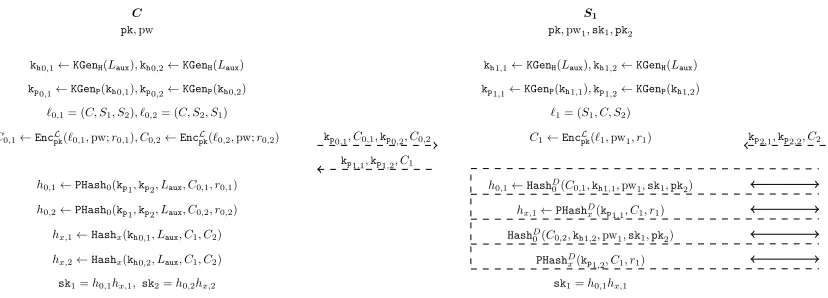
Using distributed SPHFxwe can build efficient 2PAKE protocols. We consider the same setting as 2KOY [13], in particular a client that negotiates independent session keys with both servers that hold pw1+ pw2= pw. We omit the second server in the description of the protocol in Figure2 as the framework is symmetric in the sense that the second serverS2 performs likeS1. The framework follows the same principle as the latest
PAKE frameworks from SPHFs. In particular it can be seen as a two-server variant of the PAKE protocol from [15].
You can think of the two-server protocol as the execution of two distributed SPHFx protocols, one between (C, S1, S2) and one between (C, S2, S1) where serversS2 and S1 swap roles, such that (C, S1) and
(C, S2) eventually hold common hash values that can be used to generate a shared session keysk1 andsk2.
The only overlap between the two SPHFxexecutions is theHashxcomputation. The reuse ofC1, C2inHashx
functions is covered by the concurrent pseudorandomness.
2PAKE Framework The servers encrypt their password shares under a public keypk stored in thecrs
using a CCA-secure labelled encryption scheme and distribute this ciphertext together with two appropriate projection keys for a secure distributed SPHFx, (kp1,1,kp1,2, C1) and (kp2,1,kp2,2, C2). The client computes
two independent encryptions of the password and generates two independent according projection keys (kp0,1, C0,1,kp0,2, C0,2). The previously described SPHF
x allows us to send all
kpi, Ci in one round and
therefore reach optimality for this step. Using these values, the client can compute session keys as product of the two hash values h0,1, hx,1 forsk1, which is shared withS1 and from h0,2, hx,2 forsk2 that is shared
withS2.
Subsequently, the two servers perform theHashD0 andPHashDx protocols such thatS1 andS2 eventually
hold hash values h0,1 and hx,1, h0,2 andhx,2 respectively, to compute sk1, sk2 respectively. Eventually,C
holds sk1 =h0,1·hx,1 and sk2 = h0,2·hx,2, S1 holds sk1 =h0,1·hx,1 and S2 holdssk2 =h0,2·hx,2. An
instantiation of the framework using labelled Cramer-Shoup encryption and the aforementioned distributed SPHFx yields a secure 2PAKE protocol. Note that this actually requires two SPHFxexecutions.
Security We use the well-known game based PAKE model first introduced by Bellare et al. [3] in it’s
two-server variant from [13]. For a formal description of the model we refer to [13]. The security of the two-server PAKE framework follows directly from the CCA-security of the used encryption scheme and the security of the distributed SPHFx.
Theorem 4. Let (KGenH,KGenP,PHash0,Hashx,HashD0,PHashDx) be a secure distributed SPHF
x and (KGen,
Enc, Dec) a CCA-secure labelled encryption scheme, then the proposed framework in Figure 2 is a secure
two-server PAKE protocol.
Proof (sketch). LetΠ denote a secure instantiation of the 2PAKE framework. To prove security ofΠ we
introduce three experiments such that the adversary in the last experiment Exp3 can not do better than
guessing the password as all messages are password independent, i.e. AdvExp3
Π,A ≤q/|D| for q active attacks. We initially focus on theAKE-security ofsk1.
Exp1 is identical to the two-server AKE-security experiment except that the simulator knows π, the decryption key topkin thecrs(only a syntactical change) and the following changes: IfC0,1 orC1, handed
C S1
pk,pw pk,pw1,sk1,pk2
kh0,1←KGenH(Laux),kh0,2←KGenH(Laux) kh1,1←KGenH(Laux),kh1,2←KGenH(Laux)
kp0,1←KGenP(kh0,1),kp0,2←KGenP(kh0,2) kp1,1←KGenP(kh1,1),kp1,2←KGenP(kh1,2)
`0,1= (C, S1, S2), `0,2= (C, S2, S1) `1= (S1, C, S2)
C0,1←EncLpk(`0,1,pw;r0,1), C0,2←EncLpk(`0,2,pw;r0,2) kp0,1, C0,1,kp0,2, C0,2 C1←EncLpk(`1,pw1, r1) kp2,1,kp2,2, C2
kp1,1,kp1,2, C1
h0,1←PHash0(kp1,kp2, Laux, C0,1, r0,1) h0,1←HashD
0(C0,1,kh1,1,pw1,sk1,pk2)
h0,2←PHash0(kp1,kp2, Laux, C0,2, r0,2) hx,1←PHashDx(kp1,1, C1, r1)
hx,1←Hashx(kh0,1, Laux, C1, C2) HashD
0(C0,2,kh1,2,pw1,sk1,pk2) hx,2←Hashx(kh0,2, Laux, C1, C2) PHashD
x(kp1,2, C1, r1) sk1=h0,1hx,1,sk2=h0,2hx,2 sk1=h0,1hx,1
Fig. 2: Two-Server PAKE framework using SPHFx Dashed lines denote broadcast messages.
wins the experiment. IfC0,1,C1orC2, handed toS1orC encrypt a wrong password(share), the key for that
session is drawn uniformly at random fromG. The first change only increases the adversarial advantage and the second one introduces a negligible gap according to the adaptive smoothness of the used SPHFx.
Exp2performs likeExp1 except that it draws the session key at random fromGif allCihanded toCand
S1 are oracle generated or encrypt the correct password and no session key has been chosen for the partner
in that session (otherwise that previously drawn key is used). This introduces a negligible gap between advantages inExp1 andExp2due to the concurrent pseudorandomness of the used SPHF
x
.
Exp3 acts like Exp2 except that it returns encryptions of 0 for C0,1 and C1 (note that 0 is not a valid
password). This step is covered by the CCA-security of the used encryption scheme.
AKE-security ofsk1follows as all messages are password independent inExp3unless the adversary guesses
the correct password. Using the same sequence of experiments but consideringC and S2 instead of C and
S1, AKE-security ofsk2 follows. ut
4.2 2-Server KOY (2KOY) [13]
We can now “explain” the use of SPHF in 2KOY from [13]; similar to [11] that “explained” the original KOY protocol from [14]. We define encryption schemes and distributed SPHFxused in 2KOY, highlight changes to our framework and discuss implications of this on the security of 2KOY.
Thecrscontains a public keypkfor Cramer-Shoup encryption as well as a public keyg3 for El-Gamal
encryption. Since [13] uses El-Gamal encryptions on the server side, we have to use a combination of Cramer-Shoup and El-Gamal based SPHFx in 2KOY. Instead of using Cramer-Shoup encryptions and SPHFx, the client computes projection keys for an El-Gamal distributed SPHFx, which is based on the aforementioned SPHF on El-Gamal ciphertexts.
Likewise, the servers compute projection keys for a Cramer-Shoup distributed GL-SPHFxand El-Gamal encryptions of their password shares.2 We describe the original GL-SPHF on Cramer-Shoup ciphertexts
in Appendix A.1 The client sends the projection keys in a third round together with a signature on the session transcript to the servers. The protocol is depicted in Figure 3. Note that we moved Kr into a
separate encryption compared to the original protocol. The ElGamal encryption of the password of party
i, ˆCi ←EncEGpki(g pwi;r
i) is precomputed and stored onSj, j6=i, j ∈ {1,2}. Eventually, the client computes
hash values using thePHash0 function of the GL-SPHFx scheme on CS ciphertexts and theHashxfunction
of the SPHFx scheme on El-Gamal ciphertexts. Further, the servers execute the HashD0 protocol of the
distributed GL-SPHFxscheme on CS ciphertexts and thePHashDx protocol of the distributed SPHF x
scheme on El-Gamal ciphertexts.
C S1
crs,pw crs,pw1,Cˆ2
(vk,sk)←Gen, `= (C,vk) (kh1,kh01)←KGenHCS(Laux)
C1,0←EncCSpk(`,pw;r1)
C2,0←EncCSpk(`,pw;r2) C1,0, C2,0,vk (kp1,kp01)←KGenPCS(kh1,kh01, C1,0)
(kh1,0,kh2,0)
R
←KGenHEG(Laux)
(kp1,0,kp2,0)←KGenPEG(kh1,0,kh2,0, Laux) C1,kp1,kp01 C1←EncEGg3(g
pw1
1 ;r1) C2,kp2,kp02
σ←Sign(trans,kp1,kp2)
h0,1←PHashCS0 (kp1,kp2, Laux, C1,0, r1) σ,kp1,0,kp2,0 checkC, G2,trans
h0,2←PHashCS0 (kp01,kp02, Laux, C2,0, r2) h0,1←HashD0−CS
hx,1←HashEGx (kh1,0, Laux, C1, C2)
hx,2←HashEGx (kh2,0, Laux, C1, C2) hx,1←PHashDx−EG
sk1=h0,1hx,1,sk2=h0,2hx,2 sk1=h0,1hx,1
Fig. 3: Two-Server KOY [13] using SPHFx Dashed lines denote broadcast messages.
Security of 2KOY Security of the protocol in Figure3against passive adversaries follows immediately from
[13, Theorem 1] as we do not change the protocol. However, the authors of [13] need additional mechanisms to prove their protocol secure against an active adversary. They add witness-indistinguishableΣ-protocols to
thePHashDx andHashD0 protocols that prove correctness of their messages. Without giving a proof it should
be clear that Theorem4 also holds for the 2KOY instantiationwithout additional mechanisms. Examining the proof of [13, Theorem 2] shows that the additional steps are only necessary to conduct the proof without actually giving additional security. This shows the power of distributed SPHFxas they allow for much simpler proofs of multi-party protocols. Furthermore, with our framework the protocol becomes more efficient than 2KOY as it needs only two rounds instead of three and does not need correctness proofs in the distributed hash and projection protocols.
5
Conclusion
We introduced the notion of extended (distributed) smooth projective hashing and gave an instantiation using Cramer-Shoup ciphertexts. Distributed smooth projective hashing can be used as building block in threshold and multi-party protocols. As an example, we built a two-server PAKE framework using a distributed smooth projective hash function. This two-server PAKE framework yields the most efficient two-server PAKE protocols today. The framework also allows us to explain and simplify the two-server PAKE protocol from [13].
While we focused on two-server password authenticated key exchange as application of distributed SPHF in this work, (distributed) extended smooth projective hash functions is an interesting building block for future work on other multi-party and threshold protocols.
Acknowledgments This research was supported by the German Science Foundation (DFG) through the
References
1. M. Abdalla, C. Chevalier, and D. Pointcheval. Smooth Projective Hashing for Conditionally Extractable Com-mitments. InCRYPTO’09, volume 5677 ofLecture Notes in Computer Science, pages 671–689. Springer-Verlag, 2009. 1
2. M. Abdalla and D. Pointcheval. A Scalable Password-Based Group Key Exchange Protocol in the Standard Model. InASIACRYPT’06, volume 4284 ofLecture Notes in Computer Science, pages 332–347. Springer-Verlag, 2006. 1
3. M. Bellare, D. Pointcheval, and P. Rogaway. Authenticated key exchange secure against dictionary attacks. In
EUROCRYPT’00, volume 1807 ofLecture Notes in Computer Science, pages 139–155. Springer-Verlag, 2000.11
4. F. Benhamouda, O. Blazy, C. Chevalier, D. Pointcheval, and D. Vergnaud. Efficient UC-Secure Authenticated Key-Exchange for Algebraic Languages. InPKC’13, volume 7778 ofLecture Notes in Computer Science, pages 272–291. Springer-Verlag, 2013. 1
5. F. Benhamouda, O. Blazy, C. Chevalier, D. Pointcheval, and D. Vergnaud. New Smooth Projective Hash Functions and One-Round Authenticated Key Exchange. Cryptology ePrint Archive, Report 2013/034, 2013. http:// eprint.iacr.org/. 1,2,3,4,5,15
6. F. Benhamouda, O. Blazy, C. Chevalier, D. Pointcheval, and D. Vergnaud. New Techniques for SPHFs and Efficient One-Round PAKE Protocols. In CRYPTO’13, volume 8042 of Lecture Notes in Computer Science, pages 449–475. Springer-Verlag, 2013. 2,3,10
7. O. Blazy, D. Pointcheval, and D. Vergnaud. Round-Optimal privacy-preserving protocols with smooth projective hash functions. InTCC’12, volume 7194 ofLecture Notes in Computer Science, pages 94–111. Springer-Verlag, 2012. 1
8. J. Brainard and A. Juels. A new two-server approach for authentication with short secrets. In USENIX’03, volume 12 ofSSYM’03, pages 14–14. USENIX Association, 2003. 11
9. R. Cramer and V. Shoup. A practical public key cryptosystem provably secure against adaptive chosen ciphertext attack. InCRYPOT’98, volume 1462 ofLecture Notes in Computer Science, pages 13–25. Springer-Verlag, 1998.
1
10. R. Cramer and V. Shoup. Universal Hash Proofs and a Paradigm for Adaptive Chosen Ciphertext Secure Public-Key Encryption. InEUROCRYPT’02, volume 2332 ofLecture Notes in Computer Science, pages 45–64. Springer-Verlag, 2002. 1,2
11. R. Gennaro and Y. Lindell. A Framework for Password-Based Authenticated Key Exchange. ACM Trans. Inf. Syst. Secur., 9(2):181–234, may 2006. 1,2,3,4,5,12,14
12. C. Gentry, P. D. MacKenzie, and Z. Ramzan. A Method for Making Password-Based Key Exchange Resilient to Server Compromise. In CRYPTO’06, volume 4117 of Lecture Notes in Computer Science, pages 142–159. Springer-Verlag, 2006. 10
13. J. Katz, P. MacKenzie, G. Taban, and V. Gligor. Two-server password-only authenticated key exchange. In
ACNS’05, volume 3531 ofLecture Notes in Computer Science, pages 1–16. Springer-Verlag, 2005. 1,10,11,12,
13
14. J. Katz, R. Ostrovsky, and M. Yung. Efficient Password-Authenticated Key Exchange Using Human-Memorable Passwords. InEUROCRYPT’01, volume 2045 ofLecture Notes in Computer Science, pages 475–494. Springer-Verlag, 2001. 1,11,12,14
15. J. Katz and V. Vaikuntanathan. Round-optimal password-based authenticated key exchange. InTCC’11, volume 6597 ofLecture Notes in Computer Science, pages 293–310. Springer-Verlag, 2011. 1,2,3,4,6,11
16. P. MacKenzie, T. Shrimpton, and M. Jakobsson. Threshold password-authenticated key exchange. In
CRYPTO’02, volume 2442 of Lecture Notes in Computer Science, pages 1–41. Springer-Verlag, 2002. 11
17. M. D. Raimondo and R. Gennaro. Provably secure threshold password-authenticated key exchange. In EU-ROCRYPT 2003, volume 2656 ofLecture Notes in Computer Science, pages 507–523. Springer-Verlag, 2003.
10
18. M. Szydlo and B. Kaliski. Proofs for Two-Server Password Authentication. In CT-RSA’05, volume 3376 of
Lecture Notes in Computer Science, pages 227–244. Springer-Verlag, 2005. 11
19. T. Wu. RFC 2945 - The SRP Authentication and Key Exchange System, sep 2000. 10
A
SPHF Definitions
A.1 GL-SPHF [11]
ciphertexts in the framework from [5] we define the following variables: LetΓ(C) =
g1g2h c
1 1 1dξ
T
∈G4×2,
λ=r∈Zp andΘaux(C) = (u1, u2, e/m, v)∈G1×4. GL-SPHF then is defined as follows:
– kh R
←KGenH(Laux) :kh= (η, θ, µ, ν)∈RZ1p×4
– kp←KGenP(kh, Laux, C) :
kp=Γ kh=
g1g2h c
1 1 1dξ
T
(η, θ, µ, ν) =gη1g2θhµcνdξν ∈G
– h←Hash(kh, Laux, C) :
h=Θaux(C)kh= (u1, u2, e/m, v)(η, θ, µ, ν) =u η 1u
θ 2(e/m)
µvν
∈G
– h←PHash(kp, Laux, C, r) :
h=λkp=rg η 1g
θ
2hµcνdξν= (g η 1g
θ
2hµcνdξν)r∈G
A.2 Cramer-Shoup SPHFx
The Cramer-Shoup SPHFx is fully defined as follows (please see Section3.3 for specifications ofΘx aux, Θ
0 aux
andΓ):
– khi R
←KGenH(Laux) :khi= (η1, η2, θ, µ, ν)∈RZ1p×5.
– kpi←KGenP(khi, Laux) :
kpi=Γ khi=
g1 1 g2h c
1 g1 1 1d
(η1,i, η2,i, θi, µi, νi) =
gη1,i
1 g
θi
2 h
µicνi
gη2,i
1 d
νi
∈G2×1
– hx←Hashx(kh0, Laux, C1, . . . , Cx) :
hx=Θauxx (C1, . . . , Cx)kh0
= (
x
Y
i=1
u1,i, x
Y
i=1
uξi
1,i, x
Y
i=1
u2,i, x
Y
i=1
ei/m, x
Y
i=1
vi)(η1,0, η2,0, θ0, µ0, ν0)
= (
x
Y
i=1
u1,i)η1,0·( x
Y
i=1
uξi
1,i) η2,0·(
x
Y
i=1
u2,i)θ0·( x
Y
i=1
ei/m)µ0·( x
Y
i=1
vi)ν0 ∈G
– hx←PHashx(kp0, Laux, C1, . . . , Cx, r1, . . . , rx) : with Ω(ri, Ci) = (ri, riξi)
hx= x
Y
i=1
(λikp0) = x
Y
i=1
(ri, riξi)
gη1,0
1 g
θ0
2 hµ0cν0
gη2,0
1 dν0
=
x
Y
i=1
[(gη1,0
1 g
θ0
2 h
µ0cν0)ri(gη2,0
1 d
ν0)riξi]∈
G
– h0←Hash0(kh1, . . . ,khx, Laux, C0) :
h0= x
Y
i=1
(Θ0aux(C0)khi) = x
Y
i=1
[(u1, uξ1, u2, e/m, v)(η1,i, η2,i, θi, µi, νi)]
=
x
Y
i=1
(uη1,i
1 ·u
ξη2,i
1 ·u
θi
2 ·(e/m)
– h0←PHash0(kp1, . . . ,kpx, Laux, C0, r0) : withλ0=Ω(r0, C0)
h0= x
Y
i=1
(λ0kpi) = x
Y
i=1
(r0, r0ξ0)
gη1,i
1 g
θi
2 h
µicνi
gη2,i
1 d νi = x Y i=1
[(gη1,i
1 g
θ,i
2 h
µicνi)r0(gη2,i
1 d
νi)r0ξ0]∈
G
A.3 ElGamal SPHFx
We usemfor the encrypted message, that is part ofaux0 andpkfor the ElGamal public keyh=gz from the
crs. The ciphertexts are created asCi= (u, e)←EncEGpk (mi;ri) for all i= 1, . . . , xwith mi =h(m)[i] and
C0= (u, e)←EncEGpk (m;r0). The decryption follows the ElGamal decryption such that Dec0π =DecEGz . The
combining functionguses the homomorphic property ofuandesuch thatg(C1, . . . , Cx) = (Q x i=1ui,Q
x i=1ei).
To use the SPHF framework we also need the following variables and functions:
Γ(C) = (g, h)T ∈G2×1, λ=r∈
Zp, Θaux0 (C) = (u, e/m)∈G 1×2
Θxaux(C1, . . . , Cx) = ( x
Y
i=1
ui, x
Y
i=1
ei/m)∈G1×2
Using them in the SPHFxDefinition4yields the following ElGamal SPHFx:
– h0←Hash0(kh1, . . . ,khx, Laux, C0) :
h0= x
Y
i=1
Θ0aux(C)khi= x
Y
i=1
[(u0, e0/m)(η, θ)] = x
Y
i=1
[uηi
0 (e0/m)θi]∈G
– hx←PHashx(kp0, Laux, C1, . . . , Cx, r1, . . . , rx) :
hx= x
Y
i=1
(λikp0) = x
Y
i=1
(rigη0hθ0) = x
Y
i=1
(gη0hθ0)ri ∈
G
B
SPHF Technicalities
B.1 Smoothness of Cramer-Shoup SPHFx
We want to discuss the statistical smoothness of SPHFxfrom Theorem1in this section. While the intuition and actual proof has been given in Section3, we want to formulate what actually happens there. Therefore, we use the instantiation of Cramer-Shoup SPHFx and limit x = 2. Recall that we thus want to show that (kp0,kp1,kp2, h0, hx) is uniformly distributed in Gk+2 for all C 6∈ Laux. Actually, we do not have to
bother with the projection keys kp0,kp1,kp2, as they are each uniformly at random in G
k anyway, given
the randomness of allkhi. What we want to show is that givenkp0,kp1,kp2, the hash values h0 and hx are
uniformly distributed inG. More precisely, we show that for allC= (C0, C1, C2)6∈Lauxthe projection keys
kp0,kp1,kp2 are defined by functions that are linearly independent from the functions used in Hash0 and Hashx, such that the resulting hash values h0 ← Hash0 and hx ← Hashx are uniformly distributed in G.
Computing the discrete logarithm in baseg1ofhx, h0and the projection keyskp1,kp1andkp2withm=g pw
andm0 =gpw0 such that
EncCSpk(m0)6∈Lauxwe get the following equations:
logg
1(h0) = logg1(kp1[0])·r0+ logg1(kp1[1])·ξ0r0
+ logg1(kp2[0])·r0+ logg2(kp2[1])·ξ0r0+ logg1(m
0/m)·(ν
1+ν2)
=r0(η1,1+η1,2) +ξ0r0(η2,1+η2,2) + logg1(g2)·r0(θ1+θ2) +z·r0(ν1+ν2) (1) + logg1(c)·r0(ν1+ν2) + logg1(d)·ξ0r0(ν1+ν2) + logg1(m
0/m)·(ν
logg1(hx) = logg1(kp0[0])·(r1+r2) + logg1(kp0[1])·(ξ1r1+ξ2r2) + logg1(m 0/m)·ν
0
= (r1+r2)η1,0+ (ξ1r1+ξ2r2)η2,0+ logg1(g2)·(r1+r2)θ0+z·(r1+r2)ν0 (2) + logg1(c)·(r1+r2)ν0+ logg1(d)·(ξ1r1+ξ2r2)ν0+ logg1(m
0/m)·ν
0
logg1(kp0[0]) =η1,0+ logg1(g2)·θ0+ logg1(h)·µ0+ logg1(v)·ν0 (3)
logg1(kp0[1]) =η2,0+ logg1(d)·ν0 (4)
logg1(kp1[0]) =η1,1+ logg1(g2)·θ1+z·µ1+ logg1(v)·ν1 (5) logg
1(kp1[1]) =η2,1+ logg1(d)·ν1 (6)
logg
1(kp2[0]) =η1,2+ logg1(g2)·θ2+z·µ2+ logg1(v)·ν2 (7)
logg1(kp2[1]) =η2,2+ logg1(d)·ν2. (8)
SinceC6∈Lauxwe know thatm6=m0 and thusm0/m6= 1. Therefore, the probability forg0= logg1(m 0/m)· (ν1+ν2) andgx= logg1(m
0/m)·ν
0for anyg0, gx∈Gis 1/|G|even knowing the projection keyskp0,kp1,kp2.
Note that these equations forg0andgxare linearly independent from Equations3-8such that every element
from G is equally likely to be the result. Equations 1 and 2 are fully determined by public information
C0, C1, C2 andkp0,kp1,kp2 such that their result is uniformly distributed inGgiven the randomness ofg0
andgx.
C
Notation
Using common matrix and vector operations oncan be used as follows:
bs=
b11· · ·b1y
.. . ...
bx1· · ·bxy
(s11, . . . , s1y) = (
y
Y
i=1
bs1i
1i , . . . , y
Y
i=1
bsxi
xi ) T ∈
Gx×1
sc= (s11, . . . , s1y)(c11, . . . , cy1)T = y
Y
i=1
cs1i

![Fig. 3: Two-Server KOY [13] using SPHFx](https://thumb-us.123doks.com/thumbv2/123dok_us/7916496.1314481/13.612.97.515.119.300/fig-two-server-koy-using-sphfx.webp)
