© 2014, IJCSMC All Rights Reserved 841
Available Online atwww.ijcsmc.com
International Journal of Computer Science and Mobile Computing
A Monthly Journal of Computer Science and Information Technology
ISSN 2320–088X
IJCSMC, Vol. 3, Issue. 5, May 2014, pg.841 – 850
RESEARCH ARTICLE
Dynamic Routing for ADA in Wireless
Sensor Networks
Nagaraj
PG Student, Dept of PG STUDIES, NIE Mysore, India
Email: [email protected]
C.N.Chinnaswamy
Associate Professor, Dept ofInformation Science & Engineering, NIE Mysore, India Email: [email protected]
Abstract: Sensor webs consisting of nodes with limited battery power and wireless communications are deployed to collect useful information from the field[1]. Gathering sensed information in an energy efficient manner is critical to operating the sensor network for a long period of time. Data collection problem is defined where, in a round of communication, each sensor node has a packet to be sent to the distant base station. There is some fixed amount of energy cost in the electronics when transmitting or receiving a packet and a variable cost when transmitting a packet which depends on the distance of transmission. If each node transmits its sensed data directly to the base station, then it will deplete its power quickly. Data aggregation[3][5] has been widely recognized as an efficient method to reduce energy consumption[4] in wireless sensor networks, which can support a wide range of applications such as monitoring temperature[4], humidity, level, speed etc. The data sampled by the same kind of sensors have much redundancy since the sensor nodes are usually quite dense in wireless sensor networks. To make data aggregation more efficient, the packets with the same attribute, defined as the identifier of different data sampled by different sensors such as temperature sensors, humidity sensors, etc., should be gathered together. However, to the best of our knowledge, present data aggregation mechanisms did not take packet attribute into consideration. Following this paradigm, numerous data aggregation schemes [6], [7], [8],[9],[10], [11], [12], [13], [14], [15], [16], [7], [18] have been proposed to save the limited energy on sensor nodes in WSNs. In this paper, we take the lead in introducing packet attribute into data aggregation and propose an Attribute-aware Data Aggregation(ADA) mechanism using Dynamic Routing which can make packets with the same attribute convergent as much as possible and therefore improve the efficiency of data aggregation.
Keywords- Data aggregation, Energy efficiency, dynamic routing, potential field
1. INTRODUCTION
© 2014, IJCSMC All Rights Reserved 842
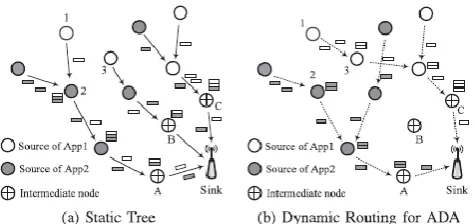
collect audio, seismic, and other types of data and collaborate to perform a high-level task in a sensor web. For example, a sensor network can be used for detecting the presence of potential threats in a military conflict. Since wireless communications consume significant amounts of battery power, sensor nodes should be energy efficient in transmitting data. Energy efficient communication in wireless networks is attracting increasing attention in the literature.fig1 shows basic idea of ADA scheme. A typical application in a sensor web is gathering of sensed data at a distant base station (BS). There is an energy cost for transmitting or receiving a packet in the radio electronics and there is a variable energy cost depending on the distance in transmissions. Due to the r2 or larger radio signal attenuation for a range r, it is important to limit transmission distances to conserve energy.
In this paper, we assume the following:
1. Each sensor node has power control and the ability to transmit data to any other sensor node or directly to the BS.
2. Our model sensor network contains homogeneous and energy constrained sensor nodes with initial uniform energy.
3. Every node has location information. 4. There is no mobility.
Fig. 1. Basic idea of the ADA scheme.
2. RELATED WORK
Energy Reduction for Data Gathering in Sensor Networks:
In each round of this data-gathering application, all data from all nodes need to be collected and transmitted to the BS, where the end-user can access the data. In some sensor network applications, data collection may be needed only from a region and, therefore, a subset of nodes will be used. A simple approach to accomplishing this data gathering task is for each node to transmit its data directly to the BS. Since the BS is typically located far away, the cost to transmit to the BS from any node is high so nodes will die very quickly. Therefore, an improved approach is to use as few transmissions as possible to the BS and reduce the amount of data that must be transmitted to the BS in order to reduce energy. Further, if all nodes in the network deplete their energy levels uniformly, then the network can operate without losing any nodes for a long time. In sensor networks, data fusion helps to reduce the amount of data transmitted between sensor nodes and the BS. Data fusion combines one or more data packets from different sensor measurements to produce a single packet, as described.
© 2014, IJCSMC All Rights Reserved 843
BS. LEACH uses randomization to rotate the cluster heads and achieves a factor of eight improvement compared to the direct approach, before the first node dies. In LEACH, clusters are formed in a self-organized manner in each round of data collection. About 5 percent of the nodes in the network selected randomly become cluster heads. These cluster heads send a strong beacon signal to all nodes and sensor nodes decide which cluster to join based on received signal strength. The distributed cluster formation in each round in LEACH may not produce good clusters to be efficient. In an improved version of this scheme, called LEACH-C [14], this cluster formation is done at the beginning of each round using a centralized algorithm by the BS. Although the energy cost for cluster formation is higher in LEACH-C, the overall performance is better than LEACH due to improved cluster formation by the BS. The steady state part of the LEACH-C protocol, i.e., data collection in rounds, is identical to the LEACH protocol. LEACH-C improves the performance by 20 percent to 40 percent, depending on the network parameters, compared to LEACH in terms of the total number of rounds of data collection that can be achieved before sensor nodes start to die. Further improvements can be obtained if each node communicates only with close neighbors and only one designated node sends the combined data to the BS in each round in order to reduce energy.
A new protocol based on this approach, called PEGASIS (Power-Efficient GAthering in Sensor Information Systems), is presented in this paper, which significantly reduces energy cost to increase the life of the sensor network. The PEGASIS protocol is near optimal in terms of energy cost for this data gathering application in sensor networks. The key idea in PEGASIS is to form a chain among the sensor nodes so that each node will receive from and transmit to a close neighbor. Gathered data move from node to node, get fused, and, eventually, a designated node transmits to the BS. Nodes take turns transmitting to the BS so that the average energy spent by each node per round is reduced. Building a chain to minimize the total length is similar to the traveling salesman problem, which is known to be intractable. However, with the radio communication energy parameters, a simple chain built with a greedy approach performs quite well. The PEGASIS protocol achieves between 100 to 200 percent improvement when 1 percent, 25 percent, 50 percent, and 100 percent of nodes die compared to the LEACH protocol. PEGASIS performance improvement in comparison with LEACH-C will be slightly less as LEACH-C improves upon LEACH by about 20 percent to 40 percent. In the rest of this paper we present all our performance comparisons with respect to the LEACH protocol with the understanding that the improvement is less by the extent that LEACH-C improves upon LEACH. When attribute-based search is to be performed, then the area and, hence, selected sensor nodes, will also change dynamically. In these situations, the BS selects the area of interest and only selected nodes in the region participate in data collection. We will still use the same chain ordering of nodes and only the selected nodes will be on to form the truncated chain. Likely, these nodes will still be nearby on the shortened chain and the data collection will still be efficient.
Information Theoretic Foundations:
© 2014, IJCSMC All Rights Reserved 844
For imaging sensors, obstacles in the line-of vision as well as confusion in background images combine to complicate propagation. The coupling between a sensor and its environment lends another important propagation consideration. For example, the coupling between a ground-deployed seismic sensor and the surface introduces an additional transfer function that must be included in source characterization. Observations, therefore, depend on propagation gains G(x,y,t) between sensors at x and sources y at a time t. Models for propagation gains may be either deterministic or based on the propagation loss statistics of the inhomogeneous medium with respect to different sensing modes. For example, in imaging a 3- dimensional obstruction model is required. It is clearly elevation dependent and thus different parts of the sensor deployment manifold have different loss values, and these values themselves will be time-dependent as the environment evolves. Together, these contributions to sensing uncertainty have been present in distributed sensing and are well-known in specific applications. Normally, complex site survey, preparation of the environment (for example the creation of a massive pier for a seismic sensor or the clearing of foliage for imaging sensors), and manual effort are devoted to each sensor. However, distributed sensor networks are planned for rapid UCLA Center for Embedded Networked Sensing.
© 2014, IJCSMC All Rights Reserved 845
detection and fire detection. However, in WSN, energy is limited and usually difficult to be supplemented due to the harsh environment where the sensors are deployed. What’s more, the raw data has much redundancy since the sensor nodes in WSN are usually quite dense. Therefore, numerous data aggregation mechanisms have been proposed to conserve energy by gathering the raw data together, preprocessing them at the intermediate nodes and transmitting only the abstracted data to the sink. To reduce the Average Number of Transmissions (ANT)1, packets containing redundant information should be gathered together. However, to the best of our knowledge, although present data aggregation protocols propose sorts of strategies to make packets more spatially and temporally convergent to reduce ANT, they ignore considering whether the packets have redundant information or not. For example, in , if two or more kind of sensors, such as pressure sensors, temperature sensors, traffic sensors etc., are working in a same region. All the packets generated by the sensor nodes are transmitted along the same pre-constructed shortest path tree to the sink. Although the timing scheme proposed in ensures that packets have a high probability to meet with each other, chances are that they cannot be aggregated since they contain different data sampled by different sensors. In this paper, we assume that the packets with the same attribute have redundant information and propose a data aggregation mechanism ADADR which takes the packet attribute into consideration. The proposed ADADR mechanism aims to make packets with the same attribute convergent as much as possible to improve the degree of data aggregation and therefore reduce ANT. This goal cannot be achieved by the static routing schemes employed in most of the present data aggregation mechanisms, such as cluster-based, chain-based and tree-based, since they preconstruct the whole route before transmitting packets while the information of packet attribute at each node continuously changes when packets are transmitted to the sink. Therefore, a distributed and dynamic routing protocol is needed to adapt to the frequent variation of packets at each node. To design the dynamic routing, we need to determine the routing metric. First node depth, which is defined as the number of hops a node is away from the sink, is considered to ensure packets reach the sink at last. Besides, the metric must be relevant with the packet attribute. Enlightened by the concept of pheromone, which will be left along the path where the ants pass and evaporate with time, in ant colony, we draw an analogy between the pheromone and the packet attribute. A packet will leave attribute-dependent pheromone when passing a node to attract the afterwards packets with the same attribute. Also the attribute-dependent pheromone will evaporate with time. With respect to the forwarding decisions, we borrow the concept of potential in the discipline of physics. Instead of determining the forwarding decisions before the packets begin to be transmitted as the static routing schemes do, we forward packets in real time to fully utilize the attribute-dependent pheromone information. The potential based routing is easy to be implemented since the information (node depth and attribute-dependent pheromone) it needs to dynamically route packets is easily gotten. More importantly, it differentiates packets with different attributes and makes the packets with the same attribute as convergent as possible. The dynamic routing scheme proposed makes packets more spatially convergent. To further reduce ANT, it is better that packets are also temporally convergent, that is, packets can meet with others at the same node as well as at the same time. Thus, we also propose an adaptive packet-driven timing scheme, which improves temporal convergent, to cooperate with the dynamic routing. The remainder of the paper is organized as follows. Next section discusses related work and the motivation. Section III describes the details of ADADR, including the potential based dynamic routing, followed with some analysis of the parameters in it, and the packet-driven timing scheme. Section IV describes the simulations conducted to evaluate the performance of the proposed ADADR mechanism. At last, section V concludes the paper. Reducing communication overhead between nodes is the main method to save energy in WSN since the largest factor of energy of a sensor node is used to transmit and receive packets.
© 2014, IJCSMC All Rights Reserved 846
between these two protocols is the method of selecting cluster heads. LEACH assumes that all the nodes have the same amount of energy capacity in each election round. While HEED aims to form efficient clusters to maximize network lifetime. All the cluster-based data aggregation mechanisms assume that each node in the network can reach the sink directly in one-hop, which limits the scalability of the WSN. Chain-based data aggregation protocols organize sensor nodes as a shortest chain along which data is transmitted to the sink. The chain can be constructed by employing a greedy algorithm or the sink can determine the chain in a centralized manner. Greedy chain formation assumes that all nodes have global knowledge of the network. A typical chain based data aggregation protocol PEGASIS employs the greedy algorithm to construct the chain. In PEGASIS the distances that most of the nodes transmit are much shorter compared to LEACH, in which nodes transmit to its cluster head? Hence, PEGASIS protocol has considerable energy savings compared to LEACH. However, the global information needed to construct the chain route incurs high overhead especially when the scale of the WSN is large. Tree-based data aggregation protocols organize sensor nodes into a tree. Data aggregation is performed at intermediate nodes along the tree and a concise representation of the data is transmitted to the root node which is usually the sink. One of the main aspects of tree-based networks is the construction of an energy efficient data-aggregation tree, such as Steiner Minimum Tree (SMT) for multicast algorithms which can be used in designing data aggregation protocols. Since they are constructed in advance and static, they can only be suitable for applications in which the source nodes are known in advance and cannot dynamically gather packets with the same attribute together.
Energy-aware distributed heuristic (EADAT) and power-efficient data gathering and aggregation protocol (PEDAP) are two typical examples of tree-based data aggregation protocols. The main advantage of EADAT is that sensors with higher residual power have higher probability to become non-leaf tree nodes and thus extends network lifetime in terms of the number of alive nodes. PEDAP minimizes the total energy expended in each communication round by computing a minimum spanning tree over the WSN with transmission overhead as the link cost. However, the cost of reconstruction of the tree before every communication round is too large. What’s more, besides the complexity and overhead of the above schemes, few of them consider the situation of multiple kind of data in WSN. However, generally only packets with the same attribute can be aggregated, the present schemes fail to utilize the correlation of packets to make data aggregation more efficient. There are also some literatures focusing on timing scheme for data aggregation. TA proposed a simple, SQL-like declarative language for expressing aggregation queries over streaming sensor data. The query semantics of the language partition time into epochs of duration. Nodes transmit packets along a tree rooted at the sink during the corresponding interval which is decided by their depth, thus each parent will receive packets from their children almost at the same time. Cascading Timeout (CT) is also based on a rooting tree in which nodes wait some time according to the depth of the node before transmitting packets. In these two protocols, the transmission schedule at a node is fixed once the aggregation tree has been constructed and there is no dynamic adjustment in response to aggregation ratio, buffer occupancy of the parent or other information. Afterwards, some aggregation protocols with dynamic timing control are proposed. F. proposed a simple centralized feedback timing control scheme for tree-based aggregation. The sink determines the maximal duration for one data aggregation operation with the knowledge of the information quality in the previous aggregation operation. K.W. Fan et. al proposed a Random Waiting (RW) timing scheme, that is, every node aggregates and forwards the receiving packets after waiting a randomized time. Z. Ye et. al proposed a distributed scheme which employs a Semi-Markov decision process model. The decisions are made at available transmission epochs with the observation of the current node’s state, such as the number of samples collected, and the elapsed time at a node.
3. EXITING SYSTEM
© 2014, IJCSMC All Rights Reserved 847
the sink directly in one-hop, which limits the scalability of the WSN. Chain-based data aggregation protocols organize sensor nodes as a shortest chain along which data is transmitted to the sink. The chain can be constructed by employing a greedy algorithm or the sink can determine the chain in a centralized manner. Greedy chain formation assumes that all nodes have global knowledge of the network. A typical chain based data aggregation protocol PEGASIS employs the greedy algorithm to construct the chain. In PEGASIS the distances that most of the nodes transmit are much shorter compared to LEACH, in which nodes transmit to its cluster head. Hence, PEGASIS protocol has considerable energy savings compared to LEACH. However, the global information needed to construct the chain route incurs high overhead especially when the scale of the WSN is large. Tree-based data aggregation protocols organize sensor nodes into a tree. Data aggregation is performed at intermediate nodes along the tree and a concise representation of the data is transmitted to the root node which is usually the sink. One of the main aspects of tree-based networks is the construction of an energy efficient data-aggregation tree, such as Steiner Minimum Tree (SMT) for multicast algorithms which can be used in designing data aggregation protocols. Since they are constructed in advance and static, they can only be suitable for applications in which the source nodes are known in advance and cannot dynamically gather packets with the same attribute together.
Energy-aware distributed heuristic (EADAT) and power-efficient data gathering and aggregation protocol (PEDAP) are two typical examples of tree-based data aggregation protocols. The main advantage of EADAT is that sensors with higher residual power have higher probability to become non-leaf tree nodes and thus extends network lifetime in terms of the number of alive nodes.
Advantages:
PEDAP minimizes the total energy expended in each communication round by computing a minimum spanning tree over the WSN with transmission overhead as the link cost.
Disadvantage:
However, the cost of reconstruction of the tree before every communication round is too large.
However, generally only packets with the same attribute can be aggregated; the present schemes fail to utilize the correlation of packets to make data aggregation more efficient.
4. PROPOSED SYSTEM
The proposed ADADR mechanism aims to make packets with the same attribute convergent as much as possible to improve the degree of data aggregation and therefore reduce ANT. This goal cannot be achieved by the static routing schemes employed in most of the present data aggregation mechanisms, such as cluster-based, chain-based and tree-cluster-based, since they reconstruct the whole route before transmitting packets while the information of packet attribute at each node continuously changes when packets are transmitted to the sink. Therefore, a distributed and dynamic routing protocol is needed to adapt to the frequent variation of packets at each node. To design the dynamic routing, we need to determine the routing metric. First node depth, which is defined as the number of hops a node is away from the sink, is considered to ensure packets reach the sink at last. Besides, the metric must be relevant with the packet attribute. Enlightened by the concept of pheromone, which will be left along the path where the ants pass and evaporate with time, in ant colony, we draw an analogy between the pheromone and the packet attribute.
© 2014, IJCSMC All Rights Reserved 848
based routing is easy to be implemented since the information (node depth and attribute-dependent pheromone) it needs to dynamically route packets is easily gotten. More importantly, it differentiates packets with different attributes and makes the packets with the same attribute as convergent as possible. The dynamic routing scheme proposed makes packets more spatially convergent. To further reduce ANT, it is better that packets are also temporally convergent, that is, packets can meet with others at the same node as well as at the same time. Thus, we also propose an adaptive packet-driven timing scheme, which improves temporal convergent, to cooperate with the dynamic routing.
Advantages:
1. Attribute-aware data aggregation mechanism ADADR using dynamic routing as an energy efficient mechanism for collecting data in WSN
2. The depth potential field guarantees packets reaching the sink at last, and the pheromone potential field gathers packets with the same attribute together. Since the information for making dynamic routing decisions is easily gotten by each node, our potential based dynamic routing scheme not only can gather packet with the same attribute together but also is simple and scalable
© 2014, IJCSMC All Rights Reserved 849
Network Creation
Given wireless sensor network nodes’ current capabilities, we set out to design a data-collection network that would meet the scientific requirements. Before deploying network we are going to collect sensor node details. Based on that network is formed.
Network Clustering
Clustering can be loosely defined as the process of grouping objects into sets called clusters, so that each cluster consists of elements that are similar in some way. Clustering is used for multiple purposes, including natural" clusters (modules) and describing their properties, classifying the data, and detecting unusual data objects (outliers). In addition, treating a cluster or one of its elements as a single representative unit allows us to achieve data reduction. Here clustering was done based on the sensor types. To reduce energy waste in the sensor networks.
Dynamic Routing
Route was found by using attribute aware aggregation algorithm. First source node was selected. For that node set of neighbors found. From that neighbor next forwarding node is the node that has same attribute as current forwarding node. This process was continued until reaching the sensor node. Finally data was transferred though that path.
Cascading time
After selecting forwarding node waiting time is calculated for each node .so that current forwarding node can wait that much time before sending data. Cascading time was calculated for each node based on the depth of node and packet size. so that time will be different to all the nodes. This cascading time is used to avoid network congestions.
Integrity verification
Before receiving data from source node sink did validation for the received file. For that diffie-hellmen key exchange algorithm was used to generate secret keys. By using that key hash value was generated for each file. By using hash value verification was done at sink node.
CONCLUSION:
© 2014, IJCSMC All Rights Reserved 850
constructed by a depth potential field which aims to guarantee packets reaching the sink at last and a pheromone potential field which makes sure that packets with the same attribute spatially convergent as much as possible.
REFERENCES
[1] R. Szewczyk, A. Mainwaring, J. Polaster, and D. Culler, “An Analysis of a Large Scale Habitat Monitoring Application,” Proc. ACM Int’l Conf. Embedded Networked Sensor Systems (SenSys), 2004.
[2] Q. Fang, F. Zhao, and L. Guibas, “Lightweight Sensing and Communication Protocols for Target Enumeration and Aggregation,” Proc. Fourth Int’l ACM Symp. Mobile Ad Hoc Networking and Computing, 2003.
[3] M. Hefeeda and M. Bagheri, “Forest Fire Modeling and Early Detection Using Wireless Sensor Networks,” Ad Hoc and Sensor Wireless Networks, vol. 7, nos. 3/4, pp. 169-224, Apr. 2009.
[4] D.L. Hall and J. Llinas, “An Introduction to Multisensor Data Fusion,” Proc. IEEE, vol. 85, no. 1, pp. 6-23, Jan. 1997.
[5] D. Li, K. Wong, Y.H. Hu, and A. Sayeed, “Detection, Classification and Tracking of Targets in Distributed Sensor Networks,” IEEE Signal Processing Magazine, vol. 19, no. 2, pp. 17-29, Mar. 2002.
[6] W.R. Heinzelman, A. Chandrakasan, and H. Balakrishnan, “Application-Specific Protocol Architecture for Wireless Networks,” IEEE Trans. Wireless Comm., vol. 1, no. 4, pp. 660-670, Oct. 2002.
[7] S. Lindsey, C. Raghavendra, and K.M. Sivalingam, “Data Gathering Algorithms in Sensor Networks Using Energy Metrics,” IEEE Trans. Parallel and Distributed Systems, vol. 13, no. 9, pp. 924- 935, Sept. 2002.
[8] O. Younis and S. Fahmy, “HEED: A Hybrid, Energy-Efficient, Distributed Clustering Approach for Ad Hoc Sensor networks,” IEEE Trans. Mobile Computing, vol. 3, no. 4, pp. 366-379, Dec. 2004.
[9] M. Ding, X. Cheng, and G. Xue, “Aggregation Tree Construction in Sensor Networks,” Proc. IEEE 58th Vehicular Technology Conf., pp. 2168-2172, Oct. 2003.
[10] H.O. Tan and I. Korpeoglu, “Power Efficient Data Gathering and Aggregation in Wireless Sensor Networks,” SIGMOD Record, vol. 32, no. 4, pp. 66-71, Dec. 2003
[11] R. Cristescu, B. Beferull-Lozano, and M. Vetterli, “On Network Correlated Data Gathering,” Proc. IEEE INFOCOM, pp. 2571-2582, Mar. 2004.
[12] J. Li, A. Deshpande, and S. Khuller, “On Computing Compression Trees for Data Collection in Wireless Sensor Networks,” Proc. IEEE INFOCOM, 2010.
[13] W. Zhang and G. Cao, “DCTC: Dynamic Convoy Tree-based Collaboration for Target Tracking in Sensor Networks,” Ad Hoc and Sensor Wireless Networks, vol. 3, pp. 1689-1701, Sept. 2004.
[14] Y.-K. Kim, R. Bista, and J.-W. Chang, “A Designated Path Scheme for Energy-Efficient Data Aggregation in Wireless Sensor Networks,” Proc. IEEE Int’l Symp. Parallel and Distributed Processing with Applications, pp. 408-415, 2009.
[15] K. Fan, S. Liu, and P. Sinha, “On the Potential of Structure-Free Data Aggregation in Sensor Networks,” Proc. IEEE INFOCOM, pp. 1-12, Apr. 2006.
[16] S.R. Madden, M.J. Franklin, J.M. Hellerstein, and W. Hong, “TAG: A Tiny Aggregation Service for Ad-hoc Sensor Networks,” Proc. Symp. Operating Systems Design and Implementation (OSDI), pp. 131-146, Dec. 2002.
[17] Z. Ye, A. Abouzeid, and J. Ai, “Optimal Policies for Distributed Data Aggregation in Wireless Sensor Networks,” Proc. IEEE INFOCOM, pp. 1676-1684, May 2007.