DOI: 10.1534/genetics.107.071811
Transposable Element Dynamics of the
hAT
Element
Herves
in the Human Malaria Vector
Anopheles gambiae s.s.
Ramanand A. Subramanian,* Peter Arensburger,
†Peter W. Atkinson
†and David A. O’Brochta*
,1*Center for Biosystems Research, University of Maryland Biotechnology Institute, Rockville, Maryland 20850 and†Department of Entomology, University of California, Riverside, California 92521-0314
Manuscript received February 6, 2007 Accepted for publication June 12, 2007
ABSTRACT
Transposable elements are being considered as genetic drive agents for introducing phenotype-altering genes into populations of vectors of human disease. The dynamics of endogenous elements will assist in predicting the behavior of introduced elements. Transposable element display was used to estimate the site-occupancy frequency distribution ofHervesin six populations ofAnopheles gambiae s.s. The site-occupancy distribution data suggest that the element has been recently active within the sampled populations. All 218 individuals sampled contained at least one copy ofHerveswith a mean of 3.6 elements per diploid genome. No significant differences in copy number were observed among populations. Nucleotide poly-morphism within the element was high (p¼ 0.0079 in noncoding sequences and 0.0046 in coding se-quences) relative to that observed in some of the more well-studied elements inDrosophila melanogaster. In total, 33 distinct forms ofHerveswere found on the basis of the sequence of the first 528 bp of the transposase open reading frame. Only two forms were found in all six study populations. AlthoughHerves elements inAn. gambiae are quite diverse, 85% of the individuals examined had evidence of complete forms of the element. Evidence was found for the lateral transfer ofHervesfrom an unknown source into theAn. gambiaelineage prior to the diversification of theAn. gambiaespecies complex. The characteristics ofHervesinAn. gambiaeare somewhat unlike those ofPelements inD. melanogaster.
h
ATelements comprise a large and prevalent group of Class II transposable elements found in a wide range of plants and animals (Kempkenand Windhofer2001; Kunzeand Weil2002; Rayet al.2007).hAT
ele-ments are not only of interest for their role in genome evolution but also as tools for genetically modifying organisms, with the elementsHermesandhobobeing two examples of hATelement-derived insect gene vectors (Blackmanet al.1989; O’Brochtaet al.1996).
Trans-posable elements from other families such aspiggyBac,
Mos I,andMinoshave also been developed into effec-tive insect gene vectors that are now employed in a var-iety of applications (Atkinsonet al.2001). Using these
relatively new gene-integration tools, a novel form of biological control is being considered to stem the trans-mission of certain arboviruses (e.g., dengue fever) and parasites (e.g., Plasmodium) by mosquitoes and other ar-thropod vectors (Adelman et al. 2002; Alphey et al.
2002; Beardet al.2002). This strategy involves the
intro-duction of transgenic insects into natural populations of a target species with the intent of replacing the native population with genetically modified conspecifics (Craig
1963; World Health Organization 1991; James
1992; Miller1992). Introduced transgenic mosquitoes
will contain transgenes conferring incompatibility (re-fractoriness) or resistance to the target pathogen or parasite. An increase in the frequency of the transgene within natural populations of the vector will, under cer-tain conditions, lead to a reduction or elimination of vector-borne disease transmission (Boeteand Koella
2002).
Designing gene vectors and effector transgenes for refractoriness such that they will increase in natural pop-ulations and eventually reach fixation is a considerable challenge, and transposable elements may provide a means by which this can be accomplished (Braigand
Yan2001). The replicative nature of transposable element
movement (even by elements that move by a cut-and-past fashion i.e.,Class II elements) results in elements acquiring a transmission advantage, resulting in their gradual increase in frequency in populations (Ribeiro
and Kidwell 1994; Kiszewski and Spielman 1998).
The magnitude of that transmission advantage is deter-mined by the rate of transposition; the degree to which transposition is conservative or replicative; the spatial patterns of element transposition within a genome; the biology of the transposable element and its interactions with the host insect; and the size, structure, and charac-teristics of the target population (Rasgonand Gould
2005).
Sequence data from this article have been deposited with the EMBL/ GenBank Data Libraries under accession nos. EF588428–EF588665.
1Corresponding author: Center for Biosystems Research, University of
Maryland Biotechnology Institute, 9600 Gudelsky Drive, Rockville, MD
20850. E-mail: [email protected]
While intraspecies spreading of transposable ele-ments through transposition has been observed in nat-ure following recent horizontal transfer events involving transposable elements (e.g., P- and hobo elements), population modification has never been attempted by the deliberate and intentional release of an active autonomous transposable element into natural popula-tions of insects (Robertson2002). Predicting the
out-come of such an intentional release of transgenic insects containing active autonomous transposable element gene vectors is an enormous challenge but one that must be successfully met if population-replacement biological control using transposable elements is to be successful (Alpheyet al.2002). Data that might inform those
pre-dictions include an understanding of the dynamics of endogenous Class II transposable elements within the host insect. Endogenous elements are likely to reveal temporal and spatial patterns of spread as well as how population structure has influenced those patterns. Cur-rently our understanding of the population dynamics of Class II transposable elements in insects is based almost entirely on studies ofP-andhoboelements inDrosophila melanogasterand closely related species (Anxolabehere
et al.1988, 1990; Buchetonet al.1992; Simmons1992;
Silva and Kidwell 2004). These studies have
docu-mented the ability of these elements to spread rapidly through populations and for the elements to become structurally modified over time, most often by internal deletion. The propensity of these elements to accumu-late internal deletions rapidly has raised a serious con-cern about using transposable elements as transgene spreading agents, namely, the frequent loss of trans-genes. Maintaining tight linkage between the antipar-asite effector gene and the associated gene drive system has been repeatedly stated as an essential characteristic of this biological control strategy (Curtis2003; James
2005). To what extent these characteristics of P, hobo, andmarinerelements are general characteristics of Class II elements remains to be fully explored. Because a pro-posed target species for this novel population-replacement– based biological control strategy is the human malaria vectorAnopheles gambiae,the study of Class II transpos-able element dynamics in this species is particularly relevant.
Recently, a functionalhATelementHerveswas discov-ered in An. gambiae, providing an opportunity to ex-amine the dynamics of an active Class II transposable element in this insect (Arensburgeret al.2005).Herves
is notably different at the sequence level from the well-studied hobo element from D. melanogaster and Hermes
fromMusca domestica, sharing only 20% amino acid identity with these elements (Arensburgeret al.2005).
A Herves element isolated from the reduced sus-ceptibility to permethrin (RSP) strain of An. gambiae
that was established as a laboratory colony in the early 1990s (Vululeet al.1994) was shown to be
transposi-tionally active in laboratory-based mobility assays inD.
melanogaster(Arensburgeret al.2005) andAedes aegypti
(P. Arensburgerand P. Atkinson, unpublished data).
A recent study of the element’s abundance and site-occupancy frequency in natural populations ofAn. gambiae s.s.,An. merus, andAn. arabiensisin Mozambique revealed that it was present in all three species at approximately five copies per diploid genome, and site-occupancy fre-quency distributions suggested that Herves had been recently active in the three species examined (O’Brochta
et al.2006). In the population ofAn. gambiaeexamined in Mozambique, 95% of the individuals tested contained intact (nondeleted) forms of the element, which is quite unlike P elements inD. melanogaster in which most ele-ments are internally deleted derivatives of the canonical element (O’Hare et al.1992). HereHerves has been
in-vestigated in six populations ofAn. gambiaeusing a variety of methods to see if the characteristics of the element observed in Mozambique were general features of the ele-ment and how it compares to other well-studied Class II elements.
MATERIALS AND METHODS
Collection site: An. gambiae s.s.from six populations were used in this study with sample sizes ranging from 15–94 individuals (Figure 1). Samples from Asembo Bay (hereafter referred to as Asembo), Kisian, and Malindi have been described (Lehmann et al. 2003). Asembo and Kisian are located in western Kenya and were sampled in 1994 and 1996, respectively (Lehmannet al.2003). Malindi, located in eastern Kenya, was sampled in 1996 (Lehmann et al. 2003). The northeastern region of Tanzania was sampled in 2004 in the region in and around the village of Zenet (Meerauset al. 2005). Samples from southern Mozambique (Furvela) were collected in 2003 as described (O’Brochta et al. 2006). Samples from north-central Nigeria (Bakin Kogi) were col-lected in 1999 (Lehmannet al.2003).
DNA isolation:Genomic DNA was isolated from individual mosquitoes as described (O’Brochtaet al.2006) and resus-pended in 100ml of distilled water and stored at80°.
Species identification: Species identification was performed using the method of Scottet al.(1993) as described (O’Brochta et al.2006) using 1/100th of the total genomic DNA from a single mosquito in a volume of 1ml (Scottet al.1993). This method permits the identification of species-specific polymorphisms in the intergenic spacer region of ribosomal RNA genes using PCR. OnlyAn. gambiae s.s.samples yielding unambiguous species iden-tification results were used in subsequent analyses.
Transposable element display: Transposable element dis-play is a PCR-based DNA fingerprinting method derived from the amplified fragment length polymorphism (AFLP) method (Voset al.1995). It was performed here as described previously with only minor modifications (O’Brochtaet al.2006). Trans-posable element display was performed in triplicate using 2–5 ml (200 ng) of genomic DNA for each replicate. Genomic DNA was digested for 4 hr in a volume of 40ml at 37°with 4 units of the restriction endonucleaseMseI using conditions recommended by the manufacturer (New England Biolabs, Ipswich, MA). Sixty picomoles of adapters were ligated to the MseI digestion products by adding 10 ml of 13 restriction enzyme buffer containing 5 mmATP, 50 mm DTT (dithio-threitol), 10mg BSA (bovine serum albumin), 4 units ofMseI, and 1 Weiss unit of T4 DNA ligase and incubated at 37° over-night. The adapters were prepared by mixing equimolar amounts of oligonucleotides HhaIa (59-GAT GAG TCC TGA GTA CG-39) and MseIb2 (59-TAC GTA CTC AGG ACT CAT CAA G-39), heat-ing them to 100°for 10 min, and then allowing the mixture to very slowly cool to room temperature. The design of the adapters and the digestion/ligation reaction conditions result in the efficient creation of only monomericMseI-cut genomic DNA fragments with terminal adapters.
Five microliters of the restriction/ligation reaction were used as the template in a polymerase chain reaction (‘‘prese-lective PCR’’) performed in a 50-ml reaction volume contain-ing 13PCR Buffer II (Applied Biosystems, Foster City, CA), 0.2 mmdNTPs (an equimolar mixture of dATP, dTTP, dCTP, and dGTP), 2.5 mm MgCl
2, 1 unit AmpliTaq DNA polymerase (Applied Biosystems), and 24 pmol of primer HhaIa and primer HervTEDAL1a (59-ATT TCG ACG GGT TCC TAC C-39). HervTEDAL1a is aHerves-specific primer that anneals to se-quences150 bp from the 59end of the element. The DNA polymerase was added as a complex with TaqStart Antibody (ClonTech, Mountain View, CA) as described by the manufac-turer for the purpose of ‘‘hot-starting’’ the reaction. The reac-tion condireac-tions were 95°/3 min followed by 25 cycles of 95°/15 sec, 63°/30 sec, and 72°/1.0 min and a final cycle of 72°/5 min. A second PCR was performed (‘‘selective PCR’’) using 5ml of the preselective PCR products as template in a 20-ml reaction containing 13PCR Buffer II, 0.2 mmdNTPs, 2.5 mmMgCl2, 1 unit AmpliTaq DNA polymerase (bound to TaqStart Antibody as above), and 9 pmol each of primers HhaIa and Cy5-labeled HervTEDAL2 (59-GTT GAT TAG ATG AAC GTA GG-39). The Cy5-labeled primers were purified by HPLC prior to their use. HervTEDAL2 anneals to sequences80 bp from the 59end of the element. Following a denaturation step at 95°for 3 min, ‘‘touchdown’’ PCR conditions were created in which during the first 5 cycles the annealing temperature was decreased 1°after each cycle with the first of these cycles being 95°/15 sec, 64°/30 sec, and 72°/1.0 min. Following these 5 cycles an additional 25 cycles were performed at 95°/15 sec, 60°/30 sec, and 72°/1.0 min with a final cycle of 72°/5 min.
To visualize products of transposable element display, 5ml of selective PCR products were mixed with 5ml of loading buffer (95% deionized formamide and 10 mmEDTA) heated to 95° for 3 min and cooled quickly on ice, and 6ml were loaded on a 6% polyacrylamide gel (19:1 acrylamide:bisacry-lamide) containing 6.7 m urea in 13 TBE buffer (90 mm Tris-borate and 2 mmEDTA). ALFExpress Sizer 50-500 (GE
Healthcare/Amersham, Piscataway, NJ) was used as a size standard. Electrophoresis was performed at 70 W (constant) for 2.5 hr at which time the gel was transferred to 3 mm filter paper and dried. The dried gel was scanned on a STORM 860 phosphoimager (GE Healthcare/Molecular Dynamics, Piscataway, NJ). The products obtained from the three in-dependent replicate reactions of the same sample were run on the same gel to assist with determining the presence of bands. On the basis of the combined results of three transposable element display experiments, a band was called as present or absent if it was unambiguously present in at least two of the three replicates. Determining the presence of bands in this way resulted in a single scoring matrix that was then used in subsequent analyses.
Site-occupancy frequency distributions were estimated using transposable element display data. Using the frequency distributions and assuming the model of Charlesworthand Charlesworth(1983), the model parameterb, which mea-sured in part the forces removing insertions from natural pop-ulations, was estimated. The model parameterbis equal to the product of four times the effective population size and the rate of element loss. Estimation ofband the copy number ofHerves per diploid genome were performed as described by Wright et al.(2001) who considered the dominant nature of transpos-able element display signals and the application of the param-eter estimation methods of Charlesworthand Charlesworth (1983) to diploid organisms. Note that although each sample was analyzed three times for transposable element display, these repli-cates were used to produce a single scoring matrix. The advantage of this procedure is that it increased the accuracy of determining the presence of bands and minimized errors that tended to result in overestimations ofb.
Transposase open reading frame detection:To assessHerves open reading frames for the presence of deletions and in-sertions, PCR primers were designed that were complemen-tary to sequences flanking the transposase ORF: 1372f (59-CCA CAA ATT GAT CTA CGC TCC-39) and 3469r (59-GAT GCA TCT ATT ATG ATT AAG GC-39). One-fiftieth of the genomic DNA from one mosquito (2ml) was used as template in a 50-ml reaction containing 13ThermalAce (Invitrogen, Carlsbad, CA), 0.2 mmdNTPs (an equimolar mixture of dATP, dTTP, dCTP, and dGTP), 2.5 mmMgCl2, 2 units ThermalAce DNA poly-merase (Invitrogen), and 24 pmol of primers 1372f and 3469r. Amplification reactions were performed under the following conditions: 95°/3 min followed by 30 cycles of 95°/30 sec, 48°/ 30 sec, and 72°/3.0 min and a final cycle of 72°/10 min. Reaction products were fractionated on a 1% agarose gel. PCR products of the samples that failed to produce a detectable product following one round of PCR were used as templates (5 ml) in a second PCR under the same conditions described above but with primers 1407f (59-GAT CAA AGG TAA CAT TAG TCT TG-39) and 3294r (59-CCA TGT TAC AAA TTT TGC AAC G-39) and rechecked on a 1% agarose gel. Open reading frames free of deletions and insertions yielded PCR products 2100 bp after the first PCR and 1900 bp after the second PCR. We estimate that elements with deletions as small as 100 bp would be detectable using this strategy.
transposable element display were included in the PCR template pool to give us an opportunity to amplifyHerveselements in-serted at different genomic sites within the populations. Using this subset of genomic DNAs, a portion of the left end of the element was amplified using a nested PCR strategy. Five mi-croliters of genomic DNA from each of the 49 individuals were used as template in separate 20-ml reactions containing 53
Phusion HF Buffer (New England Biolabs), 0.2mmdNTPs (an equimolar mixture of dATP, dTTP, dCTP, and dGTP), 0.4 units Finnzymes Phusion DNA polymerase (New England Biolabs; error rate¼4.43107), and 24 pmol of primer 24F (59-TAG AGT TGT GCC TCA AGA ACC AGA-39) and primer 2035R (59 -TGG TTC AGG TTT GTC CAT CC-39). Amplification reac-tions were performed under the following condireac-tions: 98°/1 min followed by 25 cycles of 98°/10 sec, 65°/30 sec, and 72°/1 min 30 sec and a final cycle of 72°/10 min. Reaction products were fractionated in a 1% agarose gel. PCR products from samples that failed to produce detectable products on an agarose gel following one round of PCR were used as templates (5ml) in a second PCR under the same conditions described above using primers 24F (59-TAG AGT TGT GCC TCA AGA ACC AGA-39) and 2002r (59-GCT ATA GCT TTG GCG GTC G-39) and rechecked on a 1% agarose gel. The 2-kb amplification product was eluted from the gel, precipitated, resuspended in 20ml dH2O, and cloned into the pCR-Blunt II TOPO vector (Invitrogen). Up to five clones per individual were sequenced, and these sequences were used in subsequent ana-lyses. From samples Zenet, Asembo, Bakin-Kogi, Kisian, Furvela, and Malindi a total of 57, 51, 40, 29, 33, and 28 sequences, re-spectively, were obtained. Note, the methods used to obtain the sequences for this analysis did not permit these elements to be assigned to specific sites identified in the site-occupancy (transposable element display) analysis.
Sequence analysis:Sequences were aligned using AlignX, a ClustalW-base alignment program in VectorNTI Advance 10.0.1 (Invitrogen). Nucleotide diversity was estimated from aver-age pair-wise number of differences between elements,p(Nei and Li1979), and from the number of polymorphic sites,u (Watterson1975). pand uwere estimated using DnaSP 3 (Rozasand Rozas1995; Rozaset al.2003). Estimates of the observed silent site diversity in the first 528 bp of the 59end of the transposase coding region was computed using the Kumar method (Neiand Kumar2000) as implemented in MEGA 3.1 (Kumar et al.2004). Expected values of silent site diversity were calculated following Sanchez-Graciaet al. (2005) and were the product of the haploid copy number and the average synonymous diversity (0.0209) from a sample of 35 nuclear genes (Morlaiset al.2004). Tajima’sDwas calculated using DnaSP 3. Further analysis was performed on the first 528 bp of the 59 end of the transposase open reading frame. Unique variants of elements were identified (referred to as forms), their frequencies determined, and the relationship of the forms determined using TCS1.21 (Clementet al.2000). Alignment gaps were treated as missing data in this analysis. Estimates of the number of synonymous substitutions per synonymous site (dS) and of nonsynonymous substitutions per nonsynonymous site (dN) and their ratio,v¼dN/dS, were obtained using max-imum likelihood (ML) methods employed by CODEML in PAML 3.13 (Yang 1997) using the alignment of the 33 dif-ferent forms for the analysis (supplemental Figure 1 at http:// www.genetics.org/supplmental). PAML permits an assessment of the observed substitution data after assuming different co-don substitution models that differ in the way selection pres-sure is distributed within the gene. Here we have examined our data in light of three simple models: a single ratio model (M0) that assumes onevfor all sites; a neutral model (M1) that assumes that there are two classes of sites within the gene, those that are conserved (p0) withv0¼0 and those that are
neutral (p1¼1p0) withv1¼1; and finally, a discrete model (M3) that assumes three classes of sites each having a unique value of v that is estimated from the data (Yang1997). A likelihood ratio test (LRT), which is twice the log-likelihood difference between two models being compared, was used to determine which model best reflected the observed data. The LRT statistic has a x2 distribution with degrees of freedom equal to the difference in the number of parameters between the two models (Yanget al.2000).
RESULTS
Site occupancy: Transposable element display has been a useful tool for assessing the number and position of transposable elements within the genome of individ-ual organisms (Wrightet al.2001; Biedleret al.2003;
Guimond et al. 2003). As performed here, templates
longer than 1 kb are likely to be poorly represented be-cause the length of the extension reactions during PCR was only one minute. Because theAn. gambiaegenome is composed of 64.8% adenines and thymines and we pro-duced PCR templates by digesting the genomic DNA withMseI (TTAA), we expected only 0.004% of the re-sulting fragments to be 1 kb or more in length. (We estimated this by determining what percent of the frag-ments.80 bp were.1 kb in length. Eighty base pairs is the invariable amount ofHervesDNA contained in each PCR product. We assumed fragment sizes followingMseI digestion would have an exponential distribution with
l ¼ 0.3244. Therefore, 0.415 of all fragments were
calculated to be .80 bp and 0.0017 of all fragments were .1 kb.) Consequently, few elements will be un-detected because they are on excessively long templates. Restriction site polymorphism can result in increased estimates of site-occupancy diversity since an element at one site would be displayed as two bands of different lengths resulting in those bands being scored as two elements occupying two sites. While restriction site poly-morphism will have this effect on the analysis, the fre-quency of such polymorphisms is expected to be very low on the basis of the known level of nucleotide poly-morphism inAn. gambiae s.s. (Morlaiset al.2004) and
our failure to detect the same element in two different positions in transposable element displays following band isolation, reamplification, and DNA sequencing (Guimond et al. 2003; R. A. Subramanian and D.
O’Brochta, unpublished data). Confounding effects
of restriction site polymorphism will be small and are not a significant source of variation in transposable element display.
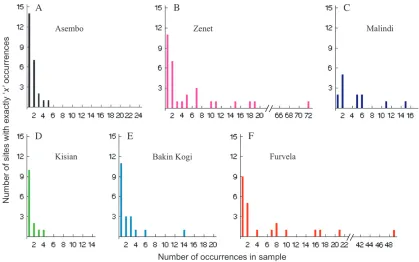
All individuals in this study that were analyzed by transposable element display (N ¼ 218) contained at least oneHerveselement (Table 1). Element copy num-bers within the six populations analyzed ranged from 2.9 to 4.4 elements per diploid genome as calculated using the method of Wrightet al.(2001). No individuals
occupied sites that were observed in only small numbers of individuals (Figure 2). In Zenet, Malindi and Furvela elements with high site-occupancy frequencies were observed although none of these elements were shared among these populations (Figure 2).
Charlesworth and Charlesworth (1983) and
Langleyet al. (1983) provided theoretical frameworks
for understanding site-occupancy frequency distributions, which could also be used to estimate element mobility rates under certain conditions. Both models can be ex-pressed using a single parameter (b), assuming that the elements are at equilibrium and that there are an infi-nite number of insertion sites within the genome.
Accord-ing to the models (Charlesworthand Charlesworth
1983; Langley et al. 1983) parameter values greater
than one indicate the existence of forces other than drift (mobility and/or selection) that have played a major role in shaping the observed distribution. In this study estimates ofbwere, in all cases, greater than one suggesting that element mobility and/or selection played a significant role in shaping the observed dis-tribution (Table 1).
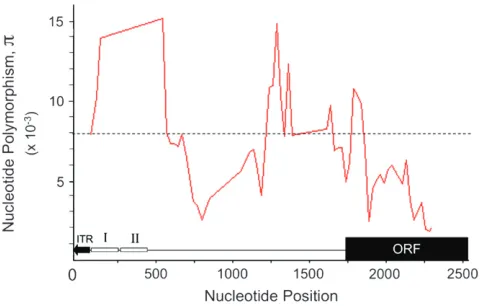
Nucleotide polymorphism: Approximately 2 kb of sequence beginning at the left (59) inverted terminal repeat and through the first 528 bp of the transposase open reading frame was amplified, cloned, and se-quenced (Figure 3). A total of 238 sequences containing the first 528 bp of the transposase open reading frame were analyzed from six different locations. The average nucleotide polymorphism in the 1474 bp of noncoding sequence (p¼0.0079) was significantly different from the polymorphism observed in the coding region (p¼
0.0046; P , 0.001) (Table 2). Within the noncoding region the observed polymorphisms were nonuniformly distributed in a 666-bp region beginning at nucleotide 568 having a highly reduced level of polymorphism (Figure 3). This region corresponds to a large stretch of DNA with unknown function 59 of the transposase-coding region and just 39of a pair of 100 bp subterminal tandem repeats (Arensburgeret al.2005).
Levels of silent site diversity in Herveselements were compared to the average silent site diversity for single-copy host genes (Table 3) as part of an effort to look for evidence of lateral introduction of Herves into the
TABLE 1
Site occupancy
Location Na kb dcnc bd
Asembo 24 25 3.5 9.5
Kisian 15 14 2.9 2.9
Malindi 25 17 3.4 11.0
Zenet 73 31 3.8 2.1
Furvelae 49 23 4.4 1.9
Bakin-Kogi 32 20 3.3 2.3
a
Individuals analyzed by transposable element display.
b
Number of unique chromosomal sites containingHerves.
c
Diploid copy number ofHerves(Wrightet al. 2001).
d4
Ne(n 1 s) from Charlesworth and Charlesworth (1983), whereNeis the effective population size,vis the excision rate, andsis the strength of selection against element insertions.
eData from O’Brochtaet al. (2006).
An. gambiaelineage (Brookfield1986; Sanchez-Gracia
et al. 2005). The observed levels of silent site diversity amongHerves elements ranged from 3- to 125-fold less than the silent site diversity seen on average in 35 nuclear genes (Morlais et al. 2004). In addition, Tajima’s D
statistic was calculated and found to be insignificant for each location, although when calculated on the basis of the pooled data it was significant (1.91; P , 0.05) (Table 3) indicating an excess of low frequency variants (Tajima1989).
Structural integrity: Class II transposable elements can be autonomous or nonautonomous. Autonomous elements code for functional transposase and can un-dergo transposition. Nonautonomous elements cannot code for functional transposase, usually as a result of deletions that remove some or all of the coding region.
Pelements in Drosophila,for example, often exist in
forms that contain large deletions of internal sequences leaving only terminal and subterminal sequences result-ing in nonautonomous elements (Engels1989). The
complete Herves open reading frame is 1.8 kb in length, and the structural integrity of Herveselements was assessed by amplifying this region using primers flanking it. Herves elements without any deletions re-sulted in PCR products of 2 kb in length, and elements with deletions 100 bp or more produced distinct prod-ucts ,2 kb. Of the 218 individuals tested from six locations, 85% showed evidence of the presence of com-plete open reading frames (Table 4). Individuals with complete elements were least abundant in Nigeria (Bakin Kogi) where only 44% showed evidence of complete open reading frames (N¼32). In western Kenya intact forms of the element were found in 100% of the indi-viduals from Asembo (N ¼ 24) and 90% of the in-dividuals from Kisian (N¼15). In eastern coastal Kenya (Malindi, N ¼ 25) and northeastern coastal Tanzania (Zenet,N¼73),85% of the individuals tested contained intact forms of the element. In southern Mozambique (Furvela,N¼49) 95% of the individuals sampled con-tained intact elements.
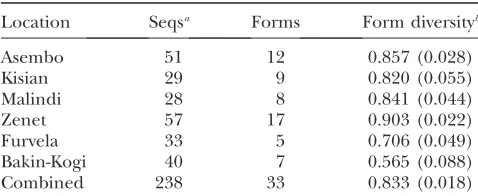
Genealogical relationships:A genealogical analysis of theHerveselements, on the basis of the first 528 bp of coding sequence, was performed and resulted in the identification of 33 forms among the 238 sequences that were analyzed (Table 5, Figure 4). Form diversity (the equivalent of haplotype diversity and measured using the same algorithm) varied among locations and ranged from a low of 0.565 in Bakin Kogi to a high of 0.903 in Zenet (Table 5). Of the 33 forms, only 2 (Forms 1 and 2) were found at all six sampling locations (Figures 4 and 5), and these comprised 51% (N¼238) of the elements analyzed. Twenty-four forms were found at only single locations (Figure 5, Table 6). Form 2 was the most abun-dant form in Bakin Kogi, Asembo, Malindi, and Kisian (Figure 1). In northeastern Tanzania (Zenet) where form diversity was highest, the most abundant form was
Figure 3.—Nucleotide polymorphism in Herves. The re-sults of a sliding window analysis (100-bp window in 25-bp steps) showing the levels of nucleotide polymorphismp as a function of position within the element. The horizontal dot-ted line represents the average nucleotide polymorphism re-ported for 35An. gambiaenuclear genes (Morlaiset al.2004). ITR, inverted terminal repeat; I, II, subterminal direct re-peats; ORF, transposase open reading frame.
TABLE 2
Nucleotide sequence polymorphism inHerves
Noncoding Coding
Location Seqsa Polyb pc ud Polyb pc ud
Asembo 51 44 0.0056 (0.0037) 0.0076 (0.0023) 15 (3112) 0.0034 (0.0042) 0.0063 (0.0023)
Kisian 29 60 0.0086 (0.0009) 0.0128 (0.0043) 7 (116) 0.0024 (0.0004) 0.0034 (0.0016)
Malindi 28 44 0.0076 (0.0006) 0.0084 (0.0029) 7 (215) 0.0033 (0.0005) 0.0034 (0.0016)
Zenet 57 109 0.0084 (0.0008) 0.0177 (0.0050) 21 (7114) 0.0057 (0.0009) 0.0104 (0.0035)
Furvela 33 35 0.0091 (0.0004) 0.0079 (0.0027) 8 (513) 0.0056 (0.0032) 0.0037 (0.0017)
Bakin-Kogi 40 53 0.0086 (0.0006) 0.0095 (0.0030) 6 (115) 0.0015 (0.0003) 0.0028 (0.0014) Combined 238 124 0.0079 (0.0003) 0.0216 (0.0049) 35 (14121) 0.0046 (0.0004) 0.0134 (0.0035)
a
Number of sequences analyzed.
b
Number of polymorphic positions; numbers in parentheses, synonymous1nonsynonymous sites.
c
Pairwise nucleotide diversity (Neiand Li1979); standard deviation in parentheses.
d
Form 5, a form that is closely related to Form 2 (Figure 4). In southern Mozambique (Furvela) however, a uni-que form (Form 30) was most abundant and accounted for 21% of the 57 sequences analyzed from this location. Form 30 was highly diverged from the abundant Form 2 and consequently was one of the most unusual elements encountered in this analysis; only Form 31 and Form 32 from Zenet were more divergent (Figure 4). Zenet was unusual among the locations analyzed because it had the greatest number of forms (17), 10 of which were unique to this location. Not only were there a large num-ber of element forms at this location but the diversity of elements was also very high. On average each location had 9.67 forms (64.27) and shared 3.6 forms (61.4) with other locations (Table 6).
Natural selection:We tested for evidence of selective constraints within the transposase open reading frame by estimatingv(the ratiodN/dS) using ML. Thevratios
ranged from 0.41 to 0.71 under all models (M0, M1, and M3; seematerialsandmethods) revealing evidence of
purifying selection (Yang 1997). The neutral model
(M1) was rejected when compared to the discrete model (M3) that allows for three classes of sites with different values ofv. The LRT statistic, 2Dl(2Dl¼2½1037.77
(1028.00), for this comparison was 19.54, which was greater than the critical value ofx2
½0:001;2¼13.816.
DISCUSSION
Understanding the dynamics of active transposable elements in An. gambiae will inform predictions con-cerning the outcomes of biological control efforts by population replacement using transposable elements as gene drive agents. While some studies have looked at the evolutionary history of Class II transposable ele-ments in insects, few studies involving insects other than Drosophila have attempted to examine the dynamics of Class II transposable elements at the population level, making the current study of Herves in An. gambiae
unique.
Here we examined the dynamics ofHervesby measur-ing the site-occupancy frequency, nucleotide-sequence diversity, and by performing a genealogical analysis of the element. The rare occurrence of locally fixed,
Herves-occupied sites and the widespread abundance of sites that are occupied in only a few individuals are consistent with the recent activity of HerveswithinAn. gambiae. The site-occupancy levels observed in this study
TABLE 3
Genetic diversity ofHerveselements from different locations
psa
Locations Haploid copy number Observed Expectedb Observed/expected Tajima’sD
Asembo 1.8 0.002 0.038 0.053 1.40c
Kisian 1.55 0.001 0.032 0.031 0.86c
Malindi 1.7 0.002 0.036 0.056 1.32c
Zenet 1.9 0.005 0.040 0.126 1.53c
Furvela 2.15 0.015 0.045 0.334 1.51c
Bakin-Kogi 1.7 0.0003 0.036 0.008 1.36c
All 1.8d 0.006 0.038 0.158 1.91e
ap
srepresents the average pairwise nucleotide diversity at synonymous sites.
bSeematerials and methods. c
P.0.05.
dAverage haploid copy number from all locations. eP,0.05.
TABLE 4
Frequency of open reading frames
Location Na Complete ORFb
Asembo 24 1.00
Kisian 15 0.90
Malindi 25 0.88
Zenet 73 0.84
Furvela 49 0.95
Bakin-Kogi 32 0.44
a
Number of mosquitoes analyzed.
b
Frequency of mosquitoes with evidence of an intactHerves ORF (2.1 kb PCR product).
TABLE 5
HervesORF form diversity
Location Seqsa Forms Form diversityb
Asembo 51 12 0.857 (0.028)
Kisian 29 9 0.820 (0.055)
Malindi 28 8 0.841 (0.044)
Zenet 57 17 0.903 (0.022)
Furvela 33 5 0.706 (0.049)
Bakin-Kogi 40 7 0.565 (0.088)
Combined 238 33 0.833 (0.018)
a
Sequences analyzed.
b
(bHerves¼1.9 11.0) were similar or somewhat lower than those reported for putatively active transposable elements inD. melanogaster:bP element¼16.6 (Ajiokaand
Eanes 1989), bP element ¼ 5.85 (Biemont et al. 1994),
bcopia¼9.79 (Biemontet al.1994),bcopia¼16.9 (Leigh
-Brownand Moss1987), andbcopia¼48.3 (Kaplanand
Brookfield1983).
An. gambiaeis distributed almost continuously through-out its range in Africa, and demes are likely to be large and diffuse (Lehmann et al. 1998). Little population
differentiation between populations separated by up to 50 km has been reported (Lehmannet al. 1997), and
this has also been found over distances of 6000 km (Lehmannet al.1996). Lehmannet al.(1998) suggest
that Wright’s isolation by distance model may best
de-scribe the relationships among populations (Wright
1951). Population admixture might be contributing to the pattern of site occupancy observed in this study. However, consistent with the idea thatHervesis currently capable of transposing in natural populations of An. gambiaeis the finding thatHerveselements isolated from
An. gambiae collected from the field within the last 20 years are active when introduced into other insects in the laboratory (Arensburgeret al.2005).
A number of pieces of data indicate that Herves
entered the An. gambiaelineage via a horizontal gene transfer. A comparison of the silent site diversity among
Herveselements and 35 nuclear genes (Morlaiset al.
2004) revealed less diversity withinHervestransposable elements than expected assuming similar mutation rates apply to Class II transposable elements and nuclear genes (Sanchez-Graciaet al.2005). Others have used
intra- and interspecific diversity comparisons to infer the introduction of transposable elements into host genomes (Silva and Kidwell 2000; Sanchez-Gracia
et al.2005), and the diversity data forHervesare quali-tatively similar to those data. Second, when elements are horizontally transferred to a new host species there is a period of time when natural selection will favor active autonomous elements and this will leave a distinct molecular signature within the elements in the form of a skewed ratio of synonymous and nonsynonymous substitution rates (Robertsonand Lampe1995). In this
study a comparison of the synonymous and nonsynon-ymous substitution rates within theHerves transposase-coding region detected evidence of purifying selection and is consistent with the hypothesis that Herves was laterally introduced into this lineage from an unknown source.
AlthoughHervesdisplays evidence of being horizon-tally introduced into theAn. gambiaelineage, the timing of this event remains uncertain. The intensity of the molecular signals indicating horizontal transfer suggests that this event was not in the very recent past. Sanchez
-Graciaet al. (2005) recently examined 14 transposable
Figure4.—Network of genealogical relationships of forms ofHerves ORFs based on statistical parsimony (Templeton et al.1992). The abundance and relationship of individual forms are shown. Each node represents a single mutational step. The area of the circles is proportional to the form fre-quency class. Shading refers to the region in which forms were found. In cases where forms are shared among regions, shad-ing is proportional to the frequency of the form in each re-gion. Small black dots represent missing forms.
elements inD. melanogasterand, on the basis of silent site diversity, concluded that 13 were products of horizontal transfer that probably occurred 5–12 million years ago. Sanchez-Gracia et al. (2005) observed levels of
silent diversity within the transposable elements studied
100-fold less than that observed in 21 nuclear genes, while in this study silent site diversity was only 6-fold less than expected when the data were pooled and ranged from 3-fold to 125-fold less than expected depending on the location from which the samples were collected. These data appear consistent with an historical lateral transfer event, although not one that has occurred recently.
The form diversity observed in this study is also con-sistent withHerveshaving an extended residence time within the An. gambiae lineage. Interestingly however, while the number of forms ofHervesas determined by the sequence of the 59 end of the transposase gene totaled 33, the frequency of individuals with at least one copy of an element that had either no internal deletions or deletions ,100 bp (the limits of the detection method) was .90%. Internally deleted elements can arise quickly following the introduction of a transpos-able element as has been displayed by the well-studiedP
element in Drosophila species (O’Hare et al. 1992).
This is distinctly not the case forHervesand may be due to a number of factors. First, if deleted elements are preferentially removed from the genome then one would see a relative abundance of intact forms as ob-served here. Currently there are no data for the differ-ential removal of smaller, internally deleted forms of an element, and indeed, smaller nonautonomous elements can have an activity advantage in the presence of func-tional transposase (Spradling1986; Lampeet al.1998).
An alternative possibility is that Herves elements may have reduced opportunities to form internally deleted elements. Internal deletions of Class II transposable ele-ments arise in some cases during the double-stranded DNA gap repair process following element excision. For example, followingPelement excision inD. melanogaster
the resulting double-stranded gap is filled during a homology-dependent recombination process in which homologous or ectopic copies of aPelement are copied into the gap (Engelset al.1990). Premature resolution
of these recombination products before this templated
gap repair process is complete results in the creation of incomplete elements. The extent to which postexcision repair involves homology-dependent recombination or nonhomologous end joining will determine, to some extent, how often internally deleted elements are created within a genome (Rio 2002). A preference forHerves
excision products to be repaired using nonhomologous end-joining mechanisms could explain two aspects of
Hervesobserved inAn. gambiae—the relative abundance of intact elements and their low copy number.
hATelement excision results in double-stranded breaks in the chromosome in which the ends of each chromo-some are sealed by hairpin structures (Zhouet al.2004).
These hairpin structures are resolved by a nicking event followed by end joining. The hairpin structures that arise on the empty donor site following hATelement excision are not seen followingPelement excision. We speculate that this predisposes Hervespostexcision re-pair to occur via nonhomologous end joining and thereby reduces the frequency with which internally deleted elements are created.
Herves is present at low copy numbers within An. gambiae, and the data suggest that copy-number equi-librium has not been reached (Tajima’s D statistic for pooled data¼ 1.91). The low copy number ofHerves, while not unique among Class II transposable elements, tends to be somewhat unexpected if the element was introduced into this lineage in the distant past. Class II transposable elements tend to increase in copy number when they are active within a genome. This increase in copy number occurs despite the conservative cut-and-paste nature of Class II element movement because the double-stranded breaks that arise following element excision can be repaired using homology-dependent repair processes that result in a copy of the element being inserted into the gap (Rio2002). Alternatively, an
increase in copy number can occur as a result of Class II transposable elements moving from replicated regions of the genome to unreplicated regions of the genome during S-phase (Wilson et al. 2003). Although the
mechanisms of copy number increase may vary, it seems well established that element copy number is expected to increase during periods of element activity. The low number of Herves elements in all individuals sampled
TABLE 6
Shared forms between locations
Location Asembo Kisian Malindi Zenet Furvela Bakin-Kogi
Asembo 5a
Kisian 4 4a
Malindi 5 4 1a
Zenet 5 4 6 10a
Furvela 3 2 3 2 2a
Bakin-Kogi 3 4 4 5 2 2a
a
therefore seems at odds with the diversity data that point to an extended residence time in the An. gambiae
lineage. The tendency of different Class II transposable elements to increase in copy number has never been systematically compared although it is reasonable to think that some elements might be more ‘‘replicative’’ than others.hATelements, andHervesin particular, may have a relatively low replication potential because of the presence of hairpin-containing intermediates following excision.
The structure of the population ofAn. gambiaein Africa has been studied, and it has been proposed that there are two main divisions of the gene pool: a northwestern division including Senegal, Ghana, Nigeria, Cameroon, Gabon, Democratic Republic of Congo, and western Kenya and a southeastern division including Kenya, Tanzania, Malawi, and Zambia (Lehmannet al.2003). It
has been proposed that there has been a recent bottle-neck in the southeast division resulting in reduced genetic diversity followed by colonization from the northwest division. (Lehmann et al. 2003). The data presented
here show little evidence of geographical variation and are inconsistent with the above model. Samples from Mozambique showed the highest levels of silent site diversity and no reduction in the diversity of forms as might be expected following a bottleneck. In fact, sam-ples from Nigeria not only showed the least silent site diversity but also had the least amount of form diversity. Further sampling ofHervesfrom populations in western Africa is needed to confirm the modest trends revealed in this study.
The generosity of Tovi Lehmann, Derek Charlwood, Christopher Curtis, and Wilhelmine Meeraus for providing samples is gratefully acknowledged. Matthew Hare, Sky Lesnick, Floyd Reed, and Sub-hamoy Pal provided us with valuable advice and useful discussions. The National Institutes of Health supported this work (grant no. R01GM48102).
LITERATURE CITED
Adelman, Z. N., N. Jasinskieneand A. A. James, 2002 Development and applications of transgenesis in the yellow fever mosquito,
Aedes aegypti.Mol. Biochem. Parasitol.121:1–10.
Ajioka, J. W., and W. F. Eanes, 1989 The accumulation of P
-elements on the tip of the X chromosomes ofDrosophila
mela-nogaster.Genet. Res.53:1–6.
Alphey, L., C. B. Beard, P. Billingsley, M. Coetzee, A. Crisanti
et al., 2002 Malaria control with genetically manipulated insect vectors. Science298:119–121.
Anxolabehere, D., M. G. Kidwelland G. Periquet, 1988 Molec-ular characteristics of diverse populations are consistent with the hypothesis of a recent invasion ofDrosophila melanogasterby mo-bilePelements. Mol. Biol. Evol.5:252–269.
Anxolabehere, D., K. Hu, D. Nouaudand G. Periquet, 1990 PM system: a survey ofDrosophila melanogasterstrains from the Peo-ple’s Republic of China. Genet. Sel. Evol.22:175–188. Arensburger, P., J. Orsetti, Y.-J. Kim, C. Aluvihare and D. A.
O’Brochta, 2005 A new active transposable element,Herves,
from the African malaria mosquitoAnopheles gambiae.Genetics
169:697–708.
Atkinson, P. W., A. C. Pinkertonand D. A. O’Brochta, 2001 Ge-netic transformation systems in insects. Ann. Rev. Entomology
46:317–346.
Beard, C. B., C. Cordon-Rosalesand R. V. Durvasula, 2002 Bac-terial symbionts of the triatominae and their potential use in
con-trol of Chagas disease transmission. Ann. Rev. Entomology47:
123–141.
Biedler, J., Y. Qi, D. Holligan, A.dellaTorre, S. Wessleret al.,
2003 Transposable element (TE) display and rapid detection
of TE insertion polymorphism in theAnopheles gambiaespecies
complex. Insect Molec. Biol.12:211–216.
Biemont, C., F. Lemeunier, M. P. GarciaGuerreiro, J. F. Brookfield, C. Gautieret al., 1994 Population dynamics of thecopia, mdg1,
mdg3, gypsyandPtransposable elements in a natural population ofDrosophila melanogaster.Genet. Res.63:197–212.
Blackman, R. K., M. Macy, D. Koehler, R. Grimaila and W. M. Gelbart, 1989 Identification of a fully-functional hobo trans-posable element and its use for germ-line transformation of
Drosophila.EMBO J.8:211–217.
Boete, C., and J. C. Koella, 2002 A theoretical approach to predict-ing the success of genetic manipulation of malaria mosquitoes in malaria control. Malaria J.25:1–3.
Braig, H. R., and G. Yan, 2001 The spread of genetic constructs in natural insect populations, pp. 251–314 inGenetically Engineered Organisms: Assessing Environmental and Human Health Effects,
edi-ted by D. K. Letourneauand B. E. Burrows. CRC Press, Boca
Raton, FL.
Brookfield, J. F., 1986 A model for DNA sequence evolution within transposable element families. Genetics112:393–407.
Bucheton, A., C. Vaury, M. C. Chaboissier, P. Abad, A. Pelisson
et al., 1992 I elements and the Drosophilagenome. Genetica
86:175–190.
Charlesworth, B., and D. Charlesworth, 1983 The population
dynamics of transposable elements. Genet. Res.42:1–27.
Clement, M., D. Posadaand K. A. Crandall, 2000 TCS: a
com-puter program to estimate gene genealogies. Molec. Ecol. 9:
1657–1679.
Craig, G. B., 1963 Prospects for vector control through manipula-tion of populamanipula-tions. Bull. World Health Organizamanipula-tion29:89–97. Curtis, C. F., 2003 Measuring public-health outcomes of release of transgenic mosquitoes, pp. 223–234 in Ecological Aspects for Application of Genetically Modified Mosquitoes, edited by W. Takken
and T. W. Scott. Kluwer Academic Publisher, Dordrecht, The
Netherlands.
Engels, W. R., 1989 Pelements inDrosophila melanogaster, pp. 439– 484 inMobile DNA, edited by D. E. Bergand M. M. How. Amer-ican Society for Microbiology, Washington DC.
Engels, W. R., D. M. Johnson-Schlitz, W. B. Egglestonand J. Sved,
1990 High-frequencyPelement loss inDrosophilais homologue
dependent. Cell62:515–525.
Guimond, N., D. K. Bideshi, A. C. Pinkerton, P. W. Atkinsonand D.
A. O’Brochta, 2003 Patterns of Hermestransposition in
Dro-sophila melanogaster.Molec. Gen. Genet.268:779–790.
James, A. A., 1992 Mosquito molecular genetics: the hands that feed bite back. Science257:37–38.
James, A. A., 2005 Gene drive systems in mosquitoes: rules of the road. Trends Parasitol.21:64–67.
Kaplan, N., and J. F. Y. Brookfield, 1983 Transposable elements in Mendelian populations. III. Statistical results. Genetics104:485– 495.
Kempken, F., and F. Windhofer, 2001 ThehATfamily: a versatile transposon group common to plants, fungi, animals, and man.
Chromosoma110:1–9.
Kiszewski, A. E., and A. Spielman, 1998 Spatially explicit model of transposon-based genetic drive mechanisms for displacing fluctu-ating populations of Anopheline vector mosquitoes. J. Med. Ento-mol.35:584–590.
Kumar, S., K. Tamuraand M. Nei, 2004 MEGA3: integrated
soft-ware for molecular evolutionary genetics analysis and sequence alignment. Brief. Bioinformatics5:150–163.
Kunze, R., and C. F. Weil, 2002 ThehATandCACTAsuperfamilies
of plant transposons, pp. 565–610 inMobile DNA II, edited by
N. L. Craig, R. Craige, M. Gellert and A. M. Lambowitz.
American Society of Microbiology, Washington, DC.
Lampe, D. J., T. E. Grantand H. M. Robertson, 1998 Factors af-fecting transposition of theHimar1 marinertransposonin vitro.
Langley, C. H., J. F. Y. Brookfieldand N. Kaplan, 1983 Trans-posable elements in Mendelian populations. I. A theory. Genetics
104:457–471.
Lehmann, T., W. A. Hawley, L. Kamau, D. Fontenille, F. Simard
et al., 1996 Genetic differentiation of Anopheles gambiaefrom East and West Africa: comparison of microsatellite and allozyme loci. Heredity77:192–200.
Lehmann, T., N. J. Besansky, W. A. Hawley, T. G. Fahey, L. Kamau
et al., 1997 Microgeographic structure ofAnopheles gambiaein western Kenya based on mtDNA and microsatellite loci. Mol. Ecol.6:243–253.
Lehmann, T., W. A. Hawley, H. Grebert and F. H. Collins, 1998 The effective population size ofAnopheles gambiaein Kenya: implications for population structure. Mol. Biol. Evol.15:264–276. Lehmann, T., M. Licht, N. Elissa, B. T. A. Maega, J. M. Chimumbwa
et al., 2003 Population structure ofAnopheles gambiaein Africa. J.
Heredity94:133–147.
Leigh-Brown, A. J., and J. E. Moss, 1987 Transposition of theI element andcopiain natural populations ofDrosophila melanogaster.
Genet. Res.49:231–237.
Meeraus, W. H., C. Maxwelland D. A. O’Brochta, 2005 Herves transposable elements in TanzanianAnopheles gambiae- potential
uses in malaria control. Trans. Royal Soc. Trop. Med. Hyg.99:
942–956.
Miller, L. H., 1992 The challenge of malaria. Science257:36–37. Morlais, I., N. Poncon, F. Simard, A. Cohuetand D. Fontenille,
2004 Intraspecific nucleotide variation in Anopheles gambiae:
new insights into the biology of malaria vectors. Am. J. Trop.
Med. Hyg.71:795–802.
Nei, M., and S. Kumar, 2000 Molecular Evolution and Phylogenetics. Oxford University Press, New York.
Nei, M., and W. H. Li, 1979 Mathematical model for studying
genetic variation in terms of restriction endonucleases. Proc. Natl. Acad. Sci. USA.76:5269–5273.
O’Brochta, D. A., W. D. Warren, K. J. Savilleand P. W. Atkinson, 1996 Hermes, a functional non-drosophilid insect gene vector fromMusca domestica.Genetics142:907–914.
O’Brochta, D. A., R. A. Subramanian, J. Orsetti, E. Peckham, N. Nolanet al., 2006 hATelement population genetics inAnopheles
gambiae s.l.in Mozambique. Genetica127:185–198.
O’Hare, K., A. Driver, S. McGrathand D. M. Johnson-Schlitz,
1992 Distribution and structure of clonedPelements for the
Drosophila melanogaster Pstrainp2. Genet. Res.60:33–41. Rasgon, J. L., and F. Gould, 2005 Transposable element insertion
location bias and the dynamics of gene drive in mosquito popu-lations. Insect Molec. Biol.14:493–500.
Ray, D. A., H. J. Pagan, M. L. Thompsonand R. D. Stevens,
2007 Bats withhATs: evidence for recent DNA transposon activ-ity in genusMyotis.Mol. Biol. Evol.24:632–639.
Ribeiro, J. M. C., and M. G. Kidwell, 1994 Transposable elements as population drive mechanisms: specification of critical param-eter values. J. Med. Entomol.31:10.
Rio, D. C., 2002 P transposable elements inDrosophila melanogaster, pp. 484–518 inMobile DNA II, edited by N. L. Craig, R. Craige, M. Gellertand A. M. Lambowitz. ASM Press, Washington, DC. Robertson, H. M., 2002 Evolution of DNA transposons in
eu-karyotes, pp. 1093–1110 in Mobile DNA II, edited by N. L.
Craig, R. Craige, M. Gellertand A. M. Lambowitz. ASM Press, Washington, DC.
Robertson, H. M., and D. J. Lampe, 1995 Recent horizontal
trans-fer of amarinerelement between Diptera and Neuroptera. Mol.
Biol. Evol.12:850–862.
Rozas, J., and R. Rozas, 1995 DnaSP, DNA sequence polymorphism: an interactive program for estimating population genetics
pa-rameters from DNA sequence data. Comput. Appl. Biosci.11:
621–625.
Rozas, J., J. C. Sanchez-DelBarrio, X. Messeguerand R. Rozas,
2003 DnaSP, DNA polymorphism analysis by the coalescent
and other methods. Bioinformatics19:2496–2497.
Sanchez-Gracia, A., X. Masideand B. Charlesworth, 2005 High rate of horizontal transfer of transposable elements inDrosophila.
Trends Genet.21:200–203.
Scott, J. A., W. G. Brogdonand F. H. Collins, 1993 Identification of single specimens of theAnopheles gambiaecomplex by
polymer-ase chain reaction. Am. J. Trop. Med. Hyg.49:520–529.
Silva, J. C., and M. G. Kidwell, 2000 Horizontal transfer and selec-tion in the evoluselec-tion ofPelements. Molec. Biol. Evol.17:1542– 1547.
Silva, J. C., and M. G. Kidwell, 2004 Evolution ofPelements in natural populations of Drosophila willistoni and D. sturtevanti.
Genetics168:1323–1335.
Simmons, G., 1992 Horizontal transfer of hobo transposable
ele-ments within the Drosophila melanogaster species complex:
evi-dence from DNA sequencing. Mol. Biol. Evol.9:1050–1060.
Spradling, A. C., 1986 P element-mediated transformation, pp.
175–198 in Drosophila. A Practical Approach, edited by D. B.
Roberts. IRL Press, Oxford and Washington, DC.
Tajima, F., 1989 Statistical method for testing the neutral mutation
hypothesis by DNA polymorphism. Genetics123:585–595.
Templeton, A. R., K. A. Crandalland C. F. Sing, 1992 A cladistic analysis of phenotypic associations with haplotypes inferred from restriction endonuclease mapping and DNA sequence data. III.
Cladogram Estimation. Genetics132:619–633.
Vos, P., R. Hogers, M. Bleeker, M. Reijans, T.van deLeeet al.,
1995 AFLP: a new technique for DNA fingerprinting. Nucleic
Acids Res.23:4407–4414.
Vulule, J. M., R. F. Beach, F. K. Atiele, J. M. Roberts, D. L. Mount
et al., 1994 Reduced susceptibility ofAnopheles gambiaeto per-methrin associated with the use of perper-methrin impregnated
bed-nets and curtains in Kenya. Med. Vet. Entomol.8:71–75.
Watterson, G. A., 1975 On the number of segregating sites in ge-netical models without recombination. Theor. Pop. Biol.7:256– 276.
Wilson, R., J. Orsetti, A. D. Klocko, C. Aluvihare, E. Peckham
et al., 2003 Post-integration behavior of aMos1gene vector in
Aedes aegypti.Insect Biochem. Mol. Biol.33:853–863.
WorldHealthOrganization, 1991 Prospects for Malaria Control by
Genetic Manipulation of Its Vectors. World Health Organization, Geneva.
Wright, S., 1951 The genetic structure of populations. Ann. Eugenics 15:323–354.
Wright, S. I., Q. H. Le, D. J. Schoenand T. E. Bureau, 2001 Pop-ulation dynamics of anAc-like transposable element in self- and cross-pollinatingArabidopsis.Genetics158:1279–1288.
Yang, Z., 1997 PAML: a program package for phylogenetic analysis
by maximum likelihood. Comput. Appl. Biosci.13:555–556.
Yang, Z., R. Nielsen, N. Goldman and A.-M. K. Pedersen,
2000 Codon-substitution models for heterogeneous selection
pressure at amino acid sites. Genetics155:431–449.
Zhou, L., R. Mitra, P. W. Atkinson, A. B. Hickman, F. Dydaet al.,
2004 Transposition of hAT elements links transposable
ele-ments and V(D)J recombination. Nature432:995–1001.