ISSN: 1992-8645 www.jatit.org E-ISSN: 1817-3195
43
DOMAIN-SPECIFIC ONTOLOGY-BASED APPROACH FOR
ARABIC QUESTION ANSWERING
1 MUSTEFA SHEKER, 2 SAIDAH SAAD, 3 REHAB ABOOD, 4 MOHANAAD SHAKIR
1,2,3Center for Artificial Intelligence Technology (CAIT), National University of Malaysia
4Alburaimi University Collage, Oman
E-mail: [email protected], [email protected][email protected]
4
ABSTRACT
Automatic Question Answering (QA) is the process of identifying exact answer in response of question asked by the user. Several QA approaches have been proposed for many languages. One of such languages is Arabic which spoken by nearly 200 million people. Approximately 90% of Arab people are Muslims. Many Muslims need religious consultations toward specific issues. Such consultations have to be acquired from a legitimate source such as Islamic scholars. The response toward these consolations is called a Fatwa, which is considered as an Islamic point of view toward such issues. Therefore, there is a vital demand to present a QA system that has the ability to answer Muslims questions based on a collection of Fatwas. Several research efforts have been implemented to provide QA for Islamic domain. However, such efforts have used simple lists of lexicons as a source of knowledge, which leads to several limitations in terms of the correctness of the answers. This is due to the process of analyzing question would not be guided with a rich source of knowledge. Hence, this study aims to propose an ontology-based question answering approach for the domain of Islamic Fatwa. The ontology has been constructed using a collection of Fatwas, which has been collected from Ibn Uthaymeen-Prayer Fatwas. Several pre-processing tasks have been applied in order to eliminate the irrelevant data (e.g. numbers, non-Arabic letters and punctuation). Furthermore, Term Frequency-Inverse Document Frequency (TFIDF) has been used in order to provide the main concepts of the domain for ontology construction. The proposed ontology-based QA has been evaluated by comparing it with QA approach that uses simple semantic lexicon as a source of knowledge. The proposed method has outperformed the other approach by obtaining an approximately 90% of F-measure. This demonstrates that the use of ontology as a source of knowledge for QA would enrich the process of extracting the answers.
Keywords: Question Answering, Query Expansion, Ontology, Similarity Measures, Arabic
1. INTRODUCTION
Question Answering (QA) is the process of identifying an accurate and automatic answer that is generated by computer in response to a random question asked by the user (restricted). Information Retrieval (IR) is the process of retrieving relevant document in response of the user query [1]. It is associated with question answering in terms of retrieving the correct answer (relevant document) in response to the user’s question (query) [2]. The key difference between IR and QA is that in IR user get relevant document however, he has to search in such document in order to obtain an answer to his question. Despite IR, Information Extraction is the process of identifying predefined templates from an unstructured text for instance, extracting the named entities form a given text is considered as an IE
where named entities represent such templates [3]. IE has been used to capture a specific portion of documents; such portions could be used for reporting such as providing a report of daily stocks. Thus, IE may be viewed as a limited form of question answering in which the questions (templates) are static and the data from which the questions are to be answered are an arbitrarily large dynamic collection of texts.
ISSN: 1992-8645 www.jatit.org E-ISSN: 1817-3195
44 question answering and open domain question answering in terms of several aspects. For instance, in terms of the size of data, open domain question answering systems require huge amount of text corpus [4]. Furthermore, there are differences between open domain question answering and restricted domain question answering systems in terms of the context of domain [5]. In fact, the sense of words in restricted domain would be less than in open domain for instance, the word ‘compound’ has a single sense in the domain of biomedical which refers to the chemical compounds. While in the open domain, the word ‘compound’ may refer to chemical, linguistic (e.g. noun compound) or it may refer to group of buildings. Therefore, restricted-domain question answering systems require more specialized user, semantic and relations among entities.
On the other hand, language is considered as a significant challenge in terms of question answering where each language has its own morphology and semantic. Unlike Latin languages where Question Answering (QA) systems are relatively advanced [6-9] Question answering systems for Arabic language are very few. To our knowledge, there are few research works on Arabic Question Answering [10-12]. Mainly, it is due to the lack of accessibility to linguistic resources, such as data sets and basic NLP tools (tokenizers, morphological analyzers, etc.). In comparison with other languages, not many are the NLP tools and resources in general which are available for Arabic. Moreover, the Arabic language has a very complex morphology (inflectional and derivational characteristics) and texts suffer from the scarcity of vowels as well as the absence of capitalization. These specificities of the Arabic language introduce many processing problems related to the word tokenization, the identification and recognition and classification of named entities, etc.
Islamic Fatwa is an answer that has been provided by respected Islamic scholars in response to a question asked by Muslim individuals. Muslims have many queries regarding daily issues such as work, education, family, praying, etc. Such queries usually turn into questions that would be asked to an Islamic scholar (i.e. Sheikh) who has the knowledge about the Islamic principles. There are several resources and books for Fatwas have been published as a collection of answers for many issues. Hence, it would be interesting to propose an automatic QA system for Islamic Fatwas that has the ability to provide an answer toward an arbitrary question asked by user. Such system would be
valuable for Muslim community regarding by providing accurate answer from respected Islamic scholars in response to their questions.
In fact, several QA systems have been proposed for Islamic Fatwa. However, such systems are using open-domain ontology such as Arabic WordNet. The problem of such ontology lies on the variety of definitions of concepts which are usually general (i.e. are not related to Islamic domain). Therefore, this study aims to propose a domain-specific ontology for automatic QA system of Islamic Fatwas. The proposed system has been evaluated by using two types of ontology; open-domain ontology (Arabic WordNet) and domain-specific ontology that has been constructed for this purpose.
2. RELATED WORK
One of the earliest Arabic question answering systems is the one that has been implemented by Hammo et al. [12] where the focus was on identifying the proper names in order to extract the answer. In fact, the authors have applied the Arabic morphological analyzer AraMorph in order to tokenize and normalize the text by removing the irrelevant data such as stop-words. In addition, AraMorph has been used also to identifying the tag of words such as adjective, verb, noun and others in order to identify the proposer names. Furthermore, some keywords have been used in order to indicate the answers. Similarly, Abuleil & Evens [13]. Such efforts has concentrated on identifying proper names in order to extract answer. This is regarding to the fact that the valuable information lies besides the proper names. In fact, the author has designed a rule-based approach that rely on keywords such as ‘manager’, ‘doctor’ and ‘professor’ and some special verbs such as ‘said’ and ‘announced’. Such hypothesis implies the co-occurrence between these keywords and the proper names. Obviously, both efforts did not consider analyzing the question.
ISSN: 1992-8645 www.jatit.org E-ISSN: 1817-3195
45 which aims to analyze the question based on the structure or the word order. For this manner, Java Information Retrieval System (JIRS) has been used as a passage retrieval module. As a result, the authors have reported an enhancement regarding to the passage retrieval.
Trigui et al. [14] have proposed a new question answering method for Arabic language which aims to answer non-complex questions or questions that required short answers using CLEFF corpus. The proposed method consists of four phases; first analyzing the question which aims to remove the stop-words in order to maintain the question with the important words. Second phase aims to analyze the anaphora that located in the question. The third phase aims to retrieve the related passages that probably contain the answer. Note that, if the selected passages do not contain the answer, a rule-based approach has been used in order to provide a list of inference represented by two words generated from the background collection. Such inference aims to replace the words with its semantic corresponding words in order to reach the answer. The fourth phase aims to select the accurate answer from the retrieved passages.
Abdelnasser et al. [15] have proposed an Arabic question answering system for Holly Quran where the system enables user to type question about Quranic verses and then response with an answer that associated with Tafseer Ibn Katheer corpus of text which contains the interpretation of Quranic verses. In fact, the proposed system consists of three main steps. The first step aims to preprocess the question by removing the stop-words, retrieving the roots of the words and identifying the POS tagging. For this purpose, MADA Arabic morphological analyzer tool has been used. The second step which is question analysis aims to classify the question into its class (e.g. who, where, what, etc.) where a Support Vector Machine classifier has been used in order to classify the questions. The third step is an information retrieval module that aims to extract the accurate passage that would contain the answer. For this manner, Quran ontology which has been presented by Atwell et al. (2011) was used to identify the Quranic concepts. In addition, multiple features have been used for this step such as TF-IDF and Named Entity Recognition approach.
Nicosia [16] have proposed an answer selection method for community question for both English and Arabic languages. In fact, the proposed method focused on the question that asked in public forums where several comments would be posted regarding
the asked question. The proposed method aims to select the best answer from the comments. The proposed method consists of multiple features including lexical, syntactic and semantic features. The lexical features aims to measure the similarity between the question and its corresponding comments based on the lexical morphology of the words. For this manner, TF-IDF has been used. Syntactic features aims to measure the similarity grammatically, for this manner shallow parser and POS tagging have been used. Semantic features aims to measure the similarity based on the meaning, for this manner, Latent Semantic Analysis (LSA) has been used. Finally, a supervised machine learning method which is logistic regression has been used in order to classify the comments into correct and incorrect answers.
3. PROPOSED SYSTEM
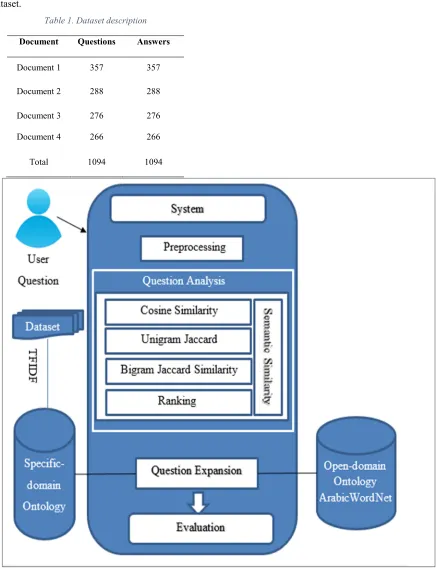
The architecture of the proposed system as shown in Fig 1 consists of eight components which are represented as follows; Dataset, User Question, Preprocessing, Question Analysis, Question Expansion, Specific-domain Ontology, Open-domain Ontology, Evaluation. (i) Dataset phase refers to the data that has been collected and used for implementation. (ii) User Question phase aims to enable user to type a question related to Islamic Fatwas. (iii) Preprocessing phase aims to analyze the typed question by the user. Such analysis include preprocessing the question by eliminating the irrelevant data such as numbers, stop-words and punctuation. (iv) Question Analysis phase aims to identify similar question from the dataset using similarity measures including Cosine and Jaccard. (v) Question Expansion phase aims to expand the typed question by providing semantic correspondences using the open-domain ontology. (vi) Specific-domain Ontology which is the proposed knowledge source for the Islamic Fatwa domain and it has been constructed using TFIDF from the dataset. (vii) Open-domain Ontology which is an online ontology called Arabic WordNet [17]. Such ontology contains a large-scale semantics in Arabic including relations. (viii) Evaluation phase which aims to evaluate the proposed system based on the retrieval effectiveness. However, the following sub-sections illustrate these phases in further details.
3.1. Dataset
ISSN: 1992-8645 www.jatit.org E-ISSN: 1817-3195
[image:4.612.99.537.119.693.2]
46 Fatwas (questions and answers) that related to Islamic praying. Table 1 shows the details of the dataset.
Table 1. Dataset description
Document Questions Answers
Document 1 357 357
Document 2 288 288
Document 3 276 276
Document 4 266 266
Total 1094 1094
ISSN: 1992-8645 www.jatit.org E-ISSN: 1817-3195
47 In fact, the questions and answers in the dataset are associated with each other. Therefore, it will be used in order to compare with the typed question by the user. Hence, the highest similarity between the
typed questions with questions from the dataset refers that the answer will be the same. Table 2 shows a sample of question and answer that located in the dataset.
Table.2. Sample of question and answer in the dataset
Question Translation
:لاﺆﺴﻟا ﺐﯾﺮﻘﻟا ﺪﺠﺴﻤﻟا كﺮﺗ زﻮﺠﯾ ﻞھ ﺪﺠﺴﻣ ﻲﻓ ةﻼﺼﻟاو
ﺔﻌﻤﺠﻟا مﻮﯾ ﺪﯿﻌﺑ
:باﻮﺠﻟا ﺪﺠﺴﻤﻟﺎﺑ ﺔﻌﻤﺠﻟا ةﻼﺻ ﻰﻠﺼﺗ نأ ﻞﻀﻔﯾ
ﻞﻋﺎﻔﺘﻟا حور ﻖﻠﺨﻟ ﻚﻟذو ،ﮫﻧاﺮﯿﺟو ﮫﺋﺎﻗﺪﺻأ ﻊﻣ ﺐﯾﺮﻘﻟا ﻢھﺪﺣأ نﺎﻛ اذإ ﻦﻜﻟ .ﺮﺧﻻا ﻢﮭﻀﻌﺑ ﻊﺠﺸﯾ ﻲﻜﻟو مﺎﺠﺴﻧﻻاو عﺎﻤﺳ ﻞﺜﻣ ﺔﻓﺮﻌﻤﻟا بﺎﺴﺘﻛﻻ ﺪﯿﻌﺑ ﺪﺠﺴﻣ ﻲﻓ ﻲﻠﺼﯾ نأ ﺪﯾﺮﯾ يأ ﺪﺟﻮﯾ ﻼﻓ ﺮﺜﻛأ ﮫﺘﻓﺮﻌﻣ ﺪﯾﺰﯾو ﺮﯿﺒﻛ ﺮﯿﺛﺄﺗ ﺎﮭﻟ ﺔﺒﻄﺧ ضاﺮﺘﻋا
Question: Is it permissible for the worshiper to abandon the mosque which is in his area on Friday and go to another which is far away?
Answer: It is better for him to pray with the people in his area in their mosque, so that they become acquainted with one another and in order to spread harmony between them and so that they encourage each other. But if one of them goes to another mosque in order to gain some religious benefit, such as acquiring knowledge or hearing a Khutbah which has a greater effect on him and increases his knowledge more, then there is no objection to it
3.2. User Question
This phase aims to enable the user to type a question that related to the Islamic Fatwas. Such typing process is passing through a graphical user interface. Regarding to the type of expected user, the expected user of the proposed system has to be expert in Islam which requires knowing Arabic language. On other hand, the type of question can be classified as opinionated question where the answer is based on the perspective of particular Islamic scholar.
3.3. Preprocessing
This phase aims to perform several tasks including encoding and normalization. Such tasks facilitate turning the data into a suitable form that enables further processing. Encoding aims to unify the encoding of the dataset in order to avoid character appearance problem. This problem occurs when treating Arabic letters by the default encoding (e.g. ASCI code). Therefore, UTF-8 has encoding has been used in order to convert the data into a compatible form. Whereas, normalization aims to eliminate the unwanted data such as stop-words, digits and punctuation.
3.4. Question Analysis
This phase aims to analyze the user typed question in terms of its morphology. This analysis aims to identify the most similar question from the dataset which obviously leads to acquire the exact answer. In fact, two similarity measures have been used which are Cosine and Jaccard. Cosine similarity is one of the common similarity
measures, which applies to the documents in many applications such as, information retrieval, text mining and clustering [19]. To measure the similarity between documents using similarity, select two strings A and B, and used the equation of cosine similarity as below:
, ‖ ‖ ‖ ‖ .
The Jaccard coefficient, which is sometimes, referred as a statistical coefficient, which is used in natural language processing (NLP). Jaccard coefficient is used to measure similarity as the intersection is divided by the union of the objects [20]. For text document, Jaccard coefficient has been used to compare the sum of shared terms weight and the sum of terms weight, which are present in either of the two documents, however they must not be shared terms. The mathematical formal definition of Jaccard coefficient is expressed below:
, | |² | |. .
ISSN: 1992-8645 www.jatit.org E-ISSN: 1817-3195
48 Jaccard have been used as similarity measures. Note that, multiple mechanisms have been used in terms of identifying the similarity. According to Thada & Jaglan [22], Jaccard similarity reveals different performance when applying different n-gram methods (e.g. unigram, bigram, etc.). Unlike Jaccard, Cosine has shown a relatively same performance in terms of applying different n-gram methods. Therefore, Jaccard has been used carried out twice; first to measure the similarity between questions using one word (Unigram), second to measure the similarity between questions using two words (Bigram).
Obviously, applying Cosine, Jaccard for unigram and Jaccard for bigram would lead to different results of similarity among the questions. Therefore, a ranking approach has been used in order to gain the most similar question. In order to illustrate the process of ranking, suppose the user has typed a question ! and the question analysis phase has revealed similarities with questions from the dataset as follows:
Cosine "#, "$, "%
Unigram-Jaccard &, %, "#
Bigram-Jaccard " , "#, %
Hence, a ranking approach has been applied that aims to calculate the frequency of candidate questions among the results. Based on the previous example, the ranking results would be as follows:
Q16 1
Q14 1
Q12 1
Q10 3
Q9 1
Q6 2
Based on the ranking results, Question no. 10 will be selected as the most similar question for the user’s question, and then the answer of Question no. 10 will be brought as the exact answer of the user’s question.
3.5. Question Expansion
Query expansion is the process of reformulating the query typed by the user to retrieve relevant documents [23]. Basically, the words in the query will be analyzed in terms of semantic and morphology and spilling errors. This study has applied the mechanism of expansion on the question in order to enhance the process of retrieving correct answer. In fact, two knowledge sources have been used for the expansion process. First, is the proposed specific-domain ontology, and
second is an open domain-domain ontology. Such ontologies have been illustrated as follows:
3.5.1 Proposed specific-domain ontology
This study has constructed a specific-domain ontology for the field of Islamic Fatwa regarding to Islamic praying. The main classes of this ontology have been created using Term Frequency – Inverse Document Frequency (TFIDF) from the dataset. TFIDF consists of term frequency which is the number of the occurrences of the term in the document [24]. It can be calculated as follow:
'( )* ,
Where TD is the frequency of term t in document d. In addition, TFIDF contains the inverse document frequency IDF which aims to provide high weight for rare conditions and low values for common conditions (Tokunaga & Makoto 1994). The formula as follows:
+*,- log 122
-3
Where N is the number of documents in the Arabic documents and 2- is the number of documents that contain the term. Finally, TFIDF combines both the term frequency and inverse document frequency based on the following equation:
'- ), , . +*,-
[image:6.612.318.516.595.712.2]Therefore, based on mentioned frequencies, the main classes have been created from the dataset. Hence, many sub-classes have been also created based on the main classes. Furthermore, several annotations (words related to the class) have been created in association with main classes. Table 3 depicts the details of the proposed ontology.
Table 3. The proposed ontology details
Attributes Answers
Main classes 13
Sub-classes 134
Relations 19
ISSN: 1992-8645 www.jatit.org E-ISSN: 1817-3195
49 As shown in Table 3, relations refer to the correlations among the classes such as is-a, part-of and instance-of. Whereas, annotations refer to the synonyms of each class such as Human and Scholar. Such parameters have been created using experts in Arabic language.
3.5.2 Open-domain ontology
This study has used an open-domain ontology which called Arabic WordNet that has been introduced by [17]. This Ontology has been developed using a translation-based method where English WordNet lexicon has been translated into Arabic including classes, sub-classes, annotations and relations using Suggested Upper Merged Ontology (SUMO).
3.6 Evaluation
Since the evaluation will be based on retrieval effectiveness thus, the metrics that have been used is precision, recall and f-measure. Precision refers to the correctness of retrieval answers, while recall refers to the correctness of not retrieved answers. Such metrics can be calculated as the following equations:
4 4 )4 ,4)4
5 5 )4 ,2)4
Where TP is the number of correct retrieved answers, FP is the number of incorrect retrieved answers, and FN is the number of correct answers but not retrieved. Hence, it is possible to calculate the overall accuracy which called f-measure based on the following equation:
6 7 2 4 54 ∗ 5
4. RESULTS
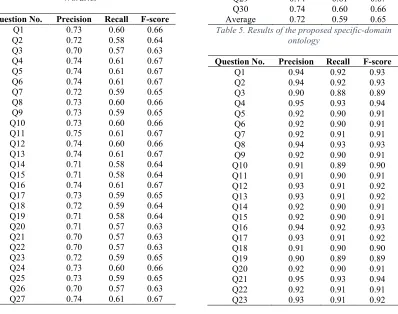
[image:7.612.114.512.421.735.2]In fact, the evaluation has been performed using 30 questions that have been proposed by expertise in Islamic studies. Such questions are not exist in the dataset instead, similar questions in the meaning are exist in the dataset. Hence, evaluating these questions have been performed using two approaches; using Arabic WordNet and using the proposed domain-specific ontology. Table 4 and 5 depicts such results.
Table 4. Results of open-domain ontology Arabic WordNet
Question No. Precision Recall F-score
Q1 0.73 0.60 0.66 Q2 0.72 0.58 0.64 Q3 0.70 0.57 0.63 Q4 0.74 0.61 0.67 Q5 0.74 0.61 0.67 Q6 0.74 0.61 0.67 Q7 0.72 0.59 0.65 Q8 0.73 0.60 0.66 Q9 0.73 0.59 0.65 Q10 0.73 0.60 0.66 Q11 0.75 0.61 0.67 Q12 0.74 0.60 0.66 Q13 0.74 0.61 0.67 Q14 0.71 0.58 0.64 Q15 0.71 0.58 0.64 Q16 0.74 0.61 0.67 Q17 0.73 0.59 0.65 Q18 0.72 0.59 0.64 Q19 0.71 0.58 0.64 Q20 0.71 0.57 0.63 Q21 0.70 0.57 0.63 Q22 0.70 0.57 0.63 Q23 0.72 0.59 0.65 Q24 0.73 0.60 0.66 Q25 0.73 0.59 0.65 Q26 0.70 0.57 0.63 Q27 0.74 0.61 0.67
[image:7.612.102.315.433.725.2]Q28 0.71 0.58 0.64 Q29 0.74 0.61 0.67 Q30 0.74 0.60 0.66 Average 0.72 0.59 0.65
Table 5. Results of the proposed specific-domain ontology
Question No. Precision Recall F-score
ISSN: 1992-8645 www.jatit.org E-ISSN: 1817-3195
50 Q24 0.95 0.93 0.94
Q25 0.91 0.89 0.90 Q26 0.94 0.92 0.93 Q27 0.95 0.93 0.94
Q28 0.91 0.89 0.90 Q29 0.94 0.92 0.93 Q30 0.90 0.88 0.89 Average 0.92 0.90 0.91
As shown in Table 4, the average results for all the 30 questions when using Arabic WordNet were 72%, 59% and 65% for precision, recall and f-measure respectively. Whereas, Table 5 shows that the average results for all the 30 questions when using the proposed domain-specific ontology are 92%, 90% and 91% for precision, recall and f-measure. Obviously, the proposed specific-domain ontology has outperformed the other method. This has been expected regarding to the study of [25] where the restricted-domain ontology has a significant impact on improving the effectiveness of question answering system especially when the system is so specific.
5. CONCLUSION
Islamic Fatwa has a significant role in the Muslim community where several issues have to be performed based on the Islamic rules which provided by Islamic scholars. This study proposed a question answering system for Islamic Fatwas based on a domain-specific ontology. A comparison has been held by comparing the performance of the proposed domain-specific ontology and open-domain ontology which is Arabic WordNet. The experimental results have shown that the proposed domain-specific ontology has outperformed the other approach. This demonstrates the significant impact of using domain-specific ontology for restricted-domain question answering. The future directions of this study can be represented by extending the ontology’s classes to include more Islamic concepts. This has a significant impact toward containing more Fatwas. However, the future directions lies on enriching the domain-specific ontology in order to contain more concepts and terms. This can improve the process of
acquiring more answers for typed questions by the user.
6. ACKNOWLEDGEMENT
This work has been supported by the University Research Grant GUP-2015-003.
REFERENCES
[1] Christopher D Manning, Prabhakar Raghavan, and Hinrich Schütze, Introduction to information retrieval vol. 1: Cambridge university press Cambridge, 2008.
[2] Ellen M Voorhees and Donna K Harman, TREC: Experiment and evaluation in information retrieval vol. 1: MIT press Cambridge, 2005.
[3] Gonçalo Simoes, Helena Galhardas, and Luısa Coheur, "Information Extraction tasks: a survey," in Proc. of INForum, 2009Retrieved from.
[4] Eric Brill, Jimmy J Lin, Michele Banko, Susan T Dumais, and Andrew Y Ng, "Data-Intensive Question Answering," in TREC, 2001, p. 90.doi:Retrieved from.
[5] Roberto Navigli, "Word sense disambiguation: A survey," ACM Comput. Surv., vol. 41, pp. 1-69,
2009.doi:10.1145/1459352.1459355Retrieved from.
[6] Fangtao Li, Yang Tang, Minlie Huang, and Xiaoyan Zhu, "Answering opinion questions with random walks on graphs," in Proceedings of the Joint Conference of the 47th Annual Meeting of the ACL and the 4th International Joint Conference on Natural Language Processing of the AFNLP: Volume 2-Volume 2, 2009, pp. 737-745.doi:Retrieved from.
0 0.2 0.4 0.6 0.8 1 Q 1 Q 2 Q 3 Q 4 Q 5 Q 6 Q 7 Q 8 Q 9 Q 1 0 Q 1 1 Q 1 2 Q 1 3 Q 1 4 Q 1 5 Q 1 6 Q 1 7 Q 1 8 Q 1 9 Q 2 0 Q 2 1 Q 2 2 Q 2 3 Q 2 4 Q 2 5 Q 2 6 Q 2 7 Q 2 8 Q 2 9 Q 3 0
ISSN: 1992-8645 www.jatit.org E-ISSN: 1817-3195
51 [7] Vanessa Lopez, Victoria Uren, Enrico Motta,
and Michele Pasin, "AquaLog: An ontology-driven question answering system for organizational semantic intranets," Web Semantics: Science, Services and Agents on the World Wide Web, vol. 5, pp. 72-105, 2007Retrieved from.
[8] Ana Cristina Mendes and Luísa Coheur, "An Approach to Answer Selection in Question-Answering Based on Semantic Relations," in IJCAI, 2011, pp. 1852-1857.doi:Retrieved from. [9] Samaneh Moghaddam and Martin Ester, "AQA: aspect-based opinion question answering," in Data Mining Workshops (ICDMW), 2011 IEEE 11th International Conference on, 2011, pp. 89-96.doi:Retrieved from.
[10] Lahsen Abouenour, Karim Bouzoubaa, and Paolo Rosso, "Three-level approach for passage retrieval in Arabic question/answering systems," in Proc. Of the 3rd International Conference on Arabic Language Processing CITALA2009, Rabat, Morocco, 2009Retrieved from.
[11] Yassine Benajiba and Paolo Rosso, "Arabic question answering," Diploma of advanced studies. Technical University of Valencia, Spain, 2007Retrieved from.
[12] Bassam Hammo, Hani Abu-Salem, and Steven Lytinen, "QARAB: A question answering system to support the Arabic language," in Proceedings of the ACL-02 workshop on Computational approaches to semitic languages, 2002, pp. 1-11.doi:Retrieved from.
[13] Saleem Abuleil and Martha Evens, "Extracting Names From Arabic Text for Question-Answering Systems," in RIAO, 2004, pp. 638-647.doi:Retrieved from.
[14] Omar Trigui, Lamia Hadrich Belguith, Paolo Rosso, Hichem Ben Amor, and Bilel Gafsaoui, "Arabic QA4MRE at CLEF 2012: Arabic Question Answering for Machine Reading Evaluation," in CLEF (Online Working Notes/Labs/Workshop), 2012Retrieved from. [15] Heba Abdelnasser, Reham Mohamed,
Maha Ragab, Alaa Mohamed, Bassant Farouk, Nagwa El-Makky, and Marwan Torki, "Al-Bayan: An Arabic Question Answering System for the Holy Quran," ANLP 2014, p. 57, 2014Retrieved from.
[16] Massimo Nicosia, Simone Filice, Alberto Barrón-Cedeno, Iman Saleh, Wei Gao Hamdy Mubarak, Preslav Nakov, Giovanni Da San Martino, Alessandro Moschitti, and Kareem Darwish, "QCRI: Answer Selection for
Community Question Answering–Experiments for Arabic and English," in Proceedings of the 9th International Workshop on Semantic Evaluation, SemEval, 2015Retrieved from. [17] William Black, Sabri Elkateb, Horacio
Rodriguez, Musa Alkhalifa, Piek Vossen, Adam Pease, and Christiane Fellbaum, "Introducing the Arabic wordnet project," in Proceedings of the Third International WordNet Conference, 2006, pp. 295-300.doi:Retrieved from.
[18] Abdul Aziz Ibn Baz, Muhammad Al-Uthaymeen, and Rabee Al-Madkhalee, "Three Essays on the Obligation of Veiling. edited by Translated by Abu Maryam Ismaeel Alarcon Toronto: Al," ed: Ibaanah Book Publishing, 2003.
[19] Sung-Hyuk Cha, "Comprehensive survey on distance/similarity measures between probability density functions," City, vol. 1, p. 1, 2007Retrieved from.
[20] Anna Huang, "Similarity measures for text document clustering," in Proceedings of the Sixth New Zealand Computer Science Research Student Conference (NZCSRSC2008), Christchurch, New Zealand, 2008, pp.
49-56.doi:Retrieved from
http://scholar.google.com.au/scholar.bib?q=info :enBKVjSSXjQJ:scholar.google.com/&output= citation&hl=en&as_sdt=2000&ct=citation&cd= 0.
[21] Yu Jiang, Guoliang Li, Jianhua Feng, and Wen-Syan Li, "String similarity joins: An experimental evaluation," Proceedings of the VLDB Endowment, vol. 7, pp. 625-636, 2014Retrieved from.
[22] Vikas Thada and Vivek Jaglan, "Comparison of Jaccard, Dice, Cosine Similarity Coefficient To Find Best Fitness Value for Web Retrieved Documents Using Genetic Algorithm," International Journal of Innovations in Engineering and Technology, 2013Retrieved from.
[23] Ellen M Voorhees, "Query expansion using lexical-semantic relations," in SIGIR’94, 1994, pp. 61-69.doi:Retrieved from.
[24] Mikio Yamamoto and Kenneth W Church, "Using suffix arrays to compute term frequency and document frequency for all substrings in a corpus," Computational Linguistics, vol. 27, pp. 1-30, 2001Retrieved from.