1007
HANDOVER PROBLEM FOR INTEGRATING LTE WITH
FEMTOCELL NETWORK
1A. BAGUBALI, 2V. PRITHIVIRAJ, 3P. S. MALLICK, 4 KISHORE V KRISHNAN
1
Asst Prof., School of Electronics Engineering, VIT University, Vellore
2Prof., Department of Electronics and Communication Engineering, PEC, Puducherry 3Prof. , School of Electrical Engineering, VIT University, Vellore
4Asst Prof., School of Electronics Engineering, VIT University, Vellore
E-mail: [email protected] ,[email protected] , [email protected] [email protected]
ABSTRACT
Femtocell handover is more exigent than normal macrocell cellular handover because the backhaul network is different and there is also little possibility of direct communication between the macrocell and the femtocell. In this paper we have analysed the prevailing handover strategy, where Femtocell deployed in LTE Network and a new handover strategy between macrocell and femtocell for LTE-based network in hybrid access mode named RWTL-HO algorithm has also been proposed. This new strategy can avoid unnecessary handover and reduce handover failure.
Keywords: LTE, Femtocell, RSS-α-Handoff, Rwtl-Handoff
1. INTRODUCTION
With the macro cellular network, it is not only intricate for the operators to grant high-quality services and cell coverage for the indoor users, but its also highly impossible for them to install a large number of outdoor base stations in heavily populated areas for the purpose of increasing indoor coverage. In order to overcome these aforesaid problems femtocells play a vital role as very useful indoor solution [1] [3].
The principal performance benefit femtocells bring to LTE is that they will ensure more users receive peak data rates most of the time, especially inside buildings where the vast majority of mobile broadband data is consumed and where the service quality is lower than outside [2][10].
Femtocell helps to induce base stations at cheaper rate but in huge volume for residential usage by connecting to the core network via broadband [1]. Femtocells also helps the LTE so that more number of users, especially indoor users who are generally fed-up with low quality signal coverage, receive peak data rates almost continuously without any interruption or disturbances [2].
The LTE network is based on OFDMA technic. The benefit of a common channel radio technology to provide better performance and more bandwidth to the users located in LTE Femtocell network coverage can be used for the LTE network [12]. But main challenge in deployment of macro cell with femtocell is optimized handover strategy [4][10]. In this paper, our proposed strategy RWTL handover scheme works basis on signal strength received and transmission loss mechanism that overcomes the disadvantages of the existing method. This strategy can reduce the unnecessary hand off between macrocell and femtocell without reduction of signalling strength. The simulation result shows that our proposed algorithm will provide efficient handoff. This paper has been structured as, Section-2: Architecture of LTE femtocell integrated network, Section-3: System model, Section-4: Analysis of existing handoff method, Section-5: Proposed handoff technique, Section-6: Simulation results and section-7: Conclusions
2. ARCHITECTURE OF LTE FEMTOCELL
INTEGRATED NETWORK
1008 hand set or the user equipment (UE), interfaces with a Home eNodeB (HeNB) over the air interface [9]. The Home eNodeB is a device that exists in the consumer’s home as FAP (Femtocell access point) that acts as a small base station providing extended wireless LTE coverage even inside the customers home or small office [1]. The broadband access gateway interfaces the HeNB to the mobile network operator (MNO) via broadband network. It is the security gateway, in turn, connects the mobile operator core network with the HeNB that has been connected to a broadband access device. The security gateway also plays the role of savior for core networks against assailment. Here comes the Home eNodeB Gateway (HeNB GW) which relies on the security gateway and is responsible for cumulating the signal traffic of HeNBs which are generally in huge numbers. Using a LTE S1-U interface via the security gateway, HeNB interfaces with the mobile operators Evolved Packet Core (EPC) network. The LTE S1-MME interface helps the HeNB gateway to carry the data [13].
3. SYSTEM MODEL
Let’s consider a model where Femtocells are being arranged randomly in a macrocell. A hierarchical environment of a complete system has been considered for the purpose of our analysis. The conventional handoff algorithms simply followed the femtocell-to-macrocell handoff [11]. But in this paper we have considered and analysed, vice-de-versa, the macrocell to femtocell handoff [6][8].
F-BS is espoused to call as the femtocell base station, and M-BS called as macrocell base station[12].The received signal strength of the Macro and femto base station is expressed as
,
]
[
]
[
]
[
i
T
,PL
i
l
i
R
M=
Mtx−
M−
M]
[
]
[
]
[
i
T
,PL
i
l
i
R
F=
Ftx−
F−
FWhere, RM [i] stands for the RSS from M-BS
RF [i] stands for the RSS from an F-BS and [i]
denote time instant.
Assuming that an MS is moving in a straight path from X to Y, Where X represents the field coverage of M-BS and Y represents the field coverage of F-BS with the speed being pedestrian speed.
Considering TM,tx being the transmission
power of an M-BS and TF,tx being the transmission
power of an F-BS, PLM [i] and PLF [i] are pathloss
of the mobile and femto base station.
Here
L
M[i
]
andL
F[i
]
represent log-normalshadowing with mean zero and variance
σ
2M
and
σ
2.Fig.1. Architecture Of LTE Femtocell Integrated Network
We assume that LM[i]and LF[i] are
independent of each other and have an exponential correlation function with a correlation distance
] [
0 i
d [7]. In order to avert rapid RSSs changes, the exponential window function can be expressed
as
ω
[
i
]
=
(
1
/
d
1) (
exp
id
s/
d
1)
, whered
s and1
d
specifies the distances between two adjoining measurement position and the window length, respectively [4][5].Applying the window functionto
R
M[i
]
andR
F[i
]
can be expressed as:]
[
*
]
[
]
[
i
i
R
i
R
M=
ω
M]
[
*
]
[
]
[
i
i
R
i
R
F=
ω
FThen the variances of the shadowing in which the corresponding shadowing and the window function are considered, become
(
)
(
0 1)
2 0 2d
d
M
d
M
ω
=
σ
−
σ
and(
)
(
0 1)
2 0 2d
d
F
d
F
ω
=
σ
−
σ
between the twoRSS adjacent events the correlation coefficient
ρ
c can be expressed as in [6].) /( ) / exp( ) /
exp( 0 1 0 0 1
0 d d d d d d d
d s s
c = − − − −
1009
4. EXISTING RSS- α-HO ALGORITHM
By the use of algorithm presented in table I the following equation was obtained [4][8].
∆
+
>
+
>
&
(
(
)
(
))
(
)
]
[
i
R
,R
i
R
i
R
i
R
F Fth Fα
M M (6)∆
+
>
<
&
(
&
(
))
(
)
]
[
i
R
,R
,R
i
R
i
R
F Fth Fth M M (7)Where αε [0, 1] refers to a combination factor that replicates large asymmetry in the transmit power of cells, and RF,th denotes a threshold that is the
minimum RSS level from the F-BS for keeping normal communication un-interrupted.
However the users will not accept a certain level of QoS as guaranteed if the threshold of RSS is not attained. Under the eq (7) condition some redundant handoff will get increased leading to unsupported service even in the occurrence of the handoff. At the same time when there is a location change in MSs and F-BSs, the calculation and attainment of α value will become more difficult and complex for MSs. To overcome this drawback of RSS-α-HO algorithms, we recommend a new RSS and wireless transmission loss-based handoff algorithm.
5. PROPOSED RWTL HANDOFF
ALGORITHM
Table I: RSS Alpha Handoff Algorithm
If
R
F>
R
F,thIf
R
F+
α
R
M>
R
M+
∆
then handoff to F-BS Else keep associated to M-BSElse
R
F<
R
F,thIf
R
R>
R
M+
∆
then handoff to F-BS Else keep associated to M-BSTable II: RWTL Handoff Algorithm
I. If
R
F>
R
F,th Ref fig 2II. If
R
F>
R
M+
∆
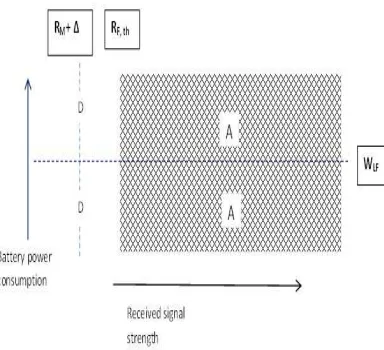
then handoff to F-BSShaded area A
III. Else if
W
LM>
W
LFthen handoff to F-BSShades area B
IV. Else then keep
associated to M-BS Shades area C
V. Else then keep
associated to M-BS Shaded area D
For our easiness let’s look at a scenario where a macrocell with one randomly deployed femtocell that has only the mobility of the MS with pedestrian
[image:3.612.310.532.249.588.2]speed from a macrocell to femtocell has been considered. In RWTL algorithm (table II) can shun the asymmetry of transmit powers, and hence can be immediately introduced to hierarchical network. If (the condition II - table II), that is, if F-BS to be
Fig.2. Two Dimensional Vector Representation With Location Of MS
[image:3.612.99.291.505.680.2]1010 far away from the M-BS is satisfied, then MS will handoff to femtocell. Relations (condition III) and (condition IV) in table denote that the F-BS is closely located to M-BS, hence the RSSs becomes unsurpassed due to heavy asymmetry. In order to avoid this asymmetry, wireless transmission loss is taken into account. The MS will pick a cell that has lowest wireless transmission loss by comparing and measuring the wireless transmission loss of different cell networks. Relation (cond. V) deals with the situation where the MS is totally out of F-BS coverage area. From the aforementioned analysis, where an MS may be located can be expressed with a two dimensional vector of RSS and wireless transmission loss shown in fig. 2 & 3. Based on the location of MS the following two dimensional vector of RSS and wireless transmission loss can be derived according to the aforesaid analysis of MS location relations. Fig. 2 depicts the situation where
th F
M R
R +∆> , and fig.3 depicts the divergent case whereRM + ∆ < RF,th.
In addition, the amounts of calculation for both RSS-α-HO and RWTL-HO algorithms can be roughly evaluated. In algorithm the key parameter α, as described in [6] is obtained not only with the location information about the f-BS viz-a-viz femto cell boundary and marginal distance RSS-α-HO, but also the prospect that both trials consigned to the M-BS and RF > RF,th arise concurrently, are
required. But while comparing with the new RWTL-HO algorithm, RSS-α-HO algorithm takes more number of calculations which leads to time consuming and heavy calculation burden for MS. Moreover, in RSS-α-HO algorithm heavy numbers of femtocells are deployed, leading to huge amount of calculation requirement, which in turn decreases the standby time of an MSs battery.
The wireless transmission losses from an MS (WL,MS) to a BS and from a BS (WL,BS) to the
relevant MS can be calculated respectively as follow BS r MS t MS
L
T
S
W
,=
,−
,MS r BS t BS
L
T
S
W
,=
,−
,Where Tr,MS and Tt,BS separately represent transmit
power of the MS and the BS. Sr,BS and Sr,MS denote
the correlative receive power at the BS and at the MS respectively, which are the same as corresponding received signal strength. Then
WL;MS and WL;BS can be almost considered as the same in very short time because of symmetry. The relevant wireless transmission losses WL,M and WL,F can be described as in equ (10) in macro network and as equ (11) in femto network ,respectively MS Mr MBS t M
L
T
S
W
,=
,−
,
W
L,F=
T
t,FBS−
S
Fr,MSwhere Tt,MBS and Tt,FBS separately denote transmit
power of the M-BS and the F-BS. Here SFr,MS and
SMr,MS denote the received powers of the MS from
different base stations. Then relying Equ on (1) and (2) in addition to (10) and (11), relevant wireless transmission losses can be represented as
]
[
]
[
]
[
]
[
]
[
, ,,
i
T
i
S
i
PL
i
L
i
W
LM=
tMBS−
MrMS=
M+
Mω
(12)
]
[
]
[
]
[
]
[
]
[
, ,,
i
T
i
S
i
PL
i
L
i
W
LF=
tFBS−
FrMS=
F+
Fω
(13)
Table III: Parameters Settings For Simulation
Parameter Value
Femto cell radius
Femto cell transmission power
Macro cell radius
Macro cell transmission power
RF,th (threshold power of
Femtobase station)
RM,th (threshold power of Macro
base station)
Path loss model
30 m 10 dBm 1.2 km 45 dBm -72 dBm -108 dBm
PL Macro, PL Femto
all the required parameters are given in the table III. Path loss model for macrocell and Femtocell is expressed as
)
(
10
log
35
28
d
PL
M=
+
)
(
10
log
10
5
.
38
d
PL
F=
+
1011
Fig.5. Comparison Of Handoff Numbers With Different Value Of ∆
Where d represents the distance from the macrocell to the MS in meters [4].
6. SIMULATION RESULTS
In the above fig. 4 the number of handoffs of RSS-α-HO as well as RWTL-HO algorithms varies with every variation in the pertinent distance between F-BS and M-F-BS, while MS is positioned at the edge of the femtocell. When the distance between F-BS and M-BS is small, say less than 150 m, the number of handoffs of both the algorithms will be very small as very large RSS from the M-BS does not lead to handoff. The numbers of handoffs for both algorithms are one and the same when the F-BS and M-BS are at their medium distance. When the distance between F-BS and M-BS moves to more than 350 m, the number of handoff gets wholly diverged between RSS- α -HO and RWTL-HO where the former takes 8 handoffs while the latter finishes off with just 4 handoffs. This is mainly because the oscillated RSSs of f-BS as well as m-BS are certainly associable. Comparing with the RSS-α-HO algorithm, RWTL-HO algorithm reduces the number of additional or unnecessary handoffs even up to 50%
To easily understand the RWTL-HO algorithm lets deal with a MS where a macrocell is deployed with numerous femtocells. The output of the conservative RSS-α-HO algorithm and the newly projected RTWL-HO algorithm are compared and analyzed in the fig. 5. Each algorithm has been assigned with 2 hysteresis values, one value being zero and the other is 3.
Along with the increase in the number of femtocells the number of handoffs also proportionately increases for both the assigned hysteresis values of both algorithms as this is the point where handoff possibility becomes sturdier. Higher the hysteresis value better will be the performance in the case of
both the algorithms. To conclude, the performance of RSS- α- HO algorithm and also RTWL-HO algorithm will be similar in any given situation except that the latter ends up with less number of handoffs comparing to the former.
7. CONCLUSION
The proposed RWTL-HO algorithm has its own added advantage of reducing the number of dismissed handoffs by exploiting the femtocells to a greater extent. This in turn largely reliefs the MS from the problem of asymmetry transmit power by measuring and deciding based on the distances between M-BSs and F-BSs.
Another additional point is that RWTL-HO can be employed even if the femtocells are irregularly arranged. But on the whole when performance is taken as the base RWTL-HO algorithm is no way different from RSS- α -HO. The hitch of RSS-α – HO is that it is time consuming and as the result reduces the battery power of MSs which has been overawed by the new anticipated algorithm.
REFERENCES:
[1]. Joseph Boccuzzi and Michael Ruggiero, Femtocells: Design & Application, 1st ed. McGraw-Hill Companies by 2011.
1012 [2]. Gang Yang, Xiaoyang Wang & Xiaolu Chen ,
Handover control for LTE femtocell networks, (ICECC) international conference on Electronics Communications and Control ,2011.
[3]. Femto Forum , http://www.femtoforum.org,
[4]. H. Zhang, X. Wen, B. Wang, W. Zheng& Y. Sun , A Novel Handover Mechanism between Femtocell and Macrocell for LTE based Networks, (ICCSN) International Conference on Communication Software and Networks , 2010.
[5]. Halgamuge, X., et al, Signal-based evaluation of handoff algorithms, IEEE Communications Letters, 9(9), 790-792, 2005.
[6]. Moon, J.-M,& Cho, Efficient handoff algorithm for inbound mobility in hierarchical macro/femto cell networks, . IEEE Communications Letters, 13(10), 755-757, 2009.
[7]. Gudmundson M, Correlation model for shadow fading in mobile radio systems, . Electronics Letters, 27(23), 21452146, 1991.
[8]. Peng Xu , Xuming Fang & Zheng Xiang, An efficient handoff algoritham based on received signal strength and wireless transmission loss in hierarchical cell networks,
Telecommunication systems Springer Science +Business Media, LLC 2011 .
[9]. 3GPP TS 22.220 V9.4.0, Service requirements for Home Node B and Home eNodeB, 2010.
[10].Harri Holma and Antti Toskala, LTE for UMTS OFDMA and SC-FDMA Based Radio Access, 1st ed. John Wiley & Sons Ltd, 2009.
[11].K.Ayyappan & P.Dananjayan, RSS Measurement for vertical handoff in heterogeneous network, JATIT. Journal of Theoretical and Applied Information Technology, Vol 4 No10, 989-994.2008.
[12].Zdenek Becvar& Pavel Mach, Adaptive Hysteresis Margin for Handover in Femtocell Networks,(ICWMC) International Conference on Wireless and Mobile Communications, 2010.