• No results found

Long_unc_0153D_15067.pdf

N/A
N/A
Protected

Academic year: 2020

Share "Long_unc_0153D_15067.pdf"

Copied!
196
0
0

Loading.... (view fulltext now)

Full text

(1)

INCOME INEQUALITY AND RELIGION: BELIEFS, DISAGREEMENTS, AND POLITICS

Adam Layton Long

A dissertation submitted to the faculty of the University of North Carolina at Chapel Hill in

partial fulfillment of the requirements for the degree of Doctor of Philosophy in the Department

of Sociology.

Chapel Hill

2014

Approved by:

Ted Mouw

Charles Kurzman

Andy Perrin

Steve Vaisey

(2)
(3)

ABSTRACT

Adam Layton Long: Income Inequality and Religion: Beliefs, Disagreements, and Politics

(Under the Direction of Ted Mouw)

This dissertation presents three papers addressing the intersection of income inequality

and religion, focusing on beliefs, disagreements, and politics.

The first paper addresses how religion influences beliefs about income inequality around

the world. The literature on stratification beliefs predicts a negative relationship between religion

and the desire for governmental redistribution. A common explanation for this relationship

portrays the church and state as substitute goods: religious involvement provides insurance

against adverse events, making government programs and spending less necessary and desired.

However, focusing solely on redistribution leaves unanswered the question of how religion

influences beliefs about income inequality itself. If being highly religious or belonging to a

particular religious group associates with support for an increase in income disparity—and not

simply for an decrease in redistribution—then there is more to the theoretical story. This paper

expands the conversation on religion and inequality by digging beneath the concept of

“substitute goods” to address the specific question, “How does religion influence beliefs about

income inequality around the world?” It presents multilevel mixed-effects linear regression

models based on the World Values Survey/European Values Survey (WVS/EVS) demonstrating

that support for income inequality correlates with being highly religious and with the interaction

(4)

The second paper addresses the effect of religiosity on the amount of disagreement over

income inequality within religious traditions around the world. Expectations that religion in the

modern world would recede into private spheres of personal concern have not come to pass.

Rather, contemporary religion continues to fuel disagreement over issues of major concern in the

public realm. Prior research indicates that disagreement about public issues such as inequality

intensifies within highly religious groups in the U.S. This paper presents heteroskedastic ordered

probit regression models based on the World Values Survey/European Values Survey

(WVS/EVS) to address the question, “What is the effect of religiosity on the amount of

disagreement over income inequality within religious traditions around the world?” Including

controls for nonreligious factors known to shape beliefs about this topic, the models provide

evidence for the hypothesis that disagreement about income inequality intensifies within highly

religious groups around the world. This empirical finding prompts the following theoretical

insight: Far from producing consensus, high religiosity intensifies variation in beliefs about

income inequality, pushing people toward divergent perspectives on this public issue. This is true

for all religious groups around the world, but especially for Catholics, Protestants, and those who

claim no religious affiliation. This helps to explain why identification with specific religious

traditions does not produce uniform beliefs about economic stratification.

(5)
(6)

TABLE OF CONTENTS

LIST OF TABLES…...………viii

LIST OF FIGURES……….x

CHAPTER 1: THE INFLUENCE OF RELIGION ON WORLDWIDE

INCOME INEQUALITY BELIEFS………...………..….1

Introduction...………...………1

Theory……….….3

Methods………..21

Findings……….……26

Conclusion……….………39

APPENDIX 1.A……….………50

APPENDIX 1.B……….……57

REFERENCES………...59

CHAPTER 2: RELIGIOSITY AND DISAGREEMENT ABOUT

INCOME INEQUALITY………..69

Introduction...………...….….69

Theory………76

Methods………..92

Findings……….……97

Conclusion……….……..112

(7)

REFERENCES………....128

CHAPTER 3 INCOME INEQUALITY AND THE INFLUENCE

OF RELIGION IN POLITICS ……….………...133

Introduction...………...……133

Theory………..138

Methods………154

Findings……….…..161

Conclusion……….……..170

APPENDIX 3……….………..179

(8)

LIST OF TABLES

Table 1.1 - Descriptive Statistics for Dependent, Independent,

and Control Variables (N = 180,817)………... 42

Table 1.2 - Cross Tabulation of Religious Groups by Religious

Status (N = 180,817)……… ……….45

Table 1.3 - Mean and Standard Deviations of Income Inequality

Beliefs (Range 1 – 10) by Cross Tabulation of Religious

Groups and Importance of Religion (N = 180,817)………...46

Table 1.4 - Coefficients from Multilevel Mixed-Effects Linear

Regression Predicting Support for Incentivising Income

Inequality with Religious and Control Variables (N = 180,817)………...…47

Table 1.5 - Combined Coefficients from Multilevel Mixed-Effects

Linear Regression Predicting Support for Incentivising Income

Inequality for the Very Religious (N = 180,817)………...49

Table 2.1. Descriptive Statistics for Dependent, Independent, and

Control Variables (N = 180,817)……….115

Table 2.2. Cross Tabulation of Religious Groups by Religious

Status (N = 180,817)………119

Table 2.3. Mean and Standard Deviations of Income Inequality

Beliefs (Range 1 – 10) by Cross Tabulation of Religious

Traditions and Importance of Religion (N = 180,817)………120

Table 2.4. Coefficients and Log Variance from Heteroskedastic Ordered

Probit Regression Predicting Support for Incentivizing Income

Inequality with Religious and Control Variables (N = 180,817)……….121

Table 2.5 - Coefficients from Ordered Probit Regression Predicting Support

for Incentivizing Income Inequality with Religious and Control

Variables (N = 180,817)………..…………126

Table 2.6. Log Variances from Ordered Probit Regression Predicting

Support for Incentivizing Income Inequality for the Very

Religious (N = 180,817)………..123

Table 3.1 - Descriptive Statistics for Dependent, Independent, and

(9)

Table 3.3 - Coefficients from Ordered Logistic Regressions Predicting

Support for Involving Religion in Politics (N = 184,164)………..176

Table 3.4 - Combined Coefficients from Ordered Logistic Regression

Predicting Support for Involving Religion in Politics for the

(10)

LIST OF FIGURES

Figure 1.1 - Histogram of Income Inequality Beliefs Ranging

from (1) “Incomes should be made more equal,” to (10) “We

need larger income differences as incentives.”………44

Figure 2.1 - Histogram of Income Inequality Beliefs Ranging from

(1) “Incomes should be made more equal.” to (10) “We need

larger income differences as incentives.”………117

Figure 2.2 - Histograms of Income Inequality Beliefs Ranging from

(1) “Incomes should be made more equal.” to (10) “We need

(11)

CHAPTER 1

THE INFLUENCE OF RELIGION ON WORLDWIDE INCOME INEQUALITY BELIEFS

Introduction

Over the past two centuries, average incomes around the world have risen dramatically

due to industrialization. However, this growth has occurred unevenly, with some nations

benefitting much more than others (Firebaugh 2003). Inequality has been on the rise both within

nations and—removing China from the calculations—between nations as well (Sala-i-Martin

2002, Firebaugh 2003, Mahler and McKeever 2009). While attempts to explain these upward

trends often focus on globalization and growth (see Appendix 1.A), the conversation about

income inequality encompasses more than pure economics. Social norms play a “crucial role” in

both legitimating and challenging inequality levels (Kluegel and Smith 1981, Fong 2001,

Kruguman 2002, Piketty and Saez 2003. Bullock 2005:2). Because of this, a comprehensive

approach to economic inequality will address how the income distribution among world citizens

reflects the influence of social norms (Benabou and Tirole 2006, McCall and Percheski 2010).

Studying these social norms requires discovering perceptions and judgments of income

inequality, economic opportunity, and governmental redistribution (Aalberg 2003, McCall

2013). What do people around the world think about rising income inequality?

(12)

conditions, 5) social norms, and 6) religious traditions. Much of the research on this final factor

predicts a negative relationship between stratification beliefs and religion. Importantly, this body

of work usually focuses on opinions about governmental redistribution (Gill and Lundsgaarde

2004, Chen and Lind 2005, Hungerman 2005, Benabou and Tirole 2006, Scheve and Stasavage

2006, Chen and Lind 2007, Gruber and Hungerman 2007, Akkoyunlu, Neustadt, and Zweifel

2008, Pepinsky and Welborne 2010, Guillaud 2011, Stegmueller et al. 2011). This approach

often conceptualizes church and state—religion and redistribution—as “substitute goods” and

attempts to explain the influence of religion on preferences for redistribution through this

specific causal mechanism. Because religious involvement provides insurance against adverse

life events, people of faith often view governmental redistribution and programs as less

necessary and desired (Chen and Lind 2005, Scheve and Stasavage 2006, Chen and Lind 2007,

Pepinsky and Welborne 2010, Guillaud 2011, Stegmueller et al. 2011). As the “substitute good”

of religiosity increases, so the demand for redistribution decreases. However, focusing solely on

redistribution leaves unanswered the question of how religion influences beliefs about income

inequality itself—an issue that is separable from redistribution (McCall 2013). If being highly

religious or belonging to a particular religious group is associated with desire for an increase in

income disparity—and not simply for an decrease in redistribution—then there is more to the

theoretical story than the church and state acting as substitute goods.

(13)

religious, and 3) identifying with religious traditions whose core teachings address stratification.

This paper tests these three hypotheses as well as a novel proposal derived from the methods

section that follows: 4) Support for income inequality correlates with the interaction between

religious intensity and religious identity. To test these hypotheses, this paper presents multilevel

mixed-effects linear regression models using the World Values Survey/European Values Survey

(WVS/EVS), the only ongoing research project designed to capture the values and beliefs of a

majority of the world’s population (Inglehart 2008). Also included are Gini indexes from the

Standardized World Income Inequality Database (SWIID), measures of Gross Domestic Product

(GDP) and Government Expenditures (as percentage of GDP) from the World Bank International

Comparison Program, and information about countries’ religious composition from The Pew

Forum on Religion and Public Life. Including controls for nonreligious factors known to shape

beliefs about income inequality, the models provide evidence for the hypotheses that support for

income inequality correlates with being highly religious and with the interaction of being highly

religious and identifying with a religious tradition whose core teaching addresses stratification.

Theory

Prior research indicates that beliefs about income inequality reflect normative judgments,

stratification systems, political orders, economic conditions, social norms, religious

commitments, and religious traditions. The discussion below describes these six factors and

presents hypotheses that follow from them.

1) Inequality beliefs reflect normative judgments.

(14)

differentiates between perceptions, ideals, attitudes. Perceptions about income inequality contain

no normative judgment; they simply register how much income inequality people perceive in

society. On the other hand, ideals represent the amount of income inequality that people think

society should have, and attitudes represent judgments about the best policies to achieve those

ideals. Whereas ideals evolve slowly, both perceptions and attitudes change more rapidly. In the

main, people’s perceptions of income inequality prove quite accurate and have been shown to

influence their ideals (Aalberg 2003). The beliefs discussed in this paper reflect the category of

ideals: how much income inequality people think society ought to have.

People’s beliefs about the widening distribution can either challenge current social

arrangements (Kluegel and Smith 1981, McCall 2013) or legitimate them (Lerner 1980, Kluegel

and Smith 1986, Bobo 1987, Fleishman 1988, Svallfors 1993, Krugman 2002, Piketty and Saez

2003, Bullock 2005, Malahy, Rubinlicht, and Kaiser 2009, Seider 2010, Kocer and van de

Werfhorst 2012). McCall (2013) encourages viewing such beliefs as being interdependent with

beliefs about economic opportunity and governmental redistribution. Following her lead, this

paper discusses beliefs about inequality, opportunity, and distribution together, noting

differences when appropriate. In this vein, it is vital to identify the methodological issues

involved in capturing inequality beliefs: “[T]he way in which we measure the desire to reduce

inequality produces different patterns of response across the surveys” (Bjoklund and Freeman

2010). Recognizing that slightly different questions can produce vastly different answers—

especially on this topic—reinforces the importance of running a tight methodological ship.

2) Inequality beliefs reflect stratification systems.

(15)

self-interest as a the major determinant of beliefs about income inequality (Arikan 2013). Those who

benefit least from unequal economic arrangements are the most likely to support egalitarian

principles. For example, women, the elderly, the unemployed, and the poor—those who typically

occupy more fragile positions in the stratification system—report more concern about income

inequality and more support for redistribution than do men, younger people, the employed, and

the affluent (Ravallion and Lokshin 2000, Alesina and La Ferrara, 2001 Aalberg 2003, Arikan

2013).

Because one’s position in the income distribution is highly correlated with education

level, it might be expected that those with advanced learning express less concern about income

inequality. Indeed some researchers find that achieving higher educational status promotes a

more favorable opinion of large wage and wealth disparities (Kocer and van de Werfhorst 2012).

The exception to this trend involves those who experience multiple forms of oppression

(16)

Given the high correlation between the current stratification system and beliefs about

income inequality, it might be expected that those who have most to gain from generous

redistributive policies would form political coalitions to achieve more egalitarian societies. As it

turns out, researchers find very little evidence of this strategy in action (Lind 2005). The

Prospect of Upward Mobility (POUM) thesis explains that “the poor do not support high levels

of redistribution because they hope that they, or their offspring, will make it up the income

ladder” (Benabou and Ok 2001:447). In this view, self-interest is still the dominant force shaping

beliefs about inequality. However, adding the concept of mobility projects self-interest into the

future (Hirschman and Rothchild 1973, Ravallion and Lokshin 2000). Indeed, the perception of

an even playing field with fair opportunities for advancement dampens concern about income

inequality (Alesina and La Ferrara 2001, Clark 2003, Senik 2005), an outlook often reproduced

from generation to generation (Piketty 1995).

To address how inequality beliefs reflect stratification systems, the models in this paper

control for sex, age, marital status, education, and income. The expectation is that being female,

older, single, less educated, and poorer will dampen support for income inequality.

3) Inequality beliefs reflect political orders.

In addition to reflecting current and projected stratification systems, beliefs about income

inequality also reflect governmental regime types (Alesina and Fuchs-Schendeln 2007). At the

broadest level, the “nature of the social contract shapes people’s beliefs” and vice versa

(17)

about the worst off in society,” with the overall trend moving toward egalitarianism (Aalberg

2003:196). Differences in ideals, however, arise from public perceptions of income inequality:

“On average, the public perceives approximately the same level of inequality as the official

figures stated was present in their country. There was a very strong positive relationship between

how people perceive occupational differences and what they believe would be the ideal

difference” (ibid.: 198). This pattern produces a continuum from English-speaking democracies,

which tolerate higher levels of inequality, to Scandinavian and formerly communist nations,

which promote stronger levels of egalitarianism, with the remainder of Western Europe falling in

between (Aalberg 2003, Jaeger 2009).

(18)

Evidence complicating the basic picture of post-Communist states must also be

acknowledged. This basic picture portrays the egalitarian influence of Soviet control as quite

durable (Suhrcke 2001, Alesina and Fuchs-Schendeln 2007). However, Eastern European

societies exhibit “considerable ideological inconsistency,” supporting minimum and maximum

income policies while simultaneously demonstrating an increased desire for social stratification

and inequality (Alwin, Gorney, and Khakhulina 1995). Such inconsistency becomes observable

within other European nations, such as Russian and Estonia (Ravallion and Lokshin 2000,

Stephenson 2000), and between nations outside of Europe, such as Kazkhstan and Kyrgyzstan

(Junisbai 2010). Thus, while the overall pattern ranging from inegalitarian English-speaking

democracies to egalitarian Scandinavian and post-Communist nations remains accurate, it is

important to acknowledge deviations from the dominant trend.

To address how inequality beliefs reflect political orders, the models in this paper control

for government expenses. The expectation is that living in a nation with low government

spending will dampen support for income inequality.

4) Inequality beliefs reflect economic conditions.

In the past, social transfers of wealth and income were rare with the exception of modest

“poor relief.” “Today, all democratic countries have well-developed welfare states albeit of

different sizes” (Lind 2005:2). Around the world, the desire for redistribution decreases as the

Gross Domestic Product (GDP)—a measure of prosperity—increases (Dallinger 2010).

(19)

countries during the 1980s and 1990s, market inequality grew, but so did redistribution

(Kenworthy and Pontusson 2005).

The median-voter model, an early account of the relationship between redistribution and

inequality, suggests that redistribution in nations with higher income inequality “is a function of

the distance between the income of the median voter and the average income of all voters”

(Meltzer and Richard 1981, Kenworthy and Pontusson 2005:456). As with most models, the

evidence for this approach is mixed. For example, positive evidence found in Europe (Fineraas

2009) and Latin America (Cramer and Kauffman 2010) meets with arguments that little

empirical support exists among OECD countries (Kenworthy and McCall 2008). An alternative

approach explains higher redistribution in nations with higher income inequality with recourse to

social movement mobilization by unions and leftist political parties (Bradley et al. 2003,

Kenworthy and Pontusson 2005).

The basic picture that nations with higher income inequality have higher levels of

demand for redistribution comes with some caveats. For example, within country inequality

influences opinions about redistribution more in Europe than in the US, where personal income

level is more of a factor (Pittau, Massari, and Zelli 2013). Indeed, the rise in economic

(20)

To address how inequality beliefs reflect economic conditions, the models in this paper

control for income inequality and economic development. The expectation is that living in a

nation with high income inequality and low economic development will dampen support for

income inequality.

5) Inequality beliefs reflect social norms.

Beyond concrete economic indicators such as GDP, Gini coefficients, and government

spending, social norms also influence beliefs about income inequality. Acknowledging that

people tend to be reciprocal beings who hold “strong principles of equity” makes it difficult to

explain inequality beliefs entirely in terms of stratification position and self-interest (Fong

2001:242). Importantly, the influence of social norms on inequality beliefs moves in both

directions. On one hand, “beliefs about economic… disparity, upward mobility, and achievement

play a crucial role in legitimizing inequality” (Bullock 2005:2). But beliefs can also challenge

economic arrangements, motivating the desire for social change and advocating specific

strategies of action (Kluegel and Smith 1981). In the US, social norms played a major role in the

maintenance of egalitarian arrangements achieved during and after World War II (Krguman

2002, Piketty and Saez 2003) as well as the recent surge in incomes at the very top of the

distribution (McCall and Percheski 2010).

(21)

fact that few people hold highly developed accounts of economic inequality and strategies for

addressing it. Instead, most people rely on core ideological commitments to justify disparate

distributions of income and wealth (Kluegel and Smith 1986, Bobo 1987, Fleishman 1988). For

example, a belief in “individualism” can promote the ideas “that opportunity for economic

advancement is widely available, that economic outcomes are determined by individual efforts

and talents (or their lack), and that in general economic inequality is fair” (Kluegel and Smith

1986:37).

A major legitimizing frame, Just World Beliefs, consists of the “notion that people get

what they deserve and deserve what they get” (Malahy, Rubinlicht, and Kaiser 2009:370, Lerner

1980). Greater acceptance of Just World Beliefs aligns with greater perceptions of inequality as

“fair, inevitable, and immutable” (Smith 1985). As one’s income increases over time, so do the

odds of holding Just World Beliefs (Malahy, Rubinlicht, and Kaiser 2009). At the same time, a

number of factors provide counterpressure to Just World Beliefs. Indeed, the relationship

between income and Just World Beliefs is not entirely static. Having a sense of political

efficacy—the notion that one’s collective participation in the political process can influence

outcomes—weakens the link between Just World Beliefs and the legitimation of income

inequality (Beierlein et al. 2011). In addition, such core ideological commitments often face

challenges from social movements, providing counterpressure to the majority view. This push

and pull between competing approaches can lead researchers to find views on economic

inequality to be ambivalent and inconsistent over time (McCall and Kenworthy 2009, McCall

2013).

(22)

As argued above, the construction and maintenance of income distributions around the

world involves more than pure economics. Social norms play an important role in creating these

unequal social arrangements. An important source of norms that motivate and justify social

action is culture in general—and religion in specific (Smith 2003, Vaisey 2009). While much

religion focuses on interaction with divine entities (Stark and Finke 2000) or conjecture about

superempirical realities (Smith 2003), many faith expressions emphasize concrete, tangible

events and situations (Casanova 1994). Indeed religious faith directly influences the differential

distribution of resources—both cultural and material—between different groups of people

(Keister 2003, 2008, 2011). “Religion affects economic outcomes mainly by fostering religious

beliefs that influence individual traits such as honesty, work ethic, thrift, and openness to

strangers” (McCleary and Barro 2006:771). A major way that religion influences economic

distributions is through its effect on inequality beliefs. Internationally, different forms of religion

shape different preferences for redistribution—which in turn shape actual levels of redistribution

(Guiso, Sapienza, and Zingales 2003).

When attempting to discern the influence of religion on beliefs about inequality around

the world, it is important to recognize that one faith often predominates within each nation,

making every citizen either a religious majority or minority. Indeed religious inequity sits at the

intersection of faith and self-interest, two issues that are theoretically central to this study. Prior

research demonstrates support for the “underdog thesis,” that minority groups with lower

socioeconomic status support more egalitarian principles than their majority counterparts

(23)

explanations of poverty and income inequality. Thus accounting for religious majority/minority

inequity addresses the possibility that the relationship between religion and inequality beliefs

may depend as much on a religious group’s numerical strength within a society as the identity of

that religious group across societies.

Hypothesis 1: Support for income inequality correlates with being in a religious majority.

Further evidence suggests that religion can intensify conflicts over issues of equality,

driving people on both sides of the debate further apart (Emerson and Smith 2001). Indeed the

literature on the relationship between religion and stratification beliefs demonstrates that

religious intensity and identity correlate with conflicting outcomes. For example, religion can be

shown to have no influence on attitudes about economic justice (Curry, Koch, and Chalfant

2010), increase the willingness to pay for income redistribution (Neustadt 2011), or increase

opposition to redistribution (Chen and Lind 2005, Lind 2005). Furthermore different aspects of

religion can have different impacts on inequality beliefs. For example, religious beliefs can drive

support for governmental responsibility in achieving social welfare while religious behaviors,

such as attendance, dampen such concern (Arikan 2013, Pittau, Massari, and Zelli 2013). Of

course, it is not simply beliefs and behaviors that matters for views on income inequality but also

the intensity of a person’s engagement with religion. For example, Perkins (1983:206) argues

that “social conformity may be a common element of religious identification that lowers concern

for social equality, while the actual faith, if highly internalized, reverses this relationship in part.”

(24)

2011, Taylor and Merino 2011). Indeed, three different but related approaches predict “a

negative relationship between religiousness and income redistribution” (Akkoyunlu, Neustadt,

and Zweifel 2008:24). First, collective cultural beliefs—such as doctrines about rewards in the

afterlife—can encourage individual industriousness and dampen desire for government

intervention (Benabou and Tirole 2006). Second, expanding governmental welfare spending

crowds out church-based charity, which can make religion seem less necessary (Gill and

Lundsgaarde 2004, Hungerman 2005, Gruber and Hungerman 2007). Third, religious

involvement provides insurance against adverse life events, making governmental programs less

necessary and desired (Scheve and Stasavage 2006, Guillaud 2011, Stegmueller et al. 2011).

From this “new political economy of religion” perspective, people of faith tend to view

redistribution negatively because their religious beliefs, behaviors, and belonging provide

psychological and material insurance against adverse life events, such as rapid drops in income

(Chen and Lind 2005, Chen and Lind 2007, Pepinsky and Welborne 2010). Even though such

believers might embrace religious teachings endorsing personal acts of charity, they do not desire

the government to get involved in this process.

(25)

governmental redistribution—then there may be more to the story than the state and the church

(or mosque or synagogue or temple) acting as “substitute goods.”

Given that a preponderance of research predicts a negative relationship between

religious intensity and the desire for governmental redistribution, this paper anticipates a similar

relationship between religious intensity and beliefs about income inequality. The following

hypothesis intends to demonstrate that beliefs about redistribution are similar to but separable

from beliefs about income inequality.

Hypothesis 2: Support for income inequality correlates with being highly religious.

Different religious traditions promote different teachings and utilize different frames, and

this is certainly true in how they address economic norms. Investigating how religion influences

inequality beliefs includes reviewing the basic teachings of the major traditions and how each

addresses poverty and income inequality. The following section reviews the major religious

traditions of Hinduism, Buddhism, Christianity, and Islam (Smith 1991). Of course, the “lived

religion” (Hall 1997) of the masses do not map neatly onto the teachings of gurus, bishops, and

imams, and there exists as much diversity within religious groups as between them. For example,

modernist believers in European and Israel are more economically individualistic than their

religiously orthodox counterparts, believing that “individuals are responsible for their own

success or failure and that the solution to poverty and unemployment is greater effort by the poor

and jobless themselves, not government aid or private charity” (Davis and Robinson 1999,

2001:23). Nonetheless, it can be helpful to frame the basic contours of the world’s major

religious traditions, linking major doctrines and practices to ideas about income inequality. As

will be evident in what follows, researchers concerned with the influence of religion on

(26)

other religious traditions. In almost every case, the influence of religious identity on beliefs about

income inequality proves contradictory.

Hinduism invites people to seek liberation (moksha) from human finitude and achieve

union of the self (Atman) with the Godhead (Brahman). Individuals souls (jivas) migrate through

a sequence of bodies through a process of reincarnation (samsara) based on the moral law of

cause and effect (karma). Indeed karma shapes society’s hereditary stratification system (caste),

sorting people into five groups: priests and scholars (Brahmins), rulers and soldiers (Kshatriyas),

professionals and merchants (Vaisyas), laborers and servants (Sudras), and the outcastes or

untouchables (Harijans). Throughout Hindu history, many groups have observed strict

separation of the castes while others have advocated for equal treatment and interaction across

lines of stratification. Evidence of this divergence appears in the research on Hindu stratification

practices and beliefs. In a study of college students, over half of respondents rated the caste

system as intolerable; but upper-caste Brahmins showed the greatest toleration (Kuppuswamy

1956). Indeed, the argument can be made that “religious bonding” among Hindus is based more

strongly on caste than income level (Stroope 2012:499). Conversely, another study demonstrates

that Brahmins exhibited less rigidity and more support than other groups for reforming the caste

system (Rath 1960). Such egalitarian impulses have been documented within Hindu temples

themselves, which have historically “served redistributive and developmental functions that

seem coextensive with those of the political system” (Appadurai and Breckenridge 1976).

Despite this conflicting evidence, the caste system of Hinduism still demonstrates the strongest

connections between religious dogma and social stratification in all the major world religions.

(27)

from desire, 4) through the Eightfold Path: right views, right intent, right speech, right conduct,

right livelihood, right effort, right mindfulness, and right concentration. Over the course of

multiple, reincarnated lifetimes shaped by the law of karma, this path can lead to nirvana, life’s

goal of extinguishing the bounded self and the the subsequent suffering caused by desire. In

terms of social stratification, Buddhism does not observe the caste system of Hinduism. On one

hand Buddhism recommends compassion towards everyone trapped in the illusion of suffering

caused by personal desire (Armstrong 2010). On the other hand, Buddhism teaches that all of

life’s suffering—including the suffering caused by unequal economic arrangements—is merely

an illusion stemming from the perception of individuated selves. Clearly, concerns with

stratification prove less central to Buddhism than to Hinduism.

Originating in a Jewish context, Christianity identifies Jesus of Nazareth as the anointed

one (Messiah or Christ) who establishes God’s kingdom by saving people from sin through his

crucifixion and resurrection. The three broad branches of Christianity originated in disputes over

authority, with a split between Eastern Orthodoxy and Roman Catholicism occurring in 1054

c.e., and a split between Roman Catholicism and Protestantism beginning in 1517 c.e. One

sociological theory links the rapid rise of Christianity in the ancient, pagan world to the

boundary-crossing behavior of Christians involving stratification, especially regarding gender

and slavery (Stark 1997). Another links rising economic disparities between Catholics and

Protestants in modernizing Europe to the capitalist-friendly ethic of Protestantism (Weber 2002).

Both Catholics and Protestants express high levels of resistance to governmental

(28)

2011). Of course, introducing additional factors into the analysis complicates this picture. For

example, being Catholic “reduces the propensity towards redistribution of the leftists whereas it

increases the propensity of the right wing” (Pittau, Massari, and Zelli 2013: 575). While some

argue that “Christian traditions, as understood by ordinary Americans, work in favor of

aspirations for equality and community in the economic realm, at least as much as against them”

(Hart 1996:vii), others see a different picture. One portrayal of this ambivalent relationship

situates religious groups along a continuum from those who contribute to economic inequality to

those who promote economic equality (Davidson and Pyle 1999). In this view, the majority of

religiously engaged people fall toward the side that contributes to economic inequality, leaving a

minority to promote economic equality.

Also from the Abrahamic tradition, Islam, meaning submission or surrender, endorses

Five Pillars: 1) Shahadah: the confession that there is no god but God (Allah), and Muhammad is

His Prophet; 2) Salah: prayers said at five times throughout the day, 3) Zakat: charity or

almsgiving to those in need, 4) Sawm: the observance of the month of Ramadan with fasting; and

5) Hajj: at least one pilgrimage to Mecca, the holy city of Islam. Islamic law (shariah),

originating with its holy book (Quran) and a collection of Muhammad’s sayings and traditions

(hadith), teaches that “a society’s health requires that material goods be widely and appropriately

distributed” and calls for the breaking of “the barriers of economic caste” in order to reduce

enormously “the injustices of special interest groups” (Smith 1991: 249-250).

(29)

poor, reduce inequality, and meet community needs via economic intervention (Davis and

Robinson 2006:167). A study of the divergent economic trajectories of two post-Communist,

majority-Muslim states—growing Kazakhstan and stagnating Kyrgyzstan—provides further

evidence for the argument that more egalitarian attitudes associate with higher levels of Islamic

orthodoxy (Junisbai 2010). However, the Islamic Redistribution Thesis is not without its

detractors. Pepinsky and Welborne (2010: 491) reject the idea that “piety has a systematic impact

on the redistributive preferences among Muslims,” arguing conversely that “higher levels of

religiosity correspond to lower support for government efforts to minimize income inequality.”

According to these critics, the choice by Davis and Robinson to define piety as support for the

implementation of Islamic law required dropping half of the Muslims in their sample because

they were not asked the question on shariah. Pepinsky and Welborne conclude that “These

findings provide little evidence to suggest that either scriptural or organizational factors unique

to Islam create distinct economic policy preferences among pious Muslims, demonstrating that

arguments derived from Christians in advanced industrial economies are largely appropriate in

the Muslim world” (Pepinksy and Welborne 2010: 491).

(30)

those in need. While the Muslim world eoncompasses widely divergent interpretations of this

instruction, the centrality of the topic remains salient for this study. Third, Buddhist teaching

generally recommends compassion but also teaches that all suffering–including the suffering that

results from one’s position in the stratification system—is illusory. While many forms of

Buddhism teach that the law of karma governs the process of reincarnation, the Buddha

explicitly rejected the caste system. Finally, Christian scriptures endorse caring for the poor;

however, such injunctions have never been identified by either ecumenical councils or

widespread consensus as essential doctrines. Furthermore, Jesus of Nazareth reportedly claimed

that his followers would always have poor people with them (Mark 14:7, Matthew 26:11). It is

expected that support for income inequality will decrease along this continuum of centrality and

specificity—from Hindus to Muslims to Buddhists to Christians. Further theoretical discussion

of this basic approach appears in the Findings section below.

Hypothesis 3: Support for income inequality correlates with identifying with religious

traditions whose core teachings address stratification.

Hypotheses

(31)

and low government spending. Once these factors are addressed, three basic hypotheses emerge

from the literature review: Support for income inequality correlates with 1) being in a religious

majority, 2) being highly religious, and 3) identifying with religious traditions whose core

teachings address stratification. This paper tests these three hypotheses as well as a novel

proposal derived from the findings section that follows: 4) Support for income inequality

correlates with the interaction between religious intensity and religious identity.

Methods

Data

In order to test these hypotheses, this study utilizes the the World Values

Survey/European Values Survey (WVS/EVS), the only ongoing research project designed to

capture the values and beliefs of a majority of the world’s population (Inglehart 2008). Collected

on all six continents by leading social scientists from each of the 97 societies studied, the

WVS/EVS includes representational national samples of at least 1,000 people from each society,

reflecting the opinions of 88 percent of the globe’s inhabitants. Using random probability

(32)

combined WVS/EVS, as these waves include measures of the dependent variable and other

theoretically important factors.

(33)

Measures

The dependent variable for this study is an indicator of beliefs about income inequality

measured on a ten-point scale. The WVS/EVS survey question reads: “Now I’d like you to tell

me your views on various issues. How would you place your views on this scale? 1 means you

agree completely with the statement on the left; 10 means you agree completely with the

statement on the right; and if your views fall somewhere in between, you can choose any number

in between. Sentences: Incomes should be made more equal (1) vs. We need larger income

differences as incentives (10).” This indicator serves as an appropriate dependent variable for

this study because it captures beliefs about income inequality and not just government

redistribution. Strictly speaking, this indicator is a categorical measure. However, having a broad

ten-point scale makes it possible to treat this dependent variable as continuous, as in the models

below.

The independent variables for this study include three religious indicators: inequity,

intensity, and identity. The first independent variable based on data from the Pew Forum on

Religion and Public Life indicates whether or not each respondent is in a religious majority. This

dichotomous variable, which is based on the six religious groups employed in this study, signals

that respondents DO identify with the majority religious groups in their societies. Second, the

WVS/EVS measure of religiosity derives from asking respondents to rate the importance of

religion in their life using the following categorical scale: very important, rather important, not

very important, and not at all important. In this study, religious intensity appears as a

(34)

third religious indicator: religious group. The WVS/EVS indicator for religious identity includes

the nominal categories of Catholic, Protestant (reference), Orthodox, Muslim, Hindu, Buddhist,

Other Religious Group, and No Religious Group.

The control variables for this study include both personal and structural factors that have

been identified in the literature as influencing beliefs about inequality. First, control variables

from the WVS/EVS that reflect personal position in the stratification system include 1) sex, a

dichotomous variable measured as female and male (reference); 2) age, a continuous variable

measured in years; 3) marital status, a nominal variable treated dichotomously with the

categories of always single or ever married (i.e., married, divorced, and widowed) (reference); 4)

education, a categorical variable measured on an an eight-point scale (including incomplete and

complete training at the elementary, technical/vocational, university preparatory and university

levels), which is treated as continuous in the following models; and 5) income, a categorical

variable reflecting the wage gradient within nations measured on a ten-point scale from lowest to

highest, which is treated as continuous in the following model. Second, control variables

(35)

Analysis

To address the relationship between religion and beliefs about income inequality, this

paper presents four multilevel mixed-effects linear regression models derived using the xtmixed

command in Stata. Utilizing multilevel models accounts for the possibility that being nested in a

particular milieu might influence the outcome of the model. The effects are “mixed” because the

intercept is allowed to vary (or be random) across groups, in this case country. The random

effects parameters include the constant (i.e., the sample mean of the independent variable), the

standard deviation of the residual (i.e., the average deviation from that constant in the sample),

and the standard deviation of the constant (i.e., the average deviation from the constant at the

country level). Allowing the constant to vary by country accounts for the possibility that the

average deviation from the sample mean might be different from one country to the next.

(36)

Findings

Sample

This study’s sample of 180,817 respondents from 82 countries derives from the third,

fourth and fifth waves of the WVS/EVS (see Appendix 1.B). As it turns out, the first wave

contains no measures of this study’s dependent variable, and the second wave does not

adequately cover measures of income, a theoretically important variable for this project. Once

variables from the SWIID, WBICPD, and the Pew Forum on Religion and Public Life were

added to the three remaining waves of the WVS/EVS, it was possible to use listwise deletion to

remove cases with missing data. Ten percent of the sample with missing data on the dependent

variable was removed, and additional 21 percent was removed due to missing data on all other

items. As listwise deletion has been shown to be methodologically sound (Allison 2001), using

this process to select a sample with 79 percent of respondents having the required dependent

variable was deemed suitable.

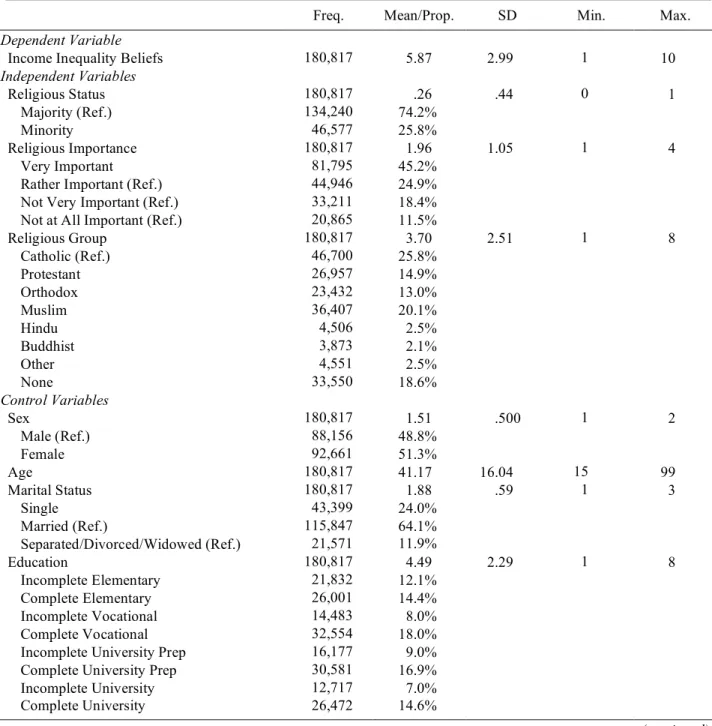
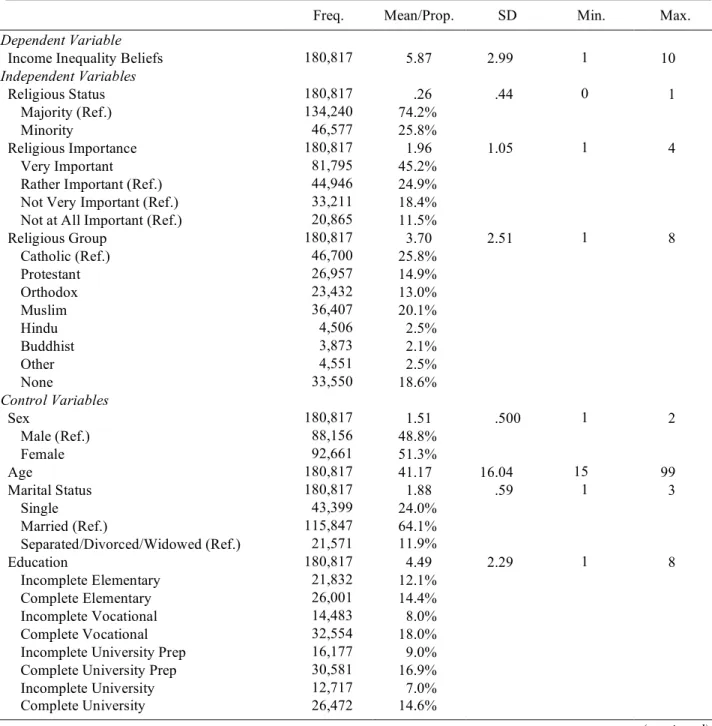
TABLE 1.1 ABOUT HERE

Descriptives

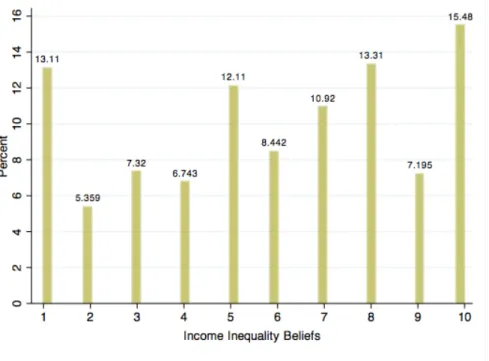
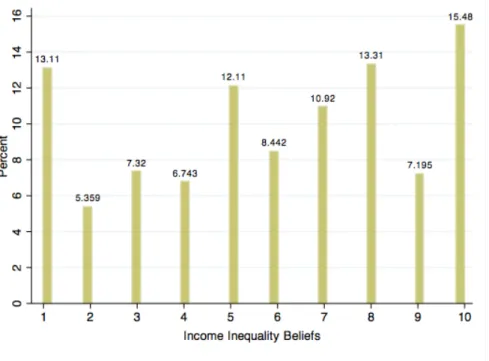
(37)

15.48 percent of respondents selected ten—the highest possible indication of the desire for using

income inequality as an incentive—and the next largest category of 13.31 percent selected eight.

FIGURE 1.1 ABOUT HERE

The independent variables measure three religious factors: 1) inequity, 2) intensity, and

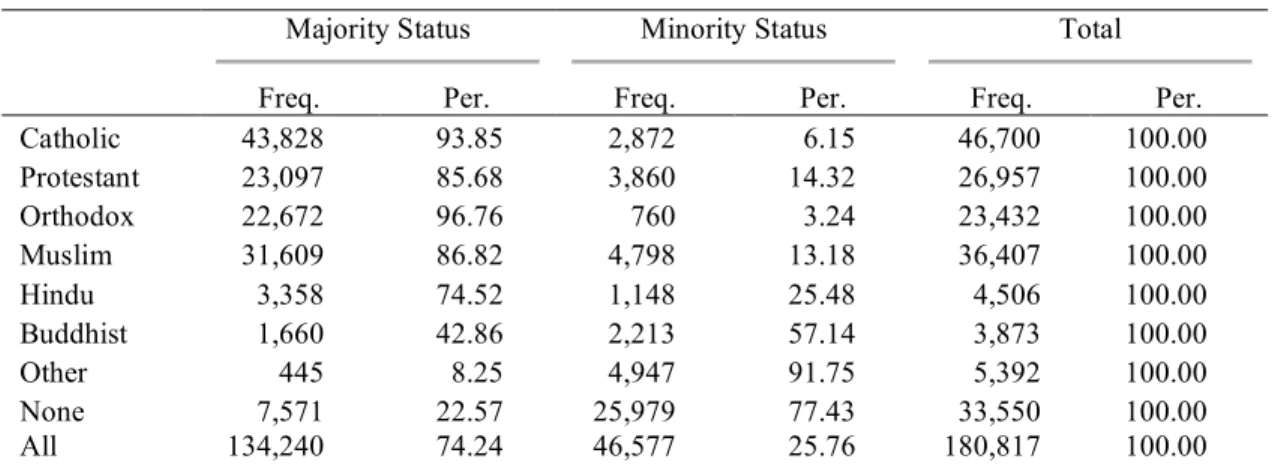
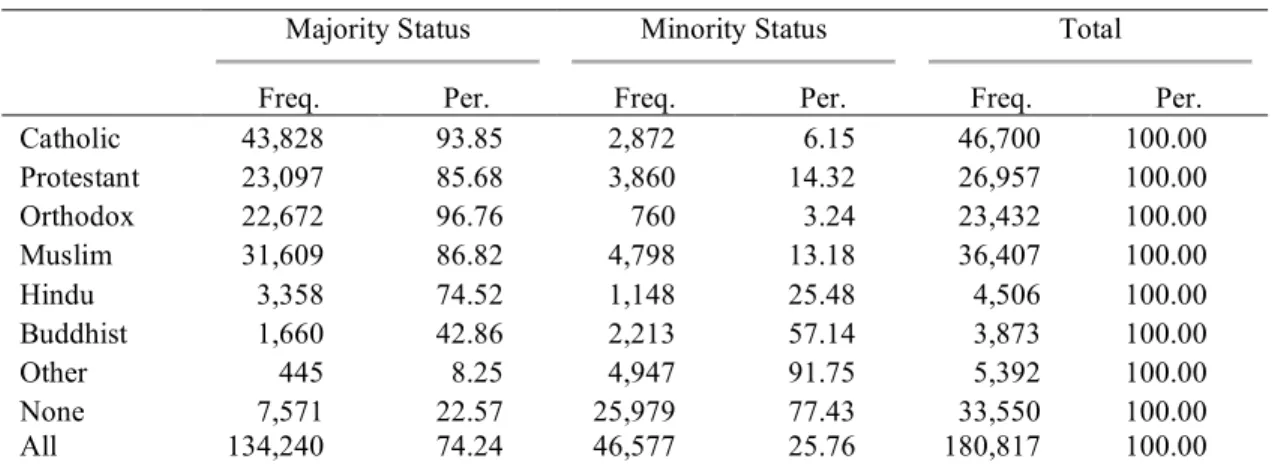
3) identity. First, when it comes to numerical inequity, about a three quarters of the sample are

religious majorities who observe the majority faith in their countries. As demonstrated in Table

1.2, 92 percent of Christians, 87 percent of Muslims, and 75 percent of Hindus share their faith

with a majority of their countries’ populations, while 57 percent of Buddhists, and 77 percent of

religious “nones,” and 100 percent of other religious groups represent religious minorities.

Second, the measure of religious intensity indicates that 45 percent of respondents rate

religion as very important, 25 percent as rather important, 18 percent as not very important, and

12 percent as not at all important. Having such a large “Very Important” category anchoring a

highly skewed distribution of religiosity makes it possible to use the other three categories as a

single reference group in the regressions that follow. Third, the sample divides into six religious

traditions. While slightly more than half of respondents identify as Christians, a fifth are

Muslims, and another fifth are religious “nones.” Hindus, Buddhists, and people of other

religions each represent between two and three percent of the sample.

(38)

currencies. Finally, three indicators reveal widely differing levels of income inequality,

economic development, and regime spending around the world: 1) Gini Indexes ranging from

21.88 to 64.80 with a mean of 37.32; 2) GDP per capita PPP (purchasing power parity) in

thousands of current international dollars ranging from .72 to 55.81 with a mean of 12.13; and

government expenses as a percentage of GDP ranging from 5.30 to 98.00 with a mean of 24.79.

Before investigating the regression models below, it proves instructive to explore the

relationships between the religious independent variables. Table 1.2 presents the cross tabulation

of religious groups by religious status. In this worldwide sample, a clear preponderance of

Christians (92 percent), Muslims (75 percent), and Hindus (75 percent) live as religious

majorities within their countries. Alternatively, all those practicing “other” religions (100

percent) and a preponderance of religious “nones” (77 percent) and Buddhists (57 percent) live

as religious minorities.

TABLE 1.2 ABOUT HERE

(39)

TABLE 1.3 ABOUT HERE

Table 1.3 also presents means and standard deviations for beliefs about income inequality

within each cross tabulated group. Reading the table once again from top to bottom, a similar

pattern emerges among religious groups. Just as in the main, increasing percentages of

Christians, Muslims, Hindus, and Buddhists rated religion as having increasingly higher

importance, so increasing percentages of these groups have increasingly higher mean values on

the dependent variable. These increasing means indicate rising support for using income

inequality as an economic incentive. Within these religious groups, it is increasingly likely to

rate religion as very important AND to demonstrate greater support for using income inequality

as an incentive. Again, the trend among religious “others” demonstrates more fluctuation, and

the pattern among religious “nones” reverses the main trend—with the caveat that those who rate

religion as not at all important have the lowest mean score within this group. Reading Table 1.3

from left to right among those who rate religion as very important reveals mean scores that

increase along the following trajectory: Hindus (5.28), religious “nones” (5.50), religious

“others” (5.65), Christians (6.03), Muslims (6.16), and Buddhists (6.77). The basic trends in this

table suggest that the relationship between religious intensity and religious identity should prove

helpful in explaining the relationship between religion and beliefs about income inequality. Thus

interaction terms between religiosity and religious tradition appear in the models below.

Models

(40)

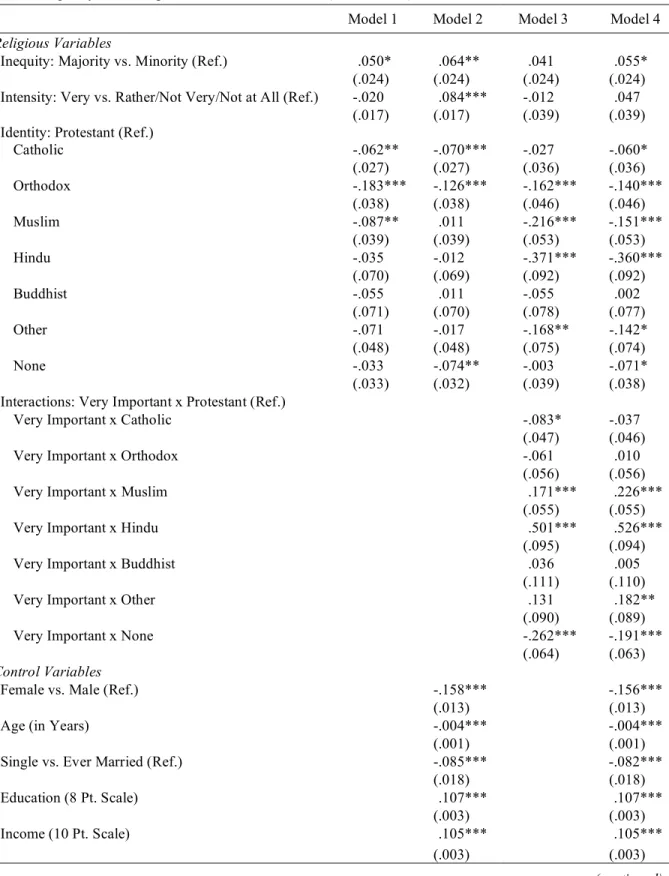
term at the country level (N=82) have a mean of approximately 2.8 in each model. Once again,

the Likelihood Ratio Tests confirm the significance of using mixed-effects models as contrasted

with regular linear regression analyses.

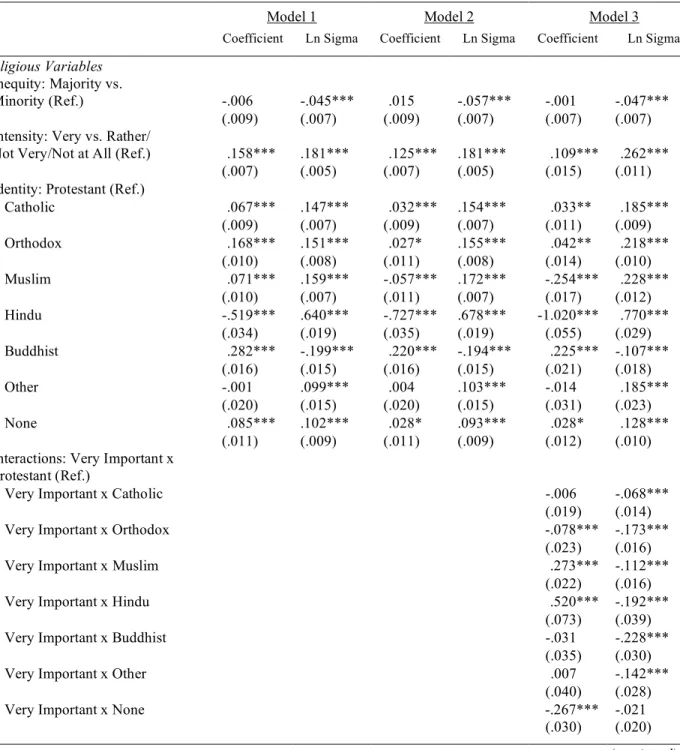
TABLE 1.4 ABOUT HERE

In the first column, Model 1 with only three religious independent variables demonstrates

few significant relationships at the p < .01 level. Only Catholics, the Orthodox, and Muslims

express less support for incentivizing income inequality than do Protestants. Adding the controls

in Model 2 alters this situation. In this model—and in the full model—the controls operate as

expected, with the caveat that income inequality, as measured by the Gini Index, presents no

significant relationship. Expressing less support for incentivizing income inequality associates

with being female, older, single, less educated, and poorer as well as living in nations with higher

development and with higher government spending relative to GDP.

The major finding in Model 2 is that religious inequity and intensity demonstrate a

significant relationship with income inequality beliefs at the p <.01 or .001 levels. Being a

religious majority associates with an increase of .064 on the ten-point scale of support for

incentivizing income inequality. And rating religion as very important as compared with

(41)

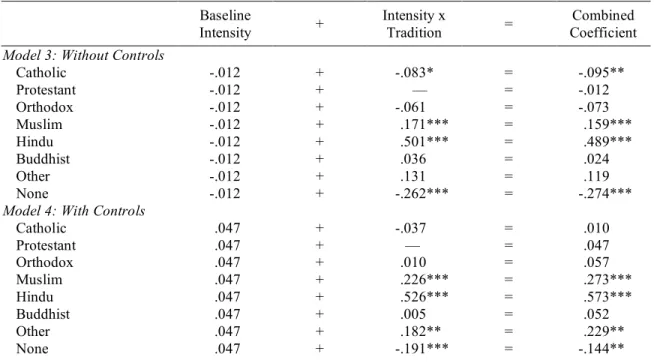
Adding interaction terms between religious intensity and religious identity in Models 3

and 4 somewhat alters this basic picture. It is vital to recognize how the addition of interaction

terms in Models 3 and 4 alters the interpretation of intensity and identity variables from Models

1 and 2. As before, the reference category remains Protestants. However, the religious intensity

variable in Models 3 and 4 now describes only Protestants who are highly religious as compared

with Protestants who are not highly religious. And each religious identity variable now describes

only those who are not highly religious as compared to Protestants who are not highly religious.

The newly added interaction terms describe the association of being highly religious in each

tradition as compared to those who are not highly religious in the same tradition. To make

interpretation simpler, Table 1.5 reports for each religious tradition the combined interaction

terms for those who are highly religious. These combined coefficients for highly religious

adherents of each tradition make for comparisons with adherents of the same tradition who are

not highly religious. They derive from adding the baseline intensity among the reference group,

highly religious Protestants, with the interaction term for each religious tradition. For example,

the first combined coefficient listed in Table 1.5 indicates a .095 decrease in incentivizing

income inequality among Catholics who are highly religious as compared with Catholics who

are not highly religious in the model without control variables. The statistical significance of

each combined coefficient reported in Table 1.6 is calculated from an F-test using matrix algebra

obtained from the lincom command in Stata.

TABLE 1.5 ABOUT HERE

(42)

drops from Models 3 and 4 with the addition of the interaction terms. Likewise, the religious

intensity variables in Models 3 and 4 demonstrate no significant relationship within the

Protestant reference category between rating religion as very important and support for

incentivizing income inequality. Thus these models report no significant difference in

incentivizing income inequality between Protestants who are highly religious and Protestants

who are not.

None of the models presents unambiguous evidence for Hypothesis 3, that support for

income inequality correlates with the centrality of a religion’s teaching about stratification.

While Catholics, the Orthodox, and religious “nones” express less support for incentivizing

income inequality than do Protestants in Model 1, it is Catholics, the Orthodox, and religious

“nones” who do so in Model 2. With the addition of interaction terms in Model 3, Catholics, the

Orthodox, Muslims, Hindus, and religious “others” who are not highly religious all express less

support for incentivizing income inequality as compared with Protestants who are not highly

religious. Interestingly, the results in this model for Muslims and Hindus who are not highly

religious reverse the expectations of Hypothesis 3. The same finding holds true in Model 4,

where the Orthodox, Muslims, and Hindus who are not highly religious express less support for

incentivizing income inequality as compared with Protestants who are not highly religious.

These results are generally inconsistent with Hypothesis 3 and do not constitute clear evidence

that religious identity in and of itself influences beliefs about income inequality in the pattern

expected. This finding presents the opportunity to deepen the investigation by addressing the

interaction terms between religious identity and religious intensity.

The major finding of this regression analysis appears in Table 1.5, involving the

(43)

tradition. Models 3 and 4 demonstrate evidence for the pattern expected in Hypothesis 3: that

support for income inequality correlates with the centrality of a religion’s teaching about

stratification—but only among the highly religious. Thus the evidence for Hypothesis 4 proceeds

along the pattern expected in Hypothesis 3. Among those who are not highly religious in Models

3 and 4, no significant difference at the .01 level can be detected when comparing Protestants

with Catholics, Buddhists, or religious “nones” concerning support for income inequality. At

only 2.1 percent of the sample, the number of Buddhists may be too small to demonstrate a

significant difference from being Protestant. Furthermore, the category of religious “other” most

likely contains too much diversity to be analytically useful in this specific situation. Given these

caveats, the relationships that remain provide evidence for Hypothesis 4, that support for income

inequality correlates with the interaction between religious intensity and religious identity. And

this relationship proceeds along the pattern expected in Hypothesis 3: that support for income

inequality correlates with the centrality of a religion’s teaching about stratification.

(44)

pattern anticipated by Hypothesis 3 with the inclusion of the interaction terms proposed in

Hypothesis 4.

Discussion

Evidence for the first hypothesis, that being a religious majority correlates with increased

support for income inequality, appears only in Model 2. The explanatory power of the interaction

terms in Models 3 and 4 renders religious majority status of no consequence in these models.

Importantly the paucity of support does not constitute proof that no relationship exists between

religious status and beliefs about inequality (Hunt 2002). Rather, this particular variable shows

no significant relationships in the models constructed for this study.

The second hypothesis, that high religiosity can intensify support for income inequality,

receives confirmation in Model 2 and partial confirmation in Models 3 and 4. This central

empirical finding prompts the following theoretical insight: There is more to the story linking

religion with stratification beliefs than the church and state—religion and redistribution—acting

as “substitute goods” (Gill and Lundsgaarde 2004, Chen and Lind 2005, Hungerman 2005,

Benabou and Tirole 2006, Scheve and Stasavage 2006, Chen and Lind 2007, Gruber and

Hungerman 2007, Pepinsky and Welborne 2010, Guillaud 2011, Stegmueller et al. 2011). By

focusing on beliefs about income inequality—and not just redistribution—this paper

demonstrates that any dampening effect of religion on egalitarian impulses may derive not just

from a distaste for government spending, but from the perceived value of income inequality

itself.

(45)

confirmation. Among those who are not highly religious, the anticipated direction of the

relationship changes directions on the coefficients that remain significant in Models 3 and 4. As

mentioned above, the pattern expected in Hypothesis 3 does indeed appear, but only when the

interaction terms are included in the models. Why might that be? Why does being highly

religious influence the association of religious tradition with support for income inequality?

The most striking support for income inequality appears among highly religious Hindus.

Being in this category correlates with an increase of .526 on the ten-point scale measuring

support for income inequality as compared with highly religious Protestants. While Hinduism

represents an immense diversity of spiritual beliefs and cultural practices, the caste system

constitutes the strongest integration of religion and stratification in any of the world’s major

religions. Of course many Hindus work tirelessly to improve the lot of lower caste people and

reform the caste system itself. Indeed the political shifts toward liberal democracy in

postcolonial India that have taken aim at the social rigidity of the caste system may be

influencing Hindu stratification beliefs in a more egalitarian direction (Nussbaum 2007). That

being said, the historic thrust of Hinduism centers on the transmigration of souls based on the

law of cause-and-effect, which determines the stratification system. And those Hindus who

report the highest levels of personal investment in this religious tradition also report the highest

levels of support for income inequality.

After highly religious Hindus, the next highest level of support for income inequality

occurs among highly religious Muslims. What might account for greater increase in support for

income inequality among highly religious Muslims as compared with their less religious

counterparts than among the next category—highly religious Christians as compared to their less

(46)

societies around the world, Steven Fish (2011) speculates that majority Muslim societies contain

lower levels of class inequality because Islamic scriptures provide much more specific directives

for assisting the poor than do other religions, especially Christianity (2011:221). In this view, the

specificity of the Islamic command to donate 2.5 percent of one’s income as an act of almsgiving

produces more egalitarianism than the more abstract New Testament teaching to “give up all one

has for the poor” (ibid.). Thus the impulse towards universal compassion is translated into

concrete action. While admittedly speculative, this method of considering the content and

centrality of religious teachings appears to illuminate the pattern of opinions about income

inequality arising in this study. Being both highly religious and identified with a particular

religious tradition is likely to be associated with prioritizing the core teachings of one’s faith.

Given Fish’s finding that majority Muslim societies exhibit lower levels of class

inequality than do majority Christian societies, it might seem surprising that highly religious

Christians express similarly egalitarian opinions about income inequality as compared with their

less religious counterparts than highly religious Muslims express as compared to their less

religious counterparts. However, it must be remembered that this study controls for majority

religious status. Furthermore, charity and equality are not synonymous. An instruction to help the

poor is not the same as an instruction to change the basic structures of society that cause

particular groups to be impoverished. The ability to separate personal charity from structural

equality aligns with the above mentioned finding by Pepinsky and Welborne (2010: 491)

concerning Muslims: “higher levels of religiosity correspond to lower support for government

efforts to minimize income inequality.” Thus highly religious Muslims may be quite comfortable

agreeing that income inequality should be used as an economic incentive all the while

(47)

Even though focusing on the content and centrality of religious teaching appears to offer

one explanation for the pattern of beliefs about income inequality among the different religious

traditions, this study does not claim airtight empirical evidence for this relationship. Once again,

the world’s major religious traditions contain immense diversity within them. Differences

abound between Shaiva, Vaishnava, and Shakti Hindus; Mayayana, Theravada, and Vajrayana

Buddhists; Orthodox, Catholic, and Protestant Christians; and Sunni and Shia Muslims. Such

diversity invites a warning about religious speculation:

“In sum, we cannot say with certainty whether there is something about Islam itself that

explains the relatively low level of class inequality found in the Muslim world. It is possible that

Muslims place an unusually high premium on avoiding gross inequalities in wealth and income.

Whether or not social practices are rooted in scriptural traditions is difficult to determine, but our

discussion provides some speculative ideas that connect the two” (Fish 2011:227, emphasis

added).

This study speaks directly to the the possibility that Muslims place an unusually high premium

on avoiding gross inequalities in wealth and income. The findings above suggest that they do

not. But that does not mean that the importance of charitable giving in Islamic teaching has no

influence on attitudes about income inequality.

(48)

in Arabic carries the connotation of ‘a payment on property in order to purify it and, hence, cause

for it to be blessed and multiply.’” (Bonner 2003:18). In explaining why highly religious

Muslims demonstrate stronger support for incentivizing income inequality than all other groups

besides highly religious Hindus, it can be helpful to recall that the very term for almsgiving in

Arabic involves the concepts of purified, multiplied property. This observation does not imply

that Muslims give to charity for selfish reasons with no concern for those in need. Rather,

understanding the possible connections between the survey’s use of the term “incentive” and a

notion of zakat that involves purified, multiplied property can prove illuminating.

(49)

Finally, highly religious “others” express more support for income inequality than their

less religious counterparts, and highly religious “nones” express much less support than their less

religious counterparts. The “other” category most likely contains too much religious diversity to

be analytically useful in this situation. However, more than one in ten religious “nones” consider

religion to be very important. Claiming no religion drastically lowers the probability that this

group shares any central teachings about stratification. As predicted by Hypothesis 3, this group

expresses the least comparative support for income inequality among the highly religious.

In summary, the final hypothesis, that the interaction between religious intensity and

religious identity increases support for income inequality, receives solid support in Models 3 and

4. And both models confirm the pattern predicted in the third hypothesis, that support for income

inequality correlates with the centrality of a religion’s teaching about stratification.

Conclusion

Review

Prior research indicates that beliefs about income inequality reflect normative judgments,

stratification systems, political orders, economic conditions, social norms, and religious

(50)

the story linking religion with stratification beliefs than the church and state—religion and

redistribution—acting as “substitute goods” (Gill and Lundsgaarde 2004, Chen and Lind 2005,

Hungerman 2005, Benabou and Tirole 2006, Scheve and Stasavage 2006, Chen and Lind 2007,

Gruber and Hungerman 2007, Pepinsky and Welborne 2010, Guillaud 2011, Stegmueller et al.

2011). By focusing on beliefs about income inequality—and not just redistribution—this paper

demonstrates that any dampening effect of religion on egalitarian impulses may derive not just

from a distaste for government spending, but from the perceived value of income inequality

itself. And the perceived value of income inequality appears to reflect the core teachings of

religious traditions, especially among their most ardent adherents.

Limitations

Figure

Table 1.1. Descriptive Statistics for Dependent, Independent, and Control Variables (N = 180,817)
Figure 1.1. Histogram of Income Inequality Beliefs Ranging from (1) “Incomes should be made more  equal,” to (10) “We need larger income differences as incentives.”
Table 1.2. Cross Tabulation of Religious Groups by Religious Status (N = 180,817)
Table 1.4. Coefficients from Multilevel Mixed-Effects Linear Regression Predicting Support for Incentivising  Income Inequality with Religious and Control Variables (N = 180,817)
+7

References

Related documents

Another investigation, which was used for the samples is scanning electron microscopy. In Figure 4 are presented microstructures obtained during the examination

The methods includes direct injection method, head space analysis, solid phase microextration SPME method and the new technique known as single drop microextraction SDME..

The scope of the information systems work performed focused on the evaluation of software access controls and internal user account management controls associated with the

The result showed that there was a statistically significant improvement of students’ reading comprehension as the significant level (0.00&lt;0.05). Furthermore, the

Crop growth parameters investigated include rate of germination, number of leaves, plant height, leaf surface area and yield biomass weight.. The growth performance results

A narrow plurality (37%) preferred part-time work in 1997; today 48% of mothers with younger children prefer part-time work, while 36% prefer not working outside the home and 16%

BMI: Body Mass Index; BP: Blood pressure; CI: Confidence interval; CVA: Cerebral Vaccine Accident; CVD: Prevention of cardiovascular diseases; DBP: Diastolic blood pressure;

Measures of overweight and obesity among South African boys and girls from 1–2 years to 16–18 years, 1 Birth-to-Twenty Cohort (Sensitivity analysis: pre- senting figures based