50
DRYING CHARACTERISTICS, COLOUR AND PHYTOCHEMICAL
CONSTITUENTS OF
BRYOPHYLLUM PINNATUM
LEAVE: A FUNCTION OF
PRETREATMENT AND DRYING METHODS.
a
Ochulorugo, M.,
bEhiem, J.C
*. and
cSimonyan, K. J.
abcDepartment of Agricultural and Bio-Resources Engineering, Michael Okpara University of Agriculture,
Umudike, P.M.B. 7267, Umuahia, Abia State, Nigeria.
*Corresponding author email: [email protected]; +2347037907689
ABSTRACT
The impact of three different drying methods (active solar, direct open sun and hot-air cabinet tray drying) and two different treatment methods (perforated and sliced) on drying characteristics, phytochemical constituents and colour of Bryophyllum pinnatum leaves were investigated. Moisture content of the leaves was measured until equilibrium moisture content is reached. The result obtained revealed that hot air cabinet drying method and slicing pretreatment improves the drying rate of Bryophyllum pinnatum leaves more than active solar and open sun drying methods. Active solar drying method and perforated pretreatment had the best Bryophyllum pinnatum leaves phytochemical constituents and colour retention during drying with brightness L*value (39±0.11), greenness a* (-70±0.60), yellowness b* (82±0.31), colour change ΔE* and intensity C (131.61±0.12) and (107.81±0.90). Logarithmic model had the best potential for describing the drying characteristics of both treated and untreated Bryophyllium pinnatum leaves using active solar and cabinet drying method.
Keyword: Bryophyllum pinnatum, drying, phytochemical, moisture content, colour.
Introduction
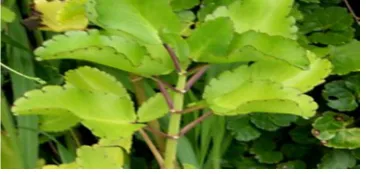
Bryophyllum pinnatum (Lam) is a succulent plant that belongs to the family of Crassulaceae. It is commonly known as air plant, love plant, miracle leaf and life plant. The plant is mostly found in the tropical and subtropical areas like Asia, Australia, China, Nigeria, New Zealand, West Indies, Hawaii (Gill, 1992; Olajide, 1998). Bryophyllum pinnatum is perennial herb that grows up to 60 to 120 cm (Oliver-Bever, 1983) tall with branches and can survive harsh and dry environmental conditions. It possesses great potentials for forming dense vegetation (Fig. 1) especially in coastal environments and along waterways.
Figure 1. Bryphyllum pinnatum plant
The leaves are fleshy and either simple or compound (i.e. trifoliate or pinnate), which are arranged oppositely. The number of leaflets varies from near the base of the stems to three or five pinnate higher up the stem. The leaflets are oval or narrowly oval in
shape with rounded tips and when more than one leaflet is present, the end leaflet is significantly larger than the others. In addition, its skin has a waxy surface which reduces evaporation and prevents insects from penetrating into the plant’s soft tissues. Bryophyllum pinnatum is astringent, sour in taste, sweet in the post digestive effect and has hot potency. It has gained considerable attention due to its medicinal qualities (26% alkaniod, 33.30% flavonoids, 27.80% saponin and 1.50% carotenoids (Kanika, 2011)) and has found application in both folk medicine and contemporary medicine (Okwu and Josiah 2006). Its haemostatic and wound healing properties especially the leaves have confirmed the acceptance of the plant as herbal remedy in almost all parts of the world (Olajide, 1998). Furthermore, the leaves have been reported to possess a variety of medicinal properties including, antimicrobial, antifungal, anticular, antihypertensive, tocolytic, anti-diabetic, anti-inflammatory and analgestic and wound healing. Other reported properties include anti-tumor (Yamagishi et al., 1989; Obaseiki-Ebor et al., 1993), sedative and muscle relaxant effects (Yemitan and Salahdeen, 2005). It may also be effective in the treatment of Cutaneousleishmaniasis (Torres-Santos et al., 2003).
51
and press (Aibinu et al., 2004) while the dried ones are ground to powder before use.Fresh Bryophyllum pinnatum is highly perishable and does not store long due to high level of moisture content and other chemical compounds in it that encourages deterioration. Over the years, drying has been the simplest and most economic means of decreasing moisture content, inhibit the development and activities of microorganisms thus prolonging the shelf life of the product (Azam, 1986). Drying also reduces cost of packaging, storage and transportation, and the acceptability of the product (Okos et al., 1992) although certain problems like shrinkage, unfavourable changes in colour, texture, flavour and nutritive value may occur if adequate precautions are not taken (Crivelli et al., 2002).
Pre-treatment activities like blanching, slicing and peeling also aid fast drying and preservation of volatile constituents of the product. Blanching inhibits enzymic browning which affects the appealing of the product while slicing and peeling increases the rate of mass transfer during drying. Various pre-treatment and drying methods have been used to dry herbal leaves. Duangrat and Prasong (2010) blanched lettuce leaves before drying and reports that pre-treatments of vegetables because enhances inactivation of enzymes, changes in tissue structure and shorter drying time. Besides, Lewicki (2006) has reported that calcium chloride blanching helps in prevent or reduce browning. The effect of drying conditions on drying characteristic, rehydration ratio (RR), color of mulberry leaves were studied by Jirakitkul and Noomhorm (2007) using microwave -vacuum drying method at 452 + 2.12W power level. The result showed that this drying method recorded the shortest drying time, highest rehydration ratio and insignificant change in the colour of mulberry leaves. Sejadi and Anua (2011) observed significant changes in colour, moisture content, crispness and phenolic content of neem leaf (Azadirachta indica) when dried under hade and oven-dried at 45 oC and 70 oC, respectively.
Eric (2013) investigated the dependence of nutritional characteristics of spicy basil leaf on different methods of drying (microwave at 3W, oven-drying at 110 oC, carbinet drying at 100 oC, open sun drying at 33 oC and ambient-air drying at 28 oC). The result obtained showed that microwave drying consumed the lowest time and retains the product nutrient more than other methods. Despite all these studies, no literature exist of the effect drying methods and pretreatment on the phytochemical and colour characteristics of Bryophyllium pinnatum leaves, hence this study was embarked on to fill this knowledge gap.
Materials and Methods
Fresh leaves of cultivated Bryophyllium pinnatum were obtained within Umuahia, Abia State Nigeria and transported that same day to the Postharvest laboratory, Department of Agricultural and Bio-Resources Engineering, Michael Okpara University of Agriculture, Umudike for drying. The leaves were washed and allowed the surface water to dry off before pre-treatment. The treatment was done by randomly selecting and dividing the leaves into three groups. The first group was sliced at a regular interval of 40 mm using hacksaw blade, the second group was perforated using a set of pin of 2 mm radius arranged in four for easy perforation while the third was untreated. Three different drying methods (cabinet, direct solar and forced convectional solar drying methods) were used to dry the leave samples. A given quantity of leave sample was taken from each group and weighed using digital weighing balance of 0.01 g accuracy before placing them in the dryer. Each drying method takes the three groups under same drying condition. The environmental temperature, relative humidity, air velocity and the weight of each sample in each group were also measured with digital thermometer, hydrometer, anemometer and electronic weighing balance respectively at interval of 24 hours. Drying took place at mean temperature and relative humidity of 40 oC and 50%, respectively for hot-air cabinet dryer and 32 oC and 68%, respectively for both open sun and active solar dryer. Drying was discontinued when no weight gradient was observed and moisture content was calculated at each weight measurement as Eq. 1 (Mohsenin, 1986):
= × 100 (1)
MC = Moisture content (%) in wet basis, Wi = Initial weight (g), Wf = Final weight (g)
Mathematical models evaluated for describing the drying characteristic of Bryophyllium leaves include, Eqs. 2 - 6 (Togrul and Pehlivan, 2002, Krokida et al., 2002):
Rayaguru and Routray, 2012): Lewis,
MR = exp(-kt) (2)
Page
MR = exp(- ktn) (3)
Henderson and Pabis \
MR = a exp(-kt) (4)
Logarithmic
MR = a exp(-kt)+c (5)
Wang and Singh
MR = 1+ at + bt (6)
52
chart. Other colour parameters (colour change (ΔE*) and intensity (C)) were calculated as in Eqs. 7 – 9, (Christie et al., 2000):∆ = (∆ ∗ + ∆ ∗ + ∆ ∗ )
(7)
= √ ∗ + ∗ (8)
= tan ∗∗ (9)
Where; C = chroma, E = colour change, H = hue angle
Phytochemical composition of the fresh and dried leaves sample of each drying method were analyzed as described by Harborne (1973) and Trease and Evans (1983). The goodness of fit of the models for describing the drying characteristics of the leaves was tested using statistical methods (reduced chi- square (χ2), root mean square error (RMSE) coefficient of determination (R2). The lower chi- square (χ2) and RMSE values and the higher R2 values, were chosen as the best goodness of fit (Yaldýz and Ertekýn, 2001, Günhan et al., 2005; Midilli and Kucuk, 2003). The drying data and phytochemical changes obtained were analyzed using the statistical analysis system (SAS); a multiple comparison of the treatment means was performed by Duncan’s new multiple range tests. Significance of the difference was determined at p = 0.05.
Result and Discussion
Effect of drying methods and pretreatments on the drying characteristics
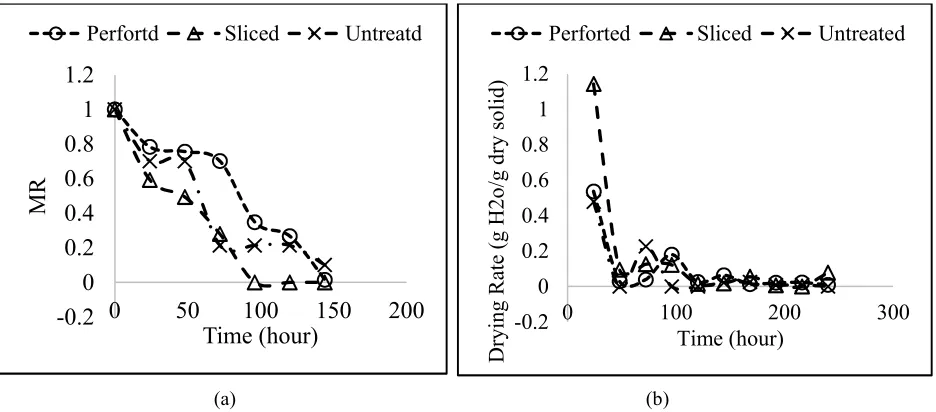
Moisture content and drying rate of both treatment and control for all the drying methods decreased
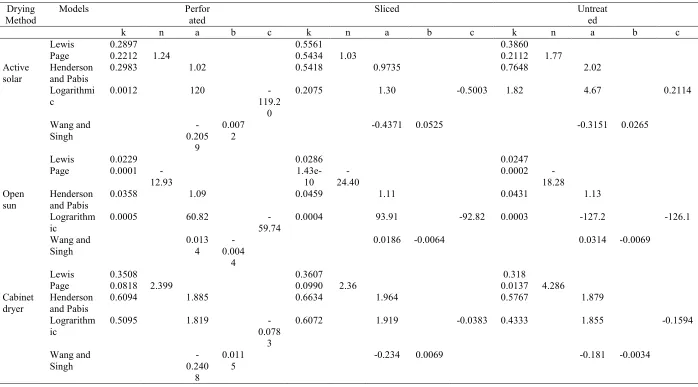
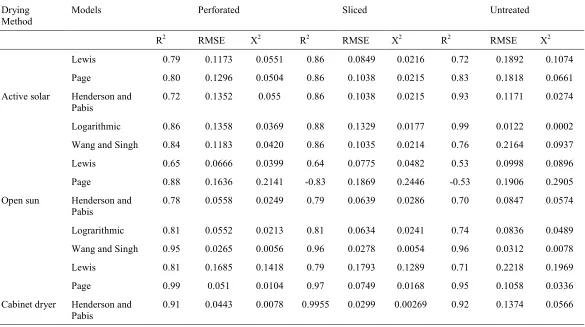
continuously with increase in drying time until equilibrium moisture content was reached as shown in Fig 2-4. Hot-air-cabinet drying method was observed to be 50% and 16.67% faster in drying Bryophyllium leaves than open sun and active solar drying methods, respectively. This could be because the temperature of the drying medium and evacuation of humid air in the cabinet drying system was consistent and not dependent on environmental air flow rate and direction. Similar observation was reported by Kaur et al. (2006) and Singh et al. (2006) for coriander and leafy vegetables. Besides, for all the drying methods tested the rate of drying the leaves was faster with sliced leaves than with perforated and untreated (control) ones. This could be because the sliced leaves had less waxy surface, more surface area and shorter distances for water molecules to migrate to the surface of the leaves than that of perforated and untreated ones. This result implies that slicing as a pretreatment increase the drying rate and reduces drying time of the leaves more. This result is in agreement with the observation of Duangrat and Prasong, (2010) for lettuce leaves. Among the models studied, logarithmic model had the best potential for describing the drying characteristics of both treated and untreated Bryophyllium pinnatum leaves using active solar and cabinet drying method except the untreated leave of cabinet method while Pages model best describes that of open sun drying (Table 2 - 3). Page model was found to had the best statistical test result with highest R2 (0.9955) and lowest RMSE (0.0457) for mint leaves (Mentha Cordfolia Opiz ex Fresen) (Nantawan and Weibaio, 2009).
(a) (b)
-0.5
0
0.5
1
1.5
0
50
100
150
200
M
oisture ra
tio
Time (hour)
Perforated
Sliced
Untreated
-0.1
0
0.1
0.2
0.3
0.4
0
100
200
300
Dry
ing
Rate
(g H2o/g dr
y
solid)
Time (hour)
Perforated
Sliced
53
Figure 2: Effect of different treatment on (a) moisture content and (b) drying rate of Bryophyllium pinnatum leaves using active solar drying method.
(a) (b)
Figure 3: Effect of different treatment on (a) moisture content (b) drying rate of Bryophyllium leaves using forced convection open sun drying method.
(a) (b)
(b)
Figure 4: Effect of different treatment on (a) moisture content (b) drying rate of Bryophyllium leaves using hot-air cabinet drying method.
-0.2
0
0.2
0.4
0.6
0.8
1
1.2
0
50
100
150
200
MR
Time (hour)
Perfortd
Sliced
Untreatd
-0.2
0
0.2
0.4
0.6
0.8
1
1.2
0
100
200
300
Dry
ing
Rate
(g
H2o/g
dry
sol
id)
Time (hour)
Perforted
Sliced
Untreated
0
0.2
0.4
0.6
0.8
1
1.2
0
50
100
150
MR
Time (hour)
Perforated Sliced Untreated
0
0.01
0.02
0.03
0.04
0.05
0.06
0
50
100
150
Dry
ing
Rate
(g
H2o/g dry
soli
d
)
Time (hour)
Perforated Sliced
54
Table 2: Drying model coefficients for different drying methods and pretreatments for Bryophyllum pinnatum leaves
Drying Method
Models Perfor
ated
Sliced Untreat
ed
k n a b c k n a b c k n a b c
Lewis 0.2897 0.5561 0.3860
Page 0.2212 1.24 0.5434 1.03 0.2112 1.77
Active solar
Henderson and Pabis
0.2983 1.02 0.5418 0.9735 0.7648 2.02
Logarithmi c
0.0012 120
-119.2 0
0.2075 1.30 -0.5003 1.82 4.67 0.2114
Wang and Singh
-0.205
9
0.007 2
-0.4371 0.0525 -0.3151 0.0265
Lewis 0.0229 0.0286 0.0247
Page 0.0001
-12.93
1.43e-10
-24.40
0.0002
-18.28 Open
sun
Henderson and Pabis
0.0358 1.09 0.0459 1.11 0.0431 1.13
Lograrithm ic
0.0005 60.82
-59.74
0.0004 93.91 -92.82 0.0003 -127.2 -126.1
Wang and Singh
0.013 4
-0.004
4
0.0186 -0.0064 0.0314 -0.0069
Lewis 0.3508 0.3607 0.318
Page 0.0818 2.399 0.0990 2.36 0.0137 4.286
Cabinet dryer
Henderson and Pabis
0.6094 1.885 0.6634 1.964 0.5767 1.879
Lograrithm ic
0.5095 1.819
-0.078 3
0.6072 1.919 -0.0383 0.4333 1.855 -0.1594
Wang and Singh
-0.240
8
0.011 5
55
Table 3: Statistical test of different models for drying characteristics of Bryophyllum pinnatum leaves
Drying Method
Models Perforated Sliced Untreated
R2 RMSE X2 R2 RMSE X2 R2 RMSE X2
Lewis 0.79 0.1173 0.0551 0.86 0.0849 0.0216 0.72 0.1892 0.1074
Page 0.80 0.1296 0.0504 0.86 0.1038 0.0215 0.83 0.1818 0.0661
Active solar Henderson and Pabis
0.72 0.1352 0.055 0.86 0.1038 0.0215 0.93 0.1171 0.0274
Logarithmic 0.86 0.1358 0.0369 0.88 0.1329 0.0177 0.99 0.0122 0.0002
Wang and Singh 0.84 0.1183 0.0420 0.86 0.1035 0.0214 0.76 0.2164 0.0937
Lewis 0.65 0.0666 0.0399 0.64 0.0775 0.0482 0.53 0.0998 0.0896
Page 0.88 0.1636 0.2141 -0.83 0.1869 0.2446 -0.53 0.1906 0.2905
Open sun Henderson and
Pabis
0.78 0.0558 0.0249 0.79 0.0639 0.0286 0.70 0.0847 0.0574
Lograrithmic 0.81 0.0552 0.0213 0.81 0.0634 0.0241 0.74 0.0836 0.0489
Wang and Singh 0.95 0.0265 0.0056 0.96 0.0278 0.0054 0.96 0.0312 0.0078
Lewis 0.81 0.1685 0.1418 0.79 0.1793 0.1289 0.71 0.2218 0.1969
Page 0.99 0.051 0.0104 0.97 0.0749 0.0168 0.95 0.1058 0.0336
Cabinet dryer Henderson and Pabis
56
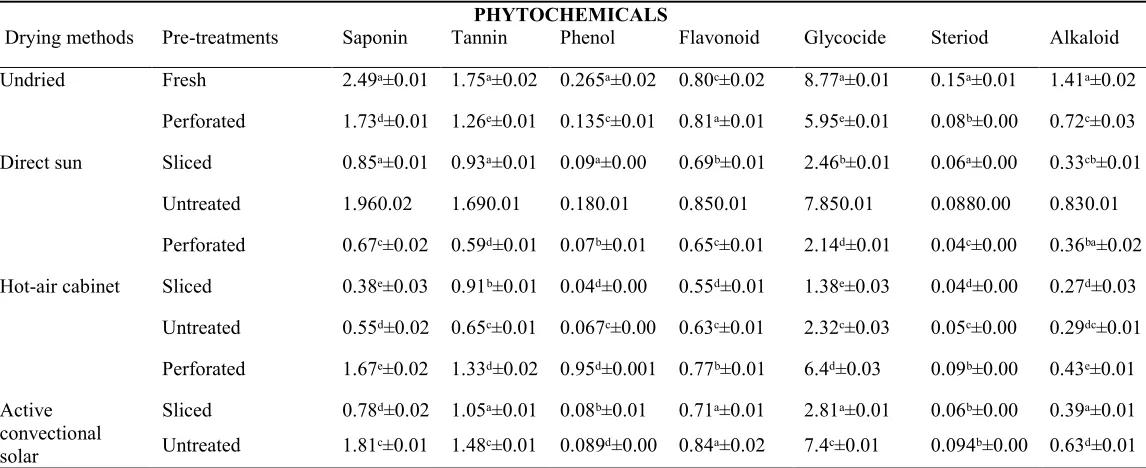
Effect of drying methods and pretreatment on the phytochemicals constituents of Bryophyllium pinnatum leavesThe summary of the effect of drying methods and pretreatment on phytochemical constituents of Bryophyllium leaves is presented in Table 3. It was observed that phytochemical constituents of the dried leaves were retained more with active solar drying than other drying methods despite that saponins, tannin, flavonoid and alkanoid constituents had higher retained values with open sun drying. This result is attribute to stable air flow rate in active solar drying while low values for hot-air cabinet is attributed to high rate of evaporation of volatile matter due to steady temperature and air flow rate. Drying methods was reported to have negative effect on chemical compound stored in Feliciamuricata leave and menthalongifolia leave (Ashafat et al. (2008) and Asekun et al. (2007)).Generally, Bryophyllium leaves lost 71.11%, 37.02% and 36.34% of their phytochemical constituents in hot air cabinet, direct open sun and active solar drying method respectively. This result means that active convectional solar drying method is the best method
for preserving the phytochemical constituents of Bryophyllium leaves during drying process.
For all the drying methods studied, perforated leaves retained more phytochemical constituents after drying than the sliced leaves when compared in relation to the untreated (control) leaves. Perforated and sliced leaves were found to retain 70.45% and 40.23% for direct open sun drying, 99.19% and 78.34% for hot air cabinet and 94.31% and 47.64% for active convective solar drying method. Comparing the level of phytochemical constituents retained after drying with the fresh leaves, untreated (control) had the highest constituents retained followed by perforated and sliced dried leaves. Treatment effect on the phytochemical constituents of dried Bryophyllium pinnatum leaves are significant (p<0.05) in all the drying methods studied. Negative effect of pretreatment on phytochemical constituents of olive leaves was also observed by Zeitoun et al. (2017).The values of retained phytochemical constituents of both pretreatment for all drying methods are low meaning that the phytochemical constituents of Bryophyllium leaves are stored near the surface.
Table 3.The quantitative determination of phytochemical constituents of Bryophyllium pinnatum leaves
All similar letters along the same column are not significant (p = 5%) (Duncan multiple comparison test)
Effect of drying methods and pretreatments on the colour of the leaf
Comparing the colour parameters of fresh Bryophyllium pinnatum leaves with that of dried leaves from different drying methods as shown in Table 4 and Fig 5, the *L (brightness) values of dried leaves from hot-air cabinet was observed to be
21.62% higher than that of fresh while direct open sun and active solar drying methods yielded 36.21% and 32.76% less, respectively. The greenness (negative a*) values was more with active solar (-70±0.60) and deviated by 83.33% with positive values for active solar drying. All the values of b* (yellowness) for all the drying methods are positive PHYTOCHEMICALS
Drying methods Pre-treatments Saponin Tannin Phenol Flavonoid Glycocide Steriod Alkaloid
Undried Fresh 2.49ᵃ±0.01 1.75ᵃ±0.02 0.265ᵃ±0.02 0.80ᶜ±0.02 8.77ᵃ±0.01 0.15ᵃ±0.01 1.41ᵃ±0.02
Perforated 1.73ᵈ±0.01 1.26ᵉ±0.01 0.135ᶜ±0.01 0.81ᵃ±0.01 5.95ᵉ±0.01 0.08ᵇ±0.00 0.72ᶜ±0.03
Direct sun Sliced 0.85ᵃ±0.01 0.93ᵃ±0.01 0.09ᵃ±0.00 0.69ᵇ±0.01 2.46ᵇ±0.01 0.06ᵃ±0.00 0.33ᶜᵇ±0.01
Untreated 1.960.02 1.690.01 0.180.01 0.850.01 7.850.01 0.0880.00 0.830.01
Perforated 0.67ᶜ±0.02 0.59ᵈ±0.01 0.07ᵇ±0.01 0.65ᶜ±0.01 2.14ᵈ±0.01 0.04ᶜ±0.00 0.36ᵇᵃ±0.02
Hot-air cabinet Sliced 0.38ᵉ±0.03 0.91ᵇ±0.01 0.04ᵈ±0.00 0.55ᵈ±0.01 1.38ᵉ±0.03 0.04ᵈ±0.00 0.27ᵈ±0.03
Untreated 0.55ᵈ±0.02 0.65ᶜ±0.01 0.067ᶜ±0.00 0.63ᶜ±0.01 2.32ᶜ±0.03 0.05ᶜ±0.00 0.29ᵈᶜ±0.01
Perforated 1.67ᵉ±0.02 1.33ᵈ±0.02 0.95ᵈ±0.001 0.77ᵇ±0.01 6.4ᵈ±0.03 0.09ᵇ±0.00 0.43ᵉ±0.01
Active convectional solar
Sliced 0.78ᵈ±0.02 1.05ᵃ±0.01 0.08ᵇ±0.01 0.71ᵃ±0.01 2.81ᵃ±0.01 0.06ᵇ±0.00 0.39ᵃ±0.01
57
and increased by 52.44% and 39.06% for active solar and hot-air cabinet, respectively but had 56.41% decrease with direct open sun drying method. Besides, colour change (ΔE*) and intensity (C) of the dried leaves from active solar drying were more than other drying methods.The high loss of colour with open sun and hot-air cabinet can be attributed to longer time it took the former to arrive at equilibrium moisture content and unstable environmental factors surrounding the leaves and, high rate of moisture and volatile loss associated with active solar during drying process. The colour
(greeness) of pretreated samples were also observed to decrease significantly (p<0.05) from untreated (control) to perforated and sliced leaves. Negative and positive values of a* and b* were observed for dried lettuce leaves and curry (Murraya koenigii) leavesdried in hot-air cabinet (Duangrat and Prasong, (2010; Kenghe et al., 2015). Their values varied with that of Bryophyllium pinnatum driedleaves and could be as a result of differences in the treatment methods used. Colour change due to pretreatment activities before drying peppermint leaves was also reported by and Marina et al. (2015).
Table 4: Colour properties of fresh and dried Bryophyllium pinnatum leaves
Leaves *L *a *b ΔE* C H Colour
Fresh 58±0.13 -60±0.21 39±1.07 - 67.18±0.5 33.02o Green
Open sun 37±0.08 10±0.09 17±0.10 66.53±0.07 19.72±0.11 59.54o Dark olive green
Active solar 39±0.11 -70±0.60 82±0.31 131.61±0.12 107.81±0.09 49.51o Dark green
Cabinet 74±0.05 -27±0.04 64±0.9 86.70±0.5 69.46±0.7 67.13o Yellow green
Active solar direct sun (control) hot air cabinet
Figure 5: Colour of dried Bryophyllium pinnatum leaves.
Conclusion
This study can be concluded that hot air cabinet drying method and slicing pretreatment improves the drying rate of Bryophyllum pinnatum leaves more than active solar and open sun drying methods. Active solar drying method and perforated pretreatment had the best ability to retention phytochemical constituent and colour of Bryophyllum pinnatum leaves during drying process. Logarithmic model had the best potential for describing the drying characteristics of both treated and untreated Bryophyllium pinnatum leaves using active solar and cabinet drying method.
REFERENCES
Aibinu, I., Adenipekun, E. and Odugbemi, T. (2004). Emergence of Quinolone
Resistance amongst Escherichia coli strains isolated from clinical infections in some Lagos State
Hospitals in Nigeria. Nigerian Journal of Health and Biomedical Science. 3(2):73-78.
Asekun, O.T., Grierson, D.S. and Afolayan, A. J. (2007). Effect of drying methods on the quality and quantity of the essentialoil of Mentha longifolia L. subsp. Capensis. Food Chem., 107: 995 – 998.
58
chemical composition of essential oil from Feliciamuricata leaves. Asian Journal of Plant Science 7(6): 603 - 606
Azam, A. S. (1986). Solar drying: practical methods of food preservation. International Labour Office (ILO), Geneva,
Duangrat, P. and Prasong, S. (2010). Effect of pre-treatments on drying characteristics and colour of dried lettuce leavesAsian Journal of Food
And Agro-Industry., 3(6), 580-586.
Eric Danso-Boateng (2013) Effect of drying methods on nutrient quality of Basil (Ocimumviride) leaves cultivated in Ghana. International Food
Research Journal 20(4): 1569-1573.
Gill, L.S., (1992). Ethno-medical uses of plants in Nigeria. University of Benin Press, pp: 46.
Günhan, T., Demir, V., Hancioglu, E. and Hepbasli, A. (2005). Mathematical modeling of drying
of bay leaves. Energy Conversion and Management 46(11–12): 1667–1679.
Harborne, I. B. (1973). Phytochemical Methods: A Guide to Modern Techniques of Plant
Analysis, Chapman and Hall, New York, NY, USA, 2nd edition.
Jirakitkul, N. and Noomhorm, A. (2007). Microwave Vacuum Drying of Mulberry Leaves. Thesis. Asian Institute of Technology. Bangkok. Thailand.
Kanika P. (2011). Pharmacognostic and phytochemical evaluation of
Bryophyllumpinnatumleaves. Journal of Advance Science and Research;2(1):42-49.
Kaur, P., Kumar, A., Arora, S. and Singh, G. B.(2006), Quality of dried coriander leaves as affected by pretreatments and method of drying. 223: 189-194.
Kenghe, R. N., Jadhav, M. S., Nimbalkar,C. A. and Kamble, T.M. (2015). Effect of
Drying Methods on Quality Characteristics of Curry (Murraya koenigii) Leaves.
International Journal of Environmental & Agriculture Research (IJOEAR), 1(5): 8-12.
Krokida, M. K., Karathanos, V. T., Maroulis, Z. B. and Marinos- Kouris, D. (2003). Drying kinetics of some vegetables. Journal of Food
Engineering 59(4): 391-403.
Lewicki, P.P. (2006). Design of hot air drying for better foods. Trends in Food Science and Technology, 17: 153–163.
Marina R., Pranas V., Edita D., Jonas V. and Rasa. (2015). Effect of drying methods on the
chemical compositionand colour of peppermint (Mentha × piperita L.) leaves. Zemdirbyste-Agriculture, 102(2): 223‒228.
Midilli, A. and Kucuk, H. (2003). Mathematical modeling of thin layer drying of pistachio by using
solar energy. Energy Conversion and Management 44(7): 1111–1122.
Mohsenin, N. N. (1986). Physical properties of plants and animals materials. 2nd edition
(revised). Gordon and Breach Science publishers. New York.
Nantawan, T. and Weibaio, Z. (2009). Drying of mint leaves (Mentha Cordfolia Opiz ex Fresen).
Journal of Food Egineering 91(3): 482 – 489.
Obaseiki-Ebor, E.E., K. Odukoya, H. Telikepalli, L.A. Mitscher and D.M. Shankel, (1993). Antimutagenic activity of extracts of leaves of four
common edible vegetable plants in Nigeria (West Africa). Mutat. Res., 302: 109-117. PMID:
7684505
Okos, M.R., Narsimhan, G., Singh, R.K. and Witnauer, A.C. (1992). Food dehydration: In eldman,
DR, Lund DB (Ed). Handbook of food engineering Marcel Dekker, New York.
Okwu D.E and C. Josiah (2006). Evaluation of the chemical composition of two Nigerian medicinal plants African Journal of Biotechnology
Vol. 5 (4), pp. 357-361, 16 February 2006.
Olajide, O.A. (1998). Analgesic, anti-inflammatory and antipyretic effects of
Bryophyllumpinnatum Fitoterapia, 69 (3): 249-252.
Oliver-Bever, B. (1983). Medicinal plants in tropical west Africa III. Ant-infection therapy with higher plants. J.Ethnopharmacol., 9: 1-83.
Rayaguru, K. and Routray, W. (2012). Mathematical modeling of thin layer drying kinetics of
stone apple slices. International Food Research Journal 19(4): 1503-1510.
Singh U., Sagar, V. R., Behera, T. K. and Kumar, S. P.(2006). Effect of drying conditions on
the quality of dehydrated selected leafy vegetables. J. Fd. Sci. Tech, 43(6): 579-582.
Sejadi, S. N. and Anua, M. S. (2011). Effect of drying methods on phenolic content of neem leaf
59
Togrul, I.T. and Pehlivan, D. (2002). Mathematicalmodeling of solar drying of apricots in thin layers. Journal of Food Engineering 55(3): 209–216.
www.workwithcolor.com/color-converter-01.htm, 2017.
Yaldiz, O., Ertekin, C. and Uzun, H.I. (2001). Mathematical modeling of thin layer solar drying of sultana grapes. Energy 26(5): 457-465.
Yamagishi, T., M. Haruna, X.Z. Yan, J.J. Chang and K.H. Lee, (1989). Antitumor agents, 110. Bryophyllin B, a novel potent cytotoxic bufadienolide
from Bryophyllumpinnatum. J. Nat. Prod., 52: 1071-1079.
Yemitan, O.K. and H.M. Salahdeen, (2005). Neurosedative and muscle relaxant activities of
aqueous extract of Bryophyllum pinnatum. Fitoterapia, 76: 187-193.
Zeitoun, M.A.M., Hanem, M.M.M., Sameh, E. and El Sohaimy, S.A. (2017). Effect of