A Real-coded Extremal Optimization Method with Multi-non-uniform
Mutation for the Design of Fractional Order PID Controllers
Guo-Qiang Zeng, Hai-Yang Liu, Di Wu, Li-Min Li
*, Lie Wu, Yu-Xing Dai
National-Local Joint Engineering Laboratory of Digitalize Electrical Design Technology & Department of Electrical and Electronic Engineering, Wenzhou University, Wenzhou, 325035, China
e-mail:[email protected], [email protected]
Kang-Di Lu
Department of Automation, College of Information Sciences and Technology, Donghua University, Shanghai 201620, China
http://dx.doi.org/10.5755/j01.itc.45.4.13310
Abstract. Design of an effective and efficient fractional order PID (FOPID) controller for an industrial control system to obtain high-quality performances is of great theoretical and practical significance. This paper presents a novel real-coded extremal optimization algorithm with multi-non-uniform mutation called RCEO-FOPID to design FOPID controllers. The key idea behind the proposed algorithm is the population-based iterated optimization, which consists of generation of a real-coded random initial population by encoding the parameters of a FOPID controller into a set of real values, evaluation of the individual fitness by using a novel and reasonable control performance index, generation of a new population based on multi-non-uniform mutation and updating the population by accepting the new population unconditionally. The proposed RCEO algorithm for the design of FOPID controller is relatively simpler than these reported popular evolutionary algorithms, e.g., genetic algorithm (GA), particle swarm optimization (PSO), chaotic anti swarm (CAS) due to its fewer adjustable parameters and only with selection and mutation operators. Furthermore, extensive simulation results on automatic voltage regulator system and multivariable control system have shown that the proposed RCEO-based FOPID controller is superior to other reported evolutionary algorithms-based FOPID and PID controllers in terms of accuracy and robustness.
Keywords: extremal optimization; fractional order PID controller; multi-non-uniform mutation; automatic voltage regulator system; multivariable control system.
* Corresponding author
1. Introduction
A variety of advancements have been gained in control theories and practices in the past decades [1-7], but Proportional-Integral-Derivative (PID) control is still widely recognized as one of the simplest but most efficient control strategies in the control industry [8, 9]. Fractional order PID (FOPID) controller namely PIλDμ controller [10] is a generalization of a standard PID controller based on fractional order calculus, and it has the ability to provide better control performance than standard integer order PID controller due to extra degrees of freedom introduced by an integrator of fractional order λ and a differentiator of fractional order μ. Consequently, FOPID controller has attracted increasing attention by
Controllers
algorithm combing electromagnetism-like algorithm and GA [29], multi-objective optimization algorithms [14, 30-32]. However, this paper focuses on an alternative novel optimization algorithm called real-coded extremal optimization (RCEO) in the attempt to obtain better performance.
Extremal optimization (EO) [33, 34] is a novel meta-heuristics optimization algorithm originally inspired by far-from-equilibrium dynamics of self-organized criticality (SOC) [35, 36]. Unlike traditional evolutionary algorithms, it merely selects against the bad instead of favoring the good randomly or according to a power-law probability distribution, and the mechanism of EO can be characterized from the perspectives of statistical physics, biological co-evolution and ecosystem [37]. The original EO algorithm and its modified versions have been successfully applied to a variety of benchmark and real-world engineering optimization problems, such as graph partitioning [38], graph coloring [39], travelling salesman problem [40, 41], maximum satisfiability (MAX-SAT) problem [42, 43], numerical optimization problems and multi-objective optimization problems [44, 45], community detection in complex network [46], steel production scheduling [47], design of heat pipe [48], and unit commitment problem for power systems [49]. The more comprehensive introduction concerning EO is referred to the surveys [50, 51].
It should be noted that the original EO algorithm and most of modified versions are with individual-based evolutionary mechanism and binary-individual-based mutation operator for combinatorial optimization problems. Nevertheless, there are few reported modified EO algorithms with population-based evolutionary mechanism for continuous optimization problems [44, 59, 60], and these algorithms have never been extended to design FOPID controllers. Mutation operator plays a key role in population-based EO search that generates new solutions [44]. The existing population-based EO algorithms are with random mutation or hybrid Gaussian and Cauchy mutation or polynomial mutation operators. A natural idea is to introduce other mutation operators in real-coded population-based EO algorithms and test whether the performance of the modified algorithms with other mutation operators can be improved. In fact, the effects of different mutation operators on the performance of other reported evolutionary algorithms, e.g., GA, have been studied in a recently reported work [61]. Extensive experimental results have shown that multi-non-uniform mutation (MNUM) performs better than random mutation (RM), non-uniform mutation (NUM), polynomial mutation (PLM), and power mutation (PM) in real-coded GA algorithm for continuous optimization problems. Motivated by these above mentioned research results, we introduce this effective mutation operator called MNUM in population-based EO in this paper. To the best of the authors’ knowledge, MNUM
is adopted in population-based EO firstly, although it was originally developed for GAs.
On the other hand, the applications of EO to the design of PID controllers are relatively rare [52, 53]. To the best of our knowledge, there is only few reported research work concerning the optimum design of FOPID controllers based on EO. In our recent work [54], a multi-objective individual-based EO algorithm is proposed to design a FOPID controller for an automatic voltage regulator (AVR) system, which is used to maintain the terminal voltage of a synchronous generator at a desired level. This paper presents a novel real-coded population-based EO algorithm with multi-non-uniform mutation called RCEO for the design of FOPID controllers. The basic idea behind the proposed algorithm is the population-based iterated optimization, which consists of generation of a real-coded random initial population by encoding the parameters of FOPID controller into a set of real values, evaluation of the individual fitness by using a more reasonable control performance index, generation of new population based on multi-non-uniform mutation (MNUM) [55], and updating the population by accepting the new population unconditionally. The proposed RCEO algorithm for the design of FOPID controller is relatively simpler than these reported evolutionary algorithms, e.g., GA [13, 56], PSO [13, 56], CAS [13], due to its fewer adjustable parameters and only with selection and mutation operations. Furthermore, a large number of experimental results on some typical benchmark control systems, e.g., AVR system and multivariable control system will demonstrate the superiority of the proposed RCEO-FOPID method to other reported evolutionary algorithms.
The rest of this paper is organized as follows. In Section 2, we give preliminaries concerning FOPID controller, AVR and multivariable fractional-order control system. Section 3 presents the proposed RCEO algorithm for the design of FOPID controller in AVR system. The simulation results on AVR system and multivariable control system are given and discussed in Sections 4 and 5, respectively. Finally, we give the conclusion and open problems in Section 6.
2. Preliminaries
2.1. Fractional order PID controller
As one the most commonly used definitions for fractional differ-integral, Riemann-Liouville (RL) definition is given as the following form [57]:
1
1 ( )
( ) , 1
( ) ( )
n t r
a t n a r n
d f
D f t d n r n
n r dt t
(1)
1
1
0 0 0
0
0
( ) ( ) ( )
n
st r r k r k
t t t
k
e D f t dt s F s s D f t
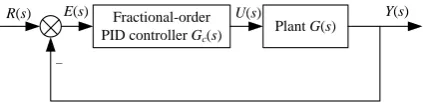
(2)Fig. 1 shows block diagram of a control system with a FOPID controller, which is also called PIλDμ controller. Its definition in terms of transfer function is given as follows:
Definition 1. The transfer function Gc(s) of a
FOPID controller is defined as the following equation [10]:
( ) ( )
( )
c P I D
U s
G s K K s K s
E s
(3)
where KP, KI, and KD are proportional, integral,
and derivative gain, respectively, λ and μ are the fractional order parameter of integrator and differentiator, respectively, and λ>0, μ>0.
Note that the standard integer order PID controller is one of the special FOPID controller with λ=1 and
μ=1.
From the perspective of time domains, the PIλDμ controller is also expressed in the following form:
( ) P ( ) I ( ) D ( )
u t K e t K D e t K D e t . (4)
2.2. AVR system
An AVR system [56] consists of four main components including amplifier, exciter, generator, and sensor. More details concerning the transfer functions with the range of parameters modeling these components are shown in Table 1. Here, KA, KE, KG, and KR are the gains of amplifier, exciter, generator, and sensors, respectively, and τA, τE, τG, and τR are inertia time constants of amplifier, exciter, generator, and sensors, respectively. The block diagram of an AVR system with a FOPID controller is given in Fig. 2, where Vref(s) and Vt(s) are the reference voltage and terminal voltage, respectively.
Plant G(s) Fractional-order
PID controller Gc(s)
R(s) E(s) Y(s)
-U(s)
Figure 1. Block diagram of a control system with a FOPID controller
Table 1. Models of the components in an AVR system
Component Transfer
function Parameters range
Amplifier KA/(1+τAs) 10<KA<400, 0.02<τA<0.1
Exciter KE/(1+τEs) 1<KE<400, 0.5<τE<1
Generator KG/(1+τGs) 0.7<KG<1, 1<τG<2
Sensor KR/(1+τRs) 0.001<τR<0.06
2.3. Multivariable fractional order control system
Fig. 3 shows the block diagram of a multivariable fractional-order control system with multivariable FOPID controller D(s) and a multivariable plant G(s)=
11 1 1 ( ) ( ) ( ) ( ) n n nn
g s g s
g s g s
.
The corresponding form of n×n multivariable FOPID controller D(s) is presented as the following equation (5): 11 1 1 ( ) ( ) ( ) ( ) ( ) n n nn
d s d s
D s
d s d s
(5)
where the transfer function of a FOPID sub-controller
dij(s) is characterized as the following equation (6):
( ) ij ij, , {1, 2, , }
ij Pij Iij Dij
d s K K s K s i j n (6)
where KPij, KIij and KDij are proportional gain, integral gain, and derivative gain, respectively, and λij and μij are fractional order parameter of integrator and differentiator, respectively.
Multivariable plant G(s) Multivariable FOPID
controller D(s)
R(s) E(s) Y(s)
-U(s)
Figure 3. A multivariable fractional-order control system with a multivariable FOPID controller
P I D
K K sK s 1 A A K s 1 E E K s 1 G G K s 1 R R K s
-Vref(s) Vt(s)
Amplifier Sensor Exciter Generator FOPID controller U(s) E(s)
Controllers
3. The proposed algorithms
3.1. Performance criterion for a FOPID controller
In most of the previous research works, the integral absolute error (IAE), or the integral of squared-error (ISE), or the integral of time-squared-error (ITSE) are often used to evaluate the control performance of a control system with a PID or FOPID controller. However, IAE and ISE result in a response with relatively small overshoot but a long settling time, and the derivation process of the analytical ITSE formula is generally complex and time consuming [56, 62]. In this paper, a novel performance criterion is proposed to evaluate a FOPID controller by
considering not only IAE, but also the following factors. For example, these indices in the time domain including overshoot Mp, steady-state error Ess, rise time tr, and settling time ts should be considered, and the square of the controllers’ output, i.e., 2
5 0w u t dt( )
is introduced in order to avoid exporting a large control value. Additionally, 6
0 w y t dt( )
is added toavoid a large overshoot value. More accurately, the definition of the proposed performance criterion is presented as follows:
Definition 2. For a real-coded solution S=[KP , KI,
KD, λ, μ], which represents a FOPID controller, the
corresponding performance criterion F(S) in the time domain is defined as equation (7):
2
1 2 3 4 5
0
2
1 2 3 4 5 6
0
( ) ( ( ) ( )) , if ( ) 0 ( )
( ) ( ( ) ( ) ( ) ) , if ( ) 0
p r s ss
p r s ss
w M w t t w E w e t w u t dt y t
F S
w M w t t w E w e t w u t w y t dt y t
(7)where Mp, Ess, tr, ts are overshoot, steady-state
error, rise time, and settling time, respectively, e(t) is the system error, y t( )y t( )y t T( s) , Ts is
sample time, u(t) is the control output at the time t,
w1, w2, w3, w4, w5, w6 are weight coefficients, and w6
>>w4. For a multivariable fractional-order control
system with multivariable FOPID controller, the fitness F(S) is the sum of the fitness of all sub-FOPID controllers.
p i d
K K sK s
-Y(s)
FOPID controller Optimization
algorithms
Kpb, Kib, Kdb,λb, μb
E(s) U(s)
Fitness computation
R(s)
Plant G(s)
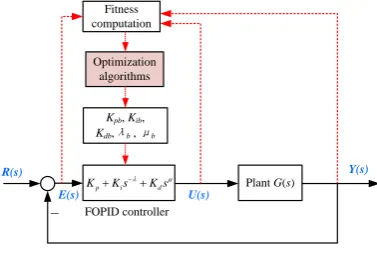
Figure 4. The design framework of optimization algorithms-based FOPID controller
3.2. Performance criterion for a FOPID controller
In general, the basic design framework of optimi-zation algorithm-based FOPID controller is shown in Fig. 4. More specifically, the basic idea behind the proposed RCEO-based FOPID controller design algo-rithm is the population-based iterated optimization, which consists of generation of a real-coded random initial population by encoding the parameters of FOPID controller into a set of real values, evaluation of individual and population fitness by using a more reasonable control performance index according to definition 2, generation of a new population based on multi-non-uniform mutation (MNUM), and updating
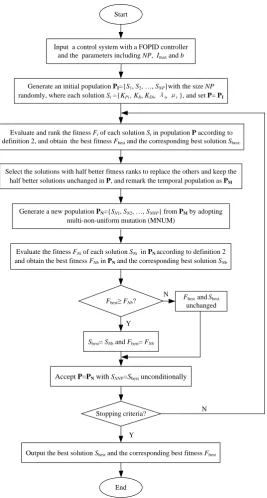
the population by accepting the new population unconditionally. Fig. 5 presents the flowchart of the proposed RCEO-based FOPID controller design algorithm. The details of the proposed algorithm are described as follows:
RCEO-based FOPID contrller design algorithm
Input: A control system with a FOPID controller and the ajustable parameters including population size NP, maximum number of iterations Imax, and shape parameter b used in MNUM.
Output: the best solution Sbest and the corresponding best fitness Fbest.
Step 1. Generate an initial population PI={S1, S2, …,
SNP}with the size NP randomly, where each solution Si =[KPi , KIi, KDi, λi, μi], and set P=
PI. The detailed process of Si is ( ). , 1, 2,...,
i i
S L UL R i NP , where L
and U are the lower and upper bounds of FOPID control parameters, respectively, and
Ri is a set of uniformly distributed random values between 0 and 1.
Step 2. Evaluate the fitness Fi of each solution Si in population P according to equation (7), rank all the solutions according to {Fi, i=1, 2, … ,
NP} , i.e., find a permutation П of the labels i
such thatF(1)F(2) ... F(NP), and obtain the best fitness Fbest=min{Fi, i=1,2,…,NP} and the corresponding best solution Sbest.
Step 3. Select the solutions associated with the fitness ranks from П(1) to П(NP/2) to replace those with the ranks from П(1+NP/2) to П(NP), and set the population PM={SM1, SM2, …, SMNP}, where SMj= SM(j+NP/2)=SП(j), j=1, 2, …, NP/2.
Step 4. Generate a new population PN={SN1, SN2, …,
multi-non-uniform mutation (MNUM) [55]. The detailed process of SNi is described as the following equations (8) and (9):
( ). ( ), if <0.5
( ). ( ), if 0.5, 1,..., , otherwise
Mi Mi
Mi Mi
Ni
Mi
S U S A t r
S S L A t r
S i NP
S
(8)
1
max
( ) 1
b
t A t r
I
(9)
where t is the current number of iteration, both r and r1 are uniform random numbers between 0 and 1, and b is the shape parameter used in MNUM.
Step 5. Evaluate the fitness FNi of each solution SNi in
PN according to equation (8) and obtain the best fitness FNb = min{FNi, i=1,2,…,NP} in
PN and the corresponding best solution SNb.
Step 6. If Fbest≥ FNb, then set Sbest= SNb and Fbest= FNb; otherwise, keep Sbest and Fbest unchanged.
Step 7. Accept P=PNwith SNNP=Sbest unconditionally.
Step 8. Repeat the steps 2 to 6 until the stopping criterion, e.g., the maximum number of iteration Imax is satisfied.
Step 9. Output the best solution Sbest=[KPb , KIb, KDb,
λb, μb] and the corresponding best fitness Fbest.
Start
Generate an initial population PI={S1, S2, …, SNP}with the size NP
randomly, where each solution Si ={KPi , KIi, KDi, λi, μi }, and set P= PI
Evaluate and rank the fitness Fi of each solution Si in population P according to
definition 2, and obtain the best fitness Fbest and the corresponding best solution Sbest.
Fbest≥ FNb?
Sbest= SNb and Fbest= FNb
Fbest andSbest unchanged
Y
N
Accept P=PNwith SNNP=Sbest unconditionally
Stopping criteria?
Y
N
Output the best solution Sbest and the corresponding best fitness Fbest
Evaluate the fitness FNi of each solution SNi in PN according to definition 2
and obtain the best fitness FNb in PN and the corresponding best solution SNb
Input a control system with a FOPID controller
and the parameters including NP, Imax and b
End
Select the solutions with half better fitness ranks to replace the others and keep the
half better solutions unchanged in P,and remark the temporal population as PM
Generate a new population PN={SN1, SN2, …, SNNP} from PM by adopting
multi-non-uniform mutation (MNUM)
Controllers
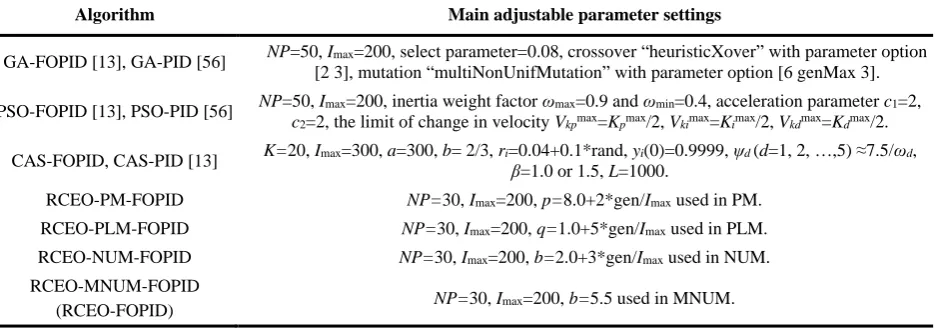
Table 3. The main adjustable parameter settings for different optimization algorithms-based FOPID and PID controllers design methods for AVR system
Algorithm Main adjustable parameter settings
GA-FOPID [13], GA-PID [56] NP=50, Imax=200, select parameter=0.08, crossover “heuristicXover” with parameter option [2 3], mutation “multiNonUnifMutation” with parameter option [6 genMax 3].
PSO-FOPID [13], PSO-PID [56] NP=50, Imax=200, inertia weight factor ωmax=0.9 and ωmin=0.4, acceleration parameter c1=2,
c2=2, the limit of change in velocity Vkpmax=Kpmax/2, Vkimax=Kimax/2, Vkdmax=Kdmax/2.
CAS-FOPID, CAS-PID [13] K=20, Imax=300, a=300, b= 2/3, ri=0.04+0.1*rand, β yi(0)=0.9999, ψd (d=1, 2, …,5) ≈7.5/ωd, =1.0 or 1.5, L=1000.
RCEO-PM-FOPID NP=30, Imax=200, p=8.0+2*gen/Imax used in PM.
RCEO-PLM-FOPID NP=30, Imax=200, q=1.0+5*gen/Imax used in PLM.
RCEO-NUM-FOPID NP=30, Imax=200, b=2.0+3*gen/Imax used in NUM.
RCEO-MNUM-FOPID
(RCEO-FOPID) NP=30, Imax=200, b=5.5 used in MNUM.
Table 2. The adjustable parameters used in different optimi-zation algorithms-based FOPID and PID controllers design algorithms
Algorithm
Number of
para-meters
Adjustable parameters
GA-FOPID [13], GA-PID [56] 5
Population size NP,maximum number of iterations Imax,
select parameter, crossover rate Pc, mutation rate Pm.
PSO-FOPID [13], PSO-PID [56] 6
NP, Imax, inertia weight factors wmax and wmin, acceleration
parameters c1 and c2.
CAS-FOPID, CAS-PID [13] 8
Number of ants K, Imax,
sufficient large positive parameter a, parameter b∈[0, 2/3], organization factor of the
ith ant ri, initial valueof the
organization variable yi(0),
weighting factor β and large positive real number L used in
fitness evaluation.
RCEO-FOPID 3 NP, Imax, the parameter b used in MNUM.
In the above described algorithm, RCEO has only selection and mutation operators, but without cross-over operator. The parameters including the size of population (NP), the maximum number of iterations (Imax), and the parameter b used in MNUM play critical roles in controlling the performance of RCEO. The effects of these parameters on the performance of RCEO will be analyzed in the next section. The comparison of adjustable parameters used in different optimization algorithms-based FOPID and PID controller design algorithms is shown in Table 2. It is clear that the proposed RCEO is simpler than other reported evolutionary algorithms, e.g., GA [13, 56], PSO [13, 56], and CAS [13], due to not only its fewer control parameters, but also with only selection and mutation operators. Some previous research works (e.g., reference [44]) have compared the
computatio-nal complexity of population-based EO, GA and PSO. The computational complexity of EO is lower than that of GA and PSO. Furthermore, the superiority of the proposed RCEO-based FOPID controller to these reported evolutionary algorithms-based FOPID and PID controllers in terms of accuracy and robustness will be demonstrated by a large number of experimen-tal results in the next section.
4. Simulation results for AVR system
To demonstrate the superiority of RCEO to other reported evolutionary algorithms, such as GA[13, 56], PSO [13, 56], CAS [13] in terms of accuracy and robustness, this section gives the simulation results on AVR system with FOPID or PID controller based on these evolutionary algorithms. For a fair comparison, the parameters of AVR system are set as the same as in the previous research work [13, 56]: KA = 10, τA = 0.1,
KE = 1, τE = 0.4, KG= 1, τG = 1, KS = 1, τS = 0.01, KR = 1, τR=0.01. The lower and upper bounds of each FOPID control parameter are set as in [13]: 0≤KP≤3, 0≤KI≤1, 0≤KD≤1, 0≤λ≤2, 0≤μ≤2 and the sample time
Ts is set as 0.01 second. The parameters used in Oustaloup approximation are set as ωl=0.001ωc,
ωh=1000ωc, approximation order N=6, where ωc represents the gain cross frequency. The weight coefficients are set as follows: w1=1, w2=50, w3=1000,
4.1. Comparison with other evolutionary algorithms-based FOPID controllers
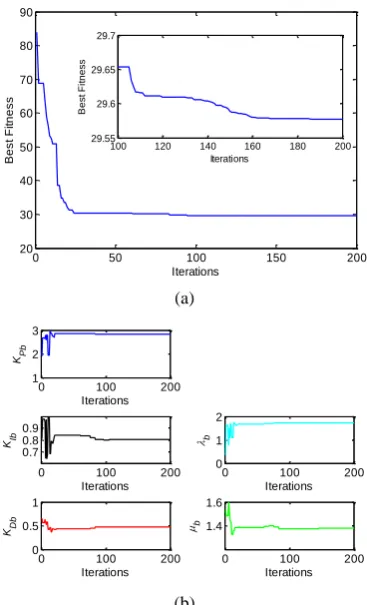
To illustrate the good convergence characteristic of the proposed RCEO algorithm for FOPID controller, we present typical optimization process of the best fitness so far and five parameters in FOPID controller based on RCEO algorithm shown in Fig. 6.
(a)
(b)
Figure 6. The optimization process of best fitness (a) and FOPID parameters (b) by RCEO-MNUM for AVR system
In order to demonstrate the effectiveness of MNUM operator in RCEO called RCEO-MNUM-FOPID or RCEO-RCEO-MNUM-FOPID for the design of RCEO-MNUM-FOPID controller for AVR system, Table 4 presents the com-parative simulation results of RCEO with different mutation operators including MNUM, NUM, PLM and PM. The statistical performance of these RCEO algorithms with different mutation operations is eva-luated by the best fitness, the average fitness, median fitness, the worst fitness and standard Deviation (SD) obtained by 20 independent runs for each algorithm. It is clear that RCEO-MNUM-FOPID obtains better statistical measures than RCEO-NUM-FOPID, RCEO-PLM-FOPID and RCEO-PM-FOPID.
Table 5 presents the FOPID parameters and the performance corresponding to the median fitness obtained by RCEO with different mutation operators, and the best parameters of FOPID controller and the best performance obtained by CAS with β=1 and
β=1.5 [13], GA [13], PSO [13], and MOEO [54]. For the convenience of comparison, the performance of these algorithms is evaluated by the best fitness Fb according to definition 2, overshoot Mp (%), rise time
tr (seconds), settling time ts with 5% steady-state error (seconds), and steady-state error Ess. The terminal voltage step responses of AVR system with different evolutionary algorithm based FOPID controllers are compared in Fig. 7. Clearly, all performance indices obtained by RCEO-FOPID are better than or at least the same good as those by CAS-FOPID with β=1 and
β=1.5, PSO-FOPID, GA-FOPID,
RCEO-NUM-FOPID, RCEO-PLM-RCEO-NUM-FOPID, and RCEO-PM-FOPID. In addition, RCEO-FOPID outperforms MOEO-FOPID [54] in terms of all performance indices but tr.
Table 4. Statistical measures of fitness obtained by RCEO algorithms with different mutation operators for AVR system
Algorithm Best fitness Average fitness Median fitness Worst fitness SD
RCEO-PM-FOPID 30.0926 32.3765 31.4906 35.3746 1.8909
RCEO-PLM-FOPID 31.4813 35.6219 32.5246 43.9432 4.8517
RCEO-NUM-FOPID 30.0130 33.2225 32.2152 39.2480 3.1642
RCEO-FOPID 29.3951 30.0006 29.5776 30.6614 0.4731
Table 5. Best FOPID controller parameters and performance obtained by different optimization algorithms
Algorithm KPb KIb KDb λb μb Fb Mp(%) tr(sec.) ts(sec.) Ess
GA-FOPID [13] 1.6947 0.8849 0.3964 1.0248 1.1296 71.5627 9.2600 0.1298 0.3395 0.0006 PSO-FOPID [13] 1.6264 0.2956 0.3226 1.3183 1.1980 78.6795 0.0953 0.1375 0.4563 0.0047 CAS-FOPID(β=1) [13] 1.0537 0.4418 0.2510 1.0624 1.1122 76.0701 0.1678 0.2223 0.3037 0.0014 CAS-FOPID (β=1.5) [13] 0.9315 0.4776 0.2536 1.0275 1.0838 70.6476 0.0642 0.2305 0.3187 0.0012 MOEO-FOPID [54] 2.9737 0.9089 0.5383 1.1446 1.3462 44.2466 3.2038 0.1300 0.1800 6.58E-09
RCEO-PM-FOPID 2.7152 0.7194 0.4045 1.9920 1.4061 31.4906 0.3353 0.1700 0.1700 0 RCEO-PLM-FOPID 2.5970 0.7362 0.3918 1.7641 1.3940 32.5246 0.5992 0.1800 0.1800 5.97E-07 RCEO-NUM-FOPID 2.3867 0.6754 0.3848 1.7651 1.3645 32.2152 0.0759 0.1800 0.1800 0
RCEO-FOPID 2.8316 0.8013 0.4726 1.7294 1.3775 29.5776 0.0644 0.1400 0.1400 0
0 50 100 150 200
20 30 40 50 60 70 80 90
Iterations
B
e
s
t
F
it
n
e
s
s
100 120 140 160 180 200 29.55
29.6 29.65 29.7
Iterations
B
e
st
F
it
n
e
ss
0 100 200
1 2 3
Iterations KP
b
0 100 200
0.7 0.8 0.9
Iterations KIb
0 100 200
0 0.5 1
Iterations KD
b
0 100 200
0 1 2
Iterations b
0 100 200
1.4 1.6
Controllers
Figure 7. Comparison of terminal voltage step responses of AVR system with different evolutionary algorithm-based FOPID controllers
Table 6. Best controller parameters and comparative performance of RCEO-FOPID, RCEO-PID, CAS-PID with β=1 and β=1.5 [13], PSO-PID [56], and GA-PID [56]
Algorithm KPb KIb KDb λb μb Fb Mp(%) tr(sec.) ts(sec.) Ess
GA-PID [56] 0.8861 0.7984 0.3158 1 1 90.1070 4.54 0.2138 0.8645 0 PSO-PID [56] 0.6254 0.45779 0.2187 1 1 74.1789 1.1592 0.2678 0.3756 1.343E-07 CAS-PID (β=1) [13] 0.6746 0.6009 0.2618 1 1 81.6639 1.7678 0.2425 0.3550 5.630E-08 CAS-PID (β=1.5) [13] 0.6202 0.4531 0.2152 1 1 75.0949 0.4000 0.3156 0.4212 2.688E-08
RCEO-PID 0.7854 0.5451 0.3048 1 1 63.5348 2.5299 0.3100 0.3400 0 RCEO-FOPID 2.8316 0.8013 0.4726 1.7294 1.3775 29.5776 0.0644 0.1400 0.1400 0
4.2. Comparison with other evolutionary algorithms-based PID controllers
On the other hand, to further demonstrate the supe-riority of RCEO-FOPID controller to other evolutio-nary algorithms-based PID controllers, we give the experimental results on AVR system with RCEO-FOPID, RCEO-PID, CAS-PID with β=1 and β=1.5 [13], PSO-PID [56], and GA-PID [56]. The best para-meters of these above controllers and the correspon-ding performance are shown in Table 6, and the com-parison of the terminal voltage step responses of AVR with RCEO-FOPID controller and other evolutionary algorithms-based PID controllers are presented in Fig. 8. Evidently, the performance of RCEO-FOPID controller is better than that of other evolutionary algorithms-based PID controllers, such as CAS-PID with β=1 and β=1.5 [13], PSO-PID [56], and GA-PID [56]. Even for the same RCEO algorithm, RCEO-FOPID controller can obtain better performance than RCEO-PID controller.
4.3. Robustness test
To illustrate the robustness of RCEO-FOPID con-troller againest the uncertainties of AVR system para-meters, the following experiments considering genera-tor, exciter and amplifier parameters uncertainties due to the changes in load conditions are implemented.
Figure 8. Comparison of the terminal voltage step responses of AVR with RCEO-FOPID controller and other
evolutionary algorithms-based PID controllers
4.3.1. Generator uncertainty
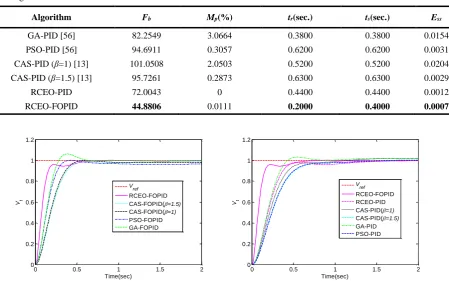
Tables 7 and 8 present the comparative performance of RCEO-FOPID controller with other evolutionary algorithms-based FOPID and PID controllers, respectively, when the parameter KG changes from 1 to 0.8 due to the change in load condition. Additionally, the similar comparative experimental results are shown in Tables 9 and 10 when the parameter τG changes from 1 to 1.5, respectively, due to the change in load condition. The
0 0.5 1 1.5 2
0 0.2 0.4 0.6 0.8 1 1.2
Time (sec)
Vt
V
ref
RCEO-MNUM-FOPID RCEO-NUM-FOPID RCEO-PLM-FOPID RCEO-PM-FOPID
0 0.1 0.2 0.3 0.4 0.5
0 0.2 0.4 0.6 0.8 1
0 0.5 1 1.5 2
0 0.2 0.4 0.6 0.8 1 1.2
Time(sec)
Vt
V
ref
RCEO-FOPID MOEO-FOPID
CAS-FOPID(=1.5)
CAS-FOPID(=1)
PSO-FOPID GA-FOPID
0 0.5 1 1.5 2
0 0.2 0.4 0.6 0.8 1 1.2
Time(sec)
Vt
V
ref RCEO-FOPID RCEO-PID CAS-PID(=1)
CAS-PID(=1.5)
corresponding terminal voltage step responses of AVR system are given in Figures 9 and 10. Clearly, the proposed RCEO-FOPID controller is more robust than other evolutionary algorithms-based FOPID controllers, such as CAS-FOPID with β=1 and β=1.5
[13], PSO-FOPID [13], and GA-FOPID [13], and also than these evolutionary algorithms-based PID controllers, such as RCEO-PID, CAS-PID with β=1
and β=1.5 [13], PSO-PID [56], and GA-PID [56], under the uncertainty of the generator.
Table 7. Comparative performance of different evolutionary algorithms-based FOPID controllers when KG changes from 1 to 0.8
Algorithm Fb Mp(%) tr(sec.) ts(sec.) Ess
GA-FOPID [13] 69.1275 6.0830 0.2600 0.4500 0.0045
PSO-FOPID [13] 89.9313 0.0355 0.3100 0.4300 0.0344
CAS-FOPID(β=1) [13] 87.8525 0.1898 0.4200 0.6000 0.0202
CAS-FOPID(β=1.5) [13] 84.0367 1.2419 0.4500 0.6300 0.0130
RCEO-FOPID 44.8806 0.0111 0.2000 0.4000 0.0007
Table 8. Comparative performance of RCEO-FOPID controller with other evolutionary algorithms-based PID controllers when
KG changes from 1 to 0.8
Algorithm Fb Mp(%) tr(sec.) ts(sec.) Ess
GA-PID [56] 82.2549 3.0664 0.3800 0.3800 0.0154
PSO-PID [56] 94.6911 0.3057 0.6200 0.6200 0.0031
CAS-PID (β=1) [13] 101.0508 2.0503 0.5200 0.5200 0.0204
CAS-PID (β=1.5) [13] 95.7261 0.2873 0.6300 0.6300 0.0029
RCEO-PID 72.0043 0 0.4400 0.4400 0.0012
RCEO-FOPID 44.8806 0.0111 0.2000 0.4000 0.0007
Figure 9. Comparison of the terminal voltage step responses when KG changes from 1 to 0.8
Figure 10. Comparison of the terminal voltage step responses with different evolutionary algorithm-based FOPID or PID controllers when τG changes from 1 to 1.5
0 0.5 1 1.5 2
0 0.2 0.4 0.6 0.8 1 1.2
Time(sec)
Vt
Vref
RCEO-FOPID CAS-FOPID(=1.5)
CAS-FOPID(=1)
PSO-FOPID GA-FOPID
0 0.5 1 1.5 2
0 0.2 0.4 0.6 0.8 1 1.2
Time(sec)
Vt
V
ref RCEO-FOPID RCEO-PID CAS-PID(=1)
CAS-PID(=1.5)
GA-PID PSO-PID
0 0.5 1 1.5 2
0 0.2 0.4 0.6 0.8 1 1.2
Time(sec)
Vt
Vref
RCEO-FOPID CAS-FOPID(=1.5)
CAS-FOPID(=1)
PSO-FOPID GA-FOPID
0 0.5 1 1.5 2
0 0.2 0.4 0.6 0.8 1 1.2
Time(sec)
Vt
Vref
RCEO-FOPID RCEO-PID CAS-PID(=1)
CAS-PID(=1.5)
Controllers
Table 9. Comparative performance of different evolutionary algorithms-based FOPID controllers when τG changes from 1 to 1.5
Algorithm Fb Mp(%) tr(sec.) ts(sec.) Ess
GA-FOPID [13] 83.2436 7.5394 0.2900 0.6200 0.0032
PSO-FOPID [13] 82.6642 2.0889 0.3400 0.5300 0.0222
CAS-FOPID(β=1) [13] 81.7349 3.3290 0.4600 0.7500 0.0041
CAS-FOPID(β=1.5) [13] 85.1029 2.5890 0.4900 1.1400 0.0055
RCEO-FOPID 48.4107 1.9606 0.2500 0.2500 0.0063
Table 10. Comparative performance of RCEO-FOPID controller with other evolutionary algorithms-based PID controllers when
τG changes from 1 to 1.5
Algorithm Fb Mp(%) tr(sec.) ts(sec.) Ess
GA-PID [56] 135.2635 6.0588 0.4200 0.9100 0.0305
PSO-PID [56] 132.3835 3.5711 0.6300 0.6300 0.0318
CAS-PID (β=1) [13] 201.5966 5.2140 0.5500 1.8100 0.0456
CAS-PID (β=1.5) [13] 132.9880 3.6268 0.6300 0.6300 0.0319
RCEO-PID 96.6990 2.1103 0.4800 0.4800 0.0205
RCEO-FOPID 48.4107 1.9606 0.2500 0.2500 0.0063
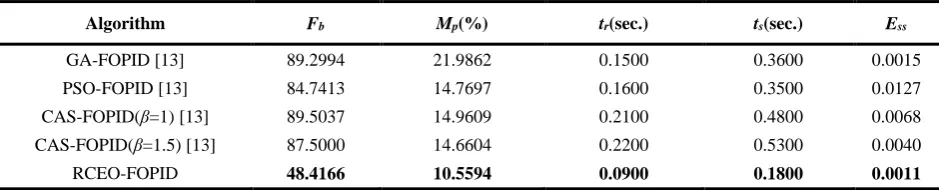
Table 11. Comparative performance of RCEO-FOPID controller with other evolutionary algorithms-based FOPID controllers when KEchanges from 1.0 to 2.0 and τE changes from 0.4 to 0.5
Algorithm Fb Mp(%) tr(sec.) ts(sec.) Ess
GA-FOPID [13] 89.2994 21.9862 0.1500 0.3600 0.0015
PSO-FOPID [13] 84.7413 14.7697 0.1600 0.3500 0.0127
CAS-FOPID(β=1) [13] 89.5037 14.9609 0.2100 0.4800 0.0068
CAS-FOPID(β=1.5) [13] 87.5000 14.6604 0.2200 0.5300 0.0040
RCEO-FOPID 48.4166 10.5594 0.0900 0.1800 0.0011
Table 12. Comparative performance of RCEO-FOPID controller with other evolutionary algorithms-based PID controllers when
KEchanges from 1.0 to 2.0 and τE changes from 0.4 to 0.5
Algorithm Fb Mp(%) tr(sec.) ts(sec.) Ess
GA-PID [56] 106.5724 21.3408 0.2100 0.4900 0.0053
PSO-PID [56] 95.4675 13.7402 0.2700 0.5900 0.0033
CAS-PID (β=1) [13] 99.3885 15.1805 0.2400 0.5300 0.0087
CAS-PID (β=1.5) [13] 95.6920 13.6418 0.2700 0.6500 0.0032
RCEO-PID 94.2162 17.6315 0.2100 0.4800 0.0018
RCEO-FOPID 48.4166 10.5594 0.0900 0.1800 0.0012
4.3.2. Exciter uncertainty
When the exciter model parameter KE changes from actual value 1.0 to 2.0 and τE changes from actual value 0.4 to 0.5, the comparative performance of RCEO-FOPID controller with other evolutionary algorithms-based FOPID and PID controllers is presented in Tables 11 and 12, respectively, and corresponding terminal voltage step responses of AVR system are shown in Fig. 11. It is clear that the proposed RCEO-FOPID controller is illustrated to be
more robust than other evolutionary algorithms-based FOPID and PID controllers in the case of changes of the exciter model parameters.
4.3.3. Amplifier uncertainty
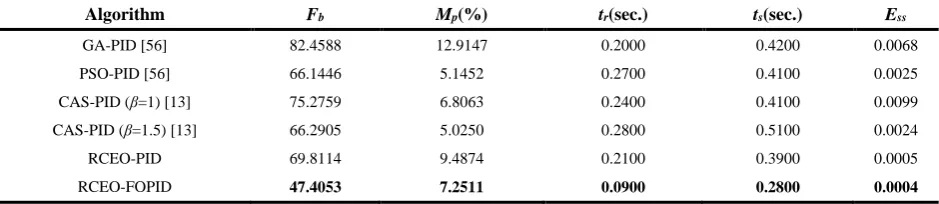
FOPID and PID controllers, respectively, and Fig. 12 presents the corresponding terminal voltage step response of AVR system. It is obvious that the proposed RCEO-FOPID is also more robust than other
evolutionary algorithms-based FOPID and PID controllers under the condition of some uncertainty of amplifier model parameters.
Figure 11. Comparison of the terminal voltage step response with different evolutionary algorithm-based FOPID or PID controllers when KEchanges from 1.0 to 2.0 and τE changes from 0.4 to 0.5
Figure 12. Comparison of the terminal voltage step response with different evolutionary algorithm-based FOPID or PID controllers when KAchanges from 10 to 16 and τA changes from 0.1 to 0.08
Table 13. Comparative performance of RCEO-FOPID controller with other evolutionary algorithms-based FOPID controllers when KAchanges from 10 to 16 and τA changes from 0.1 to 0.08
Algorithm Fb Mp(%) tr(sec.) ts(sec.) Ess
GA-FOPID [13] 69.6168 14.9167 0.1400 0.3100 0.0021
PSO-FOPID [13] 71.1200 8.1072 0.1500 0.2800 0.0168
CAS-FOPID(β=1) [13] 69.1841 7.0815 0.2100 0.3700 0.0093
CAS-FOPID(β=1.5) [13] 65.9057 6.7002 0.2200 0.4300 0.0060
RCEO-FOPID 47.4053 7.2511 0.0900 0.2800 0.0004
Table 14. Comparative performance of RCEO-FOPID controller with other evolutionary algorithms-based PID controllers when
KAchanges from 10 to 16 and τA changes from 0.1 to 0.08
Algorithm Fb Mp(%) tr(sec.) ts(sec.) Ess
GA-PID [56] 82.4588 12.9147 0.2000 0.4200 0.0068
PSO-PID [56] 66.1446 5.1452 0.2700 0.4100 0.0025
CAS-PID (β=1) [13] 75.2759 6.8063 0.2400 0.4100 0.0099
CAS-PID (β=1.5) [13] 66.2905 5.0250 0.2800 0.5100 0.0024
RCEO-PID 69.8114 9.4874 0.2100 0.3900 0.0005
RCEO-FOPID 47.4053 7.2511 0.0900 0.2800 0.0004
0 0.5 1 1.5 2
0 0.2 0.4 0.6 0.8 1 1.2 1.4
Time(sec) Vt
Vref
RCEO-FOPID
CAS-FOPID(=1.5)
CAS-FOPID(=1)
PSO-FOPID GA-FOPID
0 0.5 1 1.5 2
0 0.2 0.4 0.6 0.8 1 1.2 1.4
Time(sec) Vt
Vref
RCEO-FOPID RCEO-PID
CAS-PID(=1)
CAS-PID(=1.5)
GA-PID PSO-PID
0 0.5 1 1.5 2
0 0.2 0.4 0.6 0.8 1 1.2
Time(sec) Vt
Vref
RCEO-FOPID
CAS-FOPID(=1.5)
CAS-FOPID(=1)
PSO-FOPID GA-FOPID
0 0.5 1 1.5 2
0 0.2 0.4 0.6 0.8 1 1.2
Time(sec) Vt
Vref
RCEO-FOPID RCEO-PID
CAS-PID(=1)
CAS-PID(=1.5)
Controllers
4.4. Parameters vs. performance
As aforementioned in Section 3, the adjustable pa-rameters NP, Imax, and b used in the proposed RCEO algorithm for the design of FOPID controller play important roles in effecting the performance of RCEO and FOPID controller. This subsection presents the detailed experimental results to illustrate how these parameters affect the performance of the proposed algorithm. It should be noted that the RCEO-FOPID algorithm with each combination of values concerning
NP, Imax and b in the following experiment is performed 10 independent runs. More specifically, Fig. 13 presents the variation of the best fitness Fb when the parameter NP varies from 10 to 50, and other parameters keep unchanged, i.e., Imax=200 and
b=5.5. The best RCEO-FOPID controller parameters and the corresponding performance under different NP
values and the same Imax=200, b=5.5 are given in Table 15, and the corresponding terminal voltage step responses of AVR are shown in Fig. 14. Clearly, the average value of Fb becomes smaller as the value of
NP increases, but the corresponding computational timeTCPU also increases. In fact, the variation of the best performance of FOPID controller is relatively small though the value of NP increases. In this sense, the performance of best FOPID controller is robust for the parameter NP when the other two parameters keep unchanged.
Similarly, the effect of parameter Imax on the fitness
Fb when NP =50 and b=5.5 is given in Fig. 15. Table 16 presents the best RCEO-FOPID controller parameters and the corresponding performance under different Imaxvalues and the same NP =50 and b=5.5, and Fig. 16 gives the corresponding terminal voltage step responses of AVR. It is evident that the average value of Fb becomes smaller as the value of NP increases, but the corresponding computational time
TCPU also increases. Moreover, the performance of
best FOPID controller is also robust for the parameter
Imax when the other two parameters keep unchanged.
Figure 13. The effect of parameter NP on the fitness Fb when Imax=200 and b=5.5.
Figure 14. The terminal voltage step responses of AVR system with best RCEO-FOPID controllers as the
population size NP varies from 10 to 50 when Imax=200 and b=5.5
Table 15. The best RCEO-FOPID controller parameters and the corresponding performance under different NP values and the same values of Imax=200 and b=5.5
NP KPb KIb KDb λb μb Fb Mp(%) tr(sec.) ts(sec.) Ess TCPU(sec.)
10 2.9186 0.7955 0.4626 1.8383 1.3926 29.2760 0.1733 0.1400 0.1400 0 34.500
20 2.8765 0.8582 0.4661 1.6340 1.3884 29.6256 0.4620 0.1400 0.1400 0 69.359
30 2.9482 0.8109 0.4591 1.8153 1.3990 29.2814 0.3265 0.1400 0.1400 0 103.062
40 2.8699 0.8052 0.4677 1.7550 1.3853 29.4282 0.1577 0.1400 0.1400 0 140.735
50 2.8316 0.8013 0.4726 1.7294 1.3775 29.5776 0.0644 0.1400 0.1400 0 172.828
Table 16. The best RCEO-FOPID controller parameters and the corresponding performance under different Imaxvalues and the
same values of NP =50 and b=5.5
Imax KPb KIb KDb λb μb Fb Mp(%) tr(sec.) ts(sec.) Ess TCPU(sec.)
50 2.8379 0.7805 0.4322 1.8247 1.3987 29.9050 0.4270 0.1500 0.1500 0 46.782
100 2.8991 0.8673 0.4649 1.6307 1.3885 29.6465 0.5150 0.1400 0.1400 0 86.766
150 2.9294 0.7950 0.4613 1.8533 1.3950 29.2556 0.1915 0.1400 0.1400 0 134.218
200 2.8316 0.8013 0.4726 1.7294 1.3775 29.5776 0.0644 0.1400 0.1400 0 172.828
250 2.9407 0.7833 0.4599 1.9231 1.3976 29.2090 0.1327 0.1400 0.1400 0 216.375
300 2.9166 0.8036 0.4623 1.8075 1.3940 29.2994 0.2322 0.1400 0.1400 0 267.375
0 10 20 30 40 50 60
29 30 31 32 33 34
NP
Fb
0 0.5 1 1.5 2
0 0.2 0.4 0.6 0.8 1 1.2
Time(sec)
Vt
V
ref
NP=10 NP=20 NP=30 NP=40 NP=50
0.1 0.2 0.3 0.4 0.5 0.9
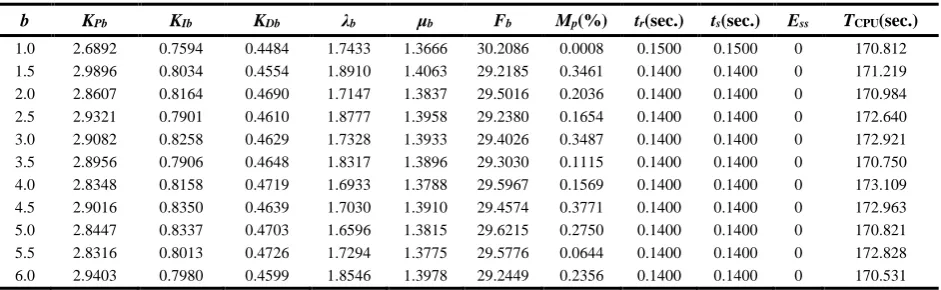
Additionally, Fig. 17 illustrates the effect of para-meter b on the fitness Fb when Imax=200 and NP=50. The best RCEO-FOPID controller parameters and the corresponding performance under different b values and the same Imax=200 and NP=50 are given as Table 17, and the corresponding terminal voltage step responses of AVR are shown as Fig. 18. Obviously, the performance of best FOPID controller is also relatively robust for the parameter b when the other two parameters keep unchanged.
Similarly, the effect of parameter Imax on the fitness
Fb when NP =50 and b=5.5 is given in Fig. 15. Table 16 presents the best RCEO-FOPID controller parameters and the corresponding performance under different Imaxvalues and the same NP =50 and b=5.5, and Fig. 16 gives the corresponding terminal voltage step responses of AVR. It is evident that the average value of Fb becomes smaller as the value of NP increases, but the corresponding computational time
TCPU also increases. Moreover, the performance of best FOPID controller is also robust for the parameter
Imax when the other two parameters keep unchanged. Additionally, Fig. 17 illustrates the effect of parameter b on the fitness Fb when Imax=200 and
NP=50. The best RCEO-FOPID controller parameters and the corresponding performance under different b
values and the same Imax=200 and NP=50 are given as Table 17, and the corresponding terminal voltage step responses of AVR are shown as Fig. 18. Obviously, the performance of best FOPID controller is also relatively robust for the parameter b when the other two parameters keep unchanged.
5. Simulation results for AVR system
To demonstrate the superiority of the proposed BCEO-FOPID algorithm to other reported evolutio-nary algorithms based PID methods, such as adaptive real-coded GA (ARGA-PID) [63], probability binary coded PSO (PBPSO-PID) [64][64], binary-coded EO (BCEO-PID) [53], and RCEO-PID for multivariable control systems, the following binary distillation column plant Gm(s) [65] described by equation (10) with 2-input and 2-output is chosen as a test benchmark:
3
7 3
12.8 18.9
1 16.7 1 21
( )
6.6 19.4
1 10.9 1 14.4
s s
m s s
e e
s s
G s
e e
s s
(10)
The steady-state decoupling matrix Dc described by equation (11) of the above multivariable plant model is given as follows:
1 0.1570 0.1529 (0)
0.0534 0.1036
c m
D G
(11)
The lower and upper bounds of each FOPID control parameter are set as −5≤KP1≤5, −1≤KI1≤1, −1≤KD1≤1, 0≤λ1≤2, 0≤μ1≤2, −5≤KP2≤5, −1≤KI2≤1, −1≤KD2≤1, 0≤λ2≤2, 0≤μ2≤2 and the sample time Ts is set as 0.1 min. The parameters used in Oustaloup approximation are set as ωl=0.01ωc, ωh=100ωc, approximation order N=5, where ωc represents the gain cross frequency. The weight coefficients are set
Table 17. The best RCEO-FOPID controller parameters and the corresponding performance under different b values and the same values of Imax=200 and NP=50
b KPb KIb KDb λb μb Fb Mp(%) tr(sec.) ts(sec.) Ess TCPU(sec.)
1.0 2.6892 0.7594 0.4484 1.7433 1.3666 30.2086 0.0008 0.1500 0.1500 0 170.812
1.5 2.9896 0.8034 0.4554 1.8910 1.4063 29.2185 0.3461 0.1400 0.1400 0 171.219
2.0 2.8607 0.8164 0.4690 1.7147 1.3837 29.5016 0.2036 0.1400 0.1400 0 170.984
2.5 2.9321 0.7901 0.4610 1.8777 1.3958 29.2380 0.1654 0.1400 0.1400 0 172.640
3.0 2.9082 0.8258 0.4629 1.7328 1.3933 29.4026 0.3487 0.1400 0.1400 0 172.921
3.5 2.8956 0.7906 0.4648 1.8317 1.3896 29.3030 0.1115 0.1400 0.1400 0 170.750
4.0 2.8348 0.8158 0.4719 1.6933 1.3788 29.5967 0.1569 0.1400 0.1400 0 173.109
4.5 2.9016 0.8350 0.4639 1.7030 1.3910 29.4574 0.3771 0.1400 0.1400 0 172.963
5.0 2.8447 0.8337 0.4703 1.6596 1.3815 29.6215 0.2750 0.1400 0.1400 0 170.821
5.5 2.8316 0.8013 0.4726 1.7294 1.3775 29.5776 0.0644 0.1400 0.1400 0 172.828
6.0 2.9403 0.7980 0.4599 1.8546 1.3978 29.2449 0.2356 0.1400 0.1400 0 170.531
Table 18. The main adjustable parameter settings of RCEO-FOPID/PID and other reported algorithms for multivariable control system with decoupler
Algorithm Main adjustable parameter settings
ARGA-PID [63] NP=30, Imax=200, select parameter=0.08, crossover probability pc=0.9, mutation probability
pc=0.1−0.01*SZ/NP, SZ=1, 2, …,NP.
PBPSO-PID [64] NP=40, Imax=200, inertia weights wmax=0.8, wmin=0.8, acceleration factors c1=2.0, c2=2.0,
Vmax=50, length of binary code l=16.
BCEO-PID [53] Imax=200, l=10, shape parameter of power law τ=1.30.
RCEO-PID,
Controllers
Figure 15. The effect of parameter Imax on the fitness Fb
when NP =50 and b=5.5
Figure 16. The terminal voltage step response of AVR system with best RCEO-FOPID controllers as Imax varies
from 50 to 300 when NP=50 and b=5.5
Figure 17. The effect of parameter b on the fitness Fb when Imax=200 and NP=50
Figure 18. The terminal voltage step response of AVR system with best RCEO-FOPID controllers as b
varies from 1.0 to 6.0 when Imax=200 and NP=5
as follows: w1=1, w2=2, w3=1000, w4=1, w5=0 and
w6=100 by considering the control performance comprehensively based on some experiential rules [53]. The simulation experiments are repeated 20 times for each algorithm. The main adjustable parameter settings of RCEO-FOPID/PID and other reported algorithms for multivariable control system with decoupler are given in Table 18.
The statistical measures of performance including the best fitness, average fitness, the worst fitness, standard Deviation (SD), and success rate (%) obtained by RCEO-FOPID and other reported evolutionary algorithms based PID controllers are shown in Table 19. Clearly, RCEO-FOPID performs better than ARGA-PID [63], PBPSO-PID [64],
BCEO-PID [53] and RCEO-PID in terms of all statistical measures. Tables 20 and 21 show the best parameters and the corresponding control performance of multivariable PID/FOPID controller with decoupler obtained by RCEO and other reported algorithms. Fig. 19 presents output y1 (left) and y2 (right) under different algorithms-based FOPID/PID controllers with decoupler. It is obvious that RCEO-FOPID obtains better performance indices, including overshoot Mp1 (%), Mp2 (%), rise time tr1, tr2, settling time ts1, ts2 with 5% steady-state error, and steady-state error Ess1, Ess2 than ARGA-PID, BCEO-PID, and RCEO-PID, and it performs better than PBPSO-PID in terms of all indices except Mp1 (%).
Table 19. Statistical measures of performance obtained by different optimization methods for multivariable control system
Algorithm Best fitness Average fitness Worst fitness SD Success rate (%)
ARGA-PID [63] 267.9776 295.0359 335.5359 15.2923 100
PBPSO-PID [64] 435.9980 451.2725 473.8254 12.1056 100
BCEO-PID [53] 273.6514 364.5557 627.4126 112.1602 100
RCEO-PID 262.2600 276.8759 285.6451 7.8989 100
RCEO-FOPID 226.2376 239.3524 255.9304 7.1862 100
0 50 100 150 200 250 300 350 29
30 31 32 33 34 35 36
Imax Fb
0 0.5 1 1.5 2
0 0.2 0.4 0.6 0.8 1 1.2
Time(sec) Vt
Vref Imax=50 I
max=100
I
max=150
I
max=200
I
max=250
I
max=300
0.1 0.2 0.3 0.4 0.5
0.8 0.85 0.9 0.95 1
1 2 3 4 5 6
29 30 31 32 33 34
b Fb
0 0.5 1 1.5 2
0 0.2 0.4 0.6 0.8 1 1.2
Time(sec) Vt
Vref b=1.0 b=1.5 b=2.0 b=2.5 b=3.0 b=3.5 b=4.0 b=4.5 b=5.0 b=5.5 b=6.0
0.1 0.2 0.3 0.4 0.5
Table 20. Best parameters of multivariable PID/FOPID controllers with decoupler obtained by RCEO and other reported evolutionary algorithms
Algorithm KP1 KI1 KD1 λ1 μ1 KP2 KI2 KD2 λ2 μ2
ARGA-PID [63] 2.945 0.159 −0.774 1 1 2.681 0.151 0.250 1 1
PBPSO-PID [64] 1.998 0.112 −0.544 1 1 1.999 0.149 −0.562 1 1
BCEO-PID [53] 2.994 0.159 0.842 1 1 2.877 0.163 0.771 1 1
RCEO-PID 2.987 0.159 −0.596 1 1 2.656 0.141 0.122 1 1
RCEO-FOPID 3.051 0.186 0.702 1.001 0.322 3.033 0.139 0.584 1.067 0.533
Table 21. Comparative best performance of RCEO-FOPID with other reported evolutionary algorithms-based multivariable PID controllers with decoupler
Algorithm FB Mp1 (%) tr1 5%ts1 Ess1 Mp2 (%) tr2 5%ts2 Ess2
ARGA-PID [63] 267.9776 0.8306 11.4 16.2 4.23E-04 4.6157 10.4 14.8 1.11E-05
PBPSO-PID [64] 435.9980 0.3729 19.0 31.4 5.01E-04 4.9962 14.1 19.5 3.21E-05
BCEO-PID [53] 273.6514 1.3916 12.3 18.3 3.95E-04 4.8063 10.0 16.6 1.84E-05
RCEO-PID 262.2600 1.0421 10.8 13.1 3.96E-04 4.0499 9.4 12.0 1.02E-05
RCEO-FOPID 226.2376 0.7200 9.46 11.63 1.21E-04 3.0747 8.52 11.36 1.09E-06
Figure 19. Comparison of output y1 (left) and y2 (right) under different algorithms-based FOPID/PID controllers with decoupler
6. Conclusions
In this paper, a novel evolutionary algorithm called RCEO with MNUM mutation operator is proposed for the design of FOPID controller. The key operations of the proposed algorithm includes generation of a real-coded random initial population by encoding the parameters of fractional-order PID controller into a set of real values, evaluation of the individual fitness by using a novel and reasonable control performance index, generation of new population based on MNUM operator, and updating the population by accepting the new population unconditionally. Extensive simulation experimental results on AVR system have demonstr-ated that the designed RCEO-FOPID controller provides more accurate and robust performance than
other reported FOPID and PID controllers based on these evolutionary algorithms, such as GA [13, 56], PSO [13, 56], CAS [13], MOEO [54], and RCEO with other mutation operators, e.g., NUM, RCEO-PLM, RCEO-PM. Furthermore, the simulation results on a multivariable control system have also shown that the proposed RCEO-FOPID performs better than these reported evolutionary algorithms, e.g., ARGA-PID [40], PBPSO-ARGA-PID [9], BCEO-ARGA-PID [31], and RCEO-PID. However, the performance of the proposed RCEO-FOPID method is further enhanced by choosing more appropriate weight coefficients and adjustable parameters. Additionally, the basic idea of the proposed RCEO algorithm will be extended to design other FOPID controllers in more complex industrial control problems.
0 50 100 150
-0.2 0 0.2 0.4 0.6 0.8 1 1.2
Time(min)
O
u
tp
u
t
y1
Reference ARGA-PID PBPSO-PID BCEO-PID RCEO-PID RCEO-FOPID
0 50 100 150
0 0.2 0.4 0.6 0.8 1 1.2
Time(min)
O
u
tp
u
t
y2
Controllers
Acknowledgments
The authors gratefully acknowledge the helpful comments and suggestions of editors and anonymous reviewers. This work was partially supported by the National Natural Science Foundation of China (No. 51207112), Zhejiang Province Science and Technolo-gy Planning Project (Nos. 2014C31074, 2014C31093, 2015C31157), Zhejiang Provincial Natural Science Foundation of China (Nos. LY16F030011, LZ16E050002, LQ14F030006, LQ14F030007), and the Program of Xinmiao (Potential) Talents in Zhejiang Province (No. 2014R424014).
References
[1] H. Lin, H. Y. Su, Z. Shu, Z. G. Wu, Y. Xu. Optimal estimation in UDP-like networked control systems with intermittent inputs: stability analysis and subop-timal filter design. IEEE Transactions on Automatic Control, 2016, Vol. 61, No. 7, 1794-1809.
[2] Y. Q. Wu, H. Y. Su, R. Q. Lu, Z. G. Wu, Z. Shu. Passivity-based non-fragile control for Markovian jump systems with aperiodic sampling. Systems & Control Letters, 2015, Vol. 84, 35-43.
[3] Z. G.Wu, P. Shi , H. Y. Su, J. Chu. Asynchronous l2 -l∞ filtering for discrete-time stochastic Markov jump systems with randomly occurred sensor nonlinearities.
Automatica, 2014, Vol. 50, No. 1, 180-186.
[4] Y. Pan, H. Yu, M. J. Er. Adaptive neural PD control with semiglobal asymptotic stabilization guarantee.
IEEE Transactions on Neural Networks and Learning Systems, 2014, Vol. 25, No. 12, 2264-2274.
[5] Y. Pan, J. E. Meng. Enhanced adaptive fuzzy control with optimal approximation error convergence. IEEE Transactions on Fuzzy Systems, 2013, Vol. 21, No. 6, 1123-1132.
[6] Y. Pan, J. E. Meng, D. P. Huang, Q. R. Wang. Adaptive fuzzy control with guaranteed convergence of optimal approximation error. IEEE Transactions on Fuzzy Systems, 2011, Vol. 19, No. 5, 807-818. [7] Y. Pan, H. Yu. Dynamic surface control via singular
perturbation analysis. Automatica, 2015, Vol. 57, 29-33.
[8] K. H. Ang, G. Chong, Y. Li. PID control system analysis, design and technology. IEEE Transactions on Control Systems Technology, 2005, Vol. 13, No. 4, 559-576.
[9] K. J. Åström, T. Hägglund. The future of PID control.
Control Engineering Practice, 2001, Vol. 9, No. 11, 1163-1175.
[10] I. Podlubny. Fractional-order systems and PIλDμ controllers. IEEE Transactions on Automatic Control, 1999, Vol. 44, No. 1, 208-213.
[11] Y. Q. Chen, I. Petráš, D.Y. Xue. Fractional order control-A tutorial. In: Procedings of 2009 American Control Conference, 2009, pp.1397-1411.
[12] C. A. Monje, Y. Q. Chen, B. M. Vinagre, D. Y. Xue, V. Feliu. Fractional-order systems and controls: Fun-damentals and Applications. Springer, 2010.
[13] Y. G. Tang, M. Y. Cui, C. C. Hua, L. X. Li, Y. X. Yang. Optimum design of fractional order PIλDμ controller for AVR system using chaotic ant swarm.
Expert Systems with Applications, 2012, Vol. 39, 6887-6896.
[14] K. Tehrani, A. Amirahmadi, S. Rafiei, G. Griva, L. Barrandon, M. Hamzaoui, I. Rasoanarivo, F. Sargos. Design of fractional order PID controller for boost converter based on multi-objective optimiza-tion. In: Proceedings of 14th International power elec-tronics and motion control conference (EPE/PEMC), 2010, pp.179-185.
[15] H. S. Li, Y. Luo, Y. Q. Chen. A Fractional Order Pro-portional and Derivative (FOPD) Motion Controller: Tuning Rule and Experiments. IEEE Transactions on Control Systems Technology, 2010, Vol. 18, No. 2, 516-520.
[16] Y. Q. Chen, T. Bhaskaran, D. Y. Xue. Practical tun-ing rule development for fractional order proportional integral controllers. ASME Journal of Computational and Nonlinear Dynamics, 2008, Vol. 3, No.2, 021403. [17] A. J. Calderón, B. M. Vinagre, V. Feliu. Fractional
Order Control Strategies for Power Electronic Buck Converters. Signal Processing, 2006, Vol. 86, No. 10, 2803-2819.
[18] C. A. Monje, B. M. Vinagre, V. Feliu, Y. Q. Chen. Tuning and auto-tuning of fractional order controllers for industry applications. Control Engineering Prac-tice, 2008, Vol. 16, No. 7, 798-812.
[19] J. Cervera, A. Banos, C. Monje, B. Vinagre. Tuning of fractional PID controllers by using QFT. In:
Proceedings of 32nd annual conference on IEEE industrial electronics, 2006, pp. 5402-5407.
[20] S. E. Hamamci. An algorithm for stabilization of order time delay systems using fractional-order PID controllers. IEEE Transactions on Automa-tic Control, 2007, Vol. 52, No. 10, 1964-1969. [21] M. K. Bouafoura, N. B. Braiek. PIλDμ controller
design for integer and fractional plants using piecewise orthogonal functions. Communications in Nonlinear Science and Numerical Simulation, 2010, Vol. 15, No. 5, 1267-1278.
[22] F. Padula, A.Visioli. Tuning rules for optimal PID and fractional-order PID controllers. Journal of Process Control, 2011, Vol. 21, No. 1, 69-81.
[23] M. S. Tavazoei. Overshoot in the step response of fractional-order control systems. Journal of Process Control, 2012, Vol. 22, No. 1, 90-94.
[24] Z. Gao, M. Yan, J. X.Wei. Robust stabilizing regions of fractional-order PDμ controllers of time-delay fractional-order systems. Journal of Process Control, 2014, Vol. 24, No. 1, 37-47.
[25] R. El-Khazali. Fractional-order PIλDμ controller de-sign. Computers and Mathematical with Applications, 2013, Vol. 66, 639-646.
[26] M. Zamani, M. K. Ghartemani, N. Sadati, M. Parniani. Design of a fractional order PID controller for an AVR using particle swarm optimization. Control Engineering Practice, 2009, Vol. 17, No. 12, 1380-1387.
[27] A. Biswas, S. Das, A. Abraham, S. Dasgupta. Design of fractional-order PIλDμ controllers with an improved differential evolution. Engineering Applications of Artificial Intelligence, 2009, Vol. 22, No. 2, 343-350. [28] H. Gozde, M. C. Taplamacioglu. Comparative