International Journal of Applied Exercise Physiology
2322-3537 www.ijaep.com Vol.6 No3
Received: April 2017 , Accepted: August 2017 , Available online: October 2107
The Effect of Bio/Neurofeedback Training on Performance, Audio and Visual Attention in Elite Shooters
Farzaneh Bagheri asl 1
, Alireza Saberi Kakhaki 2*
, HamidrezaTaheri 2
1
Ferdowsi University of Mashhad, Department of Motor Behavior, Faculty of Sport Sciences, Mashhad, Iran 2
Ferdowsi University of Mashhad, Department of Motor Behavior, Faculty of Sport Sciences, Mashhad, Iran
ABSTRACT: The aim of this study was the effect of Bio/Neurofeedback training on performance, audio
and visual attention of elite shooters. In this study 36 elite shooters of Kermanshah Province participated. They divided in three groups. Two groups were experimental groups how participated biofeedback and neurofeedback training and one group was control group. All participants were tried that their trainings as well as the number of shoots were closely controlled in order to assure their physical and special trainings. In this study, for attention affects the computerized Integrated Visual and Auditory test (IVA) was used. This test has been considered as both a pretest and a posttest after
the therapeutic intervention in three groups. The score of shooting also were collected before and
after intervention. Each athlete in neurofeedback training group carried out the neurofeedback training for 20 sessions, each lasting 45 minutes. To do so, both auricles and T3 and PZ of each individual were cleaned using alcohol and new-perp gel to prepare for the neurofeedback training. The biofeedback training was heart rate and respiratory training. To compare the results of the pretest and the posttest in each group, the dependent t-test was used. For compare three groups we used ANOVA test. The significance level was set at 0.05. The results indicated that there is a significant difference in three groups. It indicates a significant increase in the total score for attention after the implementation of the biofeedback and neurofeedback training. The results showed that the attention mean scores in three visual, audio, and total variables were higher in the posttest than in the pretest for two experimental groups. The results also indicated that the scores of the shoots were improved after training. According the research finding, we can be said that the neurofeedback and biofeedback training act on the waves of the sensory-motor beats and which are responsible for coordinating the sensory-motor acts of the brain waves and physiology parameters (Heart and respiratory systems), and strengthen these waves in addition to the beta ones and rate of the heart and respiration. This leads to regulating the performance and attention.
KEY WORDS: Performance, Auditory, Visual, Bio/Neurofeedback, Attention
INTRODUCTION
Researchers, physical educators and athletes believe that optimum performance is the most important component in action and the optimum performance is carried out when an athlete reaches at a high level of proficiency. To do so, physical educators and athletes spend
86 in individual or group tournaments [1].
Shooting is one of the sports requiring a high level of physical fitness as well as mental fitness. Optimum sports performance and shooting is carried out when an athlete has a high level of mental toughness. Creation and durability of a proper mental state requires reaching at a state known as flow [2].
Optimal performance cannot be separated from psychological factors. Some researchers have found that hypnosis and psychological consultations can prepare an individual to face some circumstances of a competition or training. One of the new and modern approaches being employed by behavioral experts and sports psychologists is the
bio/neurofeedback. Biofeedback and
neurofeedback training are a noninvasive method for controlling physiological and mental parameters in order to achieve some given optimal outcomes [3].
There is no doubt that attention is an essential factor for an individual to succeed in learning and carrying out some physical performance. Neurologists consider attention as a system of cognitive sub-processes rather than a mere function [4,5]. Researchers have identified some of the different processes of the attention system with interrelationships. Accordingly, Sohlberg, M.M., and Mateer (1987) view attention as a multidimensional cognitive ability and present an attention model consisting of five dimensions: Focused
attention, Sustained attention, Selective
attention, Alternating Attention, and Divided attention [6]. For instance, persons may choose an object or set of objects for attention, focus on, maintain attention, and change or replace it if required. Neurofeedback is a special method of biofeedback which deals with electric brain waves, utilizing brain waves as feedback. Using concepts from different sciences, biofeedback was used in the 1950s and
gradually became widespread. It was
eventually carried out in order to enhance alpha brain waves for purposes of relaxation in 1969 [7]. The main purpose of this therapeutic approach was permanent stabilization of behavior without continuous dependence on drugs or behavior therapy.
Nevertheless, while there have been
comprehensive studies done by many authors [8, 9, 10, 11, 12, 13, 14, 15 and 16] on the relationship between training and performance and psychological parameters, there has been little done on the effect of biofeedback and neurofeedback training on attention and performance. So this study intends to investigate and compare the biofeedback and
neurofeedback training effects on
performance, audio and visual attention of elite shooters.
METHODS
All the shooters of Kermanshah Province constituted the statistical population of this study, among whom 36 elite shooters participating in national competitions were purposefully selected to take part in the study. They divided in three groups one group was control group, two groups were experimental groups how participated biofeedback and neurofeedback training. In this study, the computerized Integrated Visual and Auditory test (IVA) developed by Sandford and Turner (2004) was used. It is a twenty-minute visual-auditory test which investigates an individual’s ability to focus and avoid impulsive responses. Fifteen minutes of the test are devoted to the main section, two minutes to familiarity with the test, and the last two minutes to the validation of the test and comforting [17, 18, 19 and 20]. For the neurofeedback and
biofeedback training, the ProComp
neurofeedback device produced in Canada with 8 channels was used.
The score of shooting also were collected
before and after intervention. The
performance and regulate and direct the brain waves accordingly.
Each athlete shoots 20 with rifle from 10 meters before biofeedback and neurofeedback training. Each athlete carried out the neurofeedback and biofeedback training for 20 sessions, each lasting 45 minutes. During the biofeedback and neurofeedback sessions, the individual was seated on a comfortable chair in a quiet room, and the examiner placed the leads on the appropriate positions using the 10-20 systems. The universal 10-10-20 standard is usually used to record EEG signals, which specifies the position of the leads on the head. To do so, both auricles and T3 (left temple) and PZ (central parietal) of each individual were cleaned using alcohol and new-perp gel to prepare for the training. The record of shooting and the audio and visual performance test was carried out before embarking on the training and repeated after 20 sessions of biofeedback and neurofeedback training. After applying the independent variable, the initial results were compared with the final ones and then analyzed. Descriptive statistics was employed to describe the data. To compare the results of the pretest and posttest in each group, the dependent t-test was used. For compare three groups we used ANOVA test. The significance level was set at 0.05.
STATISTICAL RESULTS
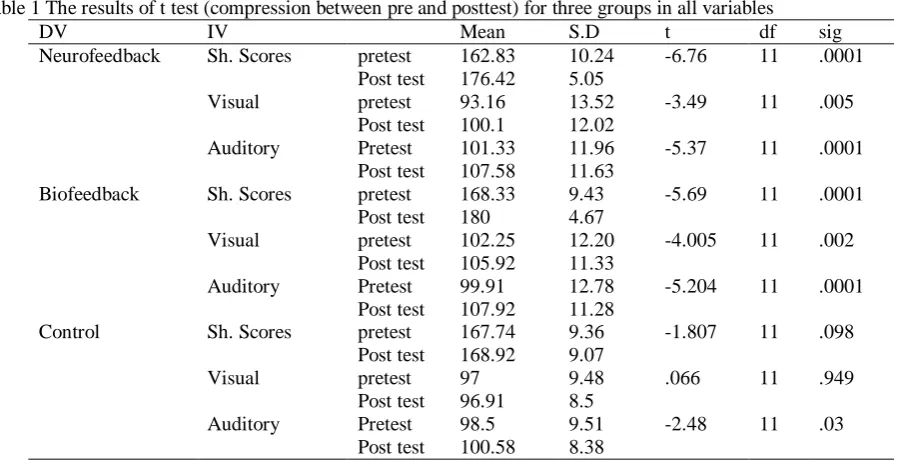
As shown in table 1, the mean of scores in the post test were improved significantly. The dependent t-test was used to study the significance of the obtained differences. The tvalue for the scores of shoots in the table is -6.76 at 0.0001 level of significance, which indicates a significant difference between the mean scores obtained from the pretest and
posttest for neurofeedback group. In
biofeedback training group the t-value is -5.69 at 0.0001 level of significance, which indicates a significant difference between the mean scores obtained from the pretest and posttest. So we can say that the neurofeedback and biofeedback training could improve athletes’ performance.
In order to study the effect of neurofeedback and biofeedback training on the increase in the
score as well as visual and audio attentions, the dependent t-test was used with the results reported in table 1. According to the t value for visual attention in neurofeedback group (-3.49 at 0.005 level of significance) and in biofeedback group (-4.005 at 0.0001 level of significance) presented in the table, the individuals’ scores on visual attention shows a significant difference from the pretest to the posttest. It indicates that these scores rose significantly in the posttest after the implementation of the both biofeedback and neurofeedback training.
The t-value for the audio attention in the table is -5.37 at 0.0001 level of significance for neurofeedback training and -5.204 at 0.0001 level of significance for biofeedback group, which indicates a significant difference between the audio mean scores obtained from the pretest and posttest. In other words, the audio attention score in the posttest was significantly higher than that of the pretest. The table also indicated that there are no significant differences between the pretest and posttest in scores of shooting, visual and audio variables (table 1). Comparing between neurofeedback, biofeedback and control groups in all three independent variables indicated that there are not significantly differences between groups during pretest
(Table 2). Comparing between
neurofeedback, biofeedback and control groups in all three independent variables also indicated that there is significant difference between neurofeedback and control groups. There is also significant difference between biofeedback and control groups in all three independent variables. The results also show that there is no significant difference between neurofeedback and biofeedback groups in three independent variables (Table 3).
88
Figure1The results of pre and posttest for Shooting Scores in three groups
Table 1 The results of t test (compression between pre and posttest) for three groups in all variables
DV IV Mean S.D t df sig
Neurofeedback Sh. Scores pretest 162.83 10.24 -6.76 11 .0001
Post test 176.42 5.05
Visual pretest 93.16 13.52 -3.49 11 .005
Post test 100.1 12.02
Auditory Pretest 101.33 11.96 -5.37 11 .0001
Post test 107.58 11.63
Biofeedback Sh. Scores pretest 168.33 9.43 -5.69 11 .0001
Post test 180 4.67
Visual pretest 102.25 12.20 -4.005 11 .002
Post test 105.92 11.33
Auditory Pretest 99.91 12.78 -5.204 11 .0001
Post test 107.92 11.28
Control Sh. Scores pretest 167.74 9.36 -1.807 11 .098
Post test 168.92 9.07
Visual pretest 97 9.48 .066 11 .949
Post test 96.91 8.5
Auditory Pretest 98.5 9.51 -2.48 11 .03
Post test 100.58 8.38
Table 2 Significant level (Tukey post hoc test) of Shooting, Visual and Auditory variables before DV intervention
IV DV Mean Difference sig
Sh. Scores Neurofeedback Biofeedback -5.5 .507
Control -4.58 .651
Biofeedback Control .91 .99
Visual Neurofeedback Biofeedback -1.25 .98
Control -2.5 .9
Biofeedback Control -1.25 .98
Auditory Neurofeedback Biofeedback 4.91 .82
Control 2.83 .96
Biofeedback Control -2.08 .98
*The mean difference is significant at the .05 level.
Table 3 Significant level (Tukey post hoc test) of Shooting, Visual and Auditory variables after DV intervention
IV DV Mean Difference sig
Sh. Scores Neurofeedback Biofeedback -3.66 .37
Control 7.5* .023
Biofeedback Control 11.16* .001
Visual Neurofeedback Biofeedback -1.33 .98
Control 10.25* .04
Biofeedback Control 11.58* .01
Auditory Neurofeedback Biofeedback .083* .0001
Control 14.33* .037
150 160 170 180
Mean.Sh. N
Mean.Sh.B
Mean.Sh.C
Sh
.S
co
res
Groups
pre test
Biofeedback Control 14.25* .038
*The mean difference is significant at the .05 level.
DISCUSSION
This study investigated the effects of biofeedback and neurofeedback training on visual and audio attention of shooters. The results indicated that there was a significant difference between performance scores (the point of shoots) on pretest and posttest in both experimental groups. The results also showed that there was a significant difference between visual, and audio, attention scores on pretest and posttest in two experimental groups. The results indicate that the neurofeedback and biofeedback training managed to improve all the three visual, audio, and performance variables.
The results are in line with those of some other studies such as Wangler et al. (2011), Zoefel et al. (2010), Lubar (2003), Jensen and Tesche (2002), Rossiter (2002), Padolsky (2001). The results might be due to the fact that these individuals are highly active at theta waves, which lead to their agitation, distraction, and unfocused thinking. As a result, a decline in the theta waves and heart rate improves the
athletes’ attention and concentration.
Strengthening the waves in the forehead region and especially in the anterior cingulate gyros also results in decreasing the problems in a person with distraction disorders as these areas
monitor attention, concentration, and
controlling impulses and maintain attention and excitement in the individual to continue the task.
To explain the obtained results, it can be said that the biofeedback and neurofeedback training act on the waves of the sensory-motor beats and respiratory and heart rate parameters which are responsible for coordinating the sensory-motor acts of the brain waves, and strengthen these waves in addition to the beta ones and also physiological systems. This leads to regulating the motor acts in the person under treatment.
ACKNOWLEDGEMENT
90 REFERENCES
1. Martens, R., Vealey, R. S., and Burton, D. Competitive anxiety in sport. Champaign. IL: Human Kinetics Books,1999.
2. Vernon, D. and Gruzelier, J. H. Electroencephalographic biofeedback as a mechanism to alter mood, creativity and artistic performance. In B. N. DeLuca (ed.), Mind–Body and Relaxation Research Focus. New York: Nova Science, 2008.
3. Walker, P. M. A refined model of sleep and the time course of memory formation. Behavioral and brain sciences, 2005. 28, 51–104.
4. Zimmerman, P., and Leclercq, M. Neuropsychological aspects of attentional functions and disturbances. In M. Leclercq and P. Zimmerman (Eds.), Applied Neuropsychology of Attention New York: Psychology Press, 2002. p. 56-85.
5. Leclercq, M. Theoretical aspects of the main components and functions of attention. In M. Leclercq and P. Zimmerman (Eds.), Applied Neuropsychology of Attention. New York: Psychology Press, 2002. P.3-55 6. Sohlberg, M.M., and Mateer, C.A. Effectiveness of an attention-training program. Journal of Clinical and
Experimental Neuropsychology, 1987. 9: p. 117-130.
7. Demos, J. Getting Started with Neurofeedback.New York, Norton publishing, 2004.
8. Wangler, S., Gevensleben, H., Albrecht, B., Studer, P., Rothenberger A, Moll, G. H., and Heinrich, H.
Neurofeedback in children with ADHD: Specific event-related potential findings of a randomized controlled trial. Clinical Neurophysiology, 2011. 122(5): p.942-950.
9. Zoefel, B., Huster, R.J., and Herrmann, C.S. Neurofeedback training of the upper alpha frequency band in EEG improves cognitive performance. NeuroImage, 2011. 54(2): p.1427-1431.
10. Gevensleben, H., Holl, B., Albrecht, B., Schlamp, D., Kratz, O., Studer, P.,Wangler, S., Rothenberger, A., Moll, G.H., and Heinrich, H. Distinct EEG effects related to neurofeedback training in children with ADHD: a randomized controlled trial. International Journal of Psychophysiology, 2009. 74(2): p.149-157.
11. Arns, M., de Ridder, S., Strehl, U., Breteler, M., and Coenen, T. Efficacy of neurofeedback treatment in ADHD: The effects on inattention, impulsivity and hyperactivity: A meta-analysis. Clinical EEG and Neuroscience, 2009.
40, p.180-189.
12. Fox, D.J., Tharp, D.F., and Fox, L.C. Neurofeedback: An alternative and efficacious treatment for attention deficit hyperactivity disorder. Applied Psychophysiology and Biofeedback, 2005. 30(4): p.365-373.
13. Fuchs, T., Birbaumer, N., Lutzenberger, W., Gruzelier, J.H., and Kaiser, J. Neurofeedback treatment for attention-deficit/hyperactivity disorder in children: A comparison with methylphenidate. Applied Psychophysiology and Biofeedback, 2003. 28(1), p.1-12.
14. Rossiter, T.R. Neurofeedback for AD/HD: A ratio feedback case study and tutorial. Journal of Neurotherapy, 2002. 6(3): p.9-35.
15. Jensen, O., and Tesche, C.D. Frontal theta activity in humans increases with memory load in a working memory task. European Journal of Neuroscience, 2002. 15(8): p.1395-1399.
16. Padolsky, I.P. The efficacy of EEG neurofeedback in the treatment of ADHD children: A case study analysis.
Dissertation Abstracts International: Section B: The Science and Engineering, 2001. 61(12-B): 6716.
17. Zotev, V., Krueger, F., Phillips, R., Alvarez, R.P., Simmons, W.K., et al. Self-regulation of amygdala activation using real-time fMRI neurofeedback. PLoSONE6.e24522, 2011.
18. Sandford, J. A., and Turner, A. Integrated visual and auditory continuous performance test interpretation manual. Richmond, VA: BrainTrain, 2004.
19. Lubar, J. F., and Lubar, J. O. Neurofeedback assessment and treatment for ADD/HD. In J. R. Evans and A. Abarbanel (Eds.), Introduction to quantitative EEG and neurofeedback San Diego: Academic Press, 1999. p.103-143.