Synthetic Text Generation for Sentiment Analysis
Umar Maqsud
Technische Universit¨at Berlin
Straße des 17. Juni 135, 10623 Berlin, Germany
Abstract
Natural language is a common type of in-put for data processing systems. There-fore, it is often required to have a large testing data set of this type. In this context, the task to automatically generate natural language texts, which maintain the prop-erties of real texts is desirable. However, current synthetic data generators do not capture natural language text data suffi-ciently. In this paper, we present a prelim-inary study on different generative models for text generation, which maintain spe-cific properties of natural language text, i.e., the sentiment of a review text. In a series of experiments using different data sets and sentiment analysis methods, we show that generative models can gener-ate texts with a specific sentiment and that hidden Markov model based text genera-tion achieves less accuracy than Markov chain based text generation, but can gen-erate a higher number of distinct texts.
1 Introduction
Text generation is the task of automatically gener-ating texts, which maintain specific properties of real texts. In the context of synthetic text gener-ation, generative models are used to generate test data for benchmarking big data systems (Rabl and Jacobsen, 2012). BDGS (Ming et al., 2014) is a text generator that applies latent dirichlet allo-cation (Blei et al., 2003) as the text data genera-tion model and BigBench (Ghazal et al., 2013) is a benchmark that provides a text generator based on Markov chain model (Rabiner, 1989).
Sentiment analysis (SA) is a method of process-ing opinions and subjectivity of a text. The task is to find and extract the sentiment polarity expressed in a text.
The goal of the paper is to demonstrate the ability of different generative models, i.e., latent dirichlet allocation (LDA), Markov chains (MC), and hidden Markov model (HMM), to generate text with a specific sentiment. This is an important problem because the sentiment of a text may be crucial in several applications like extracting the customers reviews about books, movies, or food and classifying them along their sentiment.
The contributions of this paper are as follows. We present a primary study on three different generative models for text generation. LDA and MC are used for text generation in previous work (Ming et al., 2014; Ghazal et al., 2013). We in-troduce the well known HMM to use it for text generation and compare it with LDA and MC. In a series of experiments, we analyze the scalability, cardinality, and the ability to generate text with a sentiment. For sentiment analysis, we use state-of-the-art methods. The evaluation indicates that the models can generate texts with a specific senti-ment. The hidden Markov model achieves a lower accuracy than Markov chains, but can generate more distinct texts.
The remainder of the paper is organized as follows. Sections 2 and 3 provide an overview on generative models and sentiment analysis ap-proaches. In Section 4 the results of the prelim-inary experiments are presented. Finally, Section 5 presents a summary and discusses directions for future work.
2 Generative Models
We describe in this section the previously men-tioned generative models for text generation.
2.1 Latent Dirichlet Allocation
Latent dirichlet allocation (LDA) is a generative probabilistic model and can be applied for text generation (Ming et al., 2014). Documents are modeled as mixtures over latent topics and topics
are described by a distribution over words. The generation process in LDA has following steps for each document, as described in (Blei et al., 2003): 1. ChooseN ∼Poisson(ξ) as the length of a the
document.
2. Choose θ ∼Dir(α) as the mixture of latent topics of the document.
3. For each of N wordswn:
(a) Choose a topiczn∼Multinomial(θ)
(b) Choose a wordwnfromp(wn|zn, β), a
multinomial probability conditioned on the topiczn.
To learn a LDA model of text documents the library lda-c1is used. BDGS (Ming et al., 2014)
is used to generate text based on these models.
2.2 Markov Chain
A Markov chain is a sequence of random variables with the Markov property (Rabiner, 1989). Sup-pose X = (X1, X2...XT) is a sequence of
ran-dom variables andW = (w1, w2. . . wn)the state
space. Then the Markov property is:
1. Transition probability depends only on the previous state.
P(Xt = wi|X1, . . . , Xt−1) = P(Xt =
wi|Xt−1)
2. Transition probability depends on k previous states (k-order markov chain).
P(Xt = wi|X1, . . . , Xt−1) = P(Xt =
wi|Xt−k, . . . , Xt−1)
A first order Markov chain will only consider the probability of a word appearing after another one. To get more realistic text, higher order n-gram models should be used for generating the text (Ghazal et al., 2013).
2.3 Hidden Markov Model
A hidden Markov model (HMM) is a Markov process with unobserved states and an observ-able variobserv-able (Rabiner, 1989). The hidden states have a probability distribution over the possible observable outputs. Suppose X = (X1, X2. . . XT) is a sequence of hidden random
variables,H = (h1, h2. . . hn)the state space and
1http://www.cs.princeton.edu/˜blei/
lda-c
O = (o1, o2, . . . om)an observable variable.
Ad-ditionally to MC, HMM is defined as:
1. Observation probability depends only on the current hidden state.
P(Ot=oj|Xt=hi)
A basic task of HMM is the supervised learning process, where given a set of hidden and observed sequences, the most likely model that produced the observed sequence is searched. A typical ap-plication for this problem is part-of-speech tag-ging, where the observed variables are the words and the hidden states are the part-of-speech tags (Brants, 2000; Cutting et al., 1992).
HMM is used for text generation as follows. First, the text is tagged using a part-of-speech tag-ger from the Stanford CoreNLP library (Manning et al., 2014). Then, the most likely model that pro-duces those sequences is computed. The hidden state transitions and observations are counted and used as relative frequencies to estimate the transi-tion probabilities.
3 Sentiment Analysis
Two different approaches of sentiment analysis can be identified. The first approach uses lexicons to retrieve the sentiment polarity of a text. This lexicons contain dictionaries of positive, negative, and neutral words and the sentiment polarity is re-trieved according to the words in a text. Machine learning uses annotated texts with a given senti-ment to build a classification model. Sentisenti-ment analysis is implemented as a binary classification problem (Pang et al., 2002).
3.1 SentiWordNet
SentiWordNet (Baccianella et al., 2010) is a widely used lexical resource in sentiment analy-sis and is based on the English lexical dictionary WordNet (Miller, 1995). This lexical dictionary groups words into synonym sets, which are called synsets, and provides relations between these synsets. SentiWordNet associates each synset with three numeric polarity scores: positive, negative andneutral.
positive polarity is greater than that of the nega-tive. The overall average of all words is calculated to assess the sentiment of a text.
3.2 Supervised Classification
Machine learning can be applied to build a super-vised classification model. Text elements are rep-resented by a feature vectors. The features can be the words of the text or their part-of-speech tags.
Support vector machines (SVMs) have been shown to be appropriate for text categorization (Joachims, 1998). In binary classification, the task is to find a hyperplane that separates the docu-ment vectors in the two classes and to maximize the margin between them. SVMs are widely used in sentiment analysis (Pang et al., 2002).
For training and testing LibShortText library2is
used (Fan et al., 2008).
3.3 Stanford Sentiment Treebank
Socher et al. (2013) have introduced a treebank, which includes phrases and sentences annotated with fine-grained sentiment labels. In the five class fine-grained classification task following la-bels are used: very negative, negative, neutral, positive, andvery positive.
As described in (Manning et al., 2014), sen-timent analysis is performed with a model over parse trees. Nodes of a parse tree of each sentence are given a sentiment score. The overall score of the sentence is given at the root node of the parse tree. But it is unclear how to combine the timents over many sentences. We count all sen-timent representations and take the mean as the overall sentiment of a set of sentences.
4 Experiments
In a series of experiments we analyzed the scala-bility, cardinality and the ability to generate text with a sentiment.
4.1 Experiment 1: Scalability
In this experiment the scalability of the presented models are measured on data sets of different sizes.
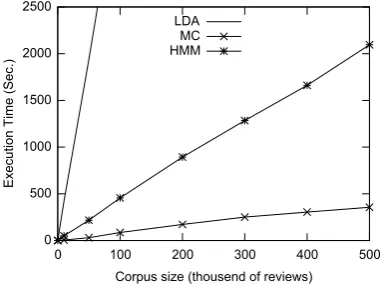
We use the food reviews data set used in (McAuley and Leskovec, 2013) and construct seven sub data sets with 10K, 50K, 100K, 200K, 300K and 500K food reviews respectively. We
2http://www.csie.ntu.edu.tw/˜cjlin/
libshorttext/
[image:3.595.319.512.104.246.2]measure the execution time of the learning algo-rithms of the models on each of these sub data sets.
Figure 1: Execution time of LDA, MC and HMM on data sets of different sizes. HMM achieves a smaller execution time than LDA but greater than MC.
Figure 1 shows for each sub data set the execu-tion time of the learning phase. As we can see, MC outperforms the other methods in terms of scala-bility because it only builds n-grams. HMM has a higher execution time because the data sets have to be tagged using a part-of-speech tagger. LDA performs the worst due to the extensive learning phase.
4.2 Experiment 2: Cardinality
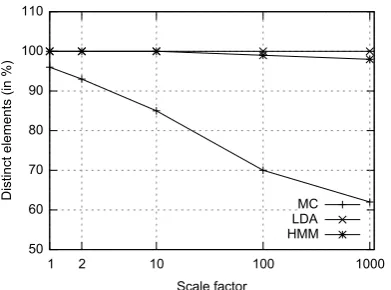
In this experiment the cardinality of the synthetic data sets are measured. The cardinality is defined as the amount of distinct text elements in the gen-erated data set. Two text elements are the same if they have the exact same string. A text element can be an arbitrary type of text, i.e. a sentence or a document. This will show the upscaling behavior in terms of the ability to generate distinct texts.
We use a data set of 10,662 movie reviews used in (Pang and Lee, 2005), which contains an equal number of positive and negative reviews, and di-vide it into two data sets along their sentiment po-larity. On both data sets we build the presented models, which we utilize to scale up by factors of 1, 2, 10, 100 and 1000.
vari-Figure 2: The relative amount of distinct text ele-ments in the synthetic datasets. The synthetic data sets are generated by scale up factors of 1, 2, 10, 100 and 1000. MC generates the smallest amount of distinct text elements, while LDA and HMM generate almost no duplicates.
able and not on the previous words, where in LDA it depends on the latent topics and in HMM on the part-of-speech tags. Therefore, more combi-nations of words are possible.
4.3 Experiment 3: Sentiment-aware Text Generation
In this experiment it is demonstrated that the mod-els learn high-quality language presented modmod-els and are able to generate text with a sentiment.
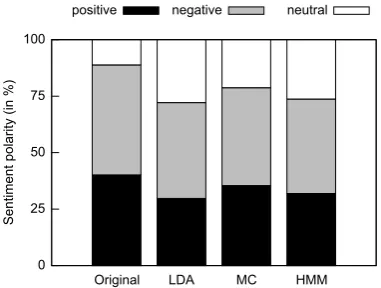
We use the same data set as in the previous ex-periment and divide it into two data sets along their sentiment polarity. To build an SVM based classifier we split each data set into a training and test data set. On both data sets we learn the pre-sented models, which we utilize to scale up by factors of 1, 2 and 10. We use (a) SentiWord-Net (Baccianella et al., 2010), (b) SVM, and (c) the Stanford sentiment analysis library (Socher et al., 2013) to assess whether the generated reviews have the appropriate sentiment.
Table 1 shows the main experimental results. We see that the HMM is more accurately than LDA but less accurately than the MC. The method (c) outperforms the other methods and achieves an F-measure of 79% for the positive and 79% for the negative class. The basic methods (a) and (b) reveal only a modest difference between the original and synthetic data set, while the advanced method (c) illustrates a significant decrease of the F-measure in the synthetic data sets. One rea-son why the F-measure have declined is that
ba-positive negative
(a) (b) (c) (a) (b) (c)
Original 63 75 79 57 75 79
LDA (1x) 60 73 68 52 71 58
LDA (2x) 62 70 68 52 69 59
LDA (10x) 63 70 69 55 67 59
MC (1x) 62 72 75 54 72 70
MC (2x) 62 73 75 55 73 72
MC (10x) 63 74 76 56 73 72
HMM (1x) 61 69 73 54 68 68
HMM (2x) 61 71 73 54 70 67
[image:4.595.308.524.60.236.2]HMM (10x) 62 71 73 54 70 67
Table 1: This table shows the F-measures of the original and synthetic data sets for the positive and negative class separately. The synthetic data sets are generated by scale up factors of 1, 2 and 10. The sentiments analysis methods are SentiWord-Net (a) SVM (b), and Stanford library (c). The HMM achieves a lower F-measure than MC but a higher than LDA on each scale up factor.
sic methods work by assessing words in isolation. They give positive scores for positive words and negative scores for negative words and then aggre-gate these scores. Therefore, the order of words is ignored. In contrast, the advanced method builds a representation of the whole sentence based on the sentence structure using the parse tree. Conse-quently, MC and HMM perform better than LDA because of their ability to capture the order of words.
The F-measures of all models and sentiment analysis methods are almost constant on each scale up factor, which indicates a robust upscaling be-havior of these models. The HMM achieves a lower F-measure than MC, but can generate a higher number of distinct text elements than MC.
[image:4.595.83.279.64.209.2]Figure 3: This figure shows the sentiment polar-ity of the original data set and synthetic data sets. For sentiment analysis the Stanford library is used. The sentiment polarity of the synthetic data set us-ing MC is most similar to the original one.
4.4 Samples from the models
In this section we qualitatively investigate the ca-pabilities of the presented models. The simplest qualitative experiment is to inspect the samples generated by the three models. We use the movie reviews data set and divide it into two data sets along their sentiment polarity. On both data sets we build the presented models, which we utilize to generate the samples.
The samples below were obtained by generat-ing random texts 10 times and selectgenerat-ing the most interesting sample. The samples declared as neg-ative sentiment, for example, are retrieved from a model learned on the negative sub data set.
4.4.1 Samples from the LDA model
negative sentiment:
credits i’ll emotional uglier camera and can see moore’s wanes reason film writ-ten to is by her that that that rather
positive sentiment:
simple interdependence particularly and quinn with baran rich questing del-icate messenger on wallet comedy-drama such funny check a , . .
4.4.2 Samples from the MC model
negative sentiment:
a little thin , leaving these actors , that it gave me no reason to see the same
il-logical things keep happening over and over again .
positive sentiment:
often shocking but ultimately worth-while exploration of the acting , have made to be introverted young men set out to be viewed and treasured for its straight-ahead approach to visualizing nijinsky’s diaries is both inspiring and pure of heart , you can’t go home again
4.4.3 Samples from the HMM model
negative sentiment:
in his franchise , chou-chou , ” the ex-ercise at the love ah-nuld attempted than drama , but pretty predictably , this split-ting of the plays to funny routines title of there ’s badly the director , and no beau-tiful life which is someone on a stagy episode .
positive sentiment:
you is hard n’t of beautiful updating comedy complex family – be acquainted the usual recipe at every quiet but laughs truly a melodramatic at the in her whole-some , heartwarming david that ’s an in-evitable bio-pic with museum .
5 Conclusion
In this paper, we presented a primary study on generative models for text generation. A series of experiments indicate that the presented models can generate texts with a specific sentiment. The hidden Markov model achieves a lower F-measure than Markov chain, but can generate a higher num-ber of distinct texts than Markov chains.
References
Stefano Baccianella, Andrea Esuli, and Fabrizio Sebas-tiani. 2010. Sentiwordnet 3.0: An enhanced lexical resource for sentiment analysis and opinion mining. In Nicoletta Calzolari (Conference Chair), Khalid Choukri, Bente Maegaard, Joseph Mariani, Jan Odijk, Stelios Piperidis, Mike Rosner, and Daniel Tapias, editors,Proceedings of the Seventh Interna-tional Conference on Language Resources and Eval-uation (LREC’10), Valletta, Malta, may. European Language Resources Association (ELRA).
David M. Blei, Andrew Y. Ng, and Michael I. Jordan.
2003. Latent dirichlet allocation. Journal of
Ma-chine Learning Research, 3:993–1022.
Thorsten Brants. 2000. Tnt – A statistical
part-of-speech tagger. InANLP, pages 224–231.
Douglas R. Cutting, Julian Kupiec, Jan O. Pedersen, and Penelope Sibun. 1992. A practical
part-of-speech tagger. InANLP, pages 133–140.
Rong-En Fan, Kai-Wei Chang, Cho-Jui Hsieh, Xiang-Rui Wang, and Chih-Jen Lin. 2008. LIBLINEAR: A library for large linear classification. Journal of Machine Learning Research, 9:1871–1874.
Ahmad Ghazal, Tilmann Rabl, Minqing Hu, Francois Raab, Meikel Poess, Alain Crolotte, and Hans-Arno Jacobsen. 2013. Bigbench: towards an industry
standard benchmark for big data analytics. In
Pro-ceedings of the ACM SIGMOD International Con-ference on Management of Data, SIGMOD 2013, New York, NY, USA, June 22-27, 2013, pages 1197– 1208.
Edouard Grave, Guillaume Obozinski, and Francis R. Bach. 2014. A markovian approach to distributional semantics with application to semantic
composition-ality. In COLING 2014, 25th International
Con-ference on Computational Linguistics, Proceedings of the Conference: Technical Papers, August 23-29, 2014, Dublin, Ireland, pages 1447–1456.
Thorsten Joachims. 1998. Text categorization with support vector machines: Learning with many rel-evant features. InProceedings of the 10th European Conference on Machine Learning, ECML ’98, pages 137–142, London, UK, UK. Springer-Verlag.
Christopher D. Manning, Mihai Surdeanu, John Bauer, Jenny Finkel, Steven J. Bethard, and David Mc-Closky. 2014. The Stanford CoreNLP natural
lan-guage processing toolkit. In Proceedings of 52nd
Annual Meeting of the Association for Computa-tional Linguistics: System Demonstrations, pages 55–60.
Julian J. McAuley and Jure Leskovec. 2013. From amateurs to connoisseurs: Modeling the evolution
of user expertise through online reviews. CoRR,
abs/1303.4402.
George A. Miller. 1995. Wordnet: A lexical database
for english. Commun. ACM, 38(11):39–41,
Novem-ber.
Zijian Ming, Chunjie Luo, Wanling Gao, Rui Han, Qiang Yang, Lei Wang, and Jianfeng Zhan. 2014. BDGS: A scalable big data generator suite in big
data benchmarking. CoRR, abs/1401.5465.
Bo Pang and Lillian Lee. 2005. Seeing stars: Ex-ploiting class relationships for sentiment categoriza-tion with respect to rating scales. InProceedings of the 43rd Annual Meeting on Association for Com-putational Linguistics, ACL ’05, pages 115–124, Stroudsburg, PA, USA. Association for Computa-tional Linguistics.
Bo Pang, Lillian Lee, and Shivakumar Vaithyanathan. 2002. Thumbs up?: sentiment classification using
machine learning techniques. InProceedings of the
ACL-02 conference on Empirical methods in natural language processing-Volume 10, pages 79–86. As-sociation for Computational Linguistics.
Lawrence R. Rabiner. 1989. A tutorial on hidden markov models and selected applications in speech
recognition. Proceedings of the IEEE, 77(2):257–
286, Feb.
Tilmann Rabl and Hans-Arno Jacobsen. 2012. Big
data generation. InSpecifying Big Data Benchmarks
- First Workshop, WBDB 2012, San Jose, CA, USA, May 8-9, 2012, and Second Workshop, WBDB 2012, Pune, India, December 17-18, 2012, Revised Se-lected Papers, pages 20–27.
Richard Socher, Alex Perelygin, Jean Wu, Jason Chuang, Christopher D. Manning, Andrew Y. Ng, and Christopher Potts. 2013. Recursive deep mod-els for semantic compositionality over a sentiment
treebank. InProceedings of the 2013 Conference on
Empirical Methods in Natural Language
Process-ing, pages 1631–1642, Stroudsburg, PA, October.
Association for Computational Linguistics.
Ilya Sutskever, James Martens, and Geoffrey E. Hin-ton. 2011. Generating text with recurrent
neu-ral networks. In Proceedings of the 28th
Inter-national Conference on Machine Learning, ICML 2011, Bellevue, Washington, USA, June 28 - July 2,