A Hybrid Morpheme-Word Representation
for Machine Translation of Morphologically Rich Languages
∗Minh-Thang Luong Preslav Nakov Min-Yen Kan
Department of Computer Science National University of Singapore
13 Computing Drive Singapore 117417
{luongmin,nakov,kanmy}@comp.nus.edu.sg
Abstract
We propose a language-independent approach for improving statistical machine translation for morphologically rich languages using a hybrid morpheme-word representation where the basic unit of translation is the morpheme, but word boundaries are respected at all stages of the translation process. Our model extends the classic phrase-based model by means of (1) word boundary-aware morpheme-level phrase extraction, (2) minimum error-rate training for a morpheme-level translation model using word-level BLEU, and (3) joint scoring with morpheme- and word-level lan-guage models. Further improvements are achieved by combining our model with the classic one. The evaluation on English to Finnish using Europarl (714K sentence pairs; 15.5M English words) shows statistically sig-nificant improvements over the classic model based on BLEU and human judgments.
1 Introduction
The fast progress of statistical machine translation (SMT) has boosted translation quality significantly. While research keeps diversifying, the word remains the atomic token-unit of translation. This is fine for languages with limited morphology like English and French, or no morphology at all like Chinese, but it is inadequate for morphologically rich languages like Arabic, Czech or Finnish (Lee, 2004; Goldwater and McClosky, 2005; Yang and Kirchhoff, 2006).
∗
This research was sponsored in part by CSIDM (grant # 200805) and by a National Research Foundation grant entitled “Interactive Media Search” (grant # R-252-000-325-279).
There has been a line of recent SMT research that incorporates morphological analysis as part of the translation process, thus providing access to the information within the individual words. Unfortu-nately, most of this work either relies on language-specific tools, or only works for very small datasets. Below we propose a language-independent ap-proach to SMT of morphologically rich lan-guages using a hybrid morpheme-word representa-tion where the basic unit of translarepresenta-tion is the mor-pheme, but word boundaries are respected at all stages of the translation process. We use unsuper-vised morphological analysis and we incorporate its output into the process of translation, as opposed to relying on pre-processing and post-processing only as has been done in previous work.
The remainder of the paper is organized as fol-lows. Section 2 reviews related work. Sections 3 and 4 present our morphological and phrase merging enhancements. Section 5 describes our experiments, and Section 6 analyzes the results. Finally, Section 7 concludes and suggests directions for future work.
2 Related Work
Most previous work on morphology-aware ap-proaches relies heavily on language-specific tools, e.g., the TreeTagger (Schmid, 1994) or the
Buck-walter Arabic Morphological Analyzer
(Buckwal-ter, 2004), which hampers their portability to other languages. Moreover, the prevalent method for incorporating morphological information is by heuristically-driven pre- or post-processing. For example, Sadat and Habash (2006) use different combinations of Arabic pre-processing schemes
for Arabic-English SMT, whereas Oflazer and El-Kahlout (2007) post-processes Turkish morpheme-level translations by re-scoring n-best lists with a word-based language model. These systems, how-ever, do not attempt to incorporate their analysis as part of the decoding process, but rather rely on mod-els designed for word-token translation.
We should also note the importance of the trans-lation direction: it is much harder to translate from a morphologically poor to a morphologically rich lan-guage, where morphological distinctions not present in the source need to be generated in the target lan-guage. Research in translating into morphologically rich languages, has attracted interest for languages like Arabic (Badr et al., 2008), Greek (Avramidis and Koehn, 2008), Hungarian (Nov´ak, 2009; Koehn and Haddow, 2009), Russian (Toutanova et al., 2008), and Turkish (Oflazer and El-Kahlout, 2007). These approaches, however, either only succeed in enhancing the performance for small bi-texts (Badr et al., 2008; Oflazer and El-Kahlout, 2007), or im-prove only modestly for large bi-texts1.
3 Morphological Enhancements
We present a morphologically-enhanced version of the classic phrase-based SMT model (Koehn et al., 2003). We use a hybrid morpheme-word representa-tion where the basic unit of translarepresenta-tion is the mor-pheme, but word boundaries are respected at all stages of the translation process. This is in con-trast with previous work, where morphological en-hancements are typically performed as pre-/post-processing steps only.
In addition to changing the basic translation token unit from a word to a morpheme, our model extends the phrase-based SMT model with the following:
1. word boundary-aware morpheme-level phrase extraction;
2. minimum error-rate training for a morpheme-level model using word-morpheme-level BLEU;
3. joint scoring with morpheme- and word-level language models.
We first introduce our morpheme-level represen-tation, and then describe our enhancements.
1Avramidis and Koehn (2008) improved by 0.15 BLEU over
a 18.05 English-Greek baseline; Toutanova et al. (2008) im-proved by 0.72 BLEU over a 36.00 English-Russian baseline.
3.1 Morphological Representation
Our morphological representation is based on the output of an unsupervised morphological analyzer. Following Virpioja et al. (2007), we use Morfessor, which is trained on raw tokenized text (Creutz and Lagus, 2007). The tool segments words into mor-phemes annotated with the following labels: PRE
(prefix),STM(stem),SUF(suffix). Multiple prefixes and suffixes can be proposed for each word; word compounding is allowed as well. The output can be described by the following regular expression:
WORD = ( PRE* STM SUF* )+
For example,uncarefullyis analyzed as
un/PRE+ care/STM+ ful/SUF+ ly/SUF
The above token sequence forms the input to our
system. We keep thePRE/STM/SUF tags as part
of the tokens, and distinguish betweencare/STM+
andcare/STM. Note also that the “+” sign is ap-pended to each nonfinal tag so that we can distin-guish word-internal from word-final morphemes.
3.2 Word Boundary-aware Phrase Extraction
The core translation structure of a phrase-based SMT model is the phrase table, which is learned from a bilingual parallel sentence-aligned corpus, typically using the alignment template approach (Och and Ney, 2004). It contains a set of bilingual phrase pairs, each associated with five scores: for-ward and backfor-ward phrase translation probabilities, forward and backward lexicalized translation proba-bilities, and a constant phrase penalty.
The maximum phrase lengthnis normally limited to seven words; higher values ofnincrease the table size exponentially without actually yielding perfor-mance benefit (Koehn et al., 2003). However, things are different when translating with morphemes, for two reasons: (1) morpheme-token phrases of length
ncan span less than nwords; and (2) morpheme-token phrases may only partially span words.
The first point means that morpheme-token phrase pairs span fewer word tokens, and thus cover a smaller context, which may result in fewer total extracted pairs compared to a word-level approach. Figure 1 shows a case where three Finnish words consist of nine morphemes. Previously, this issue was addressed by simply increasing the value ofn
SRC= theSTMnewSTM, unPRE+democraticSTMimmigrationSTMpolicySTM
TGT= uusiSTM, epäPRE+demokraatSTM+tSUF+iSUF+sSUF+enSUFmaahanmuuttoPRE+politiikanSTM
(uusi=new , epädemokraattisen=undemocratic maahanmuuttopolitiikan=immigration policy)
Figure 1: Example of English-Finnish bilingual fragments morphologically segmented by Morfessor. Solid links represent IBM Model 4 alignments at the morpheme-token level. Translation glosses for Finnish are given below.
The second point is more interesting: morpheme-level phrases may span words partially, making them potentially usable in translating unknown inflected forms of known source language words, but also creates the danger of generating sequences of mor-phemes that are not legal target language words.
For example, let us consider the phrase in Fig-ure 1: unPRE+ democraticSTM. The original algorithm will extract the spurious phraseep¨aPRE+
demokraatSTM+ tSUF+ iSUF+ sSUF+, beside
the correct one that has enSUF appended at the end. Such a spurious phrase does not generally help in translating unknown inflected forms, especially for morphologically-rich languages that feature mul-tiple affixes, but negatively affects the translation model in terms of complexity and quality.
We solve both problems by modifying the phrase-pair extraction algorithm so that morpheme-token phrases can extend longer than n, as long as they span n words or less. We further require that word boundaries be respected2, i.e., morpheme-token phrases span a sequence of whole words. This is a fair extension of the morpheme-token system with respect to a word-token one since both are re-stricted to span up tonword-tokens.
3.3 Morpheme-Token MERT Optimizing Word-Token BLEU
Modern phrase-based SMT systems use a log-linear model with the following typical feature functions: language model probabilities, word penalty, distor-tion cost, and the five parameters from the phrase ta-ble. Their weights are set by optimizing BLEU score (Papineni et al., 2001) directly using minimum error rate training (MERT), as suggested by Och (2003).
In previous work, phrase-based SMT systems using morpheme-token input/output naturally
per-2This means that we miss the opportunity to generate new
wordforms for known baseforms, but removes the problem of proposing nonwords in the target language.
formed MERT at the morpheme-token level as well. This is not optimal since the final expected system output is a sequence of words, not morphemes. The main danger is that optimizing a morpheme-token BLEU score could lead to a suboptimal weight for the word penalty feature function: this is because the brevity penalty of BLEU is calculated with re-spect to the number of morphemes, which may vary for sentences with an identical number of words.
This motivates us to perform MERT at the word-token level, although our input consists of mor-phemes. In particular, for each iteration of MERT, as soon as the decoder generates a morpheme-token translation for a sentence, we convert it into a word-token sequence, which is used to calculate BLEU. We thus achieve MERT optimization at the word-token level while translating a morpheme-word-token in-put and generating a morpheme-token outin-put.
3.4 Scoring with Twin Language Models
An SMT system that takes morpheme-token input and generates morpheme-token output should natu-rally use a morpheme-token language model (LM). This has the advantage of alleviating the problem of data sparseness, especially when translating into a morphologically rich language, since the LM would be able to handle some new unseen inflected forms of known words. On the negative side, a morpheme-token LM spans fewer word-morpheme-tokens and thus has a more limited word “horizon” compared to one op-erating at the word level. As with the maximum phrase length, mechanically increasing the order of the morpheme-token LM has a limited impact.
uusiSTM , epäPRE+demokraatSTM+tSUF+iSUF+sSUF+enSUFmaahanmuuttoPRE+politiikanSTM
•Score: “sSUF+enSUFmaahanmuuttoPRE+” ; “enSUFmaahanmuuttoPRE+politiikanSTM ”
•Concatenate: uusi , epädemokraattisen maahanmuuttopolitiikan •Score: “, epädemokraattisen maahanmuuttopolitiikan”
Previous hypotheses Current hypothesis
(i)
(ii)
(iii)
Figure 2: Scoring with twin LMs. Shown are: (i) The current state of the decoding process with the target phrases covered by the current partial hypotheses. (ii, iii) Scoring with 3-gram morpheme-token and 3-gram word-token LMs, respectively. For the word-token LM, the morpheme-token sequence is concatenated into word-tokens before scoring.
it can be enhanced with an appropriate word-token “view” on the partial morpheme-level hypotheses3.
The interaction of the twin LMs is illustrated in Figure 2. The word-token LM can capture much longer phrases and more complete contexts such as “, ep¨ademokraattisen maahanmuuttopolitiikan” compared to the morpheme-token LM.
Note that scoring with two LMs that see the out-put sequence as different numbers of tokens is not readily offered by the existing SMT decoders. For example, the phrase-based model in Moses (Koehn et al., 2007) allows scoring with multiple LMs, but assumes they use the same token granularity, which is useful for LMs trained on different monolingual corpora, but cannot handle our case. While the fac-tored translation model (Koehn and Hoang, 2007) in Moses does allow scoring with models of different granularity, e.g., lemma-token and word-token LMs, it requires a 1:1 correspondence between the tokens in the different factors, which clearly is not our case. Note that scoring with twin LMs is conceptu-ally superior ton-best re-scoring with a word-token LM, e.g., (Oflazer and El-Kahlout, 2007), since it is tightly integrated into decoding: it scores partial hy-potheses and influenced the search process directly.
4 Enriching the Translation Model
Another general strategy for combining evidence from the word-token and the morpheme-token rep-resentations is to build two separate SMT systems and then combine them. This can be done as a post-processing system combination step; see (Chen et al., 2009a) for an overview of such approaches.
3
We use the term “hypothesis” to collectively refer to the following (Koehn, 2003): the source phrase covered, the cor-responding target phrase, and most importantly, a reference to
the previous hypothesis that it extends.
However, for phrase-based SMT systems, it is theo-retically more appealing to combine their phrase ta-bles since this allows the translation models of both systems to influence the hypothesis search directly.
We now describe our phrase table combination approach. Note that it is orthogonal to the work pre-sented in the previous section, which suggests com-bining the two (which we will do in Section 5).
[image:4.612.328.519.488.638.2]4.1 Building a Twin Translation Model
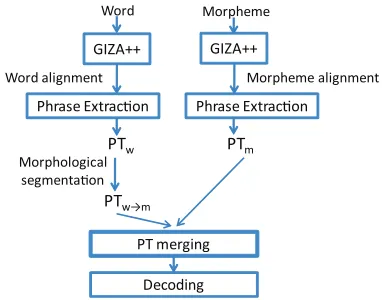
Figure 3 shows a general scheme of our twin trans-lation model. First, we tokenize the input at differ-ent granularities: (1) morpheme-token and (2) word-token. We then build separate phrase tables (PT) for the two inputs: a word-tokenP Twand a morpheme-token P Tm. Second, we re-tokenize P Tw at the morpheme level, thus obtaining a new phrase table
P Tw→m, which is of the same granularity asP Tm. Finally, we mergeP Tw→mandP Tm, and we input the resulting phrase table to the decoder.
GIZA++
Decoding
Word alignment Morpheme alignment Word Morpheme
PTm
PTw→m
PTw
Morphological segmenta"on
Phrase Extrac"on
PT merging
Phrase Extrac"on GIZA++
4.2 Merging and Normalizing Phrase Tables
Below we first describe the two general phrase ta-ble combination strategies used in previous work: (1) direct merging using additional feature func-tions, and (2) phrase table interpolation. We then introduce our approach.
Add-feature methods. The first line of research
on phrase table merging is exemplified by (Niehues et al., 2009; Chen et al., 2009b; Do et al., 2009; Nakov and Ng, 2009). The idea is to select one of the phrase tables as primary and to add to it all non-duplicating phrase pairs from the second table to-gether with their associated scores. For each entry, features can be added to indicate its origin (whether from the primary or from the secondary table). Later in our experiments, we will refer to these baseline methods as add-1 and add-2, depending on how many additional features have been added. The val-ues we used for these features in the baseline are given in Section 5.4; their weights in the log-linear model were set in the standard way using MERT.
Interpolation-based methods. A problem with
the above method is that the scores in the merged phrase table that correspond to forward and back-ward phrase translation probabilities, and forback-ward and backward lexicalized translation probabilities can no longer be interpreted as probabilities since they are not normalized any more. Theoretically, this is not necessarily a problem since the log-linear model used by the decoder does not assume that the scores for the feature functions come from a normal-ized probability distribution. While it is possible to re-normalize the scores to convert them into prob-abilities, this is rarely done; it also does not solve the problem with the dropped scores for the dupli-cated phrases. Instead, the conditional probabilities in the two phrase tables are often interpolated di-rectly, e.g., using linear interpolation. Representa-tive work adopting this approach is (Wu and Wang, 2007). We refer to this method as interpolation.
Our method. The above phrase merging ap-proaches have been proposed for phrase tables de-rived from different sources. This is in contrast with our twin translation scenario, where the morpheme-token phrase tables are built from the same training dataset; the main difference being that word align-ments and phrase extraction were performed at the
word-token level forP Tw→mand at the morpheme-token level for P Tm. Thus, we propose different merging approaches for the phrase translation prob-abilities and for the lexicalized probprob-abilities.
In phrase-based SMT, phrase translation probabil-ities are computed using maximum likelihood (ML) estimation φ( ¯f|¯e) = P#( ¯f ,¯e)
¯
f#( ¯f ,¯e)
, where #( ¯f ,¯e) is
the number of times the pair( ¯f ,¯e)is extracted from the training dataset (Koehn et al., 2003). In order to preserve the normalized ML estimations as much as possible, we refrain from interpolation. Instead, we use the raw counts for the two models#m( ¯f ,¯e)and #w→m( ¯f ,e¯)directly as follows:
φ( ¯f ,e¯) = P #m( ¯f ,e¯) + #w→m( ¯f ,e¯)
¯
f#m( ¯f ,e¯) +Pf¯#w→m( ¯f ,e¯) For lexicalized translation probabilities, we would like to use simple interpolation. However, we notice that when a phrase pair belongs to only one of the phrase tables, the corresponding lexicalized score for the other table would be zero. This might cause some good phrases to be penalized just because they were not extracted in both tables, which we want to prevent. We thus perform interpolation from P Tm andP Twaccording to the following formula:
lex( ¯f|¯e) = α×lexm( ¯fm|¯em) + (1−α)×lexw( ¯fw|¯ew)
where the concatenation off¯m and e¯m into word-token sequences yieldsf¯wand¯ew, respectively.
If both( ¯fm,e¯m)and( ¯fw,e¯w)are present inP Tm andP Tw, respectively, we have a simple interpola-tion of their corresponding lexicalized scores lexm and lexw. However, if one of them is missing, we do not use a zero for its corresponding lexicalized score, but use an estimate as follows.
5 Experiments and Evaluation
5.1 Datasets
In our experiments, we use the English-Finnish data from the 2005 shared task (Koehn and Monz, 2005), which is split into training, development, and test portions; see Table 1 for details. We further split the training dataset into four subsets T1, T2, T3, and T4of sizes 40K, 80K, 160K, and 320K parallel sen-tence pairs, which we use for studying the impact of training data size on translation performance.
Sent. Avg. words Avg. morph.
en fi en fi
[image:6.612.318.536.57.154.2]Train 714K 21.62 15.80 24.68 26.15 Dev 2K 29.33 20.99 33.40 34.94 Test 2K 28.98 20.72 33.10 34.47
Table 1: Dataset statistics. Shown are the number of parallel sentences, and the average number of words and Morfessor morphemes on the English and Finnish sides of the training, development and test datasets.
5.2 Baseline Systems
We build two phrase-based baseline SMT systems, both using Moses (Koehn et al., 2007):
w-system: works at the word-token level, extracts
phrases of up to seven words, and uses a 4-gram word-token LM (as typical for phrase-based SMT);
m-system: works at the morpheme level,
tok-enized using Morfessor4and augmented with “+” as described in Section 3.1.
Following Oflazer and El-Kahlout (2007) and Vir-pioja et al. (2007), we use phrases of up to 10 morpheme-tokens and a 5-gram morpheme-token LM. None of the enhancements described previ-ously is applied yet. After decoding, morphemes are concatenated back to words using the “+” markers.
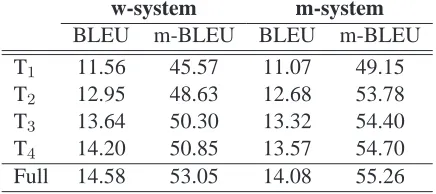
To evaluate the translation quality, we compute BLEU (Papineni et al., 2001) at the word-token level. We further introduce a morpheme-token ver-sion of BLEU, which we call m-BLEU: it first seg-ments the system output and the reference trans-lation into morpheme-tokens and then calculates a BLEU score as usual. Table 2 shows the baseline re-sults. We can see that the m-system achieves much
4
We retrained Morfessor for Finnish/English on the Finnish/English side of the training dataset.
w-system m-system
BLEU m-BLEU BLEU m-BLEU T1 11.56 45.57 11.07 49.15 T2 12.95 48.63 12.68 53.78 T3 13.64 50.30 13.32 54.40 T4 14.20 50.85 13.57 54.70 Full 14.58 53.05 14.08 55.26
Table 2: Baseline system performance (on the test dataset). Shown are word BLEU and morpheme m-BLEU scores for the w-system and m-system.
higher m-BLEU scores, indicating that it may have better morpheme coverage5. However, the m-system is outperformed by the w-system on the classic word-token BLEU, which means that it either does not perform as well as the w-system or that word-token BLEU is not capable of measuring the morpheme-level improvements. We return to this question later.
5.3 Adding Morphological Enhancements
We now add our three morphological enhancements from Section 3 to the baseline m-system:
phr (training) allow morpheme-token phrases to
get potentially longer than seven morpheme-tokens as long as they cover no more than seven words;
tune (tuning) MERT for morpheme-token
trans-lations while optimizing word-token BLEU;
lm (decoding) scoring morpheme-token
transla-tion hypotheses with a 5-gram morpheme-token and a 4-gram word-token LM.
The results are shown in Table 3 (ii). As we can see, each of the three enhancements yields improve-ments in BLEU score over the m-system, both for small and for large training corpora. In terms of per-formance ranking, tune achieves the best absolute improvement of 0.66 BLEU points onT1and of 0.47 points on the full dataset, followed by lm and phr.
Table 3 (iii) further shows that using phr and
lm together yields absolute improvements of 0.70
BLEU points onT1and 0.50 points on the full train-ing dataset. Further incorporattrain-ing tune, however, only helps when training onT1.
Overall, the morphological enhancements are on par with the w-system baseline, and yield sizable
im-5
[image:6.612.76.294.216.285.2]System T1(40K) Full(714K) (i) w-system (w) 11.56 14.58
m-system (m) 11.07 14.08
(ii)
m+phr 11.44+0.37 14.43+0.35 m+tune 11.73+0.66 14.55+0.47 m+lm 11.58+0.51 14.53+0.45 (iii) m+phr+lm 11.77
[image:7.612.75.302.55.162.2]+0.70 14.58+0.50 m+phr+lm+tune 11.90+0.83 14.39+0.31 Table 3: Impact of the morphological enhancements (on test dataset). Shown are BLEU scores (in %) for training on T1 and on the full dataset for (i) baselines, (ii) enhancements individually, and (iii) combined. Su-perscripts indicate absolute improvements w.r.t m-system.
provements over the m-system baseline: 0.83 BLEU points onT1and 0.50 on the full training dataset.
5.4 Combining Translation Tables
Finally, we investigate the effect of combining phrase tables derived from a word-token and a morpheme-token input, as described in Section 4. We experiment with the following merging methods:
add-1: phrase table merging using one table as
primary and adding one extra feature6;
add-2: phrase table merging using one table as
primary and adding two extra features7;
interpolation: simple linear interpolation with
one parameterα;
ourMethod: our interpolation-like merging method described in Section 4.2.
Parameter tuning. We tune the parameters of the
above methods on the development dataset.
[image:7.612.330.522.479.577.2]T1 (40K) Full (714K) P Tmis primary 11.99 13.45 P Tw→mis primary 12.26 14.19
Table 4: Effect of selection of primary phrase table for add-1 (on dev dataset): P Tw→m, derived from a
word-token input, vs. P Tm, from a morpheme-token input.
Shown is BLEU (in %) onT1and the full training dataset.
For add-1 and add-2, we need to decide which (P Tw→m or P Tm) phrase table should be
consid-6
The feature values are e1, e2/3 or e1/3 (e=2.71828...); when the phrase pair comes from both tables, from the primary table only, and from the secondary table only, respectively.
7The feature values are(
e1, e1), (e1, e0)or(e0, e1)when the phrase pair comes from both tables, from the primary table only, and from the secondary table only, respectively.
ered the primary table. Table 4 shows the results when trying both strategies on add-1. As we can see, usingP Tw→mas primary performs better onT1and on the full training dataset; thus, we will use it as primary on the test dataset for add-1 and add-2.
For interpolation-based methods, we need to choose a value for the interpolation parameters. Due to time constraints, we use the same value for the phrase translation probabilities and for the lexical-ized probabilities, and we perform grid search for
α∈ {0.3,0.4,0.5,0.6,0.7}using interpolate on the full training dataset. As Table 5 shows, α = 0.6 turns out to work best on the development dataset; we will use this value in our experiments on the test dataset both for interpolate and for ourMethod8.
α 0.3 0.4 0.5 0.6 0.7
BLEU 14.17 14.49 14.6 14.73 14.52
Table 5: Trying different values for interpolate (on dev dataset). BLEU (in %) is for the full training dataset.
Evaluation on the test dataset. We integrate the
morphologically enhanced system m+phr+lm and the word-token based w-system using the four merg-ing methods above. The results for the full train-ing dataset are shown in Table 6. As we can see,
add-1 and add-2 make little difference compared to
the m-system baseline. In contrast, interpolation and
ourMethod yield sizable absolute improvements of
0.55 and 0.74 BLEU points, respectively, over the
m-system; moreover, they outperform the w-system.
Merging methods Full (714K)
(i) m-system 14.08
w-system 14.58
(ii) add-1 14.25
+0.17
add-2 13.89−0.19 (iii) interpolation 14.63
+0.55
ourMethod 14.82+0.74 Table 6: Merging m+phr+lm and w-system (on test dataset). BLEU (in %) is for the full training dataset. Su-perscripts indicate performance gain/loss w.r.t m-system.
6 Discussion
Below we assess the significance of our results based on micro-analysis and human judgments.
6.1 Translation Model Comparison
We first compare the following three phrase ta-bles: P Tm of m-system, maximum phrase length of 10 morpheme-tokens; P Tw→m of w-system, maxi-mum phrase length of 7 word-tokens, re-segmented into morpheme-tokens; andP Tm+phr– morpheme-token input using word boundary-aware phrase ex-traction, maximum phrase length of 7 word-tokens.
Full(714K)
(i)
P Tm 43.5M
P Tw→m 28.9M
P Tm+phr 22.5M
(ii) P Tm+phr
T
P Tm 21.4M
P Tm+phrTP Tw→m 10.7M
Table 7: Phrase table statistics. The number of phrase pairs in (i) individual PTs and (ii) PT overlap, is shown.
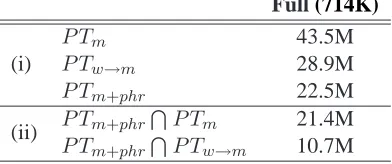
P Tm+phr versus P Tm. Table 7 shows that P Tm+phr is about half the size of P Tm. Still, as Table 3 shows, m+phr outperforms the m-system. Moreover, 95.07% (21.4M/22.5M) of the phrase pairs inP Tm+phr are also inP Tm, which confirms that boundary-aware phrase extraction selects good phrase pairs fromP Tmto be retained inP Tm+phr.
P Tm+phr versus P Tw→m. These two tables
are comparable in size: 22.5M and 28.9M pairs, but their overlap is only 47.67% (10.7M/22.5M) of
P Tm+phr. Thus, enriching the translation model withP Tw→mhelps improve coverage.
6.2 Significance of the Results
Table 8 shows the performance of our system com-pared to the two baselines: m-system and w-system. We achieve an absolute improvement of 0.74 BLEU points over the m-system, from which our system evolved. This might look modest, but note that the baseline BLEU is only 14.08, and thus the rel-ative improvement is 5.6%, which is not trivial. Furthermore, we outperform the w-system by 0.24 points (1.56% relative). Both improvements are sta-tistically significant with p < 0.01, according to Collins’ sign test (Collins et al., 2005).
In terms of m-BLEU, we achieve an improvement of 2.59 points over the w-system, which suggest our system might be performing better than what stan-dard BLEU suggests. Below we test this hypothesis
BLEU m-BLEU
ourSystem 14.82 55.64
m-system 14.08 55.26
[image:8.612.350.502.56.112.2]w-system 14.58 53.05
Table 8: Our system vs. the two baselines (on the test dataset): BLEU and m-BLEU scores (in %).
by means of micro-analysis and human evaluation.
Translation Proximity Match. We performed
automatic comparison based on corresponding phrases between the translation output (out) and the reference (ref), using the source (src) test dataset as a pivot. The decoding log gave us the phrases used to translate src to out, and we only needed to find correspondences between src and ref, which we ac-complished by appending the test dataset to training and performing IBM Model 4 word alignments.
We then looked for phrase triples (src, out, ref ), where there was a high character-level similarity be-tween out and ref, measured using longest common
subsequence ratio with a threshold of 0.7, set
ex-perimentally. We extracted 16,262 triples: for 6,758 of them, the translations matched the references ex-actly, while in the remaining triples, they were close wordforms9. These numbers support the hypothesis that our approach yields translations close to the ref-erence wordforms but unjustly penalized by BLEU, which only gives credit for exact word matches10.
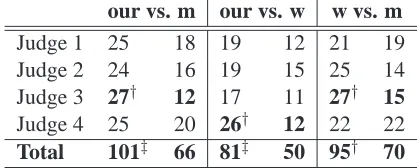
Human Evaluation. We asked four native Finnish speakers to evaluate 50 random test sen-tences. Following (Callison-Burch et al., 2009), we provided them with the source sentence, its refer-ence translation, and the outputs of three SMT sys-tems (m-system, w-system, and ourSystem), which were shown in different order for each example and were named sys1, sys2 and sys3 (by order of ap-pearance). We asked for three pairwise judgments: (i) sys1 vs. sys2, (ii) sys1 vs. sys3, and (iii) sys2 vs.
sys3. For each pair, a winner had to be designated;
ties were allowed. The results are shown in Table 10. We can see that the judges consistently preferred
9Examples of such triples are (constitutional
structure, perustuslaillinen rakenne, perustuslaillisempi rakenne) and (economic and social, taloudellisia ja sosiaalisia, taloudellisten ja sosiaalisten)
10As a reference, the w-system yielded 15,673 triples, and
[image:8.612.88.284.181.263.2]src: as a conservative , i am incredibly thrifty with taxpayers ’ money .
ref: maltillisen kokoomuspuolueen edustajana suhtaudun erittain saastavaisesti veronmaksajien rahoihin .
our: konservatiivinen , olen erittain saastavaisesti veronmaksajien rahoja .
w : konservatiivinen , olen aarettoman tarkeaa kanssa veronmaksajien rahoja .
m : kuten konservatiivinen , olen erittain saastavaisesti veronmaksajien rahoja .
Comment:ourmw. ouruses better paraphrases, from which the correct meaning could be inferred. The part “aarettoman tarkeaa kanssa” inwdoes not mention the “thriftiness” and replaces it with “important” (tarkeaa), which is wrong.mintroduces “kuten”, which slightly alters the meaning towards “like a conservative, ...”.
src: we were very constructive and we negotiated until the last minute of these talks in the hague .
ref: olimme erittain rakentavia ja neuvottelimme haagissa viime hetkeen saakka .
our: olemme olleet hyvin rakentavia ja olemme neuvotelleet viime hetkeen saakka naiden neuvottelujen haagissa .
w : olemme olleet hyvin rakentavia ja olemme neuvotelleet viime tippaan niin naiden neuvottelujen haagissa .
m : olimme erittain rakentavan ja neuvottelimme viime hetkeen saakka naiden neuvotteluiden haagissa .
Comment: our mw. Inour, the meaning is very close torefwith only a minor difference in tense at the beginning. monly gets the case wrong in “rakentavan”, and the correct case is easily guessable. Forw, the “viime tippaan” is in principle correct but somewhat colloquial, and the “niin” is extra and somewhat confusing.
src: it would be a very dangerous situation if the europeans were to become logistically reliant on russia .
ref: olisi eritt¨ain vaarallinen tilanne , jos eurooppalaiset tulisivat logistisesti riippuvaisiksi ven¨aj¨ast¨a .
our: olisi eritt¨ain vaarallinen tilanne , jos eurooppalaiset tulee logistisesti riippuvaisia ven¨aj¨an .
w : se olisi eritt¨ain vaarallinen tilanne , jos eurooppalaisten tulisi logistically riippuvaisia ven¨aj¨an .
m : se olisi hyvin vaarallinen tilanne , jos eurooppalaiset haluavat tulla logistisesti riippuvaisia ven¨aj¨an .
Comment: ourwm. ouris almost correct except for the wrong inflections at the end. wis inferior since it failed to translate “logistically”. “haluavat tulla” inmsuggests that the Europeans would “want to become logistically dependent”, which is not the case. The “se” (it), and “hyvin” (a synonym of “eritt¨ain”) are minor mistakes/differences.
Table 9: English-Finnish translation examples. Shown are the source (src), the reference (ref), and the transla-tions of three systems (our,w,m). Text in bold indicates matches with respect to theref, while italics show where a system was judged inferior to the rest, as judged by native Finnish speakers.
(1) ourSystem to the m-system, (2) ourSystem to the
w-system, (3) w-system to the m-system. These
pref-erences are statistically significant, as found by the sign test. Comparing to Table 8, we can see that BLEU correlates with human judgments better than m-BLEU; we plan to investigate this in future work.
our vs. m our vs. w w vs. m
Judge 1 25 18 19 12 21 19 Judge 2 24 16 19 15 25 14 Judge 3 27† 12 17 11 27† 15
Judge 4 25 20 26† 12 22 22
[image:9.612.80.290.497.581.2]Total 101‡ 66 81‡ 50 95† 70
Table 10: Human judgments: ourSystem (our) vs. m-system (m) vs. w-m-system (w). For each pair, we show the number of times each system was judged better than the other one, ignoring ties. Statistically significant dif-ferences are marked with†(p <0.05) and‡(p <0.01).
Finally, Table 9 shows some examples demon-strating how our system improves over the w-system and the m-system.
7 Conclusion and Future Work
In the quest towards a morphology-aware SMT that only uses unannotated data, there are two key chal-lenges: (1) to bring the performance of morpheme-token systems to a level rivaling the standard word-token ones, and (2) to incorporate morphological analysis directly into the translation process.
This work satisfies the first challenge: we have achieved statistically significant improvements in BLEU for a large training dataset of 714K sentence pairs and this was confirmed by human evaluation.
We think we have built a solid framework for the second challenge, and we plan to extend it further.
Acknowledgements
References
Eleftherios Avramidis and Philipp Koehn. 2008. Enrich-ing morphologically poor languages for statistical ma-chine translation. In ACL-HLT.
Ibrahim Badr, Rabih Zbib, and James Glass. 2008. Seg-mentation for English-to-Arabic statistical machine translation. In ACL-HLT.
Tim Buckwalter. 2004. Buckwalter Arabic Morphologi-cal Analyzer Version 2.0. Linguistic Data Consortium, Philadelphia”.
Chris Callison-Burch, Philipp Koehn, Christof Monz, and Josh Schroeder. 2009. Findings of the 2009 Workshop on Statistical Machine Translation. In EACL.
Boxing Chen, Min Zhang, Haizhou Li, and Aiti Aw. 2009a. A comparative study of hypothesis alignment and its improvement for machine translation system combination. In ACL-IJCNLP.
Yu Chen, Michael Jellinghaus, Andreas Eisele, Yi Zhang, Sabine Hunsicker, Silke Theison, Christian Feder-mann, and Hans Uszkoreit. 2009b. Combining multi-engine translations with Moses. In EACL.
Michael Collins, Philipp Koehn, and Ivona Kuˇcerov´a. 2005. Clause restructuring for statistical machine translation. In ACL.
Mathias Creutz and Krista Lagus. 2007. Unsupervised models for morpheme segmentation and morphology learning. ACM Trans. Speech Lang. Process., 4(1):3. Thi Ngoc Diep Do, Viet Bac Le, Brigitte Bigi, Laurent
Besacier, and Eric Castelli. 2009. Mining a compa-rable text corpus for a Vietnamese-French statistical machine translation system. In EACL.
Sharon Goldwater and David McClosky. 2005. Improv-ing statistical MT through morphological analysis. In HLT.
Philipp Koehn and Barry Haddow. 2009. Edinburgh’s submission to all tracks of the WMT2009 shared task with reordering and speed improvements to Moses. In EACL.
Philipp Koehn and Hieu Hoang. 2007. Factored transla-tion models. In EMNLP-CoNLL.
Philipp Koehn and Christof Monz. 2005. Shared task: Statistical machine translation between European lan-guages. In WPT.
Philipp Koehn, Franz Josef Och, and Daniel Marcu. 2003. Statistical phrase-based translation. In NAACL. Philipp Koehn, Hieu Hoang, Alexandra Birch Mayne,
Christopher Callison-Burch, Marcello Federico, Nicola Bertoldi, Brooke Cowan, Wade Shen, Chris-tine Moran, Richard Zens, Chris Dyer, Ondrej Bojar, Alexandra Constantin, and Evan Herbst. 2007. Moses: Open source toolkit for statistical machine translation. In ACL, Demonstration Session.
Philipp Koehn. 2003. Noun phrase translation. Ph.D. thesis, University of Southern California, Los Angeles, CA, USA.
Young-Suk Lee. 2004. Morphological analysis for sta-tistical machine translation. In HLT-NAACL.
Preslav Nakov and Hwee Tou Ng. 2009. Improved statis-tical machine translation for resource-poor languages using related resource-rich languages. In EMNLP. Jan Niehues, Teresa Herrmann, Muntsin Kolss, and Alex
Waibel. 2009. The Universit¨at Karlsruhe translation system for the EACL-WMT 2009. In EACL.
Attila Nov´ak. 2009. MorphoLogic’s submission for the WMT 2009 shared task. In EACL.
Franz Josef Och and Hermann Ney. 2004. The align-ment template approach to statistical machine transla-tion. Computational Linguistics, 30(4):417–449. Franz Josef Och. 2003. Minimum error rate training in
statistical machine translation. In ACL.
Kemal Oflazer and Ilknur El-Kahlout. 2007. Exploring different representational units in English-to-Turkish statistical machine translation. In StatMT.
Kishore Papineni, Salim Roukos, Todd Ward, and Wei-Jing Zhu. 2001. Bleu: a method for automatic evalua-tion of machine translaevalua-tion. In ACL.
Fatiha Sadat and Nizar Habash. 2006. Combination of Arabic preprocessing schemes for statistical machine translation. In ACL.
Helmut Schmid. 1994. Probabilistic part-of-speech tag-ging using decision trees. In International Conference on New Methods in Language Processing.
Kristina Toutanova, Hisami Suzuki, and Achim Ruopp. 2008. Applying morphology generation models to machine translation. In ACL-HLT.
Sami Virpioja, Jaakko J. Vyrynen, Mathias Creutz, and Markus Sadeniemi. 2007. Morphology-aware statisti-cal machine translation based on morphs induced in an unsupervised manner. In Machine Translation Summit XI.
Hua Wu and Haifeng Wang. 2007. Pivot language approach for phrase-based statistical machine transla-tion. Machine Translation, 21(3):165–181.