6392
Latent Variable Model for Multi-modal Translation
Iacer Calixto Miguel Rios
ILLC
The University of Amsterdam
{iacer.calixto,m.riosgaona,w.aziz}@uva.nl
Wilker Aziz
Abstract
In this work, we propose to model the in-teraction between visual and textual features for multi-modal neural machine translation (MMT) through a latent variable model. This latent variable can be seen as a multi-modal stochastic embedding of an image and its de-scription in a foreign language. It is used in a target-language decoder and also to pre-dict image features. Importantly, our model formulation utilises visual and textual inputs during training but does not require that im-ages be available at test time. We show that our latent variable MMT formulation im-proves considerably over strong baselines, in-cluding a multi-task learning approach (Elliott and K´ad´ar,2017) and a conditional variational auto-encoder approach (Toyama et al.,2016). Finally, we show improvements due to(i) pre-dicting image features in addition to only con-ditioning on them,(ii) imposing a constraint on the KL term to promote models with non-negligible mutual information between inputs and latent variable, and (iii) by training on additional target-language image descriptions (i.e. synthetic data).
1 Introduction
Multi-modal machine translation (MMT) is an exciting novel take on machine translation (MT) where we are interested in learning to translate sentencesin the presence of visual input(mostly images). In the last three years there have been shared tasks (Specia et al.,2016;Elliott et al.,2017;
Barrault et al.,2018) where many research groups proposed different techniques to integrate images into MT, e.g.Caglayan et al.(2017);Libovick´y and Helcl(2017).
Most MMT models expand neural machine trans-lation (NMT) architectures (Sutskever et al.,2014;
Bahdanau et al., 2015) to additionally condition on an image in order to compute the likelihood
of a translation in context. This gives the model a chance to exploit correlations in visual and lan-guage data, but also means that images must be available at test time. An exception to this rule is the work ofToyama et al.(2016) who exploit the framework of conditional variational auto-encoders (CVAEs) (Sohn et al.,2015) to decouple the en-coder used for posterior inference at training time from the encoder used for generation at test time. Rather than conditioning on image features, the model ofElliott and K´ad´ar(2017) learns to rank image features using language data in a multi-task learning (MTL) framework, therefore sharing pa-rameters between a translation (generative) and a sentence-image ranking model (discriminative). This similarly exploits correlations between the two modalities and has the advantage that images are also not necessary at test time.
In this work, we also aim at translating with-out images at test time, yet learning a visually grounded translation model. To that end, we re-sort to probabilistic modelling instead of multi-task learning and estimate ajoint distributionover trans-lations and images. In a nutshell, we propose to model the interaction between visual and textual features through a latent variable. This latent vari-able can be seen as a stochastic embedding which is used in the target-language decoder, as well as topredictimage features. Our experiments show that this joint formulation improves over an MTL approach (Elliott and K´ad´ar, 2017), which does model both modalities but not jointly, and over the CVAE ofToyama et al.(2016), which uses image features to condition an inference network but cru-cially does not model the images.
The main contributions of this paper are:1
• we propose a novel multi-modal NMT model
that incorporates image features through la-tent variablesin adeep generative model.
• our latent variable MMT formulation im-proves considerably over strong baselines, and compares favourably to the state-of-the-art.
• we exploit correlations between both modali-ties at training time through a joint generative approach and do not require images at predic-tion time.
The remainder of this paper is organised as fol-lows. In §2, we describe our variational MMT models. In§3, we introduce the data sets we used and report experiments and assess how our mod-els compare to prior work. In§4, we position our approach with respect to the literature. Finally, in
§5we draw conclusions and provide avenues for future work.
2 Variational Multi-modal NMT
Similarly to standard NMT, in MMT we wish to translate a source sequencexm
1 , hx1,· · ·, xmi
into a target sequence yn1 , hy1,· · ·, yni. The
main difference is the presence of an image v which illustrates the sentence pair hxm
1 , yn1i. We
do not model images directly, but instead an2048 -dimensional vector of pre-activations of a ResNet-50’spool5layer (He et al.,2015).
In our variational MMT models, image features are assumed to be generated by transforming a stochastic latent embeddingz, which is also used to inform the RNN decoder in translating source sentences into a target language.
Generative model We propose a generative model of translation and image generation where both the imagevand the target sentenceyn1 are in-dependently generated given a common stochastic embeddingz. The generative story is as follows. We observe a source sentencexm
1 and draw an
em-beddingzfrom a latent Gaussian model,
Z|xm1 ∼ N(µ,diag(σ2))
µ=fµ(xm1 ;θ)
σ =fσ(xm1 ;θ),
(1)
wherefµ(·)andfσ(·)map from a source sentence
to a vector of locations µ ∈ Rc and a vector of
scalesσ∈Rc
>0, respectively. We then proceed to
draw the image features from a Gaussian observa-tion model,
V|z∼ N(ν, ς2I)
ν =fν(z;θ),
(2)
wherefν(·) maps fromzto a vector of locations ν ∈Ro, andς ∈R>0is a hyperparameter of the
model (we use1). Conditioned on zand on the source sentencexm1 , and independently of v, we generate a translation by drawing each target word in context from a Categorical observation model,
Yj|xm1 , z, y<j ∼Cat(πj)
πj =fπ(xm1 , y<j, z;θ),
(3)
wherefπ(·) mapsz,xm1 , and a prefix translation
y<jto the parametersπjof a categorical
distribu-tion over the target vocabulary. Funcdistribu-tions fµ(·),
fσ(·), fν(·), and fπ(·) are implemented as
neu-ral networks whose parameters are collectively de-noted by θ. In particular, implementingfπ(·) is
as simple as augmenting a standard NMT architec-ture (Bahdanau et al.,2015;Luong et al.,2015), i.e. encoder-decoder with attention, with an addi-tional inputzavailable at every time-step. All other functions are single-layer MLPs that transform the average encoder hidden state to the dimensionality of the corresponding Gaussian variable followed by an appropriate activation.2
Note that in effect we model a joint distribution
pθ(yn1, v, z|xm1 ) =
pθ(z|xm1 )pθ(v|z)Pθ(y1n|xm1 , z)
(4)
consisting of three components which we parame-terise directly. As there are no observations forz, we cannot estimate these components directly. We must instead marginalisez out, which yields the marginal
Pθ(y1n, v|xm1 ) = Z
pθ(z|xm1 )pθ(v|z)Pθ(yn1|xm1 , z)dz .
(5)
An important statistical consideration about this model is that even though yn1 and v are condi-tionally independent givenz, they aremarginally dependent. This means that we have designed a data generating process where our observations
y y<
z
xm1 v
θ
n
N
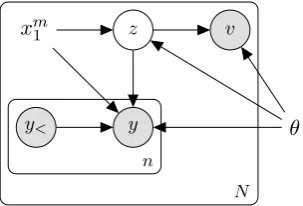
(a) VMMTC: given the source textxm1 , we model the joint likelihood of the translationy1n, the image (features)v, and a stochastic embeddingzsampled from a conditional latent Gaussian model. Note that the stochastic embedding is the sole responsible for assigning a probability to the observationv, and it helps assign a probability to the translation.
xm1
yn1
z
v
λ
N
[image:3.595.97.249.62.165.2](b) Inference model for VMMTC: to approximate the true posterior we have access to both modalities (textxm1, y1n and imagev).
Figure 1: Generative model of target text and image features (left), and inference model (right).
yn
1, v|xm1 are not assumed to have been
indepen-dently produced.3 This is in direct contrast with multi-task learning or joint modelling without la-tent variables—for an extended discussion see (Eikema and Aziz,2019,§3.1).
Finally, Figure1(left) is a graphical depiction of the generative model: shaded circles denote ob-served random variables, unshaded circles indicate latent random variables, deterministic quantities are not circled; the internal plate indicates iteration over time-steps, the external plate indicates itera-tion over the training data. Note that deterministic parameters θ are global to all training instances, while stochastic embeddings z are local to each tuplehxm
1 , yn1, vi.
Inference Parameter estimation for our model is challenging due to the intractability of the marginal likelihood function (5). We can however employ variational inference (VI) (Jordan et al., 1999), in particular amortised VI (Kingma and Welling,
2014;Rezende et al.,2014), and estimate parame-ters to maximise a lowerbound
Eqλ(z|xm1,yn1,v)[logpθ(v|z) + logPθ(y n
1|xm1 , z)]
−KL(qλ(z|xm1 , y1n, v)||pθ(z|xm1 ))
(6) on the log-likelihood function. This evidence lowerbound (ELBO) is expressed in terms of an
inference modelqλ(z|xm1 , y1n, v)which we design
having tractability in mind. In particular, our
ap-3This is an aspect of the model we aim to explore more explicitly in the near future.
proximate posterioris a Gaussian distribution
qλ(z|xm1 , y1n, v) =N(z|u,diag(s2))
u=gu(xm1 , y1n, v;λ)
s=gs(xm1 , yn1, v;λ)
(7)
parametrised by aninference network, that is, an in-dependently parameterised neural network (whose parameters we denote collectively by λ) which maps from observations, in our case a sentence pair and an image, to a variational locationu∈Rc
and a variational scales∈Rc>0. Figure1(right) is
a graphical depiction of the inference model. Location-scale variables (e.g. Gaussians) can be reparametrised, i.e. we can obtain a latent sample via a deterministic transformation of the variational parameters and a sample from the standard Gaus-sian distribution:
z=u+s where∼ N(0, I). (8)
This reparametrisation enables backpropagation through stochastic units (Kingma and Welling,
2014;Titsias and L´azaro-Gredilla,2014). In addi-tion, for two Gaussians theKLterm in the ELBO (6) can be computed in closed form (Kingma and Welling,2014, Appendix B). Altogether, we can obtain a reparameterised gradient estimate of the ELBO, we use a single sample estimate of the first term, and count on stochastic gradient descent to attain a local optimum of (6).
Architecture All of our parametric functions are neural network architectures. In particular,fπ is
slightly by providingzas additional input to the target-language decoder at each time step. Loca-tion layersfµ,fν andgu, and scale layersfσand
gs, are feed-forward networks with a single ReLU
hidden layer. Furthermore, location layers have a linear output while scale layers have asoftplus out-put. For the generative model,fµandfσtransform
the average source-language encoder hidden state. We let the inference model condition on source-language encodings without updating them, and we use a target-language bidirectional LSTM en-coder in order to also condition on the complete target sentence. Thengu andgs transform a
con-catenation of the average source-language encoder hidden state, the average target-language bidirec-tional encoder hidden state, and the image features.
Fixed Gaussian prior We have just presented our variational MMT model in its full generality— we refer to that model as VMMTC. However,
keep-ing in mind that MMT datasets are rather small, it is desirable to simplify some of our model’s com-ponents. In particular, the estimated latent Gaus-sian model (1) can be replaced by a fixed standard Gaussian prior, i.e.,Z∼ N(0, I)—we refer to this model as VMMTF. Along with this change it is
con-venient to modify the inference model to condition onxm1 alone, which allow us to use the inference model for both training and prediction. Importantly this also sidesteps the need for a target-language bidirectional LSTM encoder, which leaves us a smaller set of inference parametersλto estimate. Interestingly, this model does not rely on features from v, instead only using it as learning signal through the objective in (6), which is in direct con-trast with the model ofToyama et al.(2016).
3 Experiments
Our encoder is a 2-layer500D bidirectional RNN with GRU, the source and target word embeddings are500D, and all are trained jointly with the model. We use OpenNMT to implement all our models (Klein et al., 2017). All model parameters are initialised sampling from a uniform distribution
U(−0.1,+0.1)and bias vectors are initialised to~0. Visual features are obtained by feeding images to the pre-trained ResNet-50 and using the activations of thepool5layer (He et al., 2015). We apply dropout with a probability of 0.5in the encoder bidirectional RNN, the image features, the decoder RNN, and before emitting a target word.
All models are trained using the Adam opti-miser (Kingma and Ba,2014) with an initial learn-ing rate of0.002and minibatches of size 40, where each training instance consists of one English sen-tence, one German sentence and one image (MMT). Models are trained for up to 40 epochs and we per-form model selection based on BLEU4, and use the best performing model on the validation set to translate test data. Moreover, we halt training if the model does not improve BLEU4 scores on the vali-dation set for 10 epochs or more. We report mean and standard deviation over4independent runs for all models we trained ourselves (NMT, VMMTF,
VMMTC), and other baseline results are the ones
reported in the authors’ publications (Toyama et al.,
2016;Elliott and K´ad´ar,2017).
We preprocess our data by tokenizing, lower-casing, and converting words to subword tokens using a bilingual BPE model with10k merge oper-ations (Sennrich et al.,2016b). We quantitatively evaluate translation quality using case-insensitive and tokenized outputs in terms of BLEU4(Papineni et al., 2002), METEOR (Denkowski and Lavie,
2014), chrF3 (Popovi´c,2015), and BEER ( Stano-jevi´c and Sima’an,2014). By using these, we hope to include word-level metrics which are tradition-ally used by the MT community (i.e. BLEU and METEOR), as well as more recent metrics which operate at the character level and that better corre-late with human judgements of translation quality (i.e. chrF3 and BEER) (Bojar et al.,2017).
3.1 Datasets
The Flickr30k dataset (Young et al.,2014) consists of images from Flickr and their English descrip-tions. We use thetranslated Multi30k (M30kT)
dataset (Elliott et al., 2016), i.e. an extension of Flickr30k where for each image one of its English descriptions was translated into German by a pro-fessional translator. Training, validation and test sets contain29k,1014and1k images respectively, each accompanied by the original English sentence and its translation into German. In addition to the test set released for the first run of the multi-modal translation shared task (Elliott et al.,2016), henceforth test2016, we also usetest2017
released for the next run of this shared task (Elliott et al.,2017).
addi-Model BLEU4↑ METEOR↑ chrF↑ BEER↑
NMT 35.0 (0.4) 54.9 (0.2) 61.0 (0.2) 65.2 (0.1)
Imagination 36.8 (0.8) 55.8 (0.4) – –
Model G 36.5 56.0 – –
VMMTF 37.7 (0.4) ↑0.9 56.0 (0.1) ↑0.0 62.1 (0.1) ↑1.1 66.6 (0.1) ↑1.4
VMMTC 37.5 (0.3) ↑0.7 55.7 (0.1) ↓0.3 61.9 (0.1) ↑0.9 66.5 (0.1) ↑1.3
Table 1: Results of applying variational MMT models to translate the Multi30k 2016 test set. For each model, we report the mean and standard deviation over4independent runs where models were selected using validation BLEU4 scores. Best mean baseline scores per metric are underlined and best overall results (i.e. means) are in bold. We highlight in green/red the improvement brought by our models compared to the best baseline mean score.
tional145K monolingual German descriptions re-leased as part of the Multi30k dataset to the task of image description generation (Elliott et al.,2016). We refer to this dataset ascomparable Multi30k
(M30kC). Descriptions in thecomparable Multi30k
were collected independently of existing English descriptions and describe the same29K images as in the M30kTdataset.
In order to obtain features for images, we use ResNet-50 (He et al., 2015) pre-trained on Ima-geNet (Russakovsky et al.,2015). We report experi-ments usingpool5features as our image features, i.e. 2048-dimensional pre-activations of the last layer of the network.
In order to investigate how well our models gen-eralise, we also evaluate our models on the ambigu-ous MSCOCO test set (Elliott et al.,2017) which was designed with example sentences that are hard to translate without resorting to visual context avail-able in the accompanying image.
Finally, we use a 50D latent embedding z in our experiments with the translated Multi30k data, whereas in our ablative experiments and experi-ments with the comparable Multi30k data, we use a500D stochastic embeddingz.
3.2 Baselines
We compare our work against three different base-lines. The first one is a standard text-only sequence-to-sequence NMT model with attention (Luong et al., 2015), trained from scratch using hyper-parameters described above. The second base-line is the variational multi-modal MT model
Model Gproposed byToyama et al.(2016), where global image features are used as additional in-put to condition an inference network. Finally, a third baseline is theImagination model of El-liott and K´ad´ar(2017), a multi-task MMT model
which uses a shared source-language encoder RNN and is trained in two tasks: to translate from En-glish into German and on image-sentence ranking (English↔image).
3.3 Translated Multi30k
We now report on experiments conducted with mod-els trained to translate from English into German using thetranslated Multi30kdata set (M30kT).
In Table 1, we compare our variational MMT models—VMMTCfor the general case with a
con-ditional Gaussian latent model, and VMMTFfor
the simpler case of a fixed Gaussian prior—to the three baselines described above. The general trend is that both formulations of our VMMT improve with respect to all three baselines. We note an im-provement in BLEU and METEOR mean scores compared to the Imagination model (Elliott and K´ad´ar,2017), as well as reduced variance (though note this is based on only 4 independent runs in our case, and 3 independent runs of Imagination). Both models VMMTFand VMMTC outperform
Model G according to BLEU and perform com-parably according to METEOR, especially since results reported by (Toyama et al.,2016) are based on a single run. Moreover, we also note that both our models outperform the text-only NMT base-line according to all four metrics, and by 1%–1.4% according chrF3 and BEER, both being metrics well-suited to measure the quality of translations into German and generated with subwords units.
In Table 2, we report results when translat-ing the Multi30ktest2017and the ambiguous MSCOCO test sets. Note that standard deviations for the conditional model VMMTC are
consider-ably higher than those obtained for model VMMTF.
Model BLEU4↑ METEOR↑ chrF↑ BEER↑
Multi30k 2017 test set
VMMTF 30.1 (0.3) 49.9 (0.3) 57.2 (0.4) 62.2 (0.3)
VMMTC 26.1 (6.6) 45.4 (7.3) 52.2 (8.4) 58.6 (5.8)
Ambiguous MSCOCO 2017 test set
VMMTF 25.5 (0.5) 44.8 (0.2) 52.0 (0.3) 58.3 (0.2)
[image:6.595.158.439.65.186.2]VMMTC 21.8 (5.6) 41.2 (6.3) 47.4 (7.6) 55.3 (5.2)
Table 2: Results of applying variational MMT models to translate the Multi30k 2017 and the ambiguous MSCOCO test sets. For each model, we report the mean and standard deviation over4independent runs where models were selected using validation BLEU4 scores. Best overall results (i.e. means) are in bold. Note that standard deviations for the conditional model VMMTCare considerably higher than those obtained for model VMMTF. This is partly
due to the fact that one of the runs of VMMTCunderperformed compared to the other three.
worse than the others; this caused the mean scores to be much lower and also increased the variance significantly.
Finally, one interesting finding is that all four metrics indicate that the fixed-prior model VMMTF
either performs slightly (Table 1) or consider-ably better (Table 2) than the conditional model VMMTC. We speculate this is partly due to
VMMTF’s simpler parameterisation, after all, we
have just about29k training instances to estimate two sets of parameters (θandλ) and the more com-plex VMMTCrequires an additional bidirectional
LSTM encoder for the target text.
3.4 Back-translated Comparable Multi30k
Since thetranslated Multi30kdataset is very small, we also investigate the effect of including more in-domain data to train our models. For that pur-pose, we use additional145K monolingual German descriptions released as part of the comparable Multi30k dataset (M30kC). We train a text-only
NMT model to translate from German into English using the original 29K parallel sentences in the
translated Multi30k(without images), and apply this model to back-translate the145K German de-scriptions into English (Sennrich et al.,2016a).
In this set of experiments, we explore how pre-training models NMT, VMMTFand VMMTCusing
both thetranslatedandback-translated compara-ble Multi30kaffects results. Models are pre-trained on mini-batches with a one-to-one ratio of trans-lated andback-translated data.4 All three mod-els NMT, VMMTFand VMMTC, are further
fine-4One pre-training epoch corresponds to about290K exam-ples, i.e. we up-sample the smallertranslated Multi30kdata set to achieve the one-to-one ratio.
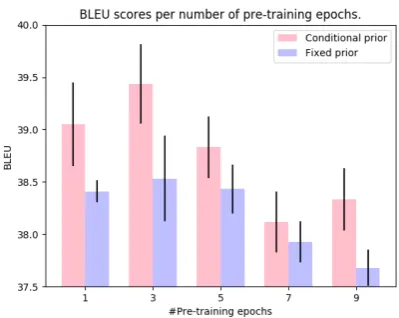
Figure 2: Validation set BLEU scores per number of pre-trained epochs for models VMMTC and VMMTF
pre-trained using thecomparable Multi30k and trans-lated Multi30kdata sets. The height of a bar represents the mean and the black vertical lines indicate±1 std over 4 independent runs.
tuned on the translated Multi30k until convergence, and model selection using BLEU is only applied during fine-tuning and not at the pre-training stage.
In Figure 2, we inspect for how many epochs should a model be pre-trained using the additional noisy back-translated descriptions, and note that both VMMTF and VMMTC reach best BLEU
scores on the validation set when pre-trained for about 3 epochs. As shown in Figure2, we note that when using additional noisy data VMMTC,
which uses a conditional prior, performs consider-ably better than its counterpart VMMTF, which has
a fixed prior. These results indicate that VMMTC
makes better use of additional synthetic data than VMMTF. Some of the reasons that explain these
[image:6.595.313.513.284.443.2]Model BLEU4↑ METEOR↑ # train sents.
NMT 37.7 (0.5) 56.0 (0.3)
145K VMMTF 38.4 (0.6)-↑0.7 56.0 (0.3)-↑0.0
VMMTC 38.4 (0.2)-↑0.7 56.3 (0.2)-↑0.3
[image:7.595.320.511.63.243.2]Imagination 37.8 (0.7) 57.1 (0.2) 654K
Table 3: Results for models pre-trained using the
translated and comparable Multi30k to translate the Multi30k test set. We report the mean and standard deviation over 4 independent runs. Our best over-all results are highlighted in bold, and we highlight in green/red the improvement/decrease brought by our models compared to the baseline mean score. We addi-tionally show results for the Imagination model trained on4×more data (as reported in the authors’ paper).
to be sensitive to whetherxis gold-standard or syn-thetic, whereasp(z)cannot;(ii)in the conditional case the posterior approximationq(z|x, y, v)can directly exploit different patterns arising from a gold-standard versus a synthetichx, yi pair; and finally(iii) our synthetic data is made of target-languagegold-standard image descriptions, which help train the inference network’s target-language BiLSTM encoder.
In Table 3, we show results when applying VMMTF and VMMTC to translate the Multi30k
test set. Both models and the NMT baseline are pre-trained on thetranslated and theback-translated comparable Multi30k data sets, and are selected according to validation set BLEU scores. For comparison, we also include results for Imagina-tion (Elliott and K´ad´ar,2017) when trained on the
translated Multi30k, the WMT News Commentary English-German dataset (240K parallel sentence pairs) and the MSCOCO image description dataset (414K German descriptions of83K images, i.e.5 descriptions for each image). In contrast, our mod-els observe29K images (i.e. the same as the mod-els evaluated in Section3.3) plus 145K German descriptions only.5
3.5 Ablative experiments
In our ablation we are interested in finding out to what extent the model makes use of the latent space, i.e. how important is the latent variable.
KL free bits A common issue when training la-tent variable models with a strong decoder is having
5There are no additional images because the
comparable Multi30kconsists of additional German descriptions for the same29K images already in thetranslatedMulti30k.
Model Number of BLEU4↑ free bits (KL)
VMMTF
0 38.3 (0.2)
1 38.1 (0.3)
2 38.4 (0.4)
4 38.4 (0.4)
8 35.7 (3.1)
VMMTC
0 38.5 (0.2)
1 38.3 (0.3)
2 38.2 (0.2)
4 36.8 (2.6)
8 38.6 (0.2)
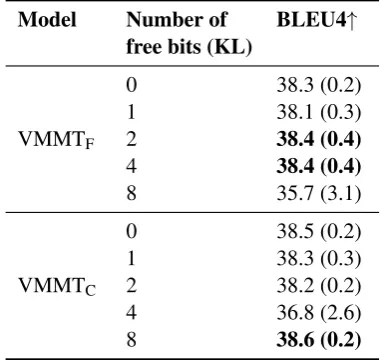
Table 4: Results of applying VMMT models trained with different numbers of free bits in the KL (Kingma et al.,2016) to translate the Multi30k validation set.
the true posterior collapse to the prior and the KL term in the ELBO vanish to zero. In practice, that would mean the model has virtually not used the latent variablezto predict image featuresv, but mostly as a source of stochasticity in the decoder. This can happen because the model has access to informative features from the source bi-LSTM en-coder and need not learn a difficult mapping from observations to latent representations predictive of image features.
For that reason, we wish to measure how well can we train latent variable MMT models while ensuring that the KL term in the loss (Equation (6)) does not vanish to zero. We use thefree bits heuris-tic (Kingma et al., 2016) to impose a constraint on the KL, which in turn promotes models with non-negligible mutual information between inputs and latent variables (Alemi et al.,2018).
In Table4, we see the results of different mod-els trained using different number of free bits in the KL component. We note that including free bits improves translations slightly, but note that finding the optimal number of free bits requires hyper-parameter search.
3.6 Discussion
Model Example #801 Example #873
source a man on a bycicle pedals through anarchway. a man throws a fishing net into thebay. reference ein mann f¨ahrt auf einem fahrrad durch einentorbogen. ein mann wirft ein fischernetz in diebucht.
M30kT M30kT
NMT ein mann auf einem fahrrad f¨ahrt durch einescheibe. ein mann wirft ein fischernetz in dieluft. VMMTF ein mann auf einem fahrrad f¨ahrt durch einentorbogen. ein mann wirft ein fischernetz in diebucht.
VMMTC ein mann auf einem fahrrad f¨ahrt durch einenbogen. ein mann wirft ein fischernetz in diebucht.
M30kT+ back-translated M30kC M30kT+ back-translated M30kC
NMT ein mann auf einem fahrrad f¨ahrt durch einenbogen. ein mann wirft ein fischernetz insmeer. VMMTF ein mann auf einem fahrrad f¨ahrt durch einentorbogen. ein mann wirft ein fischernetz in denwellen.
VMMTC ein mann auf einem fahrrad f¨ahrt durch einentorbogen. ein mann wirft ein fischernetz in diebucht.
Table 5: Translations for examples 801 and 873 of the M30k test set. In the first example, neither the NMT baseline (with or without back-translated data) nor model VMMTC(trained on limited data) could translatearchway
cor-rectly; the NMT baseline translates it as “scheibe” (disk) and “bogen” (bow), and VMMTCalso incorrectly
trans-lates it as “bogen” (bow). However, VMMTCtranslates without errors when trained on additional back-translated
data, i.e. “torbogen” (archway). In the second example, the NMT baseline translatesbayas “luft” (air) or “meer” (sea), whereas VMMTFtranslates it as “bucht” (bay) or “wellen” (waves) and VMMTCalways as “bucht” (bay).
additional back-translated data.
4 Related work
Even though there has been growing interest in vari-ational approaches to machine translation (Zhang et al., 2016; Schulz et al., 2018; Shah and Bar-ber, 2018;Eikema and Aziz, 2019) and to tasks that integrate vision and language, e.g. image de-scription generation (Pu et al.,2016;Wang et al.,
2017), relatively little attention has been dedicated to variational models for multi-modal translation. This is partly due to the fact that multi-modal ma-chine translation was only recently addressed by the MT community by means of a shared task ( Spe-cia et al.,2016;Elliott et al.,2017;Barrault et al.,
2018). Nevertheless, we now discuss relevant vari-ational and deterministic multi-modal MT models in the literature.
Fully supervised MMT models. All submis-sions to the three runs of the multi-modal MT shared tasks (Specia et al.,2016;Elliott et al.,2017;
Barrault et al.,2018) model conditional probabili-ties directly without latent variables.
Perhaps the first MMT model proposed prior to these shared tasks is that ofHitschler et al.(2016), who used image features to re-rank translations of image descriptions generated by a phrase-based statistical MT model (PBSMT) and reported sig-nificant improvements.Shah et al.(2016) propose a similar model where image logits are used to re-rank the output of PBSMT. Global image features, i.e. features computed over an entire image (such aspool5ResNet-50 features used in this work), have been directly used as “tokens” in the source sentence, to initialise encoder RNN hidden states, or as additional information used to initialise the
decoder RNN states (Huang et al.,2016;Libovick´y et al.,2016;Calixto and Liu,2017). On the other hand, spatial visual features, i.e. local features that encode different parts of the image separately in dif-ferent vectors, have been used in doubly-attentive models where there is one attention mechanism over the source RNN hidden states and another one over the image features (Caglayan et al.,2016;
Calixto et al.,2017).
Finally, Caglayan et al.(2017) proposed to in-teract image features with target word embeddings, more specifically to perform an element-wise mul-tiplication of the (projected) global image features and the target word embeddings before feeding the target word embeddings into their decoder GRU. They reported significant improvements by using image features to gate target word embeddings and won the 2017 Multi-modal MT shared task (Elliott et al.,2017).
Multi-task MMT models. Multi-task learning MMT models are easily applicable to translate sen-tences without images (at test time), which is an advantage over the above-mentioned models.
to do translation (English→German) and sentence-image ranking (English↔image), using a standard word cross-entropy and margin-based losses as its task objectives, respectively. Their model uses the pre-trained GoogleNet v3 CNN (Szegedy et al.,
2016) to extractpool5features, and has a 1-layer source-language bidirectional GRU encoder and a 1-layer GRU decoder.
Variational MMT models. Toyama et al.(2016) proposed a variational MMT model that is likely the most similar model to the one we put forward in this work. They build on the variational neural MT (VNMT) model ofZhang et al.(2016), which is a conditional latent model where a Gaussian-distributed prior ofzis parameterised as a function of the the source sentencexm1 , i.e. p(z|xm1 ), and both xm1 and z are used at each time step in an attentive decoder RNN,P(yj|xm1 , z, y<j).
InToyama et al.(2016), image features are used as input to the inference modelqλ(z|xm1 , yn1, v)that
approximates the posterior over the latent variable, but otherwise are not modelled and not used in the generative network. Differently from their work, we use image features in all our generative models, and propose modelling them as random observed outcomes while still being able to use our model to translate without images at test time. In the con-ditional case, we further use image features for posterior inference. Additionally, we also investi-gate both conditional and fixed priors, i.e.p(z|xm1 ) and p(z), whereas their model is always condi-tional. Interestingly, we found in our experiments that fixed-prior models perform slightly better than conditional ones under limited training data.
Toyama et al.(2016) uses the pre-trained VGG19 CNN (Simonyan and Zisserman,2015) to extract FC7 features, and additionally experiment with using additional features from object detections obtained with the Fast RCNN network (Girshick,
2015). One more difference between their work and ours is that we only use the ResNet-50 network to extractpool5features, and no additional pre-trained CNN nor object detections.
5 Conclusions and Future work
We have proposed a latent variable model for multi-modal neural machine translation and have shown benefits from both modelling images and promot-ing use of latent space. We also show that in the ab-sence of enough data to train a more complex infer-ence network a simple fixed prior suffices, whereas
when more training data is available (even noisy data) a conditional prior is preferable. Importantly, our models compare favourably to the state-of-the-art.
In future work we will explore other generative models for multi-modal MT, as well as different ways to directly incorporate images into these mod-els. We are also interested in modelling different views of the image, such as global vs. local image features, and also in using larger image collections and modelling images directly, i.e. pixel intensi-ties.
Acknowledgements
This work is supported by the Dutch Organisation for Scientific Research (NWO) VICI Grant nr. 277-89-002.
References
Alexander A. Alemi, Ben Poole, Ian Fischer, Joshua V. Dillon, Rif A. Saurous, and Kevin Murphy. 2018. Fixing a Broken ELBO. In
Proceedings of the 35th International Confer-ence on Machine Learning, ICML 2018, pages 159–168.
Dzmitry Bahdanau, Kyunghyun Cho, and Yoshua Bengio. 2015. Neural Machine Translation by Jointly Learning to Align and Translate. In
International Conference on Learning Repre-sentations, ICLR 2015, San Diego, California.
Lo¨ıc Barrault, Fethi Bougares, Lucia Specia, Chi-raag Lala, Desmond Elliott, and Stella Frank. 2018. Findings of the Third Shared Task on Multimodal Machine Translation. In Pro-ceedings of the Third Conference on Machine Translation: Shared Task Papers, pages 304– 323, Belgium, Brussels. Association for Com-putational Linguistics.
Ondˇrej Bojar, Yvette Graham, and Amir Kamran. 2017.Results of the WMT17 Metrics Shared Task. In Proceedings of the Second Confer-ence on Machine Translation, pages 489–513, Copenhagen, Denmark. Association for Com-putational Linguistics.
Task. In Proceedings of the Second Confer-ence on Machine Translation, pages 432–439, Copenhagen, Denmark. Association for Com-putational Linguistics.
Ozan Caglayan, Lo¨ıc Barrault, and Fethi Bougares. 2016. Multimodal attention for neural ma-chine translation. CoRR, abs/1609.03976.
Iacer Calixto and Qun Liu. 2017. Incorporating Global Visual Features into Attention-based Neural Machine Translation. InProceedings of the 2017 Conference on Empirical Methods in Natural Language Processing, pages 992– 1003, Copenhagen, Denmark. Association for Computational Linguistics.
Iacer Calixto, Qun Liu, and Nick Campbell. 2017.
Doubly-Attentive Decoder for Multi-modal Neural Machine Translation. InProceedings of the 55th Annual Meeting of the Associa-tion for ComputaAssocia-tional Linguistics (Volume 1: Long Papers), pages 1913–1924, Vancou-ver, Canada. Association for Computational Linguistics.
Michael Denkowski and Alon Lavie. 2014. Me-teor Universal: Language Specific Transla-tion EvaluaTransla-tion for Any Target Language. In
Proceedings of the EACL 2014 Workshop on Statistical Machine Translation.
Bryan Eikema and Wilker Aziz. 2019. Auto-encoding variational neural machine trans-lation. In 4th Workshop on Representation Learning for NLP.
Desmond Elliott, Stella Frank, Lo¨ıc Barrault, Fethi Bougares, and Lucia Specia. 2017.Findings of the second shared task on multimodal ma-chine translation and multilingual image de-scription. InProceedings of the Second Con-ference on Machine Translation, pages 215– 233, Copenhagen, Denmark. Association for Computational Linguistics.
Desmond Elliott, Stella Frank, Khalil Sima’an, and Lucia Specia. 2016.Multi30K: Multilingual English-German Image Descriptions. In Pro-ceedings of the 5th Workshop on Vision and Language, VL@ACL 2016, Berlin, Germany.
Desmond Elliott and ´Akos K´ad´ar. 2017. Imagi-nation improves multimodal translation. In
Proceedings of the Eighth International Joint Conference on Natural Language Processing (Volume 1: Long Papers), pages 130–141, Taipei, Taiwan. Asian Federation of Natural Language Processing.
Ross Girshick. 2015.Fast R-CNN. InProceedings of the 2015 IEEE International Conference on Computer Vision (ICCV), ICCV ’15, pages 1440–1448, Washington, DC, USA. IEEE
Computer Society.
Kaiming He, Xiangyu Zhang, Shaoqing Ren, and Jian Sun. 2015. Deep Residual Learn-ing for Image Recognition. arXiv preprint arXiv:1512.03385.
Julian Hitschler, Shigehiko Schamoni, and Stefan Riezler. 2016. Multimodal Pivots for Image Caption Translation. In Proceedings of the 54th Annual Meeting of the Association for Computational Linguistics (Volume 1: Long Papers), pages 2399–2409, Berlin, Germany.
Sepp Hochreiter and J¨urgen Schmidhuber. 1997.
Long short-term memory. Neural Comput., 9(8):1735–1780.
Po-Yao Huang, Frederick Liu, Sz-Rung Shiang, Jean Oh, and Chris Dyer. 2016. Attention-based Multimodal Neural Machine Transla-tion. In Proceedings of the First Confer-ence on Machine Translation, pages 639–645, Berlin, Germany.
MichaelI. Jordan, Zoubin Ghahramani, TommiS. Jaakkola, and LawrenceK. Saul. 1999. An introduction to variational methods for graph-ical models. Machine Learning, 37(2):183– 233.
Diederik P. Kingma and Jimmy Ba. 2014. Adam: A method for stochastic optimization. CoRR, abs/1412.6980.
Diederik P. Kingma and Max Welling. 2014. Auto-encoding variational bayes. InInternational Conference on Learning Representations.
Guillaume Klein, Yoon Kim, Yuntian Deng, Jean Senellart, and Alexander M. Rush. 2017.
OpenNMT: Open-source toolkit for neural ma-chine translation. InProc. ACL.
Jindˇrich Libovick´y and Jindˇrich Helcl. 2017. At-tention Strategies for Multi-Source Sequence-to-Sequence Learning. InProceedings of the 55th Annual Meeting of the Association for Computational Linguistics (Volume 2: Short Papers), pages 196–202, Vancouver, Canada. Association for Computational Linguistics.
Jindˇrich Libovick´y, Jindˇrich Helcl, Marek Tlust´y, Ondˇrej Bojar, and Pavel Pecina. 2016.CUNI System for WMT16 Automatic Post-Editing and Multimodal Translation Tasks. In Pro-ceedings of the First Conference on Machine Translation, pages 646–654, Berlin, Germany.
Minh-Thang Luong, Quoc V. Le, Ilya Sutskever, Oriol Vinyals, and Lukasz Kaiser. 2016. Multi-Task Sequence to Sequence Learning. InProceedings of the International Confer-ence on Learning Representations (ICLR), 2016, San Juan, Puerto Rico.
Thang Luong, Hieu Pham, and Christopher D. Manning. 2015. Effective Approaches to Attention-based Neural Machine Translation. In Proceedings of the 2015 Conference on Empirical Methods in Natural Language Pro-cessing (EMNLP), pages 1412–1421, Lisbon, Portugal.
Kishore Papineni, Salim Roukos, Todd Ward, and Wei-Jing Zhu. 2002. BLEU: A Method for Automatic Evaluation of Machine Translation. InProceedings of the 40th Annual Meeting on Association for Computational Linguistics, ACL ’02, pages 311–318, Philadelphia, Penn-sylvania.
Maja Popovi´c. 2015. chrF: character n-gram F-score for automatic MT evaluation. In Pro-ceedings of the Tenth Workshop on Statistical Machine Translation, pages 392–395, Lisbon, Portugal. Association for Computational Lin-guistics.
Yunchen Pu, Zhe Gan, Ricardo Henao, Xin Yuan, Chunyuan Li, Andrew Stevens, and Lawrence Carin. 2016.Variational autoencoder for deep learning of images, labels and captions. In D. D. Lee, M. Sugiyama, U. V. Luxburg, I. Guyon, and R. Garnett, editors,Advances in Neural Information Processing Systems 29, pages 2352–2360. Curran Associates, Inc.
Danilo Jimenez Rezende, Shakir Mohamed, and Daan Wierstra. 2014. Stochastic backprop-agation and approximate inference in deep generative models. InProceedings of the 31th International Conference on Machine Learn-ing, ICML 2014, BeijLearn-ing, China, 21-26 June 2014, pages 1278–1286.
Olga Russakovsky, Jia Deng, Hao Su, Jonathan Krause, Sanjeev Satheesh, Sean Ma, Zhi-heng Huang, Andrej Karpathy, Aditya Khosla, Michael Bernstein, Alexander C. Berg, and Li Fei-Fei. 2015. ImageNet Large Scale Visual Recognition Challenge. Interna-tional Journal of Computer Vision (IJCV), 115(3):211–252.
Philip Schulz, Wilker Aziz, and Trevor Cohn. 2018.
A stochastic decoder for neural machine trans-lation. In Proceedings of the 56th Annual Meeting of the Association for Computational Linguistics (Volume 1: Long Papers), pages 1243–1252. Association for Computational
Linguistics.
Rico Sennrich, Barry Haddow, and Alexandra Birch. 2016a. Improving Neural Machine Translation Models with Monolingual Data. InProceedings of the 54th Annual Meeting of the Association for Computational Linguis-tics (Volume 1: Long Papers), pages 86–96, Berlin, Germany. Association for Computa-tional Linguistics.
Rico Sennrich, Barry Haddow, and Alexandra Birch. 2016b.Neural Machine Translation of Rare Words with Subword Units. In Proceed-ings of the 54th Annual Meeting of the Associ-ation for ComputAssoci-ational Linguistics (Volume 1: Long Papers), pages 1715–1725, Berlin,
Germany.
N. Cesa-Bianchi, and R. Garnett, editors, Ad-vances in Neural Information Processing Sys-tems 31, pages 1346–1355. Curran Associates, Inc.
Kashif Shah, Josiah Wang, and Lucia Specia. 2016. SHEF-Multimodal: Grounding Ma-chine Translation on Images. InProceedings of the First Conference on Machine Transla-tion, pages 660–665, Berlin, Germany.
K. Simonyan and A. Zisserman. 2015. Very deep convolutional networks for large-scale image recognition. InProceedings of the Interna-tional Conference on Learning Representa-tions (ICLR), San Diego, CA.
Kihyuk Sohn, Honglak Lee, and Xinchen Yan. 2015. Learning structured output represen-tation using deep conditional generative mod-els. In C. Cortes, N. D. Lawrence, D. D. Lee, M. Sugiyama, and R. Garnett, editors, Ad-vances in Neural Information Processing Sys-tems 28, pages 3483–3491. Curran Associates, Inc.
Lucia Specia, Stella Frank, Khalil Sima’an, and Desmond Elliott. 2016. A Shared Task on Multimodal Machine Translation and Crosslingual Image Description. In Pro-ceedings of the First Conference on Machine Translation, WMT 2016, colocated with ACL 2016, pages 543–553, Berlin, Germany.
Miloˇs Stanojevi´c and Khalil Sima’an. 2014. Fit-ting sentence level translation evaluation with many dense features. In Proceedings of the 2014 Conference on Empirical Methods in Natural Language Processing (EMNLP), pages 202–206, Doha, Qatar. Association for Computational Linguistics.
Ilya Sutskever, Oriol Vinyals, and Quoc V. V Le. 2014. Sequence to sequence learning with neural networks. In Z. Ghahramani, M. Welling, C. Cortes, N.D. Lawrence, and K.Q. Weinberger, editors,Advances in Neu-ral Information Processing Systems 27, pages 3104–3112. Curran Associates, Inc.
C. Szegedy, V. Vanhoucke, S. Ioffe, J. Shlens, and Z. Wojna. 2016. Rethinking the inception ar-chitecture for computer vision. In2016 IEEE Conference on Computer Vision and Pattern Recognition (CVPR), pages 2818–2826.
Michalis Titsias and Miguel L´azaro-Gredilla. 2014. Doubly stochastic variational bayes for non-conjugate inference. InProceedings of the 31st International Conference on Machine Learning (ICML-14), pages 1971–1979.
Joji Toyama, Masanori Misono, Masahiro Suzuki, Kotaro Nakayama, and Yutaka Matsuo. 2016.
Neural machine translation with latent seman-tic of image and text. CoRR, abs/1611.08459.
Liwei Wang, Alexander Schwing, and Svetlana Lazebnik. 2017.Diverse and accurate image description using a variational auto-encoder with an additive gaussian encoding space. In I. Guyon, U. V. Luxburg, S. Bengio, H. Wal-lach, R. Fergus, S. Vishwanathan, and R. Gar-nett, editors, Advances in Neural Informa-tion Processing Systems 30, pages 5756–5766. Curran Associates, Inc.
Peter Young, Alice Lai, Micah Hodosh, and Julia Hockenmaier. 2014. From image descriptions to visual denotations: New similarity metrics for semantic inference over event descriptions.
Transactions of the Association for Computa-tional Linguistics, 2:67–78.
A Model Architecture
Once again, we wish to translate a source sequence xm1 , hx1,· · ·, xmiinto a target sequenceyn1 ,
hy1,· · ·, yni, and also predict image featuresv.
x
v y
µ σ
z
y v
λ θ
inference model generative model
∼ N(0, I)
[image:13.595.75.288.149.251.2]KL KL
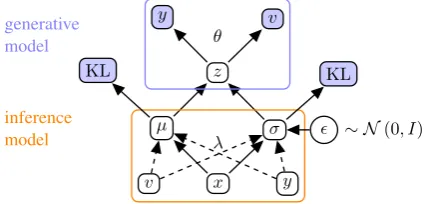
Figure 3: Illustration of multi-modal machine transla-tion generative and inference models. The conditransla-tional model VMMTCincludes dashed arrows; the fixed prior
model VMMTF does not, i.e. its inference network
only usesx.
In Figure3, we illustrate generative and infer-ence networks for models VMMTCand VMMTF.
A.1 Generative model
Source-language encoder The source-language encoder is deterministic and implemented using a 2-layer bidirectional Long Short-Term Memory (LSTM) network (Hochreiter and Schmidhuber,
1997):
fi = emb(xi;θemb-x),
h0 =~0,
− →
hi = LSTM(hi−1,fi;θlstmf-x),
←−
hi = LSTM(hi+1,fi;θlstmb-x),
hi = [
− →
hi,
←−
hi],
(9)
whereembis the source look-up matrix, trained jointly with the model, andhm1 are the final source hidden states.
Target-language decoder Now we assume that zis given, and will discuss how to compute it later on. The translation model consists of a sequence of draws from a Categorical distribution over the target-language vocabulary (independently from image featuresv):
Yj|z, x, y<j ∼Cat(fθ(z, x, y<j)),
where fθ parameterises the distribution with an
attentive encoder-decoder architecture:
wj = emb(yj;θemb-y),
s0= tanh affine(hm1 ;θinit-y)
,
sj = LSTM(sj−1,[wj,z];θlstm-y),
ci,j = attention(hm1 ,sn1;θattn),
fθ(z, x, y<j) = softmax(affine([sj,cj];θout-y)),
where the attention mechanism is a bi-linear attention (Luong et al., 2015), and the generative parameters are θ = {θemb-{x,y}, θlstm{f,b}-x, θinit-y, θlstm-y, θattn, θout-y}.
Image decoder We do not model images directly, but instead as a2048-dimensional feature vectorv
of pre-activations of a ResNet-50’spool5layer. We simply draw image features from a Gaussian observation model:
V|z∼ N(ν, ς2I),
ν = MLP(z;θ), (10)
where a multi-layer perceptron (MLP) maps from zto a vector of locationsν ∈Ro, andς ∈
R>0is
a hyper-parameter of the model (we use1).
Conditional prior VMMTC Given a source
sen-tencexm1 , we draw an embeddingzfrom a latent Gaussian model:
Z|xm1 ∼ N(µ,diag(σ2)),
µ= MLP(hm1 ;θlatent), (11)
σ= softplus(MLP(hm1 ;θlatent)), (12)
where Equations (11) and (12) employ two multi-layer perceptrons (MLPs) to map from a source sentence (i.e. source hidden states) to a vector of locationsµ∈Rcand a vector of scalesσ∈
Rc>0,
respectively.
Fixed prior VMMTF In the MMT model
VMMTF, we simply have a draw from a standard
Normal prior:
Z ∼ N(0, I).
All MLPs have one hidden layer and are imple-mented as below (eqs. (10) to (12)):
MLP(·) = affine(ReLU(affine(·;θ));θ).
A.2 Inference model
Conditional prior VMMTC Model VMMTC’s
approximate posteriorqλ(z|xm1 , yn1, v)is a
Gaus-sian distribution:
Z|xm1 , yn1, v∼ N(u,diag(s2);λ).
We use two bidirectional LSTMs, one over source-and the other over target-language words, respec-tively. To reduce the number of model parame-ters, we re-use the entire source-language BiLSTM and the target-language embeddings in the gener-ative model but prevent updates to the genergener-ative model’s parameters by blocking gradients from be-ing back-propagated (Equation9). Concretely, the inference model is parameterised as below:
hm1 = detach(BiLSTM(xm1 ;θemb-x,lstmf-x,lstmb-x)),
wn1 = detach(emb(yn1;θemb-y)),
hx= avg(affine(hm1 ;λx)),
hy = avg(BiLSTM(wn1;λy)),
hv = MLP(v;λv),
hall= [hx,hy,hv],
u= MLP(hall;λmu),
s= softplus(MLP(hall;λsigma)),
where the set of the inference network parameters areλ={λx, λy, λv, λmu, λsigma}.
Fixed prior VMMTF Model VMMTF’s
approx-imate posteriorqλ(z|xm1 )is also a Gaussian:
Z|xm1 ∼ N(u,diag(s2);λ),
where we re-use the source-language BiLSTM from the generative model but prevent updates to its parameters by blocking gradients from being back-propagated (Equation9). Concretely, the inference model is parameterised as below:
hm1 = detach(BiLSTM(xm1 ;θemb-x,lstmf-x,lstmb-x)),
hx= avg(affine(hm1 ;λx)),
u= MLP(hx;λmu),
s= softplus(MLP(hx;λsigma)),
where the set of the inference network parameters areλ={λx, λmu, λsigma}.
Finally, all MLPs are implemented as below: