71
©IJRASET: All Rights are Reserved
Virtual Grid based Dynamic Route Adjustment (
VGDRA) Scheme based on Sink Mobility for
Wireless Sensor Networks
Akanksha Sharma1 Dr.Vijay Nehra2 1,2
Department of electronics and communication Bhagat phool singh women university, Khanpur Distt. sonipat, Haryana, India
Abstract: In wireless sensor networks (WSN), to control the energy dissipation of the nodes, the use of mobile sink nodes is considered as the major solution. The mobile sink has various advantages and disadvantages as well. The data transmission in a network with mobile sink becomes difficult due to constant variations in network topology. Therefore to transmit the data from source node to sink node, the nodes need to reconstruct the route every time when sink update its location which can leads to the high energy consumption and reduction in network lifetime.
In this paper a VGDRA i.e. Virtual Grid Dynamic Route Adjustment based mechanism is developed to enhance the network lifetime along with reduced delay. The strategy of Cluster head selection is enhanced by selecting the CHs on the basis of the energy and delay. After simulating the proposed work, the results demonstrate that the Network Lifetime is enhanced, network structure cost and network convergence time is reduced.
Keywords: Wireless Sensor Network, Cluster Head, Route, VGDRA, Network Structure Cost, Network Convergence Time.
I. INTRODUCTION
The WSN has gained popularity among each and every field nowadays; this is just because of its various features like enhanced network lifetime, easy and reliable data transmission [1]. The routing is the transmission process of data between source and destination. In earlier cases, the routing evaluation is performed on the basis of sink min distance [2]. So, a Virtual grid Based Dynamic Routes adjustment (VGDRA) as a novel approach is proposed that collect data periodically and data delivery performance and energy utilization between tradeoff optimization is the purpose of using it. The route reconstruction cost is get reduced by using this proposed protocol. The virtual structure is the designing criteria of this approach and in sensor nodes various nodes deployment is done and sink location can be tracked by every node present in field of sensor.
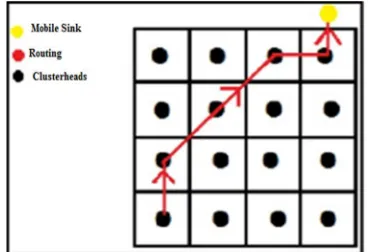
[image:1.612.212.399.533.716.2]The equal size cells are taken by dividing the field of sensor. This structure formed a grid due to which it is referred as virtual grid structure energy consumption reduction [3] is the main aim of using that methodology this is considered while routes reconstruction as well as its readjustment. This approach helps in improving network lifetime that makes it accurate, effective as well as efficient routing [4].
72
[image:2.612.214.399.77.203.2]©IJRASET: All Rights are Reserved
Figure 2:Shortest distance in grid routing approach [11]
The separation and straight line correspondence is used to assemble a virtual pine system in case of VGDRA that helps in system lifetime enhancement as well as its utilization reduction. The communication based on shortest distance is shown in figure 2 and straight line correspondence is shown in figure 1. The distance is considered as priority for communication.
A. Grid Based Routing
The routing based on grid is proposed by number of researchers. They have mainly focused on getting high scalability of network and energy conservation. In this section different researchers review is given in brief:
The Abdul Waheed Khanet al [1] (2015) have suggested the use of WSN in filling the gap of physical and digital world. In this paper, authors have focused on trade-off optimization for network lifetime and data delivery for it they have proposed a data dissemination method based on virtual grid. In most of the work sensor nodes monitoring is done by mobile sink node and there is generation of inappropriate output due to message partial delivery and delay. So, in order to achieve the required delivery and latency ration there is need of high Quality of service (QoS). The network lifetime enhancement is the aim of data distribution techniques based on mobile and on other hand some focus on data delivery performance improvement. To achieve it numbers of mobile sink nodes are added in the network but due to which there is cost of hardware as well as operating. So, authors have used the proposed technique that helps in reduction in operating and hardware cost. In this a shortest route is used that effectively distribute the update of mobile nodes related rule and as per sink mobility data delivery is performed in VGDD that confirm about the forward node delivery utilization. The network performance is tested by performing simulation on it that shows it is better in terms of delivery of data and latency reduction as compared to other existing techniques.
The VGDRA lifetime improvement is considered by Er. Yamini Sood et al [4] (2016) that control most nearest optimal path in reference to mobile sink current location . In this work networj based on grid is created using efficient routing scheme based on BBO algorithm. They have also worked on network lifetime enhancement by balancing the nodes consumption of energy. The VGDRA algorithm enhanced version is proposed by Rajanpreet Bhatti [16] (2017) that support routing algorithm based on grid. There is issue of issue in energy estimation by protocol that work on distance basis. The cell nodes and K- cells local grids categorization is done in proposed algorithm and after that cluster leader acted cluster head is elected. The proposed algorithm is tested by performing different experiments whose results show that the energy of route construction cost get minimized when shortest distance is considered between sinks.
Table 1 Related Work
Domain Authors Findings
Grid Based Routing
Liao et al. in [15] , T. P. Sharma [37], Jieun Cho et al [3] , Shrestha et al. [13] ,Bassel Arafeh [32] ,Chi and
Chang [14], Abdul
Waheed Khanet al [1] ,Er. Yamini Sood et al
A novel approach has formed on the basis of grid to handle
multiplicity as
well as
movements of
[image:2.612.175.439.594.731.2]73
©IJRASET: All Rights are Reserved
[4], Rajanpreet Bhatti [16]
in the sensor field
to ensure the
continuous delivery of data from source to the sinks.
Increases the
network lifetime.
Reduced
maintenance cost
High data
delivery ratio
Data Dissemination
Schemes
Haiyun Luo et al [17] ) ,Zeeshan Hameed Mir [19] ,Zehua Zhou [38] ,Min-Sook Jin [21] ,E. B. Hamida [18] ,B. Hamid et al [10] ,Xing G et al. [31] , Lee E [40], S.Oh et al [7], Erman.A.Dilo et al [6]
(2012) ,Ravi Kant
Sahu [20] (2012) ,Tang
et al [9]
(2012),Awadhesh
kumar [36]
(2013),Sandeep Kumar Yadav [2] (2013) ,Yun et al. in [30] (2013)
,Dinu Gopal [33]
(2015)
Presented a novel approach for Data Dissemination scheme to deploy
wireless sensor
networks on
random basis
Low
consumption of energy
Improvement
in energy
gain
Low delay
Latency
Maintaining
a balance in average delay
Sink Mobility
Juang P et al. [24] (2002),Chakrabarti A et al. in [26] (2003) ,X. Chen in [35] (2003) ,O.Younis et al [8] (2004),Chatzigiannakis I et al. in [23] (2006) ,Ishigami G et al. in [28] (2010) ,Ying et al. in [27] (2011) ,Lee H et al. in [29] (2010) ,T.S Chen et al [5]
Sink can be
categorized into
controlled and
uncontrolled sink mobility schemes based upon the data
dissemination
schemes. The
conclusion has
been derived
74
©IJRASET: All Rights are Reserved
(2013) ,Kinalis et al. in [22] (2014), ,Er. Shilpa jaswal [25] (2015) ,Gu Y [39] (2016) ,Nimisha Ghosh [34] (2017)
performed works are:
Reduced
congestion in the network.
Reduced
Path creation cost towards
the mobile
sink.
II. PROBLEM FORMULATION
As it is know that for formation of network we need to find the route between all the nodes coming in the network, for this purpose routing is done. Routing is defined as moving of information from source to destination. Along the way, at least one intermediate node is encountered. It can be referred as medium for sending packets from source and destination. Previously the routing was done on the basis of the minimum distance from the sink. Later the virtual gridding protocol was introduced. GRID is a two-level hierarchical reactive routing protocols. The main idea of GRID is that a geographic area is partitioned into several logic grids and the gateway election is held in each grid. A number of mobile nodes may exist in each grid. In traditional approach the cluster head is selected only once in the start of the communication after that the cluster head remain static but due this when the cluster head node died the communication stopped. This decrease the efficiency of the network. Another major problem of using this traditional protocol is that the node that are located far from the sink choose long route for the communication , that results in increase in the distance and the energy consumption was more. So there is a need to find some solution for the problem for the efficient routing in the network.
III. PROPOSED WORK
In this work, a new approach based on VGDRA scheme is proposed where construction of virtual infrastructure and maintenance of fresh routes towards the latest location of mobile sink is considered. A virtual infrastructure is designed using the sensor field partitioning into the form of virtual grid of uniform sized cells. The total number of cells defined in the network is a function of number of sensor nodes. Among these sensor nodes, a cluster head will be selected and data will be transmitted to the sink using this CH. Each cell in the network consists of several nodes acquired on random basis. On the whole, the evaluation of proposed technique is divided into three sections. In the first section of the work, network has been drawn and movement of sink is performed. The Cluster Head selection and final routing from source to the destination is done in the second section and in the last section of the work, energy consumption of individual node, performance parameters valuation and comparison will be achieved. The CH selection is done by using the equation below:
= + 1 + 1 … … … (1)
is Energy, Sink is base station and delay is extra time taken to transmit the data. The following steps are to be taken while carrying out the study:
A. As a initial step the main work is to firstly defining the network dimension that how much are it need to cover how many nodes
will be there and many other network parameters
B. Next step is to split the network into different grids as the main work is on basis of grid routing so the network will be split into
different grids
C. Later on as the nodes in count are defined but also need to localize then in the network with defining the x and the y coordinates
of the nodes and then deploy them in the network as per the location it got on random basiAs the communication will be there with the sink so the sink movement is mandatory in each and every round of communication,
D. 5. Further as per proposed work of the thesis as there is need to change the CH selection approach and the routing the network
75
©IJRASET: All Rights are Reserved
E. Finally the network parameters are to be calculated to get the performance of the proposed workGraphical representation of the
network parameter for the performance analysis is to be done finally.
Figure 3 Flow Diagram of Proposed Work
IV. RESULTS
This section of the study organizes the results that are obtained after implementing the proposed approach. The virtual grid based wireless network is formed firstly and then the CH selection is done. Thus, by following the route created by using CHs the data packets are transmitted to the sink node from source node. The performance of the proposed work is evaluated in the terms of network lifetime, network convergence time and structure construction cost in the terms of energy.
The graph in figure 4 delineates the comparison among BVI, VGDRA and proposes work on the basis of the network lifetime. The network lifetime of a network is evaluated on the basis of the number of rounds and number of nodes in the network. The graph shows that the network lifetime of proposed work is much better than of BVI and VGDR. The facts that are obtained from the graph, explains that in case of proposed work total 400 nodes are active till the completion of 1637 rounds whereas for BVI and VGDRA this figure is total 340 and 762 rounds respectively. Thus it can be said that the proposed work has better lifetime in contrast to BVI and VGDRA.
Defined Network Parameters such as Area, Number of nodes and source and
destination node in the network
Initialize location of sink and mobility Split the whole network into different grids
Generate x and y coordinates and locate them on the random basis in the network
Deploy all the nodes in the defined area
Select Cluster head in the network
76
[image:6.612.190.412.82.338.2]©IJRASET: All Rights are Reserved
Figure 4 Network Lifetime
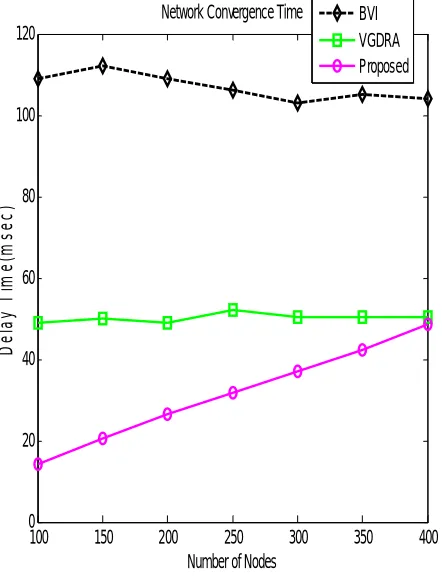
Network Convergence time reefers to the time taken by the network for connection generation. The network convergence time is measured with respect to the number of nodes and delay time. The maximum delay observed in case of proposed work is 48.45 ms, BVI is 104 ms and VGDRA is 50.2 ms. The network convergence time taken by the proposed work is minimum in comparison to the time taken by BVI and VGDRA methods.
Figure 5 Network Convergence Time
100 150 200 250 300 350 400
200 400 600 800 1000 1200 1400 1600 1800
Number of Nodes
N
u
m
b
e
r
o
f
R
o
u
n
d
s
Network Liftime BVI
VGDRA Proposed
100 150 200 250 300 350 400
0 20 40 60 80 100 120
Number of Nodes
D
e
la
y
T
im
e
(m
s
e
c
)
[image:6.612.194.415.428.716.2]77
©IJRASET: All Rights are Reserved
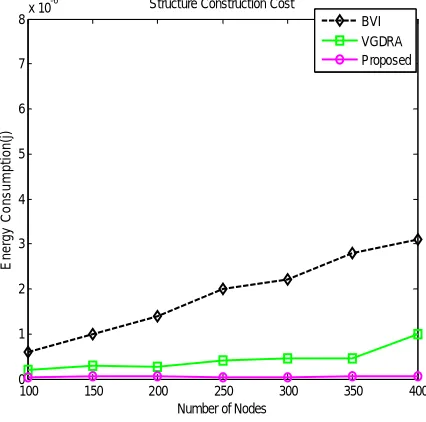
[image:7.612.199.412.124.335.2]The graph in figure 6 represents the comparison of the proposed and traditional techniques in the with respect to the structure construction cost of the network. The structure construction cost of proposed work is efficient in comparison to the BVI and VGDRA.
Figure 6 Structure Construction Cost
V. CONCLUSION
To sum up, a new VGDRA mechanism is developed in this study to reduce the energy consumption and delay in wireless sensor network. In order to achieve so the network is divided into small virtual grids and each grid is comprised of a CH or a representative node. The working of proposed mechanism is categorized into three major steps. In first the network is divided into small grids and the movement of mobile sink is located, in second the CH selection is performed and on the basis of selected CH the route creation is performed, after this, the third step is comprised of data transmission and energy consumption evaluation. Along with this various parameters such as delay in data transmission and network lifetime is also measured and concluded that the proposed work results to the higher network lifetime, reduced delay and energy consumption in the network.
As the VGDRA is considered to be efficient than the traditional routing algorithm in future the present technique can be further enhanced. The route selection method can be enhanced. The method of routing should increase the life time of network and the energy consumption of the network is reduced. . In future this technique can be further enhanced. The selection of the route should be done in the more efficient way by using advanced techniques so that the energy consumption of the network is reduced and the life time of the network is improved.
REFERENCES
[1]. Abdul Waheed Khan, “VGDD: A Virtual Grid Based Data Dissemination Scheme for Wireless Sensor Networks with Mobile Sink”, IEEE, Pp. 1-17, 2015 [2]. Sandeep Kumar Yadav, “A Novel Survey on Various Grid Based Data Dissemination”, IOSR-JECE, Pp. 1-8,2013
[3]. Jieun Cho, “A routing protocol using relative landmark based on virtual grid in wireless sensor network”, IEEE, Pp. 1-3, 2009 [4]. Rinki, Er. Yamini Sood, “Virtual based Data Dissemination Schemes for Mobile Sink in WSN”, IJCA, Vol 148, No.3, Pp 7-12, 2016
[5]. T.-S. Chen, H.-W. Tsai, Y.-H. Chang, and T.-C. Chen, “Geographic convergecast using mobile sink in wireless sensor networks,” Comput. Commun., Vol. 36, No.4, Pp.445–458, 2013
[6]. Erman, A. Dilo, and P. Havinga, “A virtual infrastructure based on honeycomb bessellation for data dissemination in multi-sink mobile wireless sensor networks,” EURASIP J. Wireless Commun. Netw., Vol. 2012, No.17, Pp.1 –54, 2012
[7]. S. Oh, E. Lee, S. Park, J. Jung, and S.-H. Kim, “Communication scheme to support sink mobility in multi-hop clustered wireless sensor networks,” in Proc. 24th IEEE Int. Conf. Adv. Inf. Netw. Appl., Apr.2010, Pp.866–872
[8]. O. Younis and S. Fahmy, “HEED: A hybrid, energy - efficient, distributed clustering approach for ad hoc sensor networks,” IEEE Trans. Mobile Comput., Vol. 3, No.4, Pp.366 –379, Oct. 2004
[9]. Tang, J. Wang, X. Geng, Y. Zheng, and J.-U. Kim, “A novel data retrieving mechanism in wireless sensor networks with path - limited mobile sink,” nt. J. Grid Distrib. Comput., Vol. 5, No.3, Pp.133 – 140 , 2012
[10]. B. Hamida and G. Chelius, “A line - based data dissemination protocol for wireless sensor networks with mobile sink,” in Proc. IEEE Int. Conf. Commun., Pp. 2201 – 2205, May 2008
100 150 200 250 300 350 400
0 1 2 3 4 5 6 7 8x 10
-6
Number of Nodes Structure Construction Cost
E
n
e
rg
y
C
o
n
s
u
m
p
ti
o
n
(j
)
78
©IJRASET: All Rights are Reserved
[11]. Er. Shilpa jaswal, Abhitesh and Abhinav, “A Review on Virtual Grid Based Dynamic Routes Adjustment in WSN”, International Research Journal of Engineering and Technology (IRJET), Vol. 3, No.2, Pp.957-960, February 2016
[12]. Jitin Rajan and Abhishek Gupta, “VGDRA (Virtual Grid Based Dynamic Routing Protocol)”, International Journal of Advanced Research in Computer Science & Technology, Vol. 4, No.2, Pp.158-160, Jun 2016
[13]. D. M. Shrestha, C. Kim, and U. -B Ko, “A reliable multi-grid protocol for tactical MANETs,” Research in Applied Computation Symposium (RACS’11), Pp.164-169, Miami Florida, USA, November 2011
[14]. Y. -P. Chi, and H. -P. Chang, “A tracking-assisted routing scheme for wireless sensor networks,” Wireless Personal Communications, Vol. 70, Pp.411–433, 2013
[15]. W. -H. Liao, Y. -C. Tseng and J.-P. Sheu, “Grid: a fully location-aware routing protocol for mobile ad hoc networks, Telecommunication Systems, Vol. 18, No. 1-3, Pp.37-60, 2001
[16]. Rajanpreet Bhatti and Gurinderjeet kaur, “Virtual Grid Based Energy Efficient Mobile sink Routing Algorithm for WSN”, 2017 11th International Conference on Intelligent Systems and Control (ISCO), Pp.30-33, 2017
[17]. H. Luo, F.-Y. J. Cheng, S. Lu and L. Zhang,"TTDD: Two Tier Data Dissemination in Large Scale Wireless Sensor Networks, “Wireless Networks, Vol. 11, No.1-2, Pp.161-175, Jan 2005
[18]. E. B. Hamida and G. Chelius, "A Line-Based Data Dissemination Protocol for Wireless Sensor Networks with Mobile Sink," Prac. IEEE ICC '08, Beijing, China, May 2008
[19]. Z. H. Mir and Y-B. Ko, "A quadtree-based data dissemination protocol for wireless sensor networks with mobile sinks," in Proc. Personal Wireless Commun., Pp.447-458, 2006
[20]. Ravi Kant Sahu, Abhishek Mohta and L.K. Awasthi, "Energy Etlicient Grid based Data Dissemination in Wireless Sensor Network" published in International Journal of Computer Application, 2012
[21]. Min-Sook Jin, Y ounghwan Choi, Fucai Yu, Euisin Lee, Soochang Park, Sangha Kim, "A Energy efficient datadissemination protocol with multiple virtual grid in wireless sensor network", Proceedings of Asia-Pacific Conference on Communications, Pp. 77-380, 2007
[22]. Kinalis, S. Nikoletseas, D. Patroumpa, and J. Rolim, “Biased sink mobility with adaptive stop times for low latency data collection in sensor networks,” Inf. Fusion, Vol. 15, Pp.56–63, Jan. 2014
[23]. Chatzigiannakis I , Kinalis A , Nikoletseas S . Sink mobility protocols for data collection in wireless sensor networks. In: Proceedings of the 4th ACM international workshop on mobility management and wireless access. MobiWac ’06. New York, NY, USA: ACM; Pp. 52–59, 2006
[24]. Juang P , Oki H , Wang Y , Martonosi M , Peh LS , Rubenstein D . Energy-efficient computing for wildlife tracking: design tradeoffs and early experiences with zebranet. In: Proceedings of the 10th international conference on architectural support for programming languages and operating systems. ASP- LOS X. New York, NY, USA: ACM; Pp. 96–107, 2002
[25]. Abo-Zahhad M , Ahmed S , Sabor N , Sasaki S . Mobile sink-based adaptive immune energy-efficient clustering protocol for improving the lifetime and stability period of wireless sensor networks. IEEE Sens J, Vol. 15, No. 8, Pp. 4576–86, 2015
[26]. Chakrabarti A , Sabharwal A , Aazhang B . Using predictable observer mobility for power efficient design of sensor networks. In: Proceedings of the 2nd international conference on information processing in sensor networks. IPSN’03. Berlin, Heidelberg: Springer-Verlag; Pp. 129–145, 2003
[27]. Ying JJ-C , Lee W-C , Weng T-C , Tseng VS . Semantic trajectory mining for location prediction. In: Proceedings of the 19th ACM SIGSPATIAL international conference on advances in geographic information systems. GIS ’11. ACM; Pp. 34–43, 2011
[28]. Ishigami G , Kewlani G , Iagnemma K . Statistical mobility prediction for planetary surface exploration rovers in uncertain terrain. In: IEEE international conference on robotics and automation (ICRA), Pp. 93-588, 2010.
[29]. Lee H , Wicke M , Kusy B , Gnawali O , Guibas L . Data stashing: energy-efficient information delivery to mobile sinks through trajectory prediction. In: Proceedings of the 9th ACM/IEEE international conference on information processing in sensor networks. IPSN ’10. New York, NY, USA: ACM; Pp. 291– 302, 2010
[30]. Yun Y , Xia Y , Behdani B , Smith J . Distributed algorithm for lifetime maximization in a delay-tolerant wireless sensor network with a mobile sink. IEEE Trans Mobile Comput, Vol.12, No. 10, Pp. 1920–30, 2013
[31]. Xing G , Wang T , Xie Z , Jia W . Rendezvous planning in wireless sensor networks with mobile elements. IEEE Trans Mobile Computer, Vol. 7, No. 12, Pp. 1430–43, 2008
[32]. Bassel Arafeh, Khaled Day, Abderezak Touzene, Nasser Alzeidi, “GEGR: A Grid-Based Enabled Geographic Routing In Wireless Sensor Networks ”, 2013 IEEE 11th Malaysia International Conference on Communications, Pp.367-372, 2013
[33]. Dinu Gopal and Dr. Suriyakala C.D, “Performance Evaluation Of Hybrid Energy Efficient Cluster Based Routing Scheme For Mobile Sink Based WSN”, Control, Instrumentation, Communication and Computational Technologies (ICCICCT), 2015 International Conference on, December 2015
[34]. Nimisha Ghosh, Riddhiman Sett and Indrajit Banerjee, “ An efficient trajectory based routing scheme for delay-sensitive data in wireless sensor network”, Computers and Electrical Engineering, Pp.1–17, 2017
[35]. X. Chen and M. Xu, “A geographical cellular-like architecture for wireless sensor networks,” in Proc. Mobile Ad-Hoc Sensor Netw., Pp.249–258, 2003 [36]. Awadhesh kumar and Vinay Kumar, “A Novel Energy Aware Data Dissemination Routing Protocol for WSN”, international Journal of Application of
innovation in engineering and management, Vol.2, No. 4, April 2013
[37]. T. P. Sharma, R.C Joshi, Manoj Misra, "GBDD: Grid Based Data Dissemination in Wireless Sensor Networks", Advanced Computing and Communications, 2008, ADCOM 2008, Pp. 234 - 240, 2008
[38]. Zehua Zhou, Xiaojing Xiang and Xang,"An Energy Etlicient Data Dissemination Protocol In Wireless Sensor Network". Advanced Science and Technology Letters Vol. 48 (CIA2014), pp.135-140, 2006
[39]. Gu Y , Ren F , Ji Y , Li J . The evolution of sink mobility management in wireless sensor networks: a survey. IEEE Commun Surv Tutorials, Vol.18, No. 1, Pp. 507–24, 2016
![Figure 1: Straight line communication in VGRDA [11]](https://thumb-us.123doks.com/thumbv2/123dok_us/1256504.652973/1.612.212.399.533.716/figure-straight-line-communication-vgrda.webp)