Zero-M-Cordial Labeling of Some Graphs
Freeda Selvanayagom, Robinson S. Chellathurai Department of Mathematics, Scott Christian College, Nagercoil, India
Email: [email protected], [email protected]
Received August 14, 2012; revised September 28, 2012; accepted October 5, 2012
ABSTRACT
In this paper we prove that the complete bipartite graph km,n where m and n are even, join of two cycle graphs cn and cm
where n m 0 (mod 4), split graph of cn for even “n”, KnP2 where n is even are admits a Zero-M-Cordial
labeling. Further we prove that KnP2 BnK1,nP2,of odd n admits a Zero-M-Cordial labeling.
Keywords: Zero-M-Cordial Labeling; Split Graphs; Cartesian Product; H-Cordial
1. Introduction
We begin with finite, connected and undirected graph G
= (V(G), E(G). If the vertices of the graph are assigned
values subject to certain conditions then it is known as graph labeling. Any graph labeling will have the follow-ing three common characteristics. A set of numbers from which Vertex labels are chosen; = number of vertices of G having label i under f
f v i
fe i = number of edges of G having label i under f*.
The concept of cordial labeling was introduced by I. Cahit, who called a graph G is Cordial if there is a vertex labeling f v G:
such that the induced labeling
: G 0,1
0,1 f E
, defined by
f xy f x f y , for all edges xyE G
andwith the following inequalities holding and
0
1f f
v v 1 and ef
0 ef
1 1
.
In [1] introduced the concept of H-Cordial labeling. Cahit calls a graph H-Cordial if it is possible to label the edges with the numbers from the set in such a way that, for some k, at each vertex v the sum of the la-
bels on the edges incident with v is either k or –k and the
1, 1inequalities vf
k vf
k 1 and
1
1f f
e e 1
are also satisfied where v(i)and e(j)
are respectively, the number of vertices labeled with i
and the number of edges labeled with j. He calls a graph
Hn-Cordial if it is possible to label the edges with the
numbers from the set in such a way that, at each vertex v the sum of the labels on the edges inci-
1, 2, , ndent with v is in the set
1, 2, , n and the inequa- lities vf
i vf
i 1 and ef
i ef
i 1 arealso satisfied for each i with . The concept of
Zero-M-Cordial labeling is defined in [2]. A labeling f of a graph G is called Zero-M-Cordial, if for each vertex v, f(v) = 0. A graph G is called to be Zero-M-Cordial, if it
admits a Zero-M-Cordial labeling. The usefulness of the above definition appears when one tries to find an H- Cordial labeling for a given graph G. If H is a Zero- M-Cordial subgraph of G then H-Cordiality of G\E(H) simply implies H-Cordiality G.
1 i n
In [1] proved that kn,n is H-Cordial if and only if n > 2
and “n” is even; and km,n, m≠n is H-Cordial if and only
if n≡ 0 (mod4), m is even and m > 2, n > 2.
In [2] proved that kn is H-Cordial if and only if n≡ 0
or 3 (mod4) and n≠ 3. Wn is H-Cordial if and only if n is
odd. kn is not H2-Cordial if n≡ 1 (mod4). Also [2] prove
that every wheel has an H2-Cordial labeling.
In [3] several variations of graph labeling such as grace- ful, bigraceful, harmonious, cordial, equitable, humming etc. have been introduced by several authors. For defini- tions and terminologies in graph theory we refer to [4].
In this paper we investigate Zero-M-Cordial labeling on some Cartesian product of graphs, join of two graphs, and bipartite graph.
1.1. Definition: The join G = G1 + G2 of graph G1 and G2 with disjoint point sets V1 and V2 and edge sets E1 and E2 denoted by G = G1 + G2 is the graph union 1 2
together with all the edges joining v1, v2. If G1 is (p1,q1)
graph and G2 is (p2,q2) graph then
G G
2 G 1
G is a
p1p q2, 1q2p p1 2
.1.2. Definition: Let G1 = (V1, E1) and G2 = (V2, E2) be
two graphs. The Cartesian product of G1 and G2 which is
denoted by G1G2 is the graph with vertex set v = v1 × v2
consisting of vertices V
u
u u1, 2
,v
v v1, 2
G G/ u
and v are adjacent in 1 2 whenever u1 = v1 and u2
1.3. Definition: For a graph G the split graph is
ob-tained by adding to each vertex v, a new vertex v
such that is adjacent to every vertex that is adjacent to in G. The resultant graph is denoted by spl (G).
v v
2. Main Results
Theorem 2.1: Every cycle Cn of even order admits a
Zero-M-Cordial labeling
Proof: Let v1, , ,v2 vn be the vertices of cycle Cn
1, 1E G
Define f: two cases are to be
consid-ered.
Case (i) n 2 (mod 4)
For 1 i n
1
1, if 1 mod 2 ,
1, if 0 mod 2 and 1 i i
i f v v
i i
n
In view of the above labeling pattern we give the proof as follows:
When n 2 (mod 4)
The total number of edges labeled with are given by
1 s
1f
e n 2 and the total number of edges labeled with 1 s are given by ef
1 n 2 . Therefore the totaldifference between the edges labeled with 1 s and 1 s
are given by ef
1 ef
1 0 . The induced vertex labels are equal to zero. Thus for each vertex v,
0f v and ef
1 ef
1 1.Case (ii) n 0 (mod 4)
The total number of edges labeled with are given by
1 s
1f
e n 2 and the total number of edges labeled with 1 s are given by ef
1 n 2 . Therefore the total difference between the edges labeled with 1 s and 1s are given by ef
1 ef
1 0. The induced vertex labels are equal to zero. Thus for each vertex v,and
0f v ef
1 ef
1 1.Hence the cycle graph cn, even n admits a zero-M-
cordial labeling.
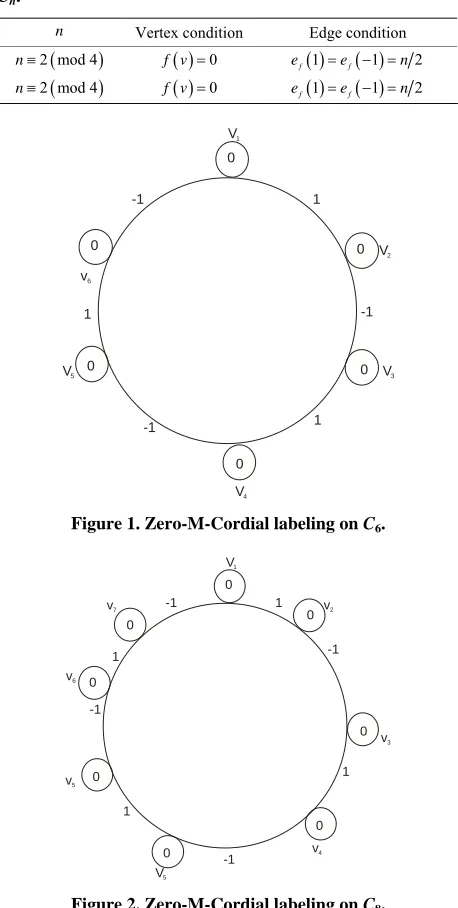
The vertex and the edge conditions are given in Table 1. The illustration is given in Figures 1 and 2.
In Figure 1 illustrates the Zero-M-Cordial labeling for
the cycle graph C6. Among the six edges three edges
re-ceive the label +1 and the other three edges rere-ceive the label –1. In Figure 2 illustrates the Zero-M-Cordial
la-beling for the cycle graph C8. Among the eight edges
four edges receive the label +1 and the other four edges receive the label –1.
Theorem 2.2: The complete bipartite graph km,n admits
a Zero-M-Cordial labeling for all m, n such that m + n
0, 2 (mod 4).
Proof: Let 1 2 and 1 2 are the
vertex set of the bipartite graph km,n. The number of ver-
tices and the edges of km,n is m + n and mn respectively.
, , , m
v v v u, , , u un
[image:2.595.309.538.103.557.2]Define f: E G
1, 1Table 1. The vertex and the edge conditions of cycle graph Cn.
n Vertex condition Edge condition
2 mod 4
n f v 0 ef 1 ef 1 n2
2 mod 4
n f v 0 ef 1 ef 1 n2
0
0
0 0
0
0 v6
V1
V2
V3
V4
V5
-1 1
-1 1
-1 1
Figure 1. Zero-M-Cordial labeling on C6.
0
0
0 0
0
0 v7
V1
v2
v3
v4
V5
-1 1
-1
-1 v6
0
v5
-1
1
1 0 1
Figure 2. Zero-M-Cordial labeling on C8.
The edge matrix of km,n is given in Table 2.
In view of the above edge matrix we give the proof as follows.
Case (i) when m + n 0 (mod 4), m = n.
Consider the bipartite graph k4,4.
Using Table 2 the edge label matrix of k4,4 is given by
1 v
2
3
4 v
v
v
1 2 3 4
1 1 1 1
1 1 1
1 1 1 1
1 1 1 1
0 0 0 0
u u u u
1
Table 2. Edge matrix of km,n.
1 2
: :
m v
v
v v
1 2
1 1 1 2 1
2 1 2 2 2
: : : : : :
n
m
m
u u u
v u v u v u
v u v u v u
1 2
1 2
m m m
n
v u v u v u
u u
: :
n
u
1
2
m v
v
With respect to the above labeling the total number of edges labeled with 1sand 1s are given by
1 fe n 2 and ef
1 n 2. Therefore the totaldif-ference between the edges labeled with
1s
and 1s
are given by ef
1 ef
1 0
. The induced vertex labels are equal to zero. Thus for each vertex v,
and
0f v ef 1 ef
1 1v
4 1 u
0
.
Hence the bipartite graph K4,4 admits a
Zero-M-Cor-dial labeling. The vertex and the edge conditions are given in Table 3. The illustration is given in Figure 3.
Figure 3 illustrates the Zero-M-Cordial labeling on
K4,4. Among the Sixteen edges eight edges receive the
label +1 and the other eight edges receive the label –1. Case (ii) When m + n 2 (mod 4), mn.
Consider the bipartite graph K2,4.
Using Table 2 the edge label matrix is given by
1
2 v
1 2 3
1 1 1
1 1 1
0 0 0 0
u u u
1 0
With respect to the above labeling the total number of edges labeled with 1sand 1sare given by
1 2,
ef n ef 1 n 2. Therefore the total difference
between the edges labeled with 1s and 1s are given
by ef
1 ef
1 0. The induced vertex labels areequal to zero. Thus for each vertex v, f v
0 and
1
1f f
e e 1.
Hence the bipartite graph k2,4 admits a zero-M-cor-
dial labeling.
Figure 4 illustrates the Zero-M-Cordial labeling on
k2,4. Among eight edges four edges receive the label +1
and other four edges receive the label –1.
Case (iii) When m + n 0 (mod 4) and mn.
Consider the bipartite graph k2,6.
Using Table 2 the edge label matrix is given by
1 v
6 u
0
2 v
1 2 3 4 5 1 1 1 1 1 1
1 1 1 1 1 1 0 0 0 0
u u u u u
0 0 0
With respect to the above labeling the total number of edges labeled with 1sand 1sare given by
Table 3. The vertex and the edge conditions of the bipartite graph Km,n.
n condition Vertex Edge condition
0 mod 4 ,
m n mn f v 0 ef 1 ef 1 n2
2 mod 4 ,
m n mn f v 0 ef 1 ef 1 n2
0 mod 4 , and
m n
m n
f v 0 ef 1 ef 1 n2
0
v1 v2 v3 v4
0 0 0
0 0
0 0
u1 u2 u3 u4
-1 1 -1
1 1
-1 1
-1 -1
1 -1 1 1
1 -1
-1
Figure 3. Zero-M-Cordial labeling on k4,4.
0 0
0 0 0 0
u1 u2 u3 u4
v1 v2
-1
-1 1 -1 -1
1 1
1
Figure 4. Zero-M-Cordial labeling on k2,4.
1 fe n 2 and ef
1 n 2. Therefore the totaldif-ference between the edges labeled with 1s and 1s
are given by ef
1 ef
1 0. The induced vertexlabels are equal to zero. Thus for each vertex v,
0f v and ef
1 ef
1 1.Hence the bipartite graph k2,6 admits a Zero-M-Cordial
labeling. The vertex and the edge conditions are given in
Table 3.
Figure 5 illustrates the Zero-M-Cordial labeling on
k2,6. Among the Twelve edges six edges receive the la-
0
-1
0
0 0 0 0
u1 u2 u3 u4
v1 v2
0 0
u5 u6
1 1
1 1 1
1 -1
-1 -1
[image:4.595.61.286.85.234.2]-1 -1
Figure 5. Zero-M-Cordial labeling on k2,6.
admits a Zero-M-Cordial labeling if n + m 0 (mod 4).
Proof: Let 1 2 and 1 2 are the
vertex set of the cycles Cn and Cm. The edge set E1 and
E2 is the graph union of Cn and Cm together with all the
edges joining the vertex set and .
, , , n
v v v
, , , m
u u u
,vn 1, ,2 v v
1, , ,2 m
u u u
We note that V G p1p2 and
1 2 1 2
1, 1E G
E G q q p p
1 v
4
1 1 0
. Define f:
The edge matrix of cn + cm is given in Table 4.
In view of the above labeling pattern we give the proof as follows:
When n + m 0 (mod 4)
[image:4.595.309.535.89.211.2]Consider the join of two cycle graphs C4 + C4. Using
Table 4 the edge label matrix of C4 & C4 is given by
2
3
4 v
v
v
1 2 3
1 1 1 1 1 1 1 1 1 1 1 1 1 1 1 1 1 1 1 1
u u u u
11 11
0 0 0 0
1 1 0 1 1 0 1 1 0
With respect to the above labeling the total number of edges labeled with 1s and 1s are given by
1 fe n 2 and ef
1 2. Therefore the totaldif-ference between the edges labeled with
n
1s
and 1s
are given by ef
1 ef
1
0. The induced vertexlabels are equal to zero. Thus for each vertex v,
0f v and f
1 f
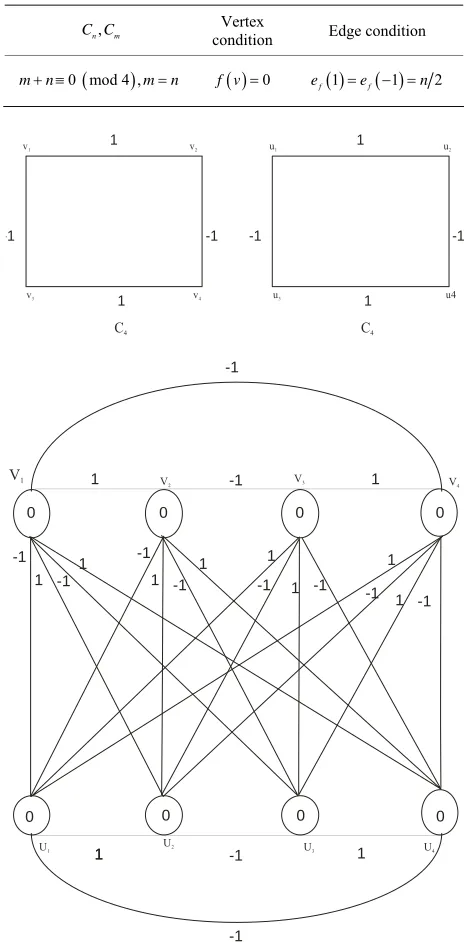
1 1Hence the join of two cycle graphs C4 and C4 admits a
Zero-M-Cordial labeling. The vertex and the edge condi-tions are given in Table 5.
e e
1
v
.
In Figure 6 illustrates the zero-M-Cordial labeling on
c4 + c4. Among the twenty four edges twelve edges
re-ceive the label +1 and the other twelve edges label –1. Theorem 2.4: The split graph of Cn, for even n, admits
Table 4. Edge matrix of Cn + Cm.
2
: :
n v
v
1 2
1 1 1 2 1
2 1 2 2 2
: : : : : :
m
m
m
u u u
v u v u v u
v u v u v u
1 2
1 2 1 1 2 2 3 1 1
, ,
n n n
m m
v u v u v u
u u , u u u u u u u u u u
m
m m
: :
1 2, 1 n
v v v v
1 2 2 3
1 n 1
,
, n n
v v v v
v v v v
Table 5. The vertex and the edge conditions of two cycle graphs Cn and Cm.
,
n m
C C condition Vertex Edge condition
0 mod 4 ,
m n mn f v 0 ef 1 ef 1 n2
u1
u3 u4
1
-1 -1
1
C4
u2
v1 1
-1 -1
1
C4 v3
v2
v4
V3 V4
U1 U2 U3 U4
1 -1 1
0 0 0 0
0 0 0 0
V1 V2
-1 -1
-1
-1
-1 -1 -1 -1
-1 1
1
1
1 1
1
1
1 -1
1
1 -1 1
[image:4.595.306.538.248.719.2] [image:4.595.83.266.463.561.2]a zero-M-cordial labeling.
Proof:
Let be the vertices of cycle Cn and
be the newly added vertices when n is even. 1, , ,2 n
v v v ,vn 1, ,2 v v
Let G be the split graph of cycle Cn with
i, ,1i
V G v v i n ,
1 1
1 1 1
, , 1 1, ,
, , 1 1,
i i n i i
n i i n
E G v v i n v v v v
v v v v i n v v
1,
we note that V G
2n and E G
3n.Define two cases are to be con-sidered. :
1f E G , 1
Case (i) when n 0 (mod 4)
For 1 i n 1
1
1 , if is odd ,
1, if is even
i i
i f v v
i
n, 1
1 f v v For 1 i n 1
i, i1
1 f v v
n, 1
1 f v v For 1 i n 1
i, i1
1 f v v
n, 1
1 f v v Case (ii) when n 2 (mod 4)
For 1 i n 1
1
1 , if 1 mod 2
,
1, if 0 mod 2
i i
i f v v
i
n, 1
1f v v
For 1 i n 1
i, i 1
1 f v v
n, 1
1 f v v For 1 i n 1
i, i 1
1 f v v
n, 1
1 f v v With respect to the above labeling pattern we give the proof as follows.
The total number of edges labeled with 1s and 1s
are given by and . Therefore the total difference between the edges labeled with
1 f
e
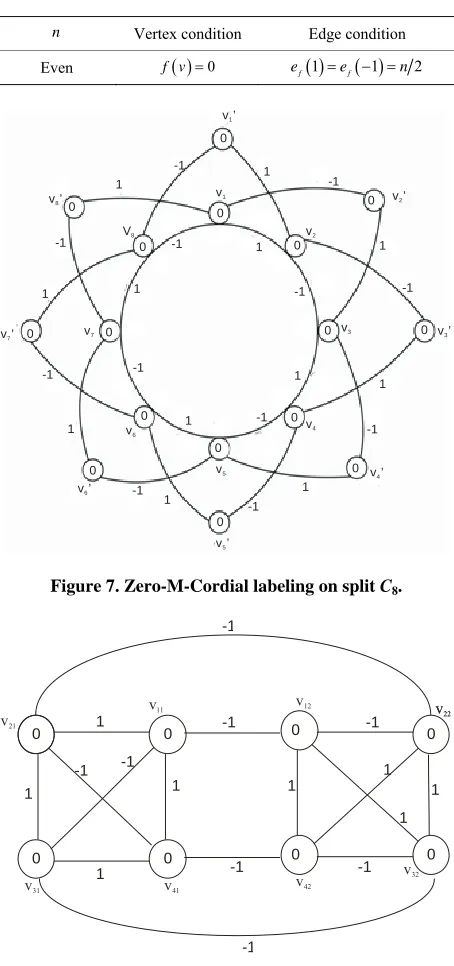
Hence the split graph of Cn for even n admits a Zero-
M-Cordial labeling. The vertex and the edge conditions are given in Table 6.
In Figure 7 illustrates the Zero-M-Cordial labeling on
split c8. Among the twenty four edges twelve edges re-ceive the label +1 and the other twelve edges rere-ceive the label –1.
Theorem 2.5: KnP2 admits a Zero-M-Cordial
la-beling for even n.
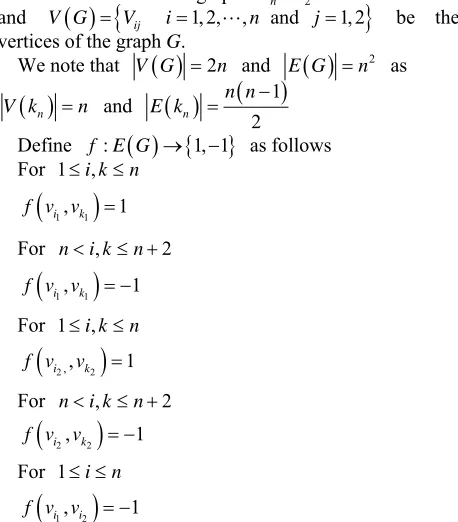
Proof: Let G be the graph KnP2 where n is even
and V G
Vij i1, 2, , n and j1, 2
be thevertices of the graph G.
We note that V G
2n and E G
n2 as
nV k n and
1
2
n n n
E k
Define f E G:
11 i k, n
, 1 as follows For
i1, k1
1f v v
For ni k, n 2
i1, k1
1f v v
For 1i k, n
i2,, k2
1f v v
For ni k, n 2
i2, k2
1f v v
For 1 i n
i1, i2
1f v v
With respect to the above labeling pattern we give the proof as follows.
The total number of edges labeled with 1s and 1s
are given by ef
1 n 2 and ef
1 n 2. Thereforethe total difference between the edges labeled with 1s
and 1s are given by e
1 e
1 0,f f differ by 0.
The induced vertex labels are equal to zero. Thus for each vertex v, f v
0 and f
1 f
1 1Hence n 2
e e .
K P admits a Zero-M-Cordial labeling for
even n. The vertex and the edge conditions are given in
Table 7.
Figure 8 illustrates the Zero-M-Cordial labeling on
2 n
k p . Among the sixteen edges eight edges label +1
and the other eight edges label –1.
Theorem 2.6: WnP2 admits a Zero-M-Cordial
la-beling for odd n.
Proof: Let G be the graph where n is odd
and n 2
W P
1, 2, , 1, 2
V G Vij i n1 and j be the
vertices of graph G. n ef
1 n1s and
1s are given by
1
1 0,
f f differ by
zero. The induced vertex labels are equal to zero. Thus for each vertex v, and
e e n
0f v
n
1 1 1
f f
e e .
We note that V G
2
n1
and E G
5n1 [image:5.595.309.538.203.464.2]Table 6. The vertex and the edge conditions of split of Cn.
,
n m
C C Vertex condition Edge condition
0 mod 4
n f v 0 ef 1 ef 1 n
2 mod 4
[image:6.595.57.285.101.145.2]n f v 0 ef 1 ef 1 n
Table 7. Vertex and the edge condition of knp2.
n Vertex condition Edge condition
Even f v 0 ef 1 ef 1 n2
0
0
0
0
0
0
0 0 0 0
0
0 0
0
0
0 1
1
1
1
1 1
1 1
-1
-1
-1
-1
-1
-1 -1
-1
v ’1
v ’2
v ’3
v ’4
v ’5
v ’6
v ’7
v ’8
v1
v2
v3
v4
v5
v6
v7
V8
1
1
1
1 -1
-1
[image:6.595.59.286.168.651.2]-1 -1
Figure 7. Zero-M-Cordial labeling on split C8.
v21
1
0 0 0
0 0
0
0
0
v11 v12 v22
v31 v41 v42
v32
1
1
1 1
1
1 1
-1 -1
-1 -1
-1
-1 -1
-1
v22
Figure 8. Zero-M-Cordial labeling on k4p2.
Define f E G:
1 as follows1i k, 2n2 , 1
n
For
i1, k1
1f v v
For 2n 2 i k, 2
i1, k1
1f v v
For 1i k, 2n2
i2,, k2
1f v v
For 2n 2 i k, 2n
i2, k2
1f v v
For 1 i n 1
i1, i2
1f v v
The total number of edges labeled with 1s and 1s
are given by ef
1 n 2 and ef
1 n 2. Thereforethe total difference between the edges labeled with 1s
and 1s are given by
1
1 0,ef ef differ by 0.
The induced vertex labels are equal to zero. Thus for each vertex v, f v
0 and f
1 f
1 1Hence n 2
e e .
W P admits a Zero-M-Cordial labeling for
odd n. The vertex and the edge conditions are given in
Table 8.
Figure 9 illustrates the Zero-M-Cordial labeling on
3 2
W P . Among the sixteen edges eight edges receive the
label +1 and the other eight edges label –1.
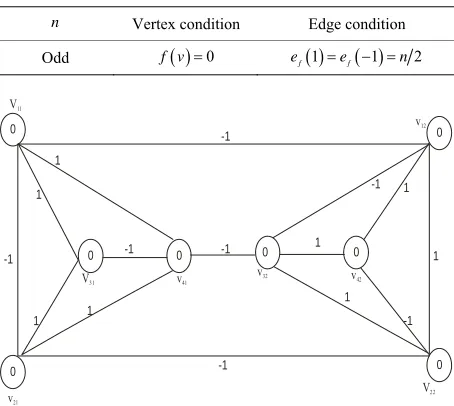
Theorem 2.7: Bnk1,nP2 (also known as book
graph) admits a Zero-M-Cordial labeling for odd n.
Proof: Let G be the graph K1,nP2 where n is odd
and V G
Vij i1, 2, , n1,j1, 2
be theverti-ces of G.
We note that V G
2
n1
and E G
3n1.Define f E G:
11 i k, n 1
, 1 as follows For
i1, k1
1f v v
For n 1 i k, n
i1, k1
1f v v
For 1i k, n 1
i2,, k2
1f v v
For n 1 i k, n
i2, k2
1f v v
For 1 i n
i1, i2
1f v v
For n i n 1
i1, i2
1f v v
The total number of edges labeled with 1s and 1s
are given by ef
1 n 2 and ef
1 n 2. Thereforethe total difference between the edges labeled with 1s
and 1s are given by
1
12 2
f f
n n
e e 0,
[image:6.595.60.284.431.640.2]
1
1f f
[image:7.595.56.284.105.139.2]e e
Table 8. Vertex and the edge condition of WnP2. 1.
Hence Bnk1,nP2 (also known as book graph) ad-
mits a Zero-M-Cordial labeling for odd n. The vertex and
the edge conditions are given in Table 9.
n Vertex condition Edge condition
[image:7.595.59.286.169.372.2]Odd f v 0 ef 1 ef 1 n2
Figure 10 illustrates Zero-M-Cordial labeling on
1,3 2
K P. Among the ten edges five edges receive the
label +1 and the other five edges receive the label –1.
Table 9. Vertex and the edge condition of Bnk1,nP2.
n Vertex condition Edge condition
Odd f v 0 ef 1 ef 1 n2
3. Concluding Remark
Here we investigate Zero-M-Cordial labeling for Carte- sian product of some graphs, join of two cycle graphs, split graphs and bipartite graphs. Similar results can be derived for other graph families and in the context of di- fferent graph labeling problem is an open area of re- search.
0 0
0 0
V31 v41 v42
v32
-1 V11
0
0 0
0 v12
v2
V22
1 1
1 1
1 -1
-1
-1 1
1
1 -1
-1
-1
REFERENCES
[1] I. Cahit, “H-Cordial Graphs,” Bulletin of the Institute of Combinatorics and Its Applications, Vol. 18, 1996, pp.
87-101.
[2] M. Ghebleh and R. Khoeilar, “A Note on ‘H-Cordial graphs’,” Bulletin of the Institute of Combinatorics and Its Applications, Vol. 31, 2001, pp. 60-68.
[image:7.595.76.266.223.566.2]1
Figure 9. Zero-M-Cordial labeling on W3P2. [3] J. A. Gallian, “A Dynamic Survey of Graph Labeling,”
The Electronics Journal of Combinatories, Vol. 18, 2011.
v21
0 0
0 0
v11 v12
v31 v32 v41 v42
1 1
-1
-1 v
22
0 0 0 0
-1
-1
-1 1
1 1
[4] F. Harary, “Graph Theory,” Addison Wesley, Reading, 1972.
[image:7.595.84.256.397.572.2]