NET GENERATION COMMUNICATION METHODS PREFERENCES Irina Sidorcuka
Riga International School of Economics and Business Administration Meza 3, Riga LV1049, Latvia
Abstract
Communication methods have been greatly affected by the development of technology and the emerging new media. At the same time communication has always been an integral part of culture, and cultural traditions and values of communication differ in different countries.
Net generation students entering higher educational establishments and later the employment market have their preferences to particular types of communication methods and to successfully reach them both high schools management and faculty as well as the potential employers should be aware of their fragmented communication media and the most preferred channels of communication of this generation.
The research shows that net generation students in Latvia, though well-equipped with new technology, tend to prefer face-to-face communication for both educational and social purposes, though representatives of different culture groups have different priorities in the choice of communication methods.
Key words: net generation, communication methods, culture, Latvian higher school
1. INTRODUCTION
Many research works have been devoted to the study of net generation, their characteristics (Prensky, Rishi, Oblinger, Strauss and Howe, etc.) and the implications for higher educational institutions in teaching these students and communicating with them. This generation has also been termed as “Digital Natives”, “Millennials” or “Generation Y” or i-Pod generation and characterized as being very different from generations of the past in their knowledge and experience in the use of technologies and a wide choice of communication media.
But this is not only technology that influences this generation communication methods .Many authors claim that generation is influenced and moulded by the historical events of high importance, which at their turn influence the value system of the whole generation. So it is not so much the time frame for net gen (being born between 1982-2002) or the technology itself but the values they have adopted through their childhood and youth.
The author considers that net generation representatives, though sharing some common characteristics, are still different as they belong to different cultures (countries),and under the influence of different historical events, specific and valuable for their country or even particular ethnic group can develop different values regarding the mode of communication and its meaning. They still grow in different environment including economic development, accessibility of technologies, attitude to time, money and understanding of success, availability of employment and future prospects for career and other aspect shaping their values of communication, needs for communication and the forms of communication.
2. NET GENERATION AND TECHNOLOGY
Net generation representatives called “digital natives” by Prensky (2001) and now making a bigger part of the university students are highly influenced by the development of telecommunication.
Technological development provides them with the new instruments to enhance the efficiency of communication, and give the choice of variety of communication channels and forms. The involvement of IT in the development of this generation has changed the way they communicate at school, at work and is social environment. Some researches claim that it has even affected the physiology of their brains and has led to psychological changes.
According to Rishi (2007, p. 7), “Contemporary students use a new and different model for communication and information access, one created by the Internet and fuelled by mobile technology”. Students of the Net Generation take availability of technology for granted; staying connected is a central part of their lives (Frand, 2000). They not only need to be connected at any one moment but also demand prompt reaction to their communication enquiry. Moreover it is not only the “need for speed” that is evident, but also “a faster approach is often perceived as a better approach” (Johnson, Levine, Smith & Stone, 2010, p. 4).
Nevertheless connectivity of the students does not guarantee that they can be timely reached and relevant exchange of information can be ensured between the students and the university .Though students seem to be always connected to their digital devices, their media is very fragmented and this halts efficiency of communication as their communication channels may include both „traditional „ and new media (Rishi, 2007) and their attention is also fragmented between them.
Another difficulty of reaching this generation is the level of appreciation of particular channels of communication by individual representatives. Though the impact of technological availability is undisputable over the net generation, it cannot be assumed that individual representatives of this generation group perceive the implementation of technology in communication as equally efficient, necessary or preferable over face-to-face communication. Some of the net gen demonstrates passionate appreciation and evident preference to technologies whereas others use technologies as it is generally practiced and necessary for the successful information exchange in contemporary learning or working environment.
2.1 Characteristics of net generation
The characteristics of this generation students are believed to be shaped not only by information technology revolutionary development but also by significant historical events that they share and general processes of globalisation involving economic, political and social change both at the level of state, organisations and communities.
This generation is also believed to be influenced by economic and social change at the family level such as the parental attention when “helicopter parent”, who “hover” over their college-student children, (Juncoand Mastrodicasa, 2007, p.14) provide higher level of security and self-confidence to them.
These students have become therefore more assertive and demanding. In their attitude to studies they are described as hands-on, collaborative students with personalised learning demands (Oblinger, 2003, p.37). They belong to a 24/7 culture with short attention span, ability for parallel processing and multitasking. They evidently demonstrate that their approach to studying is no longer linear but is based on “trial and error” where doing is more important than learning, and knowledge is no longer the ultimate goal (Schofield and Honore, 2010).
They have also developed consumer mentality which results in having high expectations in any area of life including communication for learning purposes or work. This consumer mentality commands the need not only for permanent connectedness and immediate feedback, but also detailed information and directness in communication. This at its turn creates difficulties for the university management and
faculty as these “digital natives” expectations for communication do not always comply with those of older generations “digital immigrants” (Prensky,2001).
Strauss and Howe (2006) identified 7 key characteristics of this generation: special, sheltered, confident, team-oriented, conventional, pressured, and achieving. They also were characterised as racially and ethnically more diverse than previous generations.
Other authors add that net generation value strong leadership, concern for community, structure, fair play, and diversity (Mastrodicasa & Junco, 2006). They are also described as optimistic, competent, outspoken, collaborative in the work setting, and responding well to authority (Alberta Learning Information Service, 2005).
They are driven, social, experiential learners, multitaskers (Junco and Mastrodicasa, 2007, p.138) with strong preference to visual information and team work. According to the authors, their ability to socialise and work or study in team has been generated and developed over the years of school education where group assignments and joint presentations as well as social interaction in the learning process were an important element of study process and contributed both to their collective grades and development of meaningful relationships with peers and teachers.
They are considered to be active learners with a tendency to involve themselves actively in discussions and team projects, rather than demonstrate interest to lecture based education. (Junco and Mastrodicasa, 2007 p.141).
Taking into account the above mentioned we can assume that net generation share the following characteristics : apart from being technology savvy and in need of permanent connectivity and fast response in communication , they are self-confident, multi-taskers, competent, outspoken, team-oriented, with short attention span and evident preference of visual information.
Young people of this generation are believed to identify with the values of their parents (babyboomers generation) more than other young people have in the past century Strauss and Howe (2006). This is an important factor as the values of the personality are formed to a great extent under the influence of the family, mainly parents, who ensure that their ethnical culture heritage is protected by teaching their values and creating the patterns of behaviour.
Communication forms, norms and meaning of communication occupy a central position in the value systems of any culture. So the assumption can be made that the importance of communication and its forms may vary in different ethnic groups and the attempt to describe the net generation as a whole using broad generalisation may not lead to an objective picture.
As learners backgrounds and values are much more diverse nowadays and their goals, expectations and needs to communication also differ, it can to a certain extend impact higher schools communication system. So it is important to discuss net generation also in relation to their culture and such integral spheres shaping this culture as :important events they are sharing, economic (or material ) background of their parents, country’s economic development and system , living conditions, norms of behaviour, and in close connection to previous generations of this culture group and interaction between them.
2.2 Net generation in Latvia
Net generation of Latvia is made up be young people whose parents went through tough economic and political change of 1990s which was called “perestroika” and later resulted in the collapse of the soviet economic system and led to creation of an independent country of Latvia, when the whole system of values was broken and a new model of society started shaping. Many of these parents failed to fit into this new system and have been experiencing severe economic problems, others have been successful in their entrepreneurial experience and created substantial material basis for their children. The gap between the material status of the net generation families in Latvia has influenced the values and attitudes of this generation greatly. On the one hand we encounter young people from rich families with a high level of self-confidence and a feeling of security, protection and independence
accompanied by indifference to community, negligence of social duties, consumerism in all aspects of life including education, in many cases low level of motivation in studies as they expect to be employed by their parents and granted well paid job or even ownership of a business. On the other hand young people originating from families with low income demonstrate a high level of responsibility and self-reliance, motivation in studies, usually they combine work and studying, lack of confidence, modesty, sometimes depression and insecurity caused by the lack of finance and unfair competition from their financially successful peers .This group is most endangered by economic instability and unemployment.
Both groups, nevertheless, are equipped with electronic means of communication though the ownership of devises is determined by the material status of the family.
Family values have been always important for Latvians and communication in the family is built according to the ethnic traditions. As the population of this country is made by ethnic Latvians (57,7%), Russian (29,6%) and other Russian speaking groups: Ukrainian, Belorussian, etc. So communication models and values are shaped differently in the families: Latvians are one of the low context cultures where directness in communication is most valued, time spent on socialising is limited, time efficiency is dominating over the process of communication itself. Latvians are sometimes seen as a “silent” nation as the process of communication is limited both in family environment and outside it. Russian speaking community on the contrary is made by representatives of higher context cultures which attributes special role to communication as the basis for building relationships and friendship and context, opening business opportunities, emotional development. Cultural roots identify to a big degree how these groups of population communicate. Latvians belong to an individualistic culture, whereas Russians to a collectivistic one, thus for Latvians communication channels will be fewer than for Russian-speaking minority.
Racial or ethnic diversity in Latvia is insubstantial and this also has its impact on the ability of young people to communicate with different culture groups and individuals. This to a certain degree also limits the tolerance of Latvian population to other cultures, unwillingness to share and communicate, and stimulates an already high level of ethnocentrism in this country.
Latvian students are not as group oriented as Russian speaking minority, so they cannot always be willing to work in teams. These two ethnic groups do not share attitude to authority either: for Latvian students hierarchy is almost non-existent as they respect low power distance within their group, whereas Russian speaking minority supports moderately high power distance. The authority of the teacher (instructor) therefore is also different among these students which results in different ways of communication between the peers and the teacher and peers.
Latvian students are also more introvertial, time –conscious, disciplined and well organised whereas Russian students in Latvia are group oriented, flexible with time, emotional extraverts who value multiple contacts and communication itself, at the same time they tend to lack discipline and self-motivation.
The net generation in Latvia though not being homogeneous in financial and cultural background still share the qualities developed under the influence of technological development : they are technology savvy, multitaskers, possess short attention span , are addicted to their electronic devises, need to stay connected at all times.
3. PURPOSE
The purpose of this preliminary research was to further understand characteristics of the Net Generation in general and Latvian net gens in particular, to identify differences in their values in Latvia and other countries regarding the use of communication media and methods at school( work) and social communication (peer, parents, relatives, interest groups networking) and to compare the results gained from the survey conducted among the students in Latvia (taking into account their
ethnic cultural -Latvian and Russian ) and International students hosted in RISEBA (Latvia) and HAAGA-HEILA ( Finland).
As one of the most comprehensive studies in the area of electronic communication is being conducted in US by EDUCAUSE Center for Applied Research (ECAR) since 2004, some of the data from this research dating back to 2010 was compared with the present research data.
Then comparing the data with the results obtained from EDUCAUSE Center for Applied Research study, USA (Rishi, 2007, p. 8) and data collected in 2010 by Robinson, Sherry and Stubberud, Hans Anton from Penn State University, Buskerud University College (Norway), a difference in communication methods preferences of net generation students in different countries could be identified to see if their ethnical cultural values for communication can influence the choice of media and methods as well as the time they spend on communicating via technological devices and barriers they face in the process of communication.
The results of the study can help in shaping a better communication structure between the school and the students regarding management and learning. It should also be beneficial for understanding how to reach the students most efficiently, to balance the use of technology in the learning process and to predict how the net generation representatives are going to communicate in their working multigenerational environment.
4. ADMINISTRATION
A multi-step process was used to create a survey. The survey was designed for 2 focus groups: 1st and 2nd year students of European Business Studies programme in the years 2012-2013-2014, N= 110, International students at RISEBA(N=48) and Haaga-Helia University in Helsinki, Finland (N=26) where ECO-SUPport 11 took place in 2013. Majority of students aged 17-21 (96%).
The students were asked to complete a questionnaire about their use of different communication methods for different purposes such as: face-to –face, telephone, email, SMS texting, Face book and other social networks, communication barriers they face and positive and negative effects electronic communication has over their study and social interaction and time they spend in the Internet.
To provide better rate of responses the questionnaires were prepared in a printed form and distributed in the class. It took about 10 min to fill the questionnaire. The process was voluntary and confidential. The analysis of responses was followed by in-depth interviews and discussions with the students and faculty with no less than 20 years of teaching experience in interactive courses, longitudinal observation of student’s communication in the study process as well as beyond lecture time at school and during social events and random sample analysis of the student’s activity in Facebook.
5. DATA ANALYSIS , FINDINGS AND DISCUSSION 5.1 Communication methods overall preference.
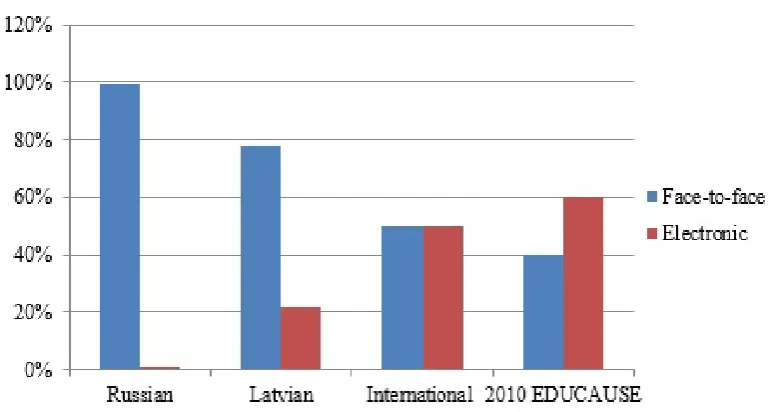
In spite of the accessibility of the new technologies and the benefits of communication they can provide the majority of Latvian students expressed strong preference of face-to-face communication for both educational and social communication in general. Among Russian Latvians this figure approached 99%, Latvians scored 78% for face-to-face and 19% for electronic communication, and international students are equally comfortable with face-to-face and electronic communication 50% respectively.
Figure 1. Students overall preferences in communication methods.
Such high score on face-to-face communication for both Russian and Latvian students may be explained by the traditional need for synchronous communication in the study process and socialising and a more collectivistic and emotional nature of representatives of Russian culture. Live discussion is a valuable tool for studying as the students engage in a dialogue when a number of contradictory ideas can be expressed and brainstorming session can lead to generating innovative approach, learning from others is inspirational, ideas can be instantly clarified, critical thinking and analytical aptitude can develop. Russian students also mentioned that emotional enrichment and body language is also important part of face-to –face communication for them. All the students mentioned that they prefer face-to-face communication for socialising and use technology excessively only when the first is not possible.
For Latvian students it is less important or sometimes problematic and discouraging to express their opinion in public, they also demonstrate a much lower level of emotional involvement and team communication. Nevertheless they also give preference to face-to-face communication as it is considered more time efficient and productive.
High level of preference of electronic media for communication among the students in the USA (EDUCAUSE) was explained by the wide availability of electronic devices and Internet as well as the distance one has to cover in order to communicate in face, e.g. some students explained that for them it is easier to reach a person on-line than to travel long distance.
5.2 Formal communication with the school management
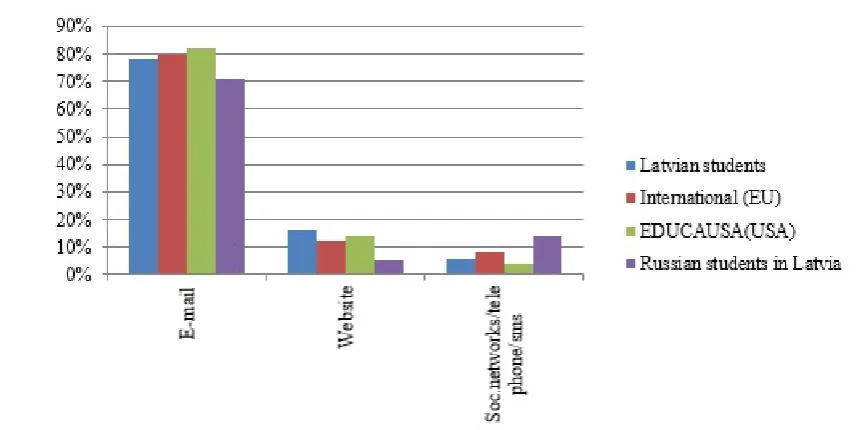
Formal communication with the school is meant for informing and up-dating the students on time-tables, academic curriculum and grades, school projects, events, quest lectures, etc. All the groups of students demonstrated evident preference for e-mails (70-82%) as the most efficient written formal communication mode, with website information being useful for Latvian students -14% and lowest for Russian students – 6%, social networks, SMS and telephoning was considered more efficient than website only by Russian students -14% and was lowest for American students -2% (EDUCAUSE). Quite a substantial number of students: 14% USA, 14,8% in EU countries (other than Latvia) and 28% in Latvia consider the use of Face book by school as intrusion in their personal space and prefer the school not to use it for reaching them.
Figure 2. Preferred methods for formal communication with school management.
5.3 Study related communication with faculty
In the following part of the research the distinction was made between communication with the faculty for educational purposes and with peers.
The results obtained signal the preference of face-to-face communication with faculty in all sample groups followed by e-mails for Russian culture group and international students. Surprisingly Latvian students chose communication on paper as their second preference, which can be explained by the traditional school requirement to submit written assignments on paper as well as it guarantees the act of formal acceptance and timely feedback, as most Latvian students’ ambiguity avoidance is quite high.
E-mailing was the third option by the Latvian students, for Russian students it was telephoning and for international students SMS texting. Other modes of communication preferences were ranked differently as well in all groups.
Latvian and international students’ preferences in communication methods with faculty for educational purposes were graded in the following way:
Communication method Students’ scores in Latvia International Students RISEBA/ HaagaHelia Latvian speaking Russian speaking
Face to face 1 1 1
e-mail 3 2 2
paper 2 6 7
Facebook 5 4 6
SMS texting 4 5 3
telephone 6 3 5
Other (chat) 7 7 4
Table 1. Students ranking of communication methods with faculty.
Both Latvian and Russian students in RISEBA did not express readiness to involve totally or partially in e-learning or blended learning, web-based courses did not attract international students at RISEBA either, though due to the lack of English language knowledge or communication barriers some of them expressed a wish to have access to the full version of the course on-line.
Latvian students’ reluctance to web-based education can be attributed to the lack of specific qualities which are necessary to ensure the preference to computer –based communication in educational process. They are either culture specific „national character„stereotypes or/and influenced by the country of education at pre-school, elementary and secondary school levels (which is also a sphere of culture values, as education is one of the main elements of culture), and can be highly individual at the same time. Among those qualities the following can be mentioned : high level of individualism, acceptance of working or studying alone, no need for team-work and team responsibility, high level of self-discipline, a wish to overwhelming control over the process, good time management, wish to work and study flexible hours.
Sometimes the students who prefer web-based courses also lack the ability to compromise with others, demonstrate no need for peer support, have fear to lose face or fear of public speaking, do not possess necessary soft skills. They tend to be less involved in socialising, value time, convenience and flexibility, usually combine work and studies.
These characteristics were not found to be typical for Russian minority in Latvia, though more Latvian students tend to share some of the qualities mentioned above, mainly: high level of individualism, value of time, reluctance to be involved in socialising with peers and public speaking, which can lead to a more active use of on-line distant education by Latvian students in the future. Latvian students in majority of cases still explain their preference to face-to-face communication in the educational process by the wish to learn from the lecturer, discussion and other students’ contribution to the lecture, as they realise that “good public speaking and developed soft skills” are necessary requirement for both academic success and more importantly for their future career development.
Among other factors influencing the choice of face-to-face communication methods for studying-learning, which were identified in the process of research, one of strongest for Russian minority and averagely strong for Latvian students was the lack of motivation to manage individual studies, as for the majority of students learning remains teacher- motivated and teacher-controlled process. Many of the respondents highlighted that “learning without a teacher is not motivating or stimulating”, they “need being instructed quite regularly, need emotional participation and feedback, many of them want the teacher to be a “guru” in his area and an “entertainer” at the same time, who “can add something beyond his course”.
Respondents among students in Latvia admit low level of responsibility and self-discipline, over reliance on supervision from the tutor (teacher), bad time management. In comparison with international students the students in Latvia are not well-organized in individual studies, seek better contact with teachers, lack maturity, perceive challenge with reluctance. This can also be explained by the economic realities ( including student loan system and /or the share of tuition fee the student has to pay himself vs. parents financial compensation for his education), family role in the choice of education institution and value of education in the society, the system of education in this country, which are culture specific.
Free education in higher schools in Latvia is provided only for exclusively limited number of students on the basis of their academic results obtained from secondary school, which makes higher education in Latvia expensive for the students and thus creates consumer attitude of students to their educational establishment. Financial inequality makes those from high income group more demanding and less self-critical, seeking hassle free access to higher education and expect knowledge to be transferred in a customised way. This together with parental attention and financial support (majority of students do not pay their studies themselves, though student loans are accessible in Latvia) creates the platform of their demands and expectations to educational process. And as digital resources including web-based courses provide only „ raw material„ for experiential learning this cannot satisfy the students of
Latvian higher schools. For them consistent interaction and engagement with the faculty in a traditional class is preferable.
Nevertheless the students in Latvia scored quite high on the use of technology for management of their studies, they appreciate convenience provided by on-line syllabi, submission of assignments and feedback with grades, on-line reading , e.g. 75% use on-line syllabus, 82% track their grades, 54% submit assignments, very few read supplementary materials or take part in discussions. This was different from international students among whom 95% use syllabus, 89% track grades, 78% submit assignments , 94% read on-line and 74% take part in discussion. Both Latvian and international students share study materials with peers: 70% and 73% respectively, and wish to obtain faculty feedback: 64% and 72% respectively.
5.4 Study- related communication with peers
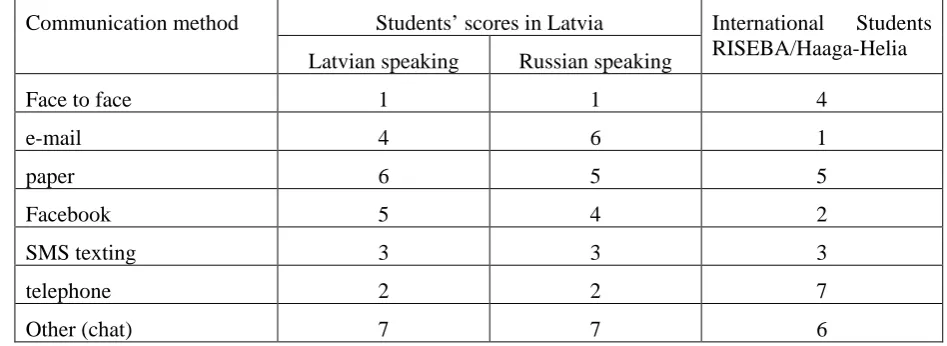
Students in Latvia prefer face-to –face communication with their peers on educational issues whereas international students find e-mail more acceptable for this, implying more formal approach as peers are not always viewed as friends, and educational issues differ in the level of formality from socialising issues. As they explained „it is easier to reach the person and to clarify a specific issue when you do it in writing „ or it is also a question of convenience of exchanging learning materials if necessary. International students tend to make a clear difference between communication for education or study related issues and personal socialising, which Latvian and Russian minority students seem to ignore.
The second choice for peer contact was Facebook by international students and telephone for the students in Latvia.
Communication method Students’ scores in Latvia International Students RISEBA/Haaga-Helia Latvian speaking Russian speaking
Face to face 1 1 4
e-mail 4 6 1
paper 6 5 5
Facebook 5 4 2
SMS texting 3 3 3
telephone 2 2 7
Other (chat) 7 7 6
Table 2. Students ranking of study – related communication with peers.
5.5 Use of IT in the class
The attitude to the implementation of video demonstrations, power-point presentations, laptops or even smart phones or other IT in the class during the lecture as a part of educational process is to a certain degree influenced by the individual’s attitude to technology in general, learning style, technological competence, but mostly it depend on the type of course where these methods are appropriate or necessary to be used for the efficiency consideration. As the research sample groups were only those studying at business department, it is inappropriate to make broad generalisation about the preferences of the students to the use of IT in the study process.
Nevertheless the comparison of the responses among the students in Latvia and International students in RISEBA and Haaga-Helia schools demonstrate a substantial difference: 86% of students in Latvia
and 54-53% of International students expressed a wish to have limited use of IT. The results from the US (EDUCAUSE) differ even more substantially – 28,2%. At the same time extensive use of IT is preferred by the majority of American student – 64,3% and minority of Latvian students -12%.
Moreover the students in Latvia commented that their choice is also influenced by the level of interest the lecturer can arise in the audience by both his professional knowledge and personality, his leadership and ability to appeal to the audience. The more experienced is the lecturer, the better is his interaction with the audience, the fewer electronic devices are expected by the students to be used during the lecture.
Business students Prefer No technology Prefer Limited use Prefer Extensive use
EDUCAUSE (USA) 1.3% 28,2% 64,3%
RISEBA 2% 86% 12%
International EU 1% 54% 45%
International H-H 1% 53% 46%
Table 3. Students preference of IT use in the class.
5.6 Social communication
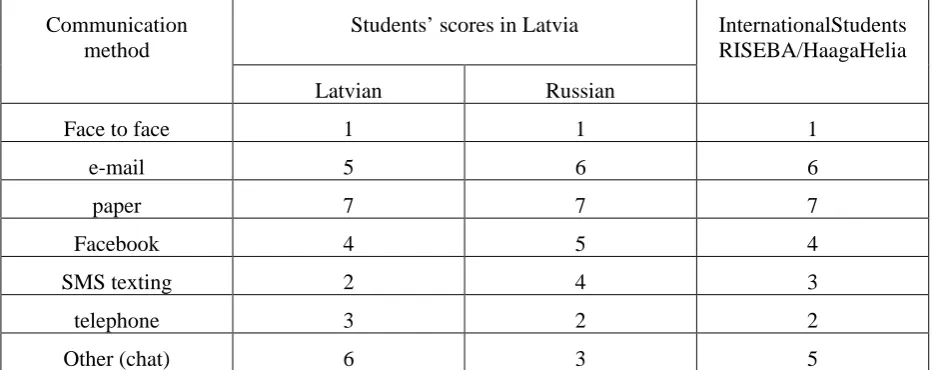
The results obtained regarding the preference to communication methods for socialising show a definite preference to face-to-face communication in all sample groups, the second position is occupied be the telephone as a preferred means for Russian and international students (RISEBA/H-H) and SMS texting by Latvian students. The 3rd option is chat for Russian, SMS texting for international and telephone for Latvian students. E-mail and paper communication are least preferred.
Communication method
Students’ scores in Latvia InternationalStudents RISEBA/HaagaHelia
Latvian Russian
Face to face 1 1 1
e-mail 5 6 6
paper 7 7 7
Facebook 4 5 4
SMS texting 2 4 3
telephone 3 2 2
Other (chat) 6 3 5
Table 4. Social communication preference ranking.
Majority of the students in Latvia admitted using chats or SMS texting while studying both at school and at home, though this kind of multitasking, according to the faculty, badly affects their academic success as really few students can effectively combine several activities without losing their focus. Only around 10% of the students admit that this distracts them from their studies and may have poor impact on the results. In comparison 14% of international students admit the same.
The purpose of multiple cases of contacting peers or friends during the day via chat, SMS or telephone , as well as Facebook presence were explained by the wish “to stay in touch”, “exchange emotions or news”.
According to the survey about 18% of students among Russian minority and 8% among Latvians suffer from “face book minute”- which starts as a routine check of the news and results in hours of uncontrolled browsing. Students in these groups lose about 4 hours and more per day in social networks without a substantial outcome of this activity in terms of valuable information, experience or connections. In comparison, according to research done in the US (Morgan and Cotton, 2003) first year students spend on average 16.3 hours a week chatting and 4 hours using e-mailing. This can be an indicator that on average the need for socializing among students in Latvia is higher. The number of students logging –in daily for socialising - 98%.
Activities in social networks include the following: personal news -35%, location -23% , links -15%, quotes-11%, contact info -9%, gossip -7.They post accounts of daily life, personal info, intimate info, post “gloat grams”- depicting post with food, drink, places they visit. Some have developed “Like shock”- a feeling of excitement about receiving more “likes” of the post than expected. According to the survey the majority of this audience are female students.
85% use emoticons and texting abbreviations to save time on sharing emotions or information. 95 % of users reported stat the main purpose of face book for them is maintaining existing real relationships when face-to-face communication is not possible. Only 3% of the students read long textual post requiring critical thinking and analysis of the informational context
This all indicates that Facebook is mostly used for surface communication and emotional sharing rather than a media for knowledge sharing or building strong social connection between the users.
6. LIMITATIONS AND IMPLICATIONS
The study was conducted in only 2 universities : RISEBA (Latvia) and Haaga-Helia ( Finland) among the students from different cultural groups : Latvian , Russian-Latvian numbering N=110 and international(Finnish, Belgian, Dutch, French, Turkish, German, Slovak) N=68. The number of respondents thus was limited and not equally spread over different cultures. Only Business Studies students doing their first or second year of bachelor programme were questioned. As sample was limited by the number of students its results cannot be generalised on the whole university or other countries especially countries with different level of IT development.
Moreover, the study deals with the HEI students and therefore, it is not projectable to the entire population as a part of net generation are already employees aged approximately 30 and younger or uneducated youth.
Future research could be conducted using a larger sample to include students of schools and uneducated youth. Moreover, a longitudinal study to examine whether changes in communication methods preferences are occurring over time is necessary, particularly when the new methods of communication emerge in the coming years.
The results obtained from the survey can be used for reconsidering the way universities communicate to the students both as a part of course administration, study process administration and educational activity itself. Furthermore academics and management might find it beneficial to reconsider the scale of Internet use, Face book and other social nets for promoting knowledge communication versus social communication. Keeping it in balance would lead to less substantial time losses on “surface” meaningless communication for the sake of keeping in touch for the benefit of information analysis and emphasis on deeper level of interaction with the students for educational needs, critical thinking development, knowledge development and better interpersonal relationships.
REFERENCES
1. Barnes, K., Marateo, R., Ferris, S., 2007, „Teaching and learning with the net generation”, Innovate 3 (4). http://www.innovateonline.info/index.php?view=article&id=382 viewed 25 March, 2014.
2. Berry, D.M., 2014, „Post-Digital Humanities: Computation and Cultural Critique in the Arts and Humanities”, EDUCAUSE Review, vol. 49, no. 3 (May/June 2014).
3. Brown, J., Adler, R., 2008, „Minds on fire: Open education, the long tail, and learning 2.0.” Educause Review, 43(1), 16-32.
4. Carlson, S., „The Net Generation Goes to College” http://chronicle.com/article/The-Net-Generation-Goes-to/12307 , viewed 8 April 2014 from the Cronicle of Higher Education.
5. Carder, S., Gatlin-Watts, R., Rubach, M., 2012, „Click click: over 1,000 international college students detail traditional computer usage.” Academy of Educational Leadership Journal. Jan, 2012 vol. 16.
6. „Connecting to the Net.Generation: What Higher Education Professionals Need to Know About Today’s Students”, 2007, National Association of Student Personnel Administrators (NASPA), Inc. http://www.naspa.org/publications.
7. Day, P., 2007, „Back to school for business schools. Works in progress”, BBC News Business http://news.bbc.co.uk/2/hi/business/6406965.stm, viewed 13 April 2014.
8. Frand, J., 2000, „The Information-age mindset”, EDUCAUSE Review, September/October. http://www.educause.edu/apps/er/erm00/articles005/erm0051.pdf, viewed 13 April 2014.
9. Floriano, S. I., Guarezi, R. M., Rodrigues, M., Schuelter, G., „The communication in the learning-teaching process from a distance” http://www.buenaspracticas-elearning.com/capitulo-8-communication-learning-teaching-process-from-distance.html, viewed 6 April 2014.
10. Junco, R., Mastrodicasa, J., 2006, „How to meet millennials’ expectations” (part 2), NetResults. www.naspa.org/membership/mem/nr/article.cfm?id=1535.
11. Junco, R., Mastrodicasa, J., 2007, „Connecting to the Net.Generation: What Higher Education Professionals Need to Know About Today’s Students”, NASPA ( National Association of Student Personnel Administartors), US http://www.naspa.org/publications.
12. Howe, N., Strauss, W., 2000, „Millennials rising: The next great generation”, New York: Vintage Books.
13. Howe, N., Strauss, W., 2003, „Millennials go to college”. Great Falls, VA.
14. Kennedy, G., Dalgarno, B., Gray, K., Judd, T., Waycott, J., Bennett, S., Maton, K., Krause, K.L., Bishop, A., Chang, R., Churchward, A., 2007, „The net generation are not big users of Web 2.0 technologies: Preliminary findings. In ICT: Providing choices for learners and learning”,
Proceedings ascilite Singapore 2007, http://www.ascilite.org.au/conferences/singapore07/procs/kennedy.pdf ,viewed 25 March 2014
15. Kennedy, G., Dalgarno, B., Bennett, S., Judd, T., Gray, K., Chang, R., 2008, „Immigrants and natives: Investigating differences between staff and students’ use of technology”, Hello! Where are you in the landscape of educational technology? Proceedings ascilite Melbourne
2008. http://www.ascilite.org.au/conferences/melbourne08/procs/kennedy.pdf.
16. Kennedy, G., Dalgarno, B., Bennett, S., Gray, K., Waycott, J., Judd, T., Bishop, A., Maton, K., Krause, K., 2009, „Educating the Net Generation. A Handbook of Findings for Practice and Policy”, www.netgen.unimelb.edu.au.
17. Loan, F.A., 2011, „Media preferences of the net generation college students”, International Journal of Library and Information Science Vol. 3(7), pp. 155-161, July 2011 http://www.academicjournals.org/ijlis.
18. Lynch, C., 2014, „The "Digital" Scholarship Disconnect”, EDUCAUSE Review, vol. 49, no. 3 (May/June 2014).
19. Nedelko, Z., Cirnu, C.L., Stanescu, I., Potocan, V., 2013, The impactnof personal values on readiness to use in e-learning process”, JADLET Journal of Advanced Distributed Learning Technology Vol.1, Number 1 2013.
20. Oblinger, D.G., 2012, „Game Changers: Education and Information Technologies”, EDUCAUSE ISBN 978-1-933046-00-6 (e-book) Downloaded from EDUCAUSE 15.06.14 (Oblinger IT as a Game Changer, 2014,p.53).
21. Oblinger, D. G., Oblinger, J.L., eds. 2005, „Educating the Net Generation”, Washington,D.C. :EDUCAUSE.http://www.educause.edu/books/educatingthenetgen/5989, viewed March 26, 2007. 22. Oblinger, D., Oblinger, J.L., Lippincott, J. K., 2005, „Educating the Net Generation”, Brockport
Bookshelf. http://digitalcommons.brockport.edu/bookshelf/272.
23. Oblinger, D., Oblinger,J., 2005, „Is It Age or IT: First Steps Toward Understanding the Net Generation”, EDUCAUSE http://judicialaffairs.tamucc.edu/assets/IsItAge.pdf.
24. Ohio State University Office of Student Life, 2010, „Student Technology Survey”, lpsl.coe.uga.edu/Projects/AAlaptop/.../ initial_student_revisedUS.pdf , viewed 13 April 2014. 25. Prensky, M., 2001, „Digital Natives, Digital Immigrants, Part II: Do They Really Think
Differently?”, On the Horizon, vol. 9, no. 6 (December 2001), pp. 15–24; http://www.marcprensky.com/writing/ viewed 14 April 2014.
26. Rishi, R., 2007, „Always connected, but hard to reach”, EDUCAUSE Quarterly, 20(2), 7-9. http://www.educausa/node101515 viewed on 7 June, 2014.
27. Robinson, S., 2011, „MAT2R Model”, https://blogs.psu.edu/mt4/mt. cgi?_mode=view&_type=entry&id= 357413&blog_id=11032.
28. Strauss, W., Howe, N., 2006, „Millennials and the pop culture: Strategies for a new generation of consumers in music, movies, television, the Internet, and video games”, Great Falls, VA: LifeCourse Associates.
29. Sherry, R., Stubberu, H.A., 2012, „Communication Preferences among University Students”, Academy of Educational Leadership Journal , Vol. 16, No. 2, viewed 13 April, 2014.
30. Tapscott, D., 2009, „Grown up digital: How the net generation is changing the world”, McGraw-Hill: London.