R E S E A R C H A R T I C L E
Open Access
Comparative efficacy and safety of
paricalcitol versus vitamin D receptor
activators for dialysis patients with
secondary hyperparathyroidism: a
meta-analysis of randomized controlled trials
Yifeng Xie
1*, Peiling Su
1, Yifan Sun
2, Hongsheng Zhang
3, Rong Zhao
1, Liang Li
1and Lanfen Meng
1Abstract
Background:Secondary hyperparathyroidism (SHPT) is a severe complication for dialysis patients. Vitamin D receptor activators (VDRAs) are used to treat SHPT, but the comparative efficacy and safety between paricalcitol and other vitamin D receptor activators for management of SHPT in dialysis patients has been unproven.
Methods:We searched PubMed, Embase, and the Cochrane Library for the time period through June 2017 to
identify randomized controlled trials that evaluated paricalcitol compared with other VDRAs for treatment of SHPT. The primary outcome was the percentage of patients with target reduction of intact parathyroid hormone (iPTH) from baseline. Secondary outcomes included incidences of hypercalcemia and hyperphosphatemia. The random-effects model was used to estimate relative risks (RRs) with 95% confidence intervals (CIs).
Results:Eight studies (N= 759) were eligible for final inclusion. Compared with other VDRAs, no significant differences were found in the percentage of patients with target reduction of intact parathyroid hormone (iPTH) from baseline for
paricalcitol treatment of SHPT in dialysis patients (RR, 1.01; 95% CI, 0. 87–1.18;p= 0.85). There were no differences in
the incidence of hypercalcemia (RR, 0.95; 95% CI, 0.74–1.21;p= 0. 65) and hyperphosphatemia (RR, 0.94; 95% CI,
0.77–1.16;p= 0.58).
Conclusions:The presently available evidence is insufficient to draw a conclusion regarding whether paricalcitol therapy has a comparative efficacy and safety over other VDRAs for treating dialysis patients with SHPT. Large-sample, well-conducted, high-quality RCTs with patient-level outcomes (i.e., mortality) are urgently needed.
Keywords:Paricalcitol, Vitamin D receptor activator, Secondary hyperparathyroidism (SHPT), Hemodialysis,
Peritoneal dialysis
Background
Secondary hyperparathyroidism (SHPT) is one of the most common abnormalities of the chronic kidney disease-mineral and bone disorders (CKD-MBD) syndrome. Ab-normalities in serum calcium, phosphorus, intact PTH, and vitamin D deficiency are common in dialysis patients
with SHPT [1]. Increased levels of serum calcium, phos-phorus, and intact PTH had been associated with increased all-cause and cardiovascular mortality [2–6]. However, the DOPPS study indicated that there was a lower mortality risk for calcium, phosphorus, and intact PTH within spe-cific ranges [7]. Based on the epidemiological and clinical evidences, Kidney Disease: Improving Global Outcomes (KDIGO) recommended a target range of serum calcium, phosphorus, and intact PTH for treating dialysis patients with SHPT [1].
* Correspondence:[email protected]
1Department of Nephrology, The Third Affiliated Hospital of Guangxi University of Chinese medicine, No.32, Jie-Fang-Bei Road, Cheng-Zhong District, Liuzhou, Guangxi 545001, People’s Republic of China Full list of author information is available at the end of the article
© The Author(s). 2017Open AccessThis article is distributed under the terms of the Creative Commons Attribution 4.0
To achieve current targets for the key mineral parame-ters set by KDIGO guidelines, a combination of dietary phosphorus restriction, phosphate binders, vitamin D re-ceptor activators (VDRAs), and adequate dialysis was adopted. Among the VDRAs used for management of SHPT in dialysis patients, paricalcitol is the most potential vitamin D analog. The observational study by Teng et al. indicated a significant survival advantage of paricalcitol over calcitriol for long-term hemodialysis patients [8]. However, whether or not paricalcitol has a comparative ef-ficacy and safety with other VDRAs for treating SHPT in dialysis patients, based on RCTs, is unknown.
Previous meta-analyses focused mainly on comparisons between paricalcitol and placebo [9–11] in both dialysis patients [12] and patients not requiring dialysis [9, 10, 13]. We performed a meta-analysis making a head-to-head comparison to check therapeutic advantages of paricalcitol over other VDRAs in dialysis patients with SHPT.
Methods
We conducted a meta-analysis of randomized controlled trials in compliance with the PRISMA (Preferred Report-ing Items for Systematic Reviews and Meta-Analyses statement) guidelines [14]. The present meta-analysis had no registered protocol.
Data sources and Searches
Literature searches for randomized, controlled trials of vitamin D receptor activators in CKD 5D (dialysis) patients with secondary hyperparathyroidism were performed in PubMed, Embase, and the Cochrane Library for the period through January 2016. The Medical Subject Headings (MeSH) terms and corresponding keywords were used for the electronic searches. The search terms used were (MeSH exp. “Kidney Disease,” “Kidney Failure,” “Chronic Kidney Failure,” and the keywords “chronic kidney”, “chronic renal”,“dialysis” and“hyperparathyroidism”), and (MeSH exp. “Vitamin D” and keywords “vitamin D” and “paricalcitol”). The complete search strategy is outlined in Additional file 1. The cited references of published primary studies and reviews were manually screened to identify relevant trials. To ensure literature saturation, we reran the searches on June 25, 2017. The ClinicalTrials.gov registry (https://clinicaltrials.gov/) was also searched. Trials were identified without language restriction.
Study selection
Two authors (Yifeng Xie and Peiling Su) independently conducted the search, screened the titles and abstracts, and checked full text for eligibility. Discrepancies be-tween authors were resolved by consensus. Published RCTs meeting the following inclusion criteria were in-cluded: (1) population: chronic kidney disease 5D adult patients (hemodialysis or peritoneal dialysis) with
secondary hyperparathyroidism; (2) intervention: paricalci-tol therapy; (3) comparison: vitamin D analogues such as calcitriol, alfacalcidol, maxacalcitol, et al.; and (4) one or more the following outcomes: percentage of participants with target reduction in intact parathyroid hormone (iPTH) from baseline; incidence of hypercalcemia, hyper-phosphatemia, and elevation in calcium phosphorus prod-uct; all-cause mortality and end-of-treatment serum phosphorus, calcium, and iPTH levels. Studies that did not meet inclusion criteria (i.e., participants were pediatric pa-tients or comparison was placebo.) were excluded.
Data extraction and Quality assessment
Data extraction was performed by Yifeng Xie and Peiling Su using a standardized data extraction sheet (Office Excel®, Microsoft® Corporation) and confirmed independ-ently by another author (Hongsheng Zhang). Three au-thors double-checked data entry independently. Any disagreements between authors were resolved by dis-cussion and consensus. The collected data included the following: first author, year of publication, country, num-ber of patients, follow-up, age, baseline mineral and bone disorders, laboratory values (serum calcium, phosphorus, and iPTH), types of phosphate binders used, dosing schedule, routine of administration, risk of bias data, and outcomes data. Risk of bias data were those that described randomization, double-blinding, and drop-outs and withdrawals. Predefined primary outcome was the percentage of patients with target reduction in iPTH from baseline. Secondary outcomes included inci-dences of hypercalcemia, hyperphosphatemia, and ele-vation in the calcium-phosphorus product; end-of-treatment serum iPTH, phosphorus, and calcium; and all-cause mortality. For crossover trials, the data from the first period were used [15].
Two authors (Yifeng Xie and Peiling Su) independ-ently assessed the risk of bias of the included studies using a validated Jadad 5-point scale [16, 17]. The scale consists of three items describing randomization (0–2 points), masking (0–2 points), and dropouts and with-drawals (0–1 points) in the report of a randomize con-trolled trial. The scale ranged from 0 to 5, with higher scores showing better reporting. The trials were rated high quality when the score was higher than 2, or low quality when the score was 2 or below, out of a max-imum score of 5.
Statistical analysis
taking clinical heterogeneity between studies into account. To examine the influence of various factors on the treat-ment effects of paricalcitol therapy for dialysis patients with secondary hyperparathyroidism, we performed post-hoc subgroup analyses according to baseline serum PTH levels (PTH > 68.4 pmol/L versus PTH < 68.4 pmol/L, with the cut-off value set as 9 times the upper normal limit for the assay), types of dialysis (hemodialysis versus peritoneal dialysis), routine of administration (oral versus intravenous), sample size (n> 100 for large sample studies versusn< 100 for small sample studies), and risk of bias (low quality versus high quality). Publication bias was evaluated visually by funnel plot and quantitatively by Egger’s test and Begg’s test [19, 20]. We performed all stat-istical analyses using RevMan 5.3 (Nordic Cochrane Centre).P< .05 was considered statistically significant.
Results Trial selection
The PRISMA statement flowchart shows the process of study identification, screening, selection, and reasons for exclusion, as shown in Fig. 1. The combined search identified a total of 640 records, 614 of which were ex-cluded after removing duplicates and screening the titles and abstracts. Full-text assessment of 26 potentially eli-gible articles identified 8 studies. Finally, 8 RCTs [21–28] were included in the meta-analysis.
Trials characteristics
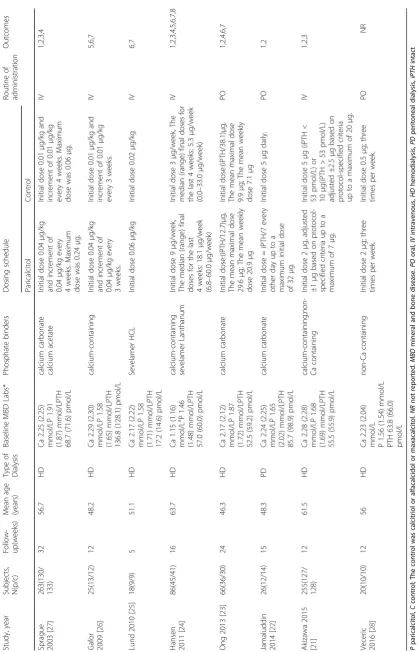
Characteristics of patients and interventions of the in-cluded trials are summarized in Table 1. The sample size ranged from 18 to 263, with a total of 759 patients. Only two trials [21, 27] had more than 100 participants. Of the included trials, seven compared paricalcitol therapy with non-selective vitamin D receptor activators, includ-ing calcitriol and alfacalcidol, and the remaininclud-ing one [21] compared paricalcitol therapy with selective vitamin D re-ceptor activator (maxacalcitol).
Five trials [21–24, 27] reported the primary outcome, which was the percentage of patients with target reduc-tion in intact parathyroid hormone (iPTH) from base-line. Of the five trials reporting the primary outcome, two trials [23, 24] used a > 30% reduction as target re-duction, whereas the remaining three trials [21, 22, 27] used a > 50% reduction. All included trials used different cut-off values to define hypercalcemia, ranging from 2.63 mmol/L (10.5 mg/dL) to 2.90 mmol/L (11.5 mg/dL). Five trials [21–24, 27] reported incidence of hypercalcemia, one [24] of them using serum ionized calcium and the others serum total calcium. Only one trial [24] presented all-cause mortality data and others did not report patient-level outcomes (i.e., all-cause mortality, cardiovascular mor-tality, and fractures). One trial [28] did not present any out-comes, either primary or secondary. All RCTs had a short duration of follow-up, lasting from 5 to 32 weeks.
Risk of bias assessment
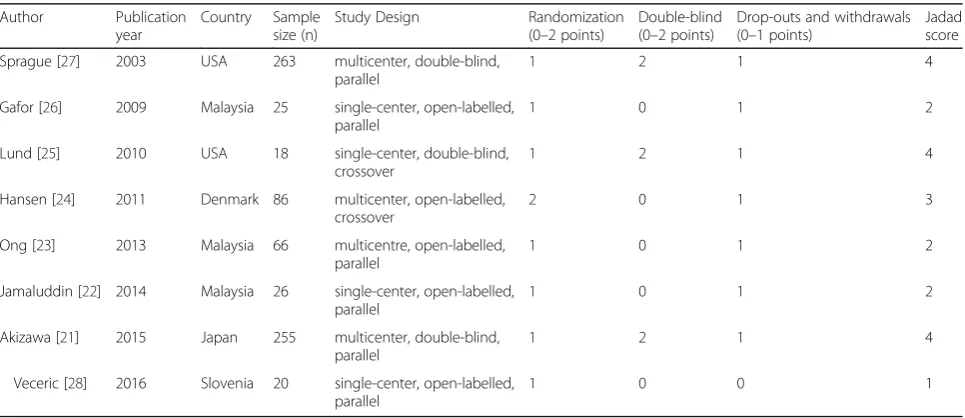
The details of risk of bias are listed in Table 2. Overall, four trials [22, 23, 26, 28] were categorized as low odological quality and four [21, 24, 25, 27] as high meth-odological quality. Only one trial [24] described appropriate allocation concealment. Three trials [21, 25, 27] reported double-blinding, and all trials except one [28] reported drop-outs and withdrawals.
Paricalcitol treatment versus vitamin D receptor activator treatment
Primary outcome
Five trials [21–24, 27] with a total of 696 patients were in-cluded for the outcome of the percentage of patients with target reduction in iPTH from baseline. Compared to ei-ther non-selective vitamin D receptor activators (calcitriol and alfacalcidol) or selective vitamin D receptor activator (maxacalcitol), paricalcitol had similar efficacy in sup-pressing the iPTH of dialysis patients with SHPT (Fig. 2.). The RR was 1.01 (95% CI: 0.87–1.18;p= 0.85). The statis-tic I2was 31%, indicating low heterogeneity.
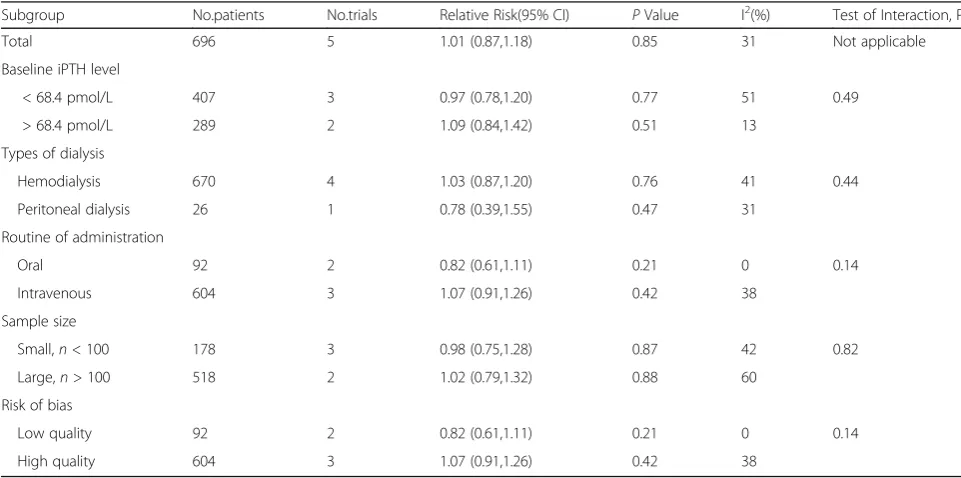
There was no significant difference in suppressing iPTH with paricalcitol in comparison to other VDRAs for all subgroup analyses. Details of subgroup analyses were presented in Table 3.
Secondary outcomes
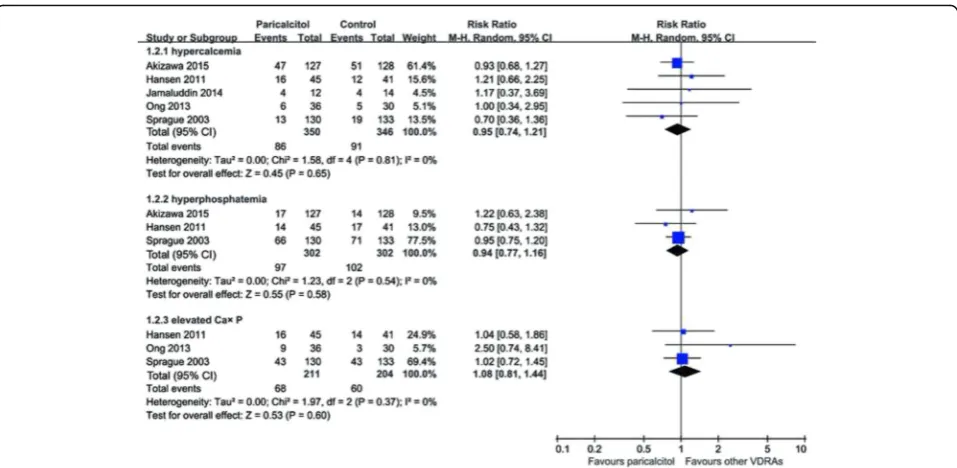
There was no significant difference in the risk of hyper-calcemia, hyperphosphatemia, and elevation in the calcium-phosphorus product with paricalcitol in comparison to other VDRAs, as shown in Fig. 3. The pooled RRs with 95% CI for incidence of hypercalcemia, hyperphosphatemia, and ele-vation in the calcium-phosphorus product were 0.95 (0.74– 1.21;p= 0.65), 0.94 (0.77–1.16;p= 0.58), 1.08 (0.81–1.44;
p= 0.60), respectively. The statistic I2was 0% for all three outcomes.
There was no significant difference in end-of-treatment serum calcium and phosphorus with paricalcitol in com-parison to other VDRAs, as shown in Fig. 4. The pooled mean differences (MDs) with 95% CI were 0 (−0.06–0.05; p = 0.95) and −0.08 (−0.19–0.03;p = 0.15), respectively. The statistics I2were 24% and 0%, respectively.
Discussion
This meta-analysis demonstrates that there was no sig-nificant difference in effectiveness and safety of paricalci-tol therapy in comparison to other VDRAs based on the biochemical end points when treating adult dialysis pa-tients with secondary hyperparathyroidism. Comparisons based on patient-centered outcomes are not possible presently because of the lack of RCTs providing data on patient-level outcomes, such as mortality, cardiovascular death, fracture, and quality of life.
KDIGO’s recommendations on dialysis patients with SHPT are to lower elevated phosphorus levels toward the normal range while maintaining intact PTH levels in the range of ~2–9 times the upper normal limit for the assay and maintaining serum calcium in the normal range [1]. To reach the treatment target, limited dietary intake of phosphorus, phosphate binder, Vitamin D compounds, and adequate dialysis are adopted. A meta-analysis of 14 observational studies demonstrated that vitamin D compound therapies reduced mortality in CKD patients, particularly in those suffering from second-ary hyperparathyroidism [29]. A study by Teng et al. showed that paricalcitol had a survival advantage over cal-citriol in patients undergoing long-term hemodialysis [8]. However, all the included trials in this meta-analysis did
Table 2Assessing risk of bias of the included studies by validated Jadad 5-point scale
Author Publication year
Country Sample size (n)
Study Design Randomization
(0–2 points)
Double-blind (0–2 points)
Drop-outs and withdrawals (0–1 points)
Jadad score
Sprague [27] 2003 USA 263 multicenter, double-blind, parallel
1 2 1 4
Gafor [26] 2009 Malaysia 25 single-center, open-labelled, parallel
1 0 1 2
Lund [25] 2010 USA 18 single-center, double-blind, crossover
1 2 1 4
Hansen [24] 2011 Denmark 86 multicenter, open-labelled, crossover
2 0 1 3
Ong [23] 2013 Malaysia 66 multicentre, open-labelled, parallel
1 0 1 2
Jamaluddin [22] 2014 Malaysia 26 single-center, open-labelled, parallel
1 0 1 2
Akizawa [21] 2015 Japan 255 multicenter, double-blind, parallel
1 2 1 4
Veceric [28] 2016 Slovenia 20 single-center, open-labelled, parallel
not report patient-level outcomes. Comparisons based on the biochemical end points did not demonstrate an advan-tage of paricalcitol therapy over other VDRAs therapies. Several factors may affect both direction and size of the ef-fect estimates and account for a risk of bias across the in-cluded studies. First, there was a diverse spectrum of iPTH at the baseline, ranging from 14.6 pmol/L to 136.8 pmol/L. Second, the majority of the included studies had a small sample size (n< 100) with inadequate power. Third, there were two target-reduction values of iPTH (>30% and >50%) for the definition of primary outcome. Also, there were different cut-off values for the definition of hypercalcemia. Fourth, different types of phosphate binders were used in the included trials. A meta-analysis showed that non-calcium-containing phosphate binders
had an advantage of a decrease in hypercalcemia in dia-lysis patients over the calcium-containing phosphate binders [30]. Fifth, dose ratios of 4:1 and 3:1, or an ini-tial dose, depending on iPTH level, were used. Thus, the potential dose-response might affect the effect size [31]. Sixth, durations of follow-up were too short for the included studies. Seventh, fibroblast growth factor 23 (FGF 23) plays an important role in the mineral and bone disorders of CKD patients [32–35]. However, the included studies of this meta-analysis had no informa-tion on the serum FGF23 levels of patients enrolled in the studies, except that one study provided incomplete data of FGF23 [36]. Any significant within-group or between-group differences of FGF23 may affect the treatment effects of the included trials.
Fig. 2Effect of paricalcitol on suppressing iPTH as compared to other VDRAs
Table 3Subgroup analyses of paricalcitol compared with other VDRAs for target reduction of iPTH from baseline
Subgroup No.patients No.trials Relative Risk(95% CI) PValue I2(%) Test of Interaction, P
Total 696 5 1.01 (0.87,1.18) 0.85 31 Not applicable
Baseline iPTH level
< 68.4 pmol/L 407 3 0.97 (0.78,1.20) 0.77 51 0.49
> 68.4 pmol/L 289 2 1.09 (0.84,1.42) 0.51 13
Types of dialysis
Hemodialysis 670 4 1.03 (0.87,1.20) 0.76 41 0.44
Peritoneal dialysis 26 1 0.78 (0.39,1.55) 0.47 31
Routine of administration
Oral 92 2 0.82 (0.61,1.11) 0.21 0 0.14
Intravenous 604 3 1.07 (0.91,1.26) 0.42 38
Sample size
Small,n< 100 178 3 0.98 (0.75,1.28) 0.87 42 0.82
Large,n> 100 518 2 1.02 (0.79,1.32) 0.88 60
Risk of bias
Low quality 92 2 0.82 (0.61,1.11) 0.21 0 0.14
The negative result of our meta-analysis is consistent with previous meta-analyses [12, 37, 38]; however, this meta-analysis reveals several differences. First, the popu-lation is limited to CKD adult dialysis patients with SHPT. Patients not on dialysis were excluded because of significant differences of the association between serum phosphorus/calcium/iPTH and mortality in these two types of patients [1, 39, 40]. Second, active VDRA treat-ments were chosen as controls in this meta-analysis; thus, a direct comparison between paricalcitol and other VDRAs is made to check the superiority. Third, com-pared with recently published meta-analyses [37], this meta-analysis adds a comparison between selective vita-min D analogues (paricalcitol versus maxacalcitol).
This meta-analysis has the following limitations: First, the number of included studies is small and the studies
had small sample sizes and short follow-up lengths. Sec-ond, the number of included trials is too small to evalu-ate publication bias of our meta-analysis, either visually by funnel plot or quantitatively by Egger’s test [20] and Begg’s test [19]. There may be potential publication bias in this meta-analysis. Third, comparisons between pari-calcitol and other VDRAs are based on biochemical end points. Patient-level outcomes are not available in the in-cluded studies. Fourth, since the control inin-cluded both non-selectvie VDRAs and selective VDRAs, this could introduce some heterogeneity for the summarized effect.
Conclusions
The evidence that is presently available is insufficient to draw a conclusion regarding whether paricalcitol therapy has a comparative efficacy and safety over other VDRAs
Fig. 3Risk of hypercalcemia, hyperphosphatemia, and elevation in the calcium-phosphorus product with paricalcitol comparing to other VDRAs
for treating dialysis patients with SHPT. Large-sample, well-conducted, high-quality RCTs with patient-level out-comes (i.e., mortality) are urgently needed.
Additional file
Additional file 1:Search Strategy. (DOCX 18 kb)
Abbreviations
CI:Confidence interval; CKD: Chronic kidney disease; CKD-MBD: Chronic kidney disease–mineral and bone disorder; iPTH: Intact parathyroid hormone; KDIGO: Kidney Disease: Improving Global Outcomes; MD: Mean difference; MeSH: Medical Subject Headings; PRISMA: Preferred Reporting Items for Systematic Reviews and Meta-Analyses; RCT: Randomized controlled trial; RR: Relative risk; SHPT: Secondary hyperparathyroidism; VDRA: Vitamin D receptor activator
Acknowledgements
The authors thank Shifu Tang for his assistance with statistic aspects of the review.
Funding
This study is supported by the Guangxi University of Chinese Medicine Natural Science Research Foundation (2015MS025).
Availability of data and materials
All datasets analyzed in this meta-analysis are referenced in the manuscript, its Additional file 1.
Authors’contributions
XYF contributed to concept and design of the study, acquisition, analysis and interpretation of data, drafting and revising the article, and final approval of the manuscript. SPL, SYF and ZHS contributed to acquisition, analysis and interpretation of data, drafting the article, and final approval of the manuscript. ZR, LL and MLF contributed to concept and design of the study, analysis and interpretation of data, revising the article, final approval of the manuscript to be published.
Ethics approval and consent to participate
Not applicable.
Consent for publication
Not applicable.
Competing interests
The authors declare that they have no competing interests.
Publisher’s Note
Springer Nature remains neutral with regard to jurisdictional claims in published maps and institutional affiliations.
Author details 1
Department of Nephrology, The Third Affiliated Hospital of Guangxi University of Chinese medicine, No.32, Jie-Fang-Bei Road, Cheng-Zhong District, Liuzhou, Guangxi 545001, People’s Republic of China.2Department of Clinical Laboratory, The Third Affiliated Hospital of Guangxi University of Chinese medicine, Liuzhou, Guangxi, People’s Republic of China. 3Department of Orthopaedics, The Third Affiliated Hospital of Guangxi University of Chinese medicine, Liuzhou, Guangxi, People’s Republic of China.
Received: 4 May 2016 Accepted: 18 August 2017
References
1. Kidney Disease. Improving Global Outcomes (KDIGO) CKD–MBD Work Group. KDIGO clinical practice guideline for the diagnosis, evaluation, prevention, and treatment of Chronic Kidney Disease-Mineral and Bone Disorder (CKD-MBD). Kidney Int Suppl. 2009(113):S1–130.
2. Block GA, Klassen PS, Lazarus JM, Ofsthun N, Lowrie EG, Chertow GM. Mineral metabolism, mortality, and morbidity in maintenance hemodialysis. J Am Soc Nephrol. 2004;15(8):2208–18.
3. Melamed ML, Eustace JA, Plantinga L, et al. Changes in serum calcium, phosphate, and PTH and the risk of death in incident dialysis patients: a longitudinal study. Kidney Int. 2006;70(2):351–7.
4. Young EW, Albert JM, Satayathum S, et al. Predictors and consequences of altered mineral metabolism: the Dialysis Outcomes and Practice Patterns Study. Kidney Int. 2005;67(3):1179–87.
5. Kalantar-Zadeh K, Kuwae N, Regidor DL, et al. Survival predictability of time-varying indicators of bone disease in maintenance hemodialysis patients. Kidney Int. 2006;70(4):771–80.
6. Ganesh SK, Stack AG, Levin NW, Hulbert-Shearon T, Port FK. Association of elevated serum PO(4), Ca x PO(4) product, and parathyroid hormone with cardiac mortality risk in chronic hemodialysis patients. J Am Soc Nephrol. 2001;12(10):2131–8.
7. Tentori F, Blayney MJ, Albert JM, et al. Mortality risk for dialysis patients with different levels of serum calcium, phosphorus, and PTH: The Dialysis Outcomes and Practice Patterns Study (DOPPS). Am J Kidney Dis. 2008;52(3):519–30. 8. Teng M, Wolf M, Lowrie E, Ofsthun N, Lazarus JM, Thadhani R. Survival of
patients undergoing hemodialysis with paricalcitol or calcitriol therapy. N Engl J Med. 2003;349(5):446–56.
9. Cheng J, Zhang W, Zhang X, Li X, Chen J. Efficacy and Safety of Paricalcitol Therapy for Chronic Kidney Disease: A Meta-Analysis. Clin J Am Soc Nephrol. 2012;7(3):391–400.
10. Han T, Rong G, Quan D, et al. Meta-analysis: the efficacy and safety of paricalcitol for the treatment of secondary hyperparathyroidism and proteinuria in chronic kidney disease. Biomed Res Int. 2013;2013:–320560. 11. Li X-H, Feng L, Yang Z-H, Liao Y-H. Effect of active vitamin D on
cardiovascular outcomes in predialysis chronic kidney diseases: A systematic review and meta-analysis. Nephrology. 2015;20(10):706–14.
12. Palmer SC, McGregor DO, Craig JC, Elder G, Macaskill P, Strippoli GFM. Vitamin D compounds for people with chronic kidney disease requiring dialysis. Cochrane Database Syst Rev. 2009;4
13. Palmer SC, McGregor DO, Craig JC, Elder G, Macaskill P, Strippoli GFM. Vitamin D compounds for people with chronic kidney disease not requiring dialysis. Cochrane Database Syst Rev. 2009;4
14. Moher D, Liberati A, Tetzlaff J, Altman DG, Grp P. Preferred reporting items for systematic reviews and meta-analyses: The PRISMA statement. Int J Surg. 2010;8(5):336–41.
15. Stedman MR, Curtin F, Elbourne DR, Kesselheim AS, Brookhart MA. Meta-analyses involving cross-over trials: methodological issues. Int J Epidemiol. 2011;40(6):1732–4.
16. Moher D, Pham B, Jones A, et al. Does quality of reports of randomised trials affect estimates of intervention efficacy reported in meta-analyses? Lancet. 1998;352(9128):609–13.
17. Jadad AR, Moore RA, Carroll D, et al. Assessing the quality of reports of randomized clinical trials: is blinding necessary? Control Clin Trials. 1996;17(1):1–12.
18. Higgins JP, Thompson SG, Deeks JJ, Altman DG. Measuring inconsistency in meta-analyses. BMJ. 2003;327(7414):557–60.
19. Begg CB, Mazumdar M. Operating characteristics of a rank correlation test for publication bias. Biometrics. 1994;50(4):1088–101.
20. Egger M, Davey Smith G, Schneider M, Minder C. Bias in meta-analysis detected by a simple, graphical test. BMJ. 1997;315(7109):629–34. 21. Akizawa T, Akiba T, Hirakata H, et al. Comparison of paricalcitol with
maxacalcitol injection in Japanese hemodialysis patients with secondary hyperparathyroidism. Ther Apher Dial. 2015;19(3):225–34.
22. Jamaluddin EJ, Gafor AH, Yean LC, et al. Oral paricalcitol versus oral calcitriol in continuous ambulatory peritoneal dialysis patients with secondary hyperparathyroidism. Clin Exp Nephrol. 2014;18(3):507–14.
23. Ong LM, Narayanan P, Goh HK, et al. Randomized controlled trial to compare the efficacy and safety of oral paricalcitol with oral calcitriol in dialysis patients with secondary hyperparathyroidism. Nephrology. 2013;18(3):194–200. 24. Hansen D, Rasmussen K, Danielsen H, et al. No difference between
alfacalcidol and paricalcitol in the treatment of secondary hyperparathyroidism in hemodialysis patients: a randomized crossover trial. Kidney Int. 2011;80(8):841–50.
25. Lund RJ, Andress DL, Amdahl M, Williams LA, Heaney RP. Differential Effects of Paricalcitol and Calcitriol on Intestinal Calcium Absorption in
26. Abdul Gafor AH, Saidin R, Loo CY, et al. Intravenous calcitriol versus paricalcitol in haemodialysis patients with severe secondary hyperparathyroidism. Nephrology. 2009;14(5):488–92.
27. Sprague SM, Llach F, Amdahl M, Taccetta C, Batlle D. Paricalcitol versus calcitriol in the treatment of secondary hyperparathyroidism. Kidney Int. 2003;63(4):1483–90.
28. Veceric-Haler Z, Romozi K, Antonic M, et al. Comparison of the Pharmacological Effects of Paricalcitol Versus Calcitriol on Secondary Hyperparathyroidism in the Dialysis Population. Ther Apher Dial. 2016;20(3):261–6.
29. Duranton F, Rodriguez-Ortiz ME, Duny Y, Rodriguez M, Daures JP, Argiles A. Vitamin D treatment and mortality in chronic kidney disease: a systematic review and meta-analysis. Am J Nephrol. 2013;37(3):239–48.
30. Navaneethan SD, Palmer SC, Craig JC, Elder GJ, Strippoli GF. Benefits and harms of phosphate binders in CKD: a systematic review of randomized controlled trials. Am J Kidney Dis. 2009;54(4):619–37.
31. Miller JE, Molnar MZ, Kovesdy CP, et al. Administered paricalcitol dose and survival in hemodialysis patients: a marginal structural model analysis. Pharmacoepidemiol Drug Saf. 2012;21(11):1232–9.
32. Silver J, Naveh-Many T. FGF-23 and secondary hyperparathyroidism in chronic kidney disease. Nat Rev Nephrol. 2013;9(11):641–9.
33. Hu MC, Shiizaki K, Kuro-o M, Moe OW. Fibroblast growth factor 23 and Klotho: physiology and pathophysiology of an endocrine network of mineral metabolism. Annu Rev Physiol. 2013;75:503–33.
34. Gutierrez O, Isakova T, Rhee E, et al. Fibroblast growth factor-23 mitigates hyperphosphatemia but accentuates calcitriol deficiency in chronic kidney disease. J Am Soc Nephrol. 2005;16(7):2205–15.
35. Isakova T, Wahl P, Vargas GS, et al. Fibroblast growth factor 23 is elevated before parathyroid hormone and phosphate in chronic kidney disease. Kidney Int. 2011;79(12):1370–8.
36. Hansen D, Rasmussen K, Pedersen SM, Rasmussen LM, Brandi L. Changes in fibroblast growth factor 23 during treatment of secondary hyperparathyroidism with alfacalcidol or paricalcitol. Nephrol Dial Transplant. 2012;27(6):2263–9. 37. Cai P, Tang X, Qin W, Ji L, Li Z. Comparison between paricalcitol and active
non-selective vitamin D receptor activator for secondary
hyperparathyroidism in chronic kidney disease: a systematic review and meta-analysis of randomized controlled trials. Int Urol Nephrol. 2016; 38. Palmer SC, McGregor DO, Macaskill P, Craig JC, Elder GJ, Strippoli GFM.
Meta-analysis: Vitamin D compounds in chronic kidney disease. Ann Intern Med. 2007;147(12):840–53.
39. Uhlig K. What should a guideline panel do when evidence is inconclusive? The case of treatments for CKD-mineral and bone disorder (CKD-MBD). Am J Kidney Dis. 2011;58(6):872–5.
40. Palmer SC, Hayen A, Macaskill P, et al. Serum levels of phosphorus, parathyroid hormone, and calcium and risks of death and cardiovascular disease in individuals with chronic kidney disease: a systematic review and meta-analysis. JAMA. 2011;305(11):1119–27.
• We accept pre-submission inquiries
• Our selector tool helps you to find the most relevant journal • We provide round the clock customer support
• Convenient online submission • Thorough peer review
• Inclusion in PubMed and all major indexing services • Maximum visibility for your research
Submit your manuscript at www.biomedcentral.com/submit