Human Identification System based on Face using
Active Horizontal Levels (AHLs) Feature
Manhal S. Almohammad
Gouda I. Salama
Tarek A. Mahmoud
Syrian Armed Forces Egyptian Armed Forces Egyptian Armed Forces
ABSTRACT
Nowadays, face is a crucial field for many pattern recognition researchers. It is considered as a good way for biometric authentication in many surveillance systems. The most important issue in face recognition is the features extraction from the face’s images of the person’s images or videos. In this paper, a proposed method has been introduced to identify person images, which are captured by cameras. This method depends on Active Horizontal Levels (AHLs) feature. Gain ratio attribute (feature) selection has been used to choose the Horizontal Levels (HLs) that lead to the highest identification rate. The proposed method was evaluated against BioID, UK, ORL and FEI face database, to recognize person from one image. The experimental results reveal the effectiveness of our proposed method against other face recognition methods to achieve better accuracies.
Keywords
Face Identification, Feature Extraction, Biometric Authentication and Gain Ratio Attribute Selection.
1.
INTRODUCTION
Biometric-based technologies include identification based on physiological characteristics (such as face, fingerprints, finger geometry, hand geometry, hand veins, palm, iris, retina, ear and voice) and behavioral traits (such as gait, signature and keystroke dynamics) [1]. Face recognition is a task so common to humans, that the individual does not even notice the extensive number of times it is performed every day. Although research in automated face recognition has been conducted since the 1960’s, it has only recently caught the attention of the scientific community. Many face analysis and face modeling techniques have progressed significantly in the last decade [2]. However, the reliability of face recognition schemes still poses a great challenge to the scientific community [3]. Facial recognition holds several advantages over other biometric techniques. It is natural, non-intrusive and easy to use. The basic face information consists of [2]:
Landmarks set is a set of x and y coordinates that describes features (here facial features) like eyes, ears, noses, and mouth corners. Geometric information is the distinct information of an object’s shape, usually extracted by annotating the object with landmarks. Photometric information is the distinct information of the image, i.e. the pixel intensities of the image. Moreover, Shape is all the geometrical information that remain when location, scale and rotational effects are filtered out from an object. The face recognition technique can be broadly divided into three categories: methods that operate on intensity images, methods that deal with video sequences, and methods that require other sensory data such as 3D information or infra-red imagery [4].
Liposcak and Loncaric [5] reported a 90% accuracy rate using subspace filtering to derive a 21 dimensional feature vector to
describe the face profiles and employing the Euclidean distance measure to match them on a database of 30 individuals, Swets and Weng [6] achieved a 90% accuracy, when employing the Fisherfaces procedure, on a database of 1316+298 images from 504 classes. Nefian and Hayes [7] reported 98% using embedded Hidden Markove Method (HMM) face models on the ORL database. Haddadnia et. al. [8] used Principle Component Analysis PCA, the Pseudo Zernike Moment Invariant (PZMI) [2] and the Zernike Moment Invariant (ZMI) to extract feature vectors in parallel, which were then classified simultaneously by separate RBF neural networks. The outputs of these networks were then combined by a majority rule to determine the final identity of the individual in the input image. Jain et al. [9] performed the super classifier based on a voting scheme for the entire video sequence using 174 images of the eyes of 29 people (6 images per person), good recognition results (97.7% accuracy) have been reported. Gordon [10] calculated the principle curvatures of the face surface from range of data. The system was tested using the face images of 8 people (3 images per person), recognition rates of 97% and 100% were reported for individual features and the whole face respectively. Culter [11] applied the eigenface technique to a database of 288 hand-aligned low-resolution (160x120) images of 24 subjects taken from 3 viewpoints. The following recognition rates were reported: 96% for frontal views, 96% for 45 degrees views, and 100% for profile views. Dagher [12] employed Incremental PCA-LDA algorithm on BioID face database, and reported a 86.67% accuracy rate.
In this paper, we implement a proposed person’s identification approach. Based on face, a new feature extraction algorithm has been introduced. The extracted feature represents person’s presence at different horizontal levels. Active Horizontal Levels (AHLs) are selected to create a set of horizontal levels that achieve the best identification results. The proposed algorithm is implemented and evaluated against four face databases. Finally, a comparative study is introduced, where AHLs feature is compared with other methods published in literature and provides significant improvement.
2.
THE PROPOSED IDENTIFICATION
MODEL BASED ON FACE
The face recognition problem can be formulated as follows: Given an input face image and a database of face images of known individuals, how can we verify or determine the identity of the person in the input image?
2.1
Architecture of the Proposed Model
implemented using Matlab R2010b as a programming language.
2.2
Pre-processing Phase
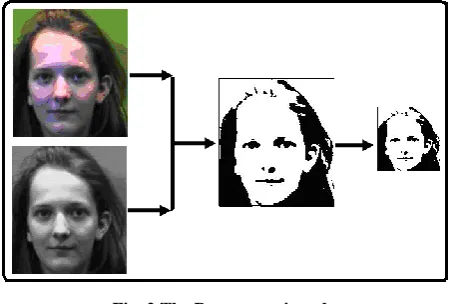
The preprocessing phase includes defining the face's region of interest. Then, the next step is converting the color or gray level image to B/W image. Furthermore, the converted B/W image is resized into 100 ×100 as shown in figure (2). The main reason for the preprocessing phase is two folded. The first one is the attempt to reduce the size of pattern vector. The second one is to isolate information of the image that distinguish faces.
2.3
Feature Extraction Phase
In this phase, two algorithms are presented. These are feature extraction algorithm and AHL algorithm.
a)Feature Extraction Algorithm: The key to the success of any face identification system is the face features extraction. Consequently, this paper resorts to the use of appearance features to characterize human face. The proposed feature extraction algorithm is developed by projecting each preprocessed B/W image on all horizontal levels (for example 1%, 2%…99%, 100% of the B/W image’s height). At each horizontal level, the valid number of occurrence of face pixels is recorded. Thus, for each B/W image a vector of the valid number of face pixels in these horizontal levels is produced so as to obtain a vector of human pixels along all horizontal levels. We denote the presence counter for the d projection level by X[d], where d varies from 1 to 100 levels and thus X={X[1], X[2], …, X[100]}. These projection horizontal levels fulfill the description of the face pattern. Moreover, for normalization, the extracted feature vector X is divided by the maximum to generate the Normalized Image Feature Vector
dimensional NIFV. List 1 introduces feature extraction algorithm.
b)Active Horizontal Level Algorithm: The second algorithm following the feature extraction phase is the feature selection that can be used for person’s authentication. Feature selection is the process of removing features from the data set that are irrelevant with respect to the task that is to be performed. Feature selection can be extremely useful in reducing the dimensionality of the data to be processed by the classifier. Moreover, the feature selection will tend to reducing execution time and improving predictive accuracy (inclusion of irrelevant features can introduce noise into the data, thus obscuring relevant features). It is worth noting that even though some machine learning algorithms perform some degree of feature selection themselves (such as classification trees). Feature space reduction can be useful even for these machine learning algorithms. Reducing the dimensionality of the data decreases the size of the hypothesis space and thus results in faster execution time. In general, feature selection techniques can be divided into two categories : filter methods and wrapper methods. Wrapper methods generally result in better performance than filter methods[13]. Different feature ranking and feature selection techniques have been proposed in machine learning literature, such as: Correlation-based Feature Selection (CFS), Principal Component Analysis (PCA), Gain Ratio Attributes Selection (GRAS), Information Gain Ratio Attributes Selection (IGRAS), Chi-Square Attributes Selection (CSAS) and Support Vector Machine Feature Elimination (SVMFE). Moreover, forward selection, backward elimination, bi-directional search, best-first search, Genetic search and other methods [13] are often used in this task.
In this paper, the performance of the feature selection algorithms (GRAS, IGRAS and CSAS) are evaluated, and the classifiers chosen including a wide range of paradigms (Neural Network with multilayer perceptron, IBK, Kstar, NNge, J48, and FT) are compared. Moreover, the mentioned classifiers techniques are used to evaluate the proposed selected feature.
The used Neural Network (NN) classifier is a predictive model loosely based on the action of biological neurons placed in several layers. The input layer takes the input feature and distributes it to the hidden layers which do all the necessary computations and outputs. The implemented IBK
classifier is a K-Nearest Neighbor (K-NN) classifier and constructs decision boundaries by just storing the complete training data. The Kstar classifier is an instance-based classifier [13]. The NNge classifier is a Nearest-Neighbor-like
List 1: Feature Extraction Algorithm
1.
Initialization:d = 1, and d is assigned a value from 1 to 100 (where d is the horizontal level and 100 is the maximum number of levels)
2.
Step-1: Calculate X[d], where X[d] is the number of pixels for a face's appearance on horizontal level d3.
Step-2: Increment d.4.
Step-3: Repeat Step-1 and 2 until d = 100.5.
Step-4: Find maximum value XMax for X[d] elements.6.
Step-5: Divide each element in X[d] by XMax to generate [image:2.595.54.288.105.240.2]Normalized Image Feature Vectors (NIFV), and thus overcoming the scaling problem.
Fig. 1 The proposed model architecture
[image:2.595.55.282.357.509.2]J48 classifier is the WEKA implementation of the C4.5 algorithm [15]. The Functional Trees (FT) classifier combines a standard univariate Decision Tree (DT), such as C4.5, with linear functions of the attributes by means of linear regressions [15]. The written code was based on the WEKA data mining package and the default parameters used for each algorithm. All experiments were carried out using a 10-fold Cross Validation (CV) approach to control the validity of experiments.
The proposed Active Horizontal level (AHL) as a feature selection algorithm is presented in List 2. First, select a sequence NIFV’s and consider them as a Reference NIFV’s (RNIFV’s). Second, calculate Gain Ratio value for every horizontal level (distance value). Select the horizontal level that has the highest Gain Ratio value. Then calculate the accuracy, using K-Nearest Neighbor (IBK) classifier, which has achieved the best accuracy among all other classifiers. The obtained results will be shown in experiment (1). Finally, repeat the previous steps as long as the accuracy is not decreased to get all possible horizontal level and is denoted by AHL. Classification accuracy is calculated by dividing the number of correct classified instances by the total number of instances [13].
3.
FACE DATABASES
In order to build a reliable face identification algorithm, a number of sizeable databases of face images are needed. Many face databases to be used for noncommercial purposes are available on the internet, either free of charge or for small fees. These databases are recorded under various conditions and with various applications in mind. The following sections briefly describe some of the available databases which are widely known and used.
BioID Face Database [16]: The BioID face database is one of the largest databases that is used in human identification using face. The BioID database was recorded in 2001. BioID contains 1521 images of 23 persons, about 66 images per person. The database was recorded during an unspecified number of sessions using a high variation of illumination, facial expression and background. The degree of variation was not controlled resulting in “real” life image occurrences. All images of the BioID database are recorded in grayscale with a resolution of 384 × 286 pixels. Some examples from the BioID dataset are shown in figure 3.
UK database [16]: The UK database contains 395 individuals (male and female), 20 images per individual. It has images of people of various racial origins, mainly of first year undergraduate students, so the majority of individuals are between 18-20 years old but some older individuals are also present. Some individuals are wearing glasses and some have beards.
ORL Face database [16]: The ORL database contains a set of face images taken between April 1992 and April 1994 at the lab. There are ten different images of each of 40 distinct subjects. For some subjects, the images were taken at different times, varying the lighting, facial expressions (open / closed eyes, smiling / not smiling) and facial details (glasses / no glasses). All the images were taken against a dark homogeneous background with the subjects in an upright, frontal position (with tolerance for some side movement). The size of each image is 92x112 pixels, with 256 grey levels per pixel. The images are organized in 40 directories (one for each subject). In each of these directories, there are ten different images of that subject.
FEIFace database [16]: The FEI face database is a Brazilian face database that contains a set of face images taken between June 2005 and March 2006, between 19 and 40 years old with distinct appearance, hairstyle, and adorns. The number of male and female subjects are exactly the same and equal to 100. Figure (6) shows some examples of face images. There are 14 images for each of 200 individuals, a total of 2800 images. All images are colorful and taken against a white homogenous background in an upright frontal position with profile rotation of up to about 180 degrees. Scale might vary about 10% and the original size of each image is 640x480 pixels.
List 2: AHL Algorithm main()
{ L= []; //Initialize the AHL’s vector.
d =1 Do {
AC[d]= GainRatioValue [d] // GainRatio value for d thlevel. Increment d.
}While (d ≤ 100)
The AC[d] is stored in a decreasing Order. Do {
Get index d of the maximum value for AC[d] and place it in AHL’s vector L
Calculate the accuracy by using IBK as a classifier and place the index d as a new attribute in vector L.
[image:3.595.318.542.71.139.2]} While (value of accuracy increases) }
[image:3.595.319.541.226.292.2]Fig. 3: Examples of BioID images
[image:3.595.317.541.457.524.2]Fig. 4: Examples of UK face database
4.
DISCUSSION AND EXPERIMENTAL
RESULTS
To evaluate the proposed model, three experiments were performed using the four prementioned face databases which have different variations such as (pose, smile, direction, speech, with glass and etc…)
Experiment 1: In this experiment, the feature selection technique and the classifier are both selected according to the best results achieved in order to use them in the AHL algorithm. The following steps are applied using a number of feature selection techniques including CSAS, GRAS and IGRAS. The aim of the feature selection algorithm is to choose the most effective attributes, the active horizontal levels in this case, among all the horizontal levels. The algorithm is applied on 40% from UK face database. In the classification, all attributes of the dataset have been first selected. Then cross validation of 10 folds have been chosen as test method using WEKA implementation. Table 1 shows the accuracies using NN, IBK, Kstar, NNge, J48, and FT
Classifiers, among different feature selection techniques including CSAS, GRAS and IGRAS algorithms applied on UK database. The average accuracy for GRAS (97.1%) as good as IGRAS (96.93%), better than CSAS (96.55%), and better than using all attributes (96.7%) without selection. Furthermore, the reduction ratios (RR) for all attribute selection techniques are equal (70%).
This experiment is repeated using ORL,FEI and BioID face databases. All results refer that the GRAS ratio attribute selection and IBK classifier achieve the best accuracy among all other attributes selection and classifiers.
Experiment 2: In this experiment, the AHL algorithm is applied to determine the best attributes (levels) corresponding to the best accuracy. From experiment 1, the average accuracy of GRAS technique was better not only than CSAS and IGRAS techniques, but also than using all attributes.
Furthermore, the accuracy of IBK classifier was better than
NN, Kstar, NNge, and FT classifiers and superior than J48
classifier. Therefore, the GRAS technique and IBK classifier
using the IBK classifier on 40% from UK face database. It could be noticed that the minimum number of AHLs is 30 levels that achieve the best accuracy (99.4 %).
This experiment is repeated using ORL,FEI and BioID face database. It could be noticed that the minimum number of AHLs is 35 levels that achieve the best accuracy (81.62 %) on 40% from ORL face database, 45 levels that have the best accuracy (75.49 %) on 40% from FEI face database, and is 35 levels that achieve the best accuracy (99.2 %) on 40% from BioID face database. A union operation is applied on different AHLs which are produced from this experiment. Figure (8) shows the final active horizontal levels (50 levels) for a B/W face image.
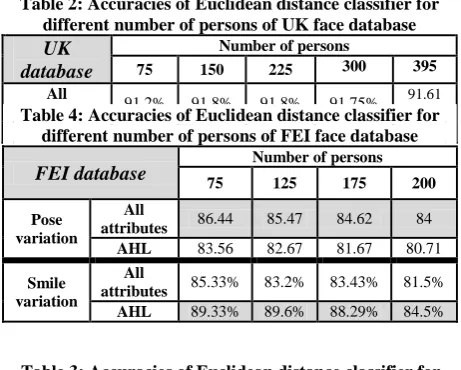
[image:4.595.57.282.72.135.2]Experiment 3: This experiment is implemented to evaluate our proposed model (AHLs algorithm) using Euclidean distance classifier for different number of persons, for four face database (UK, ORL, FEI and BioID), which have different variations. The experiment is applied after using 40% of each database in the training phase as shown in Table 2, 3, 4, 5.
Table 1. The resultant accuracies using six classifiers versus three attribute selection techniques
CSAS
(RR = 70%)
GRAS
(RR = 70%)
IGRAS
(RR = 70%)
All
Attribute
(RR = 0%)
NN 97.6% 98.6% 98.6% 98.1%
IBK 98.9% 99.4% 99.3% 99.2%
Kstar 98.9% 98.9% 98.9% 98.9%
NNge 99.1% 99.1% 99.1% 99.1%
J48 90.3% 92.1% 91.2% 90.4%
FT 94.5% 94.5% 94.5% 94.5%
Average
[image:4.595.318.535.213.302.2]Accuracy 96.55% 97.1% 96.93% 96.7%
Table 2: Accuracies of Euclidean distance classifier for different number of persons of UK face database
UK database
Number of persons
75 150 225 300 395
All
attributes 91.2% 91.8% 91.8% 91.75%
91.61 %
AHL 100% 100% 99.8% 99.8% 99.8%
Table 4: Accuracies of Euclidean distance classifier for different number of persons of FEI face database
FEI database Number of persons
75 125 175 200
Pose variation
All
attributes 86.44 85.47 84.62 84 AHL 83.56 82.67 81.67 80.71
Smile variation
All
attributes 85.33% 83.2% 83.43% 81.5% AHL 89.33% 89.6% 88.29% 84.5%
Table 3: Accuracies of Euclidean distance classifier for different number of persons of ORL face database
ORL database
Number of persons
20 25 30 35 40
Fig. 6: Examples of image variations from the FEI face database
Fig. 7: Accuracy results for different number of AHL
[image:4.595.55.282.509.644.2] [image:4.595.318.549.515.700.2]5.
COMPARATIVE STUDY
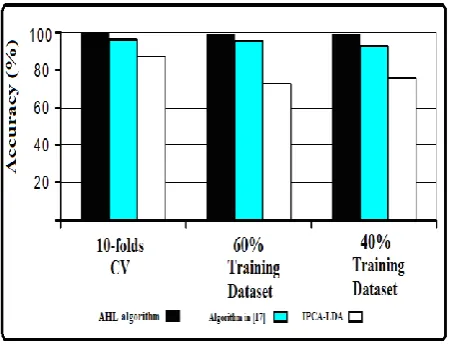
To evaluate the performance of our proposed model we should compare it with other models. Thus, an experiment is performed on BioId face database to compare our proposed face idintification method with the Incremental PCA-LDA (Principle Component Analysis - Linear Discriminant Analysis) algorithm in [12]. This algorithm computes the principal components of a sequence of vectors incrementally without estimating the covariance matrix and at the same time computing the linear discriminant directions along which the classes are well separated. Figure (9) shows the comparison of the face identification performance of our proposed method versus our proposed algorithm in [17], and Incremental PCA-LDA algorithm in [12], using IBK classifier. In this experiment, 40% and 60% training dataset, and 10-foldes Cross Validation techniques for testing. The experimental results show that the accuracy of our proposed algorithm using 40% training dataset is 98.8% superior than that algorithm proposed in [17] (93.1%) and IPCA-LDA (75%). Furthermore, by using 60% training dataset, the result of our proposed algorithm is 99.1% superior than that algorithm proposed in [17] (95.1%) and IPCA-LDA (72.5%). Moreover, by using 10-folds cross validation is the result of our proposed algorithm 99.6% better than that algorithm proposed in [17] (96.5%) and IPCA-LDA (86.7%).
6.
CONCLUSION
This paper has addressed the problem of face identification based on appearance features in human faces, with considering the issues of distance metrics and scales. Our major contribution lies on offering a promising method to extract face feature (AHL). This feature is invariant under scale, transform, smile, pose, direction, speech, with glass, with beard and illumination. Experimental results on BioID face database [16] indicate that the proposed algorithm is better than that algorithm proposed in [17][12] in case of using 40% Training dataset, 60% Training dataset, and 10-folds Cross Validation.
7.
REFERENCES
[1] K. Jain, R. Bolle and S. Pankanti, Biometrics: Personal Identification in Networked Security, Ed. Kluwer Academic Publishers, 1999.
[2] X. He, S. Yan, Y. Hu, P. Niyogi and H. Zhang. “Face Recognition using Laplacian Faces,” IEEE Trans. on Pattern Analysis and Machine Intelligence, vol. 27, no. 3, pp. 328–340, 2005.
[3] J. Fagertun. “Face Recognition,” M. Eng. Thesis, Technical University on Denmark, 2005.
[4] R. Jafri and H. Arabnia. “A Survey of Face Recognition Techniques,” Journal of Information Processing Systems (JIPS), vol.5, no.2, pp. 41-68, June 2009.
[5] Z. Liposcak and S. Loncaric. “A Scale-Space Approach to Face Recognition from Profiles,” in Proc. of the 8th Int. Conf. on Computer Analysis of Images and Patterns, vol. 1689, pp.243-250, London, UK, 1999.
[6] D. Swets and J. Weng, “Using Discriminant Eigenfeatures for Image Retrieval,” IEEE Trans. on Pattern Analysis and Machine Intelligence, vol.18, pp.831-836, August 1996.
[7] A. Nefian and M. Hayes. “Face Recognition using an Embedded HMM,” in IEEE Int. Conf. Audio Video Biometric based Person Authentication (AVBPA), pp.19-24, March, 1999.
[8] J. Haddadnia, M. Ahmadi and K. Faez, “An Efficient Method for Recognition of Human Face Recognition using Higher Order Pseudo Zernike Moment Invariant,” in the 5th IEEE Int. Conf. on Automatic Face and Gesture Recognition. pp. 315-320, Washington, DC, USA, May 2002.
[9] A. Jain, R. Duin and J. Mao, “Statistical Pattern Recognition: A Review,” IEEE Trans. on Pattern Analysis and Machine Intelligence, vol.22, no.1, pp.4-37, January 2000.
[10]G. Gordon, “Face Recognition Based on Depth Maps and Surface Curvature,” in SPIE Proc., Geometric Methods in Computer Vision, vol.1570, pp.234-247, September 1991.
[11]R. Cutler, “Face Recognition using Infrared Images and EgenFaces,” CSC Tech. Rep. 989, University of Maryland at College Park, MD, USA, 1996.
[12]I. Dagher, “Incremental PCA-LDA Algorithm,” 2nd Ed, Int. Journal of Biometrics and Bioinformatics (IJBB), vol.4, no. 2, 2010.
[image:5.595.56.282.368.541.2][13]J. Cleary and L. Trigg. “K*: An Instance-based Learner using an Entropic Distance Measure,” 12th Int. Conf. on Machine Learning, pp. 108-114, Tahoe City, CA, USA, 1995.
Table 5: Accuracies of Euclidean distance classifier for different number of persons of BioID face database
BioID database
Number of persons
15 20 23
All attributes 99.8% 99.3% 99%
AHL 100% 99.5% 99.1%
[14]E. Vasconcellos, R. De Carvalho, R. Gal, F. LaBarbera, H. Capelato, H. Campos Velho, M. Trevisan and R. Ruiz, "Decision Tree Classifiers for Star/Galaxy Separation," The Astronomical Journal, Cornell University arXiv: 1011.1951, vol. 141, no. 6, November 2010.
[15]R. Datta and S. Sanjib. “An Empirical Comparison of Rule Based Classification Techniques in Medical Databases,” Indian Institute of Foreign Trade, Indian, 2011.
[16] (2012) The Face databases website. Available: http://www.face-rec.org/databases/.