The Thirty-Third AAAI Conference on Artificial Intelligence (AAAI-19)
3D Face Synthesis Driven by Personality Impression
Yining Lang,
1Wei Liang,
1Yujia Wang,
1Lap-Fai Yu
21Beijing Laboratory of Intelligent Information Technology, Beijing Institute of Technology,2George Mason University
[email protected], [email protected], [email protected], [email protected].
Abstract
Synthesizing 3D faces that give certain personality impres-sions is commonly needed in computer games, animations, and virtual world applications for producing realistic virtual characters. In this paper, we propose a novel approach to syn-thesize 3D faces based on personality impression for creat-ing virtual characters. Our approach consists of two major steps. In the first step, we train classifiers using deep convo-lutional neural networks on a dataset of images with person-ality impression annotations, which are capable of predicting the personality impression of a face. In the second step, given a 3D face and a desired personality impression type as user inputs, our approach optimizes the facial details against the trained classifiers, so as to synthesize a face which gives the desired personality impression. We demonstrate our approach for synthesizing 3D faces giving desired personality impres-sions on a variety of 3D face models. Perceptual studies show that the perceived personality impressions of the synthesized faces agree with the target personality impressions specified for synthesizing the faces.
Introduction
A face conveys a lot of information about a person. People usually form an impression about another person in less than a second, mainly by looking at another person’s face. Re-searchers in psychology, cognitive science, and biometrics conducted a lot of studies to explore how facial appearances may influence personality impression (Willis and Todorov 2006; Hassin and Trope 2000). Some researchers investi-gated the relationship between personality impressions and specific facial features (Eisenthal, Dror, and Ruppin 2006). There are also attempts in training machine learning models for predicting personality impressions based on facial fea-tures (Gray et al. 2010; Joo, Steen, and Zhu 2015).
To create realistic 3D faces for the computer games, dig-ital entertainments, and virtual reality applications, some works have been carried on generating realistic faces (Hu et al. 2017), vivid animations (Sohre et al. 2018), natural ex-pressions (Marsella et al. 2013), and so on. Yet, synthesizing 3D faces that give certain personality is not explored, which is one of the most important considerations during the cre-ative process. For example, the main characters in games and
Copyright c⃝2019, Association for the Advancement of Artificial Intelligence (www.aaai.org). All rights reserved.
animations are usually designed to look confident and smart, whereas the “bad guys” are usually designed to look hostile. There are automatic tools for synthesizing human faces of different ethnicities and genders, however, the problem of synthesizing 3D faces with respect to personality impres-sions is still unsolved. We propose a data-driven optimiza-tion approach to solve this problem.
As the personality impression of a face depends a lot on its subtle details, under the current practice, creating a face to give a certain personality impression is usually done through a “trial-and-error” approach: a designer creates sev-eral faces; asks for people’s feedback on their impressions of the faces; and then modifies the faces accordingly. This pro-cess iterates until a satisfactory face is created. This design process involves substantial tuning efforts by a designer and is not scalable. Manual creation of faces could also be very challenging if the objectives are abstract or sophisticated. For example, while it could be relatively easy to create a face to give an impression of being friendly, it could be hard to create a face to give an impression of being friendly but silly, which could be desirable for a certain virtual character. We propose a novel approach to automate this face cre-ation process. Our approach leverages Convolutional Neural Networks (CNN) techniques to learn the non-trivial map-ping between low-level subtle details of a face and high-level personality impressions. The trained networks can then be applied for synthesizing a 3D face to give a desired personal-ity impression via an optimization process. We demonstrate that our approach can automatically synthesize a variety of 3D faces to give different personality impressions, hence overcoming the current scalability bottleneck. The synthe-sized faces could find practical uses in virtual world appli-cations (e.g., synthesizing a gang of hostile-looking guys to be used as enemies in a game).
The major contributions of our paper include:
• Introducing a novel problem of synthesizing 3D faces based on personality impressions.
• Proposing a learning-based optimization approach and a data-driven MCMC sampler for synthesizing faces with desired personality impressions.
Related Work
Faces and personality impressions.Personality impression is an active research topic in psychology and cognitive sci-ence. Researchers are interested in studying how different factors,e.g., face, body, profile, motion, influence the for-mation of personality impression on others (Naumann et al. 2009). Recent work (Over and Cook 2018) suggests that fa-cial appearances play an important role in giving personality impressions.
Some works focused on examining what facial features influence personality impression. Vernon et al. (2014) mod-eled the relationship between physical facial features ex-tracted from images and impression of social traits. Zell et al. (2015) studied the roles of face geometry and texture in affecting the perception of computer-generated faces. Some findings were adopted to predict human-related attributes based on a face. Xu et al. (2015) proposed a cascaded fine-tuning deep learning model to predict facial attractiveness. Xie et al. (2015) proposed a benchmark dataset for analyz-ing facial beauty impression. Joo et al. (2015) proposed an approach to infer the personality of a person from his face.
Motivated by these findings, we use deep learning tech-niques to learn the relationship between facial appear-ances and personality impressions based on a collected face dataset with personality impression annotations, which is applied to guide the synthesis of 3D faces to give desired personality impressions by an optimization.
Face Modeling and Exaggeration.Some commercial 3D modeling software can be used by designers for creating 3D virtual characters with rich facial details, such as Charac-ter Generator, MakeHuman, Fuse, and so on. These tools provide a variety of controls of a 3D face model, including geometry and texture,e.g., adjusting the shape of the nose, changing skin color. However, to create or modify a face to give a certain personality impression, a designer has to man-ually tune many low-level facial features, which could be very tedious and difficult.
Another line of works closely relevant to ours is face ex-aggeration, which refers to generating a facial caricature with exaggerated face features. Suwajanakorn et al. (2015) proposed an approach for creating a controllable 3D face model of a person from a large photo collection of that son captured in different occasions. Le et al. (2011) per-formed exaggeration differently by using primitive shapes to locate the face components, followed by deforming these shapes to generate an exaggerated face. They empirically found that specific combinations of primitive shapes tend to establish certain personality stereotypes. Recently, Tian and Xiao (2016) proposed an approach for face exaggeration on 2D face images based on a number of shape and texture fea-tures related to personality traits.
Compared to these works, our learning-based optimiza-tion approach provides high-level controls for 3D face mod-eling, by which designers can synthesize faces with respect to specified personality impressions conveniently.
Data-Driven 3D Modeling.
Data-driven techniques have been successfully applied for 3D modeling (Kalogerakis et al. 2012; Talton et al. 2011).
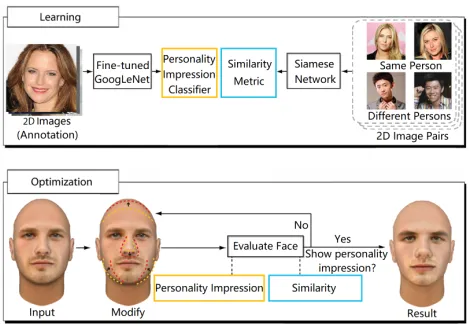
Figure 1: Overview of our approach.
Huang et al. (2017) devised deeply-learned generative models for 3D shape synthesis. Ritchie et al. (2015) used Sequential Monte Carlo to guide the procedural generation of 3D models in an efficient manner. Along the direction of face modeling, Saito et al. (2017) used deep neural networks trained with a high-resolution face database to automatically infer a high-fidelity texture map of an input face image.
Modeling the relationships between low-level facial fea-tures and high-level personality impressions is difficult. In addition, directly searching in such a complex and high-dimensional space is inefficient and unstable. In our work, we apply data-driven techniques to model the relationship between facial appearances and personality impressions. Furthermore, we speed up face synthesis by formulating a data-driven sampling approach to facilitate the optimization.
Overview
Figure 1 shows an overview of our approach. Given an in-put 3D face, our approach optimizes the face geometry and texture such that the optimized face gives the desired person-ality impression specified by the user. To achieve this goal, we present an automatic face synthesis framework driven by personality impression, which consists of two stages: learn-ingandoptimization.
In the learning stage, we define8types of personality im-pression. Then we learn a CNN personality impression clas-sifier for each type. To train the CNN clasclas-sifiers, we col-lected10,000images from CASIA WebFace database (Yi et al. 2014) and annotated them with the corresponding per-sonality impression. We also learn an end-to-end metric to evaluate the similarity between the synthesized face and the input one. The metric plays the role of constraining 3D face deformation.
data-driven sampling approach based on the learned priors. The optimization continues until a face giving the desired personality impression is synthesized.
Problem Formulation
Personality Impression Types.In our experiments, we use four pairs of personality impressions types: a) smart/silly; b) friendly/hostile; c) humorous/boring; and d) confi-dent/unconfident. These personality impression types are commonly used in psychology (Mischel 2013; Asch 1946).
3D Face Representation. To model a 3D face, we use a multi-linear PCA approach to represent the face geometry and texture (Blanz and Vetter 1999), akin to the represen-tation of (Hu et al. 2017). Our approach operates on a tex-tured 3D face mesh model. We represent a face(V,T)by its geometryV∈R3n, which is a vector containing the 3D
coordinates of then = 6,292vertices of the face mesh, as well as a vectorT∈R3ncontaining the RGB values of the
npixels of its texture image.
Each face is divided into8regions (eyes, jaw, nose, chin, cheeks, mouth, eyebrows and face contour). For each face region, we learn two Principal Component Analysis (PCA) models for representing its geometry and texture in low-dimensional spaces. The PCA models are learned using 3D faces from Basel Face Model database (Paysan et al. 2009). First, we manually segment each face into the eight re-gions. Then, for each region, we perform a PCA on the ge-ometry and a PCA on the texture to compute the averages and the sets of eigenvectors. In our implementation, when doing the PCAs for the r-th region, for all vertices in V and all pixels in T that do not belong to ther-th region, we just set their values to zero so that all regions have the same dimensionality and can be linearly combined to form the whole face(V,T):
V= 8 ∑
r=1
( ¯Vr+ Λrvr),T= 8 ∑
r=1
( ¯Tr+ Γrtr). (1)
Here r is the index of a face region; V¯r ∈ R3n and ¯
Tr∈R3ndenote the average geometry and average texture
for ther-th face region;Λr∈R3n×mandΓr∈R3n×mare matrices whose columns are respectively the eigenvectors of the geometry and texture. We usem = 40eigenvectors in our experiments.vr∈Rmandtr∈Rmare vectors whose
entries are the coefficients corresponding respectively to the eigenvectors of the geometry and texture. This representa-tion allows our approach to manipulate an individual face region by modifying its coefficientsvrandtr. Based on the
PCA models of the8face regions, a 3D face(V,T)is pa-rameterized as a tupleθ = (v1,v2,· · ·,v8,t1,t2,· · · ,t8)
containing the coefficients.
Facial Attributes.Although different faces can be synthe-sized by changing the face coefficientsviandti, in general
these coefficients do not correspond to geometry and texture facial attributes that can be intuitively controlled by a human modeler for changing a face’s outlook. It would be desirable to devise a number of facial attributes in accordance with human language (e.g., “changing the mouth to be wider”), to facilitate designers in interactively modifying a 3D face,
and to allow our optimizer to learn from and mimic human artists on the tasks of modifying a face with respect to per-sonality impression.
We describe how the effect of changing a facial attribute
acan be captured and subsequently applied for modifying a face. For simplicity, we assume that each facial attribute is defined only in one face region rather than across regions. Based on a set of exemplar faces{(Vi,Ti)}from the Basel
Face Model database with assigned facial attribute a, we compute the sums:
∆Va=
1
A
∑
i=1
µi(Vi−V¯),∆Ta=
1
A
∑
i=1
µi(Ti−T¯),
(2)
where V¯ and T¯ are the average geometry and aver-age texture computed over the whole Basel Face Model dataset. µi ∈ [0,1] is the markedness of the attribute in
face(Vi,Ti), which is manually assigned. A = ∑i=1µi
is the normalization factor. Given a face (V,T), the re-sult of changing facial attribute aon this face is given by
(V+β∆Va,T+β∆Ta), whereβis a parameter for
con-trolling the extent of applying facial attributea.
In total, we devise160facial attributes. Each attribute is modeled by5example faces. We demonstrate the effect of each attribute on an example face. It is worth noting that the representation of a 3D face can be replaced by other 3D face representations that provide controls of a face.
Optimization Objectives.We synthesize a 3D face to give a desired personality impression by an optimization process, which considers two factors: (1) Personality Impression: how likely the synthesized face gives the desired personality impression. (2)Similarity Metric: how similar the synthe-sized face is with the input face.
Given an input 3D face and a desired personality impres-sion type, our approach synthesizes a 3D face which gives the desired personality impression by minimizing a total cost function:
C(θ) = (1−λ)Cp(Iθ, P) +λCs(Iθ, Ii), (3)
whereθ = (v1,v2,· · ·,v8,t1,t2,· · · ,t8)contains the face
coefficients for synthesizing a 3D face.Cp(·)is the
person-ality impression cost term for evaluating imageIθof the face
synthesized fromθwith regard to the desired personality im-pression typeP. The face image is rendered using the frontal view of the face. Lambertian surface reflectance is assumed and the illumination is approximated by second-order spher-ical harmonics (Ramamoorthi and Hanrahan 2001).Cs(·)is
the similarity cost term, which measures the similarity be-tween the imageIθof the synthesized face and the imageIi
of the input face, constraining the deformation of the input face during the optimization. λis a trade-off parameter to balance the costs of personality impression and similarity.
Personlaity Impression Classification
To compute the personality impression costCpfor a
the personality impression type. To achieve this, we cre-ate a face image dataset annotcre-ated with personality im-pression labels based on CASIA WebFace database (Yi et al. 2014), which consists of 10,000 face images covering both genders and different ethnicities. Then, we fine-tune GoogLeNet (Szegedy et al. 2015) with a personality impres-sion classification task on the dataset.
Learning.We construct our network based on the original GoogLeNet with pre-trained parameters. The network is22
layers deep with5average pooling layers. It has a fully con-nected layer with1,024units and rectified linear activation. The images with the corresponding labels in the personal-ity impression dataset are fed to the network and an average classification loss is applied. Thus, the original GoogLeNet model is fine-tuned to adapt to a personality impression clas-sification task.
We use a GPU-based engine and implement asynchronous stochastic gradient descent with0.9momentum in the fine-tuning stage and a fixed learning rate schedule (with learning rate decreased by4%every8epochs). The mini-batch size is128.
After fine-tuning, each face image of our dataset is propa-gated to the fine-tuned network, and a1,024-dimension fea-ture vector gis extracted from the 22-nd layer. Based on those feature vectors, our approach learns a linear SVM clas-sifier for each personality impression type.
Face Similarity Metric
To constrain the synthesized face to look similar to the in-put face, we evaluate the similarity between the imageIθ
of the synthesized face and image Ii of the original input
face in the optimization. To achieve this, we train a Siamese network (Chopra, Hadsell, and LeCun 2005), an end-to-end network, to evaluate whether a pair of face images corre-spond to the same face. The network learns a feature ex-tractor which takes face images and outputs feature vectors, such that the feature vectors corresponding to images of the same face are close to each other, while those corresponding to images of different faces are far away from each other.
We train the Siamese network using the LFW dataset (Huang et al. 2007). The training dataset is constructed as {(Ia, Ib, l)}, where Ia and Ib are any two
images from the LFW dataset, andlis the label. IfIaandIb
are from the same face,l= 1, otherwisel= 0.
The Siamese network consists of two identical Convolu-tional Networks that share the same set of weightsW. The training process learns the weightsW by minimizing a loss functionL = lL1+ (1−l)L2, where L1 = ∥GW(Ia)−
GW(Ib)∥ and L2 = max(0, ρ − ∥GW(Ia)−GW(Ib)∥).
GW(I) is the mapped features of an input face imageI,
which are synthesized by the learned identical Convolutional Network. By minimizing the loss function L, the distance between the mapped features ofIaandIb is driven byL1
to be small ifIaandIbcorrespond to the same face, and is
driven byL2to be large vice versa. The constantρis set as 2.0. The parameters are learned by standard cross entropy loss and back-propagation of the error.
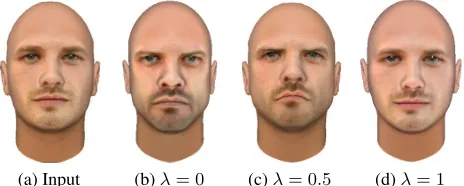
(a) Input (b)λ= 0 (c)λ= 0.5 (d)λ= 1
Figure 2: The influence ofλon the synthesized face when optimizing an example face to give a hostile personality im-pression.
Cost Functions
Given a textured 3D face model and a desired personality impression type as the input, our approach employs a data-driven MCMC sampler to update the face coefficientsθ it-eratively so as to modify the face. In each iteration, the syn-thesized face represented byθis evaluated by the total cost C(·) = (1−λ)Cp(·) +λCs(·). The optimization continues
until a face giving the desired personality impression is syn-thesized. We discuss the personality impression costCpand
the similarity costCsin the following.
Personality Impression Cost.The imageIθof the face
syn-thesized by face coefficientsθis evaluated with respect to the desired personality impression typeP in the cost func-tionCp, defined based on the fine-tuned GoogLeNet:
Cp(Iθ, P) = 1−
exp(x1)
exp(x1) +exp(x2)
, (4)
where[x1, x2]T =wPTgis the output of the full connected
layer of the fine-tuned network.x1 andx2 reflect the
pos-sibilities of the image Iθ belonging to the personality
im-pression type P or not, respectively. g ∈ R1,024 is the
face feature vector ofIθon the22-nd layer of the network;
wP ∈ R1,024×2 contains the parameters of the full
con-nected layer, which map the feature vectorgto a 2D vector (our fine-tuned network is a two-category classifier).
A low cost value means the synthesized face image gives the desired type of personality impression, according to the classifier trained by face images annotated with personality impression labels.
Similarity Cost.We want to constrain the synthesized face to look similar to the input face. To achieve this, we apply the Siamese network trained for evaluating the similarity be-tween a pair of face images to define a similarity cost as a soft constraint of the optimization:
Cs(Iθ, Ii) =
1
G∥GW(Iθ)−GW(Ii)∥, (5)
whereGW(Iθ)andGW(Ii)are the feature vectors of the
image Iθ of the synthesized face and the image Ii of
the input face computed by the Siamese network. G = max({∥GW(I)−GW(Ii)∥})is a normalization factor
cost value means that the synthesized face imageIθis
simi-lar to the input face imageIi.
To demonstrate how the similarity cost and personality impression cost affect the face synthesis results during the optimization, we do an ablation study of optimizing a face model with the personality impression type of hostile in Fig-ure 2. When the trade-off parameterλis set as0, the face is optimized to become more hostile-looking yet it differs from the input face significantly. Whenλis set as0.5, the face is optimized to look somewhat hostile and it resembles the in-put face closely. Whenλis set as1, the face resembles the input one more closely, but it shows less hostile. We can find from the results that a larger λconstrains the synthesized face to resemble the input face more closely and show fewer personality impression.In our experiments, we setλ= 0.5
by default.
Face Synthesis by Optimization
We use a Markov chain Monte Carlo (MCMC) sampler to explore the space of face coefficients efficiently. As the top-down nature of MCMC sampling makes it slow due to the initial ”burn-in” period, we devise a data-driven MCMC sampler for our problem. We propose two types of data-driven Markov chain dynamics: Region-Move and Prior-Move, corresponding to local refinement and global recon-figuration of the face.
Region-Move. We want to learn from how human artists modify faces to give a certain personality impression, so as to enable our sampler to mimic such modification process during an optimization. Considering that each face region’s contribution to a specified personality impression is differ-ent, we devise a Region-Move which modifies a face ac-cording to “important” face regions likely to be associated with the specified personality impression in training data.
Our training data is created based on5face models. We recruited 10 artists who are familiar with face modeling (with5to10years of experience in avatar design and 3D modeling). Each artist was asked to modify each of the5
face models to give the8 personality impression types by controlling the facial attributes. After the manual modifica-tions, we project the original5face models and all the man-ually modified face models into the PCA spaces, so that each face can be represented by its face coefficientsθ.
For each personality type, let ∆θ = (∆v1,· · ·,∆v8,∆t1,· · · ,∆t8) contain the sums of
face coefficients differences for the 8 face regions.
∆vr = ∑||vr −v′r|| is the sum of differences of the
geometry coefficients of ther-th face region, wherevrand
v′r are the geometry coefficients of the original face model and a face model modified by an artist respectively. The sum of differences of the texture coefficients ∆tr is similarly
defined. Suppose the current face is(V,T)with face coef-ficientsθ. During sampling, a face regionris selected with probability 0.5∑∆∆vrv
i + 0.5 ∆tr ∑∆t
i. Then a facial attribute
ain face regionris randomly selected and modified so as to create a new face(V+β∆Va,T+β∆Ta)with new
face coefficientsθ′, whereβ ∼U(−1.0,1.0). The changes
∆Va and∆Ta are learned in Section Facial Attribute for
each facial attributea.
Essentially, a face region that is more commonly modified by artists to achieve the target personality impression type is modified by our sampler with a higher probability.
Prior-Move. We also leverage the personality impression dataset to learn a prior distribution of the face coefficientsθ
for each personality impression, so as to guide our sampler to sample face coefficients near the prior face coefficients, which likely induce a similar personality impression.
For each personality impression type P, we estimate a prior distribution with the following steps:
(1) Select images in the personality impression dataset which are annotated with the personality impression typeP; and form a subsetDP ={Id}.
(2) Reconstruct the corresponding 3D face model for each imageId ∈ DP by the implementation of (Blanz and
Vetter 1999; Blanz and Vetter 2003). These 3D face models are projected onto the PCA spaces and are rep-resented using face coefficients. Thus, we form a face coefficients setΘP ={θd}.
(3) Fit a normal distribution for each of the geometry and texture coefficients (vr andtr) of each face region r
based onΘP.
Given the prior distribution, our sampler draws a value from the normal distribution of each of the geometry and texture coefficients, to generate new face coefficientsθ′.
Optimization. We apply simulated annealing with a Metropolis-Hastings state-searching step to search for face coefficientsθthat minimize the total cost functionC. In each iteration of the optimization, one type of moves is selected and applied to propose new face coefficients θ′, which is evaluated by the total cost function C. The Region-Move and Prior-Move are selected with probabilitiesαand1−α
respectively. In our experiments, we setα= 0.8by default. The proposed face coefficientsθ′generated by the move are accepted according to the Metropolis criterion:
P r(θ′|θ) = min {
1,f(θ
′)
f(θ) }
, (6)
where f(θ) = exp−1tC(θ) is a Boltzmann-like objective
function andt is the temperature parameter of the anneal-ing process. By default, we empirically settto1.0and de-crease it by0.05every10iterations until it reaches zero. We terminate the optimization if the absolute change in the to-tal cost value is less than5%over the past20iterations. In our experiments, a full optimization takes about100−150
iterations (about15seconds) to finish.
Experiments
We conducted experiments on a Linux machine equipped with an Intel i7-5930K CPU, 32GB of RAM and a Nvidia GTX 1080 graphics card. The optimization and learning components of our approach were implemented in C++.
Results and Discussion
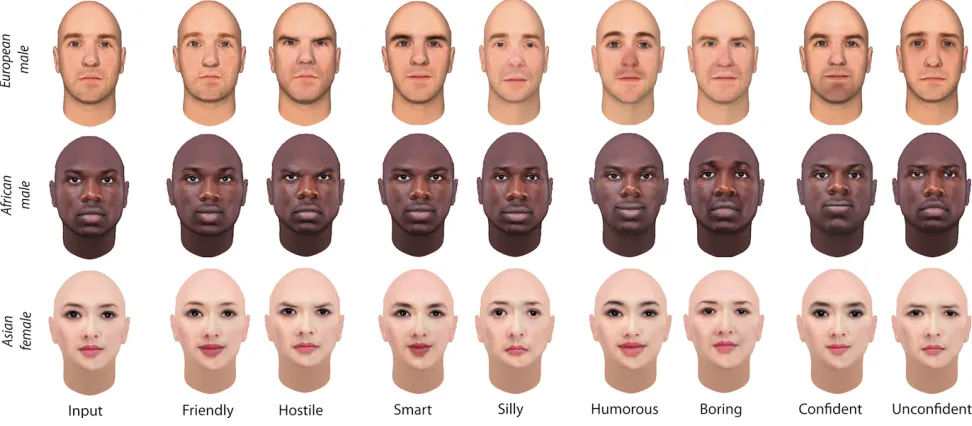
Figure 3: Results of synthesizing faces with different personality impression types.
faces and the synthesized faces. The input faces consist of anEuropean maleface, anAfrican maleface, and anAsian femaleface. For each input face, a face is synthesized using each of the8impression types.
We observe some interesting features that may result in the corresponding personality impressions. For instance, comparing the results of confident and unconfident faces, we observe that the confident faces usually have a higher nose bridge and bigger eyes. In addition, the eyebrows also look sharp and slightly slanted, which make a person look like in a state of concentration. The mouth corners lift slightly and the mouths show a subtle smile. As for the unconfident faces, the eyebrows are generally dropping or furrowed, showing a subtle sign of nervousness. The eye corners are also drop-ping, and the eyes look tired. The cheeks generally look more bonier. The mouths are also drooping, which could be perceived as signs of frustration.
We observe that usually a combination of facial features accounts for the personality impression of a face. As there are as many as160facial attributes, it is rather hard to man-ually tune these attributes to model a face. The CNN clas-sifiers effectively learn the relationships between facial fea-tures and a personality impression type, such that they can drive face synthesis by personality impression automatically.
Perceptual Studies
We conducted perceptual studies to evaluate the quality of our results. The major goal is to verify if the perceived per-sonality impressions of the synthesized faces match with the personality impression types. We recruited160participants from different countries via Amazon Turk. They are evenly distributed by gender and are aged 18to50. Each partici-pant was shown some synthesized faces and was asked about the personality impression they perceived. Definitions of the personality types from a dictionary were shown as reference.
Recognizing Face Personality Impression. In this study, we want to verify if the personality impression types of the synthesized faces agree with human impressions. We used the faces from Figure 3. Each of these faces was synthesized using a single personality impression type and was voted by
40human participants. In voting for the personality impres-sion type of a face, a participant needed to choose1out of the8personality impression types used in our approach. In total, we obtained1,600votes for40faces.
Figure 4 shows the results as a confusion matrix. The av-erage accuracy is about38.0%, compared to the chance-level accuracy of12.5%(since we have 8 personality impression types). For each personality impression type, the matching type gets the highest number of votes as shown by diagonal. “Friendly” and “hostile” receive a relatively high accu-racy (about45%−50%), probably because the facial features leading to such personality impressions are more promi-nent and easily recognizable. For example, participants usu-ally perceive a face as hostile-looking when they see dense moustache, slanted eyebrows and a drooping mouth. For other personality impressions such as humorous and boring, the accuracy is relatively lower (about 33%), probably be-cause the facial features leading to such personality impres-sions are less apparent, or because the participants do not have a strong association between facial features and such personality impressions. The facial features of some per-sonalities are overlapped, which makes some people have several different, but similar personalities. For instance, a smart person may also look confident. Thus, participants may choose a similar which reduces the total accuracy.
We also perform a t-tests on the results of perceptual study. Our null hypothesisH0was that participants can not
Figure 4: Accuracy of determining a single personality im-pression type of faces synthesized in the perceptual study. Percentages of votes are shown.
Figure 5: Example faces with expressions used in the per-ceptual study.
the participants can recognize the personality impression types of the synthesized faces out of the eight used types.
Influence of Expression. Next we want to investigate whether facial expression changes will affect the personal-ity impression of the synthesized faces. For example, does a face optimized to be hostile-looking still look hostile with a happy smile? Such findings could bring interesting insights for designing virtual character faces.
We conducted an empirical study to investigate the ef-fects of expressions on the synthesized faces. In our study,
16faces optimized with respect to each of the8personality impression types were used. Each face was tuned to show a facial expression chosen from happy, sad, angry, surprise, disgust or fear with Maya. Figure 5 shows some of the ex-amples. Each face was voted by40human participants about its personality impression types out of the eight types used in our approach. In total640votes were collected for the16
faces used.
Figure 6 shows the accuracy of determining the person-ality impression types on the synthesized faces with an ex-pression. The average accuracy is about33.4%(a drop from
38% on synthesized faces without any expression). Facial expressions do have an impact on some personality impres-sions. For example, with an angry expression, a face opti-mized to be friendly-looking may appear hostile. The accu-racy of the friendly (angry) face is30.0%; compared to the accuracy of45.5%on the friendly face without any expres-sion (Figure 4), the accuracy drops by15.5%. However, the personality impression on confident-looking faces seems to
Figure 6: Accuracy of determining the personality impres-sion types of synthesized faces with expresimpres-sions in the perceptual study. Percentages of votes for the answers are shown.
be relatively unaffected by facial expressions. For instance, even with an angry expression, a face optimized to look con-fident still has 32.5%votes for confident. This is probably because people have strong associations between certain fa-cial features and “confident”, and those fafa-cial features are still apparent under facial expression changes.
Though this study is not comprehensive, it gives some good insights about the effects of expressions on personality impression. We believe that a more comprehensive percep-tual study will be an interesting avenue for future research.
Summary
Limitations. To stay focused on face’s geometry and tex-ture, we do not consider the influence of hair, accessories or clothing on personality impression. Besides, speech and facial movements, as well as head and body poses, can also influence the impression of one’s personality, just as experienced actors can change the personality impressions they make by controlling speech, facial expression and body movements. While we only focus on static facial features in this work, we refer the reader to recent interesting efforts on adding personality to human motion (Durupinar et al. 2017).
successes in 2D image generation.
Acknowledgements
This research is supported by the National Science Founda-tion under award number 1565978.
References
Asch, S. E. 1946. Forming impressions of personality. The Journal of Abnormal and Social Psychology41(3):258. Blanz, V., and Vetter, T. 1999. A morphable model for the synthesis of 3d faces. InSIGGRAPH, 187–194.
Blanz, V., and Vetter, T. 2003. Face recognition based on fitting a 3d morphable model.IEEE PAMI25(9):1063–1074. Chopra, S.; Hadsell, R.; and LeCun, Y. 2005. Learning a similarity metric discriminatively, with application to face verification. InCVPR.
Durupinar, F.; Kapadia, M.; Deutsch, S.; Neff, M.; and Badler, N. I. 2017. Perform: Perceptual approach for adding ocean personality to human motion using laban movement analysis.TOG36(1):6.
Eisenthal, Y.; Dror, G.; and Ruppin, E. 2006. Facial at-tractiveness: Beauty and the machine. Neural Computation
18(1):119–142.
Goodfellow, I.; Pouget-Abadie, J.; Mirza, M.; Xu, B.; Warde-Farley, D.; Ozair, S.; Courville, A.; and Bengio, Y. 2014. Generative adversarial nets. InNIPS. Curran Asso-ciates, Inc. 2672–2680.
Gray, D.; Yu, K.; Xu, W.; and Gong, Y. 2010. Predicting facial beauty without landmarks. InECCV, 434–447. Hassin, R., and Trope, Y. 2000. Facing faces: studies on the cognitive aspects of physiognomy. Journal of Personality and Social Psychology78(5):837.
Hu, L.; Saito, S.; Wei, L.; Nagano, K.; Seo, J.; Fursund, J.; Sadeghi, I.; Sun, C.; Chen, Y.-C.; and Li, H. 2017. Avatar digitization from a single image for real-time ren-dering.TOG36(6):195.
Huang, G. B.; Ramesh, M.; Berg, T.; and Learned-Miller, E. 2007. Labeled faces in the wild: A database for studying face recognition in unconstrained environments. Technical Report 07-49.
Huang, H.; Kalogerakis, E.; Yumer, E.; and Mech, R. 2017. Shape synthesis from sketches via procedural models and convolutional networks. TVCG23(8):2003–2013.
Joo, J.; Steen, F. F.; and Zhu, S.-C. 2015. Automated fa-cial trait judgment and election outcome prediction: Sofa-cial dimensions of face. InICCV.
Kalogerakis, E.; Chaudhuri, S.; Koller, D.; and Koltun, V. 2012. A probabilistic model for component-based shape synthesis.TOG31(4):55.
Le, N.; Why, Y.; and Ashraf, G. 2011. Shape stylized face caricatures. Advances in Multimedia Modeling536–547. Marsella, S.; Xu, Y.; Lhommet, M.; Feng, A.; Scherer, S.; and Shapiro, A. 2013. Virtual character performance from speech. In Proceedings of Eurographics Symposium on Computer Animation, 25–35.
Mischel, W. 2013.Personality and assessment. Psychology Press.
Naumann, L. P.; Vazire, S.; Rentfrow, P. J.; and Gosling, S. D. 2009. Personality judgments based on physical appearance. Personality and Social Psychology Bulletin
35(12):1661–1671.
Over, H., and Cook, R. 2018. Where do spontaneous first impressions of faces come from? Cognition170:190–200. Paysan, P.; Knothe, R.; Amberg, B.; Romdhani, S.; and Vet-ter, T. 2009. A 3d face model for pose and illumination invariant face recognition. InAdvanced Video and Signal Based Surveillance, 296–301.
Ramamoorthi, R., and Hanrahan, P. 2001. An efficient repre-sentation for irradiance environment maps. InSIGGRAPH, 497–500.
Ritchie, D.; Mildenhall, B.; Goodman, N. D.; and Hanra-han, P. 2015. Controlling procedural modeling programs with stochastically-ordered sequential monte carlo. TOG
34(4):105.
Saito, S.; Wei, L.; Hu, L.; Nagano, K.; and Li, H. 2017. Photorealistic facial texture inference using deep neural net-works. InCVPR.
Sohre, N.; Adeagbo, M.; Helwig, N.; Lyford-Pike, S.; and Guy, S. 2018. Pvl: A framework for navigating the precision-variety trade-off in automated animation of smiles. InAAAI.
Suwajanakorn, S.; Seitz, S. M.; and Kemelmacher-Shlizerman, I. 2015. What makes tom hanks look like tom hanks. InICCV.
Szegedy, C.; Liu, W.; Jia, Y.; Sermanet, P.; Reed, S.; Anguelov, D.; Erhan, D.; Vanhoucke, V.; and Rabinovich, A. 2015. Going deeper with convolutions. InCVPR, 1–9. Talton, J. O.; Lou, Y.; Lesser, S.; Duke, J.; Mˇech, R.; and Koltun, V. 2011. Metropolis procedural modeling. TOG
30(2):11.
Tian, L., and Xiao, S. 2016. Facial feature exaggeration ac-cording to social psychology of face perception. Computer Graphics Forum35(7):391–399.
Vernon, R. J.; Sutherland, C. A.; Young, A. W.; and Hartley, T. 2014. Modeling first impressions from highly variable facial images. Proceedings of the National Academy of Sci-ences111(32):E3353–E3361.
Willis, J., and Todorov, A. 2006. First impressions making up your mind after a 100-ms exposure to a face. Psycholog-ical Science17(7):592–598.
Xie, D.; Liang, L.; Jin, L.; Xu, J.; and Li, M. 2015. Scut-fbp: A benchmark dataset for facial beauty perception. InSMC, 1821–1826.
Xu, J.; Jin, L.; Liang, L.; Feng, Z.; and Xie, D. 2015. A new humanlike facial attractiveness predictor with cascaded fine-tuning deep learning model. arXiv:1511.02465. Yi, D.; Lei, Z.; Liao, S.; and Li, S. Z. 2014. Learning face representation from scratch. arXiv:1411.7923.