Available Online at www.ijpret.com 112
INTERNATIONAL JOURNAL OF PURE AND
APPLIED RESEARCH IN ENGINEERING AND
TECHNOLOGY
A PATH FOR HORIZING YOUR INNOVATIVE WORK
EFFECT OF METAMATERIAL USING APERTURE COUPLED MICROSTRIP
PATCH ANTENNA
ANJALI B. RATHOD1, PARTH A. BHASKER2
1. M.E. Student, Department of Electronics and Telecommunication, IBSS COE, Maharashtra, India
2. M.E. Student, Department of Electronics and Communication, PIET, Gujarat Technological University, Gujarat, India
Accepted Date: 05/03/2015; Published Date: 01/05/2015
\
Abstract: Microstrip patch antenna with metamaterial properties has become a very wide topic in recent eras. Due to its flexible structure patch antennas has proven itself in various parameters (i.e. efficiency, gain, bandwidth). This paper concentrates on an aperture coupled feeding technique with and without metamaterial. The proposed antenna is designed for the frequency 2.45 GHz using Split Ring Resonator structure. The performance of the antenna can be viewed by calculating various parameters like S11, Polar plot and Efficiency using CST. The simulations results prove that the efficiency gets increased with the metamaterial structure.
Keywords: Microstrip patch antenna, Metamaterial, Efficiency.
Corresponding Author: MR. PARTH A. BHASKER
Access Online On:
www.ijpret.com
How to Cite This Article:
Parth A. Bhasker, IJPRET, 2015; Volume 3 (9): 112-118
Available Online at www.ijpret.com 113
INTRODUCTION
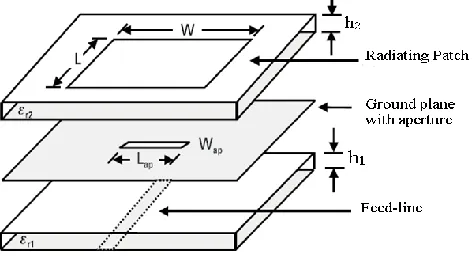
In recent days Microstrip Patch Antenna (MPA) has increasing demand in the field of RF. This is due to its various advantages like low weight, low profile, cheap, easy to fabricate etc. There are many feeding techniques but for capacitive coupling, we use aperture coupled feeding technique. Dealing with this type of feeding also increases radiation pattern and increased bandwidth. Aperture coupled is different than other coupling in the terms of feed and substrate, also ground is in between two substrates and one slot is implemented in ground which works like bridge between feed and patch. Different substrate thickness leads to better efficiency and increased bandwidth [1, 2].
As metamaterial is such a kind of material which exhibit electromagnetic properties generally not found in nature. The main purpose of using this kind of material is that it has a negative permittivity and permeability property which is sometimes referred as negative refractive index medium. The concept of this kind of material was first performed by Veselago[3]. In this medium group velocity and phase velocity are antiparallel to each other, where group velocity moves in the forward direction whereas the phase velocity moves backward and these backward waves propagate in Left handed Material [4]. In real world we cannot obtain metamaterial but we can obtain its properties by using different structures which is being followed by various researchers. And these common structures are Split Ring Resonator (SRR) and Complimentary Split Ring Resonator [5, 6]. This paper investigates and compares two methods to improve efficiency of the antenna. The first one is the general aperture coupled antenna. The second one is to investigate the same aperture coupled antenna but with the metamaterial structures.
2. APERTURE COUPLED MICROSTRIP ANTENNA DESIGN
Available Online at www.ijpret.com 114
Fig 1. Aperture coupled micro strip antenna
Width of metallic patch (W)
W = 1
2fr√μoϵo(√2/√(εr + 1
= 2fr𝑣0(√2/√(εr + 1) … (1)
Where, 𝑣0 = free space velocity of light
εr= Dielectric constant of substrate
ϵo= Dielectric constant of Air
Effective dielectric constant is calculated from Length of metallic patch (L)
L = Leff- 2ΔL … (2)
where
Leff = 1
2fr√εreff√(εoμo)… (3)
Calculation of Length Extension
∆L
h =
(0.412)(εreff + 0.3) (Wh + 0.264)
(εreff − 0.258) (Wh + 0.8)
… (4)
Available Online at www.ijpret.com 115
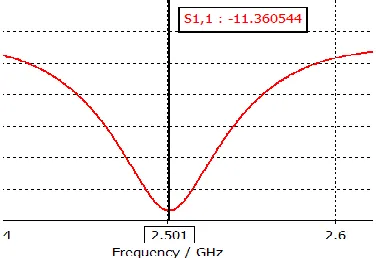
Fig 2. S11 of Aperture coupled antenna
Fig 3. Polar plot
Available Online at www.ijpret.com 116
3. APERTURE COUPLED MICROSTRIP ANTENNA WITH METAMATERIAL
Split Ring Resonator (SRR) structures with Double Negative (DNG) is represented as Metamaterial. Fig.5 illustrates a single structure of SRR.
Fig 5. SRR unit cell structure
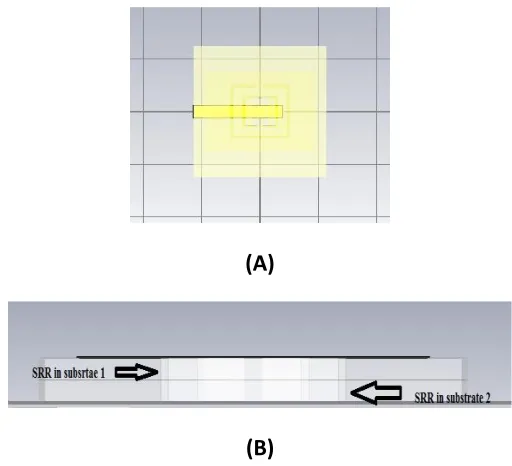
Now SRR structure is used in the dielectric material to make it a metamaterial. The square split ring resonant structures are added in the substrate to form the metamaterial which is shown in fig 6. SRR structure evolves both electric and magnetic resonance which depends on the gap between the incident electric and magnetic field [4]. The gap of the inner ring and outer ring are opposite to each other which results in to the capacitive coupling.
(A)
(B)
Available Online at www.ijpret.com 117
The above design’s simulations are done using CST. And after simulating the designs the result which we got are as follows.
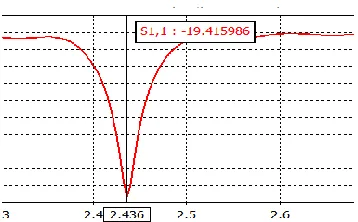
Fig. 7 shows plots of S11 at -19.41db obtained at frequency 2.436 GHz. Also fig. 8 and fig. 9 shows the simulated results of polar plot and efficiency. From the simulated results we can see that the enhancement is observed regarding the parameters like reflection coefficient, polar plot and efficiency. The graph of reflection coefficient verses frequency is shown below.
Fig 7. Graph of S11 using Metamaterial
Fig 8. Graph of Polar plot
Available Online at www.ijpret.com 118
4. CONCLUSION
Finally comparing the simulations results of the aperture coupled with and without metamaterial we can say that the performance of the aperture coupled antenna has been improved using metamaterial. The efficiency of the aperture coupled antenna has increased from 76.4% to 89.9% using metamaterial structure. An improvement of 13.5% efficiency is achieved using metamaterial. So, aperture coupled using metamaterial is preferable for attaining high efficiency in microstrip patch antenna.
REFERENCES
1. G. Kumar, and K.P. Ray, “Broadband Microstrip Antennas,”Artech House, Inc. 2003.
2. C. A. Balanis, ‘ Willy Interscience’ 3rd edition
3. D. M. Pozar, “Microstrip antenna coupled to a microstrip-line,” Electron.Lett., vol. 21, no. 2, pp. 49-50, Jan. 1985.
4. S. K. Patel & Y. P Kosta , ‘S- Shape Meandered Microstrip Patch Antenna Design using Metamaterial’ Antenna and Wave Propagation, 2014.
5. Christophe Caloz and Tatsuo Itoh, “electromagnetic metamaterials transmission line theory and microwave application”.