applied
sciences
Article
Relay-Enabled Task Offloading Management for
Wireless Body Area Networks
Yangzhe Liao1, Quan Yu1,*, Yi Han1and Mark S. Leeson2ID
1 School of Information Engineering, Wuhan University of Technology, Wuhan 430070, China;
[email protected] (Y.L.); [email protected] (Y.H.)
2 School of Engineering, University of Warwick, Coventry CV4 7AL, UK; [email protected] * Correspondence: [email protected]; Tel.: +86-132-7707-9683
Received: 9 July 2018; Accepted: 16 August 2018; Published: 20 August 2018
Abstract:Inspired by the recent developments of the Internet of Things (IoT) relay and mobile edge computing (MEC), a hospital/home-based medical monitoring framework is proposed, in which the intensive computing tasks from the implanted sensors can be efficiently executed by on-body wearable devices or a coordinator-based MEC (C-MEC). In this paper, we first propose a wireless relay-enabled task offloading mechanism that consists of a network model and a computation model. Moreover, to manage the computation resources among all relays, a task offloading decision model and the best task offloading recipient selection function is given. The performance evaluation considers different computation schemes under the predetermined link quality condition regarding the selected vital quality of service (QoS) metrics. After demonstrating the channel characterization and network topology, the performance evaluation is implemented under different scenarios regarding the network lifetime of all relays, network residual energy status, total number of locally executed packets, path loss (PL), and service delay. The results show that data transmission without the offloading scheme outperforms the offload-based technique regarding network lifetime. Moreover, the high computation capacity scenario achieves better performance regarding PL and the total number of locally executed packets.
Keywords:computation offloading; WBANs; C-MEC; resource management; QoS
1. Introduction
Recent technological developments have enabled various emerging biomedical and clinical applications such as transplanted organ monitoring and wireless capsule endoscopy image transmission that demand high a data rate and low-latency quality of service (QoS) requirements [1]. However, there exist numerous research challenges in this area. One of the most critical of these is how to handle the intensive computation tasks from implanted sensors promptly. Moreover, due to the technical constraint of the battery design, another research challenge is how to improve battery-powered relays’ computation capacity when executing intensive computing tasks [2–5].
Mobile edge computing (MEC) has been proposed as a promising candidate to replace cloud computing services when considering hospital/home-based healthcare scenarios [6,7]. This is achieved by extending conventional monitoring to ambulatory monitoring, offering real-time feedback to patients by taking full advantage of the Internet of Things (IoT) relays in combination with an edge computing server. In contrast to cloud-like computing providers that transmit the task to a remote server that is possibly several thousand kilometers away from the patients, the MEC-based scheme is capable of executing intensive computing tasks locally or in a proximal edge server. However, the majority of current MEC research is focused on mobile communications and very little has been reported on healthcare-related scenarios.
Direct transmission between the implanted sensor and the local coordinator suffers significant energy attenuation and thus decreases the network lifetime [8]. Moreover, since every piece of in-body information is critical when considering emergency intra-body data transmission, one should be aware that it is more efficient if the relays can execute the task from the implanted sensors when designing the system architecture. As a result, the patient can be notified of life-critical emergency medical information via the relay, which has user-friendly interaction [9,10]. Furthermore, due to the limited computation resources of relays, they cannot execute all computing tasks from implanted sensors. As reported in Reference [11], a cloud or cloudlet with a substantial amount of computing resources that can accept offloaded tasks from user equipment (UE) such as smartphones can decrease UE computing energy consumption. However, this is not applicable when considering emergency medical scenarios where the computing server should be closed to the patient, so as to offer computing resources under abnormal medical situations. Moreover, the network should provide multiple available physiological signal monitoring services.
To achieve the proposed targets, inspired by the MEC technique and IoT relays, the architecture of a wireless relay-enabled task offloading framework is proposed that can significantly improve the quality of the hospitalized patient monitoring services. Moreover, relay-based task offloading schemes are considered to address the research challenges related to computation intensive tasks and resource management. Furthermore, this work is motivated by the significant tradeoffs involving relays, considering different task offloading based schemes and various QoS metrics. Since the task offloading process consumes time regarding offloading decisions and transmission, a single-hop technique is adopted and the task offloads to the relay with a minimal cost function value if the relay cannot execute the task locally. Finally, if the emergency intra-body task is too large to be performed by relays locally, it will be offloaded to the C-MEC, which has higher computation capacity and power resources compared with on-body relays.
In this paper, a novel framework of the hospitalized relay-enabled offload strategy for wireless biomedical implant systems is proposed. It is assumed that the computation resource of relays is limited and that the computation tasks can be executed by either the relays or the C-MEC. The offloading decision model is given along with the numerous QoS constraints. To balance the energy consumption of all relays, a resource management scheme is investigated considering the computation task, computation capacity, and the energy status of the relays. The results show that the offloading strategy-based solution outperforms the non-offloading enhanced scheme regarding energy consumption, path loss (PL), and the total number of locally executed packets. Also, the tradeoff between different computation capacities and the related QoS metrics regarding the task offload technique are presented in detail.
The rest of the paper is organized as follows. Section2summarizes the recent work in this research area. Section3illustrates the proposed system regarding the structure of the C-MEC, channel models, and task offloading model. The proposed communication for the offloading-based transmission scheme is given in Section4, and Section5demonstrates the system performance and comparison with our previous work. Finally, Section6concludes the paper and lists a collection of on-going research and future work within wireless body area network (WBAN) techniques, which are presented as motivation towards progress in medical monitoring services.
2. Related Work
Appl. Sci.2018,8, 1409 3 of 16
Practically, the computation and wireless communication resources of relays are limited. Thus, the handling of intensive computation tasks is one of the critical research challenges in WBANs. The authors of References [12,13] reported a cloud-based data stream execution technique in mobile cloud computing and extended the access method of cloud services to mobile devices such as smart wearable devices. The results show that the proposed technology enables mobile devices to execute mobile applications efficiently by employing cloud resources. However, this technique is not applicable in medical applications because data are uploaded to a remote cloud at a distance of many kilometers and thus suffer significant transmission delay. Numerous commercially available cloud platforms have been proposed, such as ThinkAir and Amazon elastic compute cloud, which are able to migrate the computational tasks from the UE to the cloud [14]. However, when the UE requires a cloud computation resource, one has to send the instructions and the tasks all the way via the Internet. As a result, the long-distance data transmission cannot meet the healthcare monitoring requirements regarding communication reliability, flexibility, and latency. Wang et al. proposed a list of transmission algorithms regarding the uplink-based task offloading framework that can reduce the signaling between UE and the cloud [15]. However, the results proved that some UE might increase their transmission power to maintain the high data rate and this action may significantly increase other UE’s packet loss and degrade the link quality.
Another research challenge is that the traditional relay cannot offer sufficient computation or communication resources. Bello et al. [16] demonstrated that wearable devices can perform as IoT relays because of their computation and communication capabilities. After the physiological data of the human body have been sensed, the task can be executed locally and the results can be promptly noticed by patients. As reported by Guo et al. [17], data relaying processes require extra power and battery-operated IoT relays may exhaust quickly. These authors also pointed out that the network lifetime can be significantly increased by employing relay collaboration and efficient transmission scheduling techniques. However, this paper does not consider the relay selection scheme or the tradeoff between the system complexity and performance. Moreover, to overcome severe interference and inefficient use of the limited wireless communication resources of UE, small cell networks were recommended in Reference [18]. However, with less computational capacity compared with macro networks and local area networks, traditional small cell networks are likely unable to meet the low latency QoS requirement when a large number of relays offload the tasks simultaneously. Moreover, to increase the overall lifetime of all relays, relays with higher residual energy can accept as many as possible offloading requests from other relays by managing the communication and computation resource in the networks. However, there is no appropriate control mechanism or optimization techniques for this method when considering hospital/home-based medical monitoring scenarios.
The link quality of the body communication channel is of great significance when determining the network performance. Different researchers have proposed numerical solutions to handle the problem of the link disconnection in numerous methods. The authors of Reference [8] employed Line-of-Sight (LoS) and Non-Line-of-Sight (NLoS) communications, while Reference [19] deployed the store and forward routing technique to analyze the link quality. Moreover, energy efficient modulation techniques are advantageous in reducing the hardware structure and decreasing the noise interference when considering the limited UE battery capacities. References [20,21] pointed out that M-ary phase shift keying (M-PSK) modulation schemes are applicable to energy saving and maintaining channel reliability. As demonstrated in Reference [21], given the high QoS requirements of healthcare applications, the authors selected a bit error rate (BER) of 10−3 to ensure that the communication performance was acceptable.
transmission is proposed as a promising technique to minimize the communication distance and thus improve the network lifetime. Moreover, sufficient link quality should be ensured, as stated in References [23,24], because data transmission from the on-body relay to the C-MEC suffers from high energy attenuation. Moreover, similar to one of the key research challenges in IoT offloading strategies, the issue of where to execute the computation tasks should be further investigated when designing the healthcare monitoring systems [25,26].
3. System Model
A practical wireless relay-enabled biomedical implant system is proposed, whereN≥1 relays are employed to serve a series ofK≥1 implanted sensors. The relay and implanted sensor sets are denoted asN andK, respectively, with |N | = Nand|K| = K. Each relay performs an on-body physiological signal collection and has a computation task that needs to be completed locally. Since the intra-body environment is complex and different from person to person, a reasonable assumption that all devices have the same Z values is made, and we only consider the XY plane. More accurate work regarding WBAN data transmission can be investigated by extending the proposed system model to three-dimensional (3D) scenarios.
3.1. System Architecture
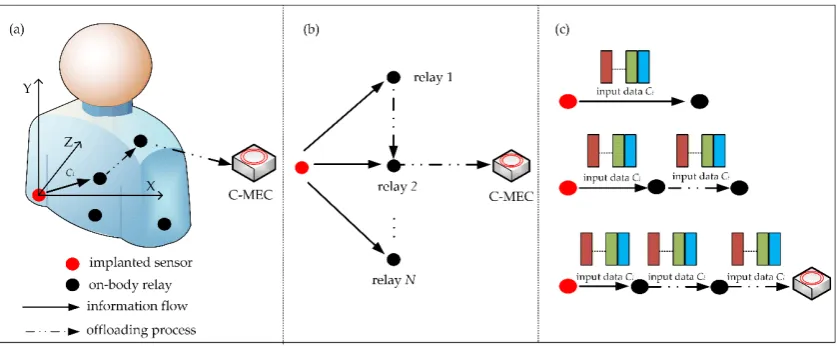
The system architecture is introduced by considering edge computing and WBAN techniques, as shown in Figure1. Unlike the work in References [27,28], we present the concept of C-MEC instead of the coordinator, as this offers computation resources to execute the medical tasks and forward the results to medical professionals in a timely manner. As can be seen from Figure1a, an implanted sensor transmits the computing taskCi to the on-body relay via the intra-body region. Moreover, since the implanted sensor broadcasts short information to the relays, one should note that relay selection should be considered, as shown in Figure1b. Once the relay is selected, different task offloading schemes are given in Figure1c. The taskCican be executed by the corresponding relay, by other relays, or by the C-MEC. One should note that we encourage tasks from intra-body devices to be executed locally by relays so that user-friendly interaction can provide timely patient warnings under emergency conditions and avoid transmitting tasks to the C-MEC, which is typically far away from the patient. In this paper, the Cartesian coordinate system in which each implanted sensor is fixed iswk= [xk,yk]T∈R2×1,k∈ Kwith the transmitted data packetCito the corresponding relay. The coordinates of the relayiare expressed aswi= [xi,yi]T ∈R2×1,i∈ N and those of the C-MEC
are expressed aswc= [xc,yc]T ∈R2×1. The data transmission energy consumption for the implanted
sensork∈ Kto transmitCito the corresponding relayican be expressed as:
Ektrans=Ci
Eek+nEamp
q
||wk−wi||2
, (1)
whereEekandEamprepresent the energy consumption to activate the implanted sensor circuit per bit and the radio amplifier, respectively. The PL exponent is represented byn, which primarily depends on the transmission environment. The energy consumption for relayito receiveCican be expressed as:
Eirec=CiEeleci ,i∈ N, (2)
Appl. Sci.2018,8, 1409 5 of 16
Appl. Sci. 2018, 8, x FOR PEER REVIEW 5 of 16
Figure 1. The architecture of the proposed system: (a) communication flow; (b) information broadcasting; (c) task offloading schemes.
3.2. Computation Model
The relay is of significant importance when considering the execution of task from the implanted devices and the on‐body physiological task . As analyzed earlier, task of relay i to be performed can be defined as:
= ( , , , ), ∈ , (3)
where and represent the required computation resource (i.e., CPU resource) and the maximum time allowance to complete all tasks, respectively. One should note that cannot be offloaded to others and should always be executed by relay i itself. In the proposed system, we assume that the MEC server performs as a coordinator and assists relays to execute the task by providing computation resources, since each relay has to be executed locally and only can be offloaded. We define the indication parameters, i.e., , ∈ , ∈ to denote whether task from relay i is offloaded to relay j. Thus, one has:
= 1, relay offloads the task to the relay , 0, no offloading, (4)
where ∈ , ∈ . Once relay i decides to execute itself, the local power consumption for this task can be given as:
= α( ) , ∈ , (5)
where means the computation capability (i.e., CPU cycles per second) of relay i as analyzed in Reference [29]. The positive constant parameters α and are pre‐configured and depend on the chip architecture. Realistic measurements of those parameters are α = 10−11 and 2 ≤ ≤ 3 [30]. Then, one has the time of local execution:
= , ∈ , (6)
where ≤ . However, when > , it means that relay i cannot accomplish the task under QoS requirements, and thus the task offloading process is needed. According to Equations (4) and (5), the energy consumption of relay i to execute task can be expressed as:
= ∙ = α( ) , ∈ (7)
[image:5.595.89.508.87.260.2]When consider the locally executed task , the energy consumption for sensing this can be expressed as: = , where is the energy consumption required for sensing one bit. Similar to Equation (7), the energy consumption of executing task can be written as:
Figure 1. The architecture of the proposed system: (a) communication flow; (b) information broadcasting; (c) task offloading schemes.
3.2. Computation Model
The relay is of significant importance when considering the execution of taskCifrom the implanted devices and the on-body physiological taskDi. As analyzed earlier, taskUiof relayito be performed can be defined as:
Ui= (Fi,Ci,Di,Tir),i∈ N, (3)
whereFiandTirrepresent the required computation resource (i.e., CPU resource) and the maximum time allowance to complete all tasks, respectively. One should note thatDicannot be offloaded to others and should always be executed by relayiitself. In the proposed system, we assume that the MEC server performs as a coordinator and assists relays to execute the taskCiby providing computation resources, since each relay hasDito be executed locally and onlyCican be offloaded. We define the indication parameters, i.e.,aij,i∈ N,j∈ N to denote whether taskCifrom relayiis offloaded to relay j. Thus, one has:
aij=
(
0, no offloading,
1, relayioffloads the taskCito the relayj,
(4)
wherei∈ N,j∈ N. Once relayidecides to executeCi itself, the local power consumption for this task can be given as:
pic=Ciα(fic)β,i∈ N, (5)
where fic means the computation capability (i.e., CPU cycles per second) of relayias analyzed in Reference [29]. The positive constant parametersαandβare pre-configured and depend on the chip architecture. Realistic measurements of those parameters areα = 10−11and 2≤ β ≤3 [30]. Then, one has the time of local execution:
TiC= Fi
fic,i∈ N, (6)
whereTiC ≤ Tir. However, whenTiC > Tir, it means that relayicannot accomplish the task under QoS requirements, and thus the task offloading process is needed. According to Equations (4) and (5), the energy consumption of relayito execute taskCican be expressed as:
ECi
i =pci·TiC=FiCiα(fic)β
−1,i∈ N (7)
EDi
i =FiDiα(f c i)β
−1
,i∈ N (8)
Thus, the minimal energy consumption for relayiisEimin=EDi
i +Eisen. Recalling Equation (4), aij = 1 indicates that relay i decides to offload task Ci to relay j via an on-body to on-body communication link. The distance between the two relays can be expressed as:
dij =
q
|wi−wj|
2
,i∈ N,j∈ N,i6=j, (9)
wherewjis the coordinate of relayj. The time of the task offloading can be expressed as:
Tijo f f aij
=
∑
j∈N aij q|wi−wj|
2
c
,i∈ N,j∈ N,i6=j, (10)
wherecis the speed of light. Relayjcan then execute taskCiin the same manner as relayi. However, once relayjcannot execute the task due to a lack of computation resources or the execution time TiC≥Tir, the task will be offloaded to the C-MEC. This then assigns bandwidthBijto relayj; the task offloading rate then can be written as:
Rij(Ui) =Bijlog2
1+
hjCpTj σ2
,i∈ N,j∈ N,i6=j, (11)
whereσ2represents the power of the additive white Gaussian noise (AWGN) at relayj. All of the channels are assumed to be orthogonal and ignore the interference caused by other relays.hCj is the channel state information from relayjto the C-MEC and pTj is the transmission power of relayj, respectively. As proposed in Reference [21], only white Gaussian noise is considered in this paper. Then the time of task offloading can be expressed as:
Tijo f f(Ui) =
∑
j∈N aij qwj−wc
2
Rij(Ui)
,i∈ N,j∈ N,i6=j (12)
The energy consumption of the task offloading can be calculated as:
Eij(Ui) =piTTijo f f(Ui),i∈ N,j∈ N,i6= j (13)
Once the C-MEC receives the offloading task from relayj, it will execute it and transmit the results back to relayjpromptly.
3.3. Channel Characterization
The PL model characterizing the transmission energy attenuation between the on-body transmitting relay node and the receiving relay at distancedcan be formulated as [8,28]:
PLdB(d) =PLdB(d0) +10nlog10
d d0
+S,d≥d0, (14)
Appl. Sci.2018,8, 1409 7 of 16
(M≥4) can be found in Reference [20]. Assuming the transmitting power isPtand the noise to power density ratio isN0, one can obtain the instantaneous signal to noise ratio (SNR)γas:
γ= Pt
N0Rij(Ui)PLdB(d)
(15)
The BER performance can be formulated as a function of the instantaneous SNR as:
Pe(γ) =Qp2γ= 1 2er f c(
√
γ) (16)
whereerfc(·) represents the Gaussian error function. The average BER of the transmission link can be expressed as:
Pe(γ) = Z +∞
0 P(γ)Pe(γ)dγ= 1 2
Z +∞
0 P(γ)er f c(
√
γ)dγ, (17)
whereγandP(γ)represent the average value of SNR and the BER performance of the additive white Gaussian noise (AWGN) channel, respectively. Consequently, Equation (17) can be rewritten as:
Pe(γm) = 1 2
∑
N n=1er f c(
√
γ)Pm(γn−γn−1), (18)
where
Pm(γn) = 1 µγnσdB exp
−
lnγn−γn+12µ2σdB2
2
2µ2σ2 dB
, (19)
whereµ=ln 10/10. The average BER performance of the WBAN channel under BPSK modulation can be obtained by the numerical evaluation of Equation (18). Considering data transmission over a fading channel such as a relay to relay or relay to the C-MEC, the capacity per unit bandwidth can be written as:
C
B =log2(1+γrec), (20)
whereCdenotes the channel capacity. γrecandBrepresent the received SNR and the transmitting channel bandwidth, respectively. Theγrecin dB can be given as:
γrec =Prec−10 log10Rij(Ui)−Pn, (21)
wherePrecis the received power andPncan be expressed as:
Pn=10 log10(vTBNF), (22)
wherevis the Boltzmann constant andNFis the noise figure. Recalling the AWGN noise with one-sided power spectral density, one can obtain that:
N0=v[Trx+ (NF−1)Ttx], (23)
whereTrxandTtxare the temperatures at the transmitter and the receiver in Kelvin (K), respectively.
4. Proposed Resource Management Solution
4.1. Network Initialization Phase
The C-MEC is placed at the center of the hospital ward and a series of on-body relays are attached to a patient’s clothes. Implanted sensors are located inside the human body at the predetermined positions. The C-MEC broadcasts a short message information packet to the relays, which assigns a unique ID to each. The relays store the C-MEC location information and send information packets, which contain the energy status and locations. In accordance with Reference [22], the implanted sensors broadcast short information to all relays, which are then updated with the location and energy status of the implanted devices. In this way, all relays can update the location and channel information for potential task offloading. After network initialization is complete, one round starts.
4.2. Local Decision Process
Equation (1) points out that the transmission energy consumption of an implanted sensor is related to the communication distance. To minimize the energy consumption of the implanted sensors, the relay selection algorithm is proposed as:
ψ(i) =
q
||wk−wi||2 Ei−Eimin
, (24)
whereEiis the initial energy of relayiandEi−Ei,minis the residual energy status of relayi. The relay with the minimal value ofψ(i)will be elected as the best relay. Relayireceives taskCifrom the implant sensor while simultaneously executing the on-body taskDi. If relayican execute taskCiby itself, then we employ Equations (4)–(8). Numerous key QoS metrics are obtained and one round is finished. If relayicannot executes taskCiby itself according toUi, it will trigger the offloading process, and task Ciwill be offloaded to another relay. This method is summarized in Algorithm 1.
Algorithm 1.Proposed Iterative Relay Selection Method
The relay and implanted sensor sets are denoted asN andK. Initialization: each relay is assigned a unique ID;
select thex-th relay as the target to connect; for a specific implanted sensork;
current roundr;
current residual energy statusEres; Fori∈ N do
calculate the distance between the implanted sensor and thei-th relay:
q
||wk−wi||2
calculate the relay’s residual energy:Ei−Emini ; Ifψ(x)≤ψ(i)then
//do nothing,xis still the best choice so far; Else
x=i;//i-th relay becomes a better choice; End if
End for
establish a link between the implanted sensor and thex-th relay; UpdateEres,r=r+1
4.3. Data Offloading Process
Appl. Sci.2018,8, 1409 9 of 16
capacity is more likely to handleCiunder QoS constraints, the priority task offloading receiver selection function can be formulated as:
Z(j) = Ci
EjFj, (25)
whereEjandFjrepresent the residual energy and computation resource of relayj. Relayj, which has a higherZ(j)value, does not have enough resources in terms of computation resource or residual energy. The offloading requests that relayidelivers taskCi to relayjwith the minimal valueZ(j). One should note that the nearest relay may not be able to accept the task due to a lack of computation resources. By doing so, the relay with the appropriate resources takes the computing task described by Equations (9) and (10). If relayjcan execute the task locally, as mentioned in Equations (5)–(8), in a similar way to Section4.2, numerous key QoS metrics are obtained and one round finishes. However, if relayjcannot execute the task, this will be offloaded to the C-MEC. The detailed information is given in Algorithm 2.
Algorithm 2.Proposed Iterative Task Offloading Strategy
InitializeFi,Di,Tir,Ci,Eres
The task with a size ofCireceived according to Algorithm 1;
UpdateUiaccording to Equation (3); IfEresi <ECi
i +E
Di
i orTiC≤TirThen
execute the task locally according to Equations (5)–(8) Else
Z(j)with a minimal value is selected according to Equation (25); offload taskCito relayjaccording to Equations (9)–(12);
End if
WhileEj≥ECji+E Di
j do
execute the task onj-th relay according to Equations (5)–(8); Else
offload taskCito the C-MEC according to Equations (9)–(12); End while
4.4. Scheduling and Data Transmission
At this stage, the C-MEC assigns a time slot to relayj. The task will be offloaded to the C-MEC for executing as indicated in Equations (11)–(13) and then the selected QoS metrics will be calculated and one round finishes. This process continues until the energy of all relays is exhausted.
5. Results and Discussion 5.1. Link Quality Analysis
The cumulative distribution function (CDF) of the channel capacity per unit bandwidth should follow as:
P
C
B
≤P
C
B
thr
, (26)
where PCB
thr is the threshold value and depends on the specific application. According to Equations (17)–(22), Equation (26) can be rewritten as:
P
C B
≤ 1 2er f c(
Pt−Pn√−PLdB(d) 2σs
). (27)
Ms=SNRdB−SNRthr ≥0. (28)
A negative value ofMs indicates that the link cannot provide enough power to maintain the channel link reliability [32].
5.2. Network Topology
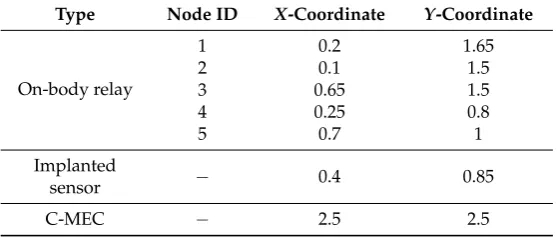
[image:10.595.159.438.272.391.2]The proposed scenario is a hospital ward with dimensions of 5 m×5 m, where the C-MEC is placed at the center of the room, the implanted sensor is located at the center of the human body, and five relays are attached on the clothes with the same initial energy and computational capabilities. Table1summarizes the coordination of the relays, implanted sensor, and C-MEC.
Table 1. Coordinates of on-body relays, implanted sensor, and coordinator-based mobile edge computer (C-MEC).
Type Node ID X-Coordinate Y-Coordinate
On-body relay
1 0.2 1.65
2 0.1 1.5
3 0.65 1.5
4 0.25 0.8
5 0.7 1
Implanted
sensor − 0.4 0.85
C-MEC − 2.5 2.5
5.3. Performance Evaluation
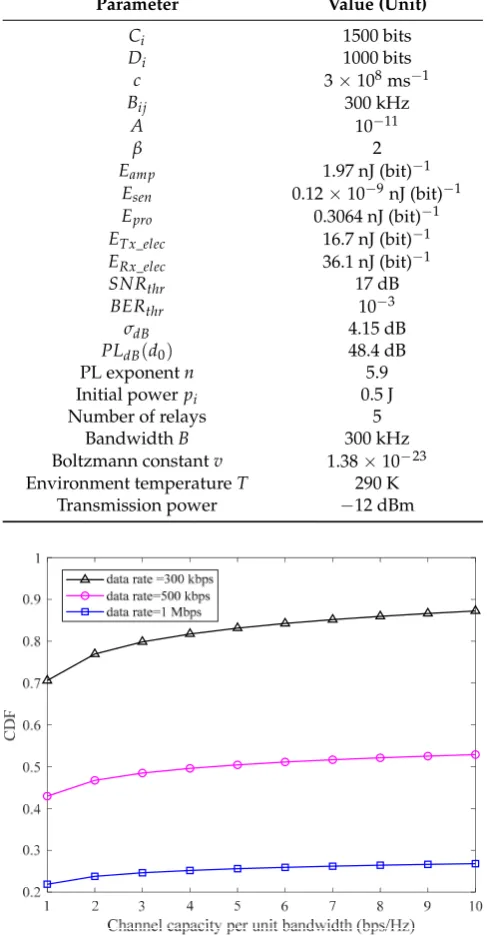
In this section, the performance of the proposed task offloading-based resource management scheme is compared with a non-offloading technique. We focus on the performance of the relays and assume that the energy resources of the implanted sensor and the C-MEC are infinite. The performance is conducted on the basis of the residual network energy, network lifetime, PL, and total number of executed tasksCi. The characteristics of a commercially available WBAN transceiver (CC2420) are employed in the simulations and an initial energy of 0.5 Joule (J) is provided to all relays. The number of relays is limited to five, each with a single antenna. The packet size ofCiis set as 1500 bits since this is the typical payload defined by the IEEE 802.15.6 technical standard [8] andDiis set as 1000 bits. The simulation parameters are summarized in Table2. Simulations were conducted in MATLAB and performance results are compared in terms of fic = 1500 CPU cycles, fic = 2500 CPU cycles, and the scheme without offloading. One should notice that other simulation techniques such as NS2 and OMNET+ are also applicable; detailed information can be found in References [33,34].
Appl. Sci.2018,8, 1409 11 of 16
Table 2.Selected simulation parameters.
Parameter Value (Unit)
Ci 1500 bits
Di 1000 bits
c 3×10⁸ms−1
Bij 300 kHz
A 10−11
β 2
Eamp 1.97 nJ (bit)−1
Esen 0.12×10⁻⁹nJ (bit)−1
Epro 0.3064 nJ (bit)−1
ETx_elec 16.7 nJ (bit)−1
ERx_elec 36.1 nJ (bit)−1
SNRthr 17 dB
BERthr 10−3
σdB 4.15 dB
PLdB(d0) 48.4 dB
PL exponentn 5.9
Initial powerpi 0.5 J
Number of relays 5
BandwidthB 300 kHz
Boltzmann constantv 1.38×10⁻²³
Environment temperatureT 290 K
Transmission power −12 dBm
Appl. Sci. 2018, 8, x FOR PEER REVIEW 11 of 16
Bandwidth B 300 kHz
Boltzmann constant v 1.38 × 10⁻²³
Environment temperature 290 K
Transmission power −12 dBm
Considering the strict QoS requirements of healthcare applications, and according to the
previous work on WBANs, a minimum acceptable BER threshold of 10−3 is selected for on‐body
transmission channel analysis. To guarantee human body safety, the maximum transmission power
is set as −12 dBm since this is recommended by the IEEE 802.15.6 technical standard. The maximum
data transmission distance is selected as 2.5 m since this is a typical value of commercial IoT WBAN
platforms for home and hospital areas [35,36]. Since the on‐body fading channel is time‐varying, one
should note that the channel capacity of the transmission link is not static. Figures 2 and 3 demonstrate the CDF versus channel capacity per unit and the link quality versus different transmission distances, respectively. It can be seen from Figure 2 that, under the same channel capacity, the higher transmission rate achieves a lower CDF performance. Moreover, from Figure 3 it can be seen that the lower data rate realizes a better link quality performance. As a result, an
appropriate data rate ℛ ( ) = 500 kbps is selected for further investigation.
Figure 2. Cumulative distribution function (CDF) versus channel capacity per unit under on‐body channel under different rates.
Figure 3. Link quality versus transmission distance under different rates.
Figure 2.Cumulative distribution function (CDF) versus channel capacity per unit under on-body channel under different rates.
In this paper, the network lifetime is defined as the time spanning from the network initiation until the energy of all relays is exhausted. The relationship between the residual energy of all relays and the network lifetime is given in Figure4under different scenarios. One can see that application requiring higher computation resources leads to a shorter lifetime when employing the offloading strategy. Primarily, the network lifetime is approximately 1200 rounds whenfic =2500 CPU cycles, while it is 1800 rounds when fc
[image:11.595.176.420.117.585.2]Appl. Sci.2018,8, 1409 12 of 16
Bandwidth B 300 kHz
Boltzmann constant v 1.38 × 10⁻²³
Environment temperature 290 K
Transmission power −12 dBm
Considering the strict QoS requirements of healthcare applications, and according to the
previous work on WBANs, a minimum acceptable BER threshold of 10−3 is selected for on‐body
transmission channel analysis. To guarantee human body safety, the maximum transmission power
is set as −12 dBm since this is recommended by the IEEE 802.15.6 technical standard. The maximum
data transmission distance is selected as 2.5 m since this is a typical value of commercial IoT WBAN
platforms for home and hospital areas [35,36]. Since the on‐body fading channel is time‐varying, one
should note that the channel capacity of the transmission link is not static. Figures 2 and 3 demonstrate the CDF versus channel capacity per unit and the link quality versus different transmission distances, respectively. It can be seen from Figure 2 that, under the same channel capacity, the higher transmission rate achieves a lower CDF performance. Moreover, from Figure 3 it can be seen that the lower data rate realizes a better link quality performance. As a result, an
appropriate data rate ℛ ( ) = 500 kbps is selected for further investigation.
[image:12.595.178.418.87.282.2]Figure 2. Cumulative distribution function (CDF) versus channel capacity per unit under on‐body channel under different rates.
[image:12.595.176.419.323.513.2]Figure 3. Link quality versus transmission distance under different rates.
Figure 3.Link quality versus transmission distance under different rates.
Appl. Sci. 2018, 8, x FOR PEER REVIEW 12 of 16
In this paper, the network lifetime is defined as the time spanning from the network initiation until the energy of all relays is exhausted. The relationship between the residual energy of all relays and the network lifetime is given in Figure 4 under different scenarios. One can see that application requiring higher computation resources leads to a shorter lifetime when employing the offloading
strategy. Primarily, the network lifetime is approximately 1200 rounds when = 2500 CPU cycles,
while it is 1800 rounds when = 1500 CPU cycles. The reasons for these results are as follows:
relay i with a higher computation capacity is highly likely to accept the offload task from others according to the proposed task offloading recipient selection algorithm in Section 4.2. Moreover,
when considering the non‐offloading technique, the relays only forward to the C‐MEC, thus
significantly reducing the relays’ task computing power consumption.
Figure 4. Residual energy of all relays versus time under different scenarios.
PL is a significant indicator through which we can explore the signal power reduction when considering data transmission from the transmitter to the receiver. In accordance with Reference [8],
we only analyze the on‐body NLoS communications. The analysis of the LoS communication can be
found in Reference [28]. The PL parameters are given as follows: PL exponent n of 5.9, standard
deviation of 4.15 dB, and ( ) of 48.4 dB. As can be obtained from Equation (14), a longer
transmission distance d leads to higher PL values. It can be seen from Figure 5 that relays in scenarios requiring higher computation resources achieve lower PL values. On the contrary, when relay i cannot handle task locally (when providing lower CPU cycles), it will trigger the offloading
process and then offload the task to others. Therefore, the offloaded task with higher computation
resources required suffers a longer transmission distance and leads to higher PL values. Data transmission without offloading leads to the highest PL results because all data packets are
transmitted to the C‐MEC from the implanted sensors via relays, which results in the longest
transmission distance when compared with task offload schemes.
Figure 4.Residual energy of all relays versus time under different scenarios.
Appl. Sci.2018,8, 1409 13 of 16
Appl. Sci. 2018, 8, x FOR PEER REVIEW 13 of 16
Figure 5. Path loss (PL) performance versus time under different scenarios.
Figure 6 shows the total number of executed packets by relays under different scenarios. As mentioned in Sections 4.2 and 4.3, the total number of executed packets depends heavily on the relays’ computation resources and energy status. It can be seen from Figure 6 that approximately 12,500
packets are executed by the relay when = 2500 CPU cycles, while around 4500 packets can be
implemented when = 1500 CPU cycles. Clearly, the number of executed packets is zero without
deploying the task offload scheme.
Figure 6. The number of executed packets by relays versus time under different scenarios.
Figure 7 illustrates the total delay performance under different scenarios. As mentioned in Equation (6), a larger value of leads to longer local execution time. As can be seen from Figure 7,
the maximum delay is around 60 nanoseconds (ns) when = 2500 CPU cycles and about 40 ns
when = 1500 CPU cycles. Then the network becomes stable after 750 rounds and 1250 rounds
when = 1500 CPU cycles and = 1500 CPU cycles, respectively. The non‐offloading scheme
achieves the worst performance with a maximum delay at approximate 81 ns. One can observe that
the value of should be selected carefully when designing a task offloading‐based healthcare
monitoring system because the large value of promises a lower PL and a higher number of locally
executed tasks, while also decreasing the network lifetime significantly due to the large energy consumption. Moreover, one should note that the medical service should satisfy the latency requirement of not more than 250 milliseconds. As can be seen from the results, our proposed solution can achieve satisfactory latency performance.
Figure 5.Path loss (PL) performance versus time under different scenarios.
Figure 6 shows the total number of executed packets by relays under different scenarios. As mentioned in Sections 4.2and 4.3, the total number of executed packets depends heavily on the relays’ computation resources and energy status. It can be seen from Figure6that approximately 12,500 packets are executed by the relay when fc
i =2500 CPU cycles, while around 4500 packets can be implemented when fic =1500 CPU cycles. Clearly, the number of executed packets is zero without deploying the task offload scheme.
Appl. Sci. 2018, 8, x FOR PEER REVIEW 13 of 16
Figure 5. Path loss (PL) performance versus time under different scenarios.
Figure 6 shows the total number of executed packets by relays under different scenarios. As mentioned in Sections 4.2 and 4.3, the total number of executed packets depends heavily on the relays’ computation resources and energy status. It can be seen from Figure 6 that approximately 12,500
packets are executed by the relay when = 2500 CPU cycles, while around 4500 packets can be
implemented when = 1500 CPU cycles. Clearly, the number of executed packets is zero without
deploying the task offload scheme.
Figure 6. The number of executed packets by relays versus time under different scenarios.
Figure 7 illustrates the total delay performance under different scenarios. As mentioned in Equation (6), a larger value of leads to longer local execution time. As can be seen from Figure 7,
the maximum delay is around 60 nanoseconds (ns) when = 2500 CPU cycles and about 40 ns
when = 1500 CPU cycles. Then the network becomes stable after 750 rounds and 1250 rounds
when = 1500 CPU cycles and = 1500 CPU cycles, respectively. The non‐offloading scheme
achieves the worst performance with a maximum delay at approximate 81 ns. One can observe that
the value of should be selected carefully when designing a task offloading‐based healthcare
monitoring system because the large value of promises a lower PL and a higher number of locally
executed tasks, while also decreasing the network lifetime significantly due to the large energy consumption. Moreover, one should note that the medical service should satisfy the latency requirement of not more than 250 milliseconds. As can be seen from the results, our proposed solution can achieve satisfactory latency performance.
Figure 6.The number of executed packets by relays versus time under different scenarios.
Moreover, one should note that the medical service should satisfy the latency requirement of not more than 250 milliseconds. As can be seen from the results, our proposed solution can achieve satisfactory latency performance.Appl. Sci. 2018, 8, x FOR PEER REVIEW 14 of 16
Figure 7. The overall delay under different scenarios.
6. Conclusions
Owing to the rapid developments of IoT relay and MEC, a novel framework of a relay‐enabled
task offloading system is proposed in this paper to handle the intensive computing tasks sent from an implanted sensor. We first proposed the network model and the task offloading decision model. Moreover, resource management of relays was determined based on the computation task, the residual energy of relays, and the computation resources, so as to be capable of balancing the energy consumption among all relays. Furthermore, we analyzed the channel capacity and the data rate under the predetermined acceptable BER condition. The results proved that the task offloading
technique outperforms the non‐offloading scheme in multiple aspects. Specifically, the higher
computation capacity relay‐based network achieved a lower PL and higher total number of locally
executed packets. Moreover, the results showed that the non‐offloading scheme achieves the highest
network lifetime. The outcomes of this paper can be applied to future home/hospital‐based healthcare
monitoring services such as transplanted organ monitoring and intra‐body high data rate
transmission scenarios.
In this future, we are interested in evaluating the proposed technique on a real experiment testbed. Moreover, the comprehensive tradeoff between wireless communication and computation
resources for the wireless relay‐enabled task offloading scheme could be selected as a future research
topic. In addition, the power allocation of implanted and wearable devices is of great significance when designing healthcare systems. We are also interested in exploiting efficient power allocation techniques for WBANs by employing optimization solutions [37,38].
Author Contributions: Y.L. and Q.Y. conducted the research ideas of this manuscript; Y.L. conceived the research subject and designed the simulation codes; Y.H. analyzed the data; Y.L. and Q.Y. wrote the paper. M.S.L. supervised the paperwork, provided a review, comments, assessment, and revised the paper.
Funding: This work was supported by the National Natural Science Foundation of China (Grant No. 61801342 and Grant No. 61801341) and the Fundamental Research Funds for the Central Universities (Grant No. 2018IVA098 and 2018IVA099).
Conflicts of Interest: The authors declare no conflict of interest.
References
1. Hu, F.; Liu, X.; Shao, M.; Sui, D.; Wang, L. Wireless energy and information transfer in WBAN: An
overview. IEEE Netw.2017, 31, 90–96.
2. Movassaghi, S.; Abolhasan, M.; Lipman, J.; Smith, D.; Jamalipour, A. Wireless body area networks: A
survey. IEEE Commun. Surv. Tutor.2014, 16, 1658–1686.
Figure 7.The overall delay under different scenarios.
6. Conclusions
Owing to the rapid developments of IoT relay and MEC, a novel framework of a relay-enabled task offloading system is proposed in this paper to handle the intensive computing tasks sent from an implanted sensor. We first proposed the network model and the task offloading decision model. Moreover, resource management of relays was determined based on the computation task, the residual energy of relays, and the computation resources, so as to be capable of balancing the energy consumption among all relays. Furthermore, we analyzed the channel capacity and the data rate under the predetermined acceptable BER condition. The results proved that the task offloading technique outperforms the non-offloading scheme in multiple aspects. Specifically, the higher computation capacity relay-based network achieved a lower PL and higher total number of locally executed packets. Moreover, the results showed that the non-offloading scheme achieves the highest network lifetime. The outcomes of this paper can be applied to future home/hospital-based healthcare monitoring services such as transplanted organ monitoring and intra-body high data rate transmission scenarios.
In this future, we are interested in evaluating the proposed technique on a real experiment testbed. Moreover, the comprehensive tradeoff between wireless communication and computation resources for the wireless relay-enabled task offloading scheme could be selected as a future research topic. In addition, the power allocation of implanted and wearable devices is of great significance when designing healthcare systems. We are also interested in exploiting efficient power allocation techniques for WBANs by employing optimization solutions [37,38].
Author Contributions:Y.L. and Q.Y. conducted the research ideas of this manuscript; Y.L. conceived the research subject and designed the simulation codes; Y.H. analyzed the data; Y.L. and Q.Y. wrote the paper. M.S.L. supervised the paperwork, provided a review, comments, assessment, and revised the paper.
Funding:This work was supported by the National Natural Science Foundation of China (Grant No. 61801342 and Grant No. 61801341) and the Fundamental Research Funds for the Central Universities (Grant No. 2018IVA098 and 2018IVA099).
Appl. Sci.2018,8, 1409 15 of 16
References
1. Hu, F.; Liu, X.; Shao, M.; Sui, D.; Wang, L. Wireless energy and information transfer in WBAN: An overview. IEEE Netw.2017,31, 90–96. [CrossRef]
2. Movassaghi, S.; Abolhasan, M.; Lipman, J.; Smith, D.; Jamalipour, A. Wireless body area networks: A survey. IEEE Commun. Surv. Tutor.2014,16, 1658–1686. [CrossRef]
3. Salayma, M.; Al-Dubai, A.; Romdhani, I.; Nasser, Y. Wireless body area network (WBAN): A survey on reliability, fault tolerance, and technologies coexistence.ACM Comput. Surv.2017,50, 3. [CrossRef] 4. Qi, X.; Wang, K.; Huang, A.; Hu, H.; Han, G. MAC protocol in wireless body area network for mobile health:
A survey and an architecture design.Int. J. Distrib. Sens. Netw.2015,11, 289404. [CrossRef]
5. Cavallari, R.; Martelli, F.; Rosini, R.; Buratti, C.; Verdone, R. A survey on wireless body area networks: Technologies and design challenges.IEEE Commun. Surv. Tutor.2014,16, 1635–1657. [CrossRef]
6. Tran, T.X.; Hajisami, A.; Pandey, P.; Pompili, D. Collaborative mobile edge computing in 5G networks: New paradigms, scenarios, and challenges.IEEE Commun. Mag.2017,55, 54–61. [CrossRef]
7. Jararweh, Y.; Doulat, A.; AlQudah, O.; Ahmed, E.; Al-Ayyoub, M.; Benkhelifa, E. The future of mobile cloud computing: Integrating cloudlets and mobile edge computing. In Proceedings of the 23rd International Conference on Telecommunications (ICT), Thessaloniki, Greece, 16–18 May 2016.
8. Deepak, K.S.; Babu, A.V. Improving energy efficiency of incremental relay based cooperative communications in wireless body area networks.Int. J. Commun. Syst.2015,28, 91–111. [CrossRef]
9. Sawand, A.; Djahel, S.; Zhang, Z.; Naït-Abdesselam, F. Multidisciplinary approaches to achieving efficient and trustworthy eHealth monitoring systems. In Proceedings of the IEEE/CIC International Conference on Communications in China (ICCC), Shanghai, China, 13–15 October 2014.
10. Maskooki, A.; Soh, C.B.; Gunawan, E.; Low, K.S. Opportunistic routing for body area network. In Proceedings of the IEEE Consumer Communications and Networking Conference (CCNC), Las Vegas, NV, USA, 9–12 January 2011.
11. Gai, K.; Qiu, M.; Zhao, H.; Tao, L.; Zong, Z. Dynamic energy-aware cloudlet-based mobile cloud computing model for green computing.J. Netw. Comput. Appl.2016,59, 46–54. [CrossRef]
12. Yang, L.; Cao, J.; Yuan, Y.; Li, T.; Han, A.; Chan, A. A framework for partitioning and execution of data stream applications in mobile cloud computing.ACM SIGMETRICS Perform. Eval. Rev.2013,40, 23–32. [CrossRef] 13. Dinh, H.T.; Lee, C.; Niyato, D.; Wang, P. A survey of mobile cloud computing: Architecture, applications,
and approaches.Wirel. Commun. Mob. Comput.2013,13, 1587–1611. [CrossRef]
14. Rahimi, M.R.; Ren, J.; Liu, C.H.; Vasilakos, A.V.; Venkatasubramanian, N. Mobile cloud computing: A survey, state of art and future directions.Mob. Netw. Appl.2014,19, 133–143. [CrossRef]
15. Wang, K.; Yang, K.; Pan, C.; Wang, J. Joint offloading framework to support communication and computation cooperation.arXiv. 2017. Available online:https://arxiv.org/abs/1705.10384(accessed on 20 July 2018). 16. Bello, O.; Zeadally, S.; Badra, M. Network layer inter-operation of device-to-device communication
technologies in Internet of Things (IoT).Ad Hoc Netw.2017,57, 52–62. [CrossRef]
17. Guo, W.; Zhou, S.; Chen, Y.; Wang, S.; Chu, X.; Niu, Z. Simultaneous information and energy flow for IoT relay systems with crowd harvesting.IEEE Commun. Mag.2016,54, 143–149. [CrossRef]
18. Nakamura, T.; Nagata, S.; Benjebbour, A.; Kishiyama, Y.; Hai, T.; Xiaodong, S.; Nan, L. Trends in small cell enhancements in LTE advanced.IEEE Commun. Mag.2013,51, 98–105. [CrossRef]
19. Liao, Y.; Leeson, M.S.; Cai, Q.; Ai, Q.; Liu, Q. Mutual-information-based incremental relaying communications for wireless biomedical implant systems.Sensors2018,18, 515. [CrossRef] [PubMed]
20. Yi, C.; Wang, L.; Li, Y. Energy efficient transmission approach for WBAN based on threshold distance. IEEE Sens. J.2015,15, 5133–5141. [CrossRef]
21. Liao, Y.; Leeson, M.S.; Higgins, M.D.; Bai, C. Analysis of in-to-out wireless body area network systems: Towards QoS-aware health internet of things applications.Electronics2016,5, 38. [CrossRef]
22. Javaid, N.; Ahmad, A.; Khan, Y.; Khan, Z.A.; Alghamdi, T.A. A relay based routing protocol for wireless in-body sensor networks.Wirel. Pers. Commun.2015,80, 1063–1078. [CrossRef]
23. Wang, K.; Chen, Y.; Alouini, M.S.; Xu, F. BER and optimal power allocation for amplify-and-forward relaying using pilot-aided maximum likelihood estimation.IEEE Trans. Commun.2014,62, 3462–3475. [CrossRef] 24. Wang, K.; Chen, Y.; Di Renzo, M. Outage probability of dual-hop selective AF with randomly distributed
25. Kim, S. Nested game-based computation offloading scheme for mobile cloud IoT systems.EURASIP J. Wirel. Commun. Netw.2015,1, 229. [CrossRef]
26. Chen, M.; Hao, Y.; Qiu, M.; Song, J.; Wu, D.; Humar, I. Mobility-aware caching and computation offloading in 5G ultra-dense cellular networks.Sensors2016,16, 974. [CrossRef] [PubMed]
27. Javaid, N.; Ahmad, A.; Nadeem, Q.; Imran, M.; Haider, N. iM-SIMPLE: IMproved stable
increased-throughput multi-hop link efficient routing protocol for wireless body area networks. Comput. Hum. Behav.2015,15, 1003–1011. [CrossRef]
28. Ahmed, S.; Javaid, N.; Yousaf, S.; Ahmad, A.; Sandhu, M.M.; Imran, M.; Khan, Z.A.; Alrajeh, N. Co-LAEEBA: Cooperative link aware and energy efficient protocol for wireless body area networks.Comput. Hum. Behav.
2015,51, 1205–1215. [CrossRef]
29. Magurawalage, C.M.S.; Yang, K.; Hu, L.; Zhang, J. Energy-efficient and network-aware offloading algorithm for mobile cloud computing.Comput. Netw.2014,74, 22–33. [CrossRef]
30. Nguyen, T.T.; Le Long, B. Joint computation offloading and resource allocation in cloud based wireless HetNets. In Proceedings of the IEEE Global Communications Conference, Singapore, 4–8 December 2017. 31. Cheffena, M. Performance evaluation of wireless body sensors in the presence of slow and fast fading effects.
IEEE Sens. J.2015,15, 5518–5526. [CrossRef]
32. Zhang, L.; Leeson, M.S.; Liao, Y.; Higgins, M.D. Performance evaluation of reliable communications for wireless in-body sensor networks. In Proceedings of the 2017 International Conference on Computer, Information and Telecommunication Systems (CITS), Dalian, China, 21–23 July 2017.
33. Al Ameen, M.; Hong, C.S. An on-demand emergency packet transmission scheme for wireless body area networks.Sensors2015,15, 30584–30616. [CrossRef] [PubMed]
34. Akbar, M.S.; Yu, H.; Cang, S. Delay, reliability, and throughput based QoS profile: A MAC layer performance optimization mechanism for biomedical applications in wireless body area sensor networks.J. Sens.2016, 2016, 7170943. [CrossRef]
35. Kim, T.Y.; Youm, S.; Jung, J.J.; Kim, E.J. Multi-hop WBAN construction for healthcare IoT systems. In Proceedings of the 2015 International Conference on Platform Technology and Service (PlatCon), Jeju, Korea, 26–28 January 2015.
36. Fouad, H. Continuous health-monitoring for early detection of patient by Web telemedicine
system. In Proceedings of the International Conference on Circuits, Systems and Signal Processing, St. Petersburg, Russia, 23–25 September 2014.
37. Pham, Q.V.; Hwang, W.J. Fairness-aware spectral and energy efficiency in spectrum-sharing wireless networks.IEEE Trans. Veh. Technol.2017,66, 10207–10219. [CrossRef]
38. Ngo, D.T.; Khakurel, S.; Le-Ngoc, T. Joint subchannel assignment and power allocation for OFDMA femtocell networks.IEEE Trans. Wirel. Commun.2014,13, 342–355. [CrossRef]