NewsQA: A Machine Comprehension Dataset
Adam Trischler∗ Tong Wang∗ Xingdi Yuan∗ Justin Harris Alessandro Sordoni Philip Bachman Kaheer Suleman
{adam.trischler, tong.wang, eric.yuan, justin.harris, alsordon, phbachma, kasulema}@microsoft.com
Microsoft Maluuba Montréal, Québec, Canada
Abstract
We present NewsQA, a challenging ma-chine comprehension dataset of over 100,000 human-generated question-answer pairs. Crowdworkers supply questions and answers based on a set of over 10,000 news articles from CNN, with answers consisting of spans of text in the articles. We collect this dataset through a four-stage process de-signed to solicit exploratory questions that require reasoning. Analysis confirms that
NewsQAdemands abilities beyond simple
word matching and recognizing textual en-tailment. We measure human performance on the dataset and compare it to several strong neural models. The performance gap between humans and machines (13.3% F1) indicates that significant progress can be made on NewsQA through future re-search. The dataset is freely available on-line.
1 Introduction
Almost all human knowledge is recorded in the medium of text. As such, comprehension of writ-ten language by machines, at a near-human level, would enable a broad class of artificial intelligence applications. In human students we evaluate read-ing comprehension by posread-ing questions based on a text passage and then assessing a student’s answers. Such comprehension tests are objectively gradable and may measure a range of important abilities, from basic understanding to causal reasoning to inference (Richardson et al.,2013). To teach liter-acy to machines, the research community has taken a similar approach with machine comprehension (MC).
∗Equal contribution.
Recent years have seen the release of a host of MC datasets. Generally, these consist of (docu-ment, question, answer) triples to be used in a su-pervised learning framework. Existing datasets vary in size, difficulty, and collection methodol-ogy; however, as pointed out byRajpurkar et al.
(2016), most suffer from one of two shortcomings: those that are designed explicitly to test compre-hension (Richardson et al., 2013) are too small for training data-intensive deep learning models, while those that are sufficiently large for deep learn-ing (Hermann et al.,2015;Hill et al.,2016;Bajgar et al.,2016) are generated synthetically, yielding questions that are not posed in natural language and that may not test comprehension directly (Chen et al.,2016). More recently,Rajpurkar et al.(2016) proposedSQuAD, a dataset that overcomes these deficiencies as it contains crowdsourced natural language questions.
In this paper, we present a challenging new largescale dataset for machine comprehension:
NewsQA. It contains 119,633 natural language
questions posed by crowdworkers on 12,744 news articles from CNN. InSQuAD, crowdworkers are tasked with both asking and answering questions given a paragraph. In contrast,NewsQAwas built using a collection process designed to encourage exploratory, curiosity-based questions that may bet-ter reflect realistic information-seeking behaviors. Particularly, a set of crowdworkers were tasked to answer questions given a summary of the arti-cle, i.e. the CNN article highlights. A separate set of crowdworkers selects answers given the full arti-cle, which consist of word spans in the correspond-ing articles. This gives rise to interestcorrespond-ing patterns such as questions that may not be answerable by the original article.
AsTrischler et al.(2016a),Chen et al.(2016), and others have argued, it is important for datasets to be sufficiently challenging to teach models
the abilities we wish them to learn. Thus, in line with Richardson et al. (2013), our goal
with NewsQAwas to construct a corpus of
chal-lenging questions that necessitate reasoning-like behaviors—for example, synthesis of information across different parts of an article. We designed our collection methodology explicitly to capture such questions.
NewsQAis closely related to theSQuADdataset:
it is crowdsourced, with answers given by spans of text within an article rather than single words or entities, and there are no candidate answers from which to choose. The challenging characteristics
ofNewsQAthat distinguish it fromSQuADare as
follows:
1. Articles inNewsQAare significantly longer (6x on average) and come from a distinct do-main.
2. Our collection process encourages lexical and syntactic divergence between questions and answers.
3. A greater proportion of questions requires reasoning beyond simple word- and context-matching.
4. A significant proportion of questions have no answer in the corresponding article.
We demonstrate through several metrics that, con-sequently, NewsQAoffers a greater challenge to existing comprehension models. Given their simi-larities, we believe thatSQuADandNewsQAcan be used to complement each other, for instance to explore models’ ability to transfer across domains.
In this paper we describe the collection method-ology forNewsQA, provide a variety of statistics to characterize it and contrast it with previous datasets, and assess its difficulty. In particular, we measure human performance and compare it to that of two strong neural-network baselines. Humans signif-icantly outperform powerful question-answering models, suggesting NewsQA could drive further advances in machine comprehension research.
2 Related Datasets
NewsQAfollows in the tradition of several recent
comprehension datasets. These vary in size, diffi-culty, and collection methodology, and each has its own distinguishing characteristics.
2.1 MCTest
MCTest(Richardson et al.,2013) is a crowdsourced
collection of 660 elementary-level children’s ries with associated questions and answers. The sto-ries are fictional, to ensure that the answer must be found in the text itself, and carefully limited in lan-guage and depth. Each question comes with a set of 4 candidate answers that range from single words to full sentences. Questions are designed to re-quire rudimentary reasoning and synthesis of infor-mation across sentences, making the dataset quite challenging. This is compounded by the dataset’s size, which limits the training of expressive statis-tical models. Nevertheless, recent comprehension models have performed well onMCTest(Sachan et al.,2015;Wang et al.,2015), including a highly structured neural model (Trischler et al., 2016a). These models all rely on access to the small set of candidate answers, a crutch thatNewsQAdoes not provide.
2.2 CNN/Daily Mail
TheCNN/Daily Mailcorpus (Hermann et al.,2015)
consists of news articles scraped from those outlets with corresponding cloze-style questions. Cloze questions are constructed synthetically by deleting a single entity from abstractive summary points that accompany each article (written presumably by human authors). As such, determining the cor-rect answer relies mostly on recognizing textual entailment between the article and the question. The named entities within an article are identi-fied and anonymized in a preprocessing step and constitute the set of candidate answers; contrast this withNewsQAin which answers often include longer phrases and no candidates are given. Perfor-mance of the strongest models (Kadlec et al.,2016;
Trischler et al.,2016b;Sordoni et al.,2016) on this dataset now nearly matches that of humans.
2.3 Children’s Book Test
TheChildren’s Book Test(CBT) (Hill et al.,2016)
was collected using a process similar to that of
CNN/Daily Mail. Text passages are 20-sentence
2.4 BookTest
Bajgar et al.(2016) convincingly argue that, be-cause existing datasets are not large enough, we have yet to reach the full capacity of existing com-prehension models. As a remedy they present Book-Test. This is an extension to the named-entity and common-noun strata ofCBT that increases their size by over 60 times.
2.5 SQuAD
The comprehension dataset most closely related
toNewsQAisSQuAD(Rajpurkar et al.,2016). It
consists of natural language questions posed by crowdworkers on paragraphs from Wikipedia ar-ticles with high PageRank score. As inNewsQA, each answer consists of a span of text from the related paragraph and no candidates are provided.
SQuADprovides 107,785 question-answer pairs
based on 536 articles. In contrast, our questions are based on a larger number of articles, i.e. 12,744.
AlthoughSQuADis a more realistic and more challenging comprehension task than the other largescale MC datasets, machine performance has rapidly improved towards that of humans in re-cent months. This suggests that new, more difficult alternatives likeNewsQA could further push the development of advanced MC systems.
3 Collection methodology
We collected NewsQA through a four-stage pro-cess: article curation, question sourcing, answer sourcing, and validation. We also applied a post-processing step to consolidate near-duplicate an-swers and to merge multiple spans in order to en-hance the dataset’s usability. These steps are de-tailed below.
3.1 Article curation
We retrieve articles from CNN using the script cre-ated byHermann et al.(2015) forCNN/Daily Mail. From the returned set of 90,266 articles, we select 12,744 uniformly at random. These cover a wide range of topics that includes politics, economics, and current events. Articles are partitioned at ran-dom into a training set (90%), a development set (5%), and a test set (5%).
3.2 Question sourcing
It was important to us to collect challenging ques-tions that could not be answered using straightfor-ward word- or context-matching. LikeRichardson
et al.(2013) we want to encourage reasoning in comprehension models. We are also interested in questions that, in some sense, model human curios-ity and reflect actual human use-cases of informa-tion seeking. Along a similar line, we consider it an important (though as yet overlooked) capacity of a comprehension model to recognize when given in-formation is inadequate, so we are also interested in questions that may not have sufficient evidence in the text. Our question sourcing stage was designed to solicit questions of this nature, and deliberately separated from the answer sourcing stage for the same reason.
Questioners (a distinct set of crowdworkers)
see only a news article’s headline and its sum-mary points (also available from CNN); they do not see the full article itself. They are asked to formulate a question from this incomplete infor-mation. This encourages curiosity about the con-tents of the article and prevents questions that are simple reformulations of sentences in the text. It also increases the likelihood of questions whose answers do not exist in the text. We reject ques-tions that have significant word overlap with the summary points to ensure that crowdworkers do not treat the summaries as mini-articles, and fur-ther discourage this in the instructions. During collection each Questioner is solicited for up to three questions about an article. They are provided with positive and negative examples to prompt and guide them (detailed instructions are available at
datasets.maluuba.com).
3.3 Answer sourcing
A second set of crowdworkers (Answerers) pro-vide answers. Although this separation of question and answer increases the overall cognitive load, we hypothesized that unburdening Questioners in this way would encourage more complex ques-tions. Answerers receive a full article along with a crowdsourced question and are tasked with de-termining the answer. They may also reject the question as nonsensical, or select thenullanswer if the article contains insufficient information. An-swers are submitted by clicking on and highlight-ing words in the article, while instructions encour-age the set of answer words to consist of a single continuous span (an example prompt is given at
between at least two Answerers.
3.4 Validation
Crowdsourcing is a powerful tool but it is not with-out peril (collection glitches; uninterested or mali-cious workers). To obtain a dataset of the highest possible quality we use a validation process that mitigates some of these issues. In validation, a third set of crowdworkers sees the full article, a question, and the set of unique answers to that question. We task these workers with choosing the best answer from the candidate set or rejecting all answers. Each article-question pair is validated by an average of 2.48 crowdworkers. Validation was used on those questionswithoutanswer-agreement after the previous stage, amounting to 43.2% of all questions.
3.5 Answer marking and cleanup
After validation, 86.0% of all questions inNewsQA
have answers agreed upon by at least two separate crowdworkers—either at the initial answer sourc-ing stage or after validation. This improves the dataset’s quality. We choose to include the ques-tions without agreed answers in the corpus also, but they are specially marked. Such questions could be treated as having thenullanswer and used to train models that are aware of poorly posed questions.
As a final cleanup step, if two answer spans are less than 3 words apart (punctuation is discounted), we take the start of the first span and the end of the second span as the new boundary of the an-swer span. We find that 5.68% of anan-swers consist of multiple spans, while 71.3% of multi-spans are within the 3-word threshold. Looking more closely at the data reveals that the multi-span answers often represent lists. These may present an interesting challenge for comprehension models moving for-ward.
4 Data analysis
We analyze questions and answers inNewsQAto demonstrate its challenge and usefulness as a ma-chine comprehension benchmark. Our analysis focuses on the types of answers that appear in the dataset and the various forms of reasoning required to solve it.1
1Additional statistics are available at datasets.
[image:4.595.310.521.101.209.2]maluuba.com.
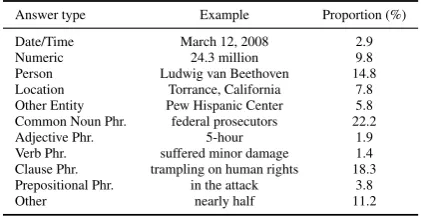
Table 1: The variety of answer types appearing in
NewsQA, with proportion statistics and examples.
Answer type Example Proportion (%) Date/Time March 12, 2008 2.9 Numeric 24.3 million 9.8 Person Ludwig van Beethoven 14.8 Location Torrance, California 7.8 Other Entity Pew Hispanic Center 5.8 Common Noun Phr. federal prosecutors 22.2 Adjective Phr. 5-hour 1.9 Verb Phr. suffered minor damage 1.4 Clause Phr. trampling on human rights 18.3 Prepositional Phr. in the attack 3.8 Other nearly half 11.2
4.1 Answer types
FollowingRajpurkar et al.(2016), we categorize answers based on their linguistic type in Table1. This categorization relies on Stanford CoreNLP to generate constituency parses, POS tags, and NER tags for answer spans (seeRajpurkar et al.
(2016) for more details). From the table we see that the majority of answers (22.2%) are common noun phrases. Thereafter, answers are fairly evenly spread among the clause phrase (18.3%), person (14.8%), numeric (9.8%), and other (11.2%) types.
The proportions in Table1only account for cases when an answer span exists. The complement of this set comprises questions with an agreednull
answer (9.5% of the full corpus) and answers with-out agreement after validation (4.5% of the full corpus).
4.2 Reasoning types
The forms of reasoning required to solveNewsQA
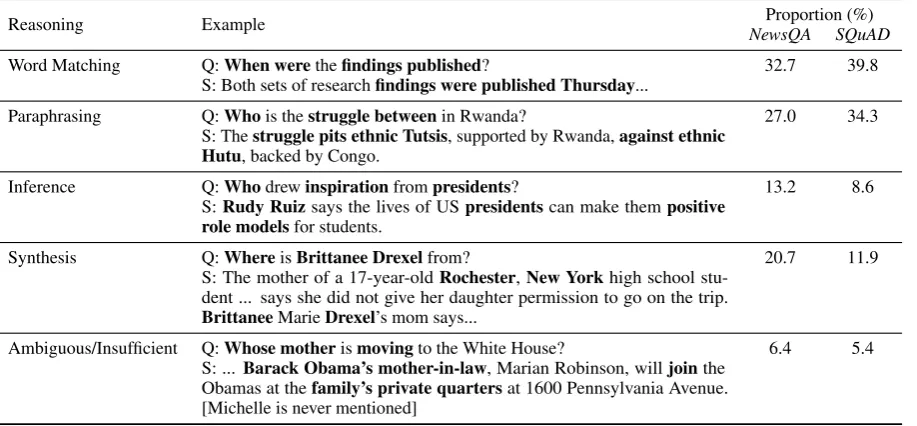
directly influence the abilities that models will learn from the dataset. We stratified reasoning types us-ing a variation on the taxonomy presented byChen et al. (2016) in their analysis of the CNN/Daily Maildataset. Types are as follows, in ascending order of difficulty:
1. Word Matching: Important words in the question exactly match words in the imme-diate context of an answer span, such that a keyword search algorithm could perform well on this subset.
2. Paraphrasing:A single sentence in the arti-cle entails or paraphrases the question. Para-phrase recognition may require synonymy and world knowledge.
rec-ognizing conceptual overlap. This typically draws on world knowledge.
4. Synthesis: The answer can only be inferred by synthesizing information distributed across multiple sentences.
5. Ambiguous/Insufficient: The question has no answer or no unique answer in the article.
For bothNewsQAandSQuAD, we manually la-belled 1,000 examples (drawn randomly from the respective development sets) according to these types and compiled the results in Table2. Some ex-amples fall into more than one category, in which case we defaulted to the more challenging type. We can see from the table that word matching, the easiest type, makes up the largest subset in both datasets (32.7% forNewsQAand 39.8% for
SQuAD). Paraphrasing constitutes a larger
propor-tion inSQuADthan inNewsQA(34.3% vs 27.0%), possibly a result of the explicit encouragement of lexical variety inSQuADquestion sourcing. How-ever, NewsQA significantly outnumbers SQuAD
on the distribution of the more difficult forms of reasoning: synthesis and inference make up a com-bined 33.9% of the data in contrast to 20.5% in
SQuAD.
5 Baseline models
To benchmarkNewsQAfor the MC task, we com-pare the performance of four comprehension sys-tems: a heuristic sentence-level baseline, two ral models, and human data analysts. The first neu-ral model is the match-LSTM (mLSTM) ofWang and Jiang (2016b). The second is the FastQA model ofWeissenborn et al.(2017). We describe these models below but omit the personal details of our analysts.
5.1 Sentence-level baseline
First we investigate a simple baseline that we found to perform surprisingly well onSQuAD. Given a document and question, the baseline aims to indi-cate which sentence contains the answer (rather indicating the specific answer span). Although this task is easier, we hypothesized that naive tech-niques like word-matching would yet be inadequate
ifNewsQArequired more involved reasoning as
in-tended.
The baseline uses a variation on inverse docu-ment frequency (idf), which we call inverse
sen-tence frequency (isf).2 Given a sentenceS i from an article and its corresponding questionQ, the
isf score is given by the sum of theidf scores of the words common toSiandQ(each sentence is treated as a document for theidf computation). The sentence with the highestisf is taken as the answer sentenceS∗, that is,
S∗ = arg max i
X
w∈Si∩Q
idf(w).
5.2 Match-LSTM
The mLSTM model (Wang and Jiang, 2016b) is straightforward to implement and offers strong, though not state-of-the-art, performance on the similarSQuADdataset. There are three stages in-volved. First, LSTM networks encode the docu-ment and question (represented by GloVe word em-beddings (Pennington et al.,2014)) as sequences of hidden states. Second, an mLSTM network (Wang and Jiang,2016a) compares the document encod-ings with the question encodencod-ings. This network pro-cesses the document sequentially and at each token uses an attention mechanism to obtain a weighted vector representation of the question; the weighted combination is concatenated with the encoding of the current token and fed into a standard LSTM. Finally, a Pointer Network uses the hidden states of the mLSTM to select the boundaries of the an-swer span. We refer the reader toWang and Jiang
(2016a,b) for full details.
5.3 FastQA
Table 2: Reasoning mechanisms needed to answer questions. For each we show an example question with the sentence that contains the answer span. Words relevant to the reasoning type are inbold. The corresponding proportion in the human-evaluated subset of bothNewsQAandSQuAD(1,000 samples each) is also given.
Reasoning Example NewsQAProportion (%)SQuAD
Word Matching Q:When werethefindings published?
S: Both sets of researchfindings were published Thursday... 32.7 39.8 Paraphrasing Q:Whois thestruggle betweenin Rwanda?
S: Thestruggle pits ethnic Tutsis, supported by Rwanda,against ethnic Hutu, backed by Congo.
27.0 34.3
Inference Q:Whodrewinspirationfrompresidents?
S:Rudy Ruizsays the lives of USpresidentscan make thempositive role modelsfor students.
13.2 8.6
Synthesis Q:WhereisBrittanee Drexelfrom?
S: The mother of a 17-year-oldRochester,New Yorkhigh school stu-dent ... says she did not give her daughter permission to go on the trip.
BrittaneeMarieDrexel’s mom says...
20.7 11.9
Ambiguous/Insufficient Q:Whose motherismovingto the White House?
S: ...Barack Obama’s mother-in-law, Marian Robinson, willjointhe Obamas at thefamily’s private quartersat 1600 Pennsylvania Avenue. [Michelle is never mentioned]
6.4 5.4
it uses beam search to maximize (approximately) the answer span probability. We refer the reader toWeissenborn et al.(2017) for full details. Note that we report results of the “extended” FastQA model from that work.
6 Experiments
All of our present experiments use the subset of
NewsQAwith agreed or validated answers (92,549
samples for training, 5,166 for validation, and 5,126 for testing). We leave the challenge of identi-fying the unanswerable questions for future work.
6.1 Human performance
We tested four English speakers on a total of 1,000 questions from theNewsQAdevelopment set. We used four performance measures: F1 and exact match (EM) scores (the same measures used by
SQuAD), as well as BLEU and CIDEr.3 BLEU is a
precision-based metric popular in machine transla-tion that uses a weighted average of variable length phrase matches (n-grams) against the reference sentence (Papineni et al.,2002). CIDEr was de-signed to correlate better with human judgements of sentence similarity, and usestf-idf scores over
n-grams (Vedantam et al.,2015).
As given in Table3, humans averaged 69.4% F1 3We calculate these two scores usinghttps://github.
com/tylin/coco-caption.
onNewsQA. The human EM scores are relatively
low at 46.5%. These lower scores are a reflection of the fact that, particularly in a dataset as complex
asNewsQA, there are multiple ways to select
se-mantically equivalent answers,e.g., “1996” versus “in 1996”. Although these answers are equally
cor-rect they would be measured at 50% F1 and 0% EM relative to each other. This suggests that sim-pler automatic metrics are not equal to the task of complex MC evaluation, a problem that has been noted in other domains,e.g., dialogue (Liu et al.,
2016). It is for this reason that we consider BLEU and CIDEr scores, also: humans score 56.0 and 3.596 on these metrics, respectively.
The original evaluation of human performance
on SQuAD compares distinct answers given by
crowdworkers according to EM and F1; for a closer comparison withNewsQA, we replicated our hu-man test on the same number of development ques-tions (1,000) with the same humans. We measured human answers against the second group of crowd-sourced responses in SQuAD’s development set, giving 80.7% F1, 62.5 BLEU, and 3.998 CIDEr. Note that the F1 score is close to the performance of 78.9% achieved by the FastQA model and re-ported in Table5.
Table 3: Human performance on SQuAD and
NewsQAdatasets. The first row is taken from
Ra-jpurkar et al.(2016).
Dataset Exact Match F1 BLEU CIDEr
SQuAD 80.3 90.5 -
-SQuAD(ours) 65.0 80.7 62.5 3.998
NewsQA 46.5 69.4 56.0 3.596
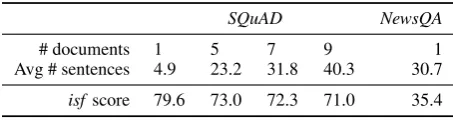
Table 4: Sentence-level accuracy on standard and artificially-lengthenedSQuADdocuments.
SQuAD NewsQA
# documents 1 5 7 9 1
Avg # sentences 4.9 23.2 31.8 40.3 30.7 isfscore 79.6 73.0 72.3 71.0 35.4
1.4% F1. This suggests our validation stage yields good-quality answers.
6.2 Model performance 6.2.1 ISF sentence selection
As reported in Table 4, the heuristicisf baseline achieves an impressive 79.6% accuracy in deter-mining the correct answer sentence forSQuAD’s development set; however, it reaches only 35.4% sentence-selection accuracy onNewsQA’s develop-ment set. Selecting the answer sentence inNewsQA
should be inherently more difficult, sinceSQuAD
documents are on average 4.9 sentences long, while
NewsQA articles are on average 30.7 sentences.
To eliminate this difference in article length as a possible cause of the observed performance gap, we concatenated adjacentSQuADparagraphs that come from the same Wikipedia article and ran the baseline on these lengthened documents. Accuracy decreases as expected with increasedSQuAD docu-ment length, yet remains significantly higher than
onNewsQAeven when the lengthened documents
are longer than the news articles (see Table4). 6.2.2 Neural models
Performance of the neural baselines is measured by EM and F1 using the official evaluation script from
SQuAD. Results are listed in Table5. We see that
on both datasets, FastQA outperforms our imple-mentation of the mLSTM according to all measures. Moreover, comparing with Table 3, the gap be-tween human and FastQA performance onSQuAD
is 1.8% F1 under our evaluation scheme compared with 13.3% F1 onNewsQA. This suggests a large
margin for improvement remains for machine com-prehension methods to masterNewsQA.
For a finer-grained analysis, we measured our implementation of mLSTM’s performance on ques-tions from the human-evaluated portion of the de-velopment set. We stratified performance accord-ing to answer type and reasonaccord-ing type as defined in Sections4.1and4.2, respectively. Results are presented in Figure1.
Answer-type stratification suggests that the model is better at pointing to named entities com-pared to other answer types. The reasoning-type stratification, on the other hand, shows that ques-tions requiringinferenceandsynthesisare, not sur-prisingly, most difficult for the model. Consistent with observations in Table5, stratified performance
onNewsQAis significantly lower than onSQuAD.
The difference is smallest on word matching and largest on synthesis. We postulate that the longer stories inNewsQAmake synthesizing information from separate sentences more difficult, since the rel-evant sentences may be farther apart. This requires the model to track longer-term dependencies. The details of our mLSTM implementation are given in the Appendix.
7 Conclusion
We have introduced a challenging new comprehen-sion dataset:NewsQA. We collected the 100,000+ examples ofNewsQAusing teams of crowdwork-ers, who variously read CNN articles or highlights, posed questions about them, and determined an-swers. Our methodology yields diverse answer types and a significant proportion of questions that require some reasoning ability to solve. This makes the corpus challenging, as confirmed by the large performance gap between humans and deep neural models. By its size and complexity, we believe
NewsQAmakes a significant extension to the
exist-ing body of comprehension datasets, in particular complementingSQuAD. We hope that our corpus will spur further advances in machine comprehen-sion and foster the development of more literate machines.
References
Ondrej Bajgar, Rudolf Kadlec, and Jan Kleindienst. 2016. Embracing data abundance: Booktest dataset for reading comprehension. arXiv preprint
[image:7.595.71.298.218.278.2]Table 5: Neural model performance onSQuADandNewsQA. mLSTM results onSQuADare derived from our implementation ofWang and Jiang(2016b), and all FastQA results are taken fromWeissenborn et al.
(2017).
SQuAD Dev Test
Model F1 EM F1 EM mLSTM 73.9 63.1 - -FastQA 78.5 70.3 78.9 70.8
NewsQA Dev Test
Model F1 EM F1 EM mLSTM 51.0 35.7 50.5 35.4 FastQA 56.1 43.7 56.1 42.8
Date/time
Numeric
Person
Adjective Phrase
Location
Prepositional Phrase
Common Noun Phrase
Other
Other entity
Clause Phrase
Verb Phrase
0 0.175 0.35 0.525 0.7
F1 EM
Word
Matching
Paraphrasing
Inference
Synthesis
Ambiguous/
Insufficient
0 0.15 0.3 0.45 0.6 0.75 0.9
NewsQA SQuAD
Figure 1:Left: mLSTM performance (F1 and EM) stratified by answer type on the full development set of
NewsQA. Right: mLSTM performance (F1) stratified by reasoning type on the human-assessed subset
on bothNewsQAandSQuAD. Error bars indicate performance differences between mLSTM and human annotators.
J. Bergstra, O. Breuleux, F. Bastien, P. Lamblin, R. Pas-canu, G. Desjardins, J. Turian, D. Warde-Farley, and Y. Bengio. 2010. Theano: a CPU and GPU math expression compiler. InIn Proc. of SciPy.
Danqi Chen, Jason Bolton, and Christopher D. Man-ning. 2016. A thorough examination of the cnn / daily mail reading comprehension task. In
Associa-tion for ComputaAssocia-tional Linguistics (ACL).
François Chollet. 2015. keras. https://github. com/fchollet/keras.
Karl Moritz Hermann, Tomas Kocisky, Edward Grefen-stette, Lasse Espeholt, Will Kay, Mustafa Suleyman, and Phil Blunsom. 2015. Teaching machines to read and comprehend. In Advances in Neural
Informa-tion Processing Systems. pages 1684–1692.
Felix Hill, Antoine Bordes, Sumit Chopra, and Jason Weston. 2016. The goldilocks principle: Reading children’s books with explicit memory representa-tions. ICLR.
Rudolf Kadlec, Martin Schmid, Ondrej Bajgar, and Jan Kleindienst. 2016. Text understanding with the attention sum reader network. arXiv preprint
arXiv:1603.01547.
Diederik Kingma and Jimmy Ba. 2015. Adam: A method for stochastic optimization.ICLR.
Chia-Wei Liu, Ryan Lowe, Iulian V Serban, Michael Noseworthy, Laurent Charlin, and Joelle Pineau. 2016. How not to evaluate your dialogue system:
An empirical study of unsupervised evaluation met-rics for dialogue response generation. arXiv preprint
arXiv:1603.08023.
Kishore Papineni, Salim Roukos, Todd Ward, and Wei-Jing Zhu. 2002. Bleu: a method for automatic eval-uation of machine translation. In Proceedings of the 40th annual meeting on association for
compu-tational linguistics. Association for Computational
Linguistics, pages 311–318.
Razvan Pascanu, Tomas Mikolov, and Yoshua Bengio. 2013. On the difficulty of training recurrent neural networks. ICML (3)28:1310–1318.
Jeffrey Pennington, Richard Socher, and Christopher D Manning. 2014. Glove: Global vectors for word rep-resentation. InEMNLP. volume 14, pages 1532–43.
Pranav Rajpurkar, Jian Zhang, Konstantin Lopyrev, and Percy Liang. 2016. Squad: 100,000+ questions for machine comprehension of text. arXiv preprint
arXiv:1606.05250.
Matthew Richardson, Christopher JC Burges, and Erin Renshaw. 2013. Mctest: A challenge dataset for the open-domain machine comprehension of text. In
EMNLP. volume 1, page 2.
Mrinmaya Sachan, Avinava Dubey, Eric P Xing, and Matthew Richardson. 2015. Learning answer entail-ing structures for machine comprehension. In
Andrew M Saxe, James L McClelland, and Surya Gan-guli. 2013. Exact solutions to the nonlinear dynam-ics of learning in deep linear neural networks. arXiv
preprint arXiv:1312.6120.
Alessandro Sordoni, Philip Bachman, Adam Trischler, and Yoshua Bengio. 2016. Iterative alternating neu-ral attention for machine reading. arXiv preprint
arXiv:1606.02245.
Adam Trischler, Zheng Ye, Xingdi Yuan, Jing He, Philip Bachman, and Kaheer Suleman. 2016a. A parallel-hierarchical model for machine comprehen-sion on sparse data. InProceedings of the 54th An-nual Meeting of the Association for Computational
Linguistics.
Adam Trischler, Zheng Ye, Xingdi Yuan, and Kaheer Suleman. 2016b. Natural language comprehension with the epireader. InEMNLP.
Ramakrishna Vedantam, C Lawrence Zitnick, and Devi Parikh. 2015. Cider: Consensus-based image de-scription evaluation. In Proceedings of the IEEE Conference on Computer Vision and Pattern
Recog-nition. pages 4566–4575.
Hai Wang, Mohit Bansal, Kevin Gimpel, and David McAllester. 2015. Machine comprehension with syntax, frames, and semantics. In Proceedings of
ACL, Volume 2: Short Papers. page 700.
Shuohang Wang and Jing Jiang. 2016a. Learning natu-ral language inference with lstm. NAACL.
Shuohang Wang and Jing Jiang. 2016b. Machine com-prehension using match-lstm and answer pointer.
arXiv preprint arXiv:1608.07905.
Dirk Weissenborn, Georg Wiese, and Laura Seiffe. 2017. Fastqa: A simple and efficient neural ar-chitecture for question answering. arXiv preprint
Appendices
A Implementation details
mLSTM was implemented with the Keras frame-work (Chollet,2015) using the Theano (Bergstra et al.,2010) backend. Word embeddings are initial-ized using GloVe vectors (Pennington et al.,2014) pre-trained on the 840-billionCommon Crawl cor-pus. The word embeddings are not updated during training. Embeddings for out-of-vocabulary words are initialized with zero.
The training objective is to maximize the log likelihood of the boundary pointers. Optimiza-tion is performed using stochastic gradient descent (with a batch-size of 32) with the ADAM optimizer (Kingma and Ba,2015). The initial learning rate is 0.003. The learning rate is decayed by a factor of 0.7 if validation loss does not decrease at the end of each epoch. Gradient clipping (Pascanu et al.,2013) is applied with a threshold of 5. Pa-rameter tuning is performed on both models using
hyperopt4. Configuration for the best observed performance was as follows:
InSQuADexperiments, both the pre-processing
layer and the answer-pointing layer use RNNs with a hidden size of 150. These settings are consis-tent with those used byWang and Jiang(2016b).
InNewsQAexperiments, both the pre-processing
layer and the answer-pointing layer use RNNs with a hidden size of 192.
Model parameters are initialized with either the normal distribution (N(0,0.05)) or the orthogonal initialization (O, Saxe et al. 2013) in Keras. All weight matrices in the LSTMs are initialized with O. In the Match-LSTM layer,Wq,Wp, andWr are initialized withO,bpandware initialized with N, andbis initialized as 1.
In the answer-pointing layer,V andWaare ini-tialized with O, ba andv are initialized withN, andcis initialized as 1.