Feedback Controller Design for Chemotherapy Drug
Scheduling via PSO Optimization Algorithm
P. Baghernia, R. K. moghaddam
Abstract
—
Cancer is related to a class of diseases characterized by out-of-control cell growth. Chemotherapy as one of the most conventional methods of cancer treatment aims to kill cancer cells, but this treatment will damage healthy cells as well. In this regard, mathematical modeling and optimization of drug scheduling can be effective in improving the drug injection timing, with minimum side effects. In this paper a phase specific cancer tumor model have been considered to describe the effect of drug on different cell populations, plasma drug concentration and toxic side effects. A feedback controller of PID type is developed in order to maintain a predefined drug concentration level. This level or controller’s input signal have been determined in such a way asto limit the plasma drug concentration which also limits the toxic side effects. In addition, the Particle Swarm Optimization (PSO) algorithm is employed to optimize the PID controller parameters. Simulation results show that the drug which is injected using this algorithm leads to a reduced number of cancer cells at the end of treatment while the normal cells population, despite the toxicity of the drug, remains almost in the acceptable range.Index Terms—Cancer chemotherapy, Drug scheduling, feedback controller, Particle Swarm Optimization algorithm.
I. INTRODUCTION
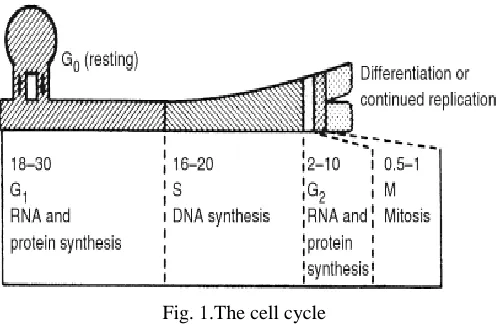
ancer is a disease characterized by a loss in the normal control mechanisms that govern cell survival, proliferating, and differentiation and it continues to be the second leading cause of mortality from disease. Chemotherapy has been known as one of the most essential methods of cancer treatment. The main goal of chemotherapy is to decrease the number of cancer cells at the end of the treatment but chemotherapeutic agents has generally negative effects on healthy cells as well. The actions of these agents are based upon an understanding of the cell cycle. Cell cycle is a sequence of phases that normal and cancer cells undergo from their birth to death (fig. 1).
Each cell begins its growth during a post mitotic period, a phase called G1, during which enzymes necessary for DNA
production, other proteins, and RNA are produced.
Manuscript received June 24, 2012; revised July 22, 2012. This work was supported in part by the Electrical Department of Islamaic Azad University, Mashhad Branch.
P. Baghernia is with the Department of Electrical Engineering, Mashhad Branch, Islamic Azad University, Mashhad, Iran (e-mail: [email protected]).
R. K. Moghaddam is with the Department of Electrical Engineering, Mashhad Branch, Islamic Azad University, Mashhad, Iran (e-mail: [email protected]).
G1 is followed by a period of DNA synthesis in which,
essentially all DNA synthesis for a given cycle takes place. When DNA synthesis is completed the cell enters a pre mitotic period (G2), during which further protein and RNA synthesis
occurs. This gap is followed immediately by mitosis, at the end of which actual physical division takes place, two daughter cells are formed, and each cell again enters G1. Many
anticancer drugs in this phase, which interference with DNA, cause the loss of cancer cells. G1 phase is in equilibrium with a
resting state called G0. Cells in G0 are relatively inactive with
[image:1.612.317.566.322.485.2]respect to macromolecular synthesis and are consequently insensitive to many traditional chemotherapeutic agents [1].
Fig. 1.The cell cycle
In order to help the patient to minimize the tumor cells with minimum side effects, it is crucial to design an optimal drug schedule for chemotherapy based on cell cycle mechanisms. So many mathematical models have ever been proposed to find the optimal chemotherapy schedule and predict the tumor and immune system behaviors when the drug is administrated. In [2] an optimal drug scheduling model is introduced that most effectively reduces the tumor cells population after a specific period of treatment. Although due to the contradiction between cumulative drug toxicity and medical knowledge, this model had been modified by Liang [3]. Then the idea of optimal chemotherapeutic schedules based on two different models, cell cycle non-specific and cell cycle specific, is proposed [4]. The ultimate aim for these referred models is declining the final tumor size while taking into account the constraints on drug resistance and toxicity. In [5], feedback controller scheme for chemotherapy drug scheduling, based on phase specific cancer model, has been introduced. In [6] and [7] a multi drug chemotherapy scheduling method for cancer
therapy using multi objective optimization techniques is presented. Combination of drugs for chemotherapy has various advantages. As a result, adaption of multiple chemotherapeutic agents can decrease the drug resistance incidence and the overall toxicity to the patient’s body would also be reduced.
The rest of this issue is organized as follows. Section 2 presents a phase specific cancer tumor model describing the growth of tumor and effect of chemotherapeutic agents on the different cell populations. A feedback controller scheme in order to maintain a pre defined drug concentration level is introduced in section 3. In section 4 to optimize the PID controller’s coefficients the PSO algorithm is employed. Section 5 describes the implementation details and results of applying this proposed schedule of drug injection. Finally concluding remarks are presented in section 6.
II. MATHEMATICALMODELOFPHASESPECIFIC CANCERTUMOR
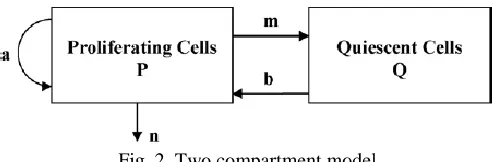
In this section, a phase specific cancer mathematical model is considered to predict the tumor response and to design the chemotherapy drug scheduling. In this model the cell cycle is divided into two compartments (fig. 2). One compartment consists of cells in four phases G1, S, G2 and M which are
called proliferating cells and another compartment only contains cells in resting phase or G0, called quiescent cells [4].
[image:2.612.49.298.430.511.2]Drugs primary act during specific phase of the cell cycle and only proliferating cells will be killed.
Fig. 2. Two compartment model
A number of differential equations used to build two compartments model of cancer chemotherapy treatment and describe the effect of drug on different cell populations,
plasma drug concentration and toxic side effects [5]. The first two equations represent the rate of change of cycling and no cycling tumor cells mass:
̇ – (1) ,
̇ (2) ,
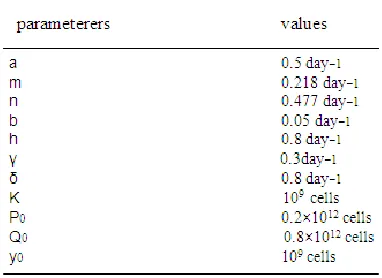
where a is the cycling or proliferating cells growth rate, m is the rate at which these cycling cells become no cycling, n is the natural death of cycling cells and b is the rate at which no cycling or quiescent cells become cycling. All these
parameters are assumed to be constant and positive and their values are listed in table І. P and Q represent the cycling and no cycling tumor cells population, respectively. It is assumed that there is positive net growth rate (a >n), so that the tumor will grow without bound in the absence of chemotherapy. It is also assumed that a large number of proliferating cells become quiescent cells (a−m−n< 0) [4]. In this equations parameter
g (t)also indicates the effect of chemotherapeutic agent which is the rate of cell killing in per unit drug and it is determined by equation (3):
(3)
Where k1is a constant related to effect of drug concentration
on cell killing and D (t) shows the rate of change of drug concentration at the tumor site during the treatment cycle shown in equation (4).
̇ (4) ,
Which u (t) is the amount of drug doses to be infused to patient’s body and is drug decay which is related to the metabolism of drug inside patient’s body. It is noted that the drug concentration D (t) at the tumor site should not exceed the limit as suggested by equation (5) [5].
(5) It is well known normal cells are also influenced by chemotherapy agents. So, in order to control the drug toxicity side effects to normal tissue another differential equation will be considered. Based on it normal cells are required to have limited growth and reduction during treatment. This equation have been expressed by following formula:
̇ ( ) (6) ,
Where Y is the number of normal cells, whereas and K
present the growth rate of the normal cells and carrying capacity of normal cells respectively. To limit the toxic side effects of the chemotherapy treatment, the below inequality should be maintained throughout the period of the treatment [5]:
(7)
Finally Equation (8) shows the relationship between level of toxicity and drug concentration during the treatment period:
rate of elimination of toxicity. T (t) should also be limited by inequality (9) [5]:
[image:3.612.76.267.111.250.2](9)
TABLE І
PARAMETER VALUES FOR THE CELL CYCLE SPECIFIC MODEL
1. PROPOSED FEEDBACK CONTROLLER SCHEME
[image:3.612.46.298.328.485.2]In this paper, a feedback controller of PID type is used to deliver the drug concentration at the tumor sites to the desired level. This proposed controller scheme have been displayed in fig. 3.
Fig. 3. Schematic diagram of the proposed drug scheduling scheme
The reference input to the PID controller is XD or the
desired drug concentration that should be injected to the patient’s body. This optimal concentration level is determined so that, the cell killing can be maximum [5]. D (t) or drug concentration at the tumor site is considered as feedback signal. The difference between reference XD and drug
concentration D (t) is the error signal and the controller’s input. e (t)is defined using the following equation:
(10) If the error converges to zero, it means the drug concentration at the tumor site is exactly equal to desired level and treatment is done with the best rate of the drug dose and minimum toxicity side effects.
The output of the controller is then obtained by the following formula:
∫ – * + (11)
kp, ki, kd are proportional, integral and derivative coefficients
of PID controller, respectively. It is required to tune these three parameters to achieve desirable performance.
In this work for optimizing the PID controller parameters, PSO algorithm is applied that improves the drug scheduling as well as the effectiveness of the proposed approach.
III. PARTICLESWARMOPTIMIZATIONALGORITHM Particle swarm optimization is a population based stochastic optimization technique developed by Eberhart and Kennedy in 1995 [8], inspired by social behavior of bird flocking or fish schooling. In PSO, each particle representing a potential solution moves in search space and adaptively updates its velocity and position according to its own and neighbor’s flying experience, aiming at a better position for itself. PSO starts with the random initial swarm of particles. Each particle is considered in a D-dimensional search space, so the ith particle position and its velocity (the rate of position change) are represented as ⃗⃗⃗ and⃗⃗⃗
, respectively. The best previous position of
each ith particle is ⃗⃗⃗ and the best particle among all the particles in the population will be ⃗⃗⃗⃗
. In each of iterations, the velocity and
position of each particle is updated by following two equations:
(12)
(13)
Where k is the iteration number, d =1,2,…,D, i =1,2,…,N, and
N is the size of the population (swarm). C1and C2are two
positive values called acceleration constants, rand1 and rand2
are two independent random numbers that uniformly distribute in [0, 1] and are used to stochastically vary the relative pull of
⃗⃗⃗ and⃗⃗⃗⃗ . W is the inertial weight introduced by Shi and Eberhart in order to control the impact of the previous history of velocities on the current one. In this paper, w is determined by the Equation (14) below:
(14) When maximum iterations or minimum error criteria is attained, the updating process of particle’s position and velocity stops [9].
∑ (15)
Thus, the entire design process is trying to determine the controller parameters using PSO algorithm in such a way that minimizes the above objective function. In this work, we consider initial population consists of ten completely random particles and the value of parameters C1 and C2 are assumed to
be 3 and 1 respectively. The best objective function value after 50 runs is obtained as 2.33.
It is important to note that the whole control scheme and drug scheduling is designed for a period of 84 days (T=84) as recommended by many researchers [4, 5]. For this time horizon the optimal values of PID controller parameters are calculated as Kp=1, Ki=.99 and Kd=0.86.
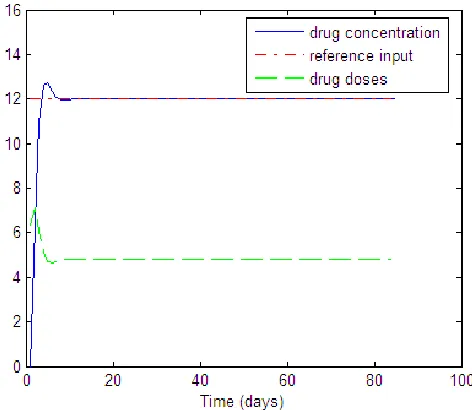
IV. IPLEMENTATIONANDSIMULATIONRESULTS In this paper, the optimal chemotherapy drug scheduling was intended to deliver the drug concentration at tumor site to specific, predetermined level. For this purpose a feedback controller is used. As mentioned before, the controller parameters are determined by PSO algorithm. The drug dosage, which is obtained with these parameters values, is applied to the compartment model and response is observed. The reference input, drug concentration and dosage for the whole treatment period is shown in Fig. 4. It is observed that the drug concentration in patient’s body is initially zero. It means that in the beginning of treatment no drug is infused. Then the drug concentration increases and it becomes stable and follows the reference signal of the controller for the remained period of the treatment. The drug dose is also initially zero and increases with time and records a highest value on day-5, which is 12.73D.
The level of toxicity for the whole period of treatment cycle is shown in Fig. 5. It is observed that the toxicity effect of the drug remains in an acceptable level 40 which is less than maximum amount set by the constraints.
The evolution of the number of proliferating and quiescent cells during the therapy period is illustrated in fig. 6. After applying the proposed drug scheduling to the model, the predicted number of these cells reduces. The proliferating cells and quiescent decreased to 71.4% and 59.38% of their initial values.
[image:4.612.318.562.261.443.2]Nevertheless, the phase specific cancer model includes the constraint that places strict limits to the acceptable number of normal cells. As shown in fig. 6, the number of normal cells at the end of treatment is which is near to its lower bound. According to the result obtained in [5], despite an equal reduction in number of cancer cells, normal cells population has remained relatively constant, while the proposed algorithm (PSO) is much simpler and faster in comparison with GA.
[image:4.612.314.565.474.661.2]Fig. 5. The drug toxicity level for the whole period of the treatment
Fig. 6. The reduction of all types of cells due to chemotherapy treatment
V. COCLUDINGREMARKS
[image:4.612.53.289.521.726.2]objective function is introduced in such a way that minimizes the mean square error. This error is the difference between predefined drug concentration level and drug concentration in patient’s body. The controller parameters are tuned with PSO algorithm which is much simpler and its convergence speed is so faster. At the end of the treatment the number of proliferating and resting cells decrease and the level of normal cells remain in an acceptable range. An aim of the ongoing work is to formulate a multi objective optimization problem in multi drug chemotherapy scheduling and the same feedback control strategy can be extended for it.
REFERENCES
[1] Roland T. Skeel, Samir N. Khleif, “Handbook of cancer chemotherapy,” Eighth ed. vol. 1, Jonathan W.Pine,Jr. New York: Wolters Kluwer, 2011, pp. 5-7.
[2] R. B. Martin, “Optimal control drug scheduling of cancer chemotherapy”,Automatica, vol. 28, pp. 1113-1123, 1992.
[3] Yong Liang, Kwong-Sak Leung, “A novel evolutionary drug scheduling model in cancer chemotherapy,” IEEE Trans. Information technology
in biomedicine, pp. 237-245, 2008.
[4] Pinky Dua, Vivek Dua, Efstratios N. pistikopoulos, “Optimal delivery of chemotherapeutic agents in cancer,” Computer and Chemical
Engineering, vol. 32, pp.99-107, 2008.
[5] S. Algoul, M .S. Alam, M. A. Hossain, M. A. A. Majumder, “Feedback control of chemotherapy drug scheduling for phase specific cancer treatment,” The IEEE Fifth Int. Conf. Bio-Inspired Computing:
Theories and Applications, pp. 1443-1450, 2010.
[6] S. Algoul, M. S. Alam, M. A. hossain, M. A. A. Majumder, “Multi objective optimization for multi drug chemotherapy scheduling,”
Proceedings of 13th Int. Conf. Computer and Information Technology,
pp. 464-469, 2010.
[7] Sui-man Tse, Yong Liang, Kwong-Sak Leung, “ A memetic algorithm for multiple drug cancer chemotherapy schedule optimization,” IEEE Trans. Systems, vol. 37, pp. 84-91, 2007.
[8] Y. Shi, R. Eberhart, “A modified particle swarm optimizer,” IEEE
world cong. Computational Intelligence, pp.69-73, 1998.