Paradigm Completion for Derivational Morphology
Ryan Cotterell@Ekaterina VylomovaHHuda Khayrallah@Christo Kirov@David Yarowsky@ @Center for Language and Speech Processing, Johns Hopkins University, USA
HDepartment of Computing and Information Systems, University of Melbourne, Australia
[email protected] [email protected]
{huda,ckirov,yarowsky}@cs.jhu.edu
Abstract
The generation of complex derived word forms has been an overlooked problem in NLP; we fill this gap by applying neu-ral sequence-to-sequence models to the task. We overview the theoretical mo-tivation for a paradigmatic treatment of derivational morphology, and introduce the task of derivational paradigm completion as a parallel to inflectional paradigm com-pletion. State-of-the-art neural models, adapted from the inflection task, are able to learn a range of derivation patterns, and outperform a non-neural baseline by 16.4%. However, due to semantic, historical, and lexical considerations involved in deriva-tional morphology, future work will be needed to achieve performance parity with inflection-generating systems.
1 Introduction
Unlike inflectional morphology, which produces grammatical variants of the same core lexical item (e.g.,take7→takes), derivational morphology is one of the key processes by which new lemmata are created. For example, the English verbcorrodecan evolve into the nouncorrosion, the adjective corro-dent, and numerous other complex derived forms such asanticorrosive. Derivational morphology is often highly productive, leading to the ready cre-ation of neologisms such asRao-Blackwellizeand
Rao-Blackwellization, both originating from the Rao-Blackwell theorem. Despite the prevalence of productive derivational morphology, however, there has been little work on its generation. Com-monly used derivational resources such as Nom-Bank (Meyers et al.,2004) are still finite. Moreover, the complex phonological and historical changes (e.g., the adjectivizationcorrode7→corrosive) and
affix selection (e.g., choosing between English de-verbal suffixes-mentand-tion) make generation of derived forms an interesting and challenging problem for NLP.
In this work, we show that viewing derivational morphological processes as paradigmatic may be fruitful for generation. This means that there are a number of well-defined form-function pairs as-sociated with a core word. For example, a typical English verb may have five forms in its inflectional paradigm, corresponding to its base (take), past tense (took), past participle (taken), progressive (taking) and third-person singular (takes) forms. These forms are related by a consistent set of re-lations, such as affixation. Similarly, a verb may have several slots in its derivational paradigm: The form takehas the agentive nominalizationtaker, and the abilitative adjectivizationtakable. Note there are also consistent patterns associated with each derivational slot, e.g., the-ersuffix regularly produces the agentive.
Exploiting this paradigmatic characterization of derivational morphology allows us to create a sta-tistical model capable of generating derivationally complex forms. We apply state-of-the-art models for inflection generation, which learn mappings from fixed paradigm slots to derived forms. Em-pirically, we compare results for two models on the new task of derivational paradigm completion: a neural sequence-to-sequence model and a stan-dard non-neural baseline. Our best neural model for derivation achieves 71.7% accuracy, beating the non-neural baseline by 16.4 points. Nevertheless, we note this is about 25 points lower than the equiv-alent model on the English inflection task (and even 20 points lower than the model’s performance on the harder Finnish inflection generation). These re-sults point to additional complications in derivation that require more elaborate models or data anno-tation to overcome. While inflection generation is
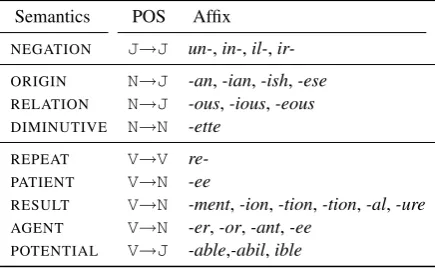
Semantics POS Affix NEGATION J→J un-,in-,il-, ir-ORIGIN N→J -an,-ian,-ish,-ese RELATION N→J -ous,-ious,-eous DIMINUTIVE N→N -ette
REPEAT V→V re-PATIENT V→N -ee
RESULT V→N -ment,-ion,-tion,-tion,-al,-ure AGENT V→N -er,-or,-ant,-ee
[image:2.595.72.290.63.197.2]POTENTIAL V→J -able,-abil,ible
Table 1: A partial list of derivational transformations in En-glish with corresponding POS changes and semantic labels.
becoming a solved problem (Cotterell et al.,2017), derivation generation is still very much open. 2 Derivational Morphology
The generation of derived forms is structurally sim-ilar to the generation of inflectional variants, but presents additional challenges for NLP. Here, we provide linguistic background comparing the two types of morphological processes.
Inflection and Derivation. Inflectional morphol-ogy primarily marks semantic features that are nec-essary for syntax, e.g., gender, tense and aspect. Thus, it follows that in most languages inflection never changes the part of speech of the word and often does not change its basic meaning. The set of inflectional forms for a given lexeme is said to form a paradigm, e.g., the full paradigm for the verbto takeishtake,taking,takes,took,takeni. Each entry in an inflectional paradigm is termed a slot and is indexed by a syntacto-semantic category, e.g., the PASTform oftakeistook. We may reasonably ex-pect that all English verbs—including neologisms— have these five forms.1 Furthermore, there is
typically a fairly regular relationship between a paradigm slot and its form (e.g., add-sfor the third person singular form). Derivational morphology, on the other hand, often changes the core part of speech of a word and makes more radical changes in meaning. In fact, derivational processes are often subcategorized by the part-of-speech change they engender, e.g., corrode7→corrosion is a deverbal nominalization.
Derivational Paradigms. Much like inflection, derivational processes may be organized into
1Only a handful of English irregulars distinguish between
the past tense and the past participle, e.g.,tookandtaken, and thus have fiveuniqueforms in their verbal paradigms; most English verbs have fouruniqueforms.
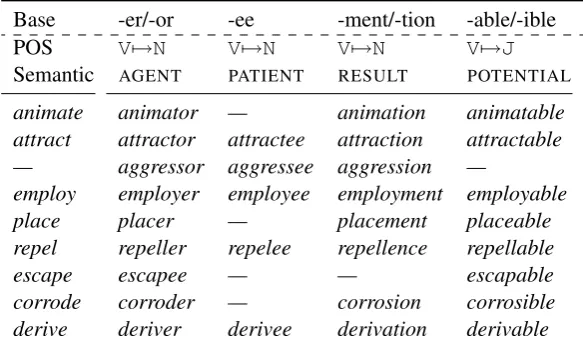
paradigms, with slots corresponding to more ab-stract lexico-semantic categories for an associ-ated part of speech (Corbin, 1987;Booij, 2008; ˇStekauer, 2014). Lieber (2004) presents one of the first theoretical frameworks to enumerate a set of derivational paradigm slots, motivated by previ-ous studies of semantic primitives byWierzbicka (1988). A partial listing of possible derivational paradigm slots for base English adjectives, nouns, and verbs is given in Table1. The list contains several productive cases. A key difficulty comes from the the fact that the mapping between seman-tics and suffixes is not always clean;Lieber(2004) points out the categoryAGENTcould be expressed by the suffix-er(as inrunner) or by-ee(as in es-capee). However, both-erand-ee may have the PATIENT role; considerburner (“a cheap phone intended to be disposed of, i.e. burned”) and em-ployee(“one being employed”), respectively. We flesh out partial derivational paradigms for several English verbs in Table2.
Unlike in inflectional paradigms, where we ex-pect most cells to be filled for any given base form, derivational paradigms often contain base-slot combinations that are not semantically compat-ible, leading to the gaps in Table2.2 We also
ob-serve increased paradigm irregularity due to some derived forms becoming lexicalized at different points in history, differences in the language from which the base word entered the target language (e.g., English roots of Germanic and Latinate ori-gin behave differently (Bauer,1983)), as well as other factors that are not obvious from the charac-ters in the base word (e.g., gender or number of the resulting noun).
As an example of how difficult these factors can make derivation, consider the wide variety of poten-tial nominalizations corresponding to theRESULT of a verb, e.g., -ion, -al and -ment, (Jackendoff, 1975). While any particular English verb will al-most exclusively employ exactly one of these suf-fixes (e.g., we haverefuse7→refusaland other can-didates∗refusionand∗refusementare illicit),3the
information required to choose the correct suffix may be both arbitrary or not easily available.
2For instance, if suffix-eemarks aPATIENTit is
seman-tically not compatible with intransitive verbs, i.e.,∗sneezee
cannot be derived from intransitivesneeze.
3Note some forms appear to have multiple nominalizations,
Base -er/-or -ee -ment/-tion -able/-ible
POS V7→N V7→N V7→N V7→J
Semantic AGENT PATIENT RESULT POTENTIAL animate animator — animation animatable attract attractor attractee attraction attractable — aggressor aggressee aggression —
employ employer employee employment employable
place placer — placement placeable
repel repeller repelee repellence repellable
escape escapee — — escapable
[image:3.595.151.443.63.236.2]corrode corroder — corrosion corrosible derive deriver derivee derivation derivable
Table 2: Partial derivational paradigm for several English verbs; semantic gaps are indicated with —.
Productivity. There is a general agreement in linguistics that frequently used complex words be-come part of the lexicon as wholes, while most oth-ers are likely to be constructed from constituents (Bauer,2001;Aronoff and Lindsay,2014); the lat-ter ones typically follow derivational patlat-terns, or rules, such as adding-ableto express potential or ability or applying-ly to convert adjectives into adverbs. These patterns typically present two es-sential properties: productivity and restrictedness. Productivity relates to the ability of a pattern to be applied to any novel base form to create a new word, potentially on-the-fly. One example of such a productive transformation is adding-less (priva-tive construction), which may attach to almost any noun to form an adjective. Moreover, the resulting form’s meaning is compositional and predictable. Many derivational suffixes in English are of this type. On the other hand, some patterns are subject to semantic, pragmatic, morphological or phono-logical restrictions. Consider the English patient suffix-ee, which cannot be attached to a base end-ing in /i(:)/, e.g., it cannot be attached to the verb
freeto formfreeee. Restrictedness is closely related to productivity, i.e., highly productive rules are less restricted. A parsimonious model of derivational morphology would describe forms using produc-tive rules when possible, but may store forms with highly restricted patterns directly as full lexical items.
A Note On Terminology. We would like to make a subtle, but important point regarding ter-minology: the phrasemorphologically richin the NLP community almost exclusively refers to inflec-tional, rather thanderivationalmorphology. For example, English is labeled as morphologically
impoverished, whereas German and Russian are considered morphologically rich, e.g., see the in-troduction of Tsarfaty et al. (2010). As regards derivation, English is quite complex and even simi-lar in richness to German or Russian as it contains productive formations from two substrata: Ger-manic and Latinate. From this perspective, English is very much a morphologically rich language. In-deed, a corpus study on the Brown Corpus showed that themajorityof English words are morphologi-cally complex when derivation is considered (Light, 1996). Note that there many languages that have exhibit neither rich inflection, nor rich derivational morphology, e.g., Chinese, which most commonly employs compounding for word word formation (Chung et al.,2014).
3 Task and Models
We discuss our two systems for derivational paradigm completion and the results they achieve.
3.1 Data
We experiment on English derivational triples ex-tracted from NomBank (Meyers et al., 2004).4
Each triple consists of a base form, the semantics of the derivation and a corresponding derived form e.g., hameliorate, RESULT, ameliorationi. Note that in this task we do not predict whether a slot ex-ists, merely what form it would take given the base and the slot. In terms of current study, we consider the following derivational types: verb nominaliza-tion such as RESULT, AGENT and PATIENT, ad-verbalization and adjective-noun transformations. We intentionally avoid zero-derivations. We also
4There are few resources annotated for derivation in
1-best 10-best
baseline seq2seq seq2seq
acc edit acc edit acc
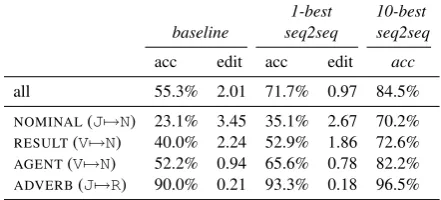
all 55.3% 2.01 71.7% 0.97 84.5%
NOMINAL(J7→N) 23.1% 3.45 35.1% 2.67 70.2% RESULT(V7→N) 40.0% 2.24 52.9% 1.86 72.6%
AGENT(V7→N) 52.2% 0.94 65.6% 0.78 82.2%
[image:4.595.70.291.65.165.2]ADVERB(J7→R) 90.0% 0.21 93.3% 0.18 96.5%
Table 3: Results under two metrics (accuracy and Levenshtein distance) comparing the non-neural baseline from the 201 SIG-MORPHON shared task and the neural sequence-to-sequence model (both for 1-best and 10-best output).
exclude overly orthographically distant pairs by fil-tering out those for which the Levenshtein distance exceeds half the sum of their lengths, which ap-pear to be misannotations in NomBank. The final dataset includes 6,029 derivational samples, which we split into train (70%), development (15%), and test (15%).5 We also note that NomBank
annota-tions are often semantically more coarse-grained.
3.2 Evaluation Metrics
We evaluate on 3 metrics: accuracy, average edit distance, and F1. Accuracy measures how often
system output exactly matches the gold string. Edit distance, by comparison, measures the Levenshtein distance between system output and the gold string. Finally, we calculate affixF1scores for individual
derivational affixes. E.g., for-ment precision is the number of words where the model correctly predicted-ment(out of total predictions) and recall is the number of words where the model correctly predicted out of the number of true words.
3.3 Baseline Transducer
We train a simple transducer for each base-to-paradigm slot mapping in the training set, identical to the baseline described inCotterell et al.(2016). This uses an averaged perceptron classifier to greed-ily apply an output transformation (substitution, deletion, or insertion) to each input character given the surrounding characters and previous decisions.
3.4 RNN Encoder-Decoder
FollowingKann and Sch¨utze(2016) on the morpho-logical inflection task, we use an encoder-decoder gated recurrent neural network (Bahdanau et al., 2015). First, an encoder network encodes a se-quence: the concatenation of the characters of
5The dataset is available at http://github.com/
ryancotterell/derviational-paradigms.
the input word and a tag describing the desired transformation—both represented by embeddings. This encoder is bidirectional and consists of two gated RNNs (Cho et al.,2014), one encoding the in-put in the forward direction, the other one encoding in the backward direction. The output of the two RNNs is the resulting hidden vectors−→hi and ←h−i. The hidden state is a concatenation of the forward and backward hidden vectors, i.e.,hi= [−→hi←h−i].
The decoder also consists of an RNN, but is ad-ditionally equipped with an attention mechanism. The latter computes a weight for each of the en-coder hidden vectors for each character or subtag, which can be roughly understood as giving a certain importance to each of the inputs. The probability of the target sequencey = (y1, . . . , y|y|)given the input sequencex= (x1, . . . , x|x|)is modeled by
p(y|x1, . . . , x|x|) = |y|
Y
t=1
p(yt| {y1, . . . , yt−1}, ct)
=
|y|
Y
t=1
g(yt−1, st, ct), (1)
wheregis a multi-layer perceptron,stis the hidden state of the decoder andctis the sum of the encoder stateshi, scored by attention weightsαi(st−1)that
depend on the decoder state:ct=Piαi(st−1)hi.
Input Encoding. We model this problem as a character translation problem, with special encod-ings for the transformation tags that indicate the type of derivation. For example, we treat the triple: hameliorate,RESULT,ameliorationias the source stringa m e l i o r a t e RESULT and target
stringa m e l i o r a t i o n. This is similar
to the encoding inKann and Sch¨utze(2016).
Training. We use the Nematus toolkit (Sennrich et al.,2017).6We exactly follow the recipe inKann
and Sch¨utze(2016), the winning submission on the 2016 SIGMORPHON shared task for inflectional morphology. Accordingly, we use a character em-bedding size of 300, 100 hidden units in both the encoder and decoder, Adadelta (Zeiler,2012) with a minibatch size of 20, and a beam size of 12. We train for 300 epochs and select the test model based on the performance on the development set. 4 Experimental Results
Table3compares the accuracy of our baseline sys-tem with the accuracy of our sequence-to-sequence
neural network using the data splits discussed in §3.1. In all cases, the network outperforms the baseline. While 1-best performance is not nearly as high as that expected from a state-of-the-art in-flectional generation system, the key point is that performance significantly increases when consider-ing the 10-best outputs. This suggests that the net-work is indeed learning the correct set of possible nominalization patterns. However, the information needed to correctly choose among these patterns for a given input is not necessarily available to the network. In particular, the network is only aware of important disambiguating historical (e.g., is the in-put of Latin or Greek origin) and lexical-semantic (e.g., is the input verb transitive or intransitive) fac-tors to the extent that they are implicitly encoded in the input character sequence. We speculate that making these additional pieces of information di-rectly available as input features will significantly improve 1-best accuracy.
Unfortunately, NomBank does not provide the necessary annotations in most cases. For instance, there is no way to differentiateactorandactress
without gender. It also does not distinguish the semantics of some adjective nominalizations, e.g.,
activismandactivity. Future work will reannotate NomBank to make these finer-grained distinctions.
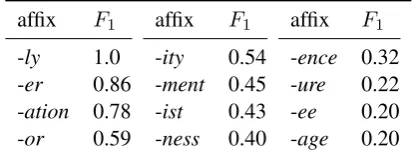
Error Analysis. We observe mistakes on less fre-quent suffixes, e.g.,-age—we predict∗draination instead ofdrainage. Also, there are several cases where NomBank only lists one available form, e.g.,
complexity, and our model predictscomplexness. We also see mistakes on irregular adverbs, e.g., we generateadvancelyfromadvance, rather than in-advance, as well as inPATIENT nominalizations, e.g., the model produces containee in place of
content—this last distinction is unpredictable. 5 Related Work
Previous work in unsupervised morphological seg-mentationand has implicitly incorporated deriva-tional morphology. Such systems attempt to seg-ment words into all constituent morphs, treating inflectional and derivational affixes as equivalent. The popular Morfessor tool (Creutz and Lagus, 2007) is one example of such an unsupervised seg-mentation system, but many others exist, e.g.,Poon et al.(2009),Narasimhan et al. (2015)inter alia. Supervised segmentation and analysis models in the literature can also break down derivationally complex forms into their morphs, provided
pre-affix F1 affix F1 affix F1
[image:5.595.312.519.63.141.2]-ly 1.0 -ity 0.54 -ence 0.32 -er 0.86 -ment 0.45 -ure 0.22 -ation 0.78 -ist 0.43 -ee 0.20 -or 0.59 -ness 0.40 -age 0.20
Table 4:F1for various suffix attachments with the sequence-to-sequence model
segmented and labeled data is available for training (Ruokolainen et al.,2013;Cotterell et al., 2015; Cotterell and Sch¨utze,2017). Our work, however, builds directly upon recent efforts in thegeneration
of inflectional morphology (Durrett and DeNero, 2013; Nicolai et al., 2015;Ahlberg et al., 2015; Rastogi et al.,2016;Faruqui et al.,2016). We dif-fer in that we focus on derivational morphology. In another recent line of work,Vylomova et al.(2017) predict derivationally complex forms using senten-tial context. Our work differs from their approach in that we attempt to generate derivational forms di-vorced from the context, but the underlying neural sequence-to-sequence architecture is quite similar.
6 Conclusion
We have presented a statistical model for the gen-eration of derivationally complex forms, a task that has gone essentially unexplored in the litera-ture. Viewing derivational morphology as paradig-matic, where slots refer to semantic categories, e.g.,
corrode+RESULT7→corrosion, we draw upon re-cent advances in the generation of inflectional mor-phology. Applying this method works well, achiev-ing an overall accuracy of 71.71%, and beatachiev-ing a non-neural baseline. Performance, however, is lower than on the task of paradigm completion for inflectional morphology, indicating that paradigm completion for derivational morphology is more challenging than its inflectional counterpart.
Acknowledgements
References
Malin Ahlberg, Markus Forsberg, and Mans Hulden. 2015. Paradigm classification in supervised learn-ing of morphology. In Proceedings of the 2015 Conference of the North American Chapter of the Association for Computational Linguistics: Human Language Technologies (NAACL), pages 1024–1029, Denver, Colorado. Association for Computational Linguistics.
Mark Aronoff and Mark Lindsay. 2014. Productivity, blocking and lexicalization. The Oxford Handbook of Derivational Morphology, pages 67–83.
Dzmitry Bahdanau, Kyunghyun Cho, and Yoshua Ben-gio. 2015. Neural machine translation by jointly learning to align and translate. InInternational Con-ference on Learning Representations (ICLR). Laurie Bauer. 1983. English Word-formation.
Cam-bridge University Press.
Laurie Bauer. 2001. Morphological Productivity, vol-ume 95. Cambridge University Press.
Geert Booij. 2008. Paradigmatic morphology. La Raison Morphologique. Hommage `a la M´emoire de Danielle Corbin, pages 29–38.
Kyunghyun Cho, Bart van Merrienboer, Dzmitry Bah-danau, and Yoshua Bengio. 2014. On the properties of neural machine translation: Encoder–decoder ap-proaches. In Proceedings of SSST-8, Eighth Work-shop on Syntax, Semantics and Structure in Statisti-cal Translation, pages 103–111, Doha, Qatar. Asso-ciation for Computational Linguistics.
Karen Steffen Chung, Nathan W. Hill, and Sun Jack-son T.-S. 2014. Sino-Tibetan. In Rochelle Lieber and Pavol ˇStekauer, editors,The Oxford Handbook of Derivational Morphology, chapter 34, pages 609– 650. Oxford University Press, Oxford.
Danielle Corbin. 1987. Morphologie D´erivationnelle et Structuration du Lexique, volume 193. Walter de Gruyter.
Ryan Cotterell, Christo Kirov, John Sylak-Glassman, G´eraldine Walther, Ekaterina Vylomova, Patrick Xia, Manaal Faruqui, Sandra K¨ubler, David Yarowsky, Jason Eisner, and Mans Hulden. 2017.
The CoNLL-SIGMORPHON 2017 shared task: Uni-versal morphological reinflection in 52 languages. InProceedings of the CoNLL-SIGMORPHON 2017 Shared Task: Universal Morphological Reinflection, Vancouver, Canada. Association for Computational Linguistics.
Ryan Cotterell, Christo Kirov, John Sylak-Glassman, David Yarowsky, Jason Eisner, and Mans Hulden. 2016. The SIGMORPHON 2016 shared task— morphological reinflection. In Proceedings of the 14th SIGMORPHON Workshop on Computational Research in Phonetics, Phonology, and Morphol-ogy, pages 10–22, Berlin, Germany. Association for Computational Linguistics.
Ryan Cotterell, Thomas M¨uller, Alexander Fraser, and Hinrich Sch¨utze. 2015. Labeled morphological seg-mentation with semi-Markov models. In Proceed-ings of the Nineteenth Conference on Computational Natural Language Learning (CoNLL), pages 164– 174, Beijing, China. Association for Computational Linguistics.
Ryan Cotterell and Hinrich Sch¨utze. 2017. Joint se-mantic synthesis and morphological analysis of the derived word. Transactions of the Association for Computational Linguistics (TACL), 5:147–161.
Mathias Creutz and Krista Lagus. 2007. Unsupervised models for morpheme segmentation and morphol-ogy learning. ACM Transactions on Speech and Lan-guage Processing (TSLP), 4(1):3.
Greg Durrett and John DeNero. 2013. Supervised learning of complete morphological paradigms. In Proceedings of the 2013 Conference of the North American Chapter of the Association for Computa-tional Linguistics: Human Language Technologies (NAACL), pages 1185–1195, Atlanta, Georgia. As-sociation for Computational Linguistics.
Manaal Faruqui, Yulia Tsvetkov, Graham Neubig, and Chris Dyer. 2016. Morphological inflection gener-ation using character sequence to sequence learn-ing. In Proceedings of the 2016 Conference of the North American Chapter of the Association for Com-putational Linguistics: Human Language Technolo-gies (NAACL), pages 634–643, San Diego, Califor-nia. Association for Computational Linguistics. Ray Jackendoff. 1975. Morphological and semantic
regularities in the lexicon. Language, pages 639– 671.
Katharina Kann and Hinrich Sch¨utze. 2016. Single-model encoder-decoder with explicit morphological representation for reinflection. InProceedings of the 54th Annual Meeting of the Association for Compu-tational Linguistics (ACL), pages 555–560, Berlin, Germany. Association for Computational Linguis-tics.
Rochelle Lieber. 2004. Morphology and Lexical Se-mantics, volume 104. Cambridge University Press. Marc Light. 1996. Morphological Cues for Lexical
Se-mantics. Ph.D. thesis, University of Rochester. A. Meyers, R. Reeves, C. Macleod, R. Szekely,
V. Zielinska, B. Young, and R. Grishman. 2004.
The nombank project: An interim report. In HLT-NAACL 2004 Workshop: Frontiers in Corpus Anno-tation, pages 24–31, Boston, Massachusetts, USA. Association for Computational Linguistics.
Garrett Nicolai, Colin Cherry, and Grzegorz Kondrak. 2015. Inflection generation as discriminative string transduction. In Proceedings of the 2015 Confer-ence of the North American Chapter of the Associ-ation for ComputAssoci-ational Linguistics: Human Lan-guage Technologies (NAACL), pages 922–931, Den-ver, Colorado. Association for Computational Lin-guistics.
Hoifung Poon, Colin Cherry, and Kristina Toutanova. 2009. Unsupervised morphological segmentation with log-linear models. InProceedings of Human Language Technologies: The 2009 Annual Confer-ence of the North American Chapter of the Associa-tion for ComputaAssocia-tional Linguistics (NAACL), pages 209–217, Boulder, Colorado. Association for Com-putational Linguistics.
Pushpendre Rastogi, Ryan Cotterell, and Jason Eisner. 2016. Weighting finite-state transductions with neu-ral context. InProceedings of the 2016 Conference of the North American Chapter of the Association for Computational Linguistics: Human Language Technologies (NAACL), pages 623–633, San Diego, California. Association for Computational Linguis-tics.
Teemu Ruokolainen, Oskar Kohonen, Sami Virpioja, and Mikko Kurimo. 2013. Supervised morphologi-cal segmentation in a low-resource learning setting using conditional random fields. In Proceedings of the Seventeenth Conference on Computational Natural Language Learning (CoNLL), pages 29–37, Sofia, Bulgaria. Association for Computational Lin-guistics.
Rico Sennrich, Orhan Firat, Kyunghyun Cho, Alexan-dra Birch, Barry Haddow, Julian Hitschler, Marcin Junczys-Dowmunt, Samuel L¨aubli, Antonio Valerio Miceli Barone, Jozef Mokry, and Maria Nadejde. 2017. Nematus: a toolkit for neural machine trans-lation. In Proceedings of the Software Demonstra-tions of the 15th Conference of the European Chap-ter of the Association for Computational Linguistics, pages 65–68, Valencia, Spain. Association for Com-putational Linguistics.
Reut Tsarfaty, Djam´e Seddah, Yoav Goldberg, Sandra Kuebler, Yannick Versley, Marie Candito, Jennifer Foster, Ines Rehbein, and Lamia Tounsi. 2010. Sta-tistical parsing of morphologically rich languages (SPMRL) what, how and whither. InProceedings of the NAACL HLT 2010 First Workshop on Statistical Parsing of Morphologically-Rich Languages, pages 1–12, Los Angeles, CA, USA. Association for Com-putational Linguistics.
Pavol ˇStekauer. 2014. Derivational paradigms. In Rochelle Lieber and Pavol ˇStekauer, editors,The Ox-ford Handbook of Derivational Morphology, chap-ter 12, pages 354–369. Oxford University Press, Ox-ford.
Ekaterina Vylomova, Ryan Cotterell, Timothy Bald-win, and Trevor Cohn. 2017. Context-aware predic-tion of derivapredic-tional word-forms. InProceedings of
the 15th Conference of the European Chapter of the Association for Computational Linguistics (EACL), pages 118–124, Valencia, Spain. Association for Computational Linguistics.
Anna Wierzbicka. 1988. The Semantics of Grammar, volume 18. John Benjamins Publishing.