R E S E A R C H
Open Access
Entity recognition from clinical texts via
recurrent neural network
Zengjian Liu
1†, Ming Yang
2†, Xiaolong Wang
1, Qingcai Chen
1, Buzhou Tang
1,3*, Zhe Wang
3and Hua Xu
4FromThe International Conference on Intelligent Biology and Medicine (ICIBM) 2016 Houston, Texas, USA. 08-10 December 2016
Abstract
Background:Entity recognition is one of the most primary steps for text analysis and has long attracted
considerable attention from researchers. In the clinical domain, various types of entities, such as clinical entities and protected health information (PHI), widely exist in clinical texts. Recognizing these entities has become a hot topic in clinical natural language processing (NLP), and a large number of traditional machine learning methods, such as support vector machine and conditional random field, have been deployed to recognize entities from clinical texts in the past few years. In recent years, recurrent neural network (RNN), one of deep learning methods that has shown great potential on many problems including named entity recognition, also has been gradually used for entity recognition from clinical texts.
Methods:In this paper, we comprehensively investigate the performance of LSTM (long-short term memory), a representative variant of RNN, on clinical entity recognition and protected health information recognition. The LSTM model consists of three layers: input layer–generates representation of each word of a sentence; LSTM layer– outputs another word representation sequence that captures the context information of each word in this sentence; Inference layer–makes tagging decisions according to the output of LSTM layer, that is, outputting a label sequence.
Results:Experiments conducted on corpora of the 2010, 2012 and 2014 i2b2 NLP challenges show that LSTM achieves highest micro-average F1-scores of 85.81% on the 2010 i2b2 medical concept extraction, 92.29% on the 2012 i2b2 clinical event detection, and 94.37% on the 2014 i2b2 de-identification, which is considerably competitive with other state-of-the-art systems.
Conclusions:LSTM that requires no hand-crafted feature has great potential on entity recognition from clinical texts. It outperforms traditional machine learning methods that suffer from fussy feature engineering. A possible future direction is how to integrate knowledge bases widely existing in the clinical domain into LSTM, which is a case of our future work. Moreover, how to use LSTM to recognize entities in specific formats is also another possible future direction.
Keywords:Entity recognition, Recurrent neural network, Clinical notes, Deep learning, Sequence labeling
* Correspondence:[email protected] †Equal contributors
1
Key Laboratory of Network Oriented Intelligent Computation, Harbin Institute of Technology Shenzhen Graduate School, Shenzhen 518055, China
3Key Laboratory of Symbolic Computation and Knowledge Engineering of
Ministry of Education, Jilin University, Changchun 130012, China Full list of author information is available at the end of the article
Background
With rapid development of electronic medical record (EMR) systems, more and more EMRs are available for researches and applications. Entity recognition, one of the most primary clinical natural language processing (NLP) tasks, has attracted considerable attention. As a large number of various types of entities widely exist in clinical texts, studies on entity recognition from clinical texts cover clinical entity recognition, clinical event recognition, protected health information recognition (PHI), etc. Compared to entity recognition in the news-wire domain, studies on entity recognition in the clinical domain are slower initially.
The early entity recognition systems in the clinical domain are mainly rule-based, such as MedLEE [1], SymText/MPlus [2, 3], MetaMap [4], KnowledgeMap [5], cTAKES [6], and HiTEX [7]. In the past several years, lots of machine learning-based clinical entity rec-ognition systems have been proposed, may due to some publicly available corpora provided by organizers of some shared tasks, such as the Center for Informatics for Integrating Biology & the Beside (i2b2) 2009 [8], 2010 [9–13], 2012 [14–18] and 2014 track1 [19–23] datasets, ShARe/CLEF eHealth Evaluation Lab (SHEL) 2013 dataset [24], and SemEval (Semantic Evaluation) 2014 task 7 [25], 2015 task 6 [26] 2015 task 14 [27], and 2016 task 12 [28] datasets. The main machine learning algorithms used in these systems are those once widely used for entity recognition in the newswire domain, in-cluding support vector machine (SVM), hidden markov model (HMM), conditional random field (CRF) and structured support vector machine (SSVM), etc. Among the algorithms, CRF is the most popular one. Most state-of-the-art systems adopt CRF. For example, in the 2014 i2b2 de-identification challenge, 6 out of 10 were based on CRF, including all top 4 systems. The key to the CRF-based systems lies in a variety of features, which are time-consuming.
In recent years, deep learning, which has advantages in feature engineering, has been widely introduced into various fields, such as image processing, speech recog-nition and NLP, and has shown great potential. In the case of NLP, deep learning has been deployed to tackle machine translation [29], relation extraction [30], entity recognition [31–35], word sense disambiguation [36], syntax parsing [37, 38], emotion classification [39], etc. Most related studies are limited to the newswire do-main rather than other dodo-mains such as the clinical domain.
In this study, we comprehensively investigate entity recognition from clinical texts based on deep learning. Long-short term memory (LSTM), a representative vari-ant of one type of deep learning method (i.e., recurrent neural network [40]), is deployed to recognize clinical
entities and PHI instances in clinical texts. Specifically, we investigate the effects of two different types of character-level word representations on LSTM when they are used as parts of input of LSTM, and compare LSTM with CRF and other state-of-the-art systems. Experiments conducted on corpora of the 2010, 2012 and 2014 i2b2 NLP challenges show that: 1) each type of character-level word representation is beneficial to LSTM on entity extraction from clinical texts, but it is not easy to determine which one is better. 2) LSTM achieves highest micro-average F1-scores of 85.81% on the 2010 i2b2 medical concept extraction, 92.29% on the 2012 i2b2 clinical event detection, and 94.37% on the 2014 i2b2 de-identification, which outperforms CRF by 2.12%, 1.47% and 1.79% respectively. 3) Compared with other state-of-the-art systems, the LSTM-based system is considerably competitive.
The following sections are organized as: section 2 in-troduces RNN in detail, experiments and results are pre-sented in section 3, section 4 discusses the experimental results and section 5 draws conclusions.
Methods
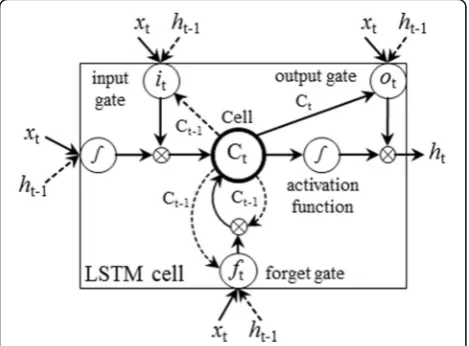
Entity recognition is usually treated as a sequence label-ing problem, which can be modeled by RNN. Instead of traditional RNN, we used Long short-term memory (LSTM) [41, 42], a variant of RNN that is capable of cap-turing long-distance dependencies of context and avoid-ing gradient varnishavoid-ing or explodavoid-ing [43, 44], for entity recognition from clinical texts. The overview architec-ture of the LSTM used in our study is shown in Fig. 1, which consists of the following three layers: 1) input layer - generates representation of each word of a sen-tence using dictionary lookup, which includes two parts: token-level representation (denoted by grey squares) and character-level representation (denoted by blank squares); 2) LSTM layer –takes the word repre-sentation sequence of the sentence as input and returns another sequence that represents context information of the input at every position; 3) Inference layer – makes tagging decisions according to the output of the LSTM layer, that is, outputting a label sequence. Before introducing each the three layers one-by-one in detail, we present the LSTM unit first as it is used in both in-put layer and LSTM layer.
LSTM unit
unit at steptthat takesxt,ht-1and ct-1as input and pro-duceshtandctvia the following formulas:
it ¼σðWxixtþWhiht−1þWcict−1þbiÞ f t¼σ WxfxtþWhfht−1þWcfct−1þbf
ct¼ ft⊙ct−1þit⊙tanh Wð xcxtþWhcht−1þbcÞ ot¼σðWxoxtþWhoht−1þWcoctþboÞ
ht ¼ ot⊙tanh ctð Þ;
where σ is the element-wise sigmoid function, ☉is the element-wise product, it, ftand ot are the input, forget, and output gates, ct is the cell vector, Wi, Wf, Wc, Wo (with subscripts:x,h and c) are the weight matrices for input xt, hidden state htand memory cellctrespectively, andbi,bf,bcandbodenote the bias vectors.
Input layer
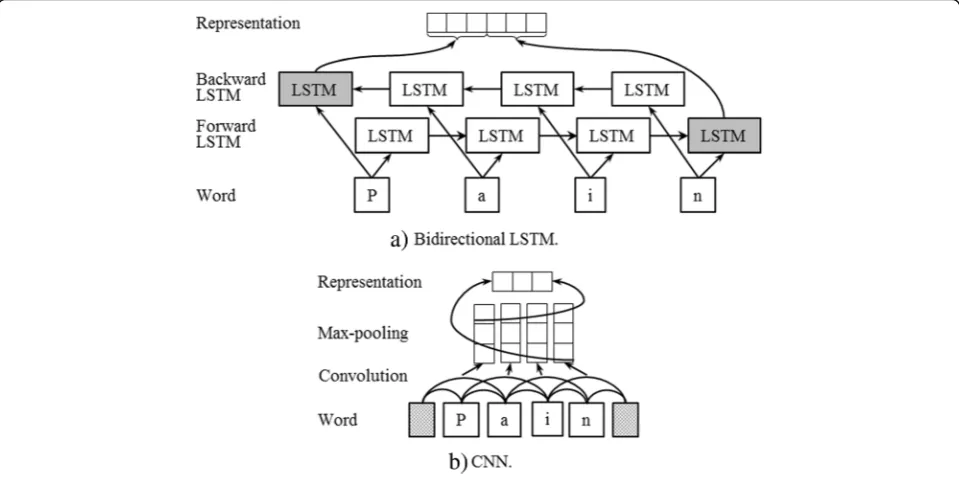
The representation of a word is generated from the fol-lowing two aspects: token-level and character-level, which capture context information and morphological information of the word respectively. The token-level representation is usually pre-trained by neural lan-guage models, such as continuous bag-of-words (CBOW) and skip-gram [45], on a large unlabeled data. To generate character-level representation, we can use a bidirectional LSTM, which can capture both past and future contexts of words, or a convolutional neural network (CNN) to model the character se-quences of words (see Fig. 3). In the bidirectional LSTM (see Fig. 3a), the last two output vectors of the forward and backward LSTMs (rectangles in grey) are concatenated into the character-level representation of the word (i.e., pain). In the CNN (see Fig. 3b, where chess boards are paddings), the sequence of character embeddings are convoluted with filters and further pooled to generate the character-level representation of the word (i.e., pain). For detailed information about CNN, please refer to [46].
LSTM layer
A bidirectional LSTM is used to generate context rep-resentation at every position. Given a sentence s = w1w2…wnwith each word wt(1≤t≤n) represented by xt (i.e., concatenation of token-level and character-level representations of the word), the bidirectional LSTM takes a sequence of word representations x = x1x2…xn as input and produces a sequence of context representations h = h1h2…hn, where ht= [hftT, hbtT]T (1≤t≤n) is a concatenation of outputs of both for-ward and backfor-ward LSTMs.
Fig. 1Overview architecture of our LSTM
Inference layer
Conditional random field (CRF) is employed to predict a label sequence from a sequence of context representa-tions. Given a training set D ={(x(i),y(i))|i= 1,…,m} (y(i) is a label sequence like “… O B-problem I-problem O
…”for clinical entity recognition), all parameters of CRF (θ) are estimated by maximizing the following log-likelihood function over D(only 1storder is considered here):
Lð Þ ¼θ Xmi¼1logp yð Þijxð Þi;θ
; ð1Þ
where
p y ð Þijxð Þi;θ¼p y ð Þijhð Þi;θ
¼ exp
Xn
t¼1θyð Þt−i1y
T tð Þihtð Þi
X
y0∈Y xðð ÞiÞexp
Xn
t¼1θ T yt−01y t0htð Þi
Y(x(i)
) denotes the set of possible label sequences forx(i). The goal of inference at test phase is to search the label sequence y* with the highest conditional probability:
y¼argmax
y∈Y xð Þp yð jx;θÞ ¼argmaxy∈Y xð Þp yð jh;θÞ
ð2Þ
Equation 1 and equation 2 can be solved efficiently by dynamic programing and the Viterbi algorithm respectively.
It is clear that if interactions between successive labels are not considered, the inference layer will be simplified into a softmax output layer to classify each token individually.
Results
In order to investigate the performance of LSTM on en-tity recognition from clinical texts, we start with two baseline systems: 1) a CRF-based system using rich fea-tures (denoted by CRF); 2) a LSTM-based system only using token-level word representations in the input layer (denoted by LSTM-BASELINE), then compare them with the LSTM-based systems using token-level word representations and two different types of character-level word representations. Moreover, we also compare the LSTM-based systems with other state-of-the-art systems. Three benchmark datasets from three clinical NLP chal-lenges: i2b2 (the Center for Informatics for Integrating Biology & the Beside) 2010, 2012 and 2014 are used to evaluate the performance of all systems. Both 2010 and 2012 i2b2 NLP challenges have a subtask of clinical en-tity recognition, and the 2014 i2b2 NLP challenge have a subtask of PHI recognition.
Datasets and evaluation
recognized. The detailed statistics of the entity recogni-tion datasets of the three challenges are listed in Table 1, where “2010”, “2012” and “2014” denote the i2b2 NLP challenges in corresponding years, and “#*” denotes the number of ‘*’.
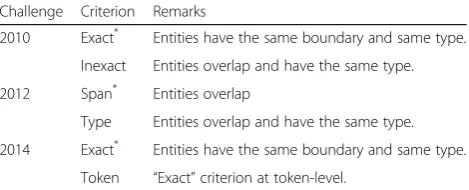
The performances of all systems are measured by micro-averaged precision (P), recall (R) and F1-score (F) under different criteria, which are calculated by the offi-cial evaluation tools provided by the organizers of the challenges. A brief introduction of the evaluation criteria for the three entity recognition tasks is presented in Table 2, where the key criteria are marked with“*”.
Experimental settings
Before training LSTM, we use the following two simple rules to split raw texts into sentences and tokenize the sentences:
1) Sentence split: separate sentences using‘\n’,‘.’,‘?’ and‘!’.
2) Tokenization: split sentences into tokens by blank characters at first, and then separate those tokens composed of more than two types of characters (letters, digitals and other characters) into smaller parts that only contains only one type of characters. For example,“4/16/91CPT Code:”is split into“4/16/ 91CPT”and“Code:”at first, and then further separated into‘4’,‘/’,“16”,‘/’,“91”,“CPT”,“Code” and‘:’.
In this study, we use “BIOES” (B-beginning of an en-tity, I-insider an enen-tity, O-outsider an enen-tity, E-end of an entity, S-a single-token entity) to represent entities, and follow previous studies [31–35] to use the stochastic gra-dient descent (SGD) algorithm for parameter estimation with hyperparameters as shown in Table 3. The token-level word representations are pre-trained by word2vec [45] on a large-scale unlabeled dataset from MEDLINE and Wikipedia, and the character representations are randomly initialized from a uniform distribution ranging in [-1, 1]. Both token-level word representations and character representations are fine-tuned during training. We adopt CRFsuite [47] as an implement of CRF, and the features used in the CRF-based system includes bag-of-words, part-of-speech, combinations of words and
POS tags, word shapes, affixes, orthographical features, sentence information, section information, general NER information, and dictionary features. All model parame-ters are optimized by 10-fold cross validation on training datasets.
Experimental results
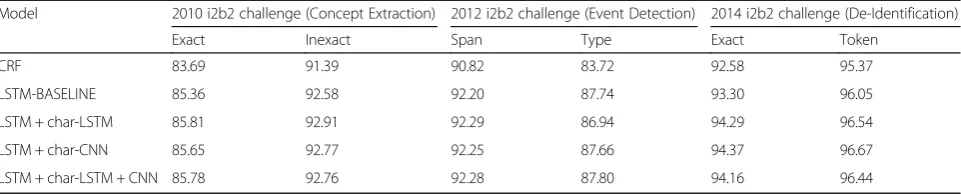
LSTM only using token-level word representations as in-put (i.e., LSTM-BASELINE) achieves F1-scores of 85.36% and 92.58% under “exact” and “inexact” criteria on the 2010 i2b2 challenge test set, F1-scores of 92.20% and 87.74% under“span”and“type” criteria on the 2012 i2b2 challenge test set, and F1-scores of 93.30% and 96.05% under “exact” and “token” criteria on the 2014 i2b2 challenge test set, as shown in Table 4, much higher than CRF. The key performance measure differences be-tween LSTM-BASELINE and CRF on the three test sets are 1.67%, 1.38% and 0.72%, respectively.
When one type of character-level word representations (i.e., character-level word representations generated by LSTM or CNN, denoted by char-LSTM and char-CNN respectively in Table 4) is added in the input layer as shown in Fig. 1, the performance of LSTM is slightly im-proved, LSTM considering char-LSTM (i.e., LSTM + char-LSTM) achieves a little better performance on the 2010 and 2012 i2b2 NLP challenge test sets, while the LSTM considering char-CNN (i.e., LSTM + char-CNN) achieves a little better performance on the 2014 i2b2
Table 1Statistics of entity recognition datasets used in our
study
Challenge 2010 2012 2014
Training #Note 349 190 790
#Entity 27837 16468 17405
Test #Note 477 120 514
#Entity 45009 13594 11462
Table 2Evaluation criteria for the three entity recognition tasks
Challenge Criterion Remarks
2010 Exact* Entities have the same boundary and same type.
Inexact Entities overlap and have the same type.
2012 Span* Entities overlap
Type Entities overlap and have the same type.
2014 Exact* Entities have the same boundary and same type.
Token “Exact”criterion at token-level.
*represents the primary evaluation criterion for each task
Table 3Hyperparameters chosen for all our experiments
Hyperparameter 2010/2012/2014
Dimension of token-level word representation 50
Dimension of character representation 25
Character-level LSTM size 25
Character-level CNN filter size 3
Character-level CNN filter number 25
Token-level LSTM size 100
Dropout probability 0.5
Learning rate 0.005
Gradient clipping 5.0
NLP challenge. No remarkable sign shows which character-level word representation is better. When both two types of character-level word representations are added, the performance of LSTM is not further im-proved. The highest F1-scores of LSTM are 85.81% and 92.91% under“exact” and “inexact” criteria on the 2010 i2b2 challenge test set, 92.29% and 86.94% under“span” and “type” criteria on the 2012 i2b2 challenge test set, and 94.37% and 96.67% under “exact” and “token” cri-teria on the 2014 i2b2 challenge test set.
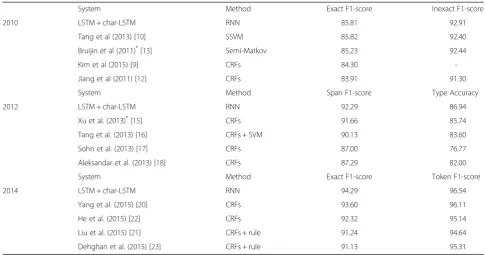
Moreover, we also compare “LSTM + char-LSTM” with other state-of-art systems including the best tems of the three challenges and the best up-to-date sys-tems on the same corpora (as shown in Table 5, where the starred systems are the best systems of the corre-sponding challenges).“LSTM + char-LSTM” significantly outperforms the best systems of the three challenges. On the 2010 i2b2 NLP challenge corpus,“LSTM + char-LSTM”achieves almost the same F1-score as the current best system (85.81% vs 85.82%), which is a SSVM-based system using rich hand-crafted features, under “exact” criterion. On other two i2b2 NLP challenge corpora,
“LSTM + char-LSTM” outperforms the current best systems.
Discussion
In this study, we investigate the performance of LSTM on entity recognition from clinical texts. The LSTM-based systems achieves highest F1-scores of 85.81% under “exact” criterion on the 2010 i2b2 challenge test set, 92.29% under“span”criterion on the 2012 i2b2 chal-lenge test set, and 94.37% under“exact”criterion on the 2014 i2b2 challenge test set, which are competitive with other state-of-the-art systems. The major advantage of the LSTM-based system is that it does not rely on a large number of hand-crafted features any more. Simi-lar to previous studies in the newswire domain, LSTM shows great potential on entity recognition in the clinical domain, outperforming most traditional state-of-the-art methods that suffer from fussy feature en-gineering such as CRF.
Experiments shown in Table 4 demonstrate that any one type of the two character-level word representations is beneficial to entity recognition from clinical texts. The
reason may lie in that both the two types of character-level word representations have ability to capture some morphological information of each word such as suffixes and prefixes, which cannot be captured by the token-level word representation that relies on word context. Then, when any one of the character-level word representations is added into the input layer of LSTM, errors like“Test” event“URINE” missed in“2014-11-29 05:11 PM URINE” and hospital“FPC”correctly identified in“…have a PCP at FPC…”but missed in“…Dr. Harry Tolliver, FPC cardi-ology unit…”are fixed.
Although the LSTM-based system shows better overall performance than almost all state-of-the-art systems mentioned in this study, but it does not show better per-formance on all types of entities. For example, the best system on the 2012 i2b2 challenge corpus (i.e., Xu et al. (2013) [15]) achieves better “span” F1-score than the LSTM-based system on “Test” events (94.16% vs 93.69%). The best system on the 2014 i2b2 challenge corpus (i.e., Yang et al. (2015) [20]) achieves better
“exact” F1-score than LSTM-based system on “ID” in-stances (92.71% vs 91.94%). There are two main reasons: 1) the current LSTM-based system does not use know-ledge bases widely existing in the clinical domain, but the other state-of-the-art systems take full advantages of them; 2) although the character-level word representa-tion has ability to capture some morphological informa-tion of each word, it cannot cover morphological information of specific words such as fixed size digitals. Therefore, there are two possible directions for further improvement in our opinion: 1) How to integrate widely existing knowledge bases into the input of LSTM; 2) How to use LSTM to recognize entities in specific for-mats. We will try them in the future.
In recent months, a few studies on deep learning for entity recognition from clinical text are also proposed. For example, Abhyuday et al. proposed two RNN-based models for medical event detection on their own anno-tated dataset, one of which recognizes medical event de-tection as a classification problem and the other one as a sequence labeling problem [48, 49]. Both the two RNN-based models adopt traditional RNN, which is not as good as LSTM, and only take token-level word repre-sentation as their input. Franck et al. deployed a similar
Table 4Performances of LSTM and CRF-based models for the three tasks (F1-score %)
Model 2010 i2b2 challenge (Concept Extraction) 2012 i2b2 challenge (Event Detection) 2014 i2b2 challenge (De-Identification)
Exact Inexact Span Type Exact Token
CRF 83.69 91.39 90.82 83.72 92.58 95.37
LSTM-BASELINE 85.36 92.58 92.20 87.74 93.30 96.05
LSTM + char-LSTM 85.81 92.91 92.29 86.94 94.29 96.54
LSTM + char-CNN 85.65 92.77 92.25 87.66 94.37 96.67
RNN model for the de-identification task on the 2014 i2b2 NLP challenge corpus and the MIMIC dataset [50]. According to the experimental results reported in this study and the similar studies, we may conclude that our LSTM outperforms theirs. For example, the F1-score of the RNN model proposed by Franck et al. on the 2014 i2b2 dataset, as reported, is 97.85% under the binary HIPAA token criterion (only evaluating the HIPAA-defined PHI instances under “token” criterion). Under the same evaluation criterion, the corresponding F1-score of “LSTM + char-LSTM” is 98.05% on i2b2-2014 dataset. The results demonstrate that our LSTM outper-forms RNN proposed by Franck et al [50]. Therefore, the results reported in this study can be a new bench-mark system based on deep learning methods.
Conclusions
In this study, we comprehensively investigate the per-formance of recurrent neural network (i.e., LSTM) on clinical entity recognition and protected health informa-tion (PHI) recogniinforma-tion. Experiments on the 2010, 2012 and 2014 i2b2 NLP challenge corpora prove that 1) LSTM outperforms CRF; 2) By introducing two types of character-level word representations into the input layer of LSTM, LSTM is further improved; 3) the final LSTM-based system is competitive with other state-of-the-art systems. Furthermore, we also point out two possible di-rections for further improvement.
Acknowledgements Not applicable.
Funding
This paper is supported in part by grants: National 863 Program of China (2015AA015405), NSFCs (National natural Science Foundations of China) (61573118, 61402128, 61473101, and 61472428), Strategic Emerging Industry Development Special Funds of Shenzhen (JCYJ20140508161040764,
JCYJ20140417172417105, JCYJ20140627163809422 and JSGG20151015161015297), Innovation Fund of Harbin Institute of Technology (HIT.NSRIF.2017052) and Program from the Key Laboratory of Symbolic Computation and Knowledge Engineering of Ministry of Education (93K172016K12). The publication costs have been covered by the NSFCs 61402128.
Availability of data and materials
The datasets that support the findings of this study are available from i2b2 challenges, but restrictions apply to the availability of these data, which were used under license for the current study, and so are not publicly available. Data are however available from i2b2’s website: https://www.i2b2.org/NLP/ DataSets/Main.php upon reasonable application with a signed“data use and confidentiality agreement”to the program manager: Barbara Mawn (E-mail: [email protected]). The ethics approval would not been required as all the data have been De-Identified within the meaning of the Health Insurance Portability and Accountability Act of 1996 privacy regulations (HIPAA).
Authors’contributions
The work presented here was carried out in collaboration between all authors. Z.L., M.Y. and B.T. designed the methods and experiments, and contributed to the writing of manuscript. X.W., Q.C., Z.W. and H.X. provided guidance and reviewed the manuscript critically. All authors have approved the final manuscript.
Competing interests
The authors declare that they have no competing interests.
Consent for publication Not applicable.
Ethics approval and consent to participate Not applicable.
Table 5Comparison of the performances of various systems on the three tasks (%)
System Method Exact F1-score Inexact F1-score
2010 LSTM + char-LSTM RNN 85.81 92.91
Tang et al (2013) [10] SSVM 85.82 92.40
Bruijin et al (2011)*[13] Semi-Markov 85.23 92.44
Kim et al (2015) [9] CRFs 84.30
-Jiang et al (2011) [12] CRFs 83.91 91.30
System Method Span F1-score Type Accuracy
2012 LSTM + char-LSTM RNN 92.29 86.94
Xu et al. (2013)*[15] CRFs 91.66 85.74
Tang et al. (2013) [16] CRFs + SVM 90.13 83.60
Sohn et al. (2013) [17] CRFs 87.00 76.77
Aleksandar et al. (2013) [18] CRFs 87.29 82.00
System Method Exact F1-score Token F1-score
2014 LSTM + char-LSTM RNN 94.29 96.54
Yang et al. (2015) [20] CRFs 93.60 96.11
He et al. (2015) [22] CRFs 92.32 95.14
Liu et al. (2015) [21] CRFs + rule 91.24 94.64
About this supplement
This article has been published as part of BMC Medical Informatics and Decision Making Volume 17 Supplement 2, 2017: Selected articles from the International Conference on Intelligent Biology and Medicine (ICIBM) 2016: medical informatics and decision making. The full contents of the supplement are available online at https://bmcmedinformdecismak.biomedcentral.com/articles/ supplements/volume-17-supplement-2.
Publisher’s Note
Springer Nature remains neutral with regard to jurisdictional claims in published maps and institutional affiliations.
Author details
1Key Laboratory of Network Oriented Intelligent Computation, Harbin
Institute of Technology Shenzhen Graduate School, Shenzhen 518055, China.
2
Pharmacy Department, Shenzhen Second People’s Hospital, First Affiliated Hospital of Shenzhen University, Shenzhen 518035, China.3Key Laboratory of
Symbolic Computation and Knowledge Engineering of Ministry of Education, Jilin University, Changchun 130012, China.4School of Biomedical Informatics,
The University of Texas Health Science Center at Houston, Houston, TX, USA.
Published: 5 July 2017
References
1. Friedman C, Alderson PO, Austin JH, Cimino JJ, Johnson SB. A general natural-language text processor for clinical radiology. J Am Med Inform Assoc. 1994;1:161–74.
2. Christensen LM, Haug PJ, Fiszman M. MPLUS: a probabilistic medical language understanding system. In Proceedings of the ACL-02 workshop on Natural language processing in the biomedical domain-Volume 3. Stroudsburg: Association for Computational Linguistics; 2002:29–36. 3. Koehler SB. SymText: a natural language understanding system for
encoding free text medical data. Salt Lake City: The University of Utah; 1998. 4. Aronson AR, Lang F-M. An overview of MetaMap: historical perspective and
recent advances. J Am Med Inform Assoc. 2010;17:229–36. 5. Denny JC, Irani PR, Wehbe FH, Smithers JD, Spickard III A. The
KnowledgeMap project: development of a concept-based medical school curriculum database. In: AMIA Annu Symp Proc; 2003;2003:195–9. 6. Savova GK, Masanz JJ, Ogren PV, Zheng J, Sohn S, Kipper-Schuler KC, Chute
CG. Mayo clinical Text Analysis and Knowledge Extraction System (cTAKES): architecture, component evaluation and applications. J Am Med Inform Assoc. 2010;17:507–13.
7. Zeng QT, Goryachev S, Weiss S, Sordo M, Murphy SN, Lazarus R. Extracting principal diagnosis, co-morbidity and smoking status for asthma research: evaluation of a natural language processing system. BMC Med Inform Decis Mak. 2006;6:1.
8. Uzuner Ö, Solti I, Cadag E. Extracting medication information from clinical text. J Am Med Inform Assoc. 2010;17:514–8.
9. Kim Y, Riloff E, Hurdle JF. A Study of Concept Extraction Across Different Types of Clinical Notes. In AMIA Annual Symposium Proceedings. San Francisco: American Medical Informatics Association; 2015:737–46. 10. Tang B, Cao H, Wu Y, Jiang M, Xu H. Recognizing clinical entities in hospital
discharge summaries using Structural Support Vector Machines with word representation features. BMC Med Inform Decis Mak. 2013;13:1. 11. Uzuner Ö, South BR, Shen S, DuVall SL. i2b2/VA challenge on concepts,
assertions, and relations in clinical text. J Am Med Inform Assoc. 2010; 2011(18):552–6.
12. Jiang M, Chen Y, Liu M, Rosenbloom ST, Mani S, Denny JC, Xu H. A study of machine-learning-based approaches to extract clinical entities and their assertions from discharge summaries. J Am Med Inform Assoc. 2011;18:601–6. 13. de Bruijn B, Cherry C, Kiritchenko S, Martin J, Zhu X. Machine-learned
solutions for three stages of clinical information extraction: the state of the art at i2b2 2010. J Am Med Inform Assoc. 2011;18:557–62.
14. Sun W, Rumshisky A, Uzuner O. Evaluating temporal relations in clinical text: 2012 i2b2 challenge. J Am Med Inform Assoc. 2013;20:806–13.
15. Xu Y, Wang Y, Liu T, Tsujii J, Eric I, Chang C. An end-to-end system to identify temporal relation in discharge summaries: 2012 i2b2 challenge. J Am Med Inform Assoc. 2013;20:849–58.
16. Tang B, Wu Y, Jiang M, Chen Y, Denny JC, Xu H. A hybrid system for temporal information extraction from clinical text. J Am Med Inform Assoc. 2013;20:828–35.
17. Sohn S, Wagholikar KB, Li D, Jonnalagadda SR, Tao C, Elayavilli RK, Liu H. Comprehensive temporal information detection from clinical text: medical events, time, and TLINK identification. J Am Med Inform Assoc. 2013;20:836–42. 18. KovačevićA, Dehghan A, Filannino M, Keane JA, Nenadic G. Combining
rules and machine learning for extraction of temporal expressions and events from clinical narratives. J Am Med Inform Assoc. 2013;20:859–66. 19. Stubbs A, Kotfila C, Uzuner O. Automated systems for the de-identification
of longitudinal clinical narratives: overview of 2014 i2b2/UTHealth shared task Track 1. J Biomed Inform. 2015;58:S11–9.
20. Yang H, Garibaldi JM. Automatic detection of protected health information from clinic narratives. J Biomed Inform. 2015;58:S30–8.
21. Liu Z, Chen Y, Tang B, Wang X, Chen Q, Li H, Wang J, Deng Q, Zhu S. Automatic de-identification of electronic medical records using token-level and character-level conditional random fields. J Biomed Inform. 2015;58:S47–52.
22. He B, Guan Y, Cheng J, Cen K, Hua W. CRFs based de-identification of medical records. J Biomed Inform. 2015;58:S39–46.
23. Dehghan A, Kovacevic A, Karystianis G, Keane JA, Nenadic G. Combining knowledge-and data-driven methods for de-identification of clinical narratives. J Biomed Inform. 2015;58:S53–9.
24. Suominen H, Salanterä S, Velupillai S, Chapman WW, Savova G, Elhadad N, Pradhan S, South BR, Mowery DL, Jones GJ. Overview of the ShARe/CLEF eHealth evaluation lab 2013. In International Conference of the Cross-Language Evaluation Forum for European Cross-Languages. Berlin Heidelberg: Springer; 2013:212–31.
25. Pradhan S, Elhadad N, Chapman W, Manandhar S, Savova G. Semeval-2014 task 7: analysis of clinical text. SemEval. 2014;199:54.
26. Bethard S, Derczynski L, Savova G, Savova G, Pustejovsky J, Verhagen M. Semeval-2015 task 6: clinical tempeval. In: Proceedings of the 9th International Workshop on Semantic Evaluation (SemEval 2015). 2015. p. 806–14. 27. Elhadad N, Pradhan S, Chapman W, Manandhar S, Savova G. SemEval-2015
task 14: analysis of clinical text. In: Proc of Workshop on Semantic Evaluation Association for Computational Linguistics. 2015. p. 303–10. 28. Bethard S, Savova G, Chen W-T, Derczynski L, Pustejovsky J, Verhagen M.
Semeval-2016 task 12: clinical tempeval. Proceedings of SemEval 2016:1052-62.
29. Cho K, Van Merriënboer B, Bahdanau D, Bengio Y. On the properties of neural machine translation: Encoder-decoder approaches. arXiv preprint arXiv:14091259 2014.
30. Zeng D, Liu K, Lai S, Zhou G, Zhao J. Relation Classification via Convolutional Deep Neural Network. In: COLING. 2014. p. 2335–44. 31. Ma X, Hovy E. End-to-end sequence labeling via bi-directional
LSTM-CNNs-CRF. arXiv preprint arXiv:160301354 2016.
32. Lample G, Ballesteros M, Subramanian S, Kawakami K, Dyer C. Neural architectures for named entity recognition. arXiv preprint arXiv:160301360 2016. 33. Chiu JP, Nichols E. Named entity recognition with bidirectional LSTM-CNNs.
Trans Assoc Comput Linguist. 2016;4:357–70.
34. Huang Z, Xu W, Yu K. Bidirectional LSTM-CRF models for sequence tagging. arXiv preprint arXiv:150801991 2015.
35. dos Santos C, Guimaraes V, Niterói R, de Janeiro R: Boosting named entity recognition with neural character embeddings. In Proceedings of NEWS 2015 The Fifth Named Entities Workshop. 2015: 25
36. Chen X, Liu Z, Sun M. A Unified Model for Word Sense Representation and Disambiguation. In EMNLP. Doha: Citeseer; 2014:1025–35.
37. Chen D, Manning CD. A Fast and Accurate Dependency Parser using Neural Networks. In: EMNLP. 2014. p. 740–50.
38. Collobert R. Deep Learning for Efficient Discriminative Parsing. In: AISTATS. 2011. p. 224–32.
39. Ng H-W, Nguyen VD, Vonikakis V, Winkler S: Deep learning for emotion recognition on small datasets using transfer learning. In Proceedings of the 2015 ACM on International Conference on Multimodal Interaction. New York: ACM; 2015:443–9.
40. Goller C, Kuchler A: Learning task-dependent distributed representations by backpropagation through structure. In Neural Networks, 1996, IEEE International Conference on. IEEE; 1996: 347-52.
41. Gers FA, Schmidhuber J, Cummins F. Learning to forget: continual prediction with LSTM. Neural Comput. 2000;12:2451–71.
42. Hochreiter S, Schmidhuber J. Long short-term memory. Neural Comput. 1997;9:1735–80.
44. Bengio Y, Simard P, Frasconi P. Learning long-term dependencies with gradient descent is difficult. IEEE Trans Neural Netw. 1994;5:157–66. 45. Mikolov T, Sutskever I, Chen K, Corrado GS, Dean J. Distributed
representations of words and phrases and their compositionality. In: Advances in Neural Information Processing Systems. 2013. p. 3111–9. 46. LeCun Y, Bottou L, Bengio Y, Haffner P. Gradient-based learning applied to
document recognition. Proc IEEE. 1998;86:2278–324.
47. Okazaki N. CRFsuite: a fast implementation of conditional random fields (CRFs). 2007. URL http://www.chokkan.org/software/crfsuite/. 48. Jagannatha AN, Yu H. Bidirectional RNN for medical event detection in
electronic health records. In: Proceedings of NAACL-HLT. 2016. p. 473–82. 49. Jagannatha A, Yu H. Structured prediction models for RNN based sequence
labeling in clinical text. arXiv preprint arXiv:160800612 2016.
50. Dernoncourt F, Lee JY, Uzuner O, Szolovits P. De-identification of patient notes with recurrent neural networks. arXiv preprint arXiv:160603475 2016.
• We accept pre-submission inquiries
• Our selector tool helps you to find the most relevant journal
• We provide round the clock customer support
• Convenient online submission
• Thorough peer review
• Inclusion in PubMed and all major indexing services
• Maximum visibility for your research
Submit your manuscript at www.biomedcentral.com/submit